ECU HONDA S2000 2000 1.G User Guide
[x] Cancel search | Manufacturer: HONDA, Model Year: 2000, Model line: S2000, Model: HONDA S2000 2000 1.GPages: 273, PDF Size: 21.58 MB
Page 78 of 273
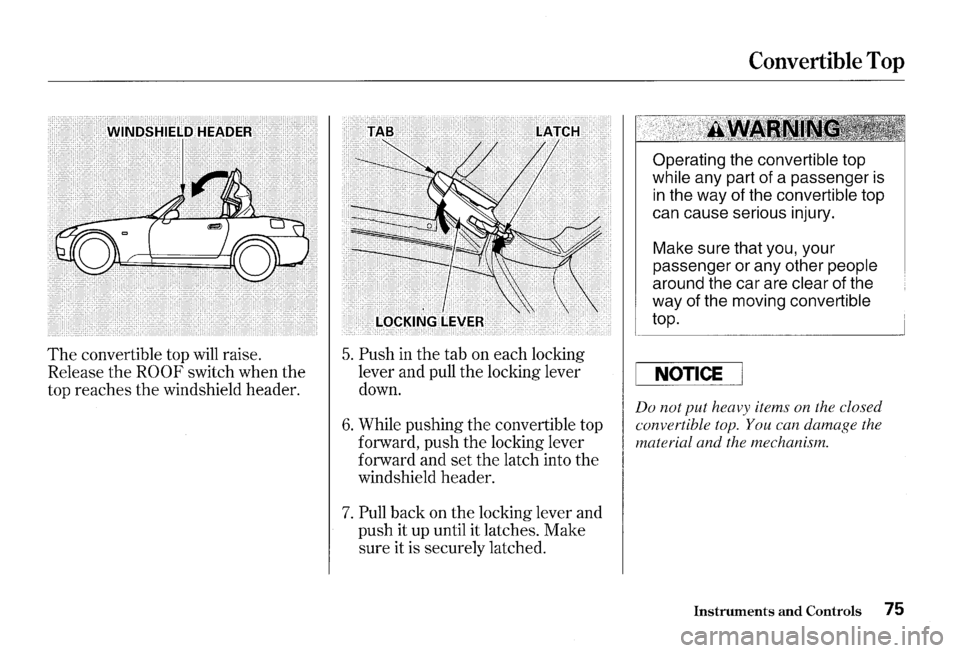
The convertible top will raise.
Release the
ROOF switch when the
top reaches
the windshield header.
5. Push in the tab on each locking
lever and pull the locking lever
down.
6. While pushing the convertible top
forward, push the locking lever
forward and
set the latch into the
windshield header.
7. Pull back on the locking lever and
push it
up until it latches. Make
sure it is securely latched.
Convertible Top
Operating the convertible top
while any part of a passenger is
in the way of the convertible top
can cause serious injury.
Make sure that you, your
passenger or any other
people
around the car are clear of the
way of the moving
convertible
top.
NOTICE
Do not put heavy items on the closed
convertible top. You can damage the
material and the mechanism.
Instruments and Controls 75
Page 122 of 273
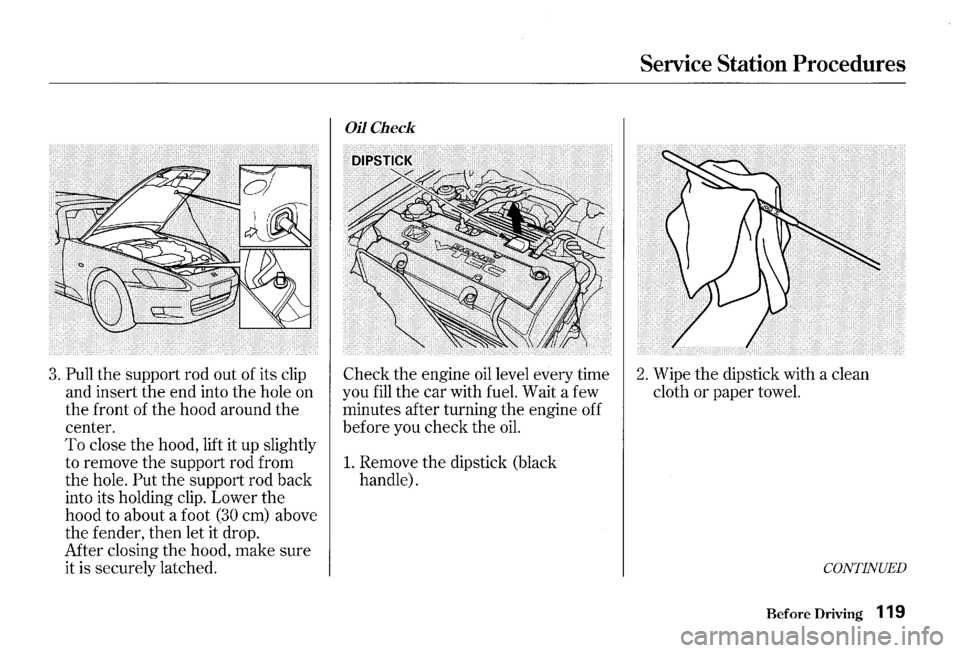
3. Pull the support rod out of its clip
and insert
the end into the hole on
the front of the hood around the
center.
To close the hood, lift it up slightly
to remove
the support rod from
the hole. Put the support rod back
into its holding clip. Lower
the
hood to about a foot (30 em) above
the fender, then let it drop.
After closing
the hood, make sure
it is securely latched.
Oil Check
Check the engine oil level every time
you
fill the car with fuel. Wait a few
minutes after turning
the engine off
before you check
the oil.
1. Remove the dipstick (black
handle).
Service Station Procedures
2. Wipe the dipstick with a clean
cloth
or paper towel.
CONTINUED
Before Driving 119
Page 128 of 273
Load Limit
The maximum load for your car is
400 lbs (185 kg).
This figure includes
the total weight
of
all occupants, cargo, and
accessories.
To figure out how much cargo you
can carry:
• Add up the weight of all occupants.
• Subtract the total from 400 lb (185
kg).
The final number is the total weight
of cargo you can carry.
Overloading or improper
loading can affect handling and
stability and cause a crash in
which you can be hurt or killed.
Follow all load limits
and other
loading guidelines in this
manual.
Carrying Cargo
Carrying Items in the Passenger
Compartment
• Store or secure all items that could
be thrown around and
hurt
someone during a crash.
• Be sure items placed on the floor
behind the front seats cannot roll
under the seats and interfere with
the driver's ability to operate the
pedals, or with the proper
operation of the seats.
Before Driving 125
Page 133 of 273
Preparing to Drive
You should do the following checks
and adjustments every day before
you drive
your car.
1. Make sure all windows, mirrors,
and outside lights
are clean and
unobstructed. Remove frost, snow,
or ice.
2. Check that the hood and trunk are
fully closed.
3. Visually check the tires. If a tire
looks low,
use a gauge to check its
pressure.
130 Driving
4. Check that any items you may be
carrying with you inside are stored
properly or fastened down
securely.
5. Check the adjustment of the seat
(see page 68 ) .
6. Check the adjustment of the
inside and outside mirrors (see
page
79 ).
7. Make sure the doors are securely
closed and locked.
8. Fasten your seat belt. Check that
your passenger has fastened his
seat belt (see page 15 ) .
9. Turn the ignition switch ON (II).
Check
the indicator lights in the
instrument panel.
10.Start
the engine (see page 131 ) .
1l.Check the gauges and indicator
lights in
the instrument panel (see
page
43 ).
Page 160 of 273
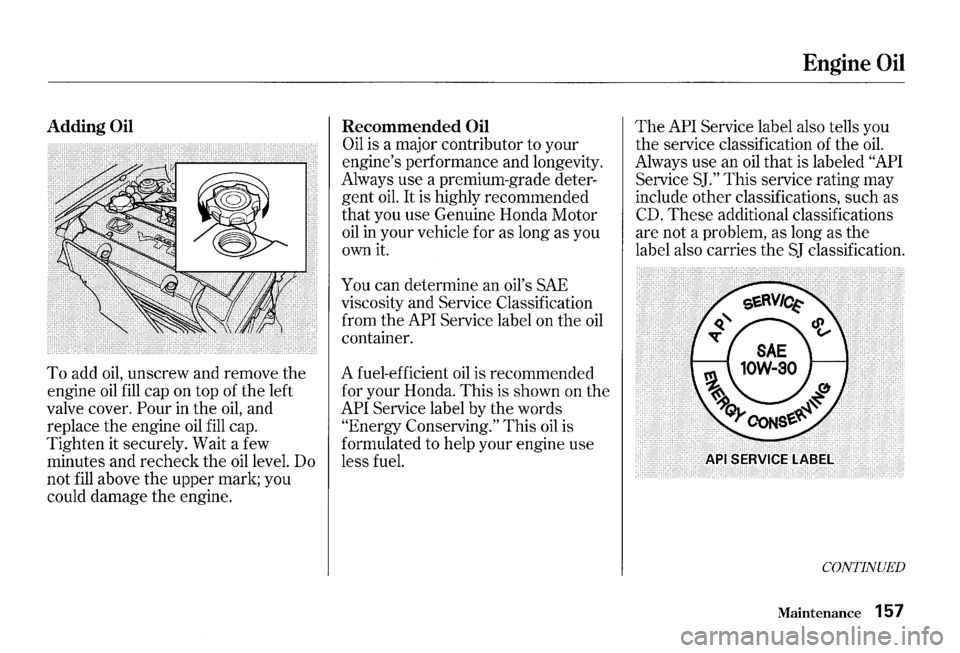
Adding Oil
To add oil, unscrew and remove the
engine oil fill cap on top of the left
valve cover.
Pour in the oil, and
replace
the engine oil fill cap.
Tighten it securely. Wait a few
minutes and
recheck the oil level. Do
not
fill above the upper mark; you
could damage the engine.
Recommended Oil
Oil is a major contributor to your
engine's performance and longevity.
Always use a premium-grade deter
gent
oil. It is highly recommended
that you use Genuine Honda Motor
oil in your vehicle for as long as you
own it.
You can determine an oil's
SAE
viscosity and Service Classification
from
the API Service label on the oil
container.
A fuel-efficient oil is recommended
for your Honda.
This is shown on the
API Service label by the words
"Energy Conserving." This oil is
formulated to help your engine use
less fuel.
Engine Oil
The API Service label also tells you
the service classification of the oil.
Always use an oil that is labeled "API
Service SJ." This service rating may
include other classifications, such as
CD. These additional classifications
are not a problem, as long as the
label also carries
the SJ classification.
CONTINUED
Maintenance 15 7
Page 167 of 273
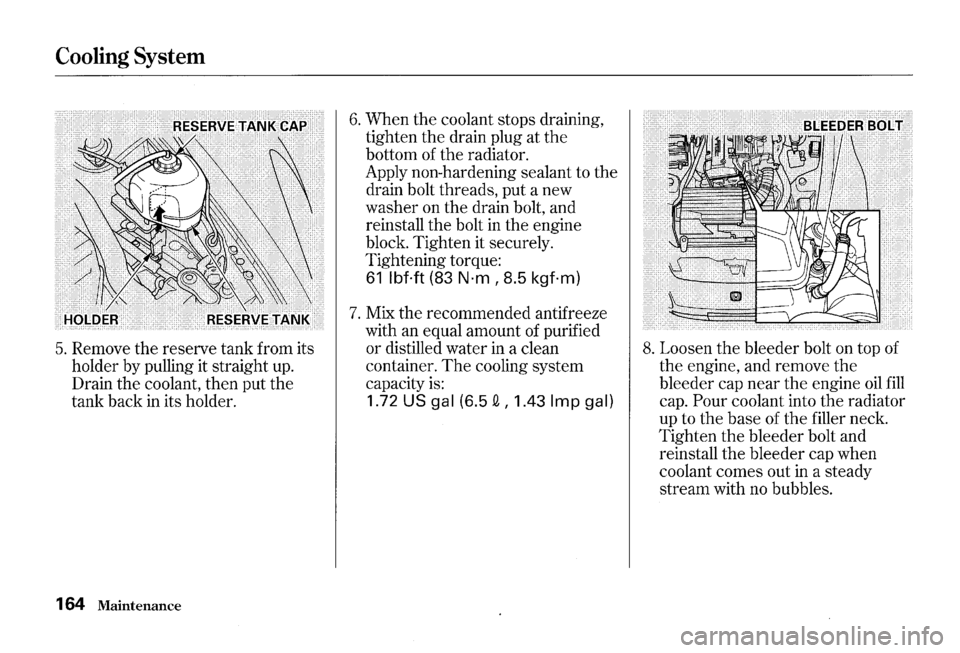
Cooling System
5. Remove the reserve tank from its
holder by pulling it straight
up.
Drain the coolant, then put the
tank back
in its holder.
164
Maintenance
6. When the coolant stops draining,
tighten the drain plug at
the
bottom of the radiator.
Apply non-hardening sealant to the
drain bolt threads, put a new
washer on the drain bolt, and
reinstall
the bolt in the engine
block. Tighten it securely.
Tightening torque:
61 lbf.ft (83 N·m I 8.5 kgf·m)
7. Mix the recommended antifreeze
with an equal amount of purified
or distilled water
in a clean
container.
The cooling system
capacity
is:
1.72 US gal (6.5 Q I 1.43 Imp gal)
8. Loosen the bleeder bolt on top of
the engine, and remove
the
bleeder cap near the engine oil fill
cap. Pour coolant into the radiator
up to the base of
the filler neck.
Tighten the bleeder bolt and
reinstall the bleeder cap when
coolant comes out in a steady
stream with no bubbles.
Page 171 of 273
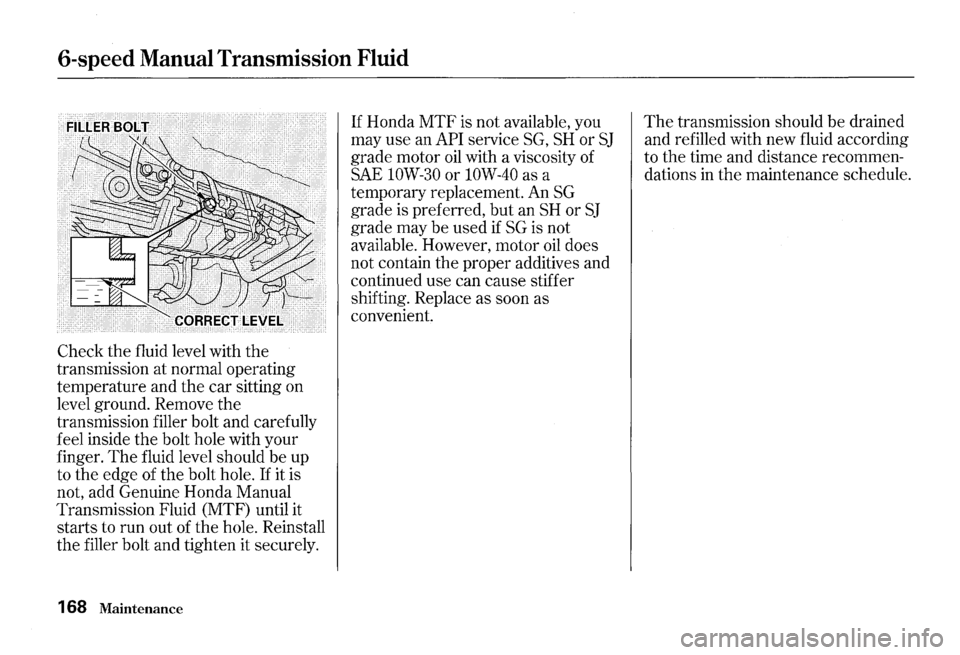
6-speed Manual Transmission Fluid
Check the fluid level with the
transmission at normal operating
temperature and the car sitting on
level ground. Remove the
transmission filler bolt and carefully
feel inside the bolt hole with your
finger.
The fluid level should be up
to the edge of the bolt hole.
If it is
not, add Genuine Honda Manual
Transmission Fluid (MTF) until it
starts to run out of the hole. Reinstall
the filler bolt and tighten it securely.
168 Maintenance
If Honda MTF is not available, you
may use an
API service SG, SH or SJ
grade motor oil with a viscosity of
SAE lOW-30 or lOW-40 as a
temporary replacement. An
SG
grade is preferred, but an SH or SJ
grade may be used if SG is not
available. However, motor
oil does
not contain the proper additives and
continued use can cause stiffer
shifting. Replace as soon as
convenient.
The transmission should be drained
and refilled with new fluid according
to the time and distance recommen
dations
in the maintenance schedule.
Page 172 of 273
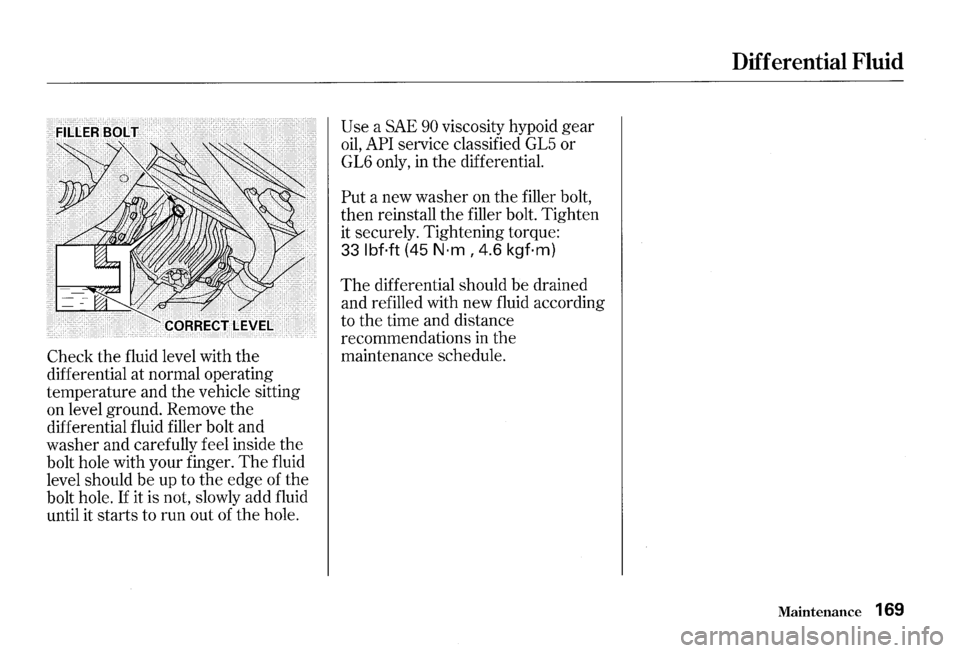
Check the fluid level with the
differential at normal operating
temperature and the vehicle sitting
onlevelground.Removethe
differential fluid filler bolt and
washer and carefully feel inside the
bolt hole with your finger.
The fluid
level should
be up to the edge of the
bolt hole.
If it is not, slowly add fluid
until it starts to run out of
the hole.
Use a SAE 90 viscosity hypoid gear
oil, API service classified GL5 or
GL6 only, in the differential.
Put a new washer on the filler bolt,
then reinstall the filler bolt. Tighten
it securely. Tightening torque:
33 lbf·ft (45 N·m, 4.6 kgf·m)
The differential should be drained
and refilled with new fluid according
to the time and distance
recommendations in the
maintenance schedule.
Differential Fluid
Maintenance 169
Page 202 of 273
7. Install the new bulb in the socket.
8. Push the socket into the light
assembly and turn it clockwise
until it locks.
9. Test the lights to make sure the
new bulb is working.
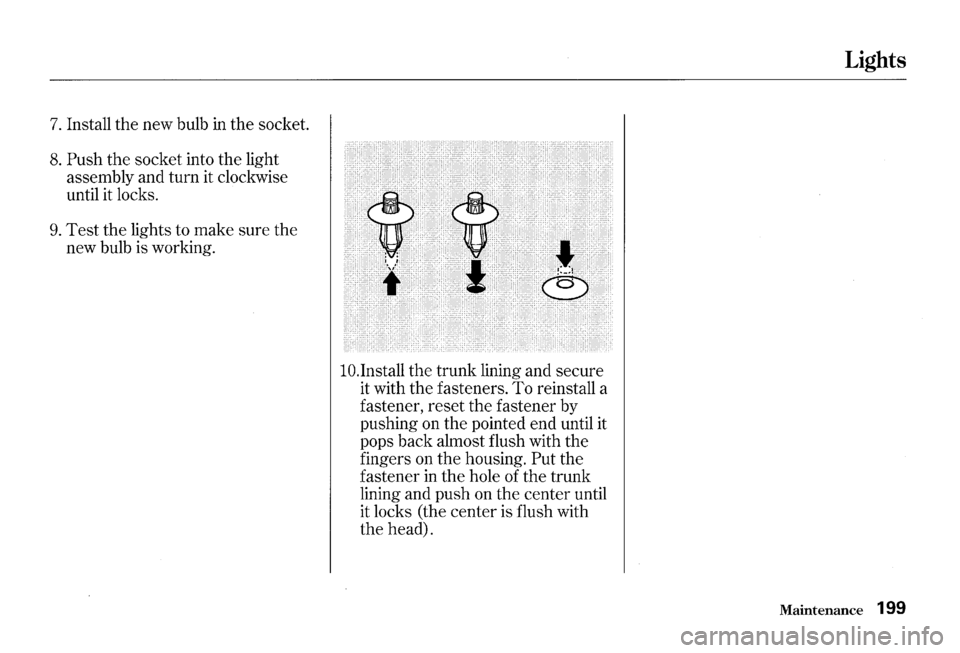
lO.Install the trunk lining and secure
it with the fasteners. To reinstall a
fastener, reset the fastener by
pushing on the pointed end until it
pops back almost flush with the
fingers on the housing.
Put the
fastener
in the hole of the trunk
lining and push on the center until
it locks (the center is flush with
the head).
Lights
Maintenance 199
Page 211 of 273
Interior Care, Corrosion Protection
Windows
Clean the windows, inside and out,
with a commercially-available glass
cleaner. You can also use a mixture
of one part white vinegar to ten parts
water.
This will remove the haze that
builds up on the inside of the
windows.
Use a soft cloth or paper
towels to clean all glass and clear
plastic surfaces.
208 Appearance Care
Air Fresheners
If you want to use an air freshener I
deodorizer in the interior of your car,
it is best to use a solid type.
Some
liquid air fresheners contain chemi
cals that may cause parts of the
interior trim and fabric to crack or
discolor.
If you use a liquid air freshener,
make sure you fasten it securely so it
does not spill as you drive.
Corrosion Protection
Two factors normally contribute to
causing corrosion
in your car:
1. Moisture trapped in body cavities.
Dirt and road salt
that collects in
hollows on the underside of the
car stays damp, promoting
corrosion
in that area.
2. Removal of paint and protective
coatings from
the exterior and
underside of the car.