cooling HONDA S2000 2000 1.G User Guide
[x] Cancel search | Manufacturer: HONDA, Model Year: 2000, Model line: S2000, Model: HONDA S2000 2000 1.GPages: 273, PDF Size: 21.58 MB
Page 96 of 273
These settings direct all the air flow
to the defroster vents at the base of
the windshield and the side window
defroster vents.
The air flow will get
warmer and clear the windows faster
as the engine warms up. You can
close the side vents with the dial
beside each vent.
This will send
more warm air to the windshield
defroster vents.
For safety, make sure you have a
clear view through all the windows
before driving away.
To Tum Everything Off
To shut off the system temporarily,
turn off the fan (no lights
illuminated).
You should shut the system
completely off only for the first few
minutes of driving in cold weather,
until the engine coolant warms up
enough to operate the heater. Keep
the fan on at
all other times so stale
air does not build up
in the interior.
Heating and Cooling
Comfort and Convenience Features 93
Page 146 of 273
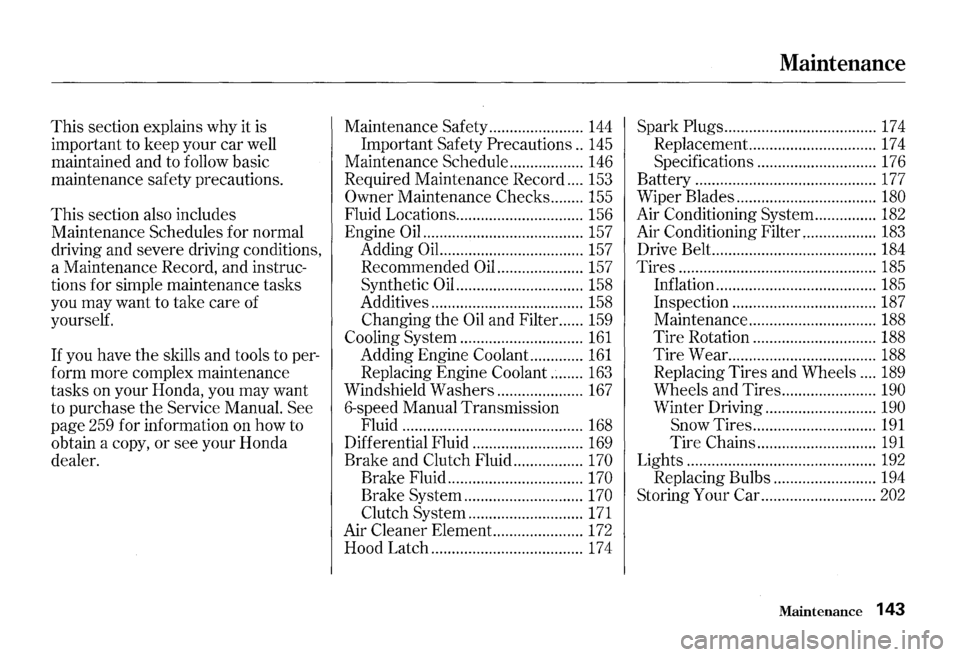
This section explains why it is
important to keep your car well
maintained and to follow basic
maintenance safety precautions.
This section also includes
Maintenance Schedules for normal
driving and severe driving conditions,
a Maintenance Record, and instruc
tions for simple maintenance tasks
you may want to take care of
yourself.
If you have the skills and tools to per
form more complex maintenance
tasks on your Honda, you may want
to purchase
the Service Manual. See
page 259 for information on how to
obtain a copy,
or see your Honda
dealer. Maintenance
Safety .......................
144
Important
Safety Precautions .. 145
Maintenance Schedule .................. 146
Required Maintenance Record
.... 153
Owner Maintenance Checks ........ 155
Fluid Locations ............................... 156
Engine Oil ....................................... 157
Adding Oil... ................................ 157
Recommended Oil ..................... 157
Synthetic
Oil ............................... 158
Additives ..................................... 158
Changing the Oil and Filter.. .... 159
Cooling System .............................. 161
Adding Engine Coolant ............. 161
Replacing Engine Coolant ........ 163
Windshield Washers ..................... 167
6-speed Manual Transmission
Fluid ............................................
168
Differential Fluid ........................... 169
Brake and Clutch Fluid ................. 170
Brake Fluid ................................. 170
Brake System ............................. 170
Clutch System ............................ 171
Air Cleaner Element.. .................... 172
Hood Latch ..................................... 174
Maintenance
Spark Plugs ..................................... 174
Replacement ............................... 17 4
Specifications ............................. 176
Battery ............................................
177
Wiper Blades .................................. 180
Air Conditioning System ............... 182
Air Conditioning Filter, ................. 183
Drive Belt ........................................ 184
Tires ................................................ 185
Inflation ....................................... 185
Inspection ................................... 187
Maintenance ............................... 188
Tire Rotation .............................. 188
Tire Wear .................................... 188
Replacing Tires and Wheels .... 189
Wheels and Tires ....................... 190
Winter Driving ........................... 190
Snow
Tires .............................. 191
Tire Chains ............................. 191
Lights .............................................. 192
Replacing Bulbs ......................... 194
Storing Your Car ............................ 202
Maintenance 143
Page 151 of 273
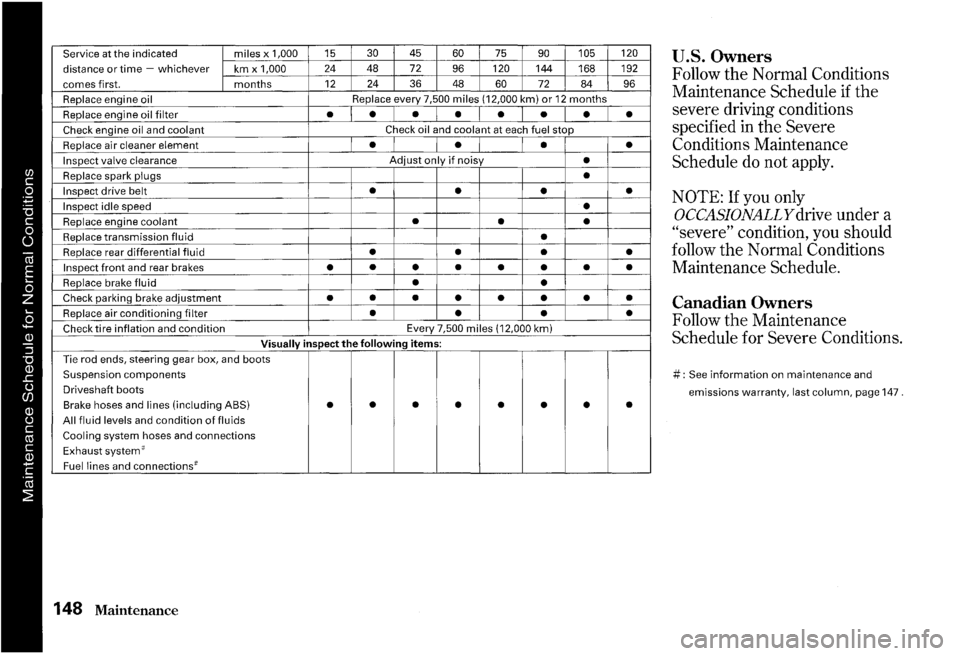
Service at the indicated miles x 1,000 15 30 45 60 75 90 105
distance ortime -whichever kmx 1,000 24 48 72 96 120 144 168
comes first.
months 12 24 36 48 60 72 84
Replace engine oil Replace every 7,500
miles (12,000 km) or 12 months
Replace engine oil filter • •
• • • • • Check engine oil and coolant Check oil and coolant at each fuel stop
Replace air cleaner element • • • Inspect valve clearance Adjust only if noisy • Replace spark plugs • Inspect drive belt • • • Inspect idle speed • Replace engine coolant • • • Replace transmission fluid • Replace rear differential fluid • • • Inspect front and rear brakes • • • • • •
• Replace brake fluid • • Check parking brake adjustment • • • •
• • • Replace air conditioning filter • • • Check tire inflation and condition Every 7,500
miles (12,000 km)
Visually inspect the following items:
Tie rod ends, steering gear box, and boots
Suspension components
Driveshaft boots
Brake hoses and
lines (including ABS) • • • • • • • All fluid levels and condition of fluids
Cooling
system hoses and connections
Exhaust system•
Fuel lines and connections•
148 Maintenance
120 192
96
•
•
•
•
•
•
•
•
U.S. Owners
Follow the Normal Conditions
Maintenance Schedule
if the
severe driving conditions
specified in
the Severe
Conditions Maintenance
Schedule do not apply.
NOTE: If you only
OCCASIONALLY drive under a
"severe" condition, you should
follow
the Normal Conditions
Maintenance Schedule.
Canadian Owners
Follow the Maintenance
Schedule for Severe Conditions.
#: See information on maintenance and
emissions warranty,
last column, page 147.
Page 152 of 273
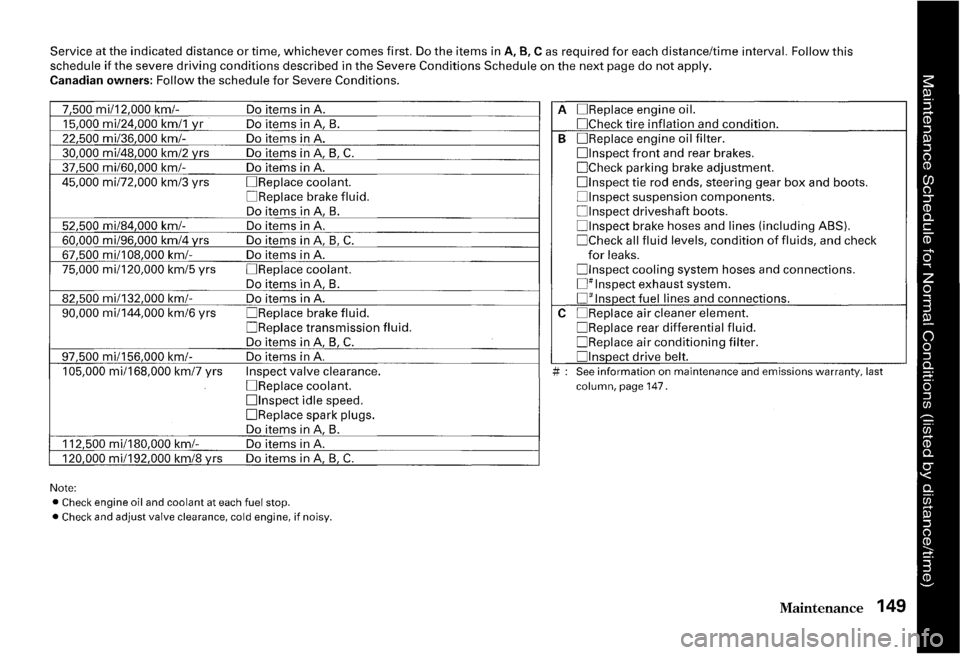
Service at the indicated distance or time, whichever comes first. Do the items in A, B, Cas required for each distance/time interval. Follow this schedule if the severe driving conditions described in the Severe Conditions Schedule on the next page do not apply. Canadian owners: Follow the schedule for Severe Conditions.
7,500 mi/12,000
km/- Do items in A. 15,000 m i/24,000 km/1 yr Do items in A, B. 22,500 mi/36,000 km/-
Do items in A. 30,000 mi/48,000 km/2 yrs Do items in A, B, C. 37,500 mi/60,000 km/- Do items in A. 45,000 mi/72,000 km/3 yrs DReplace coolant. DReplace brake fluid. Do items in A, B. 52,500 mi/84,000 km/- Do items in A. 60,000 mi/96,000 km/4 yrs Do items in A, B, C. 67,500 mi/108,000 km/- Do items in A. 75,000 mi/120,000 km/5 yrs DReplace coolant. Do items in A, B. 82,500 mi/132,000 km/- Do items in A. 90,000 mi/144,000 km/6 yrs DReplace brake fluid. DReplace transmission fluid. Do items in A, B, C. 97,500 mi/156,000 km/- Do items in A. 1 05,000 m i/168,000 km/7 yrs Inspect valve clearance. DReplace coolant. Dlnspect idle speed. DReplace spark plugs. Do items in A, B. 112,500 mi/180,000 km/-Do items in A. 120,000 mi/192,000 km/8 yrs Do items in A, B, C.
Note: • Check engine oil and coolant at each fuel stop. • Check and adjust valve clearance, cold engine, if noisy.
A DReplace engine oil. DCheck tire inflation and condition. B DReplace engine oil filter. Dlnspect front and rear brakes. CCheck parking brake adjustment. Dlnspect tie rod ends, steering gear box and boots. Dlnspect suspension components. Dlnspect driveshaft boots. Dlnspect brake hoses and lines (including ABS). DC heck all fluid levels, condition of fluids, and check for leaks. Dlnspect cooling system hoses and connections. D"lnspect exhaust system. D"lnspect fuel lines and connections. c DReplace air cleaner element. DReplace rear differential fluid. DReplace air conditioning filter. Dlnspect drive belt. # : See information on maintenance and emissions warranty, last
column, page 147.
Maintenance 149
Page 153 of 273
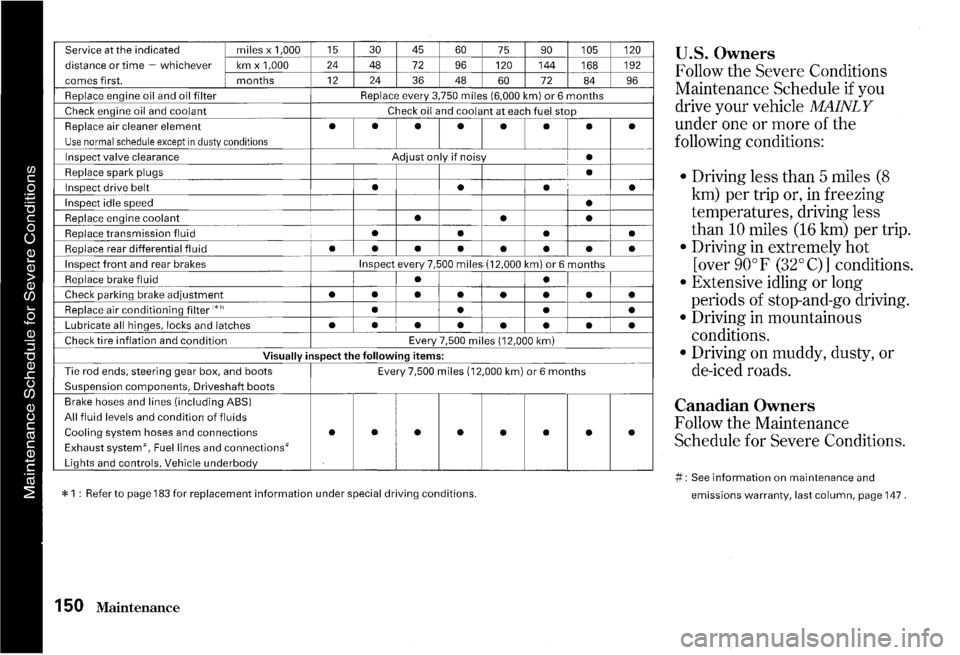
Service at the indicated miles x 1,000 15 30 45 60 75 90 105 120 distance or time -whichever km x 1,000 24 48 72 96 120 144 168 192 --~-~ comes first. months 12 24
36 48 60 72 84
96 Replace engine oil and oil filter Replace every 3,750 miles (6,000 km) or 6 months
Check engine oil and coolant Check oil and coolant at each fuel stop Replace air cleaner element • • r-·-. . . ·~ • • Use normal schedule except in dusty
conditions Inspect valve clearance Adjust only if noisy • Replace spark plugs • -·~-~-·-· ~~-~ f-----Inspect drive belt •
• • • Inspect idle speed I • --Replace engine coolant • • • -----Replace transmission fluid • •
• • Replace rear differential fluid • • • •
• •
• • Inspect front and rear brakes Inspect every 7,500 miles. (12,000 km) or 6 months
Replace brake fluid • -+-• Check parking brake adjustment • •
• • • • • • Replace air conditioning filter 1
" 1 •
•
• • i -~I-Lubricate al_~!lir1J:JeS, locks and latches • • • • • • • • Check tire inflation and condition Every 7,500 miles (12,000 km) Visually inspect the following items:
Tie rod ends, steering gear box, and boots Every 7,500 miles (12,000 km) or 6 months Suspension components, Drives haft boots -----r----~~ Brake hoses and lines (including ABS)
All fluid levels and condition of fluids
Cooling system hoses and connections • • • • • • • • Exhaust system", Fuel lines and connections'
1 Lights and controls, Vehicle underbody
* 1: Refer to page183 for replacement information under special driving conditions.
150 Maintenance
U.S. Owners
Follow the Severe Conditions
Maintenance Schedule if you
drive your vehicle
MAINLY
under one or more of the
following conditions:
• Driving less than 5 miles (8
km) per trip or, in freezing
temperatures, driving less
than
10 miles (16 km) per trip.
• Driving in extremely hot
[over
90° F (32° C)] conditions.
• Extensive idling or long
periods of stop-and-go driving.
• Driving in mountainous
conditions.
• Driving on muddy, dusty, or
de-iced roads.
Canadian Owners
Follow the Maintenance
Schedule for Severe Conditions.
#: See information on maintenance and
emissions warranty, last column, page 147.
Page 155 of 273
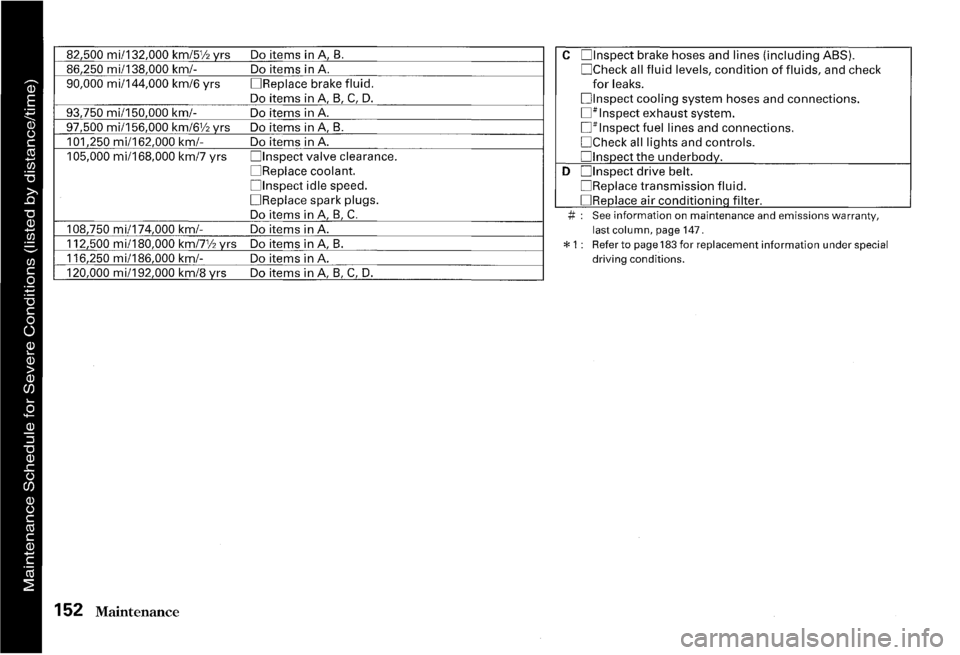
82,500 mi/132,000 km/51/z vrs Do items in A, B. 86,250 mi/138,000 km/-Do items in A. 90,000 mi/144,000 km/6 yrs ORe place brake fluid. Do items in A, B, C, D. 93,750 mi/150,000 km/-Do items in A. 97,500 mi/156,000 km/61/z yrs Do items in A. B. 101,250 mi/162,000 km/-Do items in A. 105,000 mi/168,000 km/7 yrs Dlnspect valve clearance. DReplace coolant. Dlnspect idle speed. DReplace spark plugs. Do items in A, B, C. 108,750 mi/174,000 km/-Do items in A. 112,500 mi/180,000 km/71/z yrs Do items in A, B. 116,250 mi/186,000 km/-Do items in A. 120,000 mi/192,000 km/8 vrs Do items in A, B, C D.
152 Maintenance
C Dlnspect brake hoses and lines (including ABS). DC heck all fluid levels, condition of fluids, and check for leaks. Dlnspect cooling system hoses and connections. D"lnspect exhaust system. D"lnspect fuel lines and connections. DCheck all lights and controls. Dlnspect the underbody.
D Dlnspect drive belt. DReplace transmission fluid. DReplace air conditioning filter. # : See information on maintenance and emissions warranty, last column, page 147. * 1: Refer to page183 for replacement information under special driving conditions.
Page 164 of 273
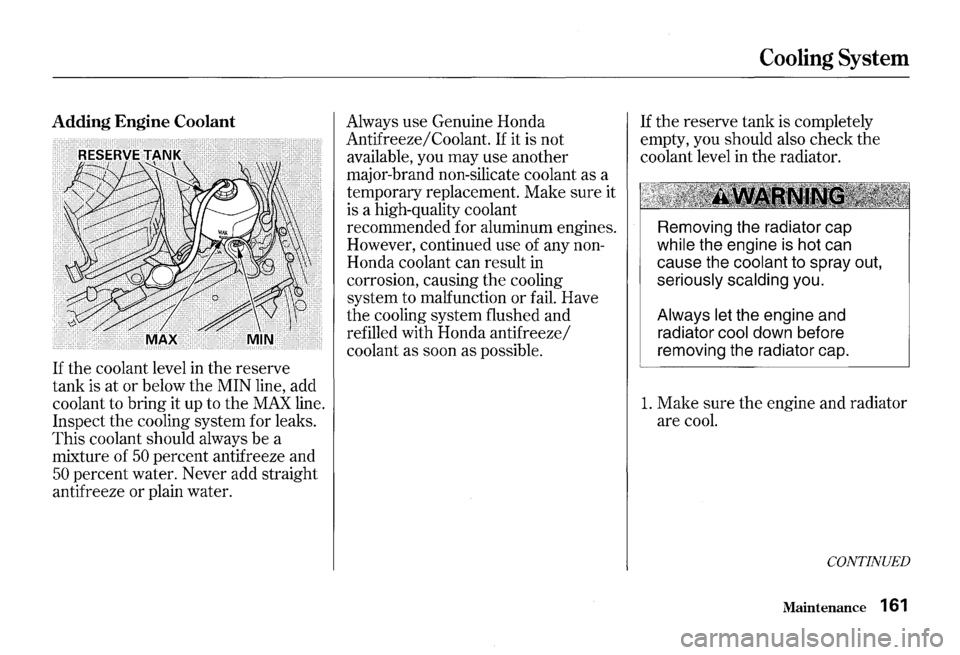
Adding Engine Coolant
If the coolant level in the reserve
tank is at or below the MIN line, add
coolant to bring it up to the
MAX line.
Inspect the cooling system for leaks.
This coolant should always be a
mixture of
50 percent antifreeze and
50 percent water. Never add straight
antifreeze
or plain water. Always
use Genuine Honda
Antifreeze/Coolant.
If it is not
available, you may use another
major-brand non-silicate coolant as a
temporary replacement. Make sure it
is a high-quality coolant
recommended for aluminum engines.
However, continued use of any non
Honda coolant can result in
corrosion, causing the cooling
system to malfunction or fail. Have
the cooling system flushed and
refilled with Honda antifreeze/
coolant as soon as possible.
Cooling System
If the reserve tank is completely
empty, you should also check the
coolant level
in the radiator.
Removing the radiator cap
while the engine is hot can
cause the
coolant to spray out,
seriously scalding you.
Always let the engine and
radiator
cool down before
removing the radiator cap.
1. Make sure the engine and radiator
are cool.
CONTINUED
Maintenance 161
Page 165 of 273
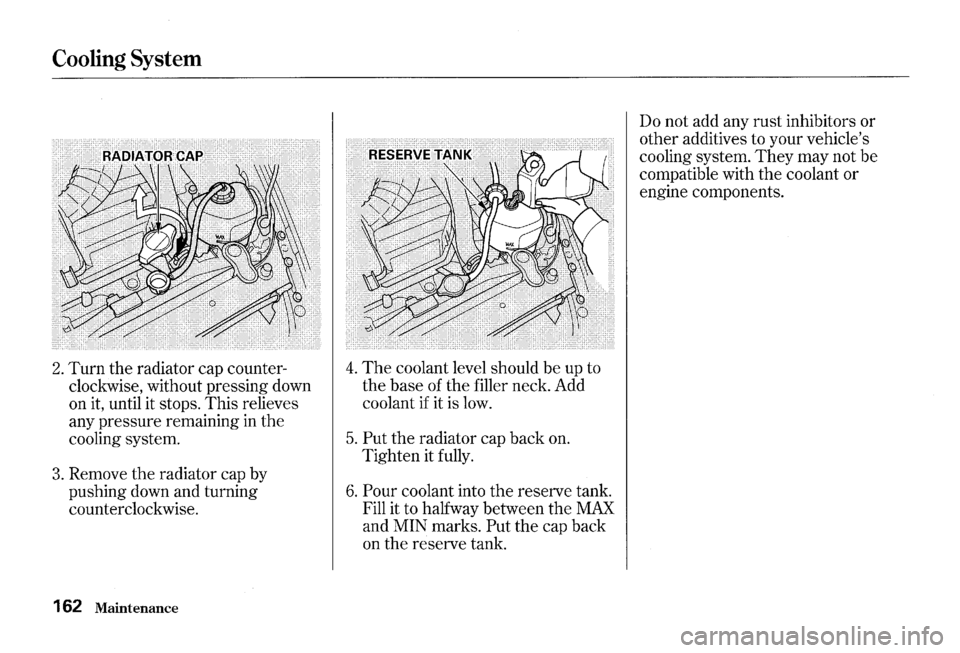
Cooling System
2. Turn the radiator cap counter
clockwise, without pressing down
on it, until it stops.
This relieves
any pressure remaining in the
cooling system.
3. Remove the radiator cap by
pushing down and turning
counterclockwise.
162 Maintenance
4. The coolant level should be up to
the base of the filler neck. Add
coolant
if it is low.
5. Put the radiator cap back on.
Tighten it fully.
6. Pour coolant into the reserve tank.
Fill it to halfway between the
MAX
and MIN marks. Put the cap back
on the reserve tank.
Do not add any rust inhibitors or
other additives to your vehicle's
cooling system.
They may not be
compatible with
the coolant or
engine components.
Page 166 of 273
Replacing Engine Coolant
The cooling system should be
completely drained and refilled with
new coolant according to
the time
and distance recommendations in
the maintenance schedule. Only use
Genuine Honda Antifreeze/Coolant.
Draining the coolant requires access
to
the underside of the vehicle.
Unless you have the tools and
knowledge, you should have this
maintenance done by a skilled
mechanic.
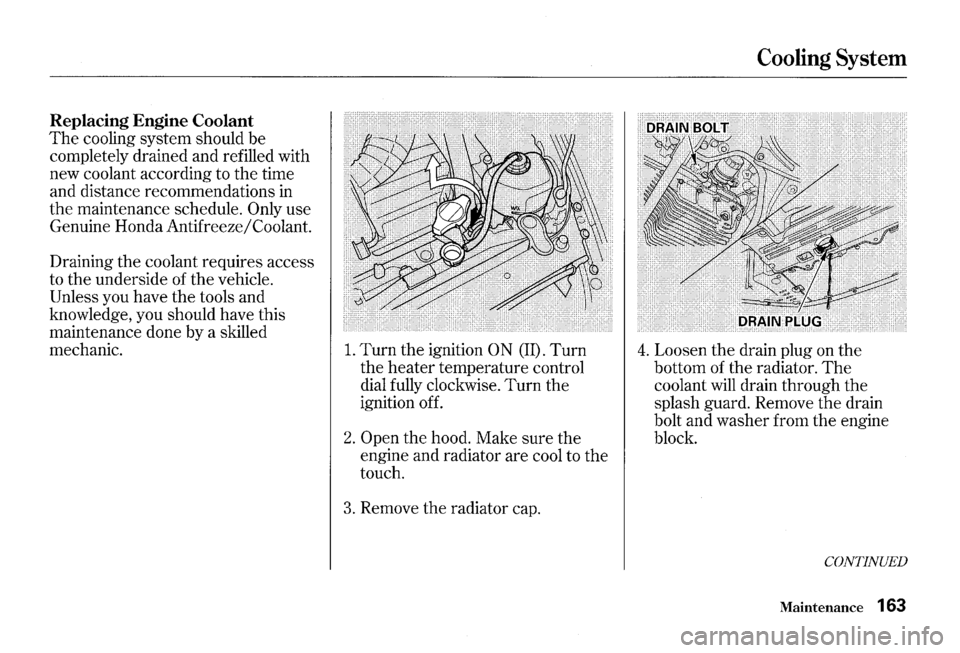
1. Turn the ignition ON (II). Turn
the heater temperature control
dial fully clockwise.
Turn the
ignition off.
2. Open the hood. Make sure the
engine and radiator are cool to the
touch.
3. Remove the radiator cap.
Cooling System
4. Loosen the drain plug on the
bottom of the radiator. The
coolant will drain through the
splash guard. Remove the drain
bolt and washer from the engine
block.
CONTINUED
Maintenance 163
Page 167 of 273
Cooling System
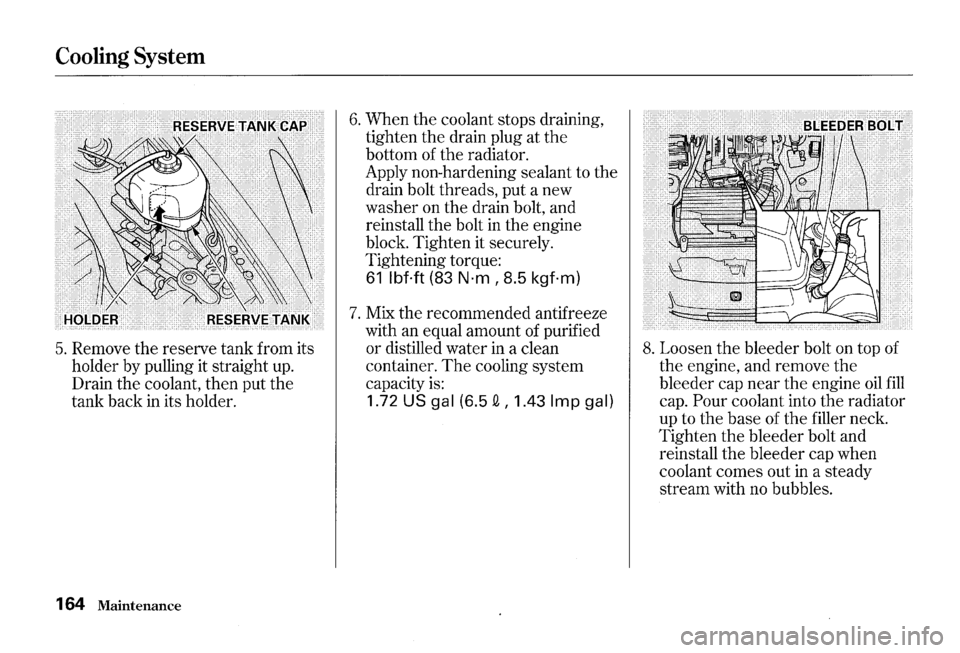
5. Remove the reserve tank from its
holder by pulling it straight
up.
Drain the coolant, then put the
tank back
in its holder.
164
Maintenance
6. When the coolant stops draining,
tighten the drain plug at
the
bottom of the radiator.
Apply non-hardening sealant to the
drain bolt threads, put a new
washer on the drain bolt, and
reinstall
the bolt in the engine
block. Tighten it securely.
Tightening torque:
61 lbf.ft (83 N·m I 8.5 kgf·m)
7. Mix the recommended antifreeze
with an equal amount of purified
or distilled water
in a clean
container.
The cooling system
capacity
is:
1.72 US gal (6.5 Q I 1.43 Imp gal)
8. Loosen the bleeder bolt on top of
the engine, and remove
the
bleeder cap near the engine oil fill
cap. Pour coolant into the radiator
up to the base of
the filler neck.
Tighten the bleeder bolt and
reinstall the bleeder cap when
coolant comes out in a steady
stream with no bubbles.