cooling HONDA S2000 2000 1.G Owner's Manual
[x] Cancel search | Manufacturer: HONDA, Model Year: 2000, Model line: S2000, Model: HONDA S2000 2000 1.GPages: 273, PDF Size: 21.58 MB
Page 168 of 273
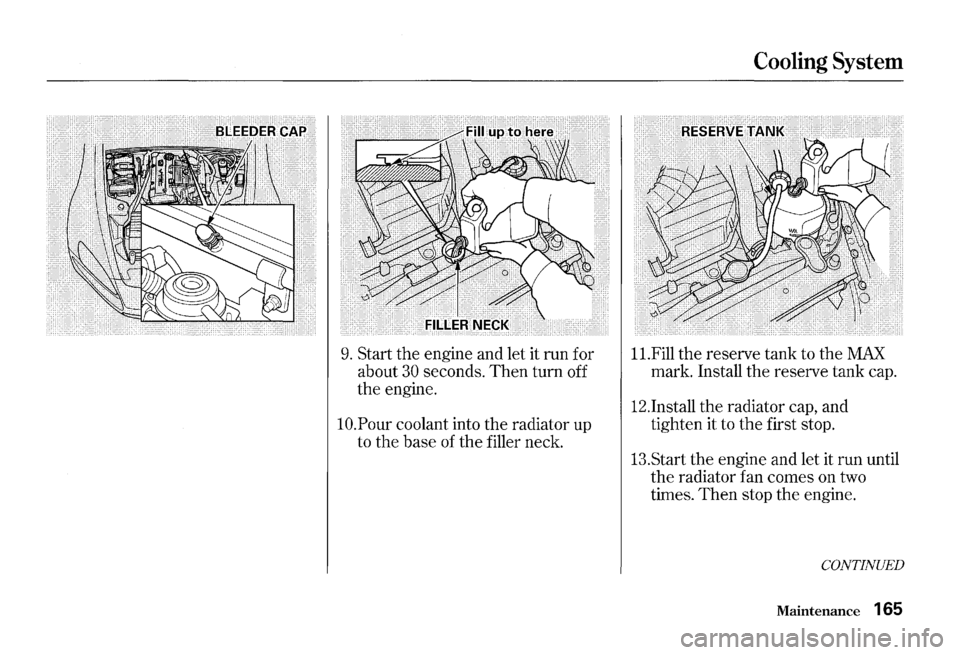
9. Start the engine and let it run for
about
30 seconds. Then turn off
the engine.
lO.Pour coolant into the radiator up
to the base of the filler neck.
Cooling System
ll.Fill the reserve tank to the MAX
mark. Install the reserve tank cap.
12.Install the radiator cap, and
tighten it to
the first stop.
13.Start the engine and let it run until
the radiator fan comes on two
times.
Then stop the engine.
CONTINUED
Maintenance 165
Page 169 of 273
Cooling System
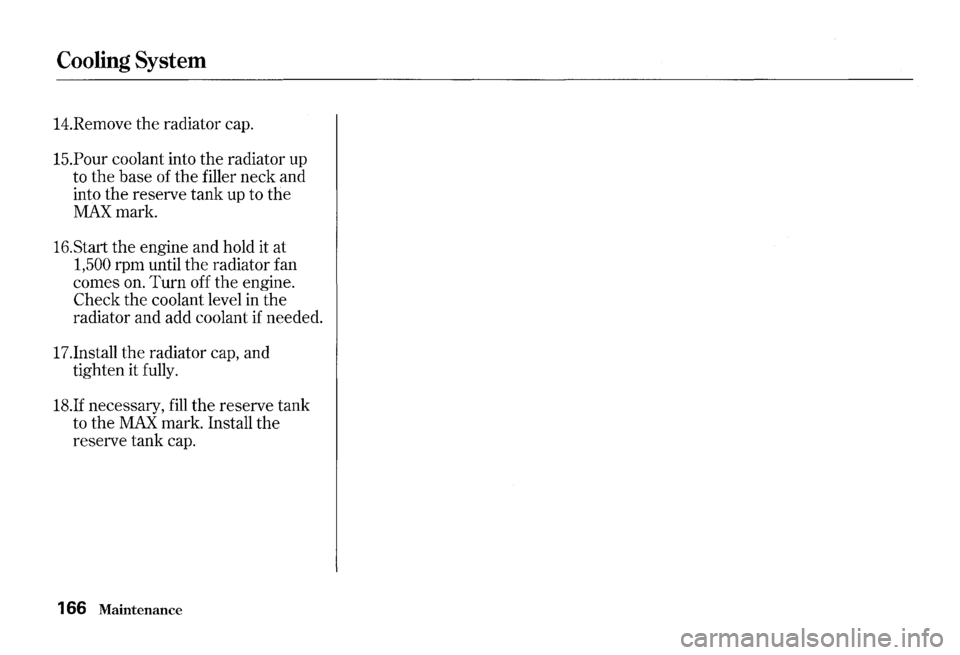
14.Remove the radiator cap.
15.Pour coolant into the radiator up
to the base of the filler neck and
into the reserve tank up to the
MAX mark.
16.Start
the engine and hold it at
1,500 rpm until the radiator fan
comes on.
Turn off the engine.
Check the coolant level in the
radiator and add coolant
if needed.
17.Install the radiator cap, and
tighten it fully.
18.If necessary, fill the reserve tank
to the
MAX mark. Install the
reserve tank cap.
166
Maintenance
Page 185 of 273
Air Conditioning System
Your car's air conditioning is a sealed
system. Any major maintenance,
such as recharging, should
be done
by a qualified mechanic. You can do
a couple of things to
make sure the
air conditioning works efficiently.
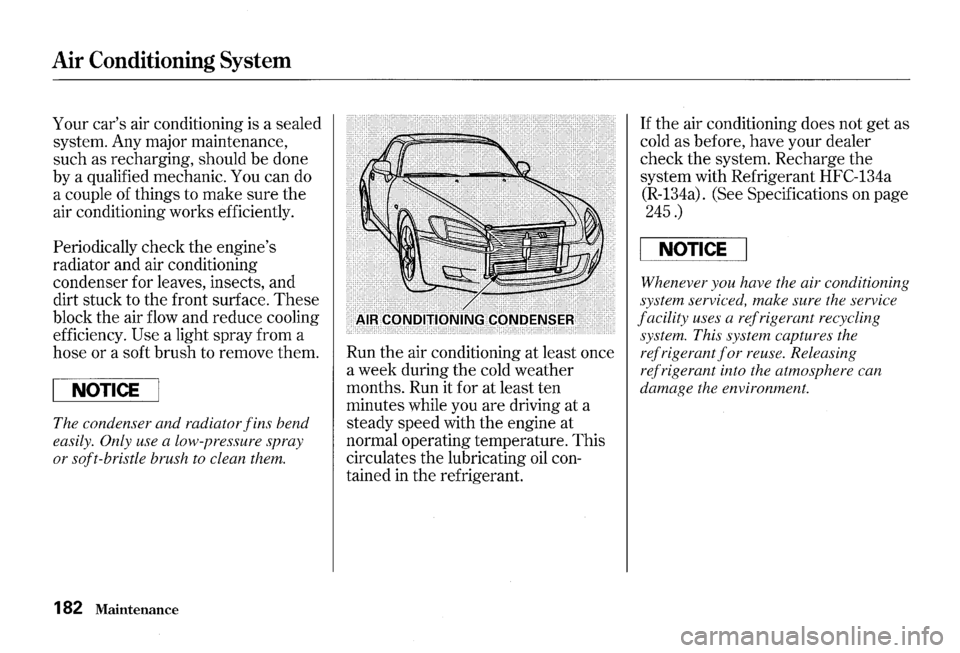
Periodically
check the engine's
radiator and air conditioning
condenser for leaves, insects, and
dirt
stuck to the front surface. These
block the air flow and reduce cooling
efficiency.
Use a light spray from a
hose or a soft
brush to remove them.
NOTICE
The condenser and radiator fins bend
easily. Only use a low-pressure
~pray
or soft-bristle brush to clean them.
182 Maintenance
Run the air conditioning at least once
a
week during the cold weather
months. Run it for at least ten
minutes while you are driving at a
steady speed with
the engine at
normal operating temperature. This
circulates the lubricating oil con
tained in
the refrigerant.
If the air conditioning does not get as
cold
as before, have your dealer
check the system. Recharge the
system with Refrigerant HFC-134a
(R-134a). (See Specifications on page
245.)
NOTICE
Whenever you have the air conditioning
system serviced, make sure the service
facility uses a refrigerant recycling
system. This system captures the
refrigerant
for reuse. Releasing
refrigerant into the atmosphere can
damage the environment.
Page 186 of 273
The air conditioning filter removes
pollen and dust from outside air the
heating and cooling system brings
into the interior.
It should be
replaced according to the time and
distance recommendations
in the
maintenance schedule.
This filter should be replaced every
30,000 miles (48,000 km) under
normal conditions.
It should be
replaced every
15,000 miles (24,000
km) if you drive primarily in urban
areas that have high concentrations
of soot in the air from industry and
diesel-powered vehicles. Replace it
more often
if air flow from the
climate control system becomes less
than usual. Have the air conditioning
filter replaced by your Honda dealer.
Replacement
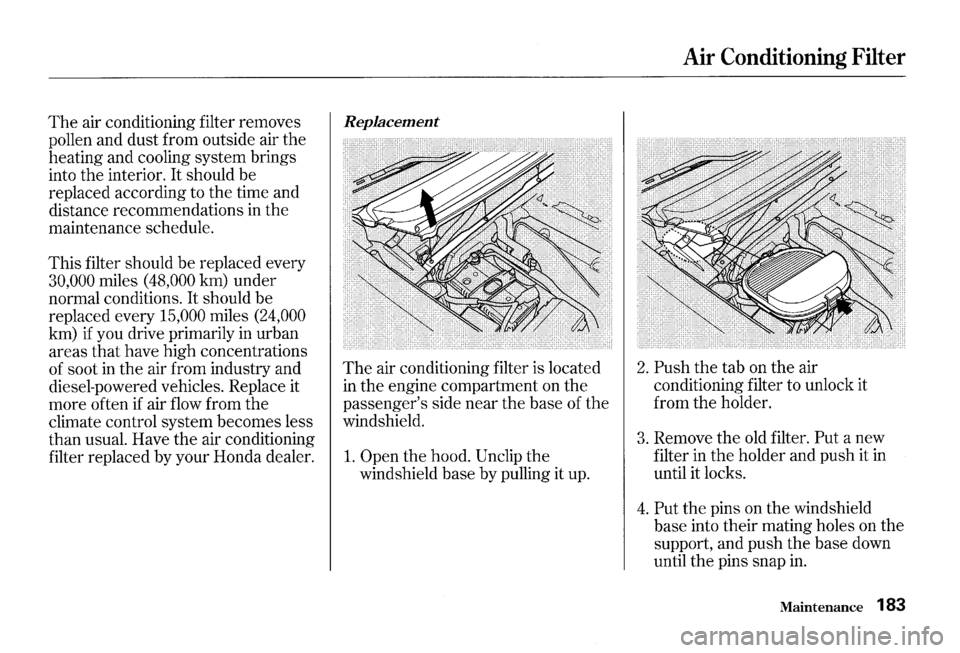
The air conditioning filter is located
in the engine compartment on the
passenger's side near the base of the
windshield.
1. Open the hood. Unclip the
windshield base by pulling it
up.
Air Conditioning Filter
2. Push the tab on the air
conditioning filter to unlock it
from the holder.
3. Remove the old filter. Put a new
filter in the holder and push it in
until it locks.
4. Put the pins on the windshield
base into their mating holes on the
support, and push the base down
until the pins snap
in.
Maintenance 183
Page 226 of 273
The reading on your car's
temperature gauge should stay in
the midrange under most conditions.
It may go higher if you are driving up
a long steep hill on a very
hot day. If
it climbs to the red mark, you should
determine
the reason.
NOTICE
Driving with the temperature gauge
reading
at the red mark can cause
serious damage to your engine.
Your car can overheat for several
reasons,
such as lack of coolant or a
mechanical problem.
The only
indication may be
the temperature
gauge climbing to or above
the red
mark. Or you may see steam or
spray coming from
under the car or
engine cover. In either case, you
should take immediate action.
Steam and spray from an
overheated engine can
seriously scald you.
Do not open the hood if steam
is coming out.
1. Safely pull to the side of the road.
Put the transmission in Neutral
and
set the parking brake. Turn
off the heating and cooling system
and all
other accessories. Turn on
the hazard warning indicators.
2. If you see steam and/ or spray
coming from
under the hood, turn
off
the engine.
If Your Engine Overheats
3. If you do not see steam or spray,
leave
the engine running and
watch
the temperature gauge. If
the high heat is due to overloading
(climbing a long, steep hill on a
hot day with
the A/C running, for
example),
the engine should start
to cool down almost immediately.
If it does, wait until the tempera
ture gauge comes down to
the mid
point
then continue driving.
4. If the temperature gauge stays at
the red mark, turn off the engine.
5. Wait until you see no more signs
of
steam or spray, then open the
hood.
CONTINUED
Taking Care of the Unexpected 223
Page 227 of 273
If Your Engine Overheats
6. Look for any obvious coolant leaks,
such as a split radiator hose.
Everything is still extremely hot,
so use caution.
If you find a leak, it
must be repaired before you
continue driving (see
Emergency
Towing on page 238 ) .
Removing the radiator cap
while the engine is hot can
cause the
coolant to spray out,
seriously scalding you.
Always let the engine and
radiator
cool down before
removing the radiator cap.
224 Taking Care of the Unexpected
7. If you don't find an obvious leak,
check the coolant level in
the
radiator reserve tank (see page
120 ) . If the level is below the
MIN mark, add coolant to halfway
between the MIN and
MAX marks.
8. If there was no coolant in the
reserve tank, you may also have to
add coolant to the radiator. Let the
engine cool down until the reading
reaches the middle of the
temperature gauge, or lower,
before checking the radiator.
9. Using gloves or a large heavy
cloth, turn
the radiator cap
counterclockwise, without pushing
down, to
the first stop. This
releases any remaining pressure
in
the cooling system. After the
pressure releases, push down on
the cap and turn it until it comes
off.
Page 228 of 273
lO.Start the engine and set the
temperature control dial to
maximum. Add coolant to the
radiator up to the base of the filler
neck.
If you do not have the
proper coolant mixture available,
you can add plain water.
Remember to have the cooling
system drained and refilled with
the proper mixture as soon as you
can.
ll.Put the radiator cap back on
tightly. Run the engine and watch
the temperature gauge.
If it goes
back to the red mark, the engine
needs repair. (See
Emergency
Towing on page 238 .)
If Your Engine Overheats
12.If the temperature stays normal,
check the coolant level in the
radiator reserve tank.
If it has
gone down, add coolant to the
MAX mark. Put the cap back on
tightly.
Taking Care of the Unexpected 225
Page 237 of 273
Fuses
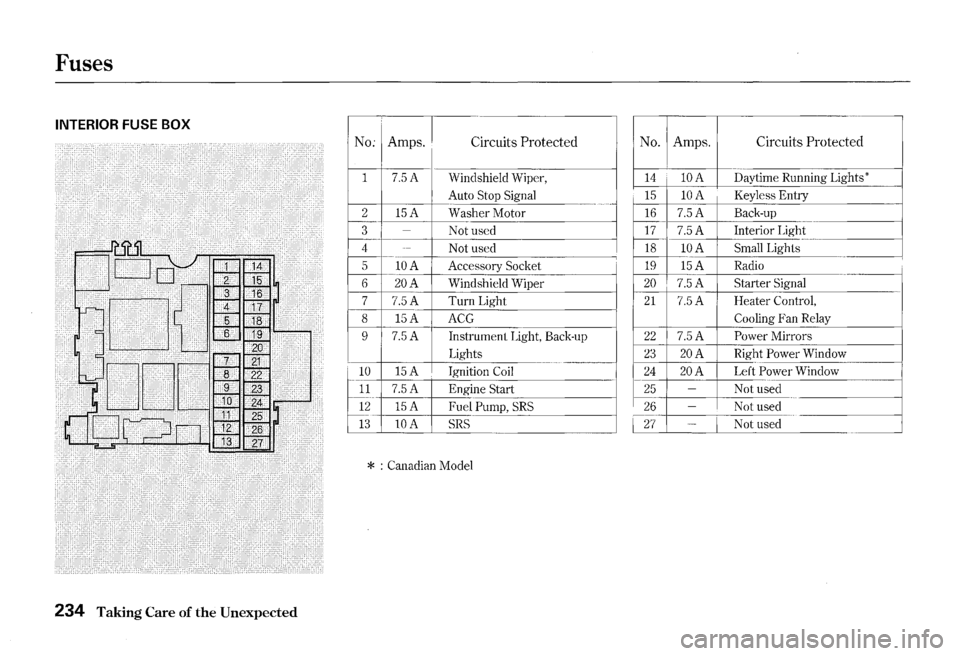
INTERIOR FUSE BOX
No: Amps. Circuits Protected No. Amps. Circuits Protected
1 7.5A Windshield Wiper, 14 lOA Daytime Running Lights*
Auto
Stop Signal 15 lOA Keyless Entry
2
15A Washer Motor 16 7.5A Back-up
3
-Not used 17 7.5A Interior Light
4
-Not used 18 lOA Small Lights
5
lOA Accessory Socket 19 15A Radio
6
20A Windshield Wiper 20 7.5A Starter Signal
7 7.5A Tum Light 21 7.5A Heater Control,
8 15A ACG Cooling Fan
Relay
9
7.5A Instrument Light, Back·up 22 7.5A Power Mirrors
Lights
23 20A Right Power Window
10 15A Ignition Coil 24 20A Left Power Window
11 7.5A Engine Start 25 -Not used
12 15A Fuel Pump, SRS 26 -Not used
13 lOA SRS 27 -Not used
* : Canadian Model
234 Taking Care of the Unexpected
Page 238 of 273
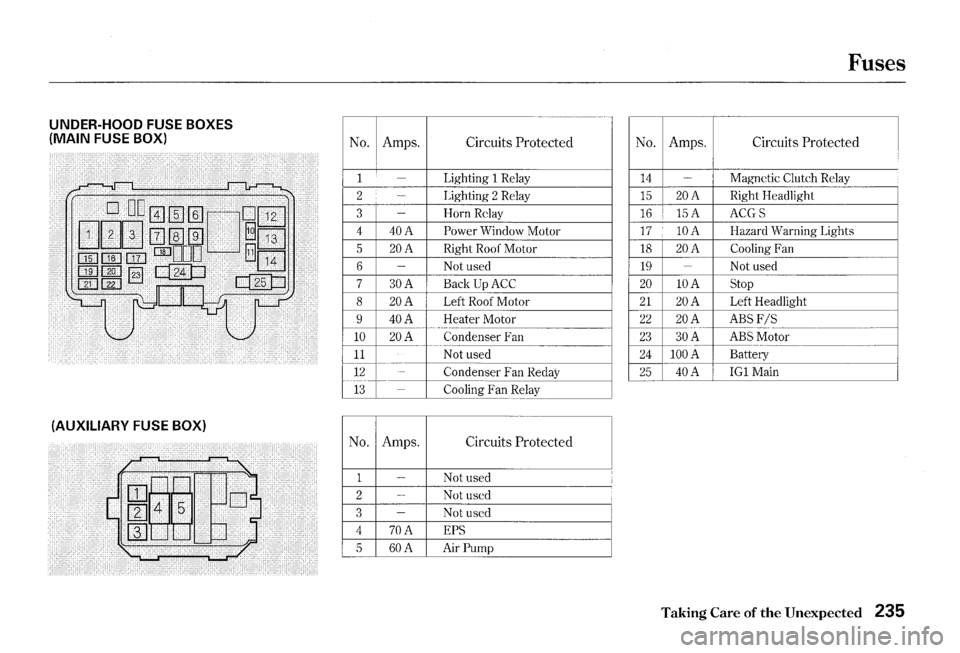
UNDER-HOOD FUSE BOXES
(MAIN FUSE BOX)
(AUXILIARY FUSE BOX)
No.
1 -~~ 2 ---------3
4
5 6
7
8 9
10
11
i 12
13
No.
1
2
~-3 4
5
Amps. Circuits Protected
Lighting 1 Relay ·--··---·-Lighting 2 Relay ~-r--c-~----Horn Relay
40A Power Window Motor
20A Right Roof Motor ~ Not used
30A ! BackUpACC
20A Left Roof Motor
40A ' Heater Motor
20A Condenser Fan ~ Not used ~ Condenser Fan Reday ~ Cooling Fan Relay
Amps. Circuits Protected
-Not used -··--·-··-· Not used ______ ,. ________ ~---~ Not used ---·· 70A EPS ___________ , __
60A Air Pump
Fuses
'
No. Amps. Circuits Protected
14 Magnetic Clutch Relay r--~~ ·--··-----------------....... -·---15 20A Right Headlight '1:6-·-· --15A ACGS
17 lOA Hazard
Warning Lights
18 20A Cooling Fan --19 ~ Not used ··-20 lOA Stop
21 20A Left Headlight
22 20A ABS F/S
23 30A ABS Motor
24 lOOA Battery
25 40A IGl Main
--------
Taking Care of the Unexpected 235
Page 267 of 273
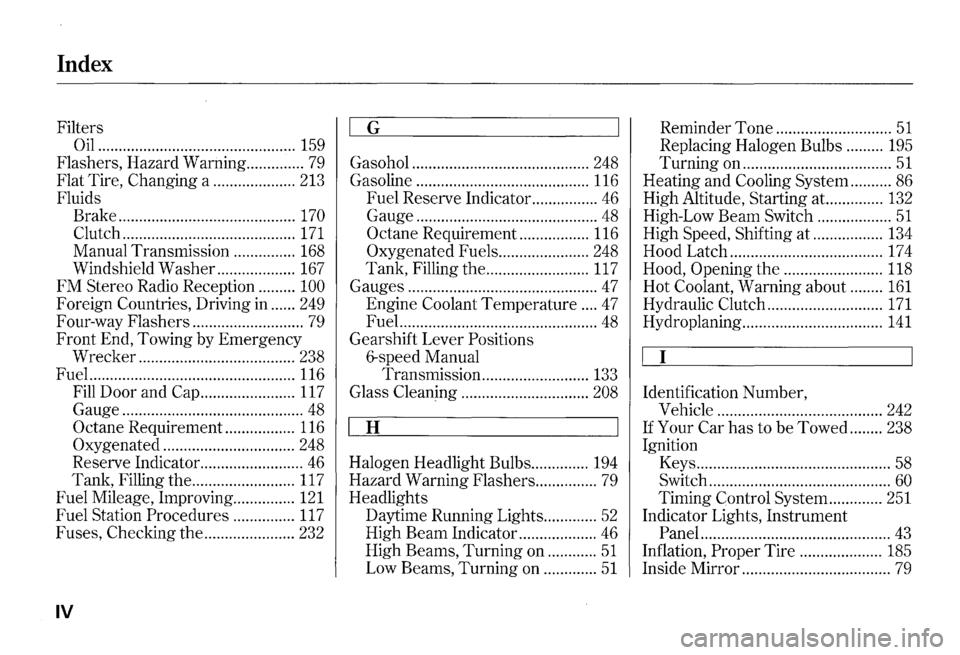
Index
Filters
Oil ................................................ 159
Flashers, Hazard Warning .............. 79
Flat Tire, Changing a .................... 213
Fluids
Brake ...........................................
170
Clutch
.......................................... 171
Manual Transmission ............... 168
Windshield Washer ................... 167
FM Stereo Radio Reception ......... 100
Foreign Countries, Driving in ...... 249
Four-way Flashers ........................... 79
Front End, Towing by Emergency
W reeker ......................................
238
Fuel .................................................. 116
Fill Door and
Cap ....................... 117
Gauge ............................................ 48
Octane Requirement.. ............... 116
Oxygenated ................................ 248
Reserve Indicator .........................
46
Tank, Filling the ......................... 117
Fuel Mileage, Improving ............... 121
Fuel Station Procedures ............... 117
Fuses, Checking the ...................... 232
IV
G
Gasohol ........................................... 248
Gasoline .......................................... 116
Fuel Reserve Indicator. ...............
46
Gauge ............................................ 48
Octane Requirement ................. 116
Oxygenated Fuels ...................... 248
Tank, Filling the .........................
117
Gauges .............................................. 47
Engine Coolant Temperature .... 47
Fuel ................................................ 48
Gearshift Lever Positions
6-speed Manual
Transmission ..........................
133
Glass Cleaning ............................... 208
IH
Halogen Headlight Bulbs .............. 194
Hazard Warning Flashers ............... 79
Headlights
Daytime Running Lights .............
52
High Beam Indicator ................... 46
High Beams, Turning on ............ 51
Low Beams, Turning on ............. 51
Reminder Tone ............................ 51
Replacing Halogen Bulbs ......... 195
Turning on .................................... 51
Heating and Cooling System .......... 86
High Altitude, Starting at.. ............ 132
High-Low Beam Switch .................. 51
High Speed, Shifting at ................. 134
Hood Latch ..................................... 17 4
Hood, Opening
the ........................ 118
Hot Coolant, Warning about ........ 161
Hydraulic Clutch ............................ 171
Hydroplaning .................................. 141
I
Identification Number,
Vehicle ........................................
242
If Your Car has to be Towed ........ 238
Ignition
Keys ...............................................
58
Switch ............................................ 60
Timing Control System ............. 251
Indicator Lights, Instrument
Panel .............................................. 43
Inflation, Proper Tire .................... 185
Inside Mirror .................................... 79