flat tire HONDA S2000 2000 1.G User Guide
[x] Cancel search | Manufacturer: HONDA, Model Year: 2000, Model line: S2000, Model: HONDA S2000 2000 1.GPages: 273, PDF Size: 21.58 MB
Page 190 of 273
Tubeless tires have some ability to
self-seal
if they are punctured.
However, because leakage is often
very slow, you should look closely
for punctures if a tire starts losing
pressure.
Inspection
Every time you check inflation, you
should also examine the tires for
damage, foreign objects, and wear.
You should look for:
• Bumps or bulges in the tread or
side of the tire. Replace the tire
if
you find either of these conditions.
• Cuts, splits, or cracks in the side
of the tire. Replace the tire
if you
can see fabric or cord.
• Excessive tread wear.
Tires
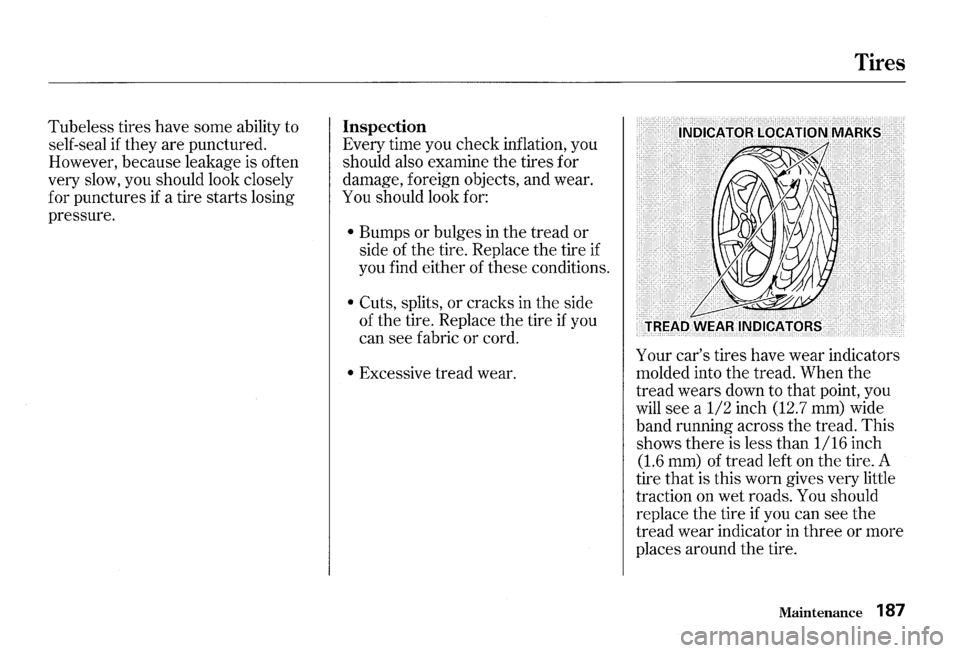
Your car's tires have wear indicators
molded into the tread. When the
tread wears down to that point, you
will see a
1/2 inch (12.7 mm) wide
band running across the tread.
This
shows there is less than 1/16 inch
(1.6 mm) of tread left on the tire. A
tire
that is this worn gives very little
traction on wet roads. You should
replace
the tire if you can see the
tread wear indicator in three or more
places around the tire.
Maintenance 187
Page 191 of 273
Tires
Maintenance
In addition to proper inflation,
correct wheel alignment helps to
decrease tire wear.
If you find a tire
is worn unevenly, have your dealer
check the wheel alignment.
The tires were properly balanced by
the factory.
They may need to be
rebalanced at some time before they
are worn out. Have your dealer
check the tires
if you feel a consis
tent vibration while driving. A tire
should always be rebalanced if it is
removed from
the wheel for repair.
188 Maintenance
Make sure the installer balances the
wheels when you have new tires
installed. This increases riding
comfort and tire life.
Your car's
original tires were dynamic or
"spin"
balanced at the factory. For best
results, have the installer perform a
dynamic balance.
NOTICE
Improper wheel weights can damage
your vehicle's aluminum wheels.
Use
only Genuine Honda wheel weights for
balancing.
Tire Rotation
You should not rotate your Honda's
tires.
The front and rear tires are
different sizes, so they cannot be
rotated front-to-rear.
The original
equipment tires on your Honda have
a unidirectional tread pattern, so
they cannot be rotated side-to-side.
Tire Wear
The tires that came on your car were
designed and constructed to provide
superior grip during acceleration,
braking, and cornering. As a trade
off, they
will wear more rapidly than
tires used on ordinary passenger
cars. Because of the car's weight
distribution, and the fact that they
are the driving wheels, you may
expect the
rear tires to wear more
rapidly than the front tires.
Page 192 of 273
You should carefully inspect your
car's tires for wear, damage, and
proper inflation every
7,500 miles
(12,000 km) (see page 186 ) .
Replacing Tires and Wheels
The tires that came with your car
were selected to match the perform
ance capabilities of the car while
providing the best combination of
handling, ride comfort, and long life.
You should replace them with radial
tires of the same size, load range,
speed rating, and maximum cold tire
pressure rating (as shown on the
tire's sidewall). Mixing radial and
bias-ply tires on your car can reduce
its braking ability, traction, and
steering accuracy.
Tires
Installing improper tires on your
car can affect
handling and
stability. This can cause a crash
in which you can be seriously
hurt or killed.
Always
use the size and type of
tires recommended
in this
owner's
manual.
It is best to replace all four tires at
the same time. If that is not possible
or necessary, then replace the two
front tires or the two
rear tires as a
pair. Replacing just one tire can
seriously affect your car's handling.
CONTINUED
Maintenance 189
Page 214 of 273
Taking Care of the Unexpected
This section covers the more
common problems
that motorists
experience with their vehicles.
It
gives you information about how to
safely evaluate the problem and what
to
do to correct it. If the problem has
stranded you on the side of the road,
you may be able to get going again.
If not, you will also find instructions
on getting your car towed. Compact
Spare Tire .......................
212
Changing a Flat Tire ..................... 213
If Your Engine Won't Start ........... 218
Nothing Happens or the
Starter Motor
Operates
Very
Slowly ......................... 218
The Starter Operates
Normally ................................. 219
Jump Starting ................................. 220
If Your Engine Overheats ............. 223
Low Oil Pressure Indicator .......... 226
Charging System Indicator.. .........
227
Malfunction Indicator Lamp ........ 228
Brake System Indicator ................ 229
Closing the Convertible Top ........ 230
Fuses ............................................... 231
Checking and Replacing ........... 232
If Your Car Gets Stuck. ................. 236
Emergency Towing ....................... 238
Taking Care of the Unexpected 211
Page 215 of 273
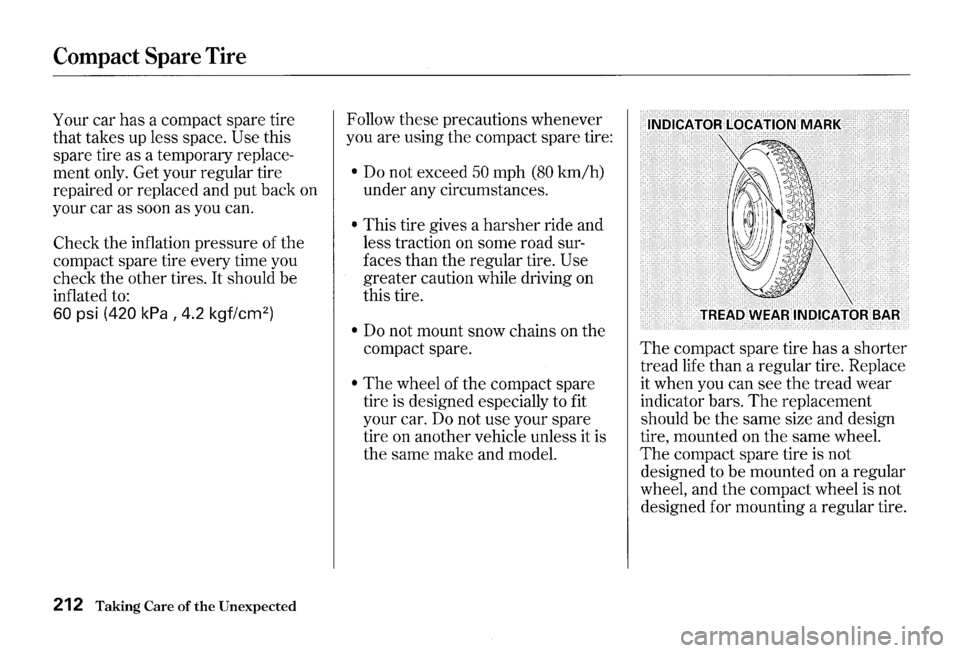
Compact Spare Tire
Your car has a compact spare tire
that takes up less space.
Use this
spare tire as a temporary replace
ment only. Get your regular tire
repaired or replaced and put back on
your car as soon as you can.
Check the inflation pressure of the
compact spare tire every time you
check the other tires.
It should be
inflated
to:
60 psi (420 kPa , 4.2 kgf/cm2
)
212 Taking Care of the Unexpected
Follow these precautions whenever
you are using the compact spare tire:
• Do not exceed 50 mph (80 km/h)
under any circumstances.
• This tire gives a harsher ride and
less traction on some road sur
faces than the regular tire.
Use
greater caution while driving on
this tire.
• Do not mount snow chains on the
compact spare.
• The wheel of the compact spare
tire is designed especially to fit
your car.
Do not use your spare
tire on another vehicle unless it is
the same make and model.
The compact spare tire has a shorter
tread life than a regular tire. Replace
it when you can see
the tread wear
indicator bars.
The replacement
should be the same size and design
tire, mounted on
the same wheel.
The compact spare tire is not
designed to be mounted on a regular
wheel, and
the compact wheel is not
designed for mounting a regular tire.
Page 216 of 273
If you have a flat tire while driving,
stop in a safe place to change it.
Stopping in traffic
or on the shoulder
of a busy road is dangerous. Drive
slowly along
the shoulder until you
get to an exit or an area to stop that
is far away from the traffic lanes.
The car can easily roll off the
jack,
seriously injuring anyone
underneath.
Follow the directions for
changing a tire
exactly, and
never get under the car when it
is supported only by the jack.
The compact spare tire is smaller
than a standard tire, which
will affect
the vehicle's handling. Drive
cautiously when this spare is
mounted on your vehicle.
The size difference may also cause
damage to
the rear differential, so do
not mount
the compact spare on the
rear. If either rear tire goes flat,
remove
the front tire on that same
side, mount
the compact spare tire
on
the front, then mount the front
tire on
the rear.
1. Park the car on firm, level, non
slippery ground away from traffic.
Put the transmission in Reverse.
Apply
the parking brake.
2. Turn on the hazard warning lights
and turn
the ignition switch to
LOCK (O). Have your passenger
get out of the car while you
change
the tire.
Changing a Flat Tire
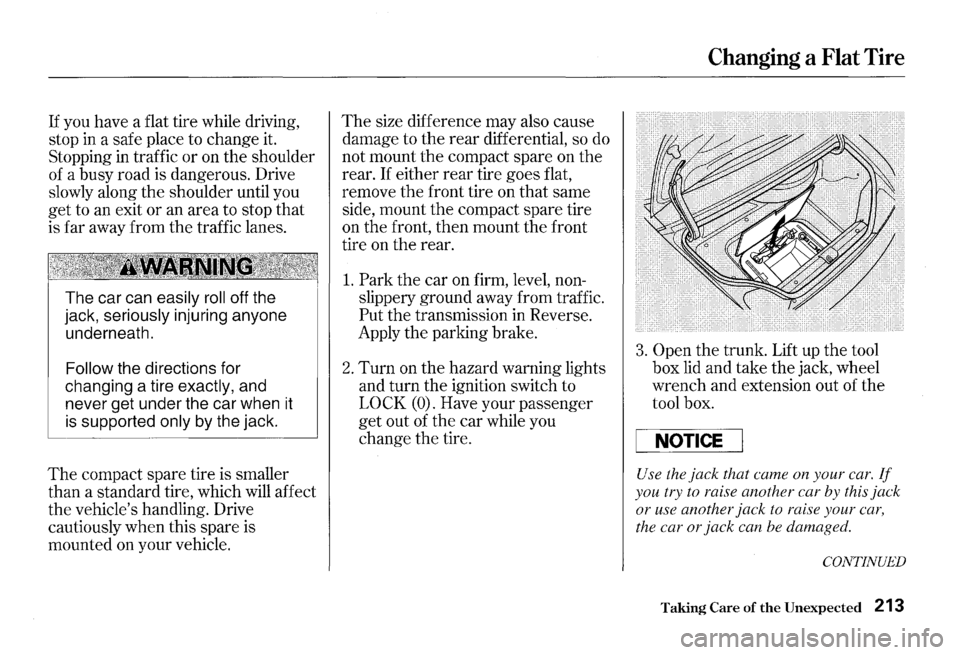
3. Open the trunk. Lift up the tool
box lid and take
the jack, wheel
wrench and extension out of
the
tool box.
NOTICE
Use the jack that came on your car. If
you try to raise another car by this jack
or use another jack to raise your car,
the car
or jack can be damaged.
CONTINUED
Taking Care of the Unexpected 213
Page 217 of 273
Changing a Flat Tire
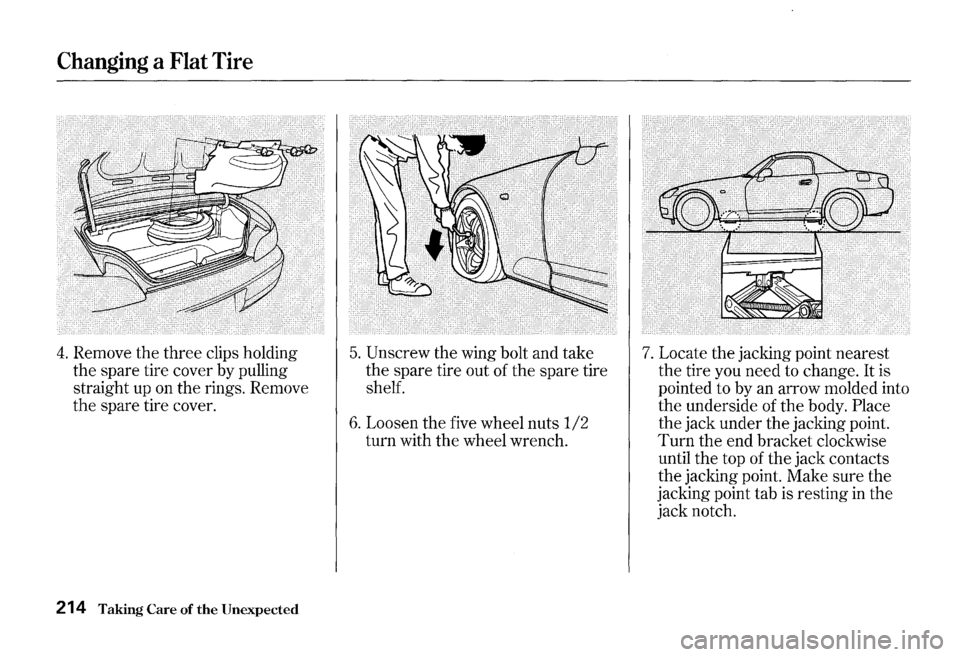
4. Remove the three clips holding
the spare tire cover by pulling
straight up on the rings. Remove
the spare tire cover.
214 Taking Care of the Unexpected
5. Unscrew the wing bolt and take
the spare tire out of the spare tire
shelf.
6. Loosen the five wheel nuts 1/2
turn with the wheel wrench.
7. Locate the jacking point nearest
the tire you need to change.
It is
pointed to by an arrow molded into
the underside of the body. Place
the jack under the jacking point.
Turn the end bracket clockwise
until the top of the jack contacts
the jacking point. Make sure the
jacking point tab is resting
in the
jack notch.
Page 218 of 273
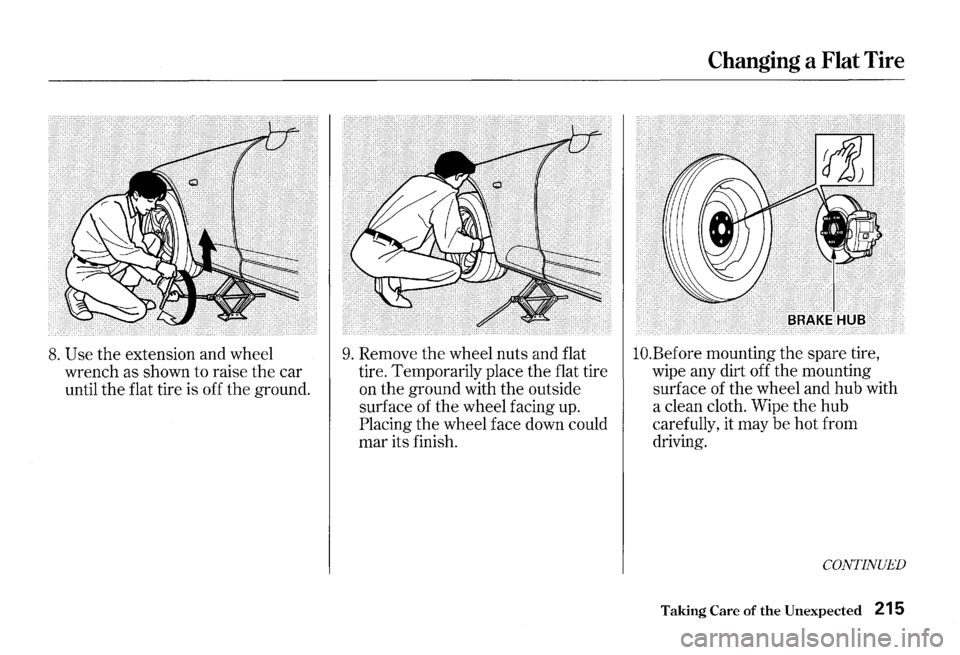
8. Use the extension and wheel
wrench as shown to raise the car
until the flat tire is off
the ground.
9. Remove the wheel nuts and flat
tire. Temporarily place the flat tire
on the ground with the outside
surface of the wheel facing
up.
Placing the wheel face down could
mar its finish.
Changing a Flat Tire
lO.Before mounting the spare tire,
wipe any dirt off the mounting
surface of the wheel and hub with
a clean cloth. Wipe the hub
carefully, it may be hot from
driving.
CONTINUED
Taking Care of the Unexpected 215
Page 219 of 273
Changing a Flat Tire
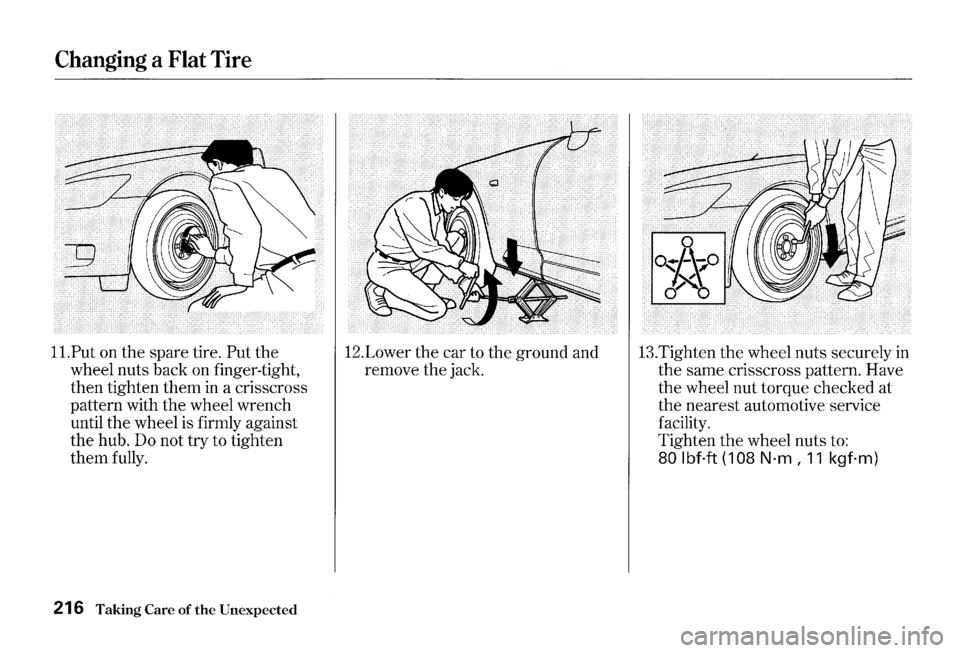
ll.Put on the spare tire. Put the
wheel nuts back on finger-tight,
then tighten them
in a crisscross
pattern with the wheel wrench
until the wheel is firmly against
the hub.
Do not try to tighten
them
fully.
216 Taking Care of the Unexpected
12.Lower the car to the ground and
remove the jack. 13.Tighten
the wheel nuts securely in
the same crisscross pattern. Have
the wheel nut torque checked at
the nearest automotive service
facility.
Tighten
the wheel nuts to:
80 lbf.ft (1 08 N·m, 11 kgf·m)
Page 220 of 273
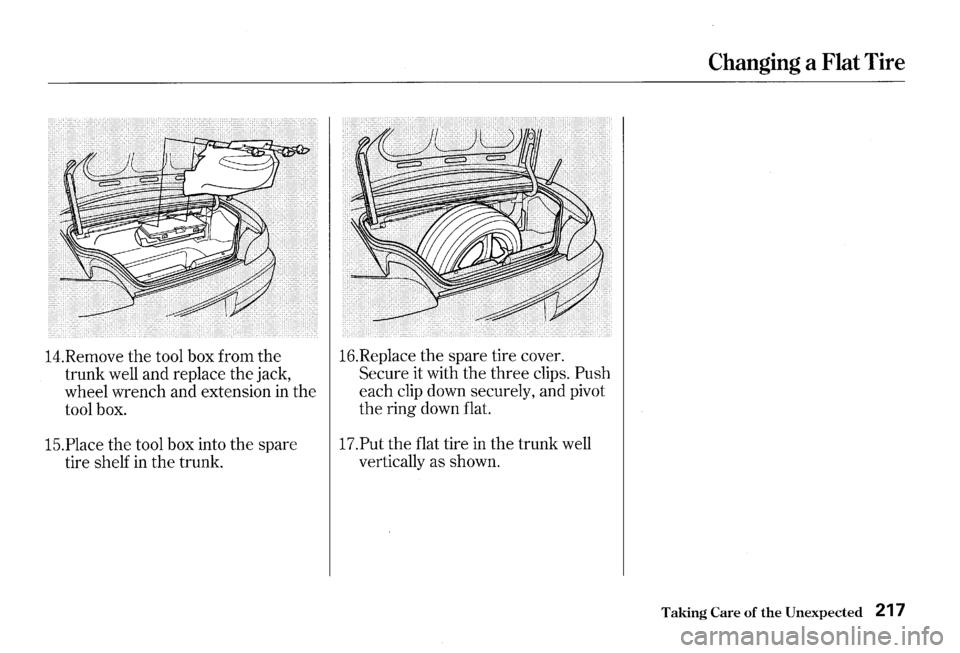
14.Remove the tool box from the
trunk well and replace the jack,
wheel wrench and extension
in the
tool box.
15.Place the tool box into the spare
tire shelf
in the trunk. 16.Replace
the spare tire cover.
Secure it with the three clips.
Push
each clip down securely, and pivot
the ring down flat.
17.Put the flat tire in the trunk well
vertically as shown.
Changing a Flat Tire
Taking Care of the Unexpected 217