key HONDA S2000 2000 1.G User Guide
[x] Cancel search | Manufacturer: HONDA, Model Year: 2000, Model line: S2000, Model: HONDA S2000 2000 1.GPages: 273, PDF Size: 21.58 MB
Page 68 of 273
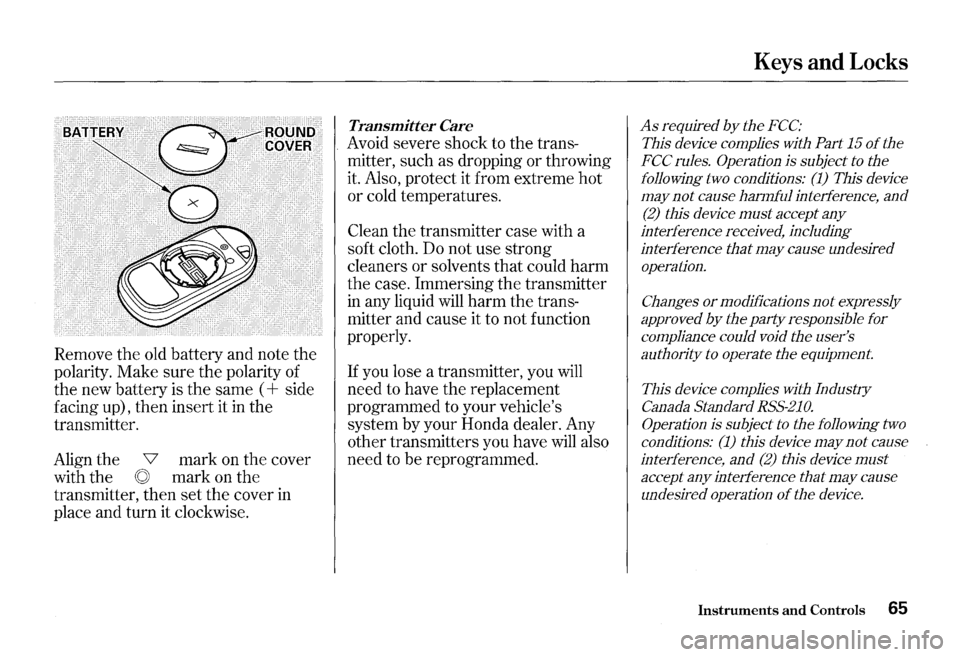
Remove the old battery and note the
polarity. Make sure the polarity of
the new battery is the same (
+ side
facing up), then insert it
in the
transmitter.
Align the
v mark on the cover
with the
0 mark on the
transmitter, then set the cover
in
place and turn it clockwise.
Transmitter Care
Avoid severe shock to the trans
mitter, such as dropping or throwing
it. Also, protect it from extreme hot
or cold temperatures.
Clean the transmitter case with a
soft cloth.
Do not use strong
cleaners or solvents that could harm
the case. Immersing the transmitter
in any liquid will harm the trans
mitter and cause it to not function
properly.
If you lose a transmitter, you will
need to have the replacement
programmed to your vehicle's
system by your Honda dealer. Any
other transmitters you have
will also
need to be reprogrammed.
Keys and Locks
As required by the FCC:
This device complies with Part 15 of the
FCC rules. Operation is subject to the
following two conditions:
(1) This device
may not cause harmful interference, and
(2) this device must accept any
interference received, including
interference that
may cause undesired
operation.
Changes
or modifications not expressly
approved
by the party responsible for
compliance could void
the user's
authority to operate
the equipment.
111is device complies with Industry
Canada Standard RSS-210.
Operation is subject
to the following two
conditions:
(1) this device may not cause
interference,
and (2) this device must
accept any interference that may cause
undesired operation
of the device.
Instruments and Controls 65
Page 69 of 273
Keys and Locks
Trunk
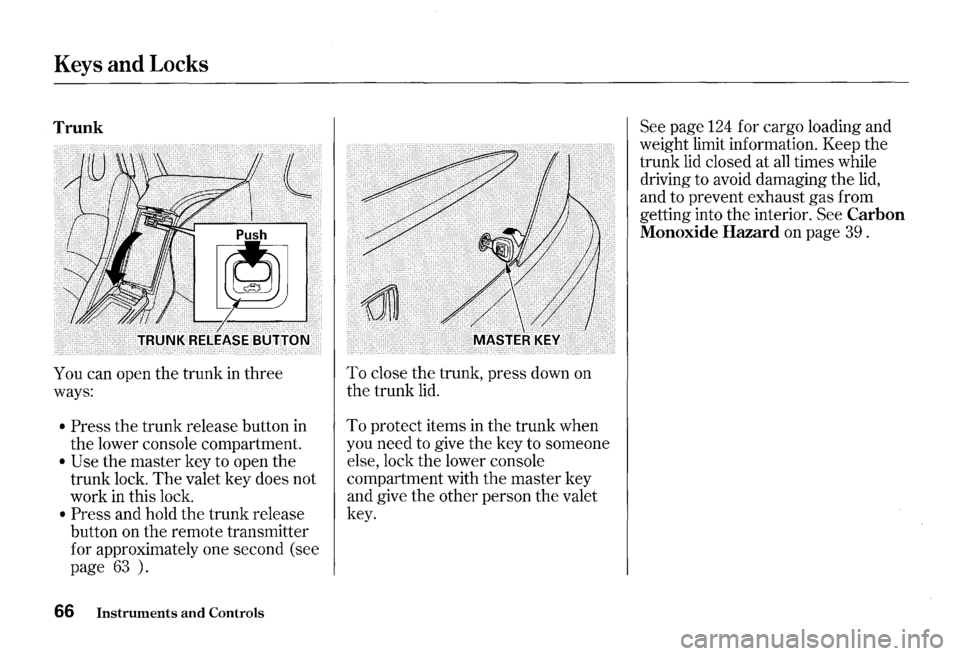
You can open the trunk in three
ways:
• Press the trunk release button in
the lower console compartment.
• Use the master key to open the
trunk lock.
The valet key does not
work in this lock.
• Press and hold the trunk release
button on the remote transmitter
for approximately one second (see
page
63 ).
66 Instruments and Controls
To close the trunk, press down on
the trunk lid.
To protect items in
the trunk when
you need to give the key to someone
else, lock the lower console
compartment with
the master key
and give
the other person the valet
key.
See page 124 for cargo loading and
weight limit information. Keep the
trunk lid closed
at all times while
driving to avoid damaging the lid,
and to prevent exhaust gas from
getting into
the interior. See Carbon
Monoxide Hazard
on page 39 .
Page 70 of 273
Console Compartments
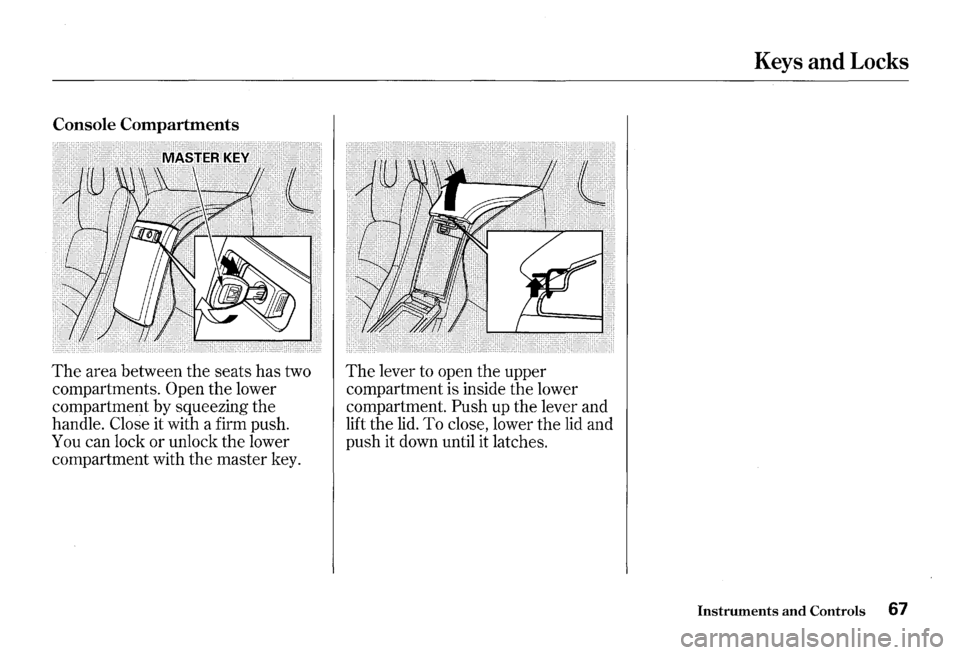
The area between the seats has two
compartments.
Open the lower
compartment by squeezing the
handle.
Close it with a firm push.
You can lock or unlock the lower
compartment with the master key.
The lever to open the upper
compartment is inside the lower
compartment.
Push up the lever and
lift the
lid. To close, lower the lid and
push it down until it latches.
Keys and Locks
Instruments and Controls 67
Page 86 of 273
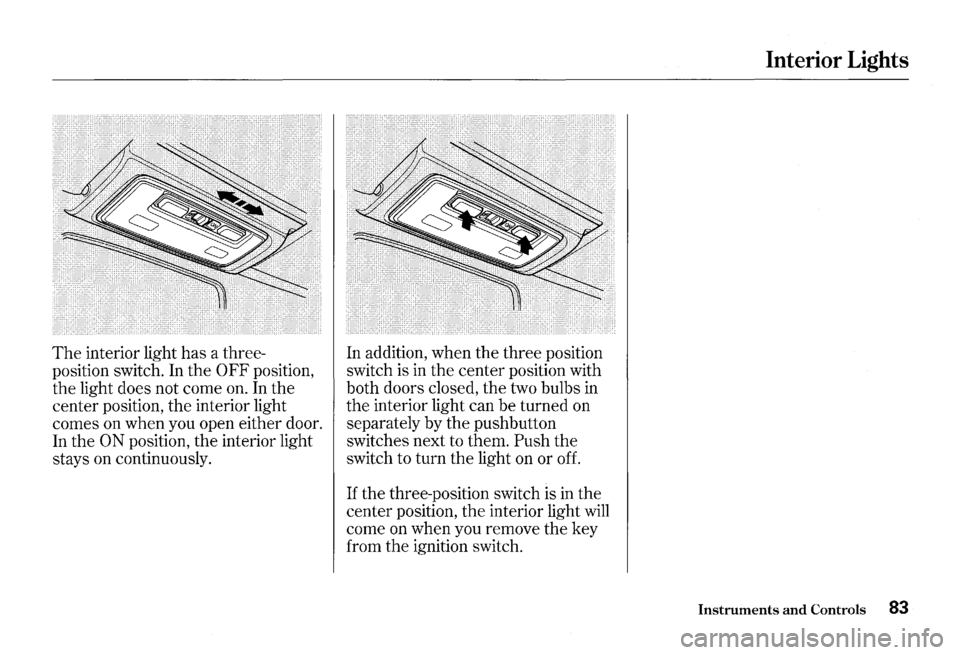
The interior light has a three
position switch. In the
0 FF position,
the light does not come on. In the
center position, the interior light
comes on when you open either door.
In the
ON position, the interior light
stays on continuously. In
addition, when the three position
switch is in the center position with
both doors closed, the two bulbs
in
the interior light can be turned on
separately by the pushbutton
switches next to them.
Push the
switch to turn the light on or off.
If the three-position switch is in the
center position,
the interior light will
come on when you remove the key
from the ignition switch.
Interior Lights
Instruments and Controls 83
Page 134 of 273
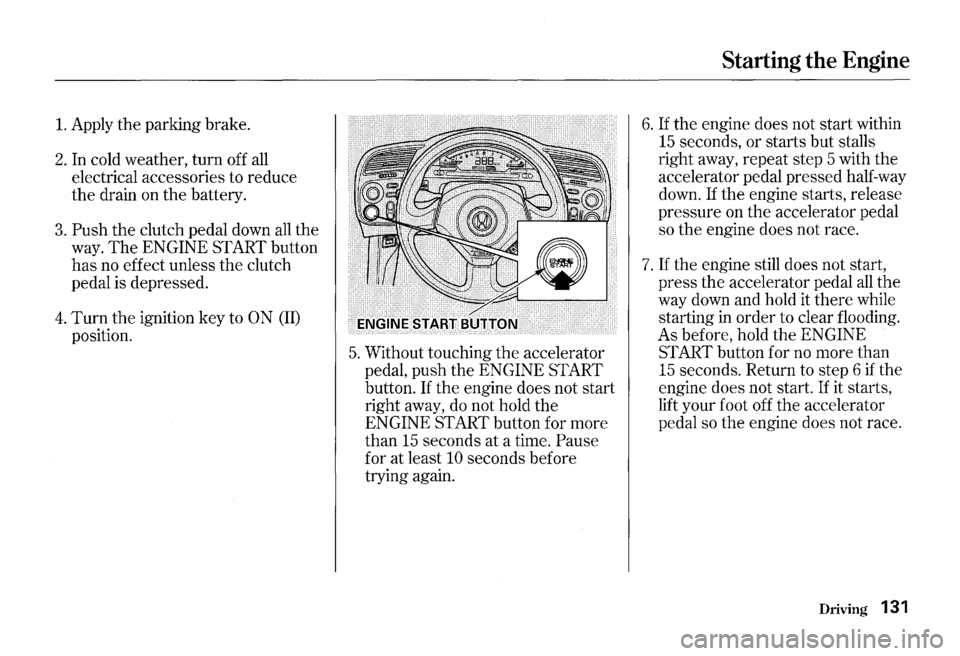
1. Apply the parking brake.
2. In cold weather, turn off all
electrical accessories to reduce
the drain on the battery.
3. Push the clutch pedal down all the
way. The ENGINE SfARTbutton
has no effect unless the clutch
pedal is depressed.
4. Turn the ignition key to ON (II)
position.
5. Without touching the accelerator
pedal, push
the ENGINE Sf ART
button.
If the engine does not start
right away, do not hold the
ENGINE Sf ART button for more
than
15 seconds at a time. Pause
for at least 10 seconds before
trying again.
Starting the Engine
6. If the engine does not start within
15 seconds, or starts but stalls
right away, repeat step 5 with
the
accelerator pedal pressed half-way
down.
If the engine starts, release
pressure on the accelerator pedal
so
the engine does not race.
7. If the engine still does not start,
press the accelerator pedal all the
way down and hold it there while
starting in
order to clear flooding.
As before, hold
the ENGINE
Sf ART button for no more than
15 seconds. Return to step 6 if the
engine does not start. If it starts,
lift your foot off
the accelerator
pedal so
the engine does not race.
Driving 131
Page 138 of 273
Always use the parking brake when
you park your car.
The indicator on
the instrument panel shows that the
parking brake is not fully released; it
does not indicate that the parking
brake is firmly set. Make sure the
parking brake is set firmly or your
car may roll
if it is parked on an
incline. If
the car is facing uphill, turn the
front wheels away from the curb and
put
the transmission in first gear.
If the car is facing downhill, turn the
front wheels toward the curb and put
the transmission
in reverse gear.
Make sure the parking brake is fully
released before driving away.
Driving with the parking brake
partially set can overheat or damage
the rear brakes.
Parking
Parking Tips
• Make sure the convertible top and
the windows are closed.
• Turn off the lights.
• Place any packages, valuables, etc.,
in the trunk or take them with you.
• Lock the doors with the key or the
remote transmitter.
• Never park over dry leaves, tall
grass, or other flammable
materials.
The three way catalytic
converter gets very hot, and could
cause these materials to catch on
fire.
Driving 135
Page 197 of 273
Lights
Replacing a Headlight Bulb
The low beam headlight bulbs are a
type of high voltage discharge tube.
High voltage can remain in
the
circuit even with the light switch off
and the key removed. Because of
this, you should not attempt to
examine or change a low beam
headlight bulb yourself.
If a low
beam headlight bulb fails, take the
car to your dealer to have it replaced.
194 Maintenance
Halogen bulbs are used for the high
beam headlight bulbs.
When
replacing a high beam headlight bulb,
handle it by its base and protect the
glass from contact with your skin or
hard objects.
If you touch the glass,
clean it with denatured alcohol and a
clean cloth.
NOTICE
Halogen headlight bulbs get very hot
when
lit. Oil, perspiration, or a scratch
on the glass can cause the bulb to
overheat and shatter.
Page 221 of 273
If Your Engine Won't Start
Diagnosing why your engine won't
start falls into two areas, depending
on what you
hear when you press
the ENGINE START button.
• You hear nothing, or almost
nothing.
The engine's starter
motor does not operate at
all, or
operates very slowly.
• You can hear the starter motor
operating normally, or the starter
motor sounds like it is spinning
faster than normal, but the engine
does not start up and run.
218 Taking Care of the Unexpected
Nothing Happens or the Starter
Motor Operates Very Slowly
When you press the ENGINE
START button, you do not hear the
normal noise of the engine trying to
start. You may hear a clicking sound
or series of clicks, or nothing at
all.
Check these things:
• Your car has the Immobilizer
System.
You should use a
properly-coded master or valet key
to start the engine (see page 59).
A key that
is not properly coded
will cause the immobilizer system
indicator
in the dash panel to blink
rapidly.
• Turn the ignition switch to ON (II).
Turn on the headlights and check
their brightness.
If the headlights
are very dim or don't light at
all,
the battery is discharged. See
Jump Starting on page 220.
• Press
the ENGINE START button,
then release
it. If the headlights do
not dim, check the condition of the
fuses.
If the fuses are 0 K, there is
probably something wrong with
the electrical circuit for the
ignition switch
or starter motor.
You
will need a qualified
technician to determine the
problem.
(See Emergency
Towing on page 238 .)
Page 237 of 273
Fuses
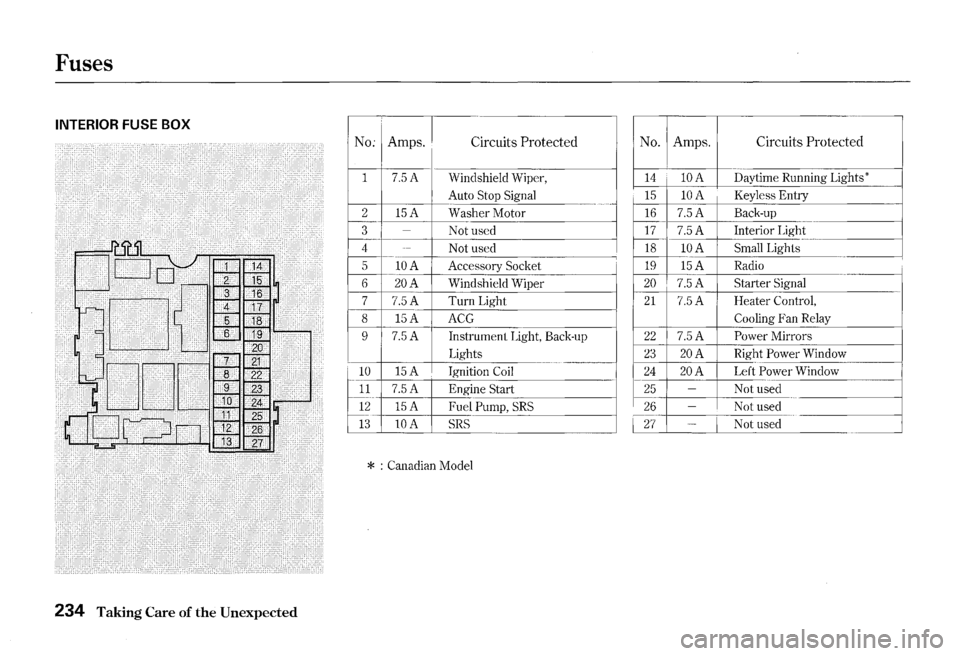
INTERIOR FUSE BOX
No: Amps. Circuits Protected No. Amps. Circuits Protected
1 7.5A Windshield Wiper, 14 lOA Daytime Running Lights*
Auto
Stop Signal 15 lOA Keyless Entry
2
15A Washer Motor 16 7.5A Back-up
3
-Not used 17 7.5A Interior Light
4
-Not used 18 lOA Small Lights
5
lOA Accessory Socket 19 15A Radio
6
20A Windshield Wiper 20 7.5A Starter Signal
7 7.5A Tum Light 21 7.5A Heater Control,
8 15A ACG Cooling Fan
Relay
9
7.5A Instrument Light, Back·up 22 7.5A Power Mirrors
Lights
23 20A Right Power Window
10 15A Ignition Coil 24 20A Left Power Window
11 7.5A Engine Start 25 -Not used
12 15A Fuel Pump, SRS 26 -Not used
13 lOA SRS 27 -Not used
* : Canadian Model
234 Taking Care of the Unexpected
Page 264 of 273
A
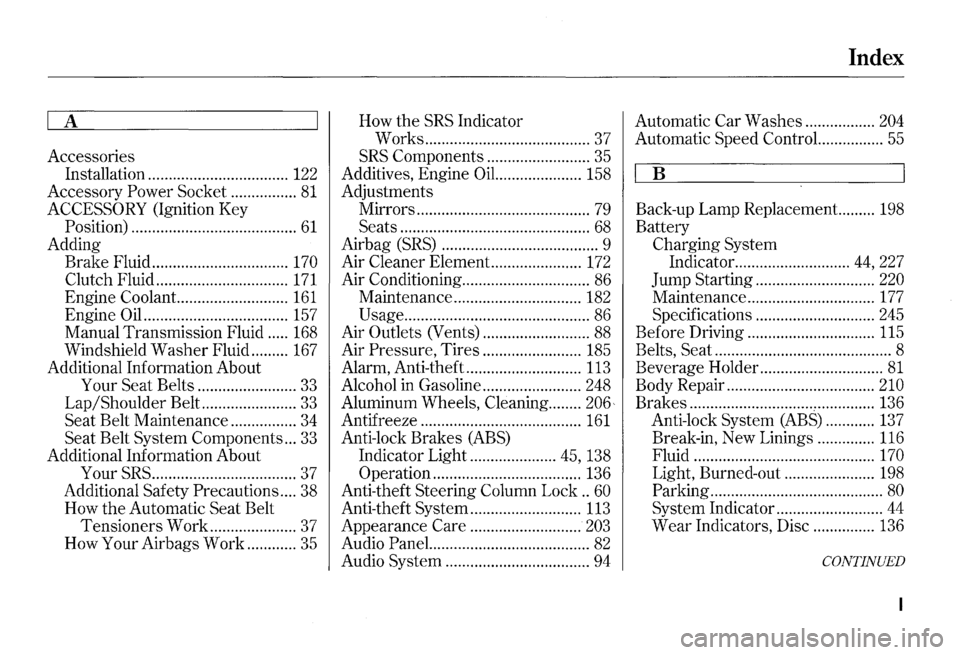
Accessories Installation .................................. 122
Accessory
Power Socket ................ 81
ACCESSORY (Ignition Key
Position) ........................................
61
Adding
Brake Fluid ................................. 170
Clutch Fluid ................................ 171
Engine Coolant.. ......................... 161
Engine
Oil ................................... 157
Manual Transmission Fluid ..... 168
Windshield
Washer Fluid ......... 167
Additional Information About
Your
Seat Belts ........................ 33
Lap/Shoulder Belt.. ..................... 33
Seat Belt Maintenance ................ 34
Seat Belt System Components
... 33
Additional Information About
Your SRS ...................................
37
Additional Safety Precautions .... 38
How
the Automatic Seat Belt
Tensioners Work ..................... 37
How Your Airbags Work ............ 35
How the SRS Indicator
Works ........................................ 37
SRS Components ......................... 35
Additives, Engine Oil... .................. 158
Adjustments
Mirrors ..........................................
79
Seats .............................................. 68
Airbag (SRS) ...................................... 9
Air Cleaner Element.. ....................
l72
Air Conditioning ............................... 86
Maintenance ............................... 182
Usage ............................................. 86
Air Outlets (Vents) .......................... 88
Air Pressure,
Tires ........................ 185
Alarm, Anti-theft.. .......................... 113
Alcohol in Gasoline ........................ 248
Aluminum Wheels, Cleaning ........
206-
Antifreeze ....................................... 161
Anti-lock
Brakes (ABS)
Indicator Light ..................... 45, 138
Operation .................................... 136
Anti-theft Steering Column Lock
.. 60
Anti-theft System ........................... 113
Appearance Care ...........................
203
Audio Panel. ...................................... 82
Audio System ................................... 94
Index
Automatic Car Washes ................. 204
Automatic Speed Control.. .............. 55
IB
Back-up Lamp Replacement.. ....... 198
Battery Charging System
Indicator.. .......................... 44, 227
Jump Starting ............................. 220
Maintenance ............................... 177
Specifications ............................. 245
Before Driving ............................... 115
Belts, Seat ........................................... 8
Beverage Holder ..............................
81
Body Repair .................................... 210
Brakes ............................................. 136
Anti-lock System (ABS) ............ 137
Break-in, New Linings .............. 116
Fluid ............................................
170
Light, Burned-out ...................... 198
Parking .......................................... 80
System Indicator .......................... 44
Wear Indicators, Disc ............... 136
CONTINUED