lights HONDA S2000 2000 1.G Owner's Manual
[x] Cancel search | Manufacturer: HONDA, Model Year: 2000, Model line: S2000, Model: HONDA S2000 2000 1.GPages: 273, PDF Size: 21.58 MB
Page 139 of 273
The Braking System
Your Honda is equipped with disc
brakes at
all four wheels. A power
assist helps reduce the effort needed
on the brake pedal.
The ABS helps
you retain steering control when
braking very hard.
Put your foot on the brake pedal only
when you intend to brake. Resting
your foot on the pedal keeps the
brakes applied lightly, causing them
to build up heat. Heat build-up can
reduce how well your brakes work.
It
also keeps your brake lights on all
the time, confusing drivers behind
you.
136 Driving
Constant application of the brakes
when going down a long hill builds
up heat and reduces their effective
ness.
Use the engine to assist the
brakes by downshifting to a lower
gear and taking your foot off the
accelerator pedal.
Check your brakes after driving
through deep water. Apply the
brakes moderately to see
if they feel
normal.
If not, apply them gently and
frequently until they
do. Since a
longer distance is needed to stop
with wet brakes, be extra cautious
and alert in your driving.
Brake Wear Indicators
All four brakes have audible brake
wear indicators.
When the brake pads need replacing,
you will
hear a distinctive metallic
"screeching" sound when you apply
the brakes.
If you do not have the
brake pads replaced, they will begin
screeching
all the time.
Your brakes may sometimes squeal
or squeak when you apply
them
lightly. Do not confuse this with the
brake wear indicators.
They make a
very audible
"screeching."
Page 143 of 273
Driving in Bad Weather
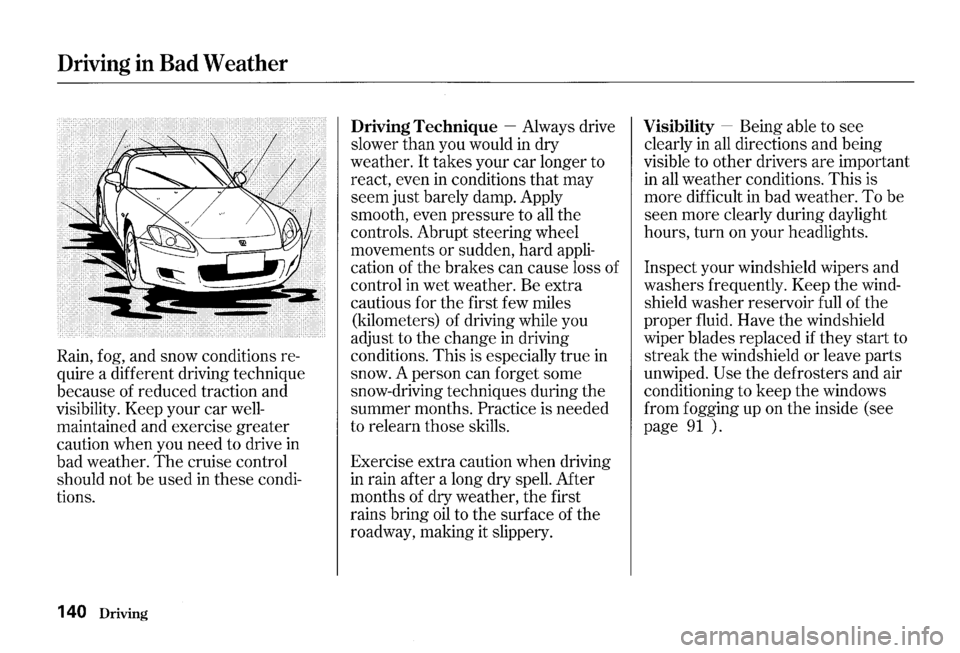
Rain, fog, and snow conditions re
quire a different driving technique
because of reduced traction and
visibility. Keep your car well
maintained and exercise greater
caution when you need to drive in
bad weather.
The cruise control
should not be used in these condi
tions.
140 Driving
Driving Technique -Always drive
slower than you would
in dry
weather.
It takes your car longer to
react, even
in conditions that may
seem just barely damp. Apply
smooth, even pressure to
all the
controls. Abrupt steering wheel
movements or sudden, hard appli
cation of the brakes can cause loss of
control in wet weather. Be extra
cautious for the first few miles
(kilometers) of driving while you
adjust to the change in driving
conditions.
This is especially true in
snow. A person can forget some
snow-driving techniques during the
summer months.
Practice is needed
to relearn those skills.
Exercise extra caution when driving
in rain after a long dry spell. After
months of dry weather, the first
rains bring
oil to the surface of the
roadway, making it slippery.
Visibility -Being able to see
clearly in
all directions and being
visible to other drivers are important
in all weather conditions. This is
more difficult
in bad weather. To be
seen more clearly during daylight
hours, turn on your headlights.
Inspect your windshield wipers and
washers frequently. Keep the wind
shield washer reservoir full of the
proper fluid. Have the windshield
wiper blades replaced
if they start to
streak the windshield or leave parts
unwiped.
Use the defrosters and air
conditioning to keep the windows
from fogging up on
the inside (see
page
91 ).
Page 146 of 273
This section explains why it is
important to keep your car well
maintained and to follow basic
maintenance safety precautions.
This section also includes
Maintenance Schedules for normal
driving and severe driving conditions,
a Maintenance Record, and instruc
tions for simple maintenance tasks
you may want to take care of
yourself.
If you have the skills and tools to per
form more complex maintenance
tasks on your Honda, you may want
to purchase
the Service Manual. See
page 259 for information on how to
obtain a copy,
or see your Honda
dealer. Maintenance
Safety .......................
144
Important
Safety Precautions .. 145
Maintenance Schedule .................. 146
Required Maintenance Record
.... 153
Owner Maintenance Checks ........ 155
Fluid Locations ............................... 156
Engine Oil ....................................... 157
Adding Oil... ................................ 157
Recommended Oil ..................... 157
Synthetic
Oil ............................... 158
Additives ..................................... 158
Changing the Oil and Filter.. .... 159
Cooling System .............................. 161
Adding Engine Coolant ............. 161
Replacing Engine Coolant ........ 163
Windshield Washers ..................... 167
6-speed Manual Transmission
Fluid ............................................
168
Differential Fluid ........................... 169
Brake and Clutch Fluid ................. 170
Brake Fluid ................................. 170
Brake System ............................. 170
Clutch System ............................ 171
Air Cleaner Element.. .................... 172
Hood Latch ..................................... 174
Maintenance
Spark Plugs ..................................... 174
Replacement ............................... 17 4
Specifications ............................. 176
Battery ............................................
177
Wiper Blades .................................. 180
Air Conditioning System ............... 182
Air Conditioning Filter, ................. 183
Drive Belt ........................................ 184
Tires ................................................ 185
Inflation ....................................... 185
Inspection ................................... 187
Maintenance ............................... 188
Tire Rotation .............................. 188
Tire Wear .................................... 188
Replacing Tires and Wheels .... 189
Wheels and Tires ....................... 190
Winter Driving ........................... 190
Snow
Tires .............................. 191
Tire Chains ............................. 191
Lights .............................................. 192
Replacing Bulbs ......................... 194
Storing Your Car ............................ 202
Maintenance 143
Page 153 of 273
Service at the indicated miles x 1,000 15 30 45 60 75 90 105 120 distance or time -whichever km x 1,000 24 48 72 96 120 144 168 192 --~-~ comes first. months 12 24
36 48 60 72 84
96 Replace engine oil and oil filter Replace every 3,750 miles (6,000 km) or 6 months
Check engine oil and coolant Check oil and coolant at each fuel stop Replace air cleaner element • • r-·-. . . ·~ • • Use normal schedule except in dusty
conditions Inspect valve clearance Adjust only if noisy • Replace spark plugs • -·~-~-·-· ~~-~ f-----Inspect drive belt •
• • • Inspect idle speed I • --Replace engine coolant • • • -----Replace transmission fluid • •
• • Replace rear differential fluid • • • •
• •
• • Inspect front and rear brakes Inspect every 7,500 miles. (12,000 km) or 6 months
Replace brake fluid • -+-• Check parking brake adjustment • •
• • • • • • Replace air conditioning filter 1
" 1 •
•
• • i -~I-Lubricate al_~!lir1J:JeS, locks and latches • • • • • • • • Check tire inflation and condition Every 7,500 miles (12,000 km) Visually inspect the following items:
Tie rod ends, steering gear box, and boots Every 7,500 miles (12,000 km) or 6 months Suspension components, Drives haft boots -----r----~~ Brake hoses and lines (including ABS)
All fluid levels and condition of fluids
Cooling system hoses and connections • • • • • • • • Exhaust system", Fuel lines and connections'
1 Lights and controls, Vehicle underbody
* 1: Refer to page183 for replacement information under special driving conditions.
150 Maintenance
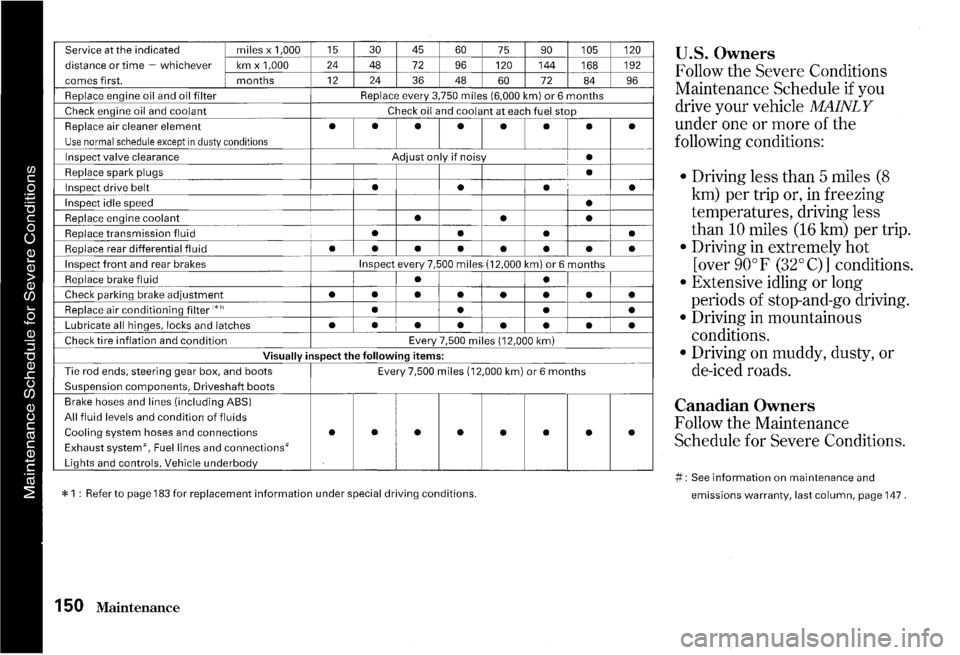
U.S. Owners
Follow the Severe Conditions
Maintenance Schedule if you
drive your vehicle
MAINLY
under one or more of the
following conditions:
• Driving less than 5 miles (8
km) per trip or, in freezing
temperatures, driving less
than
10 miles (16 km) per trip.
• Driving in extremely hot
[over
90° F (32° C)] conditions.
• Extensive idling or long
periods of stop-and-go driving.
• Driving in mountainous
conditions.
• Driving on muddy, dusty, or
de-iced roads.
Canadian Owners
Follow the Maintenance
Schedule for Severe Conditions.
#: See information on maintenance and
emissions warranty, last column, page 147.
Page 155 of 273
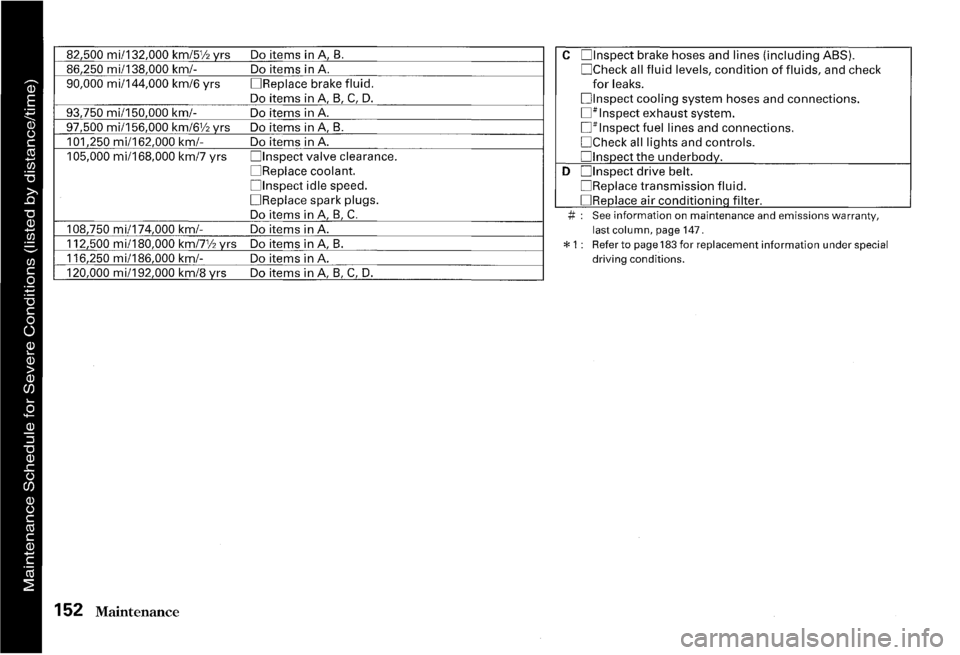
82,500 mi/132,000 km/51/z vrs Do items in A, B. 86,250 mi/138,000 km/-Do items in A. 90,000 mi/144,000 km/6 yrs ORe place brake fluid. Do items in A, B, C, D. 93,750 mi/150,000 km/-Do items in A. 97,500 mi/156,000 km/61/z yrs Do items in A. B. 101,250 mi/162,000 km/-Do items in A. 105,000 mi/168,000 km/7 yrs Dlnspect valve clearance. DReplace coolant. Dlnspect idle speed. DReplace spark plugs. Do items in A, B, C. 108,750 mi/174,000 km/-Do items in A. 112,500 mi/180,000 km/71/z yrs Do items in A, B. 116,250 mi/186,000 km/-Do items in A. 120,000 mi/192,000 km/8 vrs Do items in A, B, C D.
152 Maintenance
C Dlnspect brake hoses and lines (including ABS). DC heck all fluid levels, condition of fluids, and check for leaks. Dlnspect cooling system hoses and connections. D"lnspect exhaust system. D"lnspect fuel lines and connections. DCheck all lights and controls. Dlnspect the underbody.
D Dlnspect drive belt. DReplace transmission fluid. DReplace air conditioning filter. # : See information on maintenance and emissions warranty, last column, page 147. * 1: Refer to page183 for replacement information under special driving conditions.
Page 158 of 273
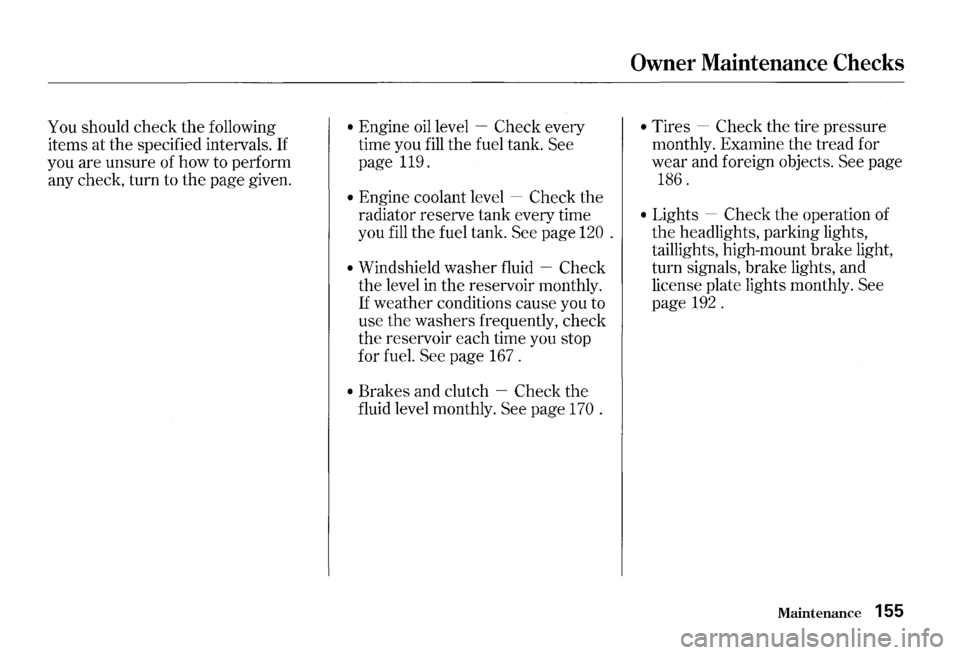
You should check the following
items at the specified intervals.
If
you are unsure of how to perform
any check, turn to the page given.
• Engine oil level -Check every
time you
fill the fuel tank. See
page 119.
• Engine coolant level -Check the
radiator reserve tank every time
you
fill the fuel tank. See page 120 .
• Windshield washer fluid -Check
the level in the reservoir monthly.
If weather conditions cause you to
use the washers frequently, check
the reservoir each time you stop
forfuel. See page 167.
• Brakes and clutch -Check the
fluid level monthly. See page
170 .
Owner Maintenance Checks
• Tires -Check the tire pressure
monthly. Examine the tread for
wear and foreign objects. See page
186.
• Lights -Check the operation of
the headlights, parking lights,
taillights, high-mount brake light,
turn signals, brake lights, and
license plate lights monthly. See
page 192.
Maintenance 155
Page 195 of 273
Lights
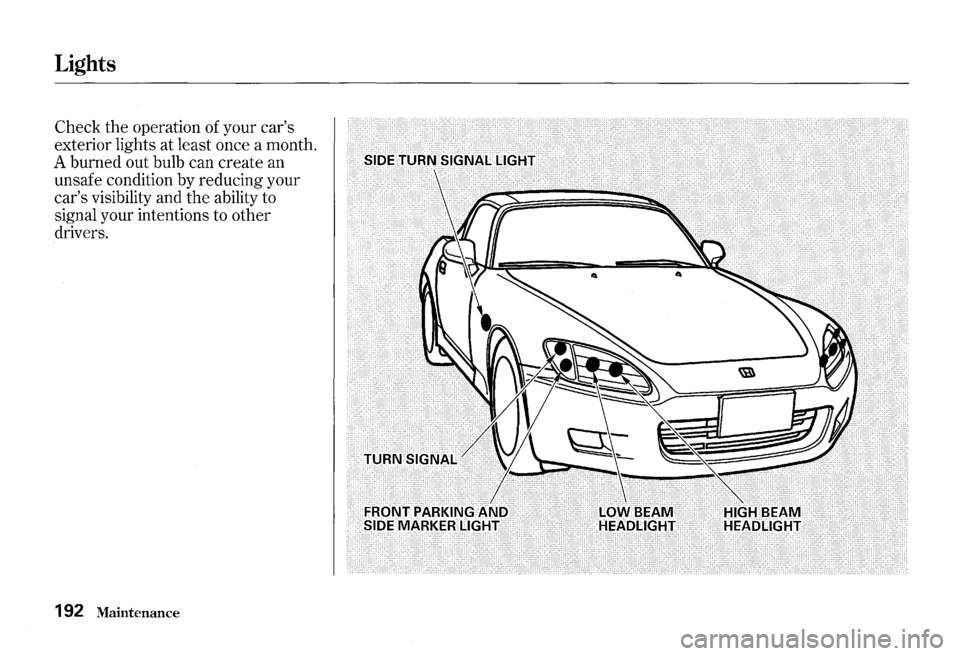
Check the operation of your car's
exterior lights at least once a month.
A burned out bulb can create an
unsafe condition
by reducing your
car's visibility and the ability to
signal your intentions to other
drivers.
192
Maintenance
Page 196 of 273
Lights
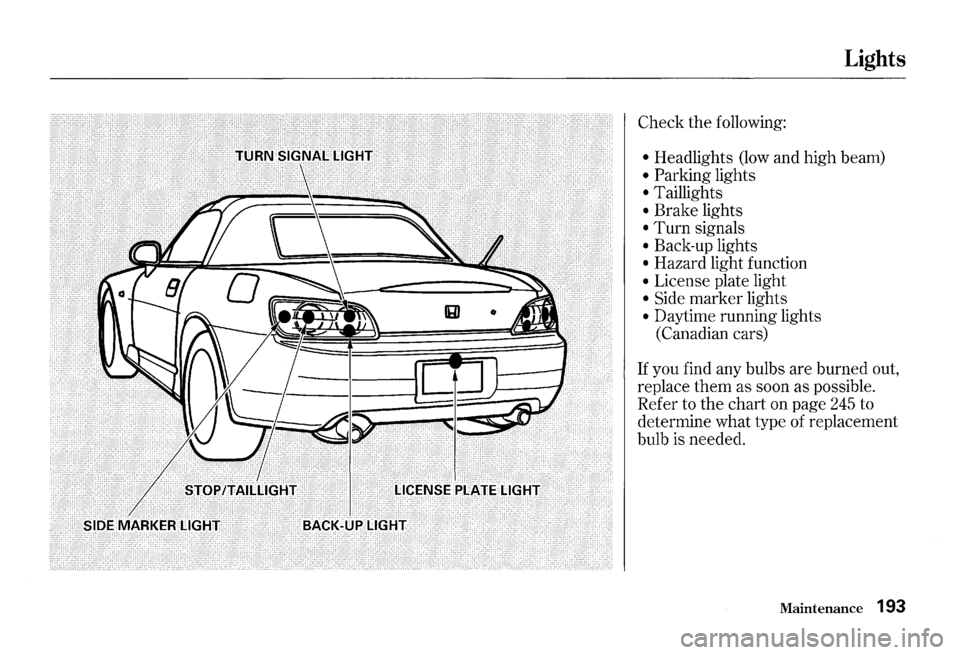
Check the following:
• Headlights (low and high beam)
• Parking lights
• Taillights
• Brake lights
• Turn signals
• Back-up lights
• Hazard light function
• License plate light
• Side marker lights
• Daytime running lights
(Canadian cars)
If you find any bulbs are burned out,
replace
them as soon as possible.
Refer to the chart on page
245 to
determine what type of replacement
bulb is needed.
Maintenance 193
Page 197 of 273
Lights
Replacing a Headlight Bulb
The low beam headlight bulbs are a
type of high voltage discharge tube.
High voltage can remain in
the
circuit even with the light switch off
and the key removed. Because of
this, you should not attempt to
examine or change a low beam
headlight bulb yourself.
If a low
beam headlight bulb fails, take the
car to your dealer to have it replaced.
194 Maintenance
Halogen bulbs are used for the high
beam headlight bulbs.
When
replacing a high beam headlight bulb,
handle it by its base and protect the
glass from contact with your skin or
hard objects.
If you touch the glass,
clean it with denatured alcohol and a
clean cloth.
NOTICE
Halogen headlight bulbs get very hot
when
lit. Oil, perspiration, or a scratch
on the glass can cause the bulb to
overheat and shatter.
Page 198 of 273
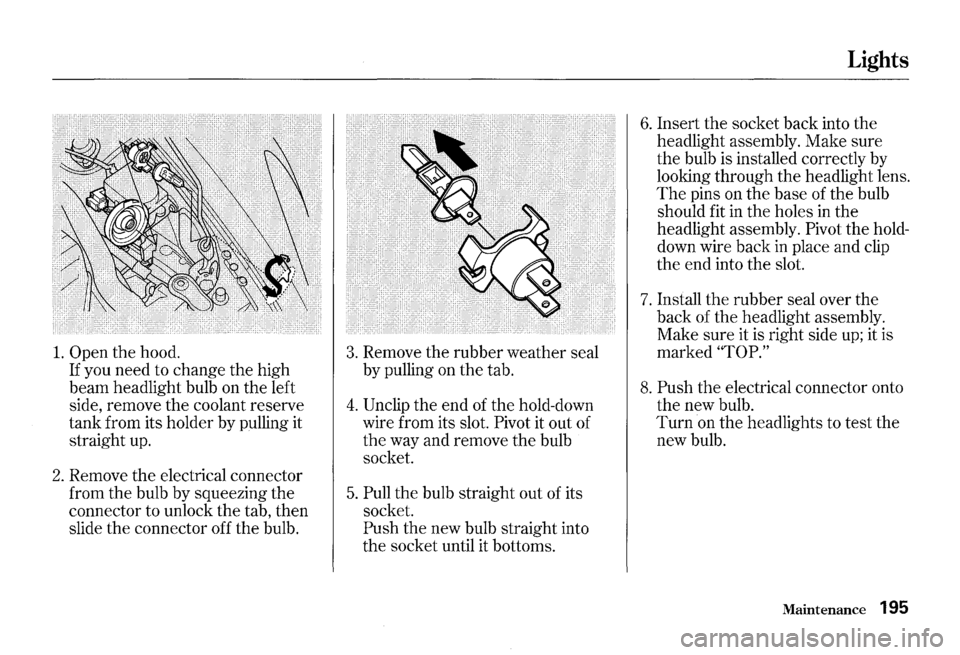
1. Open the hood.
If you need to change the high
beam headlight bulb on the left
side, remove the coolant reserve
tank from its holder by pulling it
straight up.
2. Remove the electrical connector
from
the bulb by squeezing the
connector to unlock the tab, then
slide
the connector off the bulb.
3. Remove the rubber weather seal
by pulling on the tab.
4. Unclip the end of the hold-down
wire from its slot.
Pivot it out of
the way and remove the bulb
socket.
5. Pull the bulb straight out of its
socket.
Push the new bulb straight into
the socket until it bottoms.
Lights
6. Insert the socket back into the
headlight assembly. Make sure
the bulb is installed correctly by
looking through the headlight lens.
The pins on the base of the bulb
should fit in
the holes in the
headlight assembly.
Pivot the hold
down wire back in place and clip
the end into the slot.
7. Install the rubber seal over the
back of
the headlight assembly.
Make sure it is right side
up; it is
marked
''TOP."
8. Push the electrical connector onto
the new bulb.
Turn on the headlights to test the
new bulb.
Maintenance 195