steering HONDA S2000 2000 1.G Owner's Manual
[x] Cancel search | Manufacturer: HONDA, Model Year: 2000, Model line: S2000, Model: HONDA S2000 2000 1.GPages: 273, PDF Size: 21.58 MB
Page 63 of 273
Keys and Locks
Ignition Switch
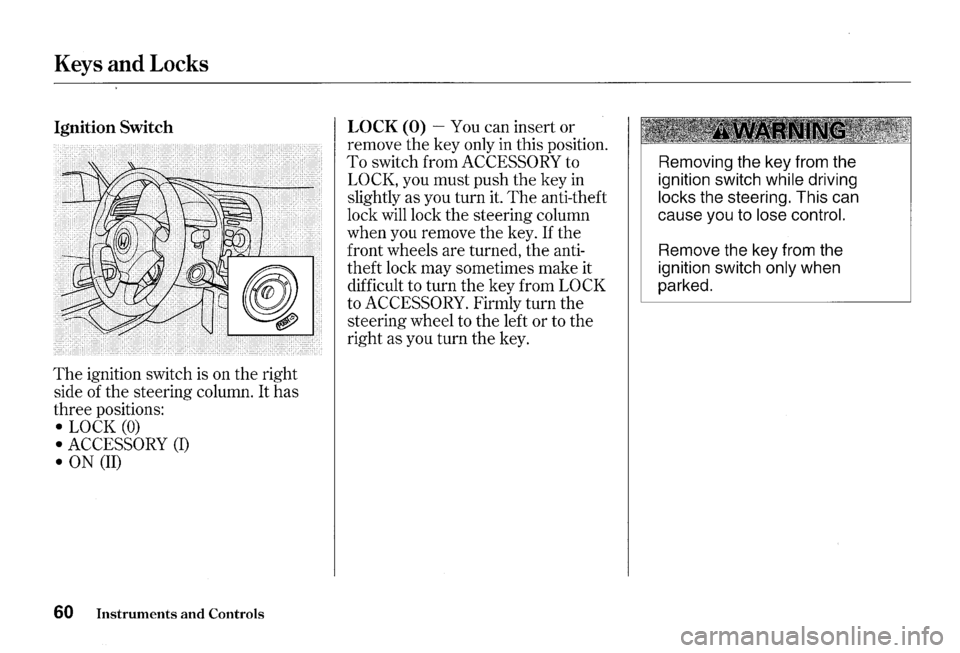
The ignition switch is on the right
side of the steering column.
It has
three positions:
• LOCK (0)
• ACCESSORY (I)
• ON (II)
60 Instruments and Controls
LOCK (0)-You can insert or
remove the key only in this position.
To switch from ACCESSORY to
LOCK, you must push the key in
slightly as you turn it. The anti-theft
lock will lock the steering column
when you remove the key.
If the
front wheels are turned, the anti
theft lock may sometimes make it
difficult to turn the key from
LOCK
to ACCESSORY. Firmly turn the
steering wheel to the left or to the
right as you turn the key.
Removing the key from the
ignition switch
while driving
locks the steering. This can
cause you to
lose control.
Remove the key from the
ignition switch
only when
parked.
Page 126 of 273
Modifications
Do not remove any original
equipment or modify your car in any
way
that would alter its design or
operation. This could make your car
unsafe and illegal to drive.
For example, do not make any
modifications
that would change the
ride height of your car, or install
wheels and tires with a different
overall diameter.
Such modifications can adversely
affect handling, and interfere with
the operation of the car's anti-lock
brakes and other systems.
Accessories and Modifications
In addition, any modifications that
decrease ground clearance increase
the chance of undercarriage parts
striking a curb, speed bump, or other
raised object, which could cause
your airbags to deploy.
Do not modify your steering wheel
or any other part of your
Supplemental Restraint System.
Modifications could make the
system ineffective. Additional Safety Precaution
Do not attach or place objects on the
airbag covers. Any object attached to
or placed on the covers marked
"SRS
AIRBAG," in the center of the
steering wheel and on top of the
dashboard, could interfere with the
proper operation of the airbags.
Or,
if the airbags inflate, the objects
could be propelled inside the car and
hurt someone.
Before Driving 123
Page 139 of 273
The Braking System
Your Honda is equipped with disc
brakes at
all four wheels. A power
assist helps reduce the effort needed
on the brake pedal.
The ABS helps
you retain steering control when
braking very hard.
Put your foot on the brake pedal only
when you intend to brake. Resting
your foot on the pedal keeps the
brakes applied lightly, causing them
to build up heat. Heat build-up can
reduce how well your brakes work.
It
also keeps your brake lights on all
the time, confusing drivers behind
you.
136 Driving
Constant application of the brakes
when going down a long hill builds
up heat and reduces their effective
ness.
Use the engine to assist the
brakes by downshifting to a lower
gear and taking your foot off the
accelerator pedal.
Check your brakes after driving
through deep water. Apply the
brakes moderately to see
if they feel
normal.
If not, apply them gently and
frequently until they
do. Since a
longer distance is needed to stop
with wet brakes, be extra cautious
and alert in your driving.
Brake Wear Indicators
All four brakes have audible brake
wear indicators.
When the brake pads need replacing,
you will
hear a distinctive metallic
"screeching" sound when you apply
the brakes.
If you do not have the
brake pads replaced, they will begin
screeching
all the time.
Your brakes may sometimes squeal
or squeak when you apply
them
lightly. Do not confuse this with the
brake wear indicators.
They make a
very audible
"screeching."
Page 140 of 273
Brake System Design
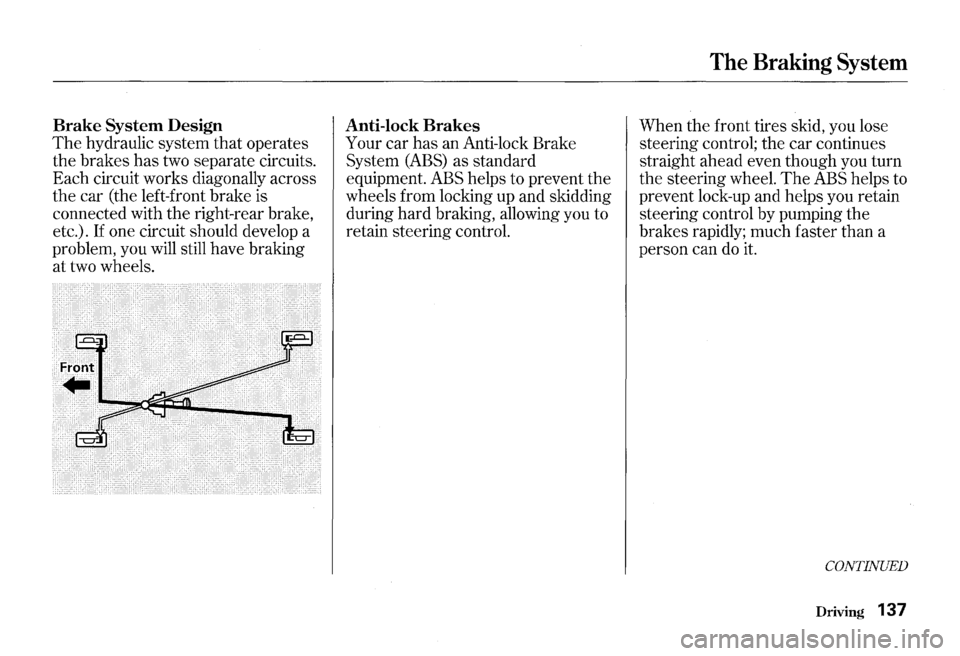
The hydraulic system that operates
the brakes has two separate circuits.
Each circuit works diagonally across
the car (the left-front brake is
connected with the right-rear brake,
etc.).
If one circuit should develop a
problem, you will still have braking
at two wheels.
Anti-lock Brakes
Your car has an Anti-lock Brake
System
(ABS) as standard
equipment. ABS helps to prevent the
wheels from locking up and skidding
during hard braking, allowing you to
retain steering control.
The Braking System
When the front tires skid, you lose
steering control; the car continues
straight ahead even though you turn
the steering wheel.
The ABS helps to
prevent lock-up and helps you retain
steering control by pumping the
brakes rapidly; much faster than a
person can do
it.
CONTINUED
Driving 137
Page 141 of 273
The Braking System
You should never pump the
brake pedal, this defeats the
purpose of the ABS. Let the ABS
work for you by always keeping firm,
steady pressure on the brake pedal
as you
steer away from the hazard.
This is sometimes referred to as
"stomp and steer."
You will feel a pulsation in the brake
pedal when the
ABS activates, and
you may
hear some noise. This is
normal, it is the
ABS rapidly
pumping the brakes.
Activation varies with the amount of
traction your tires have.
On dry
pavement, you will need to press on
the brake pedal very
hard before you
activate the
ABS. However, you may
feel the
ABS activate immediately if
you are trying to stop on snow or ice.
138
Driving
Important Safety Reminders
ABS does not reduce the time or
distance it takes to stop the car, it
only helps with steering control
during braking. You should always
maintain a safe following distance
from other vehicles.
ABS will not prevent a skid that
results from changing direction
abruptly, such as trying to take a
corner too fast or making a sudden
lane change. Always drive at a safe,
prudent speed for the road and
weather conditions.
ABS cannot prevent a loss of
stability. Always steer moderately
when you are braking hard.
Severe
or sharp steering wheel movement
can still cause your car to veer into
oncoming traffic
or off the road.
A car with ABS may require a
longer
distance to stop on loose or
uneven surfaces, such as gravel
or
snow, than a car without anti-lock.
Slow down and allow a greater
distance between cars under those
conditions.
Page 143 of 273
Driving in Bad Weather
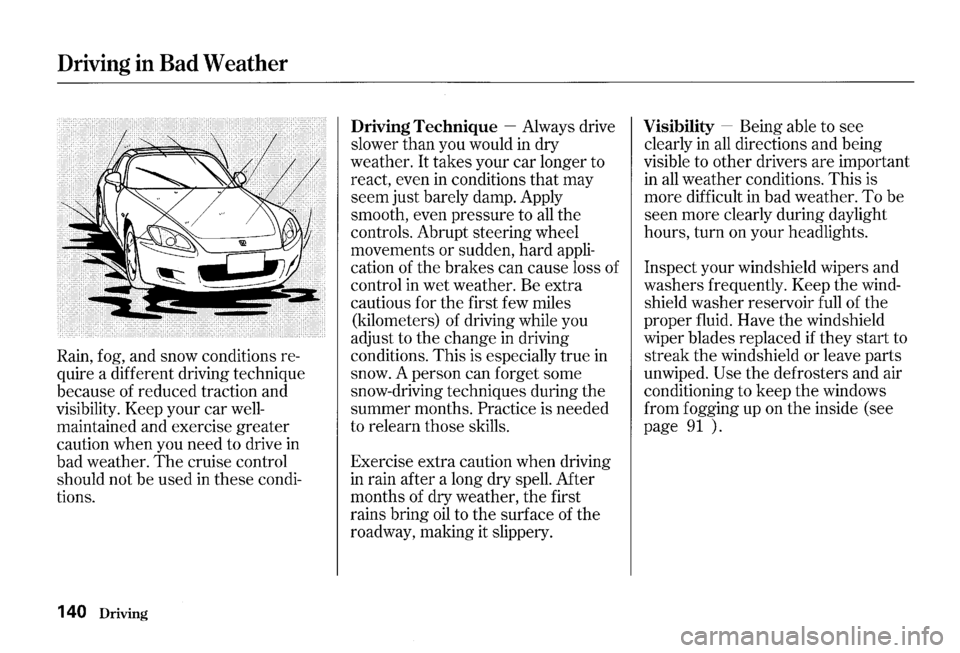
Rain, fog, and snow conditions re
quire a different driving technique
because of reduced traction and
visibility. Keep your car well
maintained and exercise greater
caution when you need to drive in
bad weather.
The cruise control
should not be used in these condi
tions.
140 Driving
Driving Technique -Always drive
slower than you would
in dry
weather.
It takes your car longer to
react, even
in conditions that may
seem just barely damp. Apply
smooth, even pressure to
all the
controls. Abrupt steering wheel
movements or sudden, hard appli
cation of the brakes can cause loss of
control in wet weather. Be extra
cautious for the first few miles
(kilometers) of driving while you
adjust to the change in driving
conditions.
This is especially true in
snow. A person can forget some
snow-driving techniques during the
summer months.
Practice is needed
to relearn those skills.
Exercise extra caution when driving
in rain after a long dry spell. After
months of dry weather, the first
rains bring
oil to the surface of the
roadway, making it slippery.
Visibility -Being able to see
clearly in
all directions and being
visible to other drivers are important
in all weather conditions. This is
more difficult
in bad weather. To be
seen more clearly during daylight
hours, turn on your headlights.
Inspect your windshield wipers and
washers frequently. Keep the wind
shield washer reservoir full of the
proper fluid. Have the windshield
wiper blades replaced
if they start to
streak the windshield or leave parts
unwiped.
Use the defrosters and air
conditioning to keep the windows
from fogging up on
the inside (see
page
91 ).
Page 151 of 273
Service at the indicated miles x 1,000 15 30 45 60 75 90 105
distance ortime -whichever kmx 1,000 24 48 72 96 120 144 168
comes first.
months 12 24 36 48 60 72 84
Replace engine oil Replace every 7,500
miles (12,000 km) or 12 months
Replace engine oil filter • •
• • • • • Check engine oil and coolant Check oil and coolant at each fuel stop
Replace air cleaner element • • • Inspect valve clearance Adjust only if noisy • Replace spark plugs • Inspect drive belt • • • Inspect idle speed • Replace engine coolant • • • Replace transmission fluid • Replace rear differential fluid • • • Inspect front and rear brakes • • • • • •
• Replace brake fluid • • Check parking brake adjustment • • • •
• • • Replace air conditioning filter • • • Check tire inflation and condition Every 7,500
miles (12,000 km)
Visually inspect the following items:
Tie rod ends, steering gear box, and boots
Suspension components
Driveshaft boots
Brake hoses and
lines (including ABS) • • • • • • • All fluid levels and condition of fluids
Cooling
system hoses and connections
Exhaust system•
Fuel lines and connections•
148 Maintenance
120 192
96
•
•
•
•
•
•
•
•
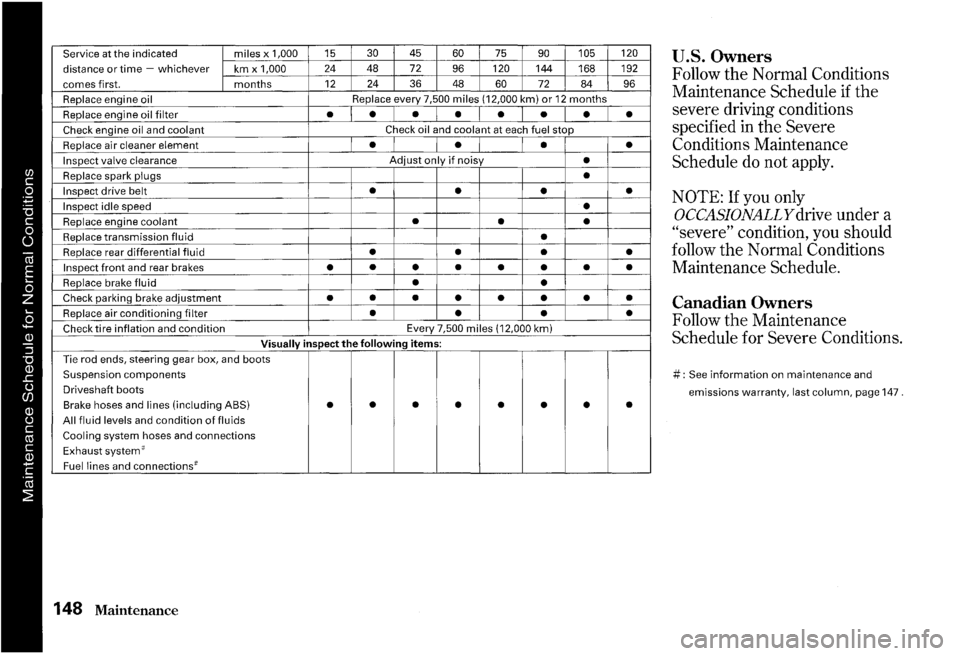
U.S. Owners
Follow the Normal Conditions
Maintenance Schedule
if the
severe driving conditions
specified in
the Severe
Conditions Maintenance
Schedule do not apply.
NOTE: If you only
OCCASIONALLY drive under a
"severe" condition, you should
follow
the Normal Conditions
Maintenance Schedule.
Canadian Owners
Follow the Maintenance
Schedule for Severe Conditions.
#: See information on maintenance and
emissions warranty,
last column, page 147.
Page 152 of 273
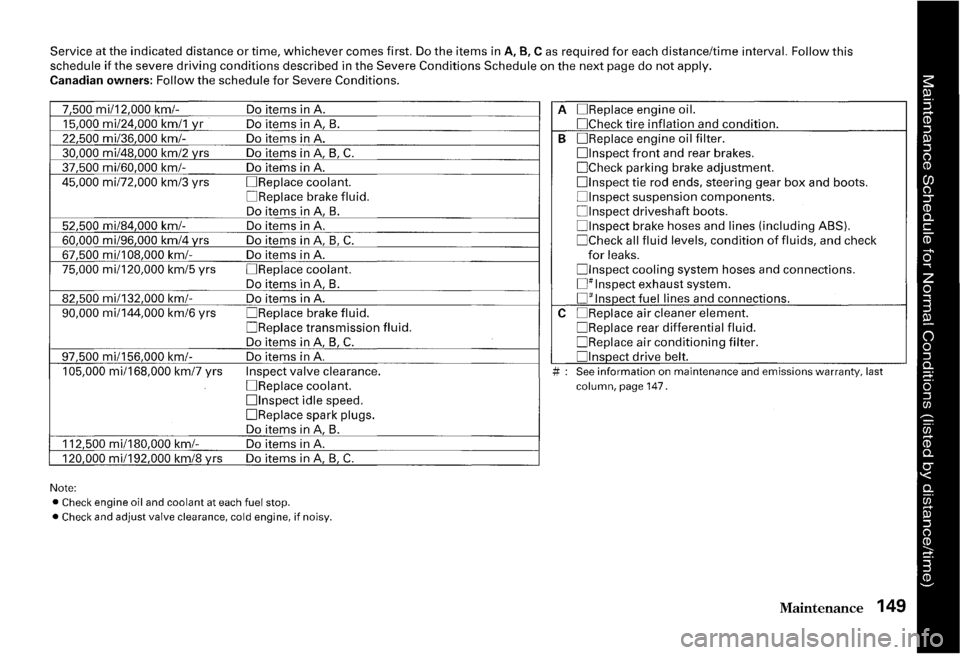
Service at the indicated distance or time, whichever comes first. Do the items in A, B, Cas required for each distance/time interval. Follow this schedule if the severe driving conditions described in the Severe Conditions Schedule on the next page do not apply. Canadian owners: Follow the schedule for Severe Conditions.
7,500 mi/12,000
km/- Do items in A. 15,000 m i/24,000 km/1 yr Do items in A, B. 22,500 mi/36,000 km/-
Do items in A. 30,000 mi/48,000 km/2 yrs Do items in A, B, C. 37,500 mi/60,000 km/- Do items in A. 45,000 mi/72,000 km/3 yrs DReplace coolant. DReplace brake fluid. Do items in A, B. 52,500 mi/84,000 km/- Do items in A. 60,000 mi/96,000 km/4 yrs Do items in A, B, C. 67,500 mi/108,000 km/- Do items in A. 75,000 mi/120,000 km/5 yrs DReplace coolant. Do items in A, B. 82,500 mi/132,000 km/- Do items in A. 90,000 mi/144,000 km/6 yrs DReplace brake fluid. DReplace transmission fluid. Do items in A, B, C. 97,500 mi/156,000 km/- Do items in A. 1 05,000 m i/168,000 km/7 yrs Inspect valve clearance. DReplace coolant. Dlnspect idle speed. DReplace spark plugs. Do items in A, B. 112,500 mi/180,000 km/-Do items in A. 120,000 mi/192,000 km/8 yrs Do items in A, B, C.
Note: • Check engine oil and coolant at each fuel stop. • Check and adjust valve clearance, cold engine, if noisy.
A DReplace engine oil. DCheck tire inflation and condition. B DReplace engine oil filter. Dlnspect front and rear brakes. CCheck parking brake adjustment. Dlnspect tie rod ends, steering gear box and boots. Dlnspect suspension components. Dlnspect driveshaft boots. Dlnspect brake hoses and lines (including ABS). DC heck all fluid levels, condition of fluids, and check for leaks. Dlnspect cooling system hoses and connections. D"lnspect exhaust system. D"lnspect fuel lines and connections. c DReplace air cleaner element. DReplace rear differential fluid. DReplace air conditioning filter. Dlnspect drive belt. # : See information on maintenance and emissions warranty, last
column, page 147.
Maintenance 149
Page 153 of 273
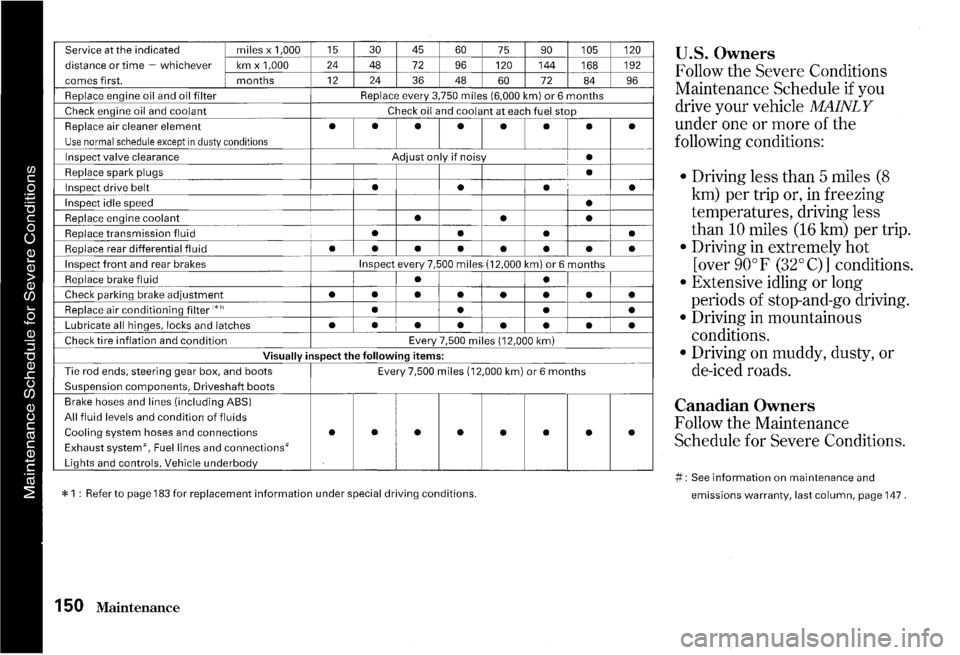
Service at the indicated miles x 1,000 15 30 45 60 75 90 105 120 distance or time -whichever km x 1,000 24 48 72 96 120 144 168 192 --~-~ comes first. months 12 24
36 48 60 72 84
96 Replace engine oil and oil filter Replace every 3,750 miles (6,000 km) or 6 months
Check engine oil and coolant Check oil and coolant at each fuel stop Replace air cleaner element • • r-·-. . . ·~ • • Use normal schedule except in dusty
conditions Inspect valve clearance Adjust only if noisy • Replace spark plugs • -·~-~-·-· ~~-~ f-----Inspect drive belt •
• • • Inspect idle speed I • --Replace engine coolant • • • -----Replace transmission fluid • •
• • Replace rear differential fluid • • • •
• •
• • Inspect front and rear brakes Inspect every 7,500 miles. (12,000 km) or 6 months
Replace brake fluid • -+-• Check parking brake adjustment • •
• • • • • • Replace air conditioning filter 1
" 1 •
•
• • i -~I-Lubricate al_~!lir1J:JeS, locks and latches • • • • • • • • Check tire inflation and condition Every 7,500 miles (12,000 km) Visually inspect the following items:
Tie rod ends, steering gear box, and boots Every 7,500 miles (12,000 km) or 6 months Suspension components, Drives haft boots -----r----~~ Brake hoses and lines (including ABS)
All fluid levels and condition of fluids
Cooling system hoses and connections • • • • • • • • Exhaust system", Fuel lines and connections'
1 Lights and controls, Vehicle underbody
* 1: Refer to page183 for replacement information under special driving conditions.
150 Maintenance
U.S. Owners
Follow the Severe Conditions
Maintenance Schedule if you
drive your vehicle
MAINLY
under one or more of the
following conditions:
• Driving less than 5 miles (8
km) per trip or, in freezing
temperatures, driving less
than
10 miles (16 km) per trip.
• Driving in extremely hot
[over
90° F (32° C)] conditions.
• Extensive idling or long
periods of stop-and-go driving.
• Driving in mountainous
conditions.
• Driving on muddy, dusty, or
de-iced roads.
Canadian Owners
Follow the Maintenance
Schedule for Severe Conditions.
#: See information on maintenance and
emissions warranty, last column, page 147.
Page 154 of 273
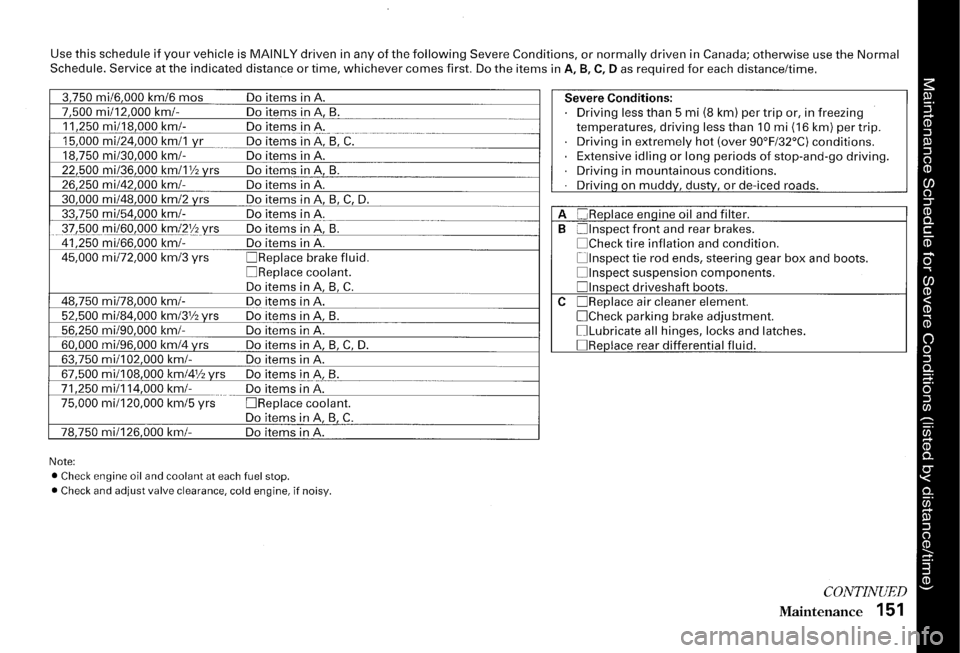
Use this schedule if your vehicle is MAINLY driven in any of the following Severe Conditions, or normally driven in Canada; otherwise use the Normal Schedule. Service at the indicated distance or time, whichever comes first. Do the items in A, B, C, D as required for each distance/time.
3,750 mi/6,000 km/6 mos Do items in A. 7,500 mi/12,000 km/- Do items in A, B. 11,250 mi/18,000 km/-
Do items in A. 15,000 mi/24,000 km/1 yr Do items in A, B, C. 18,750 mi/30,000 km/- Do items in A. 22,500 mi/36,000 km/1% yrs Do items_in_A,Jt .. ~--------· ---~~---26,250 mi/42,000 km/-Do items in A. 30,000 mi/48,000 km/2 vrs Do items in A, B, C, D. 33,750 mi/54,000 km/-
Do items in A. 37,500 mi/60,000 km/2'/z vrs
Do items in A, B. 41,250 mi/66,000 km/-
Do items in A. 45,000 mi/72,000 km/3 yrs DReplace brake fluid. DReplace coolant. Do items in A, B, C. 48,750 mi/78,000 km/- Do items in A. 52,500 mi/84,000 km/3'/z vrs Do items in A, B. 56,250 mi/90,000 km/-
Do items in A. 60,000 mi/96,000 km/4 vrs _Do items in A, B, C, D. 63,750 mi/102,000 km/-
Do items in A. 67,500 mi/108,000 km/41!2 yrs Do items in A, B. 71,250 mi/114,000 km/-
Do items in A. 75,000 mi/120,000 km/5 yrs ']Replace coolant. Do itefY!S_lll_ A,_B_,_(:, -~--~--78,750 mi/126,000 km/-
Do items in A.
Note: • Check engine oil and coolant at each fuel stop. • Check and adjust valve clearance, cold engine, if noisy.
·--~
··-
Severe Conditions:
A
B
c
Driving less than 5 mi (8 km) per trip or, in freezing
temperatures, driving less than 10 mi (16 km) per trip.
Driving in extremely hot (over 90°F/32°C) conditions.
Extensive idling or long periods of stop-and-go driving. Driving in mountainous conditions.
Drivin_gon muddy, dusty, or de-iced roads.
[]Replace enqine oil and filter. Dlnspect front and rear brakes. DC heck tire inflation and condition. Dlnspect tie rod ends, steering gear box and boots. Dlnspect suspension components. Dlnspect driveshaft boots. ORe place air cleaner element. ']Check parking brake adjustment. ']Lubricate all hinges, locks and latches. ']Replace rear differential fluid.
CONTINUED
Maintenance 151