oil HONDA S2000 2000 1.G Owners Manual
[x] Cancel search | Manufacturer: HONDA, Model Year: 2000, Model line: S2000, Model: HONDA S2000 2000 1.GPages: 273, PDF Size: 21.58 MB
Page 42 of 273
Your car's exhaust contains carbon
monoxide gas.
You should have no
problem with carbon monoxide
entering the car in normal driving
if
you maintain your car properly.
Have the exhaust system inspected
for leaks whenever:
• The car is raised for an oil change.
• You notice a change in the sound
of
the exhaust.
• The car was in an accident that
may have damaged the underside.
Carbon monoxide gas is toxic.
Breathing it can cause
unconsciousness and even
kill
you.
Avoid any
enclosed areas or
activities that expose you to
carbon monoxide.
High levels of carbon monoxide can
collect rapidly in enclosed areas,
such as a garage. Do not run the
engine with the garage door closed.
Even with the door open, run the
engine only long enough to move the
car out of the garage.
Carbon Monoxide Hazard
With the trunk lid open, air flow can
pull exhaust gas into your vehicle's
interior and create a hazardous
condition.
If you must drive with the
trunk lid open, open
all the windows
and set the heating and cooling
system as shown below.
If you must sit in your parked car,
even
in an unconfined area, with the
engine running, adjust the heating
and cooling system as follows:
1. Push the ~ button.
2. Select the w mode.
3. Turn the fan on high speed.
4. Set the temperature control to a
comfortable setting.
Driver and Passenger Safety 39
Page 47 of 273
Indicator Lights
I ~ I Seat Belt Reminder Light
This indicator flashes for several
seconds when you turn
the ignition
0 N (II). It flashes as a reminder to
you and your passenger to fasten
the
seat belts. A beeper also sounds if
you have not fastened your
seat belt.
If you do not fasten your seat belt,
the beeper will stop after a few
seconds
but the light stays on until
you do. Both
the light and the beeper
stay off if you fasten your seat belt
before turning on
the ignition.
44 Instruments and Controls
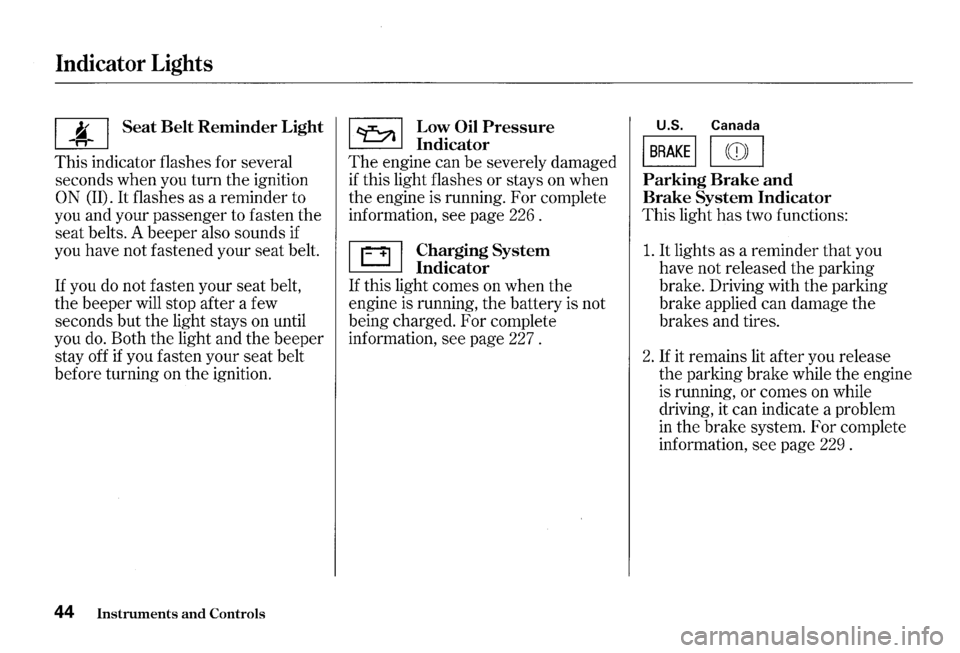
~ Low Oil Pressure
~ Indicator
The engine can be severely damaged
if this light flashes or stays on when
the engine is running. For complete
information, see page 226 .
~ Charging System
~ Indicator
If this light comes on when the
engine is running, the battery is not
being charged. For complete
information, see page 227 .
U.S. Canada
I BRAKE I I ((D) I
Parking Brake and
Brake System Indicator
This light has two functions:
1. It lights as a reminder that you
have not released
the parking
brake. Driving with
the parking
brake applied can damage
the
brakes and tires.
2. If it remains lit after you release
the parking brake while the engine
is running,
or comes on while
driving, it can indicate a problem
in
the brake system. For complete
information,
see page 229 .
Page 118 of 273
Before you begin driving your Honda,
you should know what gasoline to
use, and how to check
the levels of
important fluids. You also need to
know how to properly store luggage
or packages.
The information in this
section will help you.
If you plan to
add any accessories to your vehicle,
·
please read the information in this
section first.
Before Driving
Break-in Period .............................. 116
Gasoline .......................................... 116
Service Station Procedures ..........
117
Filling the Fuel Tank ................. 117
Opening the Hood ..................... 118
Oil Check ................................ 119
Engine Coolant Check .......... 120
Fuel Economy ................................ 121
Car Condition ............................. 121
Driving Habits ............................ 121
Accessories and Modifications .... 122
Accessories ................................. 122
Modifications ............................. 123
Additional Safety Precaution .... 123
Carrying Cargo .............................. 124
General Precautions ...................... 127
Before Driving 115
Page 122 of 273
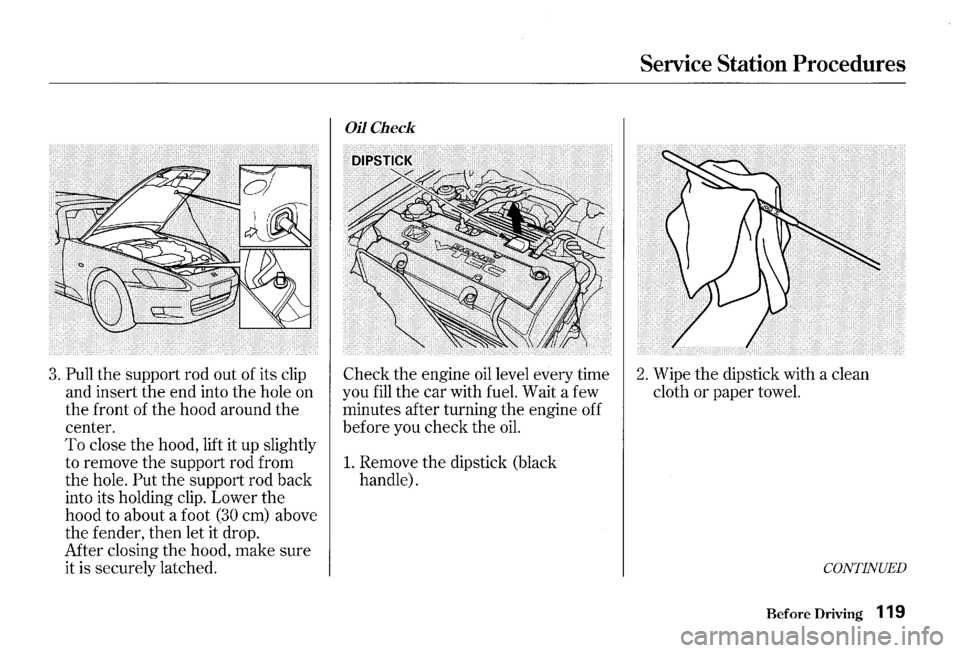
3. Pull the support rod out of its clip
and insert
the end into the hole on
the front of the hood around the
center.
To close the hood, lift it up slightly
to remove
the support rod from
the hole. Put the support rod back
into its holding clip. Lower
the
hood to about a foot (30 em) above
the fender, then let it drop.
After closing
the hood, make sure
it is securely latched.
Oil Check
Check the engine oil level every time
you
fill the car with fuel. Wait a few
minutes after turning
the engine off
before you check
the oil.
1. Remove the dipstick (black
handle).
Service Station Procedures
2. Wipe the dipstick with a clean
cloth
or paper towel.
CONTINUED
Before Driving 119
Page 123 of 273
Service Station Procedures
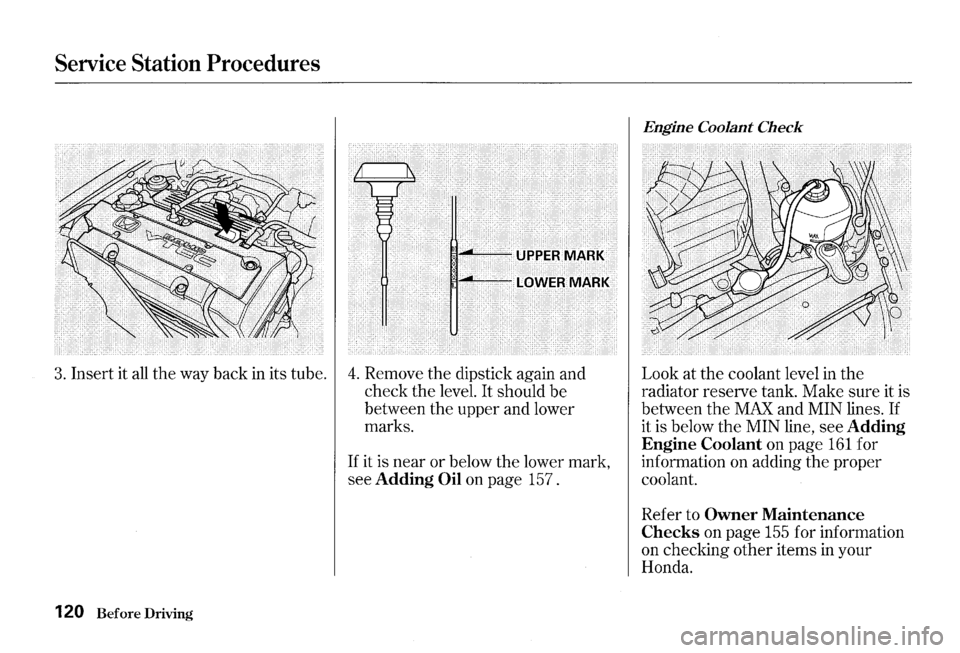
3. Insert it all the way back in its tube. 4. Remove the dipstick again and
check the level.
It should be
between the upper and lower
marks.
120 Before Driving
If it is near or below the lower mark,
see
Adding Oil on page 157.
Engine Coolant Check
Look at the coolant level in the
radiator reserve tank. Make sure it is
between
the MAX and MIN lines. If
it is below the MIN line, see Adding
Engine Coolant
on page 161 for
information on adding the proper
coolant.
Refer to
Owner Maintenance
Checks
on page 155 for information
on checking other items
in your
Honda.
Page 143 of 273
Driving in Bad Weather
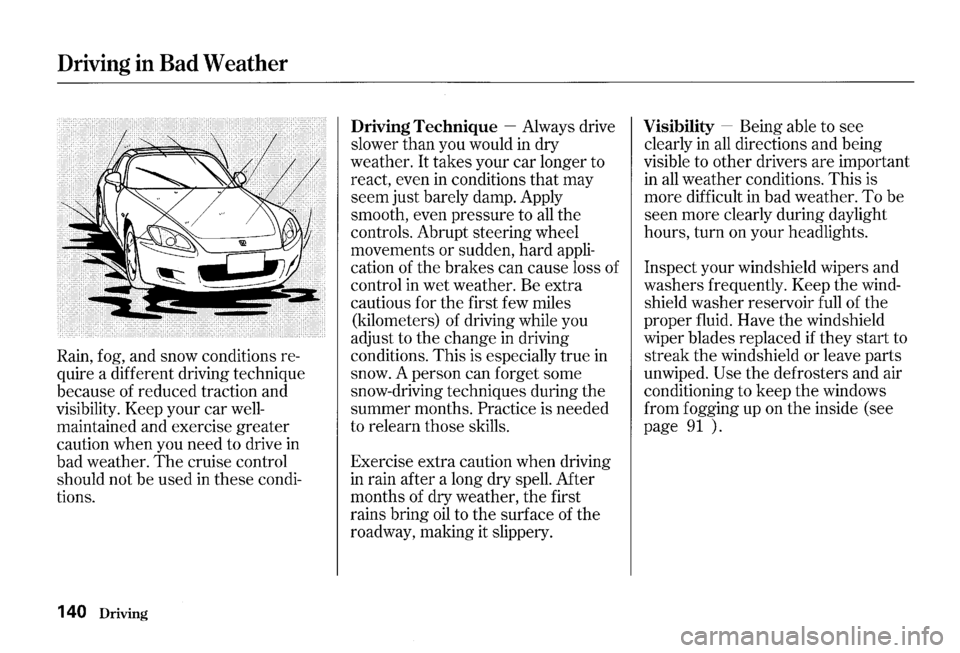
Rain, fog, and snow conditions re
quire a different driving technique
because of reduced traction and
visibility. Keep your car well
maintained and exercise greater
caution when you need to drive in
bad weather.
The cruise control
should not be used in these condi
tions.
140 Driving
Driving Technique -Always drive
slower than you would
in dry
weather.
It takes your car longer to
react, even
in conditions that may
seem just barely damp. Apply
smooth, even pressure to
all the
controls. Abrupt steering wheel
movements or sudden, hard appli
cation of the brakes can cause loss of
control in wet weather. Be extra
cautious for the first few miles
(kilometers) of driving while you
adjust to the change in driving
conditions.
This is especially true in
snow. A person can forget some
snow-driving techniques during the
summer months.
Practice is needed
to relearn those skills.
Exercise extra caution when driving
in rain after a long dry spell. After
months of dry weather, the first
rains bring
oil to the surface of the
roadway, making it slippery.
Visibility -Being able to see
clearly in
all directions and being
visible to other drivers are important
in all weather conditions. This is
more difficult
in bad weather. To be
seen more clearly during daylight
hours, turn on your headlights.
Inspect your windshield wipers and
washers frequently. Keep the wind
shield washer reservoir full of the
proper fluid. Have the windshield
wiper blades replaced
if they start to
streak the windshield or leave parts
unwiped.
Use the defrosters and air
conditioning to keep the windows
from fogging up on
the inside (see
page
91 ).
Page 146 of 273
This section explains why it is
important to keep your car well
maintained and to follow basic
maintenance safety precautions.
This section also includes
Maintenance Schedules for normal
driving and severe driving conditions,
a Maintenance Record, and instruc
tions for simple maintenance tasks
you may want to take care of
yourself.
If you have the skills and tools to per
form more complex maintenance
tasks on your Honda, you may want
to purchase
the Service Manual. See
page 259 for information on how to
obtain a copy,
or see your Honda
dealer. Maintenance
Safety .......................
144
Important
Safety Precautions .. 145
Maintenance Schedule .................. 146
Required Maintenance Record
.... 153
Owner Maintenance Checks ........ 155
Fluid Locations ............................... 156
Engine Oil ....................................... 157
Adding Oil... ................................ 157
Recommended Oil ..................... 157
Synthetic
Oil ............................... 158
Additives ..................................... 158
Changing the Oil and Filter.. .... 159
Cooling System .............................. 161
Adding Engine Coolant ............. 161
Replacing Engine Coolant ........ 163
Windshield Washers ..................... 167
6-speed Manual Transmission
Fluid ............................................
168
Differential Fluid ........................... 169
Brake and Clutch Fluid ................. 170
Brake Fluid ................................. 170
Brake System ............................. 170
Clutch System ............................ 171
Air Cleaner Element.. .................... 172
Hood Latch ..................................... 174
Maintenance
Spark Plugs ..................................... 174
Replacement ............................... 17 4
Specifications ............................. 176
Battery ............................................
177
Wiper Blades .................................. 180
Air Conditioning System ............... 182
Air Conditioning Filter, ................. 183
Drive Belt ........................................ 184
Tires ................................................ 185
Inflation ....................................... 185
Inspection ................................... 187
Maintenance ............................... 188
Tire Rotation .............................. 188
Tire Wear .................................... 188
Replacing Tires and Wheels .... 189
Wheels and Tires ....................... 190
Winter Driving ........................... 190
Snow
Tires .............................. 191
Tire Chains ............................. 191
Lights .............................................. 192
Replacing Bulbs ......................... 194
Storing Your Car ............................ 202
Maintenance 143
Page 147 of 273
Maintenance Safety
Regularly maintaining your car is the
best way to protect your investment.
Proper maintenance is essential to
your safety and the safety of your
passengers.
It will also reward you
with more economical, trouble-free
driving and help reduce air pollution.
Improperly maintaining this car
or
failing to correct a problem
before driving can cause a
crash
in which you can be
seriously hurt or killed.
Always follow
the inspection
and maintenance
recommendations and
schedules in this owner's
manual.
144 Maintenance
This section includes instructions for
simple maintenance tasks, such as
checking and adding
oil. Any service
items not detailed in this section
should be performed by a Honda
technician or other qualified
mechanic. Some
of
the most important safety
precautions are given here. However,
we cannot warn you of every
conceivable hazard
that can arise in
performing maintenance.
Only you
can decide whether or not you
should perform a given task.
Failure to properly follow
maintenance instructions and
precautions can cause you to
be seriously hurt or killed.
Always follow
the procedures
and precautions
in this owner's
manual.
Page 151 of 273
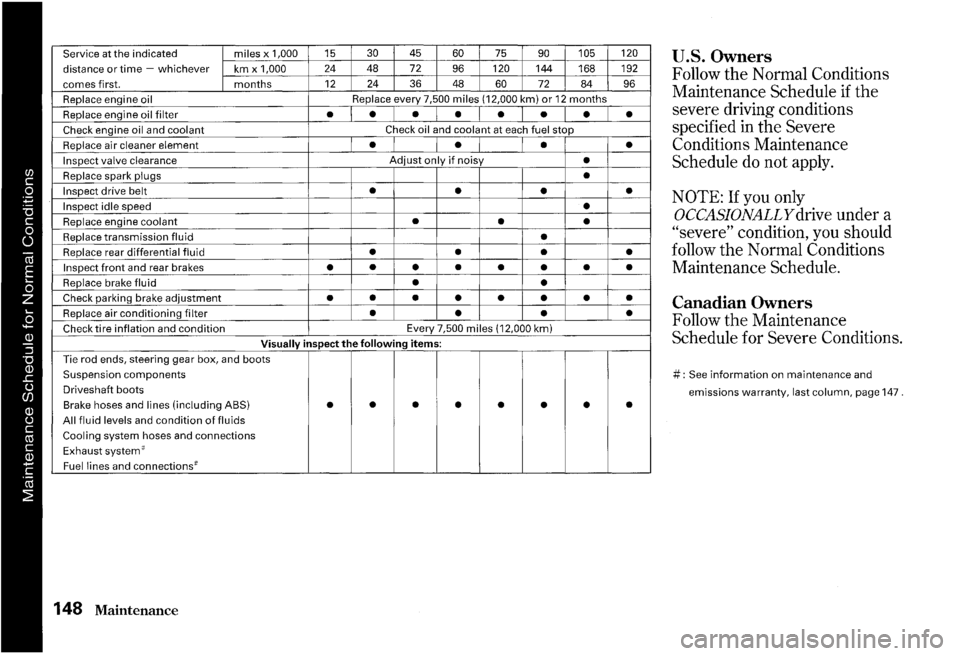
Service at the indicated miles x 1,000 15 30 45 60 75 90 105
distance ortime -whichever kmx 1,000 24 48 72 96 120 144 168
comes first.
months 12 24 36 48 60 72 84
Replace engine oil Replace every 7,500
miles (12,000 km) or 12 months
Replace engine oil filter • •
• • • • • Check engine oil and coolant Check oil and coolant at each fuel stop
Replace air cleaner element • • • Inspect valve clearance Adjust only if noisy • Replace spark plugs • Inspect drive belt • • • Inspect idle speed • Replace engine coolant • • • Replace transmission fluid • Replace rear differential fluid • • • Inspect front and rear brakes • • • • • •
• Replace brake fluid • • Check parking brake adjustment • • • •
• • • Replace air conditioning filter • • • Check tire inflation and condition Every 7,500
miles (12,000 km)
Visually inspect the following items:
Tie rod ends, steering gear box, and boots
Suspension components
Driveshaft boots
Brake hoses and
lines (including ABS) • • • • • • • All fluid levels and condition of fluids
Cooling
system hoses and connections
Exhaust system•
Fuel lines and connections•
148 Maintenance
120 192
96
•
•
•
•
•
•
•
•
U.S. Owners
Follow the Normal Conditions
Maintenance Schedule
if the
severe driving conditions
specified in
the Severe
Conditions Maintenance
Schedule do not apply.
NOTE: If you only
OCCASIONALLY drive under a
"severe" condition, you should
follow
the Normal Conditions
Maintenance Schedule.
Canadian Owners
Follow the Maintenance
Schedule for Severe Conditions.
#: See information on maintenance and
emissions warranty,
last column, page 147.
Page 152 of 273
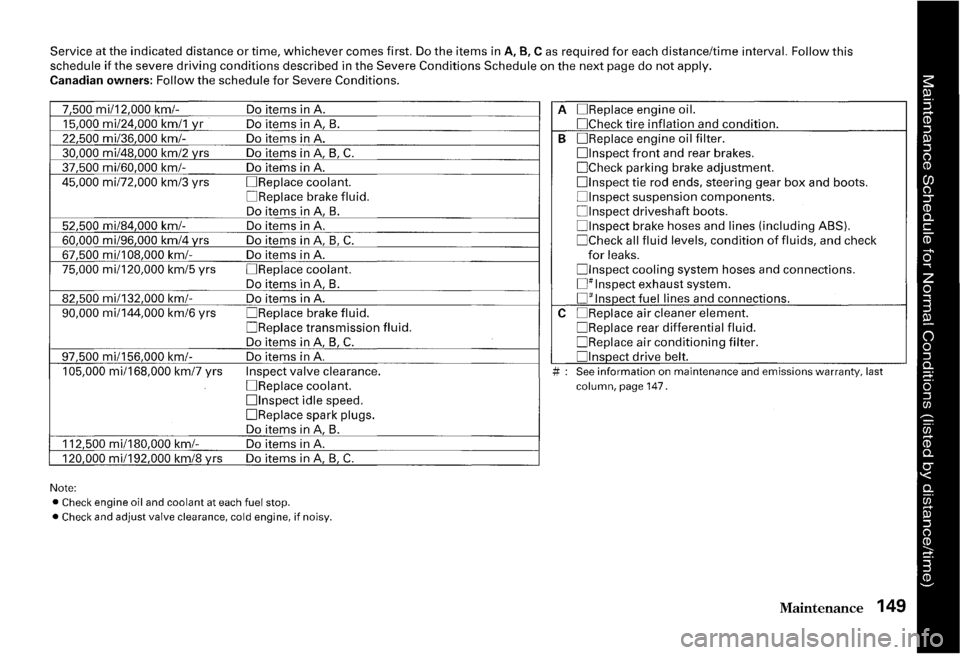
Service at the indicated distance or time, whichever comes first. Do the items in A, B, Cas required for each distance/time interval. Follow this schedule if the severe driving conditions described in the Severe Conditions Schedule on the next page do not apply. Canadian owners: Follow the schedule for Severe Conditions.
7,500 mi/12,000
km/- Do items in A. 15,000 m i/24,000 km/1 yr Do items in A, B. 22,500 mi/36,000 km/-
Do items in A. 30,000 mi/48,000 km/2 yrs Do items in A, B, C. 37,500 mi/60,000 km/- Do items in A. 45,000 mi/72,000 km/3 yrs DReplace coolant. DReplace brake fluid. Do items in A, B. 52,500 mi/84,000 km/- Do items in A. 60,000 mi/96,000 km/4 yrs Do items in A, B, C. 67,500 mi/108,000 km/- Do items in A. 75,000 mi/120,000 km/5 yrs DReplace coolant. Do items in A, B. 82,500 mi/132,000 km/- Do items in A. 90,000 mi/144,000 km/6 yrs DReplace brake fluid. DReplace transmission fluid. Do items in A, B, C. 97,500 mi/156,000 km/- Do items in A. 1 05,000 m i/168,000 km/7 yrs Inspect valve clearance. DReplace coolant. Dlnspect idle speed. DReplace spark plugs. Do items in A, B. 112,500 mi/180,000 km/-Do items in A. 120,000 mi/192,000 km/8 yrs Do items in A, B, C.
Note: • Check engine oil and coolant at each fuel stop. • Check and adjust valve clearance, cold engine, if noisy.
A DReplace engine oil. DCheck tire inflation and condition. B DReplace engine oil filter. Dlnspect front and rear brakes. CCheck parking brake adjustment. Dlnspect tie rod ends, steering gear box and boots. Dlnspect suspension components. Dlnspect driveshaft boots. Dlnspect brake hoses and lines (including ABS). DC heck all fluid levels, condition of fluids, and check for leaks. Dlnspect cooling system hoses and connections. D"lnspect exhaust system. D"lnspect fuel lines and connections. c DReplace air cleaner element. DReplace rear differential fluid. DReplace air conditioning filter. Dlnspect drive belt. # : See information on maintenance and emissions warranty, last
column, page 147.
Maintenance 149