steering HONDA S2000 2000 1.G Owners Manual
[x] Cancel search | Manufacturer: HONDA, Model Year: 2000, Model line: S2000, Model: HONDA S2000 2000 1.GPages: 273, PDF Size: 21.58 MB
Page 1 of 273
 to navigate through\
this reference.
For a printed owners manual, click on authorized manuals or go to")
2000 S2000 Online Reference Owner's Manual Use these links (and links throughout this manual) to navigate through\
this reference.
For a printed owner's manual, click on authorized manuals or go to www.h\
elminc.com.
Contents
Introduction ........................................................................\
................................................................. i
A Few Words About Safety........................................................................\
........................................ .ii
Your Vehicle at a Glance........................................................................\
............................................ .2
Driver and Passenger Safety ........................................................................\
......................................5
Proper use and care of your vehicle's seat belts, and Supplemental Restr\
aint System.
Instruments and Controls........................................................................\
........................................ .41
Instrument panel indicator and gauge, and how to use dashboard and steering colu\
mn controls.
Comfort and Convenience Features ........................................................................\
....................... 85
How to operate the climate control system, the audio system, and other c\
onvenience features.
Before Driving........................................................................\
..........................................................115
What gasoline to use, how to break-in your new vehicle, and how to load luggage and other cargo.
Driving ........................................................................\
..................................................................... .129
The proper way to start the engine, shift the transmission, and park, pl\
us towing a trailer.
Maintenance........................................................................\
.............................................................143
The Maintenance Schedule shows you when you need to take yo ur vehicle to the dealer.
Appearance Care........................................................................\
..................................................... .203
Tips on cleaning and protecting your vehicle. Things to look for if your\
vehicle ever needs body repairs.
Taking Care of the Unexpected........................................................................\
..............................211
This section covers several problems motorists sometimes experience, a nd how to handle them.
Technical Information........................................................................\
............................................ .241
ID numbers, dimensions, capacities, and technical information.
Warranty and Customer Relations (U.S. and Canada)................................................................253
A summary of the warranties covering your new Acura, and how to contact \
us.
Authorized Manuals (U.S. only)........................................................................\
..............................259
How to order manuals and other technical literature.
Index........................................................................\
........................................................................\
...... I
Service Information Summary
A summary of information you need when you pull up to the fuel pump. Owner's Identification Form
Page 10 of 273
Your Car's Safety Features
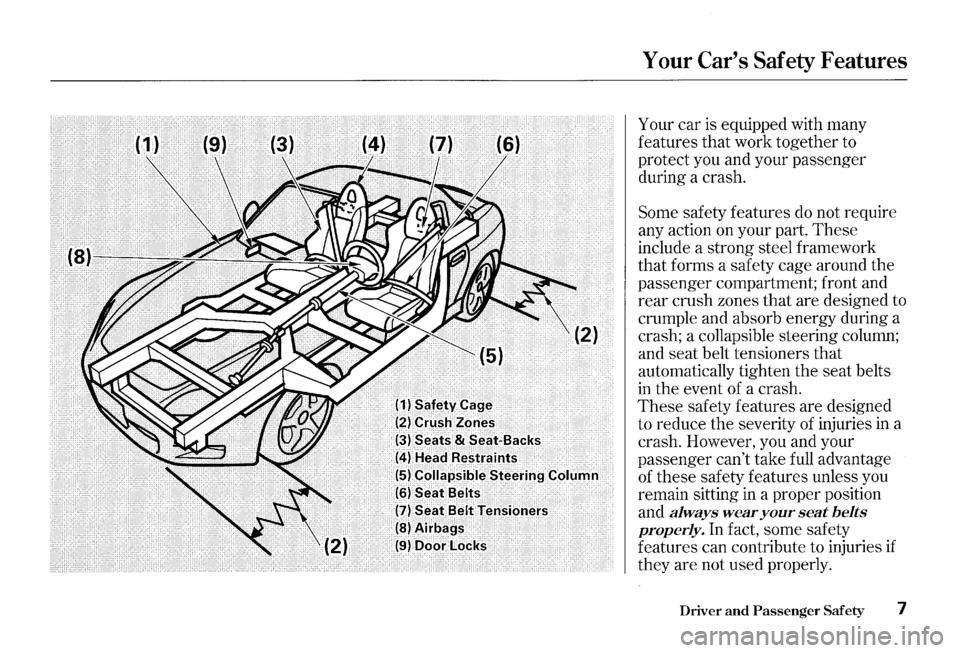
Your car is equipped with many
features that work together to
protect you and your passenger
during a crash.
Some safety features
do not require
any action on your part. These
include a strong steel framework
that forms a safety cage around the
passenger compartment; front and
rear crush zones that are designed to
crumple and absorb energy during a
crash; a collapsible steering column;
and seat belt tensioners that
automatically tighten the seat belts
in the event of a crash.
These safety features are designed
to reduce the severity of injuries
in a
crash. However, you and your
passenger can't take full advantage
of these safety features unless you
remain sitting in a proper position
and
always wear your seat belts
properly. In fact, some safety
features can contribute to injuries
if
they are not used properly.
Driver and Passenger Safety 7
Page 12 of 273
Airbags
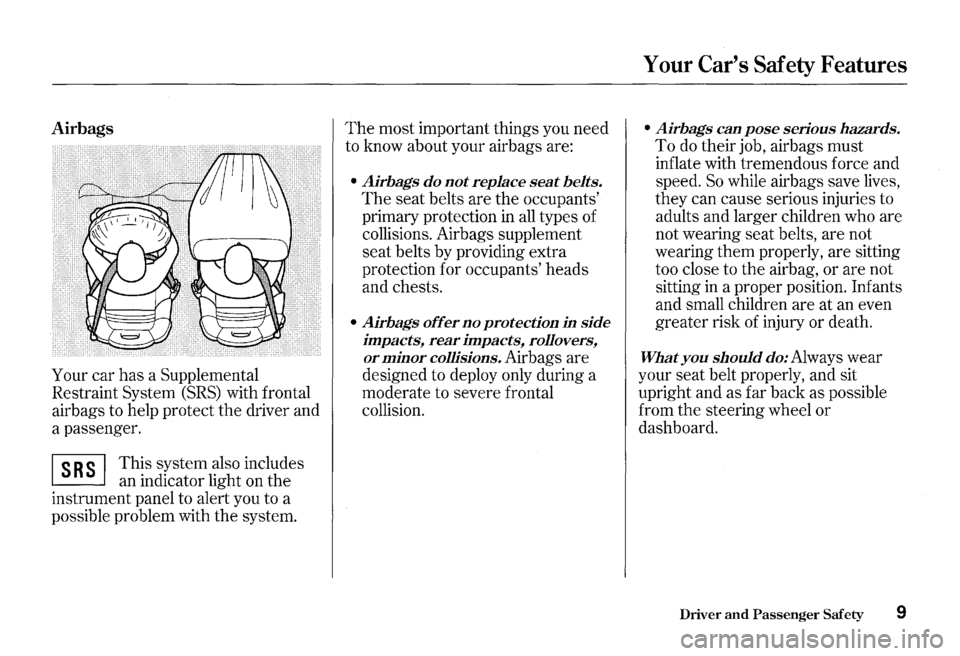
Your car has a Supplemental
Restraint System
(SRS) with frontal
airbags to help protect the driver and
a passenger.
~ This system also includes
~ an indicator light on the
instrument panel to alert you to a
possible problem with the system.
The most important things you need
to know about your airbags are:
• Airbags do not replace seat belts.
The seat belts are the occupants'
primary protection in all types of
collisions. Airbags supplement
seat belts
by providing extra
protection for occupants' heads
and chests.
• Airbags offer no protection in side
impacts, rear impacts, rollovers,
or
minor collisions. Air bags are
designed to deploy only during a
moderate to severe frontal
collision.
Your Car's Safety Features
• Airbags can pose serious hazards.
To do their job, airbags must
inflate with tremendous force and
speed.
So while airbags save lives,
they can cause serious injuries to
adults and larger children who are
not wearing seat belts, are not
wearing
them properly, are sitting
too close to the airbag,
or are not
sitting in a proper position. Infants
and small children are at an even
greater risk of injury or death.
What
you should do: Always wear
your seat belt properly, and sit
upright and as far back as possible
from the steering wheel
or
dashboard.
Driver and Passenger Safety 9
Page 13 of 273

Your Car's Safety Features
Seats & Seat-Backs
Your car's seats are designed to keep
you in a comfortable, upright
position so you can take full
advantage of
the protection offered
by seat belts and the energy
absorbing materials in
the seats.
How you adjust your seats and seat
backs can also affect your safety.
For
example, sitting too close to the
steering wheel or dashboard
increases the risk of you
or your
passenger being injured by striking
the inside of the car, or by an
inflating airbag.
Reclining a seat-back too far reduces
the seat belt's effectiveness and
increases
the chance that the seat's
occupant
will slide under the seat
belt
in a crash and be seriously
injured.
10 Driver and Passenger Safety
What you should do: Move the seats
as far back as possible, and keep
adjustable seat-backs in an upright
position whenever
the car is moving.
Head Restraints
Head restraints can help protect you
from whiplash and other injuries.
Door Locks
Keeping your doors locked reduces
the chance of being thrown out of
the car during a crash.
It also helps
prevent occupants from accidentally
opening a door and falling out, and
outsiders from unexpectedly opening
your doors.
Page 14 of 273
Pre-Drive Safety Checklist
To make sure you and your
passenger get the maximum
protection from your car's safety
features, check the following each
time before you drive
away:
• You and any adult passenger, or a
larger child who has outgrown
child seats, are wearing your seat
belts and wearing
them properly
(see page
15 ) .
• A small child riding in a forward
facing child seat is properly
restrained (see page
26).
• Occupants are sitting upright and
as far back as possible from
the
steering wheel and dashboard
(see page
12 ) .
• Seat-backs are upright (see page
13 ).
• Both doors are closed and locked
(see page
12 ).
• All cargo is properly stored or
secured (see page 124).
The rest of this section gives more
detailed information about how you
can maximize your safety.
Remember, however, that
no safety
system can prevent
all injuries or
deaths that can occur in severe
crashes, even when seat belts are
properly worn and the air bags deploy.
Your Car's Safety Features
Driver and Passenger Safety 11
Page 15 of 273
Protecting Adults
Introduction
The following pages provide
instructions on how to properly
protect adult occupants.
These instructions also apply to a
child whom you have decided is
large enough and mature enough to
ride as a passenger. (See page
29 for
important additional guidelines on
how to properly protect larger
children.)
1. Close and Lock the Doors
After everyone has entered the car,
be sure the doors are closed and
locked.
12
Driver and Passenger Safety
~ Your car has a door
~ monitor light on the
instrument panel to indicate when a
specific door is
not tightly closed.
For safety, locking the doors reduces
the chance
that a passenger,
especially a child,
will open a door
while the car is moving and
accidentally fall out.
It also reduces
the chance of someone being thrown
out of the car during a crash.
For security, locked doors can
prevent an outsider from
unexpectedly opening a door when
you come to a stop.
See page
58 for how to lock the
doors.
2.Adjust the Front Seats
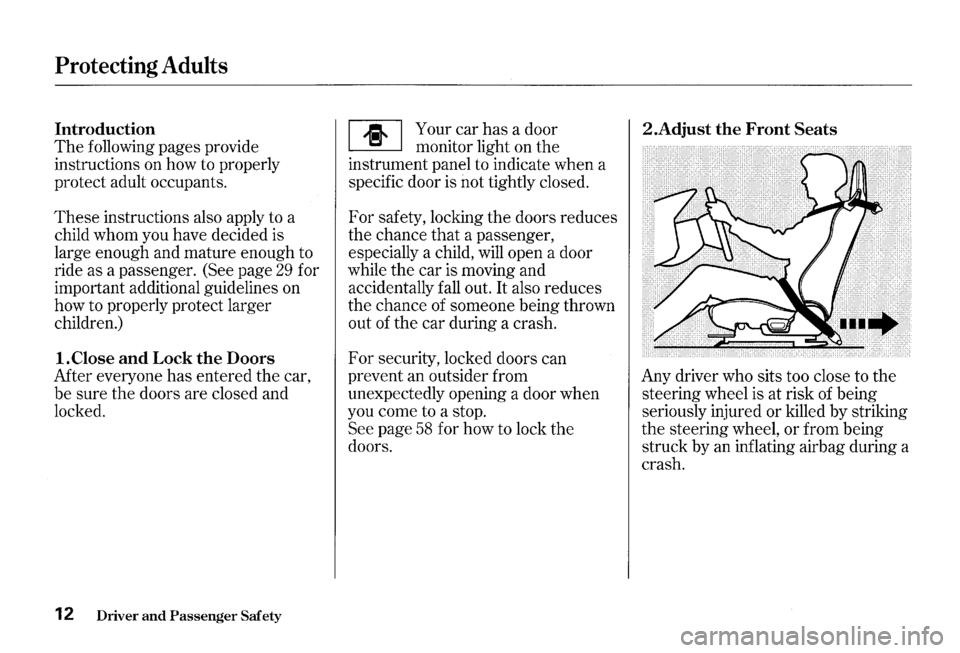
Any driver who sits too close to the
steering wheel is at risk of being
seriously injured or killed by striking
the steering wheel,
or from being
struck by an inflating airbag during a
crash.
Page 16 of 273
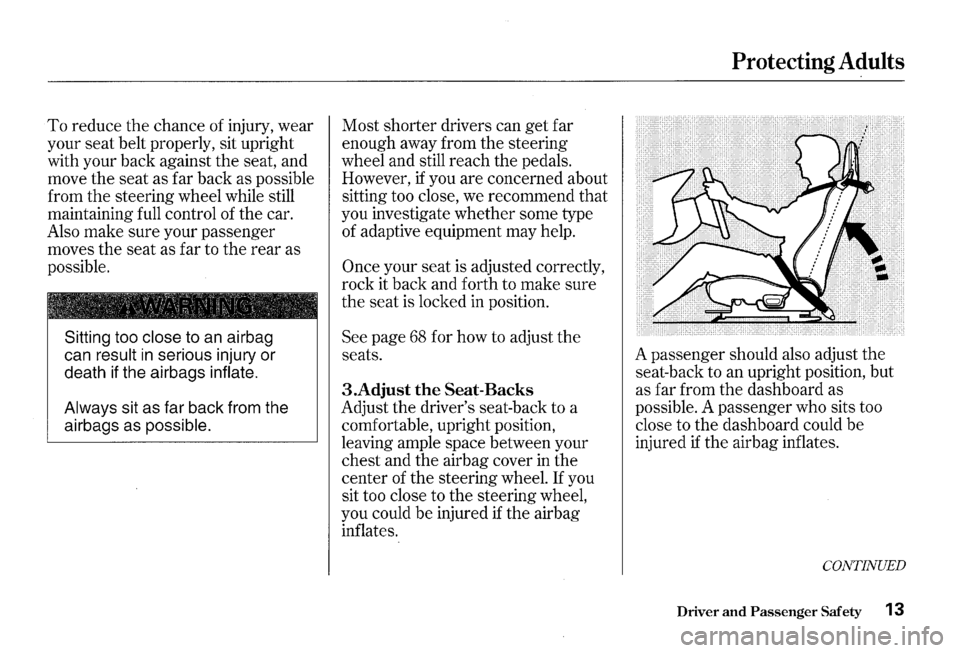
To reduce the chance of injury, wear
your seat belt properly, sit upright
with your back against the seat, and
move the seat as far back as possible
from
the steering wheel while still
maintaining full control of the car.
Also make sure your passenger
moves the seat as far to
the rear as
possible.
Sitting too close to an airbag
can
result in serious injury or
death it the airbags
inflate.
Always
sit as tar back from the
airbags as
possible.
Most shorter drivers can get far
enough away from the steering
wheel and still reach the pedals.
However, if you are concerned about
sitting too close, we recommend that
you investigate whether some type
of adaptive equipment may help.
Once your seat is adjusted correctly,
rock it back and forth to make sure
the seat is locked in position.
See page 68 for how to adjust the
seats.
3.Adjust the Seat-Backs
Adjust the driver's seat-back to a
comfortable, upright position,
leaving ample space between your
chest and the airbag cover in the
center of the steering wheel.
If you
sit too close to the steering wheel,
you could be injured
if the airbag
inflates.
Protecting Adults
A passenger should also adjust the
seat-back to an upright position, but
as far from
the dashboard as
possible. A passenger who sits too
close to the dashboard could be
injured if the airbag inflates.
CONTINUED
Driver and Passenger Safety 13
Page 20 of 273
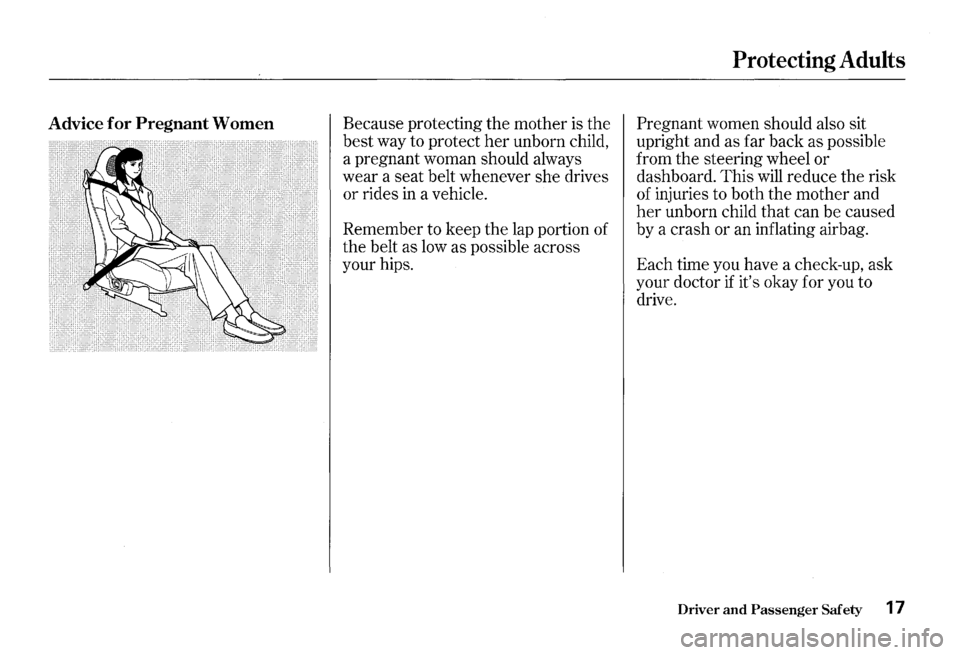
Advice for Pregnant Women Because protecting the mother is the
best way to protect
her unborn child,
a pregnant woman should always
wear a seat belt whenever she drives
or rides
in a vehicle.
Remember to keep the lap portion of
the belt as
low as possible across
your hips.
Protecting Adults
Pregnant women should also sit
upright and as far back as possible
from the steering wheel or
dashboard. This
will reduce the risk
of injuries to both the mother and
her unborn child that can be caused
by a crash or an inflating airbag.
Each time you have a check-up, ask
your doctor
if it's okay for you to
drive.
Driver and Passenger Safety 17
Page 21 of 273
Protecting Adults
Additional Safety Precautions
• Two people should never use the
same seat belt. If they do, they
could be very seriously injured in a
crash.
• Do not put any accessories on seat
belts. Devices intended to improve
occupant comfort or reposition
the
shoulder part of a seat belt can
severely compromise the
protective capability of the seat
belt and increase the chance of
serious injury in a crash.
18 Driver and Passenger Safety
• Do not place hard or sharp objects
between yourself and an airbag.
Carrying hard or sharp objects on
your lap, or driving with a pipe or
other sharp object
in your mouth,
can result
in injuries if your
airbags inflate.
• Keep your hands and arms away
from the airbag covers. If your
hands or arms are close to the
SRS
covers in the center of the
steering wheel and on top of the
dashboard, they could be injured
if
the airbags inflate.
• Do not attach or place objects on
the airbag covers. Any object
attached to or placed on the
covers marked
"SRS AIRBAG,"
in the center of the steering
wheel and on top of
the
dashboard, could interfere with
the proper operation of the
airbags.
Or, if the airbags inflate,
the objects could be propelled
inside the car and
hurt someone.
Page 38 of 273
SRS Components
Your Supplemental Restraint System
(SRS) includes:
• Two front airbags. The driver's
airbag is stored
in the center of
the steering wheel; the front
passenger's airbag is stored
in the
dashboard. Both are marked
"SRS
AIRBAG."
•
Automatic seat belt tensioners
that tighten
the front seat belts
during a moderate to severe
frontal collision.
• Sensors that can detect a
moderate to severe frontal
collision.
• A sophisticated electronic system
that continually monitors the
sensors, control unit, the airbag
activators, and all related wiring
when the ignition is
ON (II).
Additional Information About Your SRS
• An indicator light on the How Your Airbags Work
instrument panel that alerts you to
a possible problem with the
system (see page
37).
• Emergency backup power in case
your car's electrical system
is
disconnected in a crash.
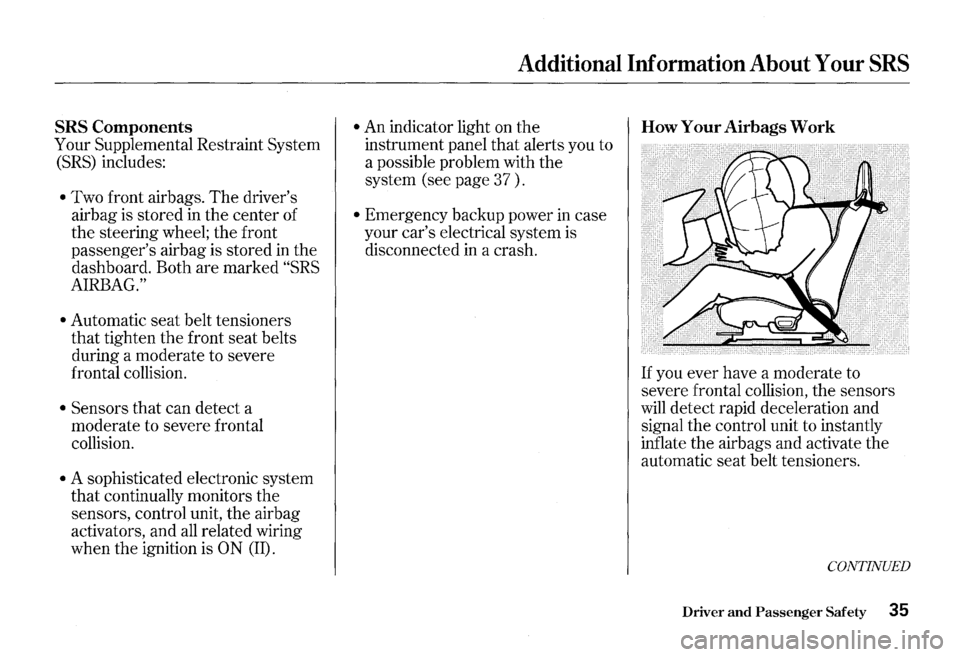
If you ever have a moderate to
severe frontal collision, the sensors
will detect rapid deceleration and
signal the control unit to instantly
inflate the airbags and activate the
automatic seat belt tensioners.
CON11NUED
Driver and Passenger Safety 35