lock HUMMER H2 2006 Manual Online
[x] Cancel search | Manufacturer: HUMMER, Model Year: 2006, Model line: H2, Model: HUMMER H2 2006Pages: 502, PDF Size: 3.35 MB
Page 275 of 502

Brake and Accelerator Operation
Techniques for Off-Road Driving
For logs, walls, rocks, severe ditches,
hills, sand, etc.
1. Bring the vehicle to a complete stop. Do not rev
the engine.
2. Select the proper transmission and transfer case
gear range; usually FIRST (1) gear, 4LO LOCK for
such obstacles.
3. If wheel spin is experienced, maintain steady
throttle, with your foot off the brake pedal, to
allow the Traction Control System (TCS) to control
the wheel spin. TCS will not operate if the brakes
are applied, even slightly.
4. If wheel spin cannot be controlled by the system,
fully press the brake pedal with your left foot so all
wheel spin is halted.
5. Back away from the obstacle so that a new
approach can be tried.
6. As the rst wheel crosses the obstacle, be prepared
to alternate the brake and accelerator pedal to
maintain control and avoid tire drop-off from
obstacles. Repeat this process for the other wheels.
For mounds, washouts, loose up-hill
slopes, ditches, etc.
When wheel spin occurs as the vehicle is moving, the
driver may notice a slight shaking or shuddering of
the vehicle. This should be stopped as soon as possible
to prevent damage to vehicle components. This is the
indication that a loss of traction is occurring on this
terrain. The operator should:
1. Reduce speed and apply the brakes.
2. Assess the terrain properly and adjust vehicle
speed and gear ranges accordingly: 4HI position
for higher speeds and 4LO LOCK for more torque
and lower speeds. Transmission FIRST (1) gear
is generally recommended.
3. Apply slight pressure to the brake when the shaking
or shuddering sensation is felt, keeping the vehicle
moving in a controlled manner.
4. Be prepared to alternate between braking and
accelerating through the adverse terrain.
4-21
Page 279 of 502
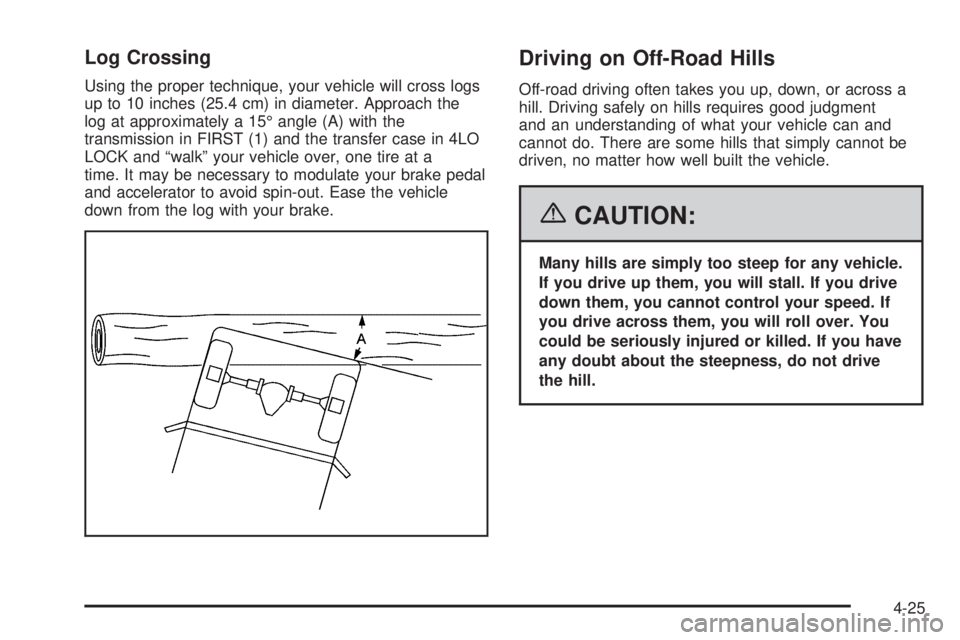
Log Crossing
Using the proper technique, your vehicle will cross logs
up to 10 inches (25.4 cm) in diameter. Approach the
log at approximately a 15° angle (A) with the
transmission in FIRST (1) and the transfer case in 4LO
LOCK and “walk” your vehicle over, one tire at a
time. It may be necessary to modulate your brake pedal
and accelerator to avoid spin-out. Ease the vehicle
down from the log with your brake.
Driving on Off-Road Hills
Off-road driving often takes you up, down, or across a
hill. Driving safely on hills requires good judgment
and an understanding of what your vehicle can and
cannot do. There are some hills that simply cannot be
driven, no matter how well built the vehicle.
{CAUTION:
Many hills are simply too steep for any vehicle.
If you drive up them, you will stall. If you drive
down them, you cannot control your speed. If
you drive across them, you will roll over. You
could be seriously injured or killed. If you have
any doubt about the steepness, do not drive
the hill.
4-25
Page 280 of 502
Approaching a Hill
When you approach a hill, you need to decide if it is
one of those hills that is just too steep to climb, descend,
or cross. Steepness can be hard to judge. On a very
small hill, for example, there may be a smooth, constant
incline with only a small change in elevation where
you can easily see all the way to the top. On a large hill,
the incline may get steeper as you near the top, but
you may not see this because the crest of the hill
is hidden by bushes, grass, or shrubs.
Here are some other things to consider as you approach
a hill:
Is there a constant incline, or does the hill get
sharply steeper in places?
Is there good traction on the hillside, or will the
surface cause tire slipping?
Is there a straight path up or down the hill so you
will not have to make turning maneuvers?
Are there obstructions on the hill that can block your
path, such as boulders, trees, logs, or ruts?
What is beyond the hill? Is there a cliff, an
embankment, a drop-off, a fence? Get out and
walk the hill if you do not know. It is the smart way
to nd out.
Is the hill simply too rough? Steep hills often have
ruts, gullies, troughs and exposed rocks because
they are more susceptible to the effects of erosion.
Driving Uphill
Once you decide you can safely drive up the hill, you
need to take some special steps:
Use transmission and transfer case low gear and
get a rm grip on the steering wheel.
Get a smooth start up the hill and try to maintain
your speed. Do not use more power than you
need, because you do not want your wheels to start
spinning or sliding.
Let the traction system work to control any wheel
slippage. The traction control system allows for
moderate wheel spin with some capability to dig in
and power up the hill.
4-26
Page 282 of 502

Q:What should I do if my vehicle stalls, or
is about to stall, and I cannot make it up
the hill?
A:If this happens, there are some things you should
do, and there are some things you must not do.
First, here is what youshoulddo:
Push the brake pedal to stop the vehicle and
keep it from rolling backwards. Also, apply the
parking brake.
If your engine is still running, shift the transmission
to REVERSE (R), release the parking brake, and
slowly back down the hill in REVERSE (R).
If your engine has stopped running, you will need to
restart it. With the brake pedal pressed and the
parking brake still applied, shift the transmission to
PARK (P) and restart the engine. Then, shift to
REVERSE (R), release the parking brake, and
slowly back down the hill as straight as possible in
REVERSE (R).
As you are backing down the hill, put your left hand
on the steering wheel at the 12 o’clock position.
This way, you will be able to tell if your wheels are
straight and maneuver as you back down. It is
best that you back down the hill with your wheels
straight rather than in the left or right direction.
Turning the wheel too far to the left or right
will increase the possibility of a rollover.Here are some things youmust notdo if you stall, or
are about to stall, when going up a hill:
Never attempt to prevent a stall by shifting into
NEUTRAL (N) to rev-up the engine and regain
forward momentum. This will not work. Your vehicle
will roll backwards very quickly and you could go
out of control.
Instead, apply the regular brake to stop the vehicle.
Then apply the parking brake. Shift to
REVERSE (R), release the parking brake, and
slowly back straight down.
Never attempt to turn around if you are about to
stall when going up a hill. If the hill is steep
enough to stall your vehicle, it is steep enough to
cause you to roll over if you turn around. If you
cannot make it up the hill, you must back straight
down the hill.
4-28
Page 283 of 502
Q:Suppose, after stalling, I try to back down the
hill and decide I just cannot do it. What should
I do?
A:Set the parking brake, put your transmission in
PARK (P) and turn off the engine. Leave the
vehicle and go get some help. Exit on the uphill
side and stay clear of the path the vehicle would
take if it rolled downhill. Do not shift the transfer
case to NEUTRAL when you leave the vehicle.
Leave it in some gear.
{CAUTION:
Shifting the transfer case to NEUTRAL can
cause your vehicle to roll even if the
transmission is in PARK (P). This is because
the NEUTRAL position on the transfer case
overrides the transmission. You or someone
else could be injured. If you are going to leave
your vehicle, set the parking brake and shift
the transmission to PARK (P). But do not shift
the transfer case to NEUTRAL. Leave the
transfer case in the 4 HI, 4 HI Lock, or 4 LO
Lock position.
Driving Downhill
When off-roading takes you downhill, you will want to
consider a number of things:
How steep is the downhill? Will I be able to maintain
vehicle control?
What is the surface like? Smooth? Rough?
Slippery? Hard-packed dirt? Gravel?
Are there hidden surface obstacles? Ruts? Logs?
Boulders?
What is at the bottom of the hill? Is there a hidden
creek bank or even a river bottom with large rocks?
If you decide you can go down a hill safely, then try to
keep your vehicle headed straight down, and use a
low gear. This way, engine drag can help your brakes
and they will not have to do all the work. Descend
slowly, keeping your vehicle under control at all times.
{CAUTION:
Heavy braking when going down a hill can
cause your brakes to overheat and fade. This
could cause loss of control and a serious
accident. Apply the brakes lightly when
descending a hill and use a low gear to keep
vehicle speed under control.
4-29
Page 290 of 502
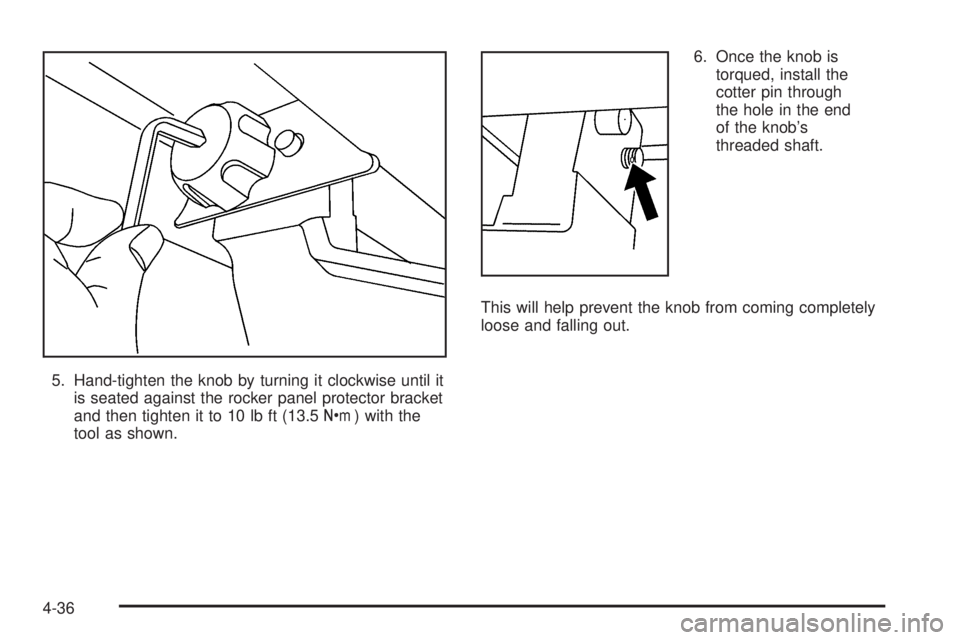
5. Hand-tighten the knob by turning it clockwise until it
is seated against the rocker panel protector bracket
and then tighten it to 10 lb ft (13.5Y) with the
tool as shown.6. Once the knob is
torqued, install the
cotter pin through
the hole in the end
of the knob’s
threaded shaft.
This will help prevent the knob from coming completely
loose and falling out.
4-36
Page 291 of 502
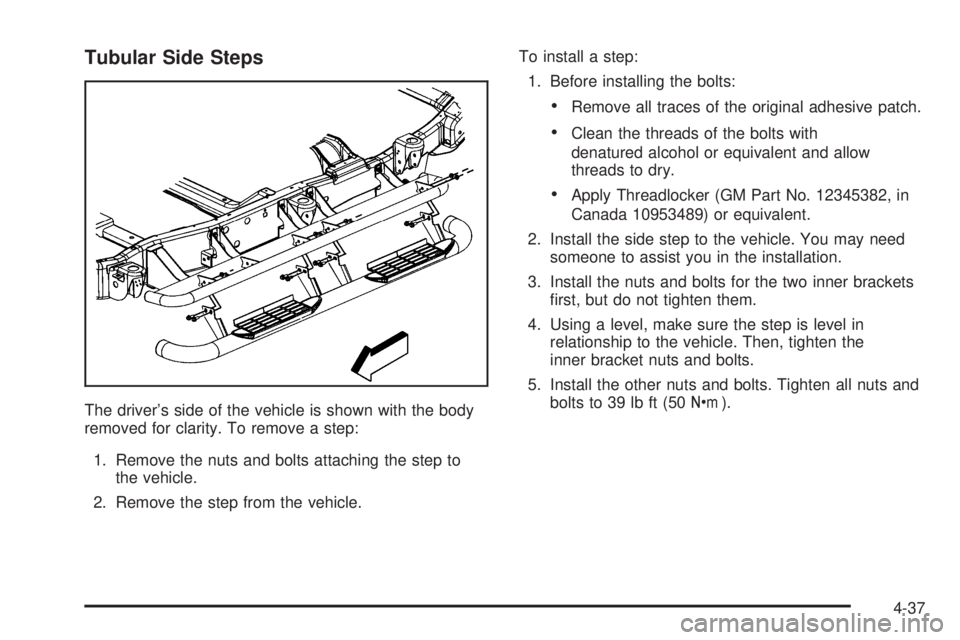
Tubular Side Steps
The driver’s side of the vehicle is shown with the body
removed for clarity. To remove a step:
1. Remove the nuts and bolts attaching the step to
the vehicle.
2. Remove the step from the vehicle.To install a step:
1. Before installing the bolts:
Remove all traces of the original adhesive patch.
Clean the threads of the bolts with
denatured alcohol or equivalent and allow
threads to dry.
Apply Threadlocker (GM Part No. 12345382, in
Canada 10953489) or equivalent.
2. Install the side step to the vehicle. You may need
someone to assist you in the installation.
3. Install the nuts and bolts for the two inner brackets
rst, but do not tighten them.
4. Using a level, make sure the step is level in
relationship to the vehicle. Then, tighten the
inner bracket nuts and bolts.
5. Install the other nuts and bolts. Tighten all nuts and
bolts to 39 lb ft (50Y).
4-37
Page 301 of 502
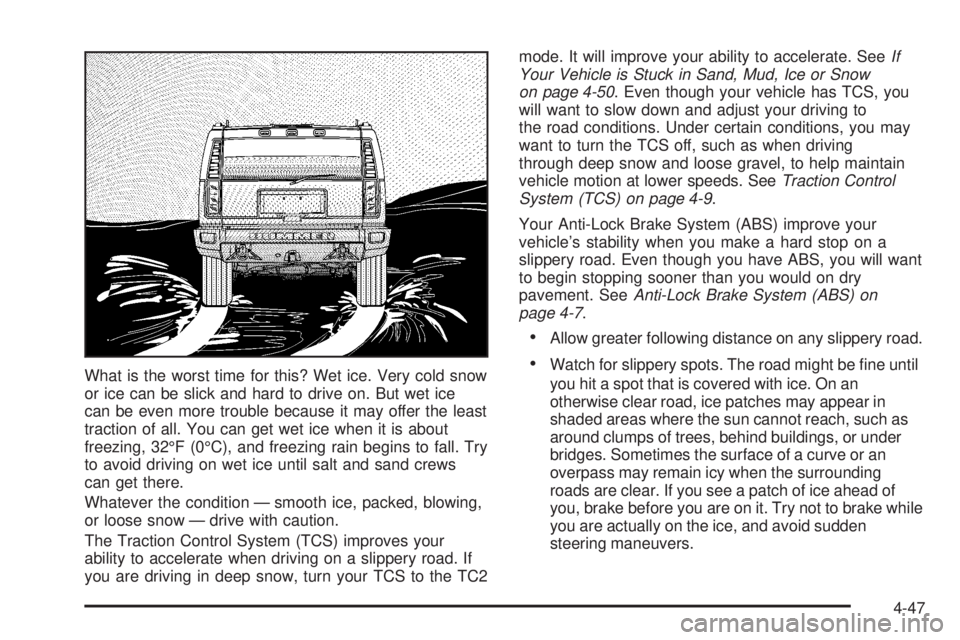
What is the worst time for this? Wet ice. Very cold snow
or ice can be slick and hard to drive on. But wet ice
can be even more trouble because it may offer the least
traction of all. You can get wet ice when it is about
freezing, 32°F (0°C), and freezing rain begins to fall. Try
to avoid driving on wet ice until salt and sand crews
can get there.
Whatever the condition — smooth ice, packed, blowing,
or loose snow — drive with caution.
The Traction Control System (TCS) improves your
ability to accelerate when driving on a slippery road. If
you are driving in deep snow, turn your TCS to the TC2mode. It will improve your ability to accelerate. SeeIf
Your Vehicle is Stuck in Sand, Mud, Ice or Snow
on page 4-50. Even though your vehicle has TCS, you
will want to slow down and adjust your driving to
the road conditions. Under certain conditions, you may
want to turn the TCS off, such as when driving
through deep snow and loose gravel, to help maintain
vehicle motion at lower speeds. SeeTraction Control
System (TCS) on page 4-9.
Your Anti-Lock Brake System (ABS) improve your
vehicle’s stability when you make a hard stop on a
slippery road. Even though you have ABS, you will want
to begin stopping sooner than you would on dry
pavement. SeeAnti-Lock Brake System (ABS) on
page 4-7.
Allow greater following distance on any slippery road.
Watch for slippery spots. The road might be ne until
you hit a spot that is covered with ice. On an
otherwise clear road, ice patches may appear in
shaded areas where the sun cannot reach, such as
around clumps of trees, behind buildings, or under
bridges. Sometimes the surface of a curve or an
overpass may remain icy when the surrounding
roads are clear. If you see a patch of ice ahead of
you, brake before you are on it. Try not to brake while
you are actually on the ice, and avoid sudden
steering maneuvers.
4-47
Page 303 of 502
{CAUTION:
Snow can trap exhaust gases under your
vehicle. This can cause deadly CO (carbon
monoxide) gas to get inside. CO could
overcome you and kill you. You cannot see it
or smell it, so you might not know it is in your
vehicle. Clear away snow from around the
base of your vehicle, especially any that is
blocking your exhaust pipe. And check around
again from time to time to be sure snow does
not collect there.
Open a window just a little on the side of the
vehicle that is away from the wind. This will
help keep CO out.Run your engine only as long as you must. This saves
fuel. When you run the engine, make it go a little
faster than just idle. That is, push the accelerator
slightly. This uses less fuel for the heat that you get and
it keeps the battery charged. You will need a
well-charged battery to restart the vehicle, and possibly
for signaling later on with your headlamps. Let the
heater run for a while.
Then, shut the engine off and close the window almost
all the way to preserve the heat. Start the engine
again and repeat this only when you feel really
uncomfortable from the cold. But do it as little as
possible. Preserve the fuel as long as you can. To
help keep warm, you can get out of the vehicle and do
some fairly vigorous exercises every half hour or so
until help comes.
4-49
Page 308 of 502
Power Winch Platform
You can use the power winch platform (if equipped) with
an aftermarket winch. Connect the winch to the
platform and wiring to the vehicle following the winch
manufacturer’s guidelines.
Notice:Do not use the winch platform to winch at
a tension of more than 9,000 lbs. (4 082 kg). This
would damage your vehicle’s frame. This damage
would not be covered by your vehicle’s warranty.
If you are using a winch to pull out another vehicle,
follow the winch manufacturer’s guidelines and observe
the following to prevent damage to your vehicle:
If possible, have your vehicle anchored from
the opposite side of the winch to a solid,
immovable object.
If winching from the front, use both of the rear
recovery loops. If winching from the rear, use both
of the front recovery loops.
Put your transmission in NEUTRAL (N).
Use your regular brakes to hold your vehicle in
place and block the wheels to keep the vehicle
from moving.Notice:Using a power winch with the transmission
in gear to pull out another vehicle may damage
the transmission. When operating a power winch,
always leave the transmission in NEUTRAL (N).
Notice:Driving your vehicle through an automatic
car wash with the winch installed, can cause
damage to your vehicle and the car wash. Always
remove the winch from your vehicle before using an
automatic car wash. SeeWashing Your Vehicle
on page 5-109for more information.
If you are using a winch to pull out your own vehicle,
follow the winch manufacturer’s guidelines for self
recovery and observe the following to prevent damage
to your vehicle:
Do not self recover your vehicle by wrapping the
winch cable around an object (such as a pulley
block or tree) and attaching it back to your vehicle’s
recovery loops.
Always attach the winch cable directly to a solid
anchor directly in front of your vehicle to achieve
a straight line pull.
4-54