wheel HUMMER H2 2008 Repair Manual
[x] Cancel search | Manufacturer: HUMMER, Model Year: 2008, Model line: H2, Model: HUMMER H2 2008Pages: 504, PDF Size: 7.12 MB
Page 307 of 504
Then, shut the engine off and close the window almost
all the way to preserve the heat. Start the engine
again and repeat this only when you feel really
uncomfortable from the cold. But do it as little as
possible. Preserve the fuel as long as you can.
To help keep warm, you can get out of the vehicle
and do some fairly vigorous exercises every half hour
or so until help comes.
If Your Vehicle is Stuck in Sand,
Mud, Ice, or Snow
Slowly and cautiously spin the wheels to free your
vehicle when stuck in sand, mud, ice, or snow.
SeeRocking Your Vehicle to Get It Out on page 4-40.
If your vehicle has a traction system, it can often help to
free a stuck vehicle. Refer to your vehicle’s traction
system in the Index. If the stuck condition is too severe
for the traction system to free the vehicle, turn the
traction system off and use the rocking method.
{CAUTION:
If you let your vehicle’s tires spin at high
speed, they can explode, and you or others
could be injured. The vehicle can overheat,
causing an engine compartment re or other
damage. Spin the wheels as little as possible
and avoid going above 35 mph (55 km/h) as
shown on the speedometer.
For information about using tire chains on your vehicle,
seeTire Chains on page 5-75.
4-39
Page 308 of 504
Rocking Your Vehicle to Get It Out
First, turn the steering wheel left and right to clear
the area around the front wheels. The traction control
system activates when the system senses that the
wheels are spinning. SeeTraction Control System (TCS)
on page 4-5. Then, shift back and forth between
REVERSE (R) and a forward gear, spinning the wheels
as little as possible. To prevent transmission wear,
wait until the wheels stop spinning before shifting gears.
Release the accelerator pedal while you shift, and
press lightly on the accelerator pedal when the
transmission is in gear. By slowly spinning the wheels in
the forward and reverse directions, you will cause a
rocking motion that could free your vehicle. If that does
not get your vehicle out after a few tries, it might
need to be towed out. Or, you can use the recovery
loops. If your vehicle does need to be towed out,
seeTowing Your Vehicle on page 4-51.
Recovery Loops
{CAUTION:
These loops, when used, are under a lot of
force. Keep people away from the vicinity of
the loops and any chains or cables during use.
Always pull the vehicle straight out. Never pull
on the loops at a sideways angle. The loops
could break off and you or others could be
injured from the chain or cable snapping back.
Notice:Never use the recovery loops to tow the
vehicle. Your vehicle could be damaged and it would
not be covered by warranty.
4-40
Page 311 of 504
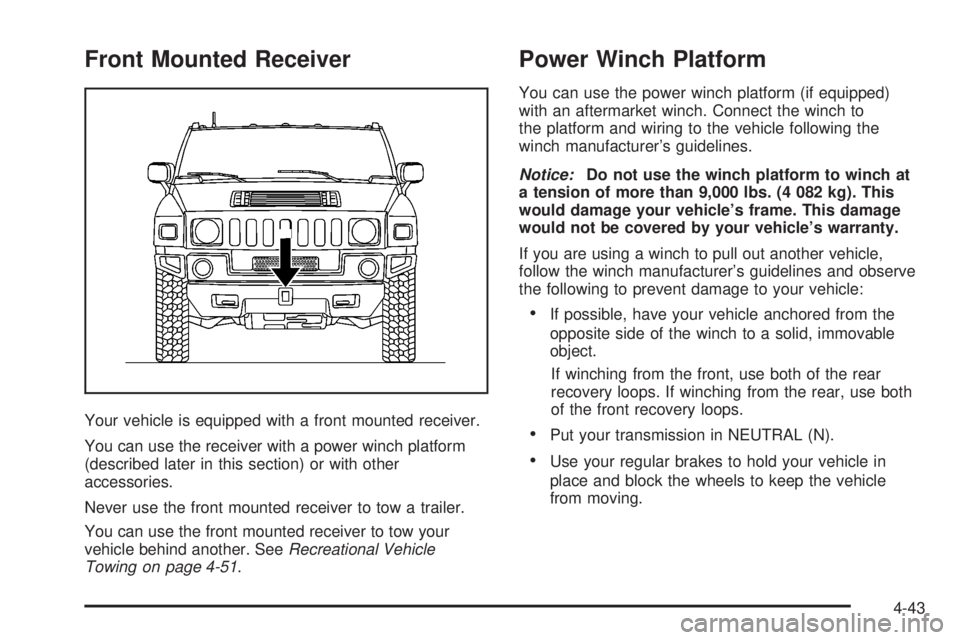
Front Mounted Receiver
Your vehicle is equipped with a front mounted receiver.
You can use the receiver with a power winch platform
(described later in this section) or with other
accessories.
Never use the front mounted receiver to tow a trailer.
You can use the front mounted receiver to tow your
vehicle behind another. SeeRecreational Vehicle
Towing on page 4-51.
Power Winch Platform
You can use the power winch platform (if equipped)
with an aftermarket winch. Connect the winch to
the platform and wiring to the vehicle following the
winch manufacturer’s guidelines.
Notice:Do not use the winch platform to winch at
a tension of more than 9,000 lbs. (4 082 kg). This
would damage your vehicle’s frame. This damage
would not be covered by your vehicle’s warranty.
If you are using a winch to pull out another vehicle,
follow the winch manufacturer’s guidelines and observe
the following to prevent damage to your vehicle:
If possible, have your vehicle anchored from the
opposite side of the winch to a solid, immovable
object.
If winching from the front, use both of the rear
recovery loops. If winching from the rear, use both
of the front recovery loops.
Put your transmission in NEUTRAL (N).
Use your regular brakes to hold your vehicle in
place and block the wheels to keep the vehicle
from moving.
4-43
Page 319 of 504
Towing
Towing Your Vehicle
Consult your dealer/retailer or a professional towing
service if you need to have your disabled vehicle towed.
SeeRoadside Assistance Program on page 7-6.
If you want to tow your vehicle behind another vehicle
for recreational purposes (such as behind a motorhome),
see “Recreational Vehicle Towing” following.
Recreational Vehicle Towing
Recreational vehicle towing means towing your vehicle
behind another vehicle – such as behind a motorhome.
The two most common types of recreational vehicle
towing are known as “dinghy towing” (towing your
vehicle with all four wheels on the ground) and “dolly
towing” (towing your vehicle with two wheels on
the ground and two wheels up on a device known as
a “dolly”).With the proper preparation and equipment, many
vehicles can be towed in these ways. See “Dinghy
Towing” and “Dolly Towing,” following.
Here are some important things to consider before you
do recreational vehicle towing:
What’s the towing capacity of the towing vehicle?
Be sure you read the tow vehicle manufacturer’s
recommendations.
How far will you tow? Some vehicles have
restrictions on how far and how long they can tow.
Do you have the proper towing equipment?
See your dealer or trailering professional for
additional advice and equipment recommendations.
Is your vehicle ready to be towed? Just as you
would prepare your vehicle for a long trip, you’ll
want to make sure your vehicle is prepared to be
towed. SeeBefore Leaving on a Long Trip on
page 4-34.
4-51
Page 320 of 504
Dinghy Towing
Use the following procedure to tow your vehicle:
1. Shift the transmission to PARK (P).
2. Turn the engine off, but leave the ignition in
ACCESSORY.
3. Firmly set the parking brake.
4. Securely attach the vehicle being towed to the
tow vehicle.
{CAUTION:
Shifting a full-time four-wheel-drive vehicle’s
transfer case into NEUTRAL can cause your
vehicle to roll even if the transmission is in
PARK (P). You or others could be injured.
Make sure the parking brake is rmly set
before you shift the transfer case to NEUTRAL.
5. Shift the transfer case to NEUTRAL (N). See
Full-Time Four-Wheel Drive on page 2-36for
the proper procedure to select the NEUTRAL
position for your vehicle.6. Release the parking brake only after the vehicle
being towed is rmly attached to the towing
vehicle. You can use your vehicle’s front mounted
receiver with the proper accessories to tow it.
See “Front Mounted Receiver” underIf Your Vehicle
is Stuck in Sand, Mud, Ice, or Snow on page 4-39.
7. Turn the ignition to ACCESSORY.
8. Disconnect the battery if you are going to tow for
long distances or long periods of time.
When towing your vehicle for extended periods of time,
start your vehicle as often as possible to prevent
battery drain. This should only be done when the tow
vehicle is parked.Dolly Towing
Your vehicle cannot be dolly towed. If you must tow
your vehicle behind another, use the dinghy towing
procedure listed previously.
Notice:Dolly towing your vehicle will damage
drivetrain components. Do not dolly tow your
vehicle.
4-52
Page 321 of 504
Selectable Extended Rear
Ride Height
If your vehicle has this feature it comes as part of the
electronically controlled air suspension system.
The selectable rear ride height allows you to raise the
rear of the vehicle about 2 inches (5 cm) over the normal
ride height. This can be helpful when driving off-road
where you may need more ground clearance to clear
an obstacle.
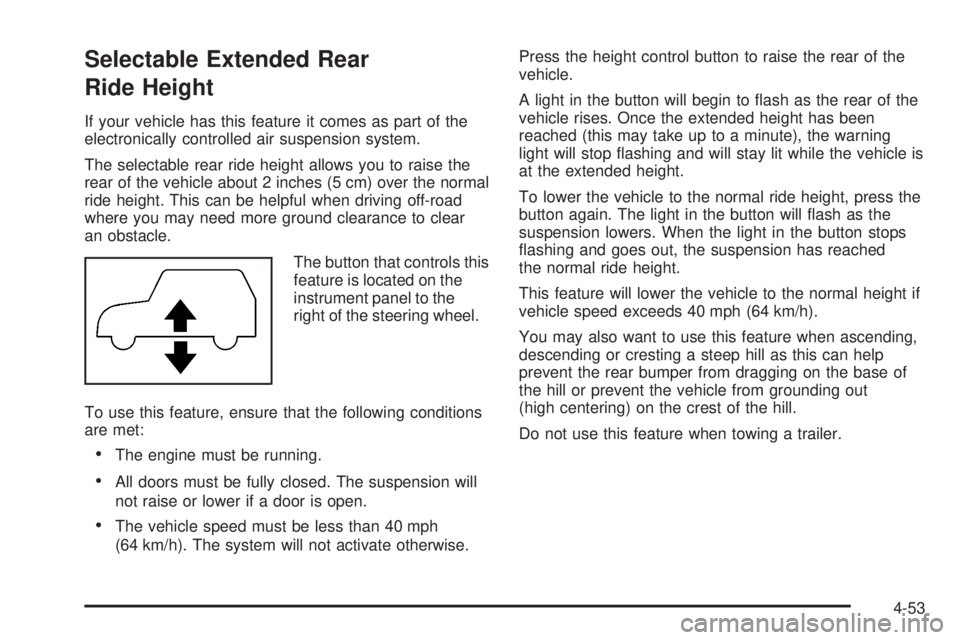
The button that controls this
feature is located on the
instrument panel to the
right of the steering wheel.
To use this feature, ensure that the following conditions
are met:
The engine must be running.
All doors must be fully closed. The suspension will
not raise or lower if a door is open.
The vehicle speed must be less than 40 mph
(64 km/h). The system will not activate otherwise.Press the height control button to raise the rear of the
vehicle.
A light in the button will begin to ash as the rear of the
vehicle rises. Once the extended height has been
reached (this may take up to a minute), the warning
light will stop ashing and will stay lit while the vehicle is
at the extended height.
To lower the vehicle to the normal ride height, press the
button again. The light in the button will ash as the
suspension lowers. When the light in the button stops
ashing and goes out, the suspension has reached
the normal ride height.
This feature will lower the vehicle to the normal height if
vehicle speed exceeds 40 mph (64 km/h).
You may also want to use this feature when ascending,
descending or cresting a steep hill as this can help
prevent the rear bumper from dragging on the base of
the hill or prevent the vehicle from grounding out
(high centering) on the crest of the hill.
Do not use this feature when towing a trailer.
4-53
Page 325 of 504
Tow/Haul mode is most effective when the vehicle and
trailer combined weight is at least 75 percent of the
vehicle’s Gross Combination Weight Rating (GCWR).
See “Weight of the Trailer” later in this section.
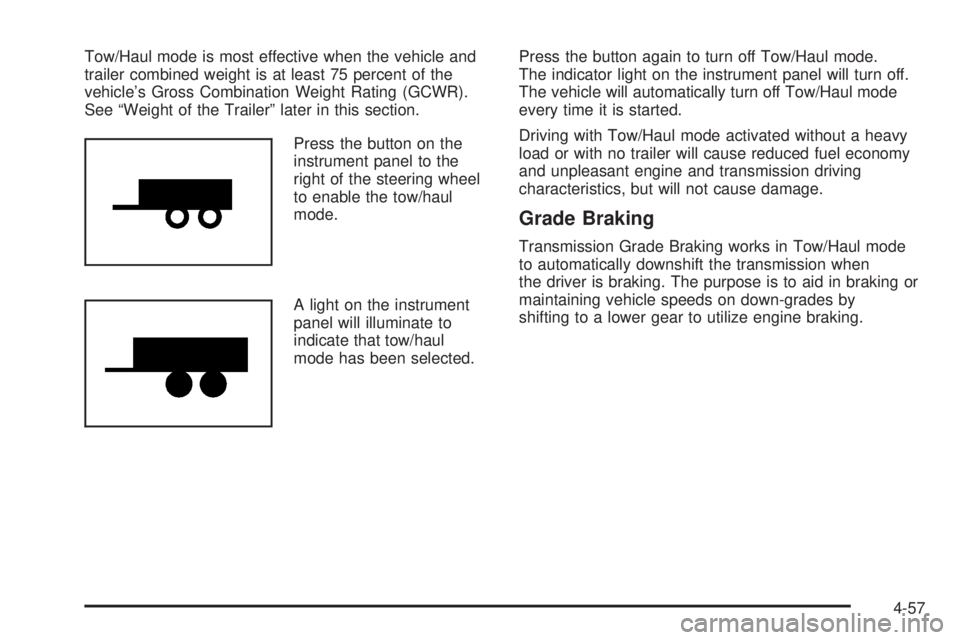
Press the button on the
instrument panel to the
right of the steering wheel
to enable the tow/haul
mode.
A light on the instrument
panel will illuminate to
indicate that tow/haul
mode has been selected.Press the button again to turn off Tow/Haul mode.
The indicator light on the instrument panel will turn off.
The vehicle will automatically turn off Tow/Haul mode
every time it is started.
Driving with Tow/Haul mode activated without a heavy
load or with no trailer will cause reduced fuel economy
and unpleasant engine and transmission driving
characteristics, but will not cause damage.
Grade Braking
Transmission Grade Braking works in Tow/Haul mode
to automatically downshift the transmission when
the driver is braking. The purpose is to aid in braking or
maintaining vehicle speeds on down-grades by
shifting to a lower gear to utilize engine braking.
4-57
Page 326 of 504
Weight of the Trailer
How heavy can a trailer safely be?
It depends on how you plan to use your rig. For example,
speed, altitude, road grades, outside temperature and
how much your vehicle is used to pull a trailer are all
important. It can also depend on any special equipment
that you have on your vehicle, and the amount of tongue
weight the vehicle can carry. See “Weight of the Trailer
Tongue” later in this section for more information.Maximum trailer weight is calculated assuming only the
driver is in the tow vehicle and it has all the required
trailering equipment. The weight of additional optional
equipment, passengers and cargo in the tow vehicle
must be subtracted from the maximum trailer weight.
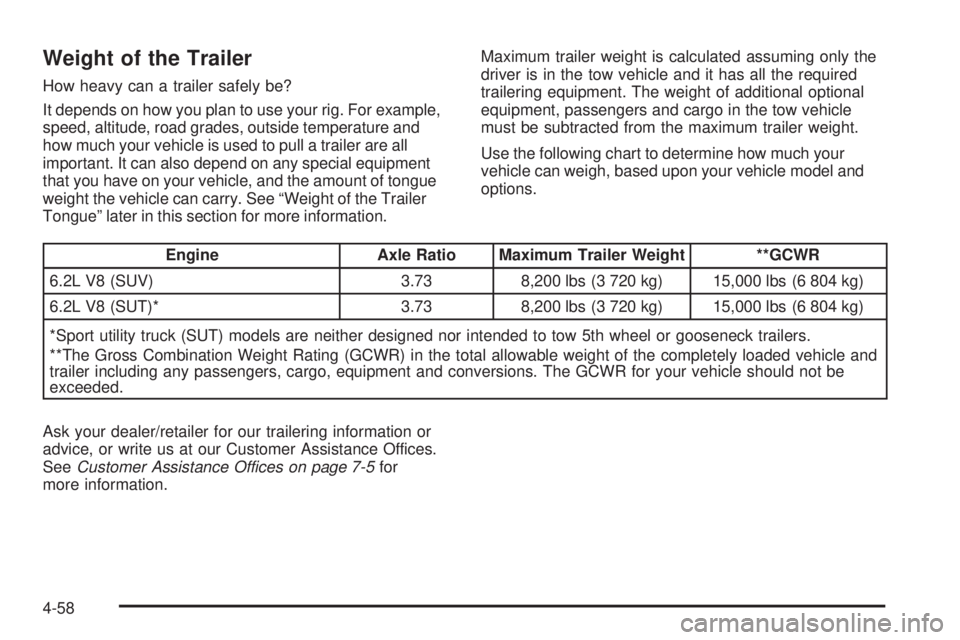
Use the following chart to determine how much your
vehicle can weigh, based upon your vehicle model and
options.
Engine Axle Ratio Maximum Trailer Weight **GCWR
6.2L V8 (SUV) 3.73 8,200 lbs (3 720 kg) 15,000 lbs (6 804 kg)
6.2L V8 (SUT)* 3.73 8,200 lbs (3 720 kg) 15,000 lbs (6 804 kg)
*Sport utility truck (SUT) models are neither designed nor intended to tow 5th wheel or gooseneck trailers.
**The Gross Combination Weight Rating (GCWR) in the total allowable weight of the completely loaded vehicle and
trailer including any passengers, cargo, equipment and conversions. The GCWR for your vehicle should not be
exceeded.
Ask your dealer/retailer for our trailering information or
advice, or write us at our Customer Assistance Offices.
SeeCustomer Assistance Offices on page 7-5for
more information.
4-58
Page 331 of 504
Driving with a Trailer
Towing a trailer requires a certain amount of experience.
Before setting out for the open road, you’ll want to get to
know your rig. Acquaint yourself with the feel of handling
and braking with the added weight of the trailer. And
always keep in mind that the vehicle you are driving is
now a good deal longer and not nearly as responsive as
your vehicle is by itself.
Before you start, check all trailer hitch parts and
attachments, safety chains, electrical connector, lamps,
tires and mirror adjustment. If the trailer has electric
brakes, start your vehicle and trailer moving and then
apply the trailer brake controller by hand to be sure
the brakes are working. This lets you check your
electrical connection at the same time.
During your trip, check occasionally to be sure that the
load is secure, and that the lamps and any trailer
brakes are still working.
Following Distance
Stay at least twice as far behind the vehicle ahead as
you would when driving your vehicle without a trailer.
This can help you avoid situations that require
heavy braking and sudden turns.
Passing
You will need more passing distance up ahead when
you’re towing a trailer. Because you are a good deal
longer, you will need to go much farther beyond the
passed vehicle before you can return to your lane.
Backing Up
Hold the bottom of the steering wheel with one hand.
Then, to move the trailer to the left, just move that hand
to the left. To move the trailer to the right, move your
hand to the right. Always back up slowly and, if possible,
have someone guide you.
4-63
Page 333 of 504
Parking on Hills
{CAUTION:
You really should not park your vehicle, with a
trailer attached, on a hill. If something goes
wrong, your rig could start to move. People
can be injured, and both your vehicle and the
trailer can be damaged.
But if you ever have to park your rig on a hill, here is
how to do it:
1. Apply your regular brakes, but do not shift into
PARK (P) yet.
2. Have someone place chocks under the trailer
wheels.
3. When the wheel chocks are in place, release the
regular brakes until the chocks absorb the load.
4. Reapply the regular brakes. Then apply your
parking brake and shift into PARK (P).
5. Release the regular brakes.
When You Are Ready to Leave After
Parking on a Hill
1. Apply your regular brakes and hold the pedal down
while you:
start your engine,
shift into a gear, and
release the parking brake.
2. Let up on the brake pedal.
3. Drive slowly until the trailer is clear of the chocks.
4. Stop and have someone pick up and store the
chocks.
Maintenance When Trailer Towing
Your vehicle will need service more often when you’re
pulling a trailer. See the Maintenance Schedule for more
on this. Things that are especially important in trailer
operation are automatic transmission uid (do not
overll), engine oil, axle lubricant, belts, cooling system
and brake system. Each of these is covered in this
manual, and the Index will help you nd them quickly.
If you are trailering, it is a good idea to review these
sections before you start your trip.
Check periodically to see that all hitch nuts and bolts
are tight.
4-65