lights HUMMER H2 2009 Owner's Manual
[x] Cancel search | Manufacturer: HUMMER, Model Year: 2009, Model line: H2, Model: HUMMER H2 2009Pages: 524, PDF Size: 3.1 MB
Page 294 of 524
Traction Control Operation
The traction control system is part of the
StabiliTrak system. Traction control limits wheel
spin by reducing engine power to the wheels (engine
speed management) and by applying brakes to
each individual wheel (brake-traction control) as
necessary.
The traction control system is enabled automatically
when the vehicle is started. It will activate and the
StabiliTrak light will ash if it senses that any of the
wheels are spinning or beginning to lose traction while
driving. If the traction control is turned off, only the
brake-traction control portion of traction control will work.
The engine speed management will be disabled. In this
mode, engine power is not reduced automatically and the
driven wheels can spin more freely. This can cause the
brake-traction control to activate constantly.
Notice:If the wheel(s) of one axle is allowed to
spin excessively while the StabiliTrak, ABS
and brake warning lights and any relevant DIC
messages are displayed, the transfer case could bedamaged. The repairs would not be covered by the
vehicle warranty. Reduce engine power and do
not spin the wheel(s) excessively while these lights
and messages are displayed.
The traction control system may activate on dry or
rough roads or under conditions such as heavy
acceleration while turning or abrupt upshifts/downshifts
of the transmission. When this happens, a reduction
in acceleration may be noticed, or a noise or vibration
may be heard. This is normal.
If cruise control is being used when StabiliTrak activates,
the cruise control automatically disengages. The
cruise control can be re-engaged when road conditions
allow. SeeCruise Control on page 3-12.
StabiliTrak may also turn off automatically if it determines
that a problem exists with the system. If the problem does
not clear itself after restarting the vehicle, see your
dealer/retailer for service.
4-8
Page 309 of 524

Surface Obstacles:Unseen or hidden obstacles can
be hazardous. A rock, log, hole, rut, or bump can startle
you if you are not prepared for them. Often these
obstacles are hidden by grass, bushes, snow, or even
the rise and fall of the terrain itself.
Some things to consider:
Is the path ahead clear?
Will the surface texture change abruptly up ahead?
Does the travel take you uphill or downhill?
Will you have to stop suddenly or change direction
quickly?
When driving over obstacles or rough terrain, keep a rm
grip on the steering wheel. Ruts, troughs, or other surface
features can jerk the wheel out of your hands.
When driving over bumps, rocks, or other obstacles, the
wheels can leave the ground. If this happens, even with
one or two wheels, you cannot control the vehicle as well
or at all.
Because you will be on an unpaved surface, it is
especially important to avoid sudden acceleration,
sudden turns, or sudden braking.
Off-roading requires a different kind of alertness from
driving on paved roads and highways. There are no road
signs, posted speed limits, or signal lights. Use good
judgment about what is safe and what is not.
Crossing Obstacles
Approach Angle — a Key to Mobility
If you encounter a large dip in the terrain, do not
enter straight on; enter at an angle — 15° minimum
approach (A), 75° maximum approach angle (B). For
very large dips, ditches or small washes, coast in, using
the engine as a brake (transmission and transfer case
lowest gears). Then, use the low ranges in the
transmission and transfer case to power out.
4-23
Page 385 of 524
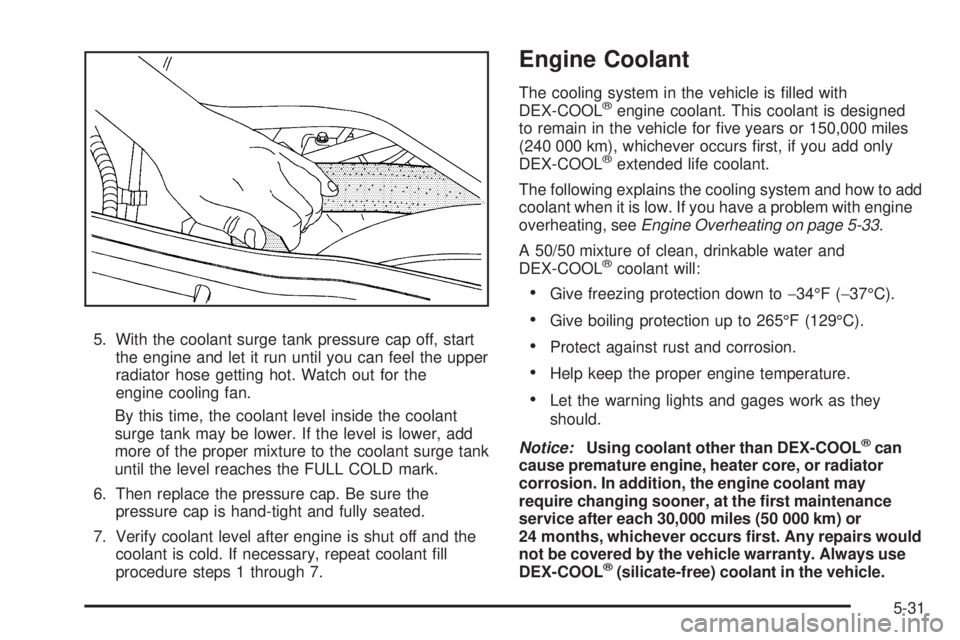
5. With the coolant surge tank pressure cap off, start
the engine and let it run until you can feel the upper
radiator hose getting hot. Watch out for the
engine cooling fan.
By this time, the coolant level inside the coolant
surge tank may be lower. If the level is lower, add
more of the proper mixture to the coolant surge tank
until the level reaches the FULL COLD mark.
6. Then replace the pressure cap. Be sure the
pressure cap is hand-tight and fully seated.
7. Verify coolant level after engine is shut off and the
coolant is cold. If necessary, repeat coolant ll
procedure steps 1 through 7.
Engine Coolant
The cooling system in the vehicle is lled with
DEX-COOL®engine coolant. This coolant is designed
to remain in the vehicle for ve years or 150,000 miles
(240 000 km), whichever occurs rst, if you add only
DEX-COOL
®extended life coolant.
The following explains the cooling system and how to add
coolant when it is low. If you have a problem with engine
overheating, seeEngine Overheating on page 5-33.
A 50/50 mixture of clean, drinkable water and
DEX-COOL
®coolant will:
Give freezing protection down to−34°F (−37°C).
Give boiling protection up to 265°F (129°C).
Protect against rust and corrosion.
Help keep the proper engine temperature.
Let the warning lights and gages work as they
should.
Notice:Using coolant other than DEX-COOL
®can
cause premature engine, heater core, or radiator
corrosion. In addition, the engine coolant may
require changing sooner, at the rst maintenance
service after each 30,000 miles (50 000 km) or
24 months, whichever occurs rst. Any repairs would
not be covered by the vehicle warranty. Always use
DEX-COOL
®(silicate-free) coolant in the vehicle.
5-31
Page 517 of 524
I
Ignition Positions.............................................2-28
Infants and Young Children, Restraints...............1-43
Ination - Tire Pressure...................................5-63
Instrument Panel
Brightness..................................................3-17
Cluster.......................................................3-30
Overview..................................................... 3-4
J
Jump Starting.................................................5-42
K
Keyless Entry System....................................... 2-4
Keys............................................................... 2-3
L
Labeling, Tire Sidewall.....................................5-58
Lamp
Malfunction Indicator....................................3-40
Lamps
Dome ........................................................3-18
Dome Lamp Override...................................3-18
Reading.....................................................3-18Lap-Shoulder Belt...........................................1-34
LATCH System for Child Restraints...................1-51
Liftgate
Carbon Monoxide........................................2-13
Light
Airbag Off..................................................3-33
Airbag Readiness........................................3-32
Antilock Brake System (ABS) Warning............3-38
Brake System Warning.................................3-37
Charging System.........................................3-35
Cruise Control.............................................3-44
Highbeam On.............................................3-44
Low Fuel Warning.......................................3-46
Oil Pressure...............................................3-43
Safety Belt Reminders..................................3-32
Security.....................................................3-44
StabiliTrak
®Indicator....................................3-38
Tire Pressure..............................................3-39
Tow/Haul Mode...........................................3-44
Lighting
Entry/Exit...................................................3-18
Lights
Exterior Lamps............................................3-15
Flash-to-Pass............................................... 3-9
High/Low Beam Changer................................ 3-9
On Reminder..............................................3-16
Loading Your Vehicle.......................................4-44
Locking Rear Axle...........................................4-10
Lockout Protection..........................................2-12
7
Page 524 of 524
W
Warning Lights, Gages, and Indicators...............3-29
Warnings
DIC Warnings and Messages........................3-56
Hazard Warning Flashers............................... 3-6
Safety and Symbols......................................... iii
Wheels
Alignment and Tire Balance..........................5-76
Different Size..............................................5-74
Replacement...............................................5-76
Where to Put the Restraint...............................1-50
Windows.......................................................2-19
Power ........................................................2-20
Windshield
Backglass, and Wiper Blades, Cleaning........5-107
Washer......................................................3-10
Washer Fluid..............................................5-37Windshield (cont.)
Wiper Blade Replacement.............................5-56
Wiper Fuses.............................................5-110
Wipers.......................................................3-10
Windshield, Rear Washer/Wiper........................3-11
Winter Driving................................................4-37
X
XM Radio Messages.....................................3-105
XM™ Satellite Radio Antenna System..............3-130
Y
Your Vehicle and the Environment....................... 6-2
14