height HUMMER H2 2009 Owners Manual
[x] Cancel search | Manufacturer: HUMMER, Model Year: 2009, Model line: H2, Model: HUMMER H2 2009Pages: 524, PDF Size: 3.1 MB
Page 6 of 524
Head Restraints
The front seats have adjustable head restraints in the
outboard seating positions.
{CAUTION:
With head restraints that are not installed and
adjusted properly, there is a greater chance that
occupants will suffer a neck/spinal injury in a
crash. Do not drive until the head restraints for all
occupants are installed and adjusted properly.
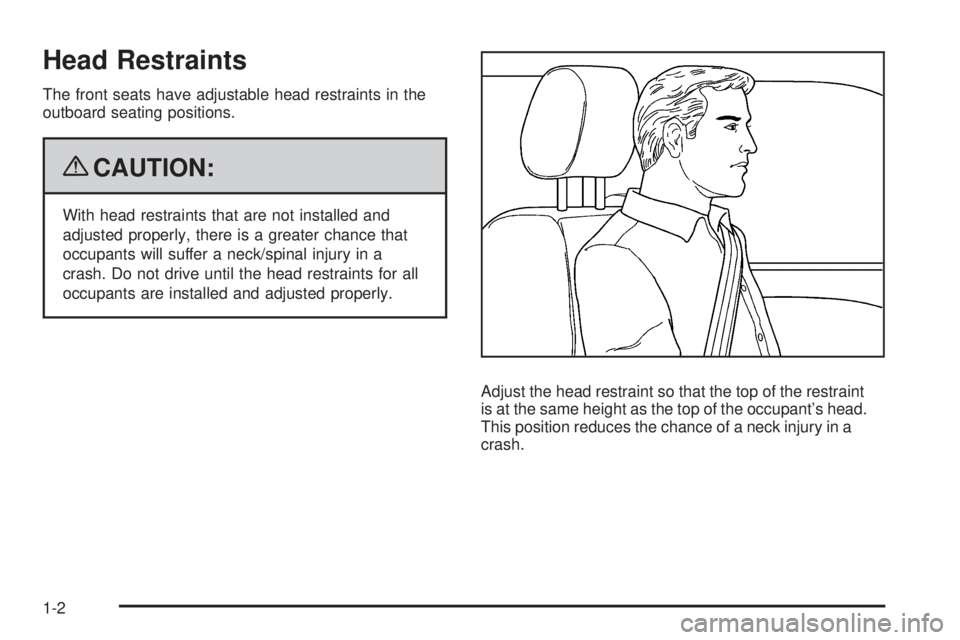
Adjust the head restraint so that the top of the restraint
is at the same height as the top of the occupant’s head.
This position reduces the chance of a neck injury in a
crash.
1-2
Page 9 of 524
Power LumbarIf the seats have power lumbar, the controls used to
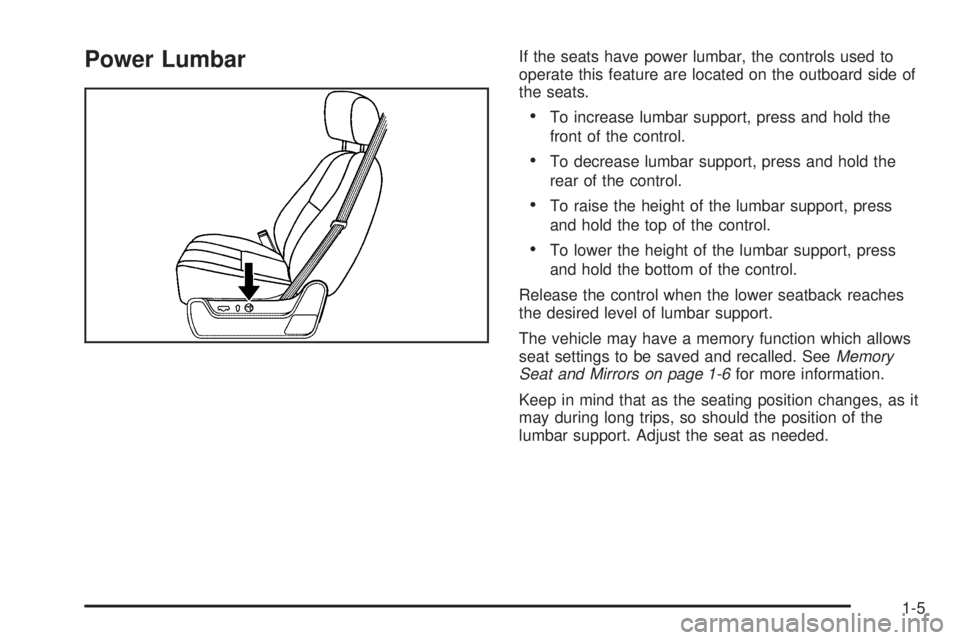
operate this feature are located on the outboard side of
the seats.
To increase lumbar support, press and hold the
front of the control.
To decrease lumbar support, press and hold the
rear of the control.
To raise the height of the lumbar support, press
and hold the top of the control.
To lower the height of the lumbar support, press
and hold the bottom of the control.
Release the control when the lower seatback reaches
the desired level of lumbar support.
The vehicle may have a memory function which allows
seat settings to be saved and recalled. SeeMemory
Seat and Mirrors on page 1-6for more information.
Keep in mind that as the seating position changes, as it
may during long trips, so should the position of the
lumbar support. Adjust the seat as needed.
1-5
Page 44 of 524

Child Restraints
Older Children
Older children who have outgrown booster seats should
wear the vehicle’s safety belts.The manufacturer’s instructions that come with the
booster seat state the weight and height limitations for
that booster. Use a booster seat with a lap-shoulder belt
until the child passes the below t test:
Sit all the way back on the seat. Do the knees bend
at the seat edge? If yes, continue. If no, return to
the booster seat.
Buckle the lap-shoulder belt. Does the shoulder belt
rest on the shoulder? If yes, continue. If no, try
using the rear safety belt comfort guide. See “Rear
Safety Belt Comfort Guides” underLap-Shoulder
Belt on page 1-34for more information. If the
shoulder belt still does not rest on the shoulder,
then return to the booster seat.
Does the lap belt t low and snug on the hips,
touching the thighs? If yes, continue. If no, return to
the booster seat.
Can proper safety belt t be maintained for the
length of the trip? If yes, continue. If no, return
to the booster seat.
If you have the choice, a child should sit in a
position with a lap-shoulder belt and get the
additional restraint a shoulder belt can provide.
1-40
Page 50 of 524

Q:What are the different types of add-on child
restraints?
A:Add-on child restraints, which are purchased by the
vehicle’s owner, are available in four basic types.
Selection of a particular restraint should take into
consideration not only the child’s weight, height, and
age but also whether or not the restraint will be
compatible with the motor vehicle in which it will
be used.
For most basic types of child restraints, there are
many different models available. When purchasing a
child restraint, be sure it is designed to be used in a
motor vehicle. If it is, the restraint will have a label
saying that it meets federal motor vehicle safety
standards.
The restraint manufacturer’s instructions that come
with the restraint state the weight and height
limitations for a particular child restraint. In addition,
there are many kinds of restraints available for
children with special needs.
{CAUTION:
To reduce the risk of neck and head injury during
a crash, infants need complete support. This is
because an infant’s neck is not fully developed
and its head weighs so much compared with the
rest of its body. In a crash, an infant in a
rear-facing child restraint settles into the restraint,
so the crash forces can be distributed across the
strongest part of an infant’s body, the back and
shoulders. Infants should always be secured in
rear-facing child restraints.
1-46
Page 83 of 524
Servicing Your Airbag-Equipped
Vehicle
Airbags affect how the vehicle should be serviced.
There are parts of the airbag system in several places
around the vehicle. Your dealer/retailer and the
service manual have information about servicing the
vehicle and the airbag system. To purchase a service
manual, seeService Publications Ordering Information
on page 7-15.
{CAUTION:
For up to 10 seconds after the ignition is turned off
and the battery is disconnected, an airbag can still
inate during improper service. You can be injured
if you are close to an airbag when it inates. Avoid
yellow connectors. They are probably part of the
airbag system. Be sure to follow proper service
procedures, and make sure the person performing
work for you is qualied to do so.
Adding Equipment to Your
Airbag-Equipped Vehicle
Q:Is there anything I might add to or change
about the vehicle that could keep the airbags
from working properly?
A:Yes. If you add things that change your vehicle’s
frame, bumper system, height, front end or side
sheet metal, they may keep the airbag system from
working properly. Changing or moving any parts
of the front seats, safety belts, the airbag sensing
and diagnostic module, steering wheel, instrument
panel, roof-rail airbag modules, ceiling headliner
or pillar garnish trim, overhead console, front
sensors, side impact sensors, rollover sensor
module, or airbag wiring can affect the operation of
the airbag system.
If you have any questions about this, you should
contact Customer Assistance before you modify
your vehicle. The phone numbers and addresses for
Customer Assistance are in Step Two of the
Customer Satisfaction Procedure in this manual.
SeeCustomer Satisfaction Procedure on page 7-2.
If your vehicle has rollover roof-rail airbags, seeDifferent
Size Tires and Wheels on page 5-74for additional
important information.
1-79
Page 161 of 524
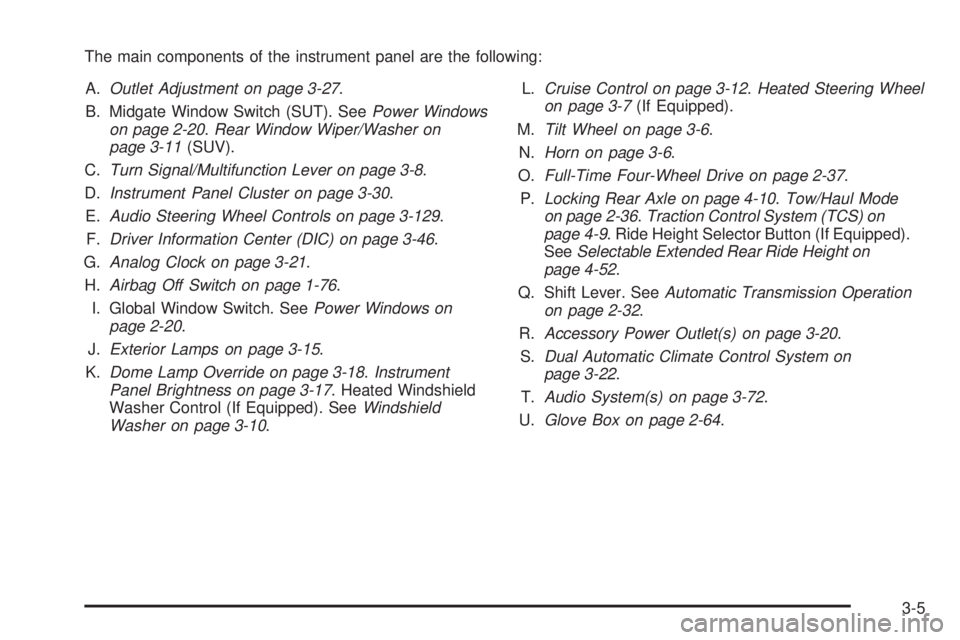
The main components of the instrument panel are the following:
A.Outlet Adjustment on page 3-27.
B. Midgate Window Switch (SUT). SeePower Windows
on page 2-20.Rear Window Wiper/Washer on
page 3-11(SUV).
C.Turn Signal/Multifunction Lever on page 3-8.
D.Instrument Panel Cluster on page 3-30.
E.Audio Steering Wheel Controls on page 3-129.
F.Driver Information Center (DIC) on page 3-46.
G.Analog Clock on page 3-21.
H.Airbag Off Switch on page 1-76.
I. Global Window Switch. SeePower Windows on
page 2-20.
J.Exterior Lamps on page 3-15.
K.Dome Lamp Override on page 3-18.Instrument
Panel Brightness on page 3-17. Heated Windshield
Washer Control (If Equipped). SeeWindshield
Washer on page 3-10.L.Cruise Control on page 3-12.Heated Steering Wheel
on page 3-7(If Equipped).
M.Tilt Wheel on page 3-6.
N.Horn on page 3-6.
O.Full-Time Four-Wheel Drive on page 2-37.
P.Locking Rear Axle on page 4-10.Tow/Haul Mode
on page 2-36.Traction Control System (TCS) on
page 4-9. Ride Height Selector Button (If Equipped).
SeeSelectable Extended Rear Ride Height on
page 4-52.
Q. Shift Lever. SeeAutomatic Transmission Operation
on page 2-32.
R.Accessory Power Outlet(s) on page 3-20.
S.Dual Automatic Climate Control System on
page 3-22.
T.Audio System(s) on page 3-72.
U.Glove Box on page 2-64.
3-5
Page 287 of 524
Your Driving, the Road, and the Vehicle............4-2
Driving for Better Fuel Economy.......................4-2
Defensive Driving...........................................4-2
Drunk Driving.................................................4-3
Control of a Vehicle........................................4-3
Braking.........................................................4-4
Antilock Brake System (ABS)...........................4-5
Braking in Emergencies...................................4-6
StabiliTrak
®System........................................4-6
Traction Control System (TCS).........................4-9
Locking Rear Axle........................................4-10
Steering......................................................4-11
Off-Road Recovery.......................................4-13
Passing.......................................................4-13
Loss of Control.............................................4-13
Off-Road Driving...........................................4-15
Assist Steps.................................................4-33
Driving at Night............................................4-33
Driving in Rain and on Wet Roads..................4-34
Before Leaving on a Long Trip.......................4-35Highway Hypnosis........................................4-35
Hill and Mountain Roads................................4-36
Winter Driving..............................................4-37
If Your Vehicle is Stuck in Sand, Mud,
Ice, or Snow.............................................4-39
Rocking Your Vehicle to Get It Out.................4-40
Recovery Loops...........................................4-40
First Aid Kit and Tool Kit...............................4-42
Front Mounted Receiver.................................4-43
Power Winch Platform...................................4-43
Loading the Vehicle......................................4-44
Towing..........................................................4-50
Towing Your Vehicle.....................................4-50
Recreational Vehicle Towing...........................4-50
Selectable Extended Rear Ride Height.............4-52
Electronically Controlled Air Suspension
System....................................................4-53
Towing a Trailer...........................................4-55
Trailer Recommendations...............................4-68
Section 4 Driving Your Vehicle
4-1
Page 338 of 524

Dolly Towing
The vehicle cannot be dolly towed. If the vehicle must
be towed behind another vehicle, use the dinghy towing
procedure explained previously.
Notice:Dolly towing the vehicle will damage
drivetrain components. Do not dolly tow the vehicle.
Selectable Extended Rear Ride
Height
If the vehicle has this feature it comes as part of the
electronically controlled air suspension system.
The selectable rear ride height allows the rear of the
vehicle to be raised about 2 inches (5 cm) over the
normal ride height. This can be helpful when driving
off-road where more ground clearance may be needed
to clear an obstacle.
The button that controls
this feature is located on
the instrument panel to the
right of the steering wheel.
4-52
Page 339 of 524

To use this feature, ensure that the following conditions
are met:
The engine must be running.
All doors must be fully closed. The suspension will
not raise or lower if a door is open.
The vehicle speed must be less than 40 mph
(64 km/h). The system will not activate otherwise.
Press the height control button to raise the rear of the
vehicle.
A light in the button will begin to ash as the rear of
the vehicle rises. Once the extended height has been
reached (this may take up to a minute), the warning light
will stop ashing and will stay lit while the vehicle is at the
extended height.
To lower the vehicle to the normal ride height, press the
button again. The light in the button will ash as the
suspension lowers. When the light in the button stops
ashing and goes out, the suspension has reached
the normal ride height.
This feature will lower the vehicle to the normal height if
vehicle speed exceeds 40 mph (64 km/h).
This feature may also be used when ascending,
descending or cresting a steep hill to help prevent the
rear bumper from dragging on the base of the hill
or prevent the vehicle from grounding out (high
centering) on the crest of the hill.
Do not use this feature when towing a trailer.
Electronically Controlled Air
Suspension System
With this feature, the electronically controlled air
suspension keeps the rear of the vehicle level under all
load conditions. The system maintains the vehicle at the
currently selected ride height. There are two ride heights:
Normal Ride Height and Extended Ride Height. The
Extended Ride Height feature is only available if the
vehicle speed is below 40 mph (64 km/h). If the vehicle is
at Extended Ride Height and the speed exceeds 40 mph
(64 km/h), the system will automatically return the vehicle
to Normal Ride Height.
The activation and
deactivation of the
Extended Ride Height
feature is controlled by
this switch on the
instrument panel.
4-53
Page 340 of 524
The system includes a compressor, two height sensors
and two air springs supporting the vehicle.
The system is activated when the engine is started
and deactivated when the ignition is returned to OFF.
The engine must be running for the rear of the vehicle to
be raised and the doors must be closed to enable a
transition between Normal Ride Height and Extended
Ride Height.
The compressor may be heard while the system is
active and the release of air similar to a hissing sound
may also be heard. This is normal.
Load leveling will not function normally with the inater
hose attached to the inator outlet. Remove the
hose from the outlet when it is not in use. See
Accessory Inflator on page 5-78.Overload and Overheat Protection
Overload protection is designed to protect the air
suspension system and is an indication to the driver that
the vehicle is overloaded.
If the rear suspension remains at a low height, the rear
axle load has exceeded GAWR (Gross Axle Weight
Rating). When the overload protection mode is activated,
the compressor operates for about 30 seconds to one
minute without raising the vehicle depending on the
amount of overload. This will continue each time the
ignition is turned on until the rear axle load is reduced
below GAWR. The system may reactivate without cycling
the ignition if some of the excess load is removed.
If the total rear GAWR (Gross Axle Weight Rating) is
reached, the suspension may be slightly less than level.
This is normal and does not mean there is a problem
with the air suspension.
In some instances the compressor may stop working
due to being overheated. This is normal. In the instance
of an abnormal overheat condition though the
compressor will stop working and the SERVICE
SUSPENSION SYSTEM will be displayed on the DIC.
SeeDIC Warnings and Messages on page 3-56for
more information.
4-54