height HUMMER H2 2009 User Guide
[x] Cancel search | Manufacturer: HUMMER, Model Year: 2009, Model line: H2, Model: HUMMER H2 2009Pages: 524, PDF Size: 3.1 MB
Page 394 of 524

Brake Wear
This vehicle has disc brakes. Disc brake pads have
built-in wear indicators that make a high-pitched warning
sound when the brake pads are worn and new pads
are needed. The sound can come and go or be heard all
the time the vehicle is moving, except when applying
the brake pedal rmly.
{CAUTION:
The brake wear warning sound means that soon
the brakes will not work well. That could lead to an
accident. When the brake wear warning sound is
heard, have the vehicle serviced.
Notice:Continuing to drive with worn-out brake
pads could result in costly brake repair.
Some driving conditions or climates can cause a brake
squeal when the brakes are rst applied or lightly applied.
This does not mean something is wrong with the brakes.Properly torqued wheel nuts are necessary to help
prevent brake pulsation. When tires are rotated, inspect
brake pads for wear and evenly tighten wheel nuts in
the proper sequence to torque specications in
Capacities and Specifications on page 5-117.
Brake linings should always be replaced as complete
axle sets.
Brake Pedal Travel
See your dealer/retailer if the brake pedal does not
return to normal height, or if there is a rapid increase in
pedal travel. This could be a sign that brake service
might be required.
Brake Adjustment
Every brake stop, the disc brakes adjust for wear.
5-40
Page 412 of 524
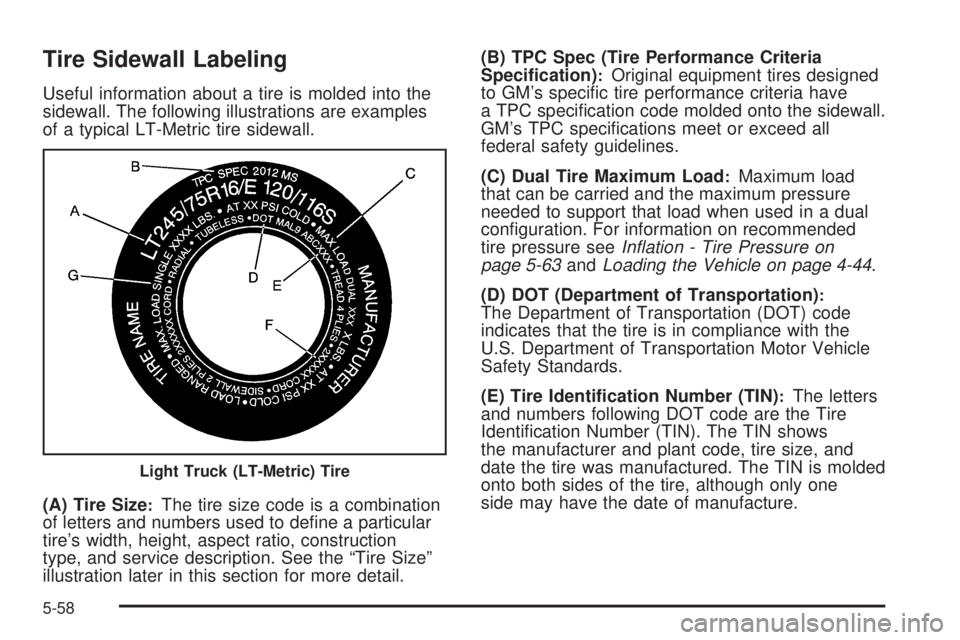
Tire Sidewall Labeling
Useful information about a tire is molded into the
sidewall. The following illustrations are examples
of a typical LT-Metric tire sidewall.
(A) Tire Size
:The tire size code is a combination
of letters and numbers used to dene a particular
tire’s width, height, aspect ratio, construction
type, and service description. See the “Tire Size”
illustration later in this section for more detail.(B) TPC Spec (Tire Performance Criteria
Specication)
:Original equipment tires designed
to GM’s specic tire performance criteria have
a TPC specication code molded onto the sidewall.
GM’s TPC specications meet or exceed all
federal safety guidelines.
(C) Dual Tire Maximum Load
:Maximum load
that can be carried and the maximum pressure
needed to support that load when used in a dual
conguration. For information on recommended
tire pressure seeInflation - Tire Pressure on
page 5-63andLoading the Vehicle on page 4-44.
(D) DOT (Department of Transportation)
:The Department of Transportation (DOT) code
indicates that the tire is in compliance with the
U.S. Department of Transportation Motor Vehicle
Safety Standards.
(E) Tire Identication Number (TIN)
:The letters
and numbers following DOT code are the Tire
Identication Number (TIN). The TIN shows
the manufacturer and plant code, tire size, and
date the tire was manufactured. The TIN is molded
onto both sides of the tire, although only one
side may have the date of manufacture.
Light Truck (LT-Metric) Tire
5-58
Page 413 of 524
(F) Tire Ply Material:The type of cord and
number of plies in the sidewall and under
the tread.
(G) Single Tire Maximum Load
:Maximum load
that can be carried and the maximum pressure
needed to support that load when used as a
single. For information on recommended
tire pressure seeInflation - Tire Pressure on
page 5-63andLoading the Vehicle on page 4-44.
Tire Size
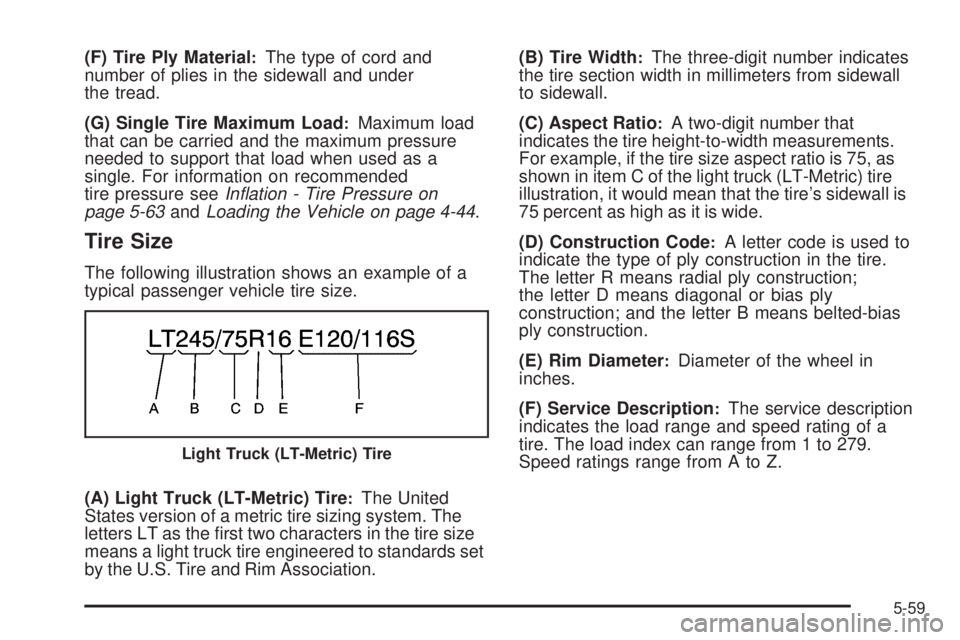
The following illustration shows an example of a
typical passenger vehicle tire size.
(A) Light Truck (LT-Metric) Tire
:The United
States version of a metric tire sizing system. The
letters LT as the rst two characters in the tire size
means a light truck tire engineered to standards set
by the U.S. Tire and Rim Association.(B) Tire Width
:The three-digit number indicates
the tire section width in millimeters from sidewall
to sidewall.
(C) Aspect Ratio
:A two-digit number that
indicates the tire height-to-width measurements.
For example, if the tire size aspect ratio is 75, as
shown in item C of the light truck (LT-Metric) tire
illustration, it would mean that the tire’s sidewall is
75 percent as high as it is wide.
(D) Construction Code
:A letter code is used to
indicate the type of ply construction in the tire.
The letter R means radial ply construction;
the letter D means diagonal or bias ply
construction; and the letter B means belted-bias
ply construction.
(E) Rim Diameter
:Diameter of the wheel in
inches.
(F) Service Description
:The service description
indicates the load range and speed rating of a
tire. The load index can range from 1 to 279.
Speed ratings range from A to Z.
Light Truck (LT-Metric) Tire
5-59
Page 414 of 524

Tire Terminology and Denitions
Air Pressure:The amount of air inside the
tire pressing outward on each square inch of the
tire. Air pressure is expressed in pounds per
square inch (psi) or kilopascal (kPa).
Accessory Weight
:This means the combined
weight of optional accessories. Some examples of
optional accessories are, automatic transmission,
power steering, power brakes, power windows,
power seats, and air conditioning.
Aspect Ratio
:The relationship of a tire’s height
to its width.
Belt
:A rubber coated layer of cords that is
located between the plies and the tread. Cords
may be made from steel or other reinforcing
materials.
Bead
:The tire bead contains steel wires wrapped
by steel cords that hold the tire onto the rim.
Bias Ply Tire
:A pneumatic tire in which the plies
are laid at alternate angles less than 90 degrees
to the centerline of the tread.Cold Tire Pressure
:The amount of air pressure in
a tire, measured in pounds per square inch (psi) or
kilopascals (kPa) before a tire has built up heat
from driving. SeeInflation - Tire Pressure on
page 5-63.
Curb Weight
:The weight of a motor vehicle with
standard and optional equipment including the
maximum capacity of fuel, oil, and coolant,
but without passengers and cargo.
DOT Markings
:A code molded into the sidewall
of a tire signifying that the tire is in compliance
with the U.S. Department of Transportation (DOT)
motor vehicle safety standards. The DOT code
includes the Tire Identication Number (TIN),
an alphanumeric designator which can also identify
the tire manufacturer, production plant, brand,
and date of production.
GVWR
:Gross Vehicle Weight Rating. See
Loading the Vehicle on page 4-44.
GAWR FRT
:Gross Axle Weight Rating for the
front axle. SeeLoading the Vehicle on page 4-44.
GAWR RR
:Gross Axle Weight Rating for the
rear axle. SeeLoading the Vehicle on page 4-44.
5-60
Page 431 of 524

If you need to replace any of your wheels, wheel bolts,
wheel nuts, or Tire Pressure Monitor System (TPMS)
sensors, replace them only with new GM original
equipment parts. This way, you will be sure to have the
right wheel, wheel bolts, wheel nuts, and TPMS
sensors for your vehicle.
{CAUTION:
Using the wrong replacement wheels, wheel bolts,
or wheel nuts on your vehicle can be dangerous. It
could affect the braking and handling of your
vehicle, make your tires lose air and make you
lose control. You could have a collision in which
you or others could be injured. Always use the
correct wheel, wheel bolts, and wheel nuts for
replacement.
Notice:The wrong wheel can also cause problems
with bearing life, brake cooling, speedometer or
odometer calibration, headlamp aim, bumper height,
vehicle ground clearance, and tire or tire chain
clearance to the body and chassis.
SeeChanging a Flat Tire on page 5-80for more
information.
Used Replacement Wheels
{CAUTION:
Putting a used wheel on the vehicle is dangerous.
You cannot know how it has been used or how far
it has been driven. It could fail suddenly and
cause a crash. If you have to replace a wheel, use
a new GM original equipment wheel.
Tire Chains
Notice:Use tire chains only where legal and only
when you must. Use chains that are the proper size
for the vehicle’s tires. Install them on the tires of
the rear axle. Do not use chains on the tires of the
front axle. Tighten them as tightly as possible
with the ends securely fastened. Drive slowly and
follow the chain manufacturer’s instructions. If
you can hear the chains contacting the vehicle, stop
and retighten them. If the contact continues, slow
down until it stops. Driving too fast or spinning the
wheels with chains on will damage the vehicle.
5-77
Page 520 of 524

Power Winch Platform.....................................4-43
Privacy..........................................................7-16
Event Data Recorders..................................7-17
Navigation System.......................................7-18
OnStar .......................................................7-18
Radio Frequency Identication.......................7-18
Programmable Automatic Door Locks.................2-11
R
Radio Frequency Identication (RFID), Privacy....7-18
Radio(s)........................................................3-75
Radios
Navigation/Radio System, see Navigation
Manual.................................................3-107
Rear Seat Audio........................................3-127
Reception.................................................3-129
Setting the Clock.........................................3-73
Theft-Deterrent..........................................3-128
Reading Lamps..............................................3-18
Rear Air Conditioning and Heating System and
Electronic Climate Controls...........................3-28
Rear Axle......................................................5-47
Locking......................................................4-10
Rear Door Security Locks................................2-12
Rear Heated Seats.........................................1-10
Rear Seat Armrest..........................................2-65
Rear Seat Audio (RSA)..................................3-127
Rear Seat Entertainment System.....................3-118Rear Vision Camera........................................2-50
Rear Windshield Washer/Wiper.........................3-11
Rearview Mirror, Automatic Dimming..................2-47
Reclining Seatbacks, Power............................... 1-8
Recommended Fluids and Lubricants.................6-13
Recovery Loops..............................................4-40
Recreational Vehicle Towing.............................4-50
Remote Keyless Entry (RKE) System.................. 2-4
Remote Keyless Entry (RKE) System, Operation . . . 2-5
Remote Vehicle Start........................................ 2-7
Removing the Flat Tire and Installing the
Spare Tire..................................................5-90
Removing the Spare Tire and Tools...........5-82, 5-86
Replacement Bulbs.........................................5-55
Replacement Parts, Maintenance......................6-15
Reporting Safety Defects
Canadian Government..................................7-15
General Motors...........................................7-15
United States Government............................7-14
Restraint System Check
Checking the Restraint Systems....................
1-80
Replacing Restraint System Parts
After a Crash..........................................1-81
Retained Accessory Power...............................2-29
Ride Height, Selectable Extended Rear Ride......4-52
Roadside
Service........................................................ 7-7
Rocking Your Vehicle to Get it Out....................4-40
Routing, Engine Drive Belt...............................6-16
Running the Vehicle While Parked.....................2-46
10
Page 521 of 524
S
Safety Belt Reminders.....................................3-32
Safety Belts
Care of ....................................................5-105
How to Wear Safety Belts Properly................1-25
Lap-Shoulder Belt........................................1-34
Safety Belt Extender....................................1-39
Safety Belt Use During Pregnancy.................1-39
Safety Belts Are for Everyone.......................1-20
Safety Warnings and Symbols.............................. iii
Scheduled Maintenance..................................... 6-4
Seats
Bucket Seats, Rear......................................1-13
Heated Seats............................................... 1-6
Heated Seats - Rear....................................1-10
Memory, Mirrors............................................ 1-6
Power Lumbar .............................................. 1-5
Power Reclining Seatbacks............................. 1-8
Power Seats................................................. 1-4
Split Folding Rear Seat................................1-11
Third Row Seat...........................................1-14
Securing a Child Restraint
Rear Seat Position......................................1-62
Right Front Seat Position..............................1-64
Security Light.................................................3-44
Selectable Extended Rear Ride Height...............4-52Service........................................................... 5-3
Accessories and Modications......................... 5-3
Adding Equipment to the Outside of
the Vehicle................................................ 5-5
California Perchlorate Materials Requirements.... 5-4
California Proposition 65 Warning.................... 5-4
Doing Your Own Work................................... 5-4
Engine Soon Lamp......................................3-40
Publications Ordering Information...................7-15
Service, Scheduling Appointments.....................7-10
Servicing Your Airbag-Equipped Vehicle..............1-79
Setting the Clock............................................3-73
Sheet Metal Damage.....................................5-108
Shifting Into Park............................................2-43
Shifting Out of Park........................................2-44
Side Steps.....................................................4-33
Signals, Turn and Lane-Change.......................... 3-8
Spare Tire....................................................5-101
Carrier, Tailgate...........................................2-16
Installing....................................................5-90
Removing...........................................5-82, 5-86
Storing...............................................5-95, 5-98
Specications, Capacities...............................5-117
Speedometer..................................................3-31
Split Folding Rear Seat....................................1-11
StabiliTrak
®Indicator Light...............................3-38
StabiliTrak®System.......................................... 4-6
11