air condition HUMMER H3 2008 Owners Manual
[x] Cancel search | Manufacturer: HUMMER, Model Year: 2008, Model line: H3, Model: HUMMER H3 2008Pages: 416, PDF Size: 5.66 MB
Page 30 of 416
Shoulder Belt Height Adjuster
Your vehicle has a shoulder belt height adjuster for
the driver and right front passenger.
Adjust the height so that the shoulder portion of the belt
is centered on your shoulder. The belt should be away
from your face and neck, but not falling off your shoulder.
Improper shoulder belt height adjustment could reduce
the effectiveness of the safety belt in a crash.
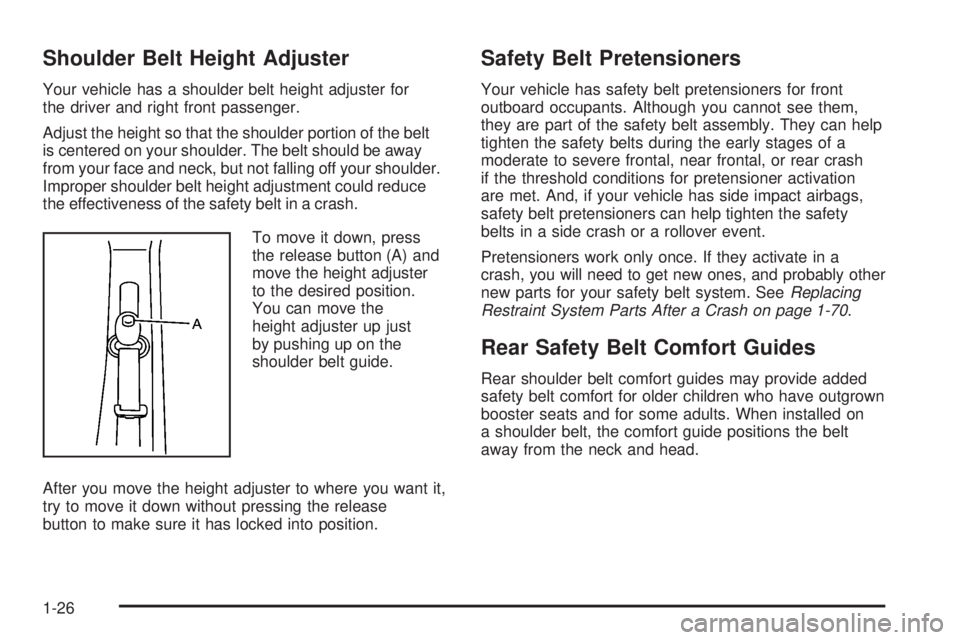
To move it down, press
the release button (A) and
move the height adjuster
to the desired position.
You can move the
height adjuster up just
by pushing up on the
shoulder belt guide.
After you move the height adjuster to where you want it,
try to move it down without pressing the release
button to make sure it has locked into position.
Safety Belt Pretensioners
Your vehicle has safety belt pretensioners for front
outboard occupants. Although you cannot see them,
they are part of the safety belt assembly. They can help
tighten the safety belts during the early stages of a
moderate to severe frontal, near frontal, or rear crash
if the threshold conditions for pretensioner activation
are met. And, if your vehicle has side impact airbags,
safety belt pretensioners can help tighten the safety
belts in a side crash or a rollover event.
Pretensioners work only once. If they activate in a
crash, you will need to get new ones, and probably other
new parts for your safety belt system. SeeReplacing
Restraint System Parts After a Crash on page 1-70.
Rear Safety Belt Comfort Guides
Rear shoulder belt comfort guides may provide added
safety belt comfort for older children who have outgrown
booster seats and for some adults. When installed on
a shoulder belt, the comfort guide positions the belt
away from the neck and head.
1-26
Page 55 of 416

Securing a Child Restraint in the
Right Front Seat Position
Your vehicle has airbags. A rear seat is a safer place to
secure a forward-facing child restraint. SeeWhere to
Put the Restraint on page 1-40.
In addition, your vehicle has a passenger sensing system
which is designed to turn off the right front passenger’s
frontal airbag under certain conditions. SeePassenger
Sensing System on page 1-62andPassenger Airbag
Status Indicator on page 3-30for more information on
this, including important safety information.
A label on your sun visor says, “Never put a rear-facing
child seat in the front.” This is because the risk to the
rear-facing child is so great, if the airbag deploys.
{CAUTION:
A child in a rear-facing child restraint can be
seriously injured or killed if the right front
passenger’s airbag inates. This is because
the back of the rear-facing child restraint
would be very close to the inating airbag.
CAUTION: (Continued)
CAUTION: (Continued)
Even though the passenger sensing system is
designed to turn off the right front passenger’s
frontal airbag if the system detects a rear-facing
child restraint, no system is fail-safe, and no
one can guarantee that an airbag will not deploy
under some unusual circumstance, even
though it is turned off. We recommend that
rear-facing child restraints be secured in a
rear seat, even if the airbag is off.
If you secure a forward-facing child restraint
in the right front seat, always move the front
passenger seat as far back as it will go. It is
better to secure the child restraint in a rear seat.
SeePassenger Sensing System on page 1-62
for additional information.
If your child restraint has the LATCH system, seeLower
Anchors and Tethers for Children (LATCH) on page 1-42
for how to install your child restraint using LATCH. If you
secure a child restraint using a safety belt and it uses a
top tether, seeLower Anchors and Tethers for Children
(LATCH) on page 1-42for top tether anchor locations.
1-51
Page 67 of 416
The passenger sensing system will turn off the right
front passenger’s frontal airbag under certain conditions.
The driver’s airbags are not part of the passenger
sensing system.
The passenger sensing system works with sensors that
are part of the right front passenger’s seat and safety
belt. The sensors are designed to detect the presence of
a properly-seated occupant and determine if the right
front passenger’s frontal airbag should be enabled
(may inate) or not.
Accident statistics show that children are safer if they
are restrained in the rear rather than the front seat.
We recommend that children be secured in a rear seat,
including: an infant or a child riding in a rear-facing
child restraint; a child riding in a forward-facing child
seat; an older child riding in a booster seat; and children,
who are large enough, using safety belts.
A label on your sun visor says, “Never put a rear-facing
child seat in the front.” This is because the risk to the
rear-facing child is so great, if the airbag deploys.
{CAUTION:
A child in a rear-facing child restraint can be
seriously injured or killed if the right front
passenger’s airbag inates. This is because
the back of the rear-facing child restraint
would be very close to the inating airbag.
Even though the passenger sensing system is
designed to turn off the right front passenger’s
frontal airbag if the system detects a rear-facing
child restraint, no system is fail-safe, and no
one can guarantee that an airbag will not deploy
under some unusual circumstance, even
though it is turned off. We recommend that
rear-facing child restraints be secured in a rear
seat, even if the airbag is off.
If you secure a forward-facing child restraint
in the right front seat, always move the front
passenger seat as far back as it will go. It is
better to secure the child restraint in a rear seat.
1-63
Page 99 of 416
DRIVE (D):This position is for normal driving.
It provides the best fuel economy for your vehicle.
If you need more power for passing, and you are:
Going less than about 35 mph (55 km/h),
push your accelerator pedal about halfway down.
Going about 35 mph (55 km/h) or more,
push the accelerator all the way down.
Downshifting the transmission in slippery road conditions
could result in skidding, see “Skidding” underLoss of
Control on page 4-10.
DRIVE (D) can be used when towing a trailer. You may
want to shift the transmission to THIRD (3) or, if
necessary, a lower gear if the transmission shifts too
often under heavy loads and/or hilly conditions.
THIRD (3):This position is also used for normal
driving. However it reduces vehicle speed more than
DRIVE (D) without using your brakes. You might
choose THIRD (3) instead of DRIVE (D) when driving
on hilly, winding roads, when towing a trailer, so there
is less shifting between gears and when going down
a steep hill.SECOND (2): This position reduces vehicle speed
even more than THIRD (3) without using your brakes.
You can use SECOND (2) on hills. It can help
control your speed as you go down steep mountain
roads, but then you would also want to use your
brakes off and on.
FIRST (1): This position reduces vehicle speed even
more than SECOND (2) without using your brakes.
You can use it on very steep hills, or in deep snow or
mud. If the shift lever is put in FIRST (1) while the
vehicle is moving forward, the transmission will not shift
into rst gear until the vehicle is going slowly enough.
Notice:Spinning the tires or holding the vehicle
in one place on a hill using only the accelerator
pedal may damage the transmission. The repair will
not be covered by your warranty. If you are stuck,
do not spin the tires. When stopping on a hill,
use the brakes to hold the vehicle in place.
2-25
Page 122 of 416
OnStar®System
OnStar uses several innovative technologies and live
advisors to provide you with a wide range of safety,
security, information, and convenience services.
If your airbags deploy, the system is designed to
make an automatic call to OnStar Emergency advisors
who can request emergency services be sent to
your location. If you lock your keys in the vehicle,
call OnStar at 1-888-4-ONSTAR and they can send
a signal to unlock your doors. If you need roadside
assistance, press the OnStar button and they can
contact Roadside Service for you.
OnStar service is provided to you subject to the
OnStar Terms and Conditions. You may cancel your
OnStar service at any time by contacting OnStar
as provided below. A complete OnStar Owner’s Guide
and the OnStar Terms and Conditions are included
in the vehicle’s OnStar Subscriber glove box literature.For more information, visit onstar.com or onstar.ca,
contact OnStar at 1-888-4-ONSTAR (1-888-466-7827)
or TTY 1-877-248-2080, or press the OnStar button
to speak with an OnStar advisor 24 hours a day,
7 days a week.
Not all OnStar features are available on all vehicles.
To check if your vehicle is equipped to provide the
services described below, or for a full description of
OnStar services and system limitations, see the OnStar
Owner’s Guide in your glove box or visit onstar.com.OnStar Services
For new vehicles equipped with OnStar, the Safe &
Sound Plan, or the Directions & Connections Plan
is included for one year from the date of purchase.
You can extend this plan beyond the rst year, or
upgrade to the Directions & Connections Plan.
For more information, press the OnStar button to
speak with an advisor. Some OnStar services (such
as Remote Door Unlock or Stolen Vehicle Location
Assistance) may not be available until you register
with OnStar.
2-48
Page 156 of 416
Ashtray(s) and Cigarette Lighter
Your vehicle may have an ashtray and cigarette lighter.
Your ashtray is located in your center console area.
The ashtray can be removed for cleaning. When
the ashtray is removed, this area can also be used as a
cupholder.
Notice:If you put papers, pins, or other ammable
items in the ashtray, hot cigarettes or other
smoking materials could ignite them and possibly
damage your vehicle. Never put ammable items in
the ashtray.
To use the lighter, press it in all the way, and let go.
When it’s ready, it will pop back out by itself.
Notice:Holding a cigarette lighter in while it is
heating does not let the lighter back away from the
heating element when it is hot. Damage from
overheating can occur to the lighter or heating
element, or a fuse could be blown. Do not hold a
cigarette lighter in while it is heating.
Climate Controls
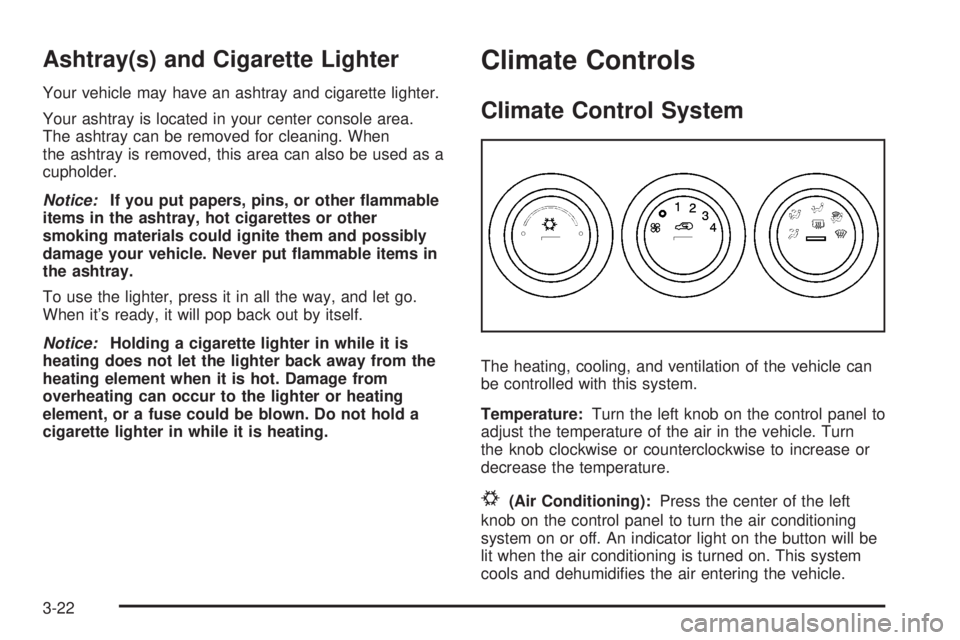
Climate Control System
The heating, cooling, and ventilation of the vehicle can
be controlled with this system.
Temperature:Turn the left knob on the control panel to
adjust the temperature of the air in the vehicle. Turn
the knob clockwise or counterclockwise to increase or
decrease the temperature.
#(Air Conditioning):Press the center of the left
knob on the control panel to turn the air conditioning
system on or off. An indicator light on the button will be
lit when the air conditioning is turned on. This system
cools and dehumidies the air entering the vehicle.
3-22
Page 157 of 416
The air conditioning will not function if the fan is turned
off. If air conditioning is selected with fan off, the
indicator light ashes three times and then turns off.
A slight change in engine performance may occur when
the air conditioning compressor shuts off and turns
on again. This is normal. The system is designed
to make adjustments to help with fuel economy while
still maintaining the selected temperature.
The air conditioning system removes moisture from the
air, so sometimes there may be a small amount of
water dripping underneath the vehicle while idling or
after turning off the engine. This is normal.
9(Fan):Turn the center knob on the control panel to
control the fan speed. Turn the knob clockwise or
counterclockwise to increase or decrease the fan speed.
9(Off):Turn the center knob to this position to turn
the fan off. With the fan off, you may still experience
airow from the system that increases with vehicle
speed depending on the mode and temperature settings.
Enable recirculation mode to stop this airow from
occurring.
@(Recirculation):Press the center of the fan
control knob to recirculate air inside the vehicle and
prevent outside air from coming in. It can be used
to prevent outside odors from entering the vehicle and
cool the air inside the vehicle more quickly. Pressthis button to turn the recirculation mode on or off. An
indicator light on the button comes on to show that
the recirculation mode is activated.
Recirculation is available in the bi-level, and vent
modes. Recirculation is not available while in oor,
oor/defog and defrost mode. If recirculation is selected
in these modes, the indicator ashes three times
indicating it is not available in that mode. When the
recirculation mode is turned on, the air conditioning turns
on automatically.
When it is hot enough outside, the recirculation mode
may turn on automatically to help improve cooling
performance. The indicator light will be lit to show this
mode is active. If the recirculation button is pressed
while in this mode, the light will ash three times
and stay on to indicate that recirculation may not be
shut off.
The right knob on the control panel is used to direct the
airow inside the vehicle. In-between modes are
available by moving the right control knob between
modes with symbols. The in-between mode is a
combination of the two modes that the control is
centered between.
Turn the right knob to select one of the following modes:
H(Vent):This mode directs air to the instrument
panel outlets.
3-23
Page 158 of 416
\(Bi-Level):This mode directs air to the instrument
panel outlets, and the remaining air to the oor
outlets and the defroster and side window outlets.
Cooler air is directed to the upper outlets and warmer
air to the oor outlets.
[(Floor):This mode directs air to the oor outlets,
side window outlets, and defroster. Recirculation is
not available in this mode.
Defogging and Defrosting
Fog on the inside of windows is a result of high humidity
(moisture) condensing on the cool window glass. This
can be minimized if the climate control system is used
properly. There are two modes to clear fog or frost from
the windshield and side windows. Use the defog mode
to clear the windows of fog or moisture and warm the
passengers. Use the defrost mode to remove fog or frost
from the windshield more quickly. For best results, clear
all snow and ice from the windshield before defrosting.
/(Floor/Defog):This mode directs the air to the
windshield, the side window outlets, and to the
oor outlets. When this mode is selected, the system
runs the air conditioning system unless the outside
temperature is near freezing or below. Recirculation is
not available in this mode.
0(Defrost):This mode directs most of the air to the
windshield, and the side window outlets. When this
mode is selected, the system runs the air conditioning
system unless the outside temperature is near or below
freezing. Recirculation is not available in this mode.
Do not drive the vehicle until all the windows are clear.
Rear Window Defogger
The rear window defogger uses a warming grid to
remove fog or frost from the rear window when the key
is in the ignition and turned to ON/RUN.
=(Rear Defogger):Press the center of the right
knob on the control panel to turn the rear window
defogger on or off. First press of this button activates
the rear window defogger for 15 minutes and each
subsequent activation lasts seven and one-half minutes.
Notice:Do not use anything sharp on the inside of
the rear window. If you do, you could cut or damage
the warming grid, and the repairs would not be
covered by your warranty. Do not attach a temporary
vehicle license, tape, a decal or anything similar to
the defogger grid.
Outlet Adjustment
Use the air outlets located in the center and on the side
of your instrument panel to direct the airow.
Your vehicle has air outlets that allow you to adjust the
direction and amount of airow inside the vehicle.
3-24
Page 159 of 416
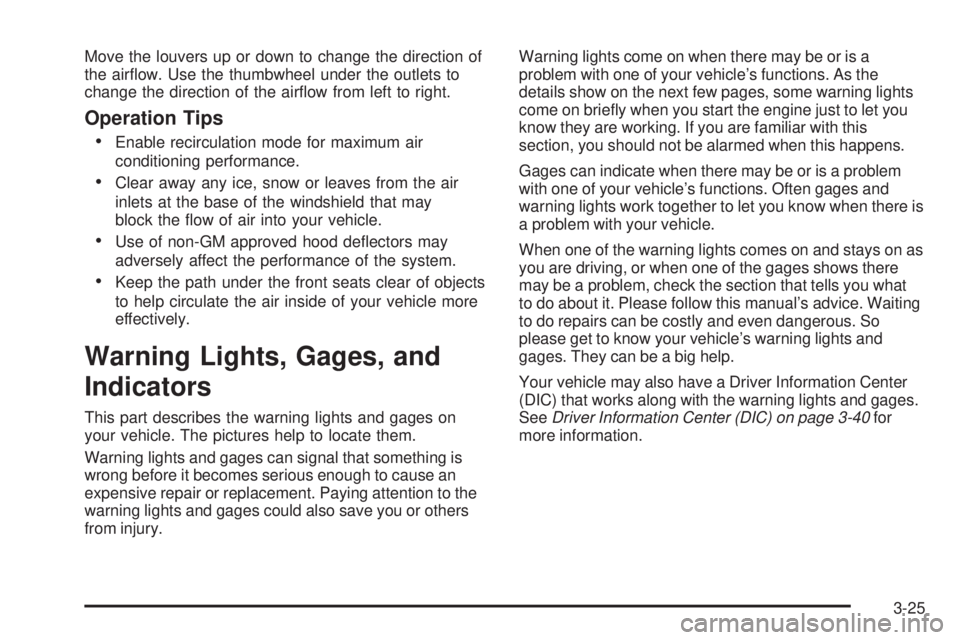
Move the louvers up or down to change the direction of
the airow. Use the thumbwheel under the outlets to
change the direction of the airow from left to right.
Operation Tips
Enable recirculation mode for maximum air
conditioning performance.
Clear away any ice, snow or leaves from the air
inlets at the base of the windshield that may
block the ow of air into your vehicle.
Use of non-GM approved hood deectors may
adversely affect the performance of the system.
Keep the path under the front seats clear of objects
to help circulate the air inside of your vehicle more
effectively.
Warning Lights, Gages, and
Indicators
This part describes the warning lights and gages on
your vehicle. The pictures help to locate them.
Warning lights and gages can signal that something is
wrong before it becomes serious enough to cause an
expensive repair or replacement. Paying attention to the
warning lights and gages could also save you or others
from injury.Warning lights come on when there may be or is a
problem with one of your vehicle’s functions. As the
details show on the next few pages, some warning lights
come on briey when you start the engine just to let you
know they are working. If you are familiar with this
section, you should not be alarmed when this happens.
Gages can indicate when there may be or is a problem
with one of your vehicle’s functions. Often gages and
warning lights work together to let you know when there is
a problem with your vehicle.
When one of the warning lights comes on and stays on as
you are driving, or when one of the gages shows there
may be a problem, check the section that tells you what
to do about it. Please follow this manual’s advice. Waiting
to do repairs can be costly and even dangerous. So
please get to know your vehicle’s warning lights and
gages. They can be a big help.
Your vehicle may also have a Driver Information Center
(DIC) that works along with the warning lights and gages.
SeeDriver Information Center (DIC) on page 3-40for
more information.
3-25
Page 166 of 416
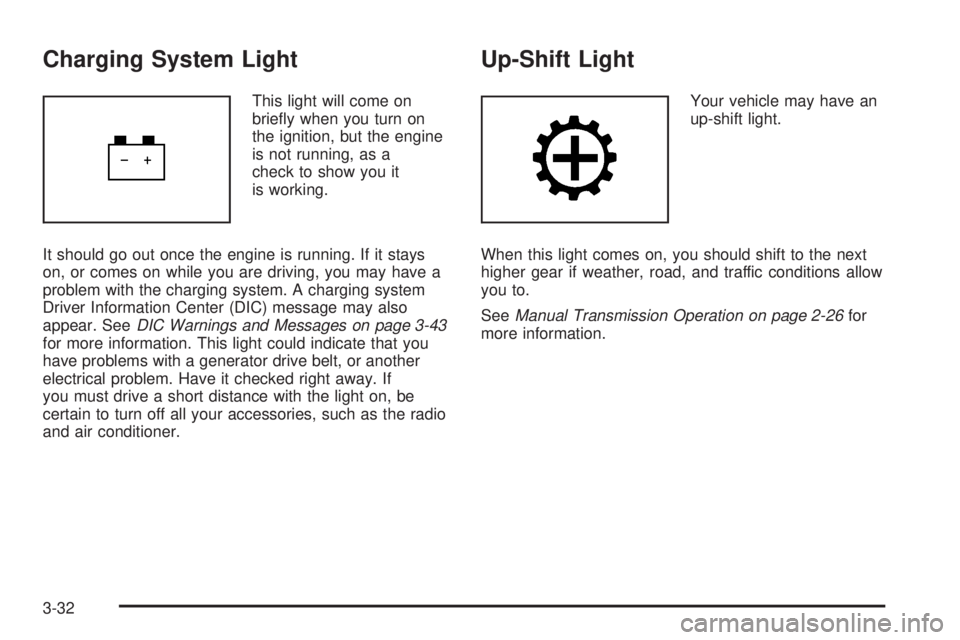
Charging System Light
This light will come on
briey when you turn on
the ignition, but the engine
is not running, as a
check to show you it
is working.
It should go out once the engine is running. If it stays
on, or comes on while you are driving, you may have a
problem with the charging system. A charging system
Driver Information Center (DIC) message may also
appear. SeeDIC Warnings and Messages on page 3-43
for more information. This light could indicate that you
have problems with a generator drive belt, or another
electrical problem. Have it checked right away. If
you must drive a short distance with the light on, be
certain to turn off all your accessories, such as the radio
and air conditioner.
Up-Shift Light
Your vehicle may have an
up-shift light.
When this light comes on, you should shift to the next
higher gear if weather, road, and traffic conditions allow
you to.
SeeManual Transmission Operation on page 2-26for
more information.
3-32