child seat Hyundai Accent 2006 User Guide
[x] Cancel search | Manufacturer: HYUNDAI, Model Year: 2006, Model line: Accent, Model: Hyundai Accent 2006Pages: 599, PDF Size: 17.59 MB
Page 51 of 599
1
FEATURES OF YOUR HYUNDAI
37
WARNING:
o Do not install a child restraint seat at the center of the rear seat using the vehicle's ISOFIX anchors. The ISOFIX anchors are only providedfor the left and right outboard rear seating positions. Do not misuse the ISOFIX anchors by attemptingto attach a child restraint seat in the middle of the rear seat to the ISOFIX anchors. In a crash, thechild restraint seat ISOFIX attach- ments may not be strong enough to secure the child restraint seatproperly in the center of the rear seat and may break, causing seri- ous injury or death.
o When using the vehicle’s "ISOFIX" system to install a child restraintsystem in the rear seat, all unusedvehicle rear seat belt metal latch plates or tabs must be latched securely in their seat belt bucklesand the seat belt webbing must be retracted behind the child restraint to prevent the child from reachingand taking hold of unretracted seat
belts. Unlatched metal latch plates
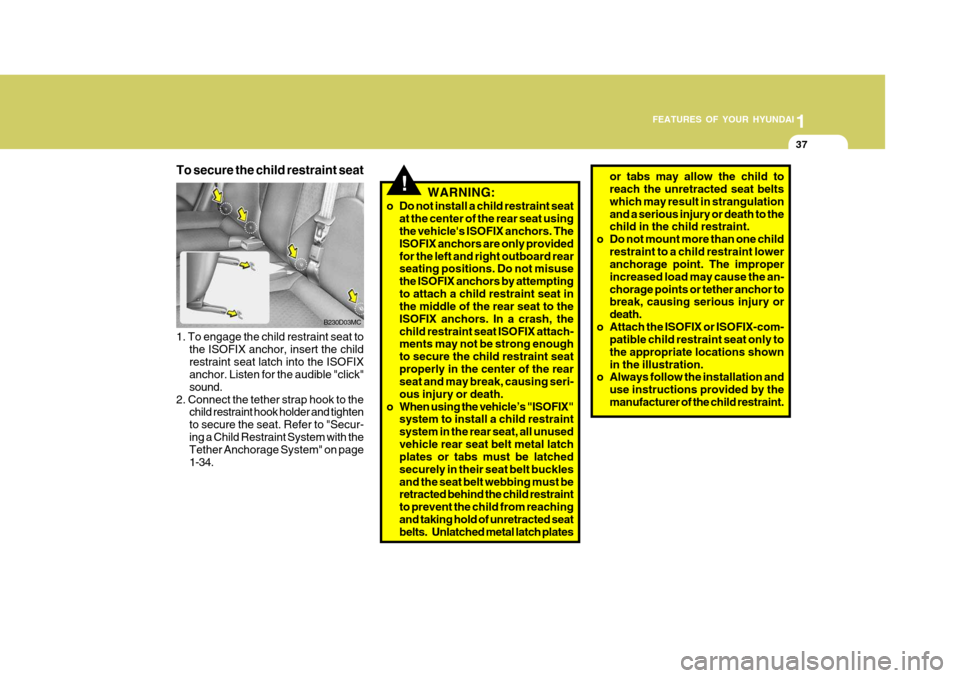
B230D03MC
1. To engage the child restraint seat to the ISOFIX anchor, insert the child restraint seat latch into the ISOFIX anchor. Listen for the audible "click" sound.
2. Connect the tether strap hook to the child restraint hook holder and tightento secure the seat. Refer to "Secur-ing a Child Restraint System with the Tether Anchorage System" on page 1-34.
To secure the child restraint seat!or tabs may allow the child to reach the unretracted seat belts which may result in strangulationand a serious injury or death to the child in the child restraint.
o Do not mount more than one child
restraint to a child restraint loweranchorage point. The improper increased load may cause the an-chorage points or tether anchor to break, causing serious injury or death.
o Attach the ISOFIX or ISOFIX-com- patible child restraint seat only tothe appropriate locations shownin the illustration.
o Always follow the installation and
use instructions provided by themanufacturer of the child restraint.
Page 52 of 599

1FEATURES OF YOUR HYUNDAI
38
L1 : Suitable for Bebe comfort ELIOS(E2 037014) approved for the use in this mass group
L2 :Suitable for PegPerego primo Viaggio (E13 030010) approved forthe use in this mass group
B230H01MC-GAT Child Seat Restraint Suitability For Seat Position Use child safety seats that have been officially approved and are appropriatefor your children. When using the child safety seats, refer to the following table.
Rear
Center
Age Group Seating Position
UU
L1, L2, L3, L4 U
U
Rear
Outboard
Front
Passenger
0 : Up to 10 kg (0 ~ 9 months)0+ : Up to 13 kg(0 ~ 9 months)I : 9kg to 18kg(9 months ~ 4years)II & III : 15kg to36kg (4 ~ 12 years) L1, L2,
L3, L4
L5, L7, L8 UU
L6, L9 U F U F
L3 : Suitable for Bebe comfort iSEOS (E2 039014) approved for the use in this mass group
L4 : Suitable for GRACO Autobaby (E11
03.44.160 / E11 03.44.161) ap-proved for the use in this mass group
L5 : Suitable for Romer Lord Plus (E1 03301136) approved for the use inthis mass group
L6 : Suitable for Euro Kids Star (E1 03301129) approved for the use inthis mass group
L7 : Suitable for BeSafe iZi COMFORT (E4 03443206) approved for theuse in this mass group
L8 : Suitable for MAXI-COSI Priori XP (E1 03301153) approved for theuse in this mass group
L9 :Suitable for Bebe comfort HiPSOS(E2 031011/E2 031017)approved for the use in this mass group
U : Suitable for "universal" category restraints approved for use in thismass group
UF :Suitable for forward-facing "univer- sal" category restraints approvedfor the use in this mass group
!WARNING:
We recommends that a child restraint seat be installed in the rear seat, even if the passenger's front airbagswitch is set to "OFF". To ensure the safety of your child, the passenger's front airbag must bedeactivated when it should be neces- sary to install a child restraint seat on the front passenger seat in excep-tional circumstances.
Page 57 of 599
1
FEATURES OF YOUR HYUNDAI
43
severely injured or killed by an airbag deployment in case of an accident.
o Do not allow children to ride in the
front passenger seat. If older chil-dren (teenagers and older) must ride in the front seat, make surethey are always properly belted and that the seat is moved back as far as possible.
o For maximum safety protection in all types of crashes, all occupantsincluding the driver should alwayswear their seat belts whether or not an airbag is also provided at their seating position to minimizethe risk of severe injury or death in the event of a crash. Do not sit or lean unnecessarily close to theairbag while the vehicle is in mo- tion.
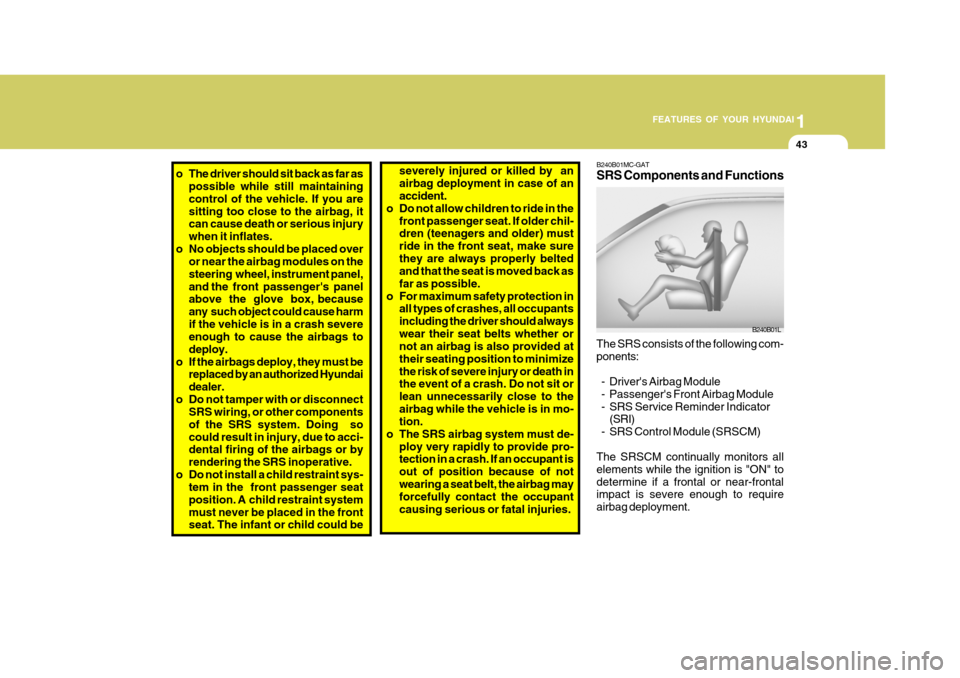
o The SRS airbag system must de- ploy very rapidly to provide pro-tection in a crash. If an occupant is out of position because of notwearing a seat belt, the airbag may forcefully contact the occupant causing serious or fatal injuries. The SRS consists of the following com-ponents:
- Driver's Airbag Module
- Passenger's Front Airbag Module
- SRS Service Reminder Indicator (SRI)
- SRS Control Module (SRSCM)
The SRSCM continually monitors allelements while the ignition is "ON" todetermine if a frontal or near-frontal impact is severe enough to require airbag deployment. B240B01MC-GAT SRS Components and Functions
B240B01L
o The driver should sit back as far as
possible while still maintaining control of the vehicle. If you aresitting too close to the airbag, it can cause death or serious injury when it inflates.
o No objects should be placed over or near the airbag modules on thesteering wheel, instrument panel,and the front passenger's panel above the glove box, because any such object could cause harmif the vehicle is in a crash severe enough to cause the airbags to deploy.
o If the airbags deploy, they must be replaced by an authorized Hyundaidealer.
o Do not tamper with or disconnect SRS wiring, or other componentsof the SRS system. Doing socould result in injury, due to acci- dental firing of the airbags or by rendering the SRS inoperative.
o Do not install a child restraint sys- tem in the front passenger seatposition. A child restraint systemmust never be placed in the front seat. The infant or child could be
Page 59 of 599

1
FEATURES OF YOUR HYUNDAI
45
o The SRS can function only when
the ignition key is in the "ON" position. If the SRS is not working properly,(1) The SRS SRI does not come on
when the ignition key is turnedto the "ON" position or after the engine is started.
(2) The SRS SRI blinks for a sec- ond and remains on after illu-minating for about 6 secondswhen the ignition key is turned to the "ON" position or after he engine is started.
(3) The SRS SRI illuminates while driving.
If this occurs, have your vehicleimmediately inspected by your Hyundai dealer.
o Before you replace a fuse or dis- connect a battery terminal, turnthe ignition key to the "LOCK" position or remove the ignitionkey. Never remove or replace the air bag related fuse(s) when the ignition key is in the "ON" posi-tion. Failure to heed this warning will cause the SRS SRI to illumi- nate.
!WARNING:
o When the SRS is activated, there may be a loud noise and fine dust will be released throughout the vehicle. These conditions are nor- mal and are not hazardous. How-ever, the fine dust generated dur- ing airbag deployment may cause skin irritation. Wash your handsand face thoroughly with lukewarm water and a mild soap after an accident in which the airbags weredeployed.
Passenger's Front Airbag
B240B05LB990A01MC-GAT Passenger's Front Airbag ON/ OFF Switch (If Installed)
B990A01MC
The passenger's front airbag can be deactivated by the passenger's frontairbag ON/OFF switch (1) if a child restraint is installed on the front passenger's seat or if the frontpassenger's seat is unoccupied by a person. To ensure the safety of your child, thepassenger's front airbag must be deac- tivated when it should be necessary to install a rearward facing child seat onthe front passenger seat in exceptional circumstances. (1)
Page 61 of 599

1
FEATURES OF YOUR HYUNDAI
47
B990B01MC-AAT Side Impact Airbag (If Installed) Your Hyundai is equipped with a side impact airbag in each front seat. The purpose of the airbag is to provide thevehicle's driver and/or the front passen- ger with additional protection than that offered by the seat belt alone. The sideimpact airbags are designed to deploy only during certain side impact colli- sions, depending on the crash severity,angle, speed and point of impact. The side impact airbags are not designed to deploy in all side impact situations.
B990B02LZ
o Even though your vehicle is equipped with the passenger's airbag ON/OFF switch, do not in-stall a child restraint system in the front passenger's seat. A child re- straint system must never beplaced in the front seat. Children who are too large for child re- straint systems should alwaysoccupy the rear seat and use the available lap/shoulder belts. Chil- dren are afforded the most safetyin the event of an accident when they are restrained by a proper restraint system in the rear seat.
o As soon as deactivation is no longer needed, reactivate the frontpassenger's airbag.!WARNING:
o The driver is responsible for the proper position of the passenger's front airbag ON/OFF switch.
o Deactivate the front passenger's
airbag only when the ignitionswitch is switched off, or the mal- function may occur in the SRSCM (SRS Control Module). And theremay be a danger that the driver's and/or passenger's front and/or side and curtain airbag may fail totrigger, or not trigger correctly during a collision.
o Never install a rearward facing
child seat on the front passenger'sseat. The infant or child could be severely injured or killed by anairbag deployment in case of an accident.
Page 63 of 599
1
FEATURES OF YOUR HYUNDAI
49
o The built in coat hooks should
only be used for light weight cloth- ing, ensure that pockets are free ofany heavy or sharp objects. When using coat hooks, do not hang clothes on coat hangers.
o The space between the occupant and the curtain airbag must neverbe occupied by children, passen-gers or pets. Occupants should never lean out or have any parts of their body protruding from thewindow while the engine is run- ning.
o Do not move the sun visor out to cover the side window if there isan item attached to it such as garage door remote control, pens,air fresheners or the like. These objects may cause injury if the Curtain Airbag is deployed.
o Where sun blinds are fitted to the rear doors, these must not ob-struct or impair the airbag in anyway.
!WARNING:
o Before installing child restraints , always refer to “Child Restraint System” to ensure correct instal- lation and occupant protection is maximized.
o Make sure that the occupant does not have any body parts (head,arms & legs) protruding outsidethe restraining system. If an inflat- ing airbag was to strike an infant child on the head, it may causeserious injury.
o Ensure the opening for the Cur-
tain Airbag System remains unob-structed at all times, so that the airbags can inflate properly if needed.
Important Safety Notes for Cur- tain Airbag Systems Following is a number of safety points concerning this system which shouldalways be observed to ensure risk of injury is reduced in an accident.
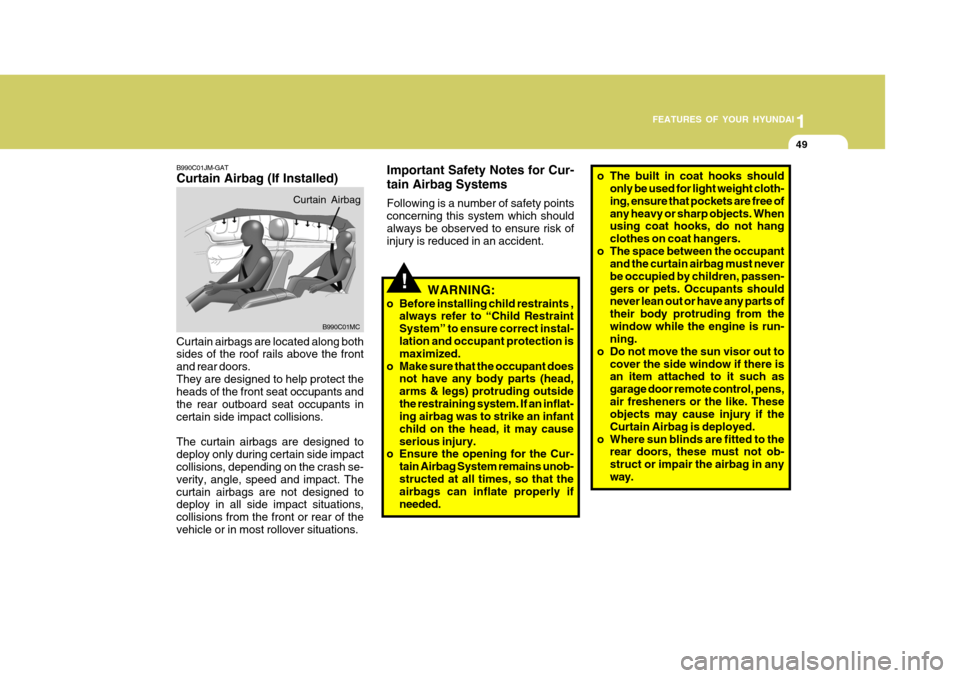
B990C01JM-GAT Curtain Airbag (If Installed)
Curtain airbags are located along both sides of the roof rails above the front and rear doors.They are designed to help protect the heads of the front seat occupants and the rear outboard seat occupants incertain side impact collisions. The curtain airbags are designed to deploy only during certain side impact collisions, depending on the crash se- verity, angle, speed and impact. Thecurtain airbags are not designed to deploy in all side impact situations, collisions from the front or rear of thevehicle or in most rollover situations. B990C01MC
Curtain Airbag
Page 64 of 599

1FEATURES OF YOUR HYUNDAI
50
!WARNING:
o Extreme Hazard! Do not use a rear- ward facing child restraint on a seat protected by an airbag in frontof it!
o Do not install a child restraint sys-
tem in the front passenger seatposition. A child restraint system must never be placed in the front seat. The infant or child could beseverely injured by an airbag de- ployment in case of an accident. B240C01HP
B240C01NF-GAT SRS Care The SRS is virtually maintenance-free and so there are no parts you can safelyservice by yourself. If the SRS SRI (Service Reminder Indicator) does not come on, or continuously remains on,have your vehicle immediately in- spected by your Hyundai dealer. Any work on the SRS system, such as removing, installing, repairing, or any work on the steering wheel must beperformed by a qualified Hyundai tech- nician. Improper handling of the SRS system may result in serious personalinjury.
o Do not install any accessories or
children’s toys in the Curtain Airbag deployment zones, as this may impair the operation of thesystem or throw parts of them into the vehicle cabin causing injury to occupants if the system is de-ployed.
o To maintain the integrity of the
Curtain Airbag system, any work,removal or installation of the airbag and associated compo- nents (such as roof lining and sidetrims) should always be performed by an authorized Hyundai dealer.
Page 283 of 599

Fuel Recommendations ................................................ 1-2
Breaking In Your New Hyundai .................................... 1-3
Key (Immobilizer System) ..................................... 1-4, 1-5
Door Locks (Theft-Alarm System) ......................... 1-7, 1-9Window Glass (Power Windows) ................................ 1-12
Seat .......................... ................................................... 1-14
Seat Belt ...................................................................... 1-19
Child Restraint System ................................................ 1-26
Supplemental Restraint (Airbag) System.................... 1-34
Dual-Stage Supplemental Restraint (AIRBAG) System ..................................................................... 1-40
Instrument Cluster and Indicator Lights .......................1-48
Warning and Indicator Lights....................................... 1-52
Trip Computer .............................................................. 1-59
Multi-function Light Switch ........................................... 1-61
Windshield Wiper/Washer Switch ................................1-63
Sunroof ........................................................................ 1-71
Mirror ........................................................................... 1-75
Hood R elease .............................................................. 1-79
Heating and Cooling Control .......... ..............................1-84
Stereo Sound System ................................................. 1-94
Audio System .............................................................. 1-96
Antenna ..................................................................... 1-113
FEATURES OF YOUR HYUNDAI
1
1
Page 289 of 599

1
FEATURES OF YOUR HYUNDAI
7
!
DOOR LOCKS
NOTE: If the engine dies while driving after limp home procedure, you can start your engine within 8 seconds with-out limp home procedure again.
5. If the immobilizer indicator blinks for five seconds, you have to try the limp home procedure again from the beginning.
After doing the limp home procedure,you have to consult with your autho-rized Hyundai dealer as soon as pos- sible.
! CAUTION:
o If you fail to try the limp home procedure with the sequence of three times, you have to wait for about one hour to do the limp home procedure again.
o If you cannot start your engine in spite of limp home procedure, haveyour vehicle towed by an autho-rized Hyundai dealer.
UNLOCK
HLC2003
LOCK
B040A02Y-AAT
B040B01A-AAT
Locking and Unlocking Front Doors With a Key
WARNING:
o Unlocked doors can be danger- ous. Before you drive away (espe- cially if there are children in the car), be sure that all the doors are securely closed and locked sothat the doors cannot be inadvert- ently opened from the inside. This helps ensure that the doors willnot be opened accidentally. Also, when combined with the proper use of seat belts, locking the doors helps keep occupants from being ejected from the car incase of an accident.
o Before opening the door, always
look for and avoid oncoming traf-fic.
o In case of accident, the door is
unlocked automatically (If In-stalled). o The door can be locked or unlocked
with a key.
o Lock the door by turning the key
toward the front of the vehicle and unlock it by turning the key toward the rear.
Page 290 of 599

1FEATURES OF YOUR HYUNDAI
8
B040D01FC-GAT Locking From the Inside To lock the doors from the inside, sim- ply close the door and push the lock switch to the "LOCK" position. Whenthis is done, neither the outside nor the inside door handle can be used.B040E03A-AAT Child-protector Rear Door Lock (If Installed) Your Hyundai is equipped with a "child- protector" rear door lock assembly.When the lock mechanism is engaged, the rear door cannot be opened from the inside. Its use is recommended when-ever there are small children in the rear seat.
NOTE: When the door is locked, the red mark on the switch is not visible and the character "LOCK" on the switchis visible.
HLC2004
LOCK
UNLOCKHLC2005
B040C04A-AAT Locking From the Outside The doors can be locked without a key. To lock the doors, first push the inside lock switch to the "LOCK" position sothat the red mark on the switch is not visible, then close the door. NOTE:
o If your vehicle is equipped with
central door locking system, the door will not lock if the key is leftin the ignition switch when the front doors close.
o When locking the door this way, be careful not to lock the door withthe ignition key left in the vehicle.
HLC2008 o To protect against theft, always
remove the ignition key, close all windows, and lock all doors and the trunk lid(4 Door)/tail gate(3/5 Door) when leaving your vehicleunattended.