maintenance schedule Hyundai Accent 2006 User Guide
[x] Cancel search | Manufacturer: HYUNDAI, Model Year: 2006, Model line: Accent, Model: Hyundai Accent 2006Pages: 599, PDF Size: 17.59 MB
Page 228 of 599
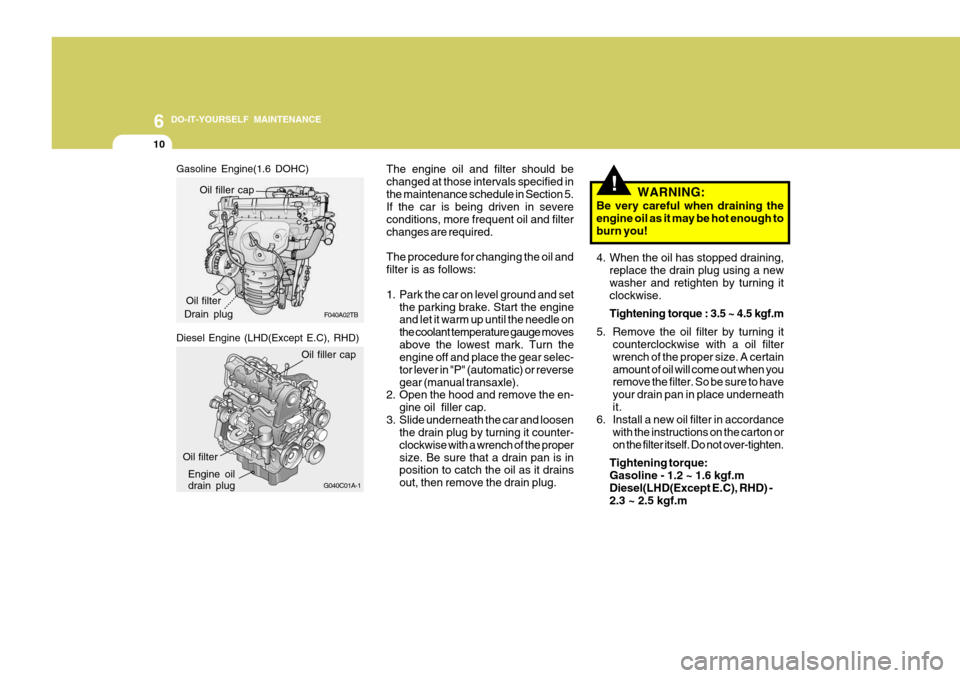
6 DO-IT-YOURSELF MAINTENANCE
10
!
The engine oil and filter should be changed at those intervals specified inthe maintenance schedule in Section 5. If the car is being driven in severe conditions, more frequent oil and filterchanges are required. The procedure for changing the oil and filter is as follows:
1. Park the car on level ground and set
the parking brake. Start the engine and let it warm up until the needle on the coolant temperature gauge movesabove the lowest mark. Turn the engine off and place the gear selec- tor lever in "P" (automatic) or reversegear (manual transaxle).
2. Open the hood and remove the en-
gine oil filler cap.
3. Slide underneath the car and loosen the drain plug by turning it counter-clockwise with a wrench of the propersize. Be sure that a drain pan is in position to catch the oil as it drains out, then remove the drain plug. WARNING:
Be very careful when draining the engine oil as it may be hot enough to burn you!
4. When the oil has stopped draining, replace the drain plug using a new washer and retighten by turning it clockwise.
Tightening torque : 3.5 ~ 4.5 kgf.m
5. Remove the oil filter by turning it counterclockwise with a oil filter wrench of the proper size. A certainamount of oil will come out when you remove the filter. So be sure to have your drain pan in place underneathit.
6. Install a new oil filter in accordance
with the instructions on the carton oron the filter itself. Do not over-tighten.
Tightening torque:Gasoline - 1.2 ~ 1.6 kgf.m Diesel(LHD(Except E.C), RHD) - 2.3 ~ 2.5 kgf.m
Diesel Engine (LHD(Except E.C), RHD)
G040C01A-1
Engine oil drain plug
Oil filter
Oil filler cap
Gasoline Engine(1.6 DOHC)
F040A02TB
Oil filler cap
Drain plug Oil filter
.........
Page 229 of 599
6
DO-IT-YOURSELF MAINTENANCE
11
!
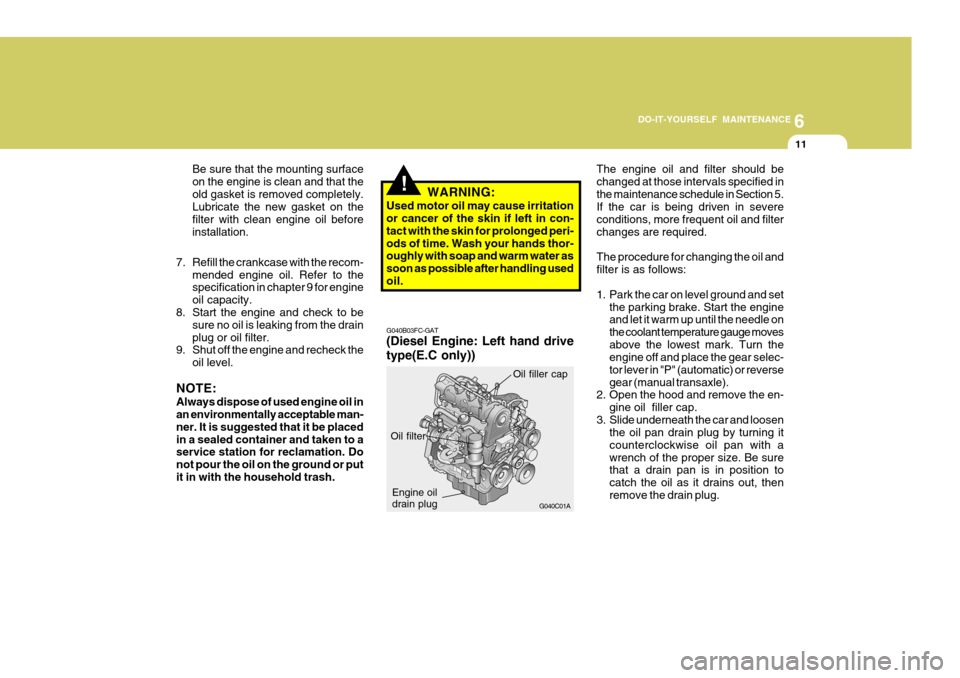
G040B03FC-GAT
(Diesel Engine: Left hand drive type(E.C only)) The engine oil and filter should be changed at those intervals specified inthe maintenance schedule in Section 5. If the car is being driven in severe conditions, more frequent oil and filterchanges are required. The procedure for changing the oil and filter is as follows:
1. Park the car on level ground and set
the parking brake. Start the engine and let it warm up until the needle on the coolant temperature gauge movesabove the lowest mark. Turn the engine off and place the gear selec- tor lever in "P" (automatic) or reversegear (manual transaxle).
2. Open the hood and remove the en-
gine oil filler cap.
3. Slide underneath the car and loosen the oil pan drain plug by turning itcounterclockwise oil pan with awrench of the proper size. Be sure that a drain pan is in position to catch the oil as it drains out, thenremove the drain plug.
Engine oil drain plug
Oil filter
G040C01A
7. Refill the crankcase with the recom-mended engine oil. Refer to the specification in chapter 9 for engine oil capacity.
8. Start the engine and check to be sure no oil is leaking from the drainplug or oil filter.
9. Shut off the engine and recheck the
oil level.
NOTE: Always dispose of used engine oil in an environmentally acceptable man- ner. It is suggested that it be placedin a sealed container and taken to a service station for reclamation. Do not pour the oil on the ground or putit in with the household trash. WARNING:
Used motor oil may cause irritation or cancer of the skin if left in con- tact with the skin for prolonged peri-ods of time. Wash your hands thor- oughly with soap and warm water as soon as possible after handling usedoil.
Oil filler cap
Be sure that the mounting surface on the engine is clean and that theold gasket is removed completely. Lubricate the new gasket on the filter with clean engine oil beforeinstallation.
Page 232 of 599
6 DO-IT-YOURSELF MAINTENANCE
14
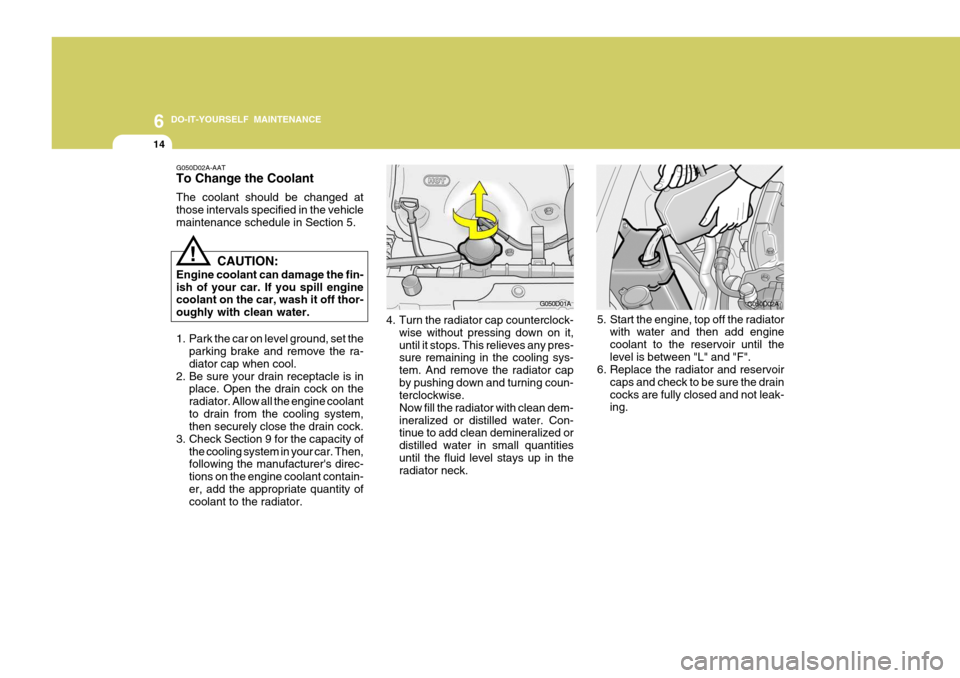
G050D01A
G050D02A-AAT To Change the Coolant The coolant should be changed at those intervals specified in the vehiclemaintenance schedule in Section 5.
CAUTION:
Engine coolant can damage the fin-ish of your car. If you spill engine coolant on the car, wash it off thor- oughly with clean water.
!
1. Park the car on level ground, set the parking brake and remove the ra- diator cap when cool.
2. Be sure your drain receptacle is in place. Open the drain cock on theradiator. Allow all the engine coolantto drain from the cooling system, then securely close the drain cock.
3. Check Section 9 for the capacity of the cooling system in your car. Then,following the manufacturer's direc- tions on the engine coolant contain-er, add the appropriate quantity of coolant to the radiator. 4. Turn the radiator cap counterclock-
wise without pressing down on it, until it stops. This relieves any pres- sure remaining in the cooling sys- tem. And remove the radiator capby pushing down and turning coun- terclockwise. Now fill the radiator with clean dem-ineralized or distilled water. Con- tinue to add clean demineralized or distilled water in small quantitiesuntil the fluid level stays up in the radiator neck. G050D02A
5. Start the engine, top off the radiator with water and then add engine coolant to the reservoir until thelevel is between "L" and "F".
6. Replace the radiator and reservoir
caps and check to be sure the draincocks are fully closed and not leak- ing.
Page 233 of 599

6
DO-IT-YOURSELF MAINTENANCE
15
!
REPLACING THE SPARK PLUGS
WARNING:
The cooling fan is controlled by engine coolant temperature andmay sometimes operate even when the engine is not running. Use ex- treme caution when working nearthe blades of the cooling fan so that you are not injured by a rotating fan blade. As the engine coolant tem-perature decreases, the fan will auto- matically shut off. This is a normal condition.
G060B02S-AAT (Gasoline Engine only)
CHAMPION NGK RC10YCBKR5ES
Unleaded
engine Leaded
engine
RC10YC4 BKR5ES-11
G060A01L
The spark plugs should be changed at the intervals specified in the vehicle maintenances schedule in Section 5 or whenever engine performance indicatesthey should be changed. Symptoms that suggest poor spark plug perfor- mance include engine misfiring underload, loss of fuel economy, poor accel- eration, etc. When spark plugs are re- placed, always use spark plugs recom-mended by Hyundai. The use of other spark plugs can result in loss of perfor- mance, radio interference or enginedamage. NOTE: When replacing the spark plugs, genuine Hyundai replacement parts are recommended. Recommended Spark Plugs:
Unleaded: 1.0 ~ 1.1 mm (0.039 ~ 0.043 in.) Leaded: 0.7 ~ 0.8 mm(0.028 ~ 0.032 in.)
Page 237 of 599
6
DO-IT-YOURSELF MAINTENANCE
19
!
CHECKING THE TRANSAXLE OIL (MANUAL)
G100A03A-GAT
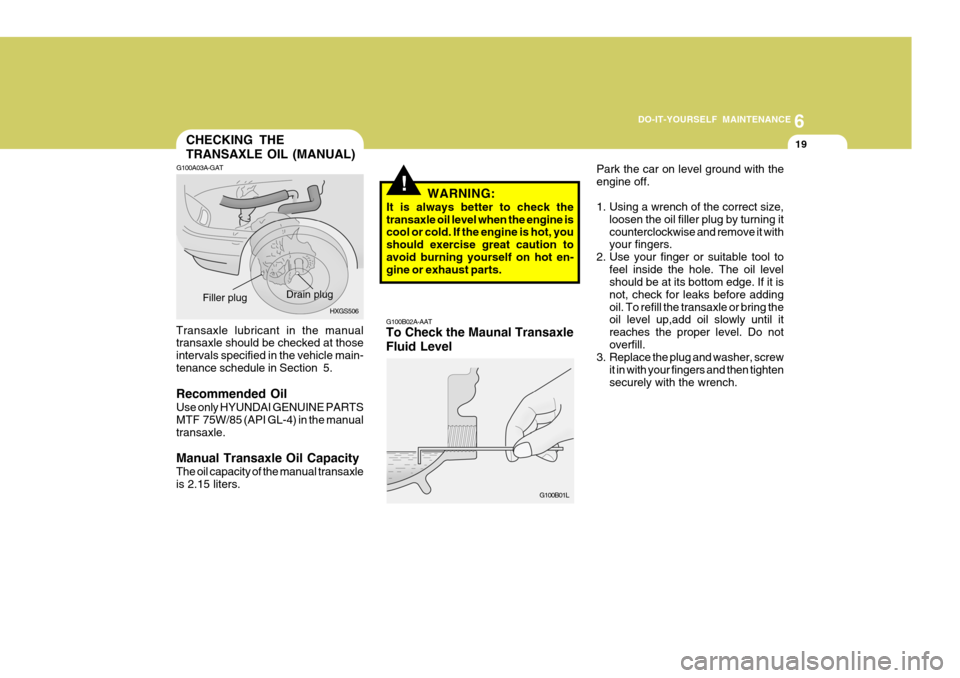
G100B02A-AAT To Check the Maunal Transaxle Fluid Level
HXGS506
Drain plug
Filler plug
G100B01L
Transaxle lubricant in the manual transaxle should be checked at those intervals specified in the vehicle main-tenance schedule in Section 5. Recommended Oil Use only HYUNDAI GENUINE PARTS MTF 75W/85 (API GL-4) in the manualtransaxle. Manual Transaxle Oil Capacity The oil capacity of the manual transaxle is 2.15 liters. WARNING:
It is always better to check thetransaxle oil level when the engine is cool or cold. If the engine is hot, you should exercise great caution toavoid burning yourself on hot en- gine or exhaust parts. Park the car on level ground with the engine off.
1. Using a wrench of the correct size,
loosen the oil filler plug by turning it counterclockwise and remove it with your fingers.
2. Use your finger or suitable tool to feel inside the hole. The oil levelshould be at its bottom edge. If it is not, check for leaks before addingoil. To refill the transaxle or bring the oil level up,add oil slowly until it reaches the proper level. Do notoverfill.
3. Replace the plug and washer, screw
it in with your fingers and then tightensecurely with the wrench.
Page 238 of 599
6 DO-IT-YOURSELF MAINTENANCE
20
!
CHECKING THE TRANSAXLE FLUID (AUTOMATIC)
G110A01E-AAT Transaxle fluid in the automatic transaxle should be checked at those intervals specified in the vehicle main- tenance schedule in Section 5. NOTE: Automatic transaxle fluid is basi- cally a red color. As driving distance increases, the fluid color turns dark-ish red gradually. It is normal condi- tion and you should not judge the need to replace based upon thechanging color. You must replace the automatic transaxle fluid in accordance withintervals specified in the vehicle maintenance schedule in section 5. G110B03A-AAT Recommended Fluid Your Hyundai automatic transaxle is specially designed to operate withHyundai Genuine ATF SP III, DIA- MOND ATF SP III or other brands approved by Hyundai Motor Co. Dam-age caused by a nonspecified fluid is not covered by your new vehicle limited warranty.
G110C02A-GAT Transaxle Fluid Capacity The fluid capacity of the automatic transaxle is 6.1 liters.
WARNING:
The transaxle fluid level should bechecked when the engine is at nor-mal operating temperature. This means that the engine, radiator, exhaust system etc., are very hot.Exercise great care not to burn your- self during this procedure. G110D02A-GAT To Check the Transaxle Fluid Level Park the car on level ground with the parking brake engaged. When thetransaxle fluid level is checked, the transaxle fluid should be at normal operating temperature and the engineidling.
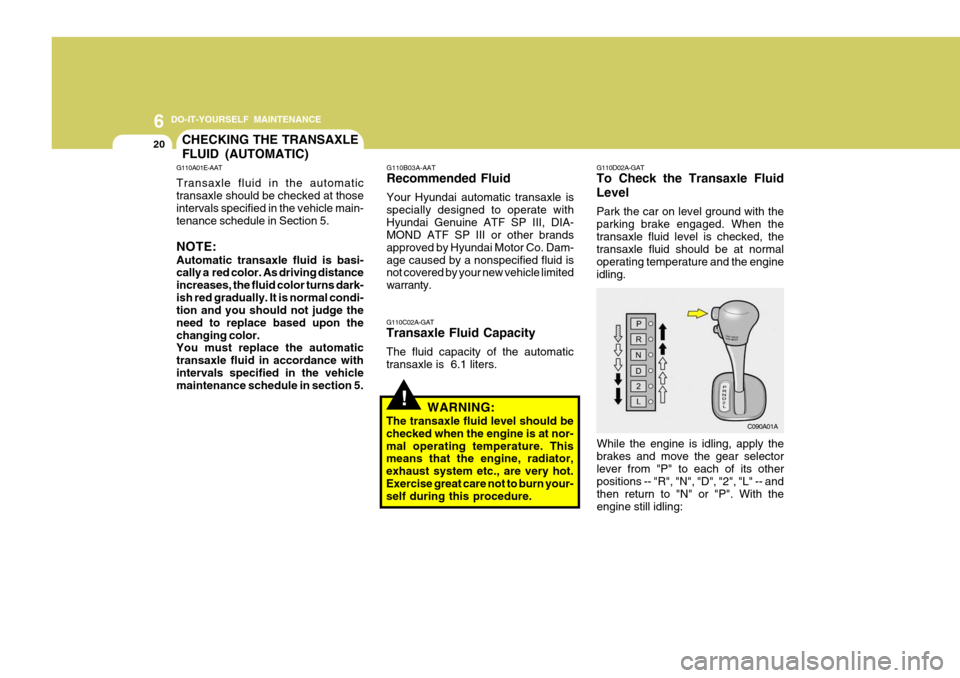
While the engine is idling, apply thebrakes and move the gear selectorlever from "P" to each of its other positions -- "R", "N", "D", "2", "L" -- and then return to "N" or "P". With theengine still idling: C090A01A
Page 240 of 599
6 DO-IT-YOURSELF MAINTENANCE
22
!
CHECKING THE BRAKES
G120A01A-AAT
G120B01A-AAT Checking the Brake Fluid Level
! CAUTION:
Because brakes are essential to the safe operation of the car, it is sug-gested that they be checked and inspected by your Hyundai dealer. The brakes should be checked andinspected for wear at those inter- vals specified in the vehicle mainte- nance schedule in Section 5.
WARNING:
Use caution when handling brakefluid. It can damage your vision if itgets into your eyes. It will also dam- age your vehicle's paint if spilled on it and not removed immediately. G120C02A-AAT Recommended Brake Fluid Use only hydraulic brake fluid con- forming to DOT 3 or DOT 4 specifica-tions in your braking system. Follow the instructions printed on the con- tainer. G120D01A-AAT To Check the Fluid Level
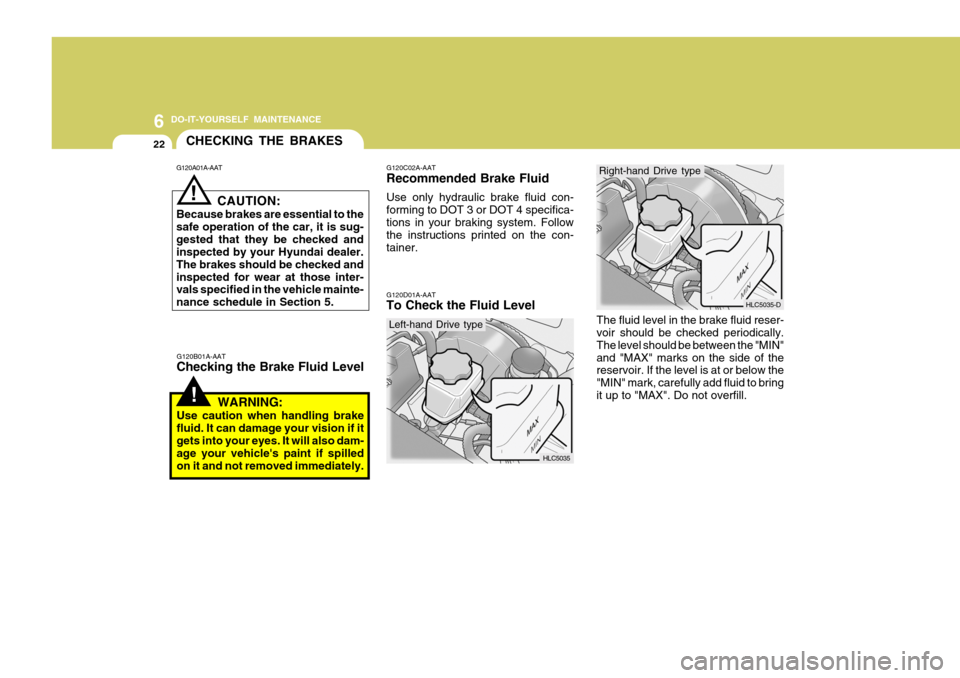
HLC5035The fluid level in the brake fluid reser- voir should be checked periodically. The level should be between the "MIN"and "MAX" marks on the side of the reservoir. If the level is at or below the "MIN" mark, carefully add fluid to bringit up to "MAX". Do not overfill.
Left-hand Drive type
HLC5035-D
Right-hand Drive type
Page 246 of 599

6 DO-IT-YOURSELF MAINTENANCE
28CHECKING AND REPLACING FUSES
CAUTION:
When replacing a fusible link, never use anything but a new fusible link with the same or lower amperagerating. Never use a piece of wire or a higher-rated fusible link. This could result in serious damage andcreate a fire hazard.!
G200A01A-AAT Replacing a Fusible Link
G200A01A
Melted
Good
G190B01TB-GAT(Diesel Engine)
A/C comp.
Auto tensioner Pulley
G190B01A
AlternatorPower steering pump
At the scheduled maintenance inspec- tion, belts should be examined for cracks, wear, fraying or other evidenceof deterioration and replaced if neces- sary. Belt routing should also be checked tobe sure there is no interference be- tween the belts and other parts of the engine. A fusible link will melt if the electricalcircuits from the battery are ever over- loaded, thus preventing damage to the entire wiring harness. (This could becaused by a short in the system draw- ing too much current.) If this ever happens, have a Hyundai dealer de-termine the cause, repair the system and replace the fusible link. The fusible links are located in a fuse box for easyinspection.
Page 264 of 599
7EMISSION CONTROL SYSTEMS
2EMISSION CONTROL SYSTEM
H010A01A-GAT
(If Installed)
Your Hyundai is equipped with an
emission control system to meet all requirements of the Emission prohibi- tion rules of your province. There are three emission control sys-
tems which are as follows.
1) Crankcase emission control sys- tem
2) Evaporative emission control sys-
tem
3) Exhaust emission control system
In order to assure the proper function
of the emission control systems, it is recommended that you have your car inspected and maintained by an au- thorized Hyundai dealer in accordancewith the maintenance schedule in this manual. H010B01A-AAT
1. Crankcase Emission Control
System
The positive crankcase ventilation
system is employed to prevent airpollution caused by blow-by gases being emitted from the crankcase.This system supplies fresh air to the crankcase through the air intake hose. Inside the crankcase, the fresh airmixes with blow-by gases, which then pass through the PCV valve and into the induction system.
H010C02E-GAT
2. Evaporative Emission
Control System
The Evaporative Emission Control
System is designed to prevent fuelvapors from escaping into the atmo-sphere. Canister
Fuel vapors generated inside the fuel
tank are absorbed and stored in the canister. When the engine is running, the fuel vapors absorbed in the can-ister are drawn into the induction sys-tem through the purge control sole- noid valve. Purge Control Solenoid Valve (PCSV)
The purge control solenoid valve is
controlled by the Engine Control Mod- ule (ECM); when the engine coolant temperature is low during idling, the PCSV closes so that evaporated fuelis not taken into the engine. After the engine warms-up during ordinary driv- ing, the PCSV opens so as to intro-duce evaporated fuel to the engine. H010D01A-AAT
3. Exhaust Emission Control
System
The exhaust emission control system is a highly effective system which controls exhaust emission while main-taining good vehicle performance.
Page 280 of 599

10INDEX
4
H Hazard Warning Syst em ........................................... 1-66
Headlight Aiming Adjustment ....................................6-34
Headlight Leveling Device Syst em ...........................1-65
Headlight Washer Switch ............ .............................. 1-65
Heating and Cooling Control ..................................... 1-84
Heating and Ventilation ............................................. 1-85
Air flow control ....................................................... 1-86
Air intake control .................................................... 1-85
Bi-level heating ....................................................... 1-89
Defrost/Defogging .................................................. 1-89
Fan speed control .................................................. 1-85
Temperature control ............................................... 1-88
High-Mounted Rear Stop Light................................. 1-78
Hood Release ........................................................... 1-79
Horn .......................................................................... 1-83
I Ignition Sw itch ............................................................. 2-3
Immobilizer S ystem ..................................................... 1-5
Instrument Cluster and Indicator Li ghts................... 1-48
Interior Light Interior light ............................................................ 1-73
Map light ................................................................ 1-74
JJump Starting .............................................................. 3-3 K
Key .............................................................................. 1-4
If you lose your keys ............................................. 3-13
Positions ................................................................... 2-4
Keyless Entry System ............................................... 1-11
LLubrication Chart ......................................................... 9-4
M Maintenance Intervals Explanation of scheduled maintenance items ......... 5-8
Maintenance under severe usage conditions .......... 5-7 Scheduled maintenance ........................................... 5-4
Service requ irements............................................... 5-2
Mirrors Day/night inside rearview .......................................1-78
Outside rearview mirror .................... ..................... 1-75
Outside rearview mirror heater .............................. 1-77
O
Odometer/ Trip Odometer ......... ...............................1-58
P Parking Brake ........................................................... 1-78
Power Steering Fluid Level .......................................6-32
Power Windows ........................................................ 1-13