wiring Hyundai Accent 2006 User Guide
[x] Cancel search | Manufacturer: HYUNDAI, Model Year: 2006, Model line: Accent, Model: Hyundai Accent 2006Pages: 599, PDF Size: 17.59 MB
Page 324 of 599
1FEATURES OF YOUR HYUNDAI
42
o The driver should sit back as far as
possible while still maintaining control of the vehicle. If you aresitting too close to the airbag, it can cause death or serious injury when it inflates.
o No objects should be placed over or near the airbag modules on thesteering wheel, instrument panel,and the front passenger's panel above the glove box, because any such object could cause harmif the vehicle is in a crash severe enough to cause the airbags to deploy.
o If the airbags deploy, they must be
replaced by an authorized Hyundaidealer.
o Do not tamper with or disconnect
SRS wiring, or other componentsof the SRS system. Doing so could result in injury, due to acci- dental firing of the airbags or byrendering the SRS inoperative.
o Do not install a child restraint sys-
tem in the front passenger seatposition. A child restraint system must never be placed in the front seat. The infant or child could be severely injured or killed by anairbag deployment in case of an accident.
o Do not allow children to ride in the front passenger seat. If older chil-dren (teenagers and older) must ride in the front seat, make surethey are always properly belted and that the seat is moved back as far as possible.
o For maximum safety protection in all types of crashes, all occupantsincluding the driver should alwayswear their seat belts whether or not an airbag is also provided at their seating position to minimizethe risk of severe injury or death in the event of a crash. Do not sit or lean unnecessarily close to theairbag while the vehicle is in mo- tion.
o The SRS airbag system must de- ploy very rapidly to provide pro-tection in a crash. If an occupant is out of position because of notwearing a seat belt, the airbag may forcefully contact the occupant causing serious or fatal injuries.
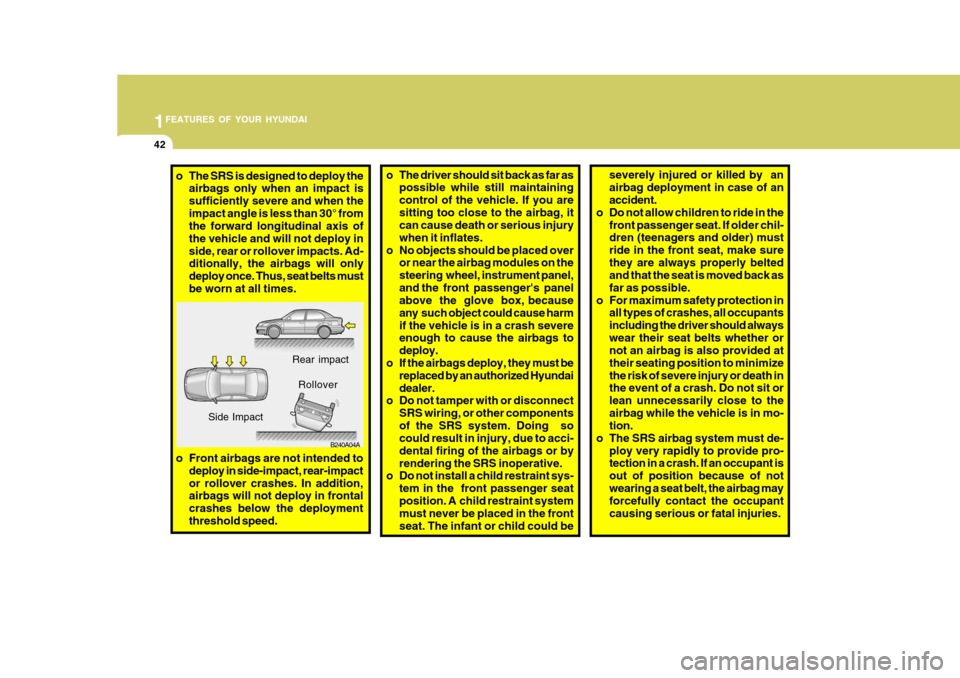
B240A04A
Rear impact
Side Impact Rollover
o The SRS is designed to deploy the
airbags only when an impact is sufficiently severe and when theimpact angle is less than 30° from the forward longitudinal axis of the vehicle and will not deploy inside, rear or rollover impacts. Ad- ditionally, the airbags will only deploy once. Thus, seat belts mustbe worn at all times.
o Front airbags are not intended to deploy in side-impact, rear-impactor rollover crashes. In addition, airbags will not deploy in frontal crashes below the deploymentthreshold speed.
Page 329 of 599
1
FEATURES OF YOUR HYUNDAI
47
o Modification to SRS components
or wiring, including the addition of any kind of badges to the padcovers or modifications to the body structure, can adversely affect SRS performance and lead to possibleinjury.
o For cleaning the airbag pad cov-
ers, use only a soft, dry cloth orone which has been moistened with plain water. Solvents or clean- ers could adversely affect theairbag covers and proper deploy- ment of the system.
o No objects should be placed over or near the airbag modules on the steering wheel, instrument panel,and the front passenger's panel above the glove box, because any such object could cause harm ifthe vehicle is in a crash severe enough to cause the airbags to inflate.
o If the airbags inflate, they must be replaced by an authorized Hyundaidealer.o Do not tamper with or disconnect
SRS wiring, or other components of the SRS system. Doing so could result in injury, due to accidentalfiring of the airbags or by render- ing the SRS inoperative.
o If components of the airbag sys- tem must be discarded, or if thevehicle must be scrapped, certain safety precautions must be ob-served. Your Hyundai dealer knows these precautions and can give you the necessary informa-tion. Failure to follow these pre- cautions and procedures could increase the risk of personal in-jury.
o If you sell your vehicle, be sure to
inform the new owner of theseimportant points and make cer- tain that this manual is transferred to the new owner.
o If your car was flooded and has soaked carpeting or water on floor-ing, you shouldn't try to start en-gine; have the car towed to autho- rized Hyundai dealer.
Page 443 of 599
1CONTROLS AND EQUIPMENT
36
o Modification to SRS components
or wiring, including the addition of any kind of badges to the padcovers or modifications to the body structure, can adversely affect SRS performance and lead to possibleinjury.
o For cleaning the airbag pad cov- ers, use only a soft, dry cloth or one which has been moistened with plain water. Solvents orcleaners could adversely affect the airbag covers and proper deployment of the system.
o No objects should be placed over or near the airbag modules on the steering wheel, instrument panel, and the front passenger'spanel above the glove box, be- cause any such object could cause harm if the vehicle is in acrash severe enough to cause the airbags to inflate.
o If the airbags inflate, they must be replaced by an authorized Hyundai dealer.
!WARNING:
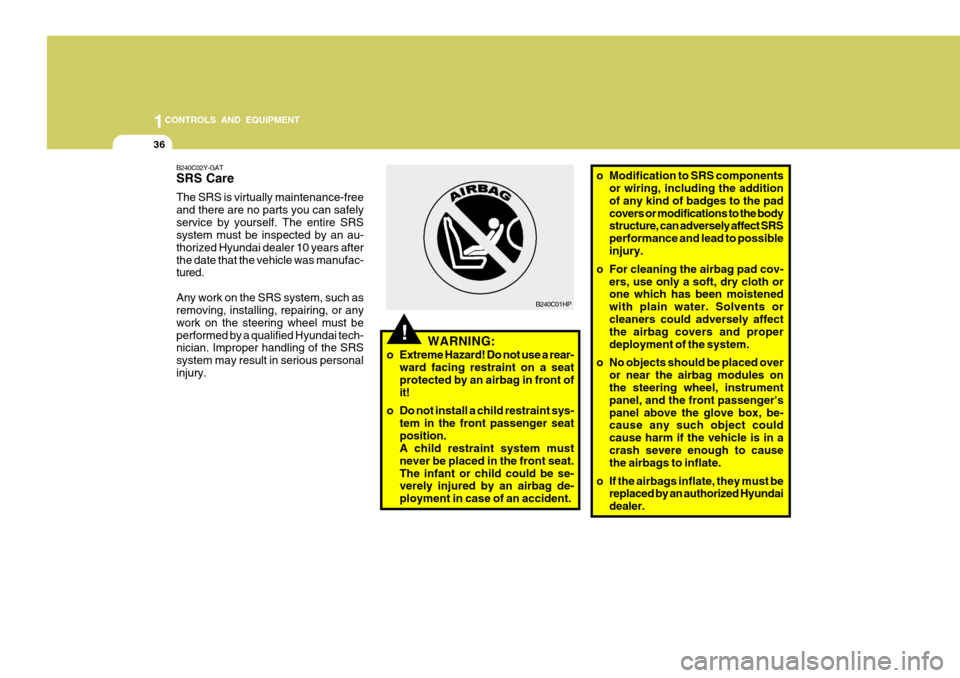
o Extreme Hazard! Do not use a rear- ward facing restraint on a seat protected by an airbag in front of it!
o Do not install a child restraint sys- tem in the front passenger seatposition. A child restraint system must never be placed in the front seat.The infant or child could be se- verely injured by an airbag de- ployment in case of an accident. B240C01HP
B240C02Y-GAT SRS Care The SRS is virtually maintenance-free and there are no parts you can safelyservice by yourself. The entire SRS system must be inspected by an au- thorized Hyundai dealer 10 years afterthe date that the vehicle was manufac- tured. Any work on the SRS system, such as removing, installing, repairing, or any work on the steering wheel must beperformed by a qualified Hyundai tech- nician. Improper handling of the SRS system may result in serious personalinjury.
Page 444 of 599
37
1
CONTROLS AND EQUIPMENT
o Do not tamper with or disconnect
SRS wiring, or other components of the SRS system. Doing so couldresult in injury, due to accidental firing of the airbags or by render- ing the SRS inoperative.
o If components of the airbag sys- tem must be discarded, or if thevehicle must be scrapped, cer- tain safety precautions must be observed. Your Hyundai dealerknows these precautions and can give you the necessary informa- tion. Failure to follow these pre- cautions and procedures could increase the risk of personal in-jury.
o If you sell your vehicle, be sure to inform the new owner of these important points and make cer- tain that this manual is trans-ferred to the new owner.
o If your car was flooded and has soaked carpeting or water on flooring, you shouldn't try to start engine; have the car towed toauthorized Hyundai dealer.
Page 464 of 599
57
1
CONTROLS AND EQUIPMENT
CIGAR LIGHTER
!
CAUTION:
Do not use electric accessories or equipment other than the Hyundaigenuine parts in the socket.
B420A02A-EAT
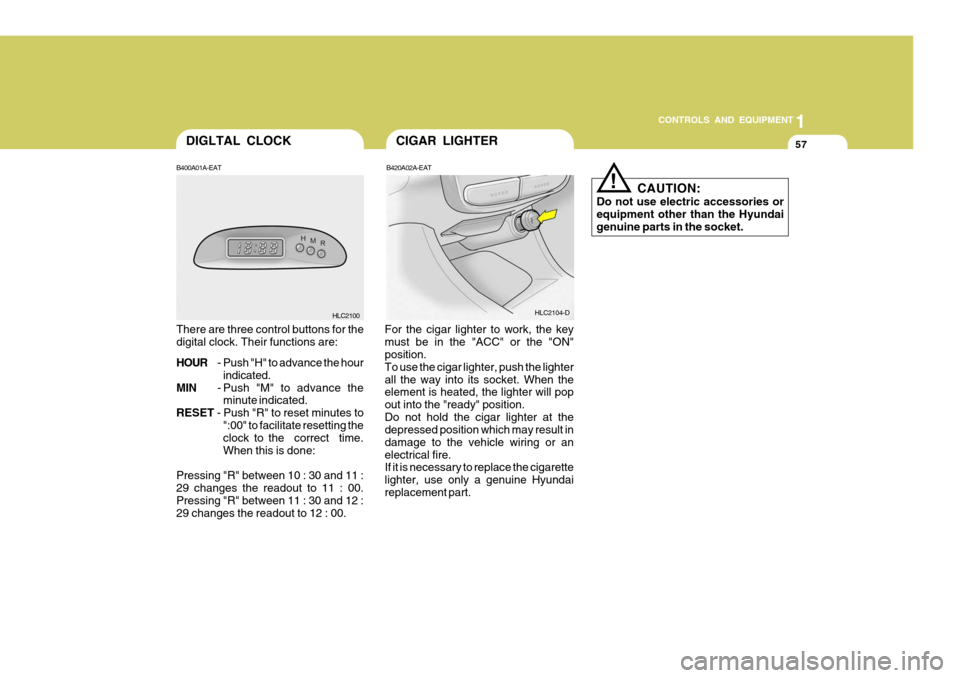
For the cigar lighter to work, the keymust be in the "ACC" or the "ON" position. To use the cigar lighter, push the lighterall the way into its socket. When the element is heated, the lighter will pop out into the "ready" position.Do not hold the cigar lighter at the depressed position which may result in damage to the vehicle wiring or anelectrical fire. If it is necessary to replace the cigarette lighter, use only a genuine Hyundaireplacement part.
B400A01A-EAT
HLC2100
There are three control buttons for thedigital clock. Their functions are: HOUR - Push "H" to advance the hour
indicated.
MIN - Push "M" to advance the
minute indicated.
RESET - Push "R" to reset minutes to
":00" to facilitate resetting the clock to the correct time. When this is done:
Pressing "R" between 10 : 30 and 11 :29 changes the readout to 11 : 00.Pressing "R" between 11 : 30 and 12 : 29 changes the readout to 12 : 00. HLC2104-D
DIGLTAL CLOCK
Page 518 of 599
3
IN CASE OF EMERGENCY
5IF THE ENGINE OVERHEATS
!
!
D030A01TB-EAT If the temperature gauge indicates overheating:
1. Pull off the road and stop as soon as
it is safe to do so.
2. Place the gear selector lever in "P"
(automatic), or neutral (manual transaxle) and set the parking brake. If the air conditioning is on, turn it off.
3. If coolant is running out under the car or steam is coming out from thebonnet, stop the engine. Do not open the bonnet until the coolanthas stopped running or the steam- ing has stopped. If there is no visible loss of coolant and no steam, leavethe engine running and check to be sure the engine cooling fan is oper- ating.If the fan is not running, turn the engine off.
4. Check to see if the water pump drive belt is missing. If it is not missing,check to see that it is tight. If the drive belt seems to be satisfactory,check for coolant leaking from the radiator, hoses or under the car. (If the air conditioning had been in use,it is normal for cold water to be draining from it). WARNING:
Whilst the engine is running, keep hands and clothing away from mov-ing parts such as the fan and drive belts to prevent injury.
WARNING (Diesel only):
Never work on injection system with engine running or within 30 sec- onds after shutting off engine. High pressure pump, rail, injectors andhigh pressure pipes are subject to high pressure even after the engine stopped. The fuel jet produced byfuel leaks may cause serious in- jury, if it touch the body. People using pacemakers should not movethan 12 in.(30 cm) closer to the ECU or wiring harness within the engine room whilst engine is running, sincethe high currents in the Common Rail system produce considerable magnetic fields. 5. If the water pump drive belt is broken
or coolant is leaking out, stop theengine immediately and call the near- est Hyundai dealer for assistance.
!WARNING:
Do not remove the radiator cap when the engine is hot since steam and boiling water may be ejected fromthe radiator resulting in burns or scalding.
6. If the cause of the overheating can- not be found, wait until the engine temperature has returned to nor- mal. Then, if coolant has been lost, carefully remove the radiator capand add water to bring the fluid level in the reservoir up to the base of the radiator fill opening. Fill the coolantexpansion tank to the halfway mark.
7. Proceed with caution until it is es-
tablished that the engine is operat-ing normally. If the engine over- heats repeatedly, the advice of a Hyundai dealer should be sought.
Page 539 of 599
5
VEHICLE MAINTENANCE REQUIREMENTS
7EXPLANATION OF SCHED- ULED MAINTENANCE ITEMS
!
6ZF060M1-A
o Engine oil and filter
The engine oil and filter should be changed at the intervals specified in the maintenance schedule. If the car is being driven in severe conditions,more frequent oil and filter changes are required. 6ZF060B1-A
o Drive belts
Inspect all drive belts for evidence of cuts, cracks, excessive wear or oil saturation and replace if necessary. Drive belts should be checked peri-odically for proper tension and ad- justed as necessary. 6ZF060C1-A
o Fuel filter
A clogged filter can limit the speed at
which the vehicle may be driven, dam-age the emission system and cause hard starting. If an excessive amountof foreign matter accumulates in the fuel tank, the filter may require re- placement more frequently. After installing a new filter, run the
engine for several minutes, and checkfor leaks at the connections.
F060D01TB-EAT
o Fuel lines, fuel hoses and con-
nections
Check the fuel lines, fuel hoses and
connections for leakage and damage.Replace any damaged or leaking partsimmediately. WARNING (Diesel only):
Never work on injection system with engine running or within 30 seconds after shutting off engine.High pressure pump, rail, injectors and high pressure pipes are sub- jected to high pressure even afterthe engine has been switched off. The fuel jet produced by fuel leaks may cause serious injury, if it con-tacts with the body. People using pacemakers should not move closer than 12 in.(30 cm) to the ECUor wiring harness within the engine room with the engine running, since the high currents in the CommonRail system produce considerable magnetic fields.
Page 559 of 599
6
OWNER MAINTENANCE
17
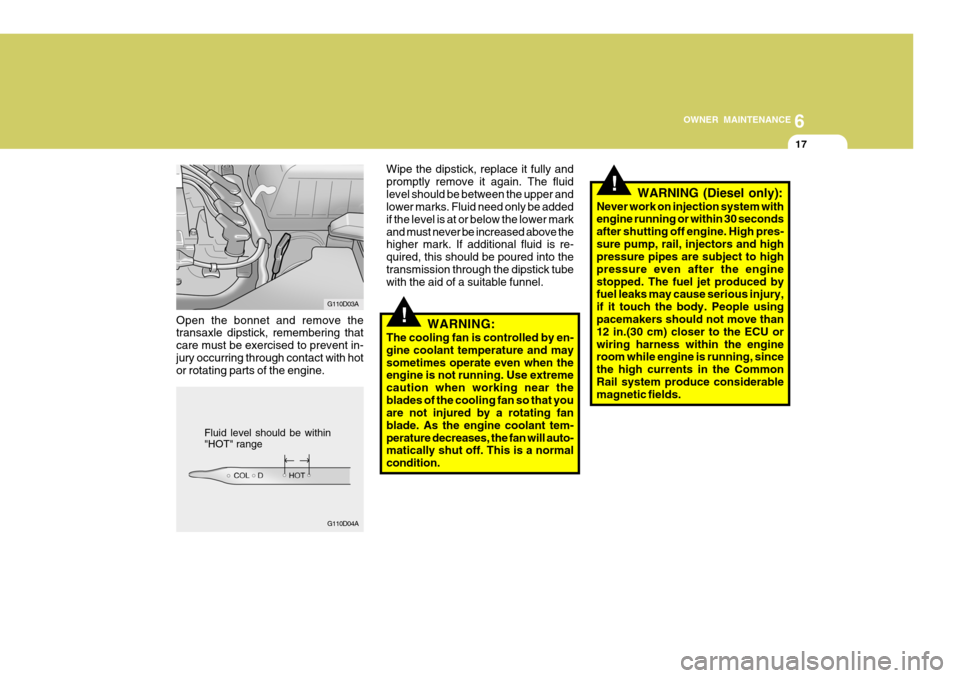
!Open the bonnet and remove the transaxle dipstick, remembering that care must be exercised to prevent in-jury occurring through contact with hot or rotating parts of the engine. WARNING:
The cooling fan is controlled by en- gine coolant temperature and maysometimes operate even when the engine is not running. Use extreme caution when working near theblades of the cooling fan so that you are not injured by a rotating fan blade. As the engine coolant tem-perature decreases, the fan will auto- matically shut off. This is a normal condition.
Wipe the dipstick, replace it fully andpromptly remove it again. The fluidlevel should be between the upper and lower marks. Fluid need only be added if the level is at or below the lower markand must never be increased above the higher mark. If additional fluid is re- quired, this should be poured into thetransmission through the dipstick tube with the aid of a suitable funnel.
G110D03A
G110D04A
Fluid level should be within "HOT" range
!WARNING (Diesel only):
Never work on injection system with engine running or within 30 seconds after shutting off engine. High pres-sure pump, rail, injectors and high pressure pipes are subject to high pressure even after the enginestopped. The fuel jet produced by fuel leaks may cause serious injury, if it touch the body. People usingpacemakers should not move than 12 in.(30 cm) closer to the ECU or wiring harness within the engine room while engine is running, since the high currents in the CommonRail system produce considerable magnetic fields.
Page 563 of 599
6
OWNER MAINTENANCE
21CHANGING THE POLLEN FILTER
B145A01A-EAT
(For Evaporator and Blower
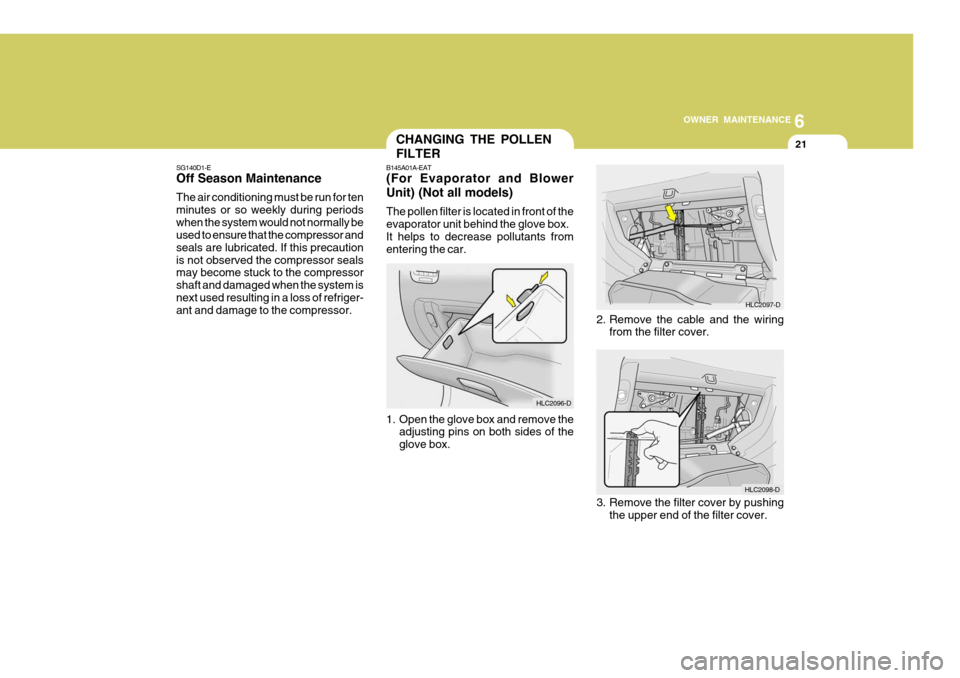
Unit) (Not all models) The pollen filter is located in front of the evaporator unit behind the glove box.It helps to decrease pollutants from entering the car.
1. Open the glove box and remove the
adjusting pins on both sides of the glove box. HLC2096-D
SG140D1-E Off Season Maintenance The air conditioning must be run for ten minutes or so weekly during periodswhen the system would not normally be used to ensure that the compressor and seals are lubricated. If this precautionis not observed the compressor seals may become stuck to the compressor shaft and damaged when the system isnext used resulting in a loss of refriger- ant and damage to the compressor.
2. Remove the cable and the wiring
from the filter cover.
3. Remove the filter cover by pushing the upper end of the filter cover. HLC2097-D
HLC2098-D
Page 566 of 599
6OWNER MAINTENANCE
24
!
FUSIBLE LINKS
WARNING:
Under no circumstances should a fusible link be replaced with any- thing other than a new link of thesame rating. The use of higher rated links or other means of connecting the circuit will create a potential firehazard.
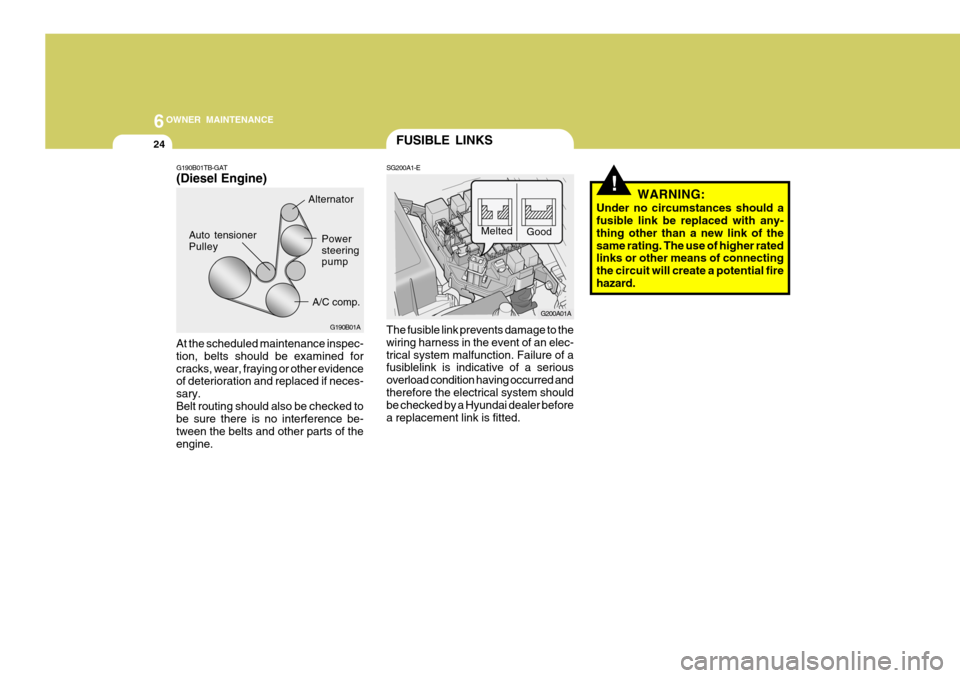
G190B01TB-GAT (Diesel Engine)
At the scheduled maintenance inspec- tion, belts should be examined forcracks, wear, fraying or other evidence of deterioration and replaced if neces- sary.Belt routing should also be checked to be sure there is no interference be- tween the belts and other parts of theengine. SG200A1-E The fusible link prevents damage to the wiring harness in the event of an elec-trical system malfunction. Failure of a fusiblelink is indicative of a serious overload condition having occurred andtherefore the electrical system should be checked by a Hyundai dealer before a replacement link is fitted.
A/C comp.
Auto tensioner Pulley
G190B01A
AlternatorPower steeringpump
G200A01A
Melted
Good