ECU Hyundai Accent 2006 Owner's Guide
[x] Cancel search | Manufacturer: HYUNDAI, Model Year: 2006, Model line: Accent, Model: Hyundai Accent 2006Pages: 599, PDF Size: 17.59 MB
Page 216 of 599

5
VEHICLE MAINTENANCE REQUIREMENTS
9
F060H01A-AAT
o Air Cleaner Filter
A Genuine Hyundai air cleaner filter is
recommended when the filter is re- placed.
F060J01A-AAT
o Spark Plugs
(For Gasoline Engine)
Make sure to install new spark plugs
of the correct heat range.
F070C01A-AAT o Coolant The coolant should be changed at the intervals specified in the mainte-nance schedule.
F060F01A-AAT
o Vacuum, Crankcase Ventila-
tion Hoses
Inspect the surface of hoses for evi-dence of heat and/or mechanical dam- age. Hard and brittle rubber, cracking, tears, cuts, abrasions, and excessiveswelling indicate deterioration. Partic- ular attention should be paid to exam- ine those hose surfaces nearest tohigh heat sources, such as the ex- haust manifold. Inspect the hose routing to assure that the hoses do not come in contact with any heat source, sharp edges or moving component which might causeheat damage or mechanical wear. Inspect all hose connections, such as clamps and couplings, to make surethey are secure, and that no leaks are present. Hoses should be replaced immediately if there is any evidenceof deterioration or damage. F070B01A-GAT o Cooling System Check the cooling system part, such as radiator, coolant reservoir, hosesand connections for leakage and dam- age. Replace any damaged parts.
F060K01A-GAT
o Ignition timing
(Carburetor only)
For basic ignition timing, refer to the
Specifications in Section 9. F060L01A-GAT
o Idle speed and CO
(Carburetor only)
After warming up the engine, check and adjust the idle speed and CO. For detailed service procedures and speci- fication, refer to the Shop Manual.
Page 232 of 599
6 DO-IT-YOURSELF MAINTENANCE
14
G050D01A
G050D02A-AAT To Change the Coolant The coolant should be changed at those intervals specified in the vehiclemaintenance schedule in Section 5.
CAUTION:
Engine coolant can damage the fin-ish of your car. If you spill engine coolant on the car, wash it off thor- oughly with clean water.
!
1. Park the car on level ground, set the parking brake and remove the ra- diator cap when cool.
2. Be sure your drain receptacle is in place. Open the drain cock on theradiator. Allow all the engine coolantto drain from the cooling system, then securely close the drain cock.
3. Check Section 9 for the capacity of the cooling system in your car. Then,following the manufacturer's direc- tions on the engine coolant contain-er, add the appropriate quantity of coolant to the radiator. 4. Turn the radiator cap counterclock-
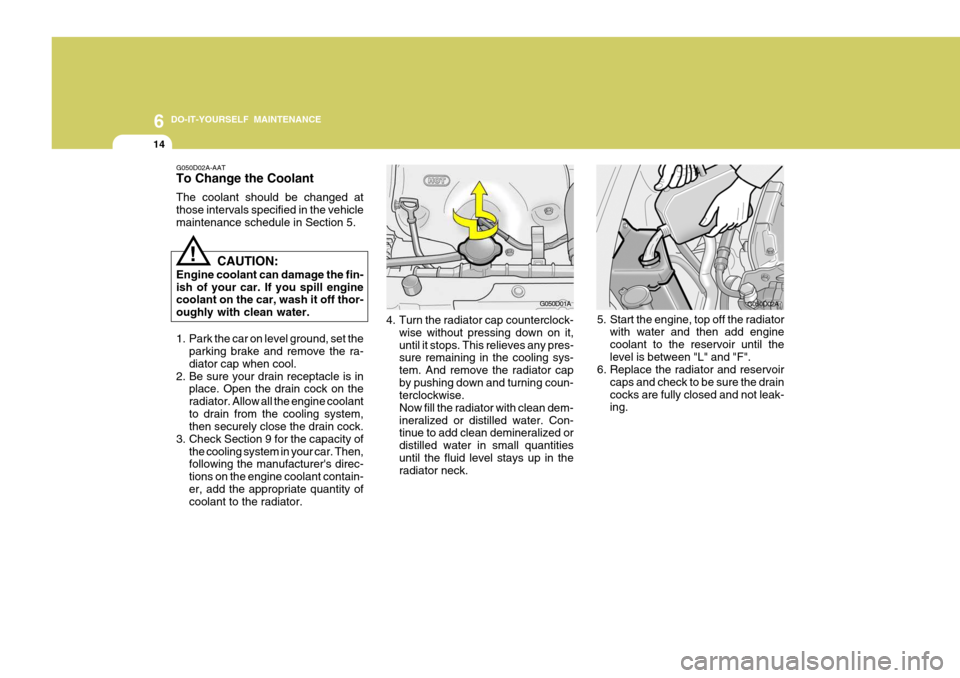
wise without pressing down on it, until it stops. This relieves any pres- sure remaining in the cooling sys- tem. And remove the radiator capby pushing down and turning coun- terclockwise. Now fill the radiator with clean dem-ineralized or distilled water. Con- tinue to add clean demineralized or distilled water in small quantitiesuntil the fluid level stays up in the radiator neck. G050D02A
5. Start the engine, top off the radiator with water and then add engine coolant to the reservoir until thelevel is between "L" and "F".
6. Replace the radiator and reservoir
caps and check to be sure the draincocks are fully closed and not leak- ing.
Page 237 of 599
6
DO-IT-YOURSELF MAINTENANCE
19
!
CHECKING THE TRANSAXLE OIL (MANUAL)
G100A03A-GAT
G100B02A-AAT To Check the Maunal Transaxle Fluid Level
HXGS506
Drain plug
Filler plug
G100B01L
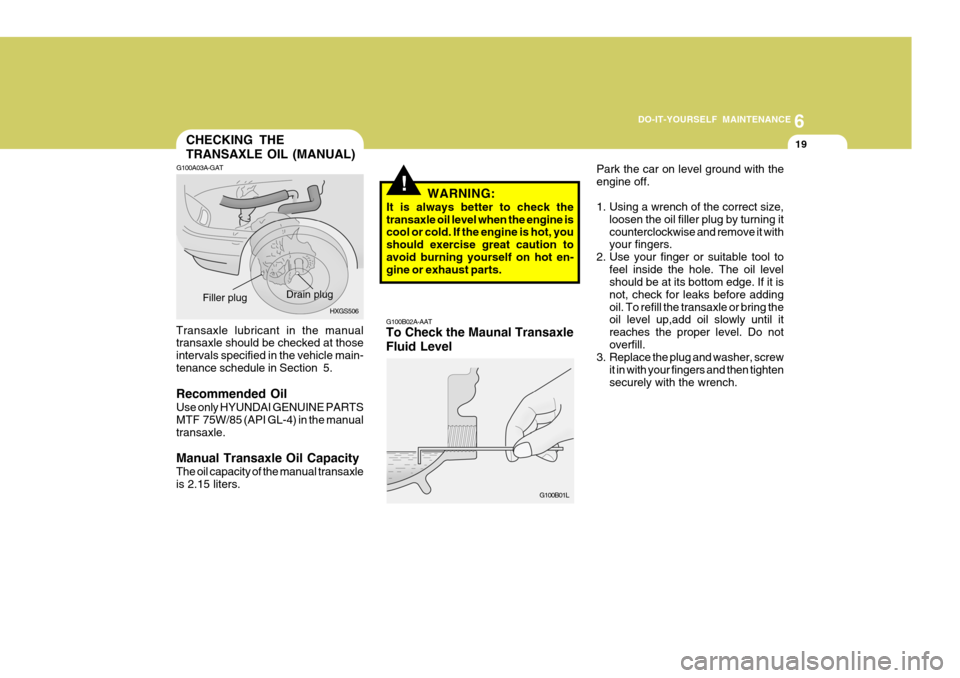
Transaxle lubricant in the manual transaxle should be checked at those intervals specified in the vehicle main-tenance schedule in Section 5. Recommended Oil Use only HYUNDAI GENUINE PARTS MTF 75W/85 (API GL-4) in the manualtransaxle. Manual Transaxle Oil Capacity The oil capacity of the manual transaxle is 2.15 liters. WARNING:
It is always better to check thetransaxle oil level when the engine is cool or cold. If the engine is hot, you should exercise great caution toavoid burning yourself on hot en- gine or exhaust parts. Park the car on level ground with the engine off.
1. Using a wrench of the correct size,
loosen the oil filler plug by turning it counterclockwise and remove it with your fingers.
2. Use your finger or suitable tool to feel inside the hole. The oil levelshould be at its bottom edge. If it is not, check for leaks before addingoil. To refill the transaxle or bring the oil level up,add oil slowly until it reaches the proper level. Do notoverfill.
3. Replace the plug and washer, screw
it in with your fingers and then tightensecurely with the wrench.
Page 239 of 599
6
DO-IT-YOURSELF MAINTENANCE
21
!
!
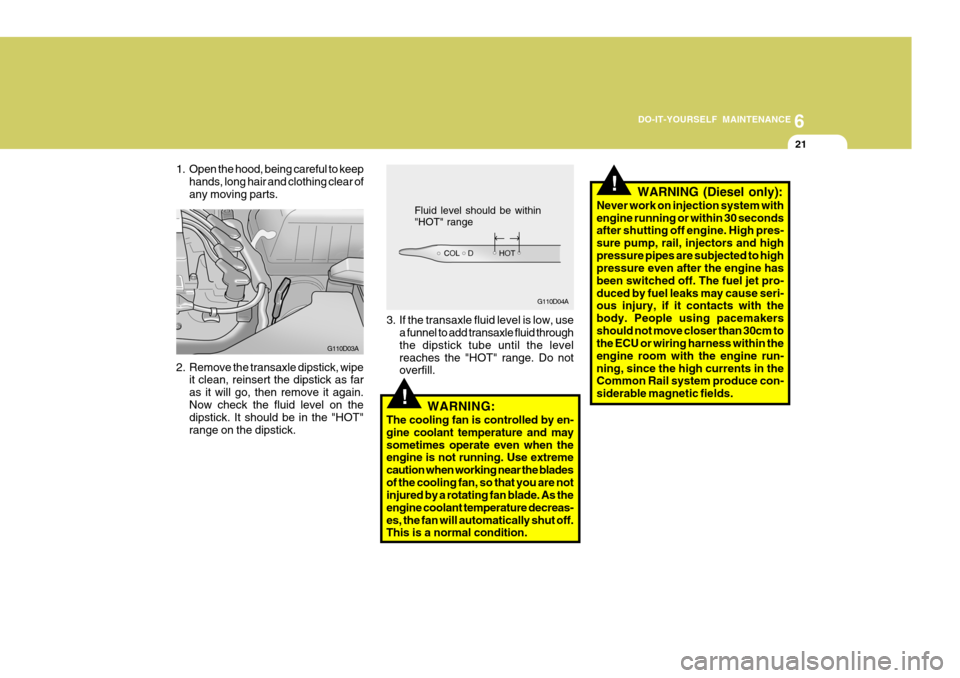
3. If the transaxle fluid level is low, use
a funnel to add transaxle fluid through the dipstick tube until the levelreaches the "HOT" range. Do not overfill.
WARNING:
The cooling fan is controlled by en- gine coolant temperature and maysometimes operate even when the engine is not running. Use extreme caution when working near the bladesof the cooling fan, so that you are not injured by a rotating fan blade. As the engine coolant temperature decreas-es, the fan will automatically shut off. This is a normal condition.
1. Open the hood, being careful to keep
hands, long hair and clothing clear of any moving parts. WARNING (Diesel only):
Never work on injection system withengine running or within 30 seconds after shutting off engine. High pres- sure pump, rail, injectors and highpressure pipes are subjected to high pressure even after the engine has been switched off. The fuel jet pro-duced by fuel leaks may cause seri- ous injury, if it contacts with the body. People using pacemakersshould not move closer than 30cm to the ECU or wiring harness within the engine room with the engine run-ning, since the high currents in the Common Rail system produce con- siderable magnetic fields.
G110D04A
Fluid level should be within "HOT" range
2. Remove the transaxle dipstick, wipe it clean, reinsert the dipstick as far as it will go, then remove it again.Now check the fluid level on the dipstick. It should be in the "HOT" range on the dipstick. G110D03A
Page 250 of 599
6 DO-IT-YOURSELF MAINTENANCE
32POWER STEERING FLUID LEVEL
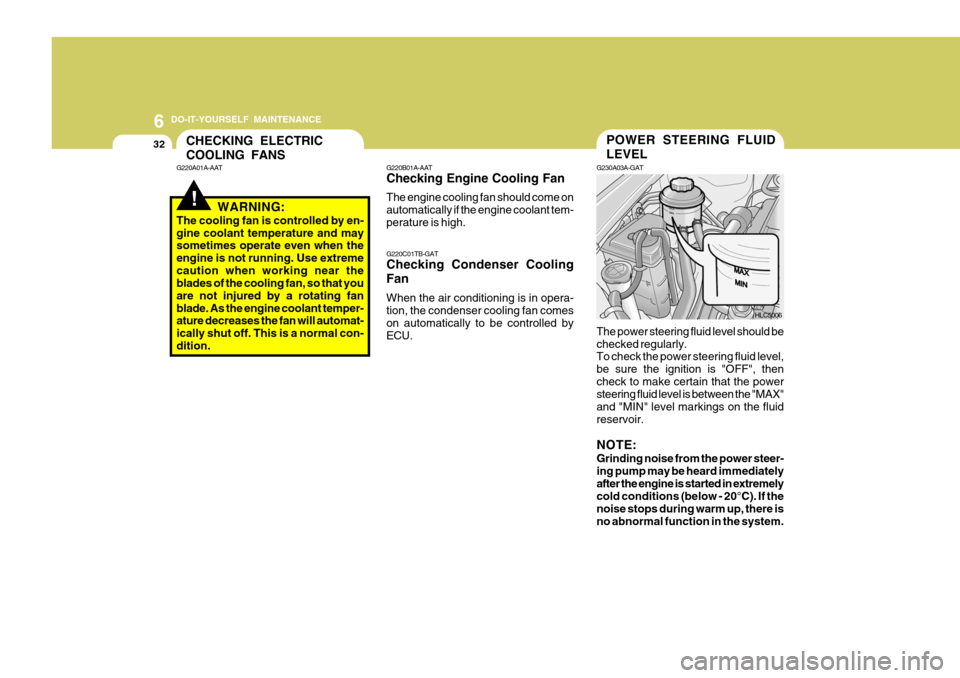
G230A03A-GAT The power steering fluid level should be checked regularly. To check the power steering fluid level, be sure the ignition is "OFF", thencheck to make certain that the power steering fluid level is between the "MAX" and "MIN" level markings on the fluidreservoir. NOTE: Grinding noise from the power steer- ing pump may be heard immediatelyafter the engine is started in extremely cold conditions (below - 20°C). If the noise stops during warm up, there isno abnormal function in the system. HLC5006
CHECKING ELECTRIC COOLING FANS
!
G220B01A-AAT Checking Engine Cooling Fan The engine cooling fan should come on automatically if the engine coolant tem-perature is high. G220C01TB-GAT Checking Condenser Cooling Fan When the air conditioning is in opera- tion, the condenser cooling fan comes on automatically to be controlled by
ECU.
G220A01A-AAT
WARNING:
The cooling fan is controlled by en-gine coolant temperature and may sometimes operate even when the engine is not running. Use extremecaution when working near the blades of the cooling fan, so that you are not injured by a rotating fanblade. As the engine coolant temper- ature decreases the fan will automat- ically shut off. This is a normal con-dition.
Page 260 of 599

6 DO-IT-YOURSELF MAINTENANCE
42
G200C02A-GAT Engine Compartment (Gasoline Engine)
HLC5027
NOTE:
Not all fuse panel descriptions in this manual may be applicable to your vehicle. It is accurate at the time of printing.
When you inspect the fuse box on your vehicle, refer to the fuse box label.FUSE RATING 120A50A 50A20A30A20A 30A 30A30A30A20A 10A 10A 10A 10A10A 10A10A15A 10A15A 15A 10A 25A PROTECTED COMPONENTS
Charging (Generator) Fuse 6, 7, 8, 9, Horn fuse, Room lamp fuse
Head lamp fuse, Front fog lamp fuse, Tail lamp relay, H/LP washer fuse
Engine control relay, Generator, Fuel pump relay, ECU #3 fuse Ignition power source, Start relayRadiator fan control Blower control ABS control, ABS bleeding connectorABS control, ABS bleeding connector Power window Condenser fan controlRadiator fan, Condenser fan, ECM, Oxygen sensor, Purge control valve,
SMATRA, Glow plug relay, Heater relay, Stop lamp switch A/C relayHorn relay Illumination lamps, Left rear combination lamp, License lamp, DRL control, Position lamp, H/LP washer relayRight rear combination lamp, License lamp, Position lamp Left head lamp, DRL control, Instrument cluster Right head lampFront fog lamp relay
Instrument cluster, Courtesy lamp, Trunk room lamp, ETACM, DLC, Door warning, Multipurpose check connectorAudio, Digital clock, Power antenna, A/C switch, Rear fog lamp switch Idle speed actuator, ECM, Camshaft position sensor, EGR actuator, Throttle plate actuatorECM Head lamp washer motor
Fuel pump relay, Fuel pump motor
ALT
BATTERY LAMPECU
IGN
RAD FAN
BLOWER
ABS ABS
P/WDW
COND FAN
ECU #1
A/CON COMP HORN
TAIL LH
TAIL RH
H/LP LH
H/LP RH
FRONT FOG
ROOM LP AUDIO
ECU #2 ECU#3
H/L WASHER
FUSIBLE
LINK
FUSE
DESCRIPTION
F/PUMP CHK (E50)
FUSE PANEL DESCRIPTION
Page 261 of 599

6
DO-IT-YOURSELF MAINTENANCE
43
HLC5026 FUSE RATING
120A50A 50A30A30A20A30A30A30A30A20A60A30A80A30A 10A 10A 10A 10A10A 10A10A15A 10A15A 15A 10A 25A PROTECTED COMPONENTS
Charging (Generator)Fuse 6, 7, 8, 9, Horn fuse, Room lamp fuse
Head lamp fuse, Front fog lamp fuse, Tail lamp relay, H/LP washer fuse
Engine control relay, Generator, Fuel pump relay, ECU #3 fuseIgnition power source, Start relayRadiator fan controlBlower controlABS control, ABS bleeding connectorABS control, ABS bleeding connectorPower windowCondenser fan controlAssist HeaterAssist HeaterGlow Plug relayFuel Heater Radiator fan, Condenser fan, ECM, Oxygen sensor, Purge control valve,
SMATRA, Glow plug relay, Heater relay, Stop lamp switchA/C relayHorn relayIllumination lamps, Left rear combination lamp, License lamp, DRL control,Position lamp, H/LP washer relayRight rear combination lamp, License lamp, Position lampLeft head lamp, DRL control, Instrument clusterRight head lampFront fog lamp relay
Instrument cluster, Courtesy lamp, Trunk room lamp, ETACM, DLC,Door warning, Multipurpose check connectorAudio, Digital clock, Power antenna, A/C switch, Rear fog lamp switchIdle speed actuator, ECM, Camshaft position sensor, EGR actuator,Throttle plate actuatorECMHead lamp washer motor
Fuel pump relay, Fuel pump motor
ALT
BATTERY LAMP
ECU (DSL) IGN
RAD FAN
BLOWER
ABS ABS
P/WDW
COND FAN
HTRHTR
GLOW F/HTR
ECU #1
A/CON COMP HORN
TAIL LH
TAIL RH
H/LP LH
H/LP RH
FRONT FOG
ROOM LP AUDIO
ECU #2 ECU#3
H/L WASHER
FUSIBLE
LINK
FUSEDESCRIPTION
F/PUMP CHK (E50)G200D02A-GAT Engine Compartment (Diesel Engine)
Page 288 of 599
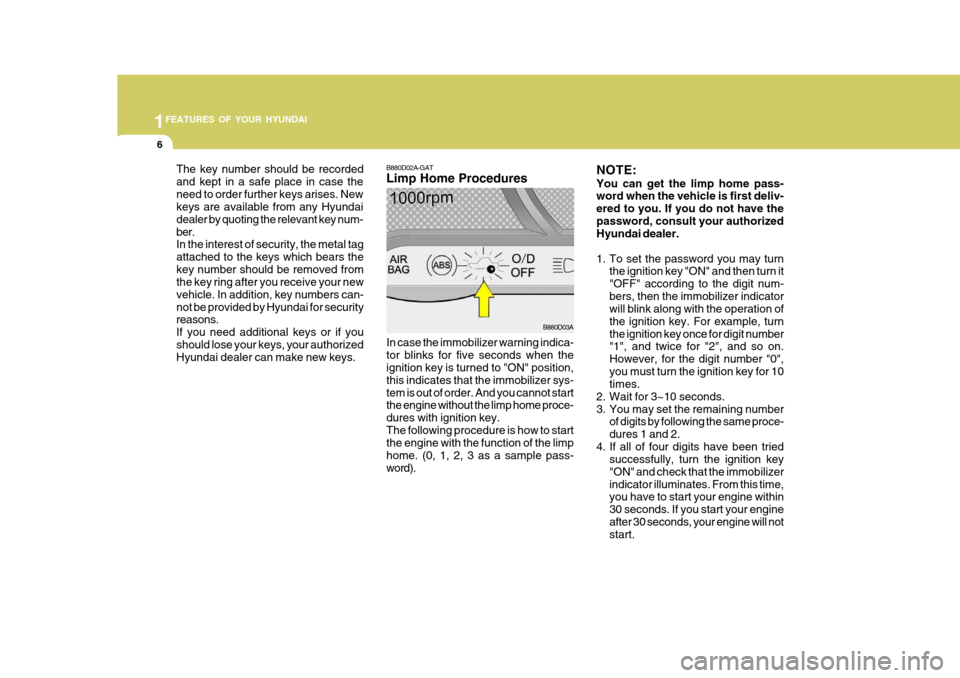
1FEATURES OF YOUR HYUNDAI
6
NOTE: You can get the limp home pass- word when the vehicle is first deliv- ered to you. If you do not have thepassword, consult your authorized Hyundai dealer.
1. To set the password you may turn
the ignition key "ON" and then turn it "OFF" according to the digit num-bers, then the immobilizer indicator will blink along with the operation of the ignition key. For example, turnthe ignition key once for digit number "1", and twice for "2", and so on. However, for the digit number "0",you must turn the ignition key for 10 times.
2. Wait for 3~10 seconds.
3. You may set the remaining number of digits by following the same proce-dures 1 and 2.
4. If all of four digits have been tried successfully, turn the ignition key"ON" and check that the immobilizerindicator illuminates. From this time, you have to start your engine within 30 seconds. If you start your engineafter 30 seconds, your engine will not start.
B880D02A-GAT Limp Home Procedures In case the immobilizer warning indica- tor blinks for five seconds when the ignition key is turned to "ON" position, this indicates that the immobilizer sys-tem is out of order. And you cannot start the engine without the limp home proce- dures with ignition key.The following procedure is how to start the engine with the function of the limp home. (0, 1, 2, 3 as a sample pass-word).
B880D03A
The key number should be recordedand kept in a safe place in case theneed to order further keys arises. New keys are available from any Hyundai dealer by quoting the relevant key num-ber. In the interest of security, the metal tag attached to the keys which bears thekey number should be removed from the key ring after you receive your new vehicle. In addition, key numbers can-not be provided by Hyundai for security reasons. If you need additional keys or if youshould lose your keys, your authorized Hyundai dealer can make new keys.
Page 289 of 599

1
FEATURES OF YOUR HYUNDAI
7
!
DOOR LOCKS
NOTE: If the engine dies while driving after limp home procedure, you can start your engine within 8 seconds with-out limp home procedure again.
5. If the immobilizer indicator blinks for five seconds, you have to try the limp home procedure again from the beginning.
After doing the limp home procedure,you have to consult with your autho-rized Hyundai dealer as soon as pos- sible.
! CAUTION:
o If you fail to try the limp home procedure with the sequence of three times, you have to wait for about one hour to do the limp home procedure again.
o If you cannot start your engine in spite of limp home procedure, haveyour vehicle towed by an autho-rized Hyundai dealer.
UNLOCK
HLC2003
LOCK
B040A02Y-AAT
B040B01A-AAT
Locking and Unlocking Front Doors With a Key
WARNING:
o Unlocked doors can be danger- ous. Before you drive away (espe- cially if there are children in the car), be sure that all the doors are securely closed and locked sothat the doors cannot be inadvert- ently opened from the inside. This helps ensure that the doors willnot be opened accidentally. Also, when combined with the proper use of seat belts, locking the doors helps keep occupants from being ejected from the car incase of an accident.
o Before opening the door, always
look for and avoid oncoming traf-fic.
o In case of accident, the door is
unlocked automatically (If In-stalled). o The door can be locked or unlocked
with a key.
o Lock the door by turning the key
toward the front of the vehicle and unlock it by turning the key toward the rear.
Page 302 of 599

1FEATURES OF YOUR HYUNDAI
20
B150D01A-AAT Pregnant Women The use of a seat belt is recommended for pregnant women to lessen the chanceof injury in an accident. When a seat belt is used, it should be placed as low and snugly as possible on the hips, notacross the abdomen. For specific rec- ommendations, consult a physician. B150E01A-AAT Injured Person A seat belt should be used when an injured person is being transported. When this is necessary, you shouldconsult a physician for recommenda- tions.
B150F01A-AAT One Person Per Belt Two people (including children) should never attempt to use a single seat belt. This could increase the severity of injuries in case of an accident.
B150C02A-AAT Larger Children Children who are too large for child restraint systems should always oc-cupy the rear seat and use the available lap/shoulder belts. The lap portion should be fastened snug on the hipsand as low as possible. Check belt fit periodically. A child's squirming could put the belt out of position. Children areafforded the most safety in the event of an accident when they are restrained by a proper restraint system in the rearseat. If a larger child (over age 13) must be seated in the front seat, the child should be securely restrained by theavailable lap/shoulder belt and the seat should be placed in the rearmost posi- tion. Children under the age of 13 shouldbe restrained securely in the rear seat. NEVER place a child under the age of 13 in the front seat. NEVER place a rearfacing child seat in the front seat of a vehicle.SEAT BELTS
B150A03A-GAT SEAT BELT PRECAUTIONS All occupants of the vehicle should wear their seat belts at all times. In-deed, your province's laws may require that some or all occupants of the ve- hicle use seat belts.The possibility of injury or the severity of injury in an accident will be de- creased if this elementary safety pre-caution is observed. In addition, follow the other instructions provided in this section. B150B01Y-GAT Infant or Small Child Some countries require the use of child restraint systems for infants and small children. Whether this is required by lawor not, it is strongly recommended that a child restraint seat or infant restraint system be used for infants or smallchildren weighing less than 18 kilo- grams (40 pounds). NOTE: Small children are best protected in an accident when properly restrained by a child restraint system.