ECU Hyundai Accent 2006 Workshop Manual
[x] Cancel search | Manufacturer: HYUNDAI, Model Year: 2006, Model line: Accent, Model: Hyundai Accent 2006Pages: 599, PDF Size: 17.59 MB
Page 469 of 599
1CONTROLS AND EQUIPMENT
62INTERIOR LIGHT
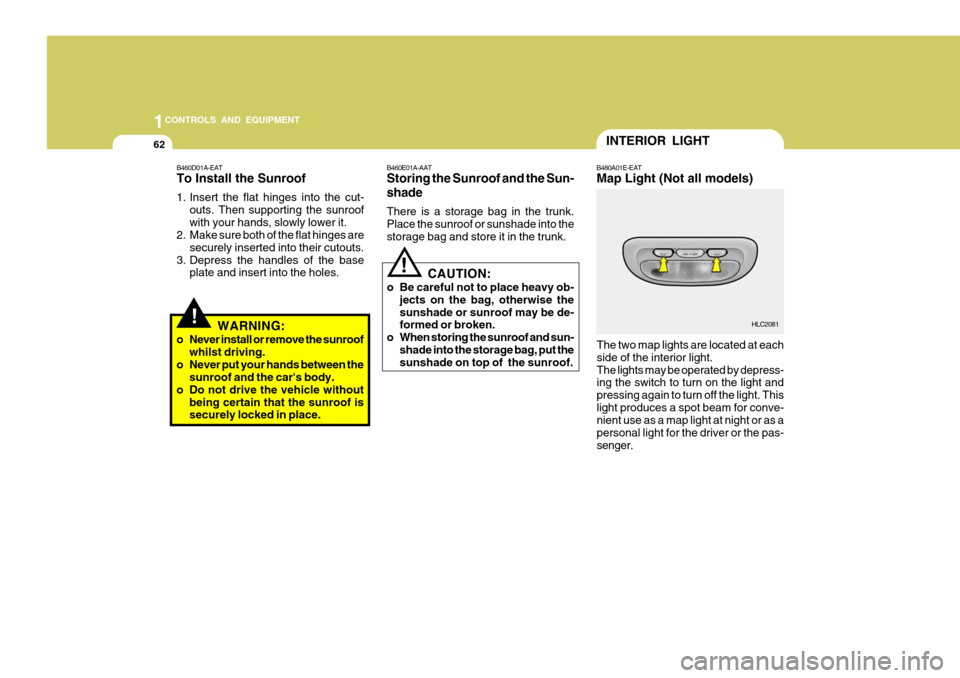
B480A01E-EAT Map Light (Not all models)
The two map lights are located at each side of the interior light.The lights may be operated by depress- ing the switch to turn on the light and pressing again to turn off the light. Thislight produces a spot beam for conve- nient use as a map light at night or as a personal light for the driver or the pas-senger. HLC2081
!
B460D01A-EAT To Install the Sunroof
1. Insert the flat hinges into the cut-
outs. Then supporting the sunroof with your hands, slowly lower it.
2. Make sure both of the flat hinges are
securely inserted into their cutouts.
3. Depress the handles of the base plate and insert into the holes. B460E01A-AAT Storing the Sunroof and the Sun- shade There is a storage bag in the trunk. Place the sunroof or sunshade into thestorage bag and store it in the trunk.
CAUTION:
o Be careful not to place heavy ob- jects on the bag, otherwise thesunshade or sunroof may be de- formed or broken.
o When storing the sunroof and sun- shade into the storage bag, put thesunshade on top of the sunroof.
!
WARNING:
o Never install or remove the sunroof whilst driving.
o Never put your hands between the sunroof and the car's body.
o Do not drive the vehicle without being certain that the sunroof is securely locked in place.
Page 476 of 599
69
1
CONTROLS AND EQUIPMENT
CARGO AREA COVER
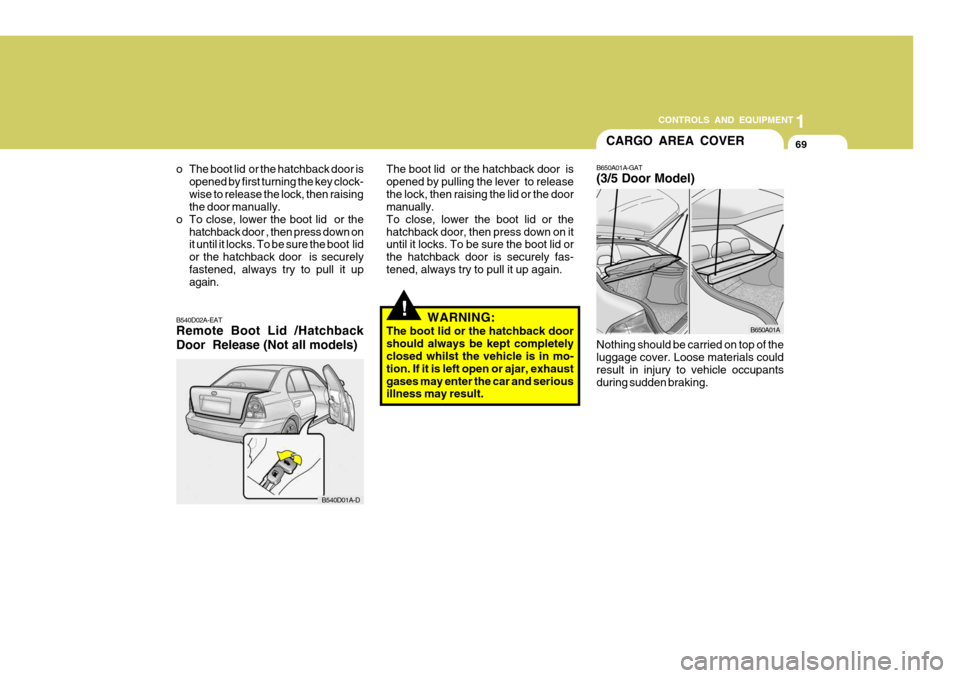
B650A01A-GAT (3/5 Door Model) Nothing should be carried on top of the luggage cover. Loose materials could result in injury to vehicle occupants during sudden braking. B650A01A
!
The boot lid or the hatchback door is opened by pulling the lever to releasethe lock, then raising the lid or the door manually. To close, lower the boot lid or thehatchback door, then press down on it until it locks. To be sure the boot lid or the hatchback door is securely fas-tened, always try to pull it up again.
WARNING:
The boot lid or the hatchback doorshould always be kept completely closed whilst the vehicle is in mo- tion. If it is left open or ajar, exhaustgases may enter the car and serious illness may result.
o The boot lid or the hatchback door is
opened by first turning the key clock- wise to release the lock, then raising the door manually.
o To close, lower the boot lid or the hatchback door , then press down onit until it locks. To be sure the boot lid or the hatchback door is securelyfastened, always try to pull it up again.
B540D02A-EAT Remote Boot Lid /Hatchback Door Release (Not all models)
B540D01A-D
Page 477 of 599
1CONTROLS AND EQUIPMENT
70STEERING WHEEL TILT LEVER
!
B600A01A-EAT (Not all models)
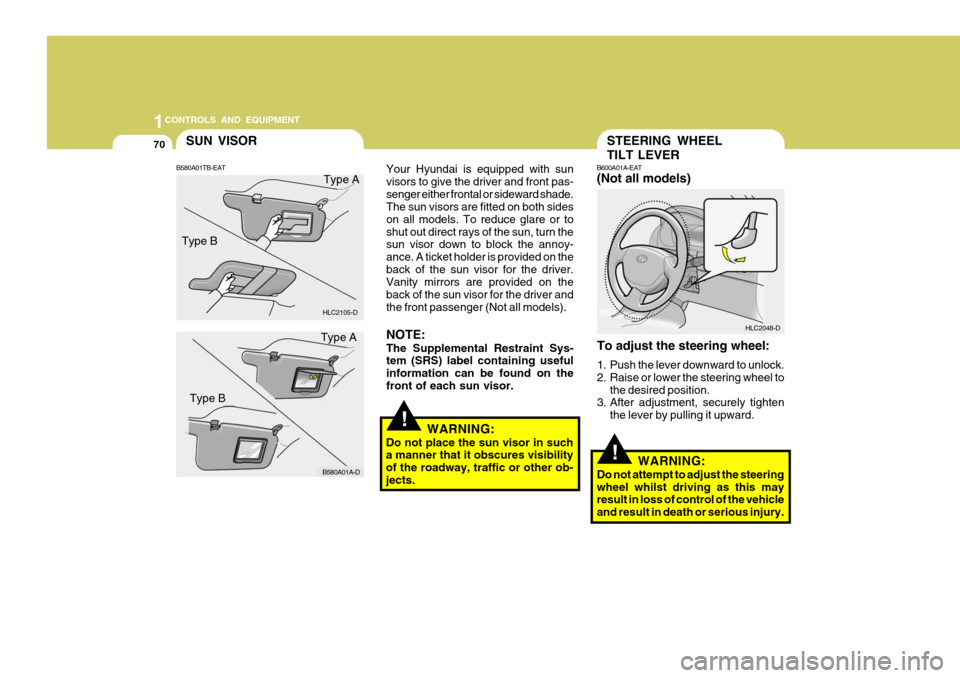
To adjust the steering wheel:
1. Push the lever downward to unlock.
2. Raise or lower the steering wheel to the desired position.
3. After adjustment, securely tighten
the lever by pulling it upward.
WARNING:
Do not attempt to adjust the steeringwheel whilst driving as this may result in loss of control of the vehicle and result in death or serious injury. HLC2048-D
B580A01A-D
SUN VISOR
!
Your Hyundai is equipped with sun visors to give the driver and front pas-senger either frontal or sideward shade. The sun visors are fitted on both sides on all models. To reduce glare or toshut out direct rays of the sun, turn the sun visor down to block the annoy- ance. A ticket holder is provided on theback of the sun visor for the driver. Vanity mirrors are provided on the back of the sun visor for the driver andthe front passenger (Not all models). NOTE: The Supplemental Restraint Sys- tem (SRS) label containing useful information can be found on thefront of each sun visor.
WARNING:
Do not place the sun visor in such a manner that it obscures visibility of the roadway, traffic or other ob-jects.
B580A01TB-EAT
HLC2105-DType A
Type B
Type A
Type B
Page 512 of 599

2DRIVING YOUR HYUNDAI
22
7. The vehicle/trailer combination ismore affected by crosswind and buffeting. When being passed by a large vehicle, keep a constant speedand steer straight ahead. If there is too much wind buffeting slow down to get out of the other vehicle's airturbulence.
8. When parking your car and trailer,
especially on a hill, be sure tofollow all the normal precautions. Turn your front wheel into the curb, set the parking brake firmly, andput the transaxle in 1st or Reverse (manual) or Park (automatic). In addition, place wheel chocks ateach of the trailer's tyres.
9. If the trailer has electric brakes,
start your vehicle and trailer mov-ing, and then apply the trailer brake controller by hand to be sure the brakes are working. This lets youcheck your electrical connection at the same time.
10. During your trip, check occasion- ally to be sure that the load issecure, and that the lights and any trailer brakes are still working.
C190F02A-EAT Trailer or Vehicle Towing Tips
1. Before towing, check towbar hitch
and safety cable connections as well as proper operation of the trailer running lights, brake lights, and turn signals.
2. Always drive your vehicle at a mod- erate speed (Less than 60 MPH)
3. Trailer towing requires more fuel than normal conditions.
4. To maintain engine braking effi-
ciency and electrical charging per-formance, do not use fifth gear (manual transaxle) or overdrive (automatic transaxle).
5. Always secure items in the trailer to prevent load shift whilst driving.
6. Check the condition and air pres- sure of all tyres on the trailer and your car. Low tyre pressure can seriously affect the handling. Alsocheck the spare tyre.
C190G01A-EAT Important Trailer Weight Infor- mation The Maximum Towable Weight of your Hyundai Accent will be reduced if thevehicle is load. The Maximum Towable Weight for a fully load is vehicle is calculated asfollows:
1. Find the Vehicle Identification Num-
ber (VIN) plate (see section 8).
2. Note the top 2 weights (in kg) of the
4 lines of weight information on the VIN plate.
3. Subtract the weight on line 1 from
line 2. This result (in kg) is themaximum towable weight of a fully loaded vehicle. For more information, contact yourlocal Hyundai Dealer.
Page 518 of 599
3
IN CASE OF EMERGENCY
5IF THE ENGINE OVERHEATS
!
!
D030A01TB-EAT If the temperature gauge indicates overheating:
1. Pull off the road and stop as soon as
it is safe to do so.
2. Place the gear selector lever in "P"
(automatic), or neutral (manual transaxle) and set the parking brake. If the air conditioning is on, turn it off.
3. If coolant is running out under the car or steam is coming out from thebonnet, stop the engine. Do not open the bonnet until the coolanthas stopped running or the steam- ing has stopped. If there is no visible loss of coolant and no steam, leavethe engine running and check to be sure the engine cooling fan is oper- ating.If the fan is not running, turn the engine off.
4. Check to see if the water pump drive belt is missing. If it is not missing,check to see that it is tight. If the drive belt seems to be satisfactory,check for coolant leaking from the radiator, hoses or under the car. (If the air conditioning had been in use,it is normal for cold water to be draining from it). WARNING:
Whilst the engine is running, keep hands and clothing away from mov-ing parts such as the fan and drive belts to prevent injury.
WARNING (Diesel only):
Never work on injection system with engine running or within 30 sec- onds after shutting off engine. High pressure pump, rail, injectors andhigh pressure pipes are subject to high pressure even after the engine stopped. The fuel jet produced byfuel leaks may cause serious in- jury, if it touch the body. People using pacemakers should not movethan 12 in.(30 cm) closer to the ECU or wiring harness within the engine room whilst engine is running, sincethe high currents in the Common Rail system produce considerable magnetic fields. 5. If the water pump drive belt is broken
or coolant is leaking out, stop theengine immediately and call the near- est Hyundai dealer for assistance.
!WARNING:
Do not remove the radiator cap when the engine is hot since steam and boiling water may be ejected fromthe radiator resulting in burns or scalding.
6. If the cause of the overheating can- not be found, wait until the engine temperature has returned to nor- mal. Then, if coolant has been lost, carefully remove the radiator capand add water to bring the fluid level in the reservoir up to the base of the radiator fill opening. Fill the coolantexpansion tank to the halfway mark.
7. Proceed with caution until it is es-
tablished that the engine is operat-ing normally. If the engine over- heats repeatedly, the advice of a Hyundai dealer should be sought.
Page 524 of 599
3
IN CASE OF EMERGENCY
11
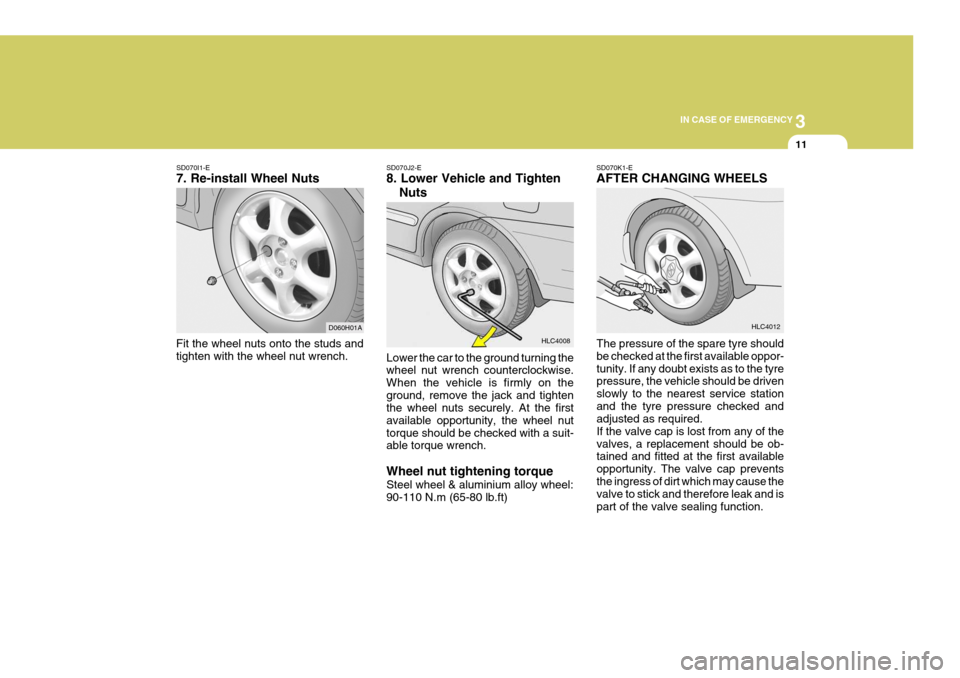
SD070I1-E 7. Re-install Wheel Nuts
Fit the wheel nuts onto the studs and tighten with the wheel nut wrench. D060H01ASD070J2-E 8. Lower Vehicle and Tighten
Nuts
Lower the car to the ground turning the wheel nut wrench counterclockwise. When the vehicle is firmly on theground, remove the jack and tighten the wheel nuts securely. At the first available opportunity, the wheel nuttorque should be checked with a suit- able torque wrench. Wheel nut tightening torque Steel wheel & aluminium alloy wheel: 90-110 N.m (65-80 lb.ft) SD070K1-E AFTER CHANGING WHEELS
The pressure of the spare tyre should be checked at the first available oppor-tunity. If any doubt exists as to the tyre pressure, the vehicle should be driven slowly to the nearest service stationand the tyre pressure checked and adjusted as required. If the valve cap is lost from any of thevalves, a replacement should be ob- tained and fitted at the first available opportunity. The valve cap preventsthe ingress of dirt which may cause the valve to stick and therefore leak and is part of the valve sealing function.
HLC4008 HLC4012
Page 539 of 599
5
VEHICLE MAINTENANCE REQUIREMENTS
7EXPLANATION OF SCHED- ULED MAINTENANCE ITEMS
!
6ZF060M1-A
o Engine oil and filter
The engine oil and filter should be changed at the intervals specified in the maintenance schedule. If the car is being driven in severe conditions,more frequent oil and filter changes are required. 6ZF060B1-A
o Drive belts
Inspect all drive belts for evidence of cuts, cracks, excessive wear or oil saturation and replace if necessary. Drive belts should be checked peri-odically for proper tension and ad- justed as necessary. 6ZF060C1-A
o Fuel filter
A clogged filter can limit the speed at
which the vehicle may be driven, dam-age the emission system and cause hard starting. If an excessive amountof foreign matter accumulates in the fuel tank, the filter may require re- placement more frequently. After installing a new filter, run the
engine for several minutes, and checkfor leaks at the connections.
F060D01TB-EAT
o Fuel lines, fuel hoses and con-
nections
Check the fuel lines, fuel hoses and
connections for leakage and damage.Replace any damaged or leaking partsimmediately. WARNING (Diesel only):
Never work on injection system with engine running or within 30 seconds after shutting off engine.High pressure pump, rail, injectors and high pressure pipes are sub- jected to high pressure even afterthe engine has been switched off. The fuel jet produced by fuel leaks may cause serious injury, if it con-tacts with the body. People using pacemakers should not move closer than 12 in.(30 cm) to the ECUor wiring harness within the engine room with the engine running, since the high currents in the CommonRail system produce considerable magnetic fields.
Page 540 of 599

5VEHICLE MAINTENANCE REQUIREMENTS
8
6ZF070C1-A
o Coolant
The engine coolant should be changed
at the intervals specified in the main- tenance schedule. F060H01A-AAT
o Air cleaner filter
A Genuine Hyundai air cleaner filter is
recommended when the filter is re- placed.
6ZF060J1-A
o Spark plugs
(For Petrol Engine)
Make sure to install new spark plugs
of the correct heat range.
6ZF070B1-A
o Cooling system
Check the cooling system part, such as radiator, coolant reservoir, hoses and connections for leakage and dam- age. Replace any damaged parts.
6ZF060G1-A o Vapour hose and fuel filler cap The vapour hose and fuel filler cap should be inspected at those intervals specified in the maintenance sched- ule. Make sure that a new vapourhose or fuel filler cap is correctly re- placed. 6ZF060F1-A
o Vacuum, crankcase
ventilation hoses
Inspect the surface of hoses for evi-
dence of heat and/or mechanical dam-age. Hard and brittle rubber, cracking, tears, cuts, abrasions, and excessiveswelling indicate deterioration. Par- ticular attention should be paid to ex- amining those hose surfaces nearestto high heat sources, such as the exhaust manifold.
Inspect the hose routing to assure
that the hoses do not come in contactwith any heat source, sharp edges or moving component which might causeheat damage or mechanical wear. Inspect all hose connections, such as clamps and couplings, to make surethey are secure, and that no leaks are present. Hoses should be replaced immediately if there is any evidence ofdeterioration or damage.
6ZF060E1-A o Timing belt Replace timimg belt and inspect all associated parts related for damage and deformation. Replace any dam- aged parts immediately.
Page 550 of 599
6OWNER MAINTENANCE
8
HTB222
Oil filler cap
Drain plug Oil filter
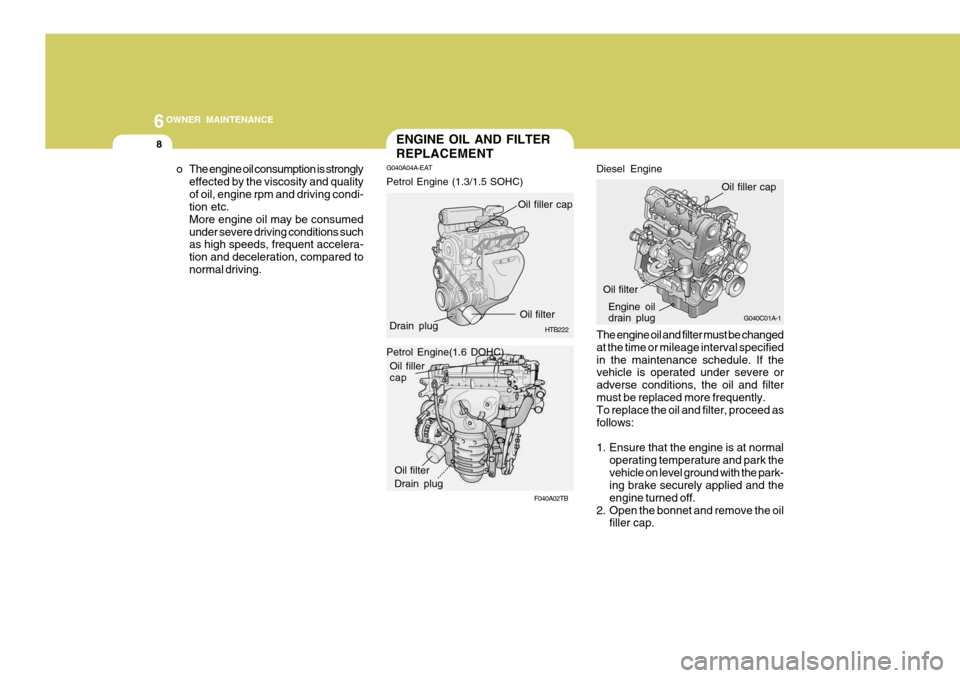
ENGINE OIL AND FILTER REPLACEMENT
o The engine oil consumption is strongly effected by the viscosity and quality of oil, engine rpm and driving condi- tion etc. More engine oil may be consumedunder severe driving conditions such as high speeds, frequent accelera- tion and deceleration, compared tonormal driving. G040A04A-EAT
The engine oil and filter must be changedat the time or mileage interval specifiedin the maintenance schedule. If the vehicle is operated under severe or adverse conditions, the oil and filtermust be replaced more frequently. To replace the oil and filter, proceed as follows:
1. Ensure that the engine is at normaloperating temperature and park the vehicle on level ground with the park- ing brake securely applied and the engine turned off.
2. Open the bonnet and remove the oil filler cap.
Petrol Engine (1.3/1.5 SOHC) Petrol Engine(1.6 DOHC)
Diesel Engine
F040A02TB
Oil filler cap Drain plug
Oil filter
.........
G040C01A-1Engine oil drain plug
Oil filter
Oil filler cap
Page 559 of 599
6
OWNER MAINTENANCE
17
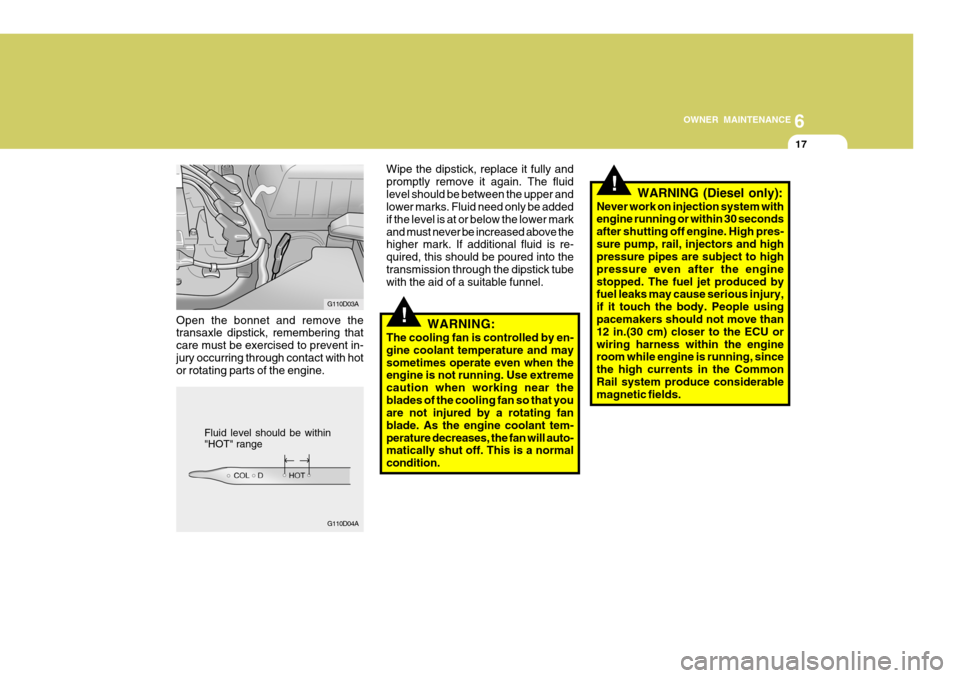
!Open the bonnet and remove the transaxle dipstick, remembering that care must be exercised to prevent in-jury occurring through contact with hot or rotating parts of the engine. WARNING:
The cooling fan is controlled by en- gine coolant temperature and maysometimes operate even when the engine is not running. Use extreme caution when working near theblades of the cooling fan so that you are not injured by a rotating fan blade. As the engine coolant tem-perature decreases, the fan will auto- matically shut off. This is a normal condition.
Wipe the dipstick, replace it fully andpromptly remove it again. The fluidlevel should be between the upper and lower marks. Fluid need only be added if the level is at or below the lower markand must never be increased above the higher mark. If additional fluid is re- quired, this should be poured into thetransmission through the dipstick tube with the aid of a suitable funnel.
G110D03A
G110D04A
Fluid level should be within "HOT" range
!WARNING (Diesel only):
Never work on injection system with engine running or within 30 seconds after shutting off engine. High pres-sure pump, rail, injectors and high pressure pipes are subject to high pressure even after the enginestopped. The fuel jet produced by fuel leaks may cause serious injury, if it touch the body. People usingpacemakers should not move than 12 in.(30 cm) closer to the ECU or wiring harness within the engine room while engine is running, since the high currents in the CommonRail system produce considerable magnetic fields.