coolant level Hyundai Accent 2006 Owner's Guide
[x] Cancel search | Manufacturer: HYUNDAI, Model Year: 2006, Model line: Accent, Model: Hyundai Accent 2006Pages: 599, PDF Size: 17.59 MB
Page 339 of 599
1
FEATURES OF YOUR HYUNDAI
57
!
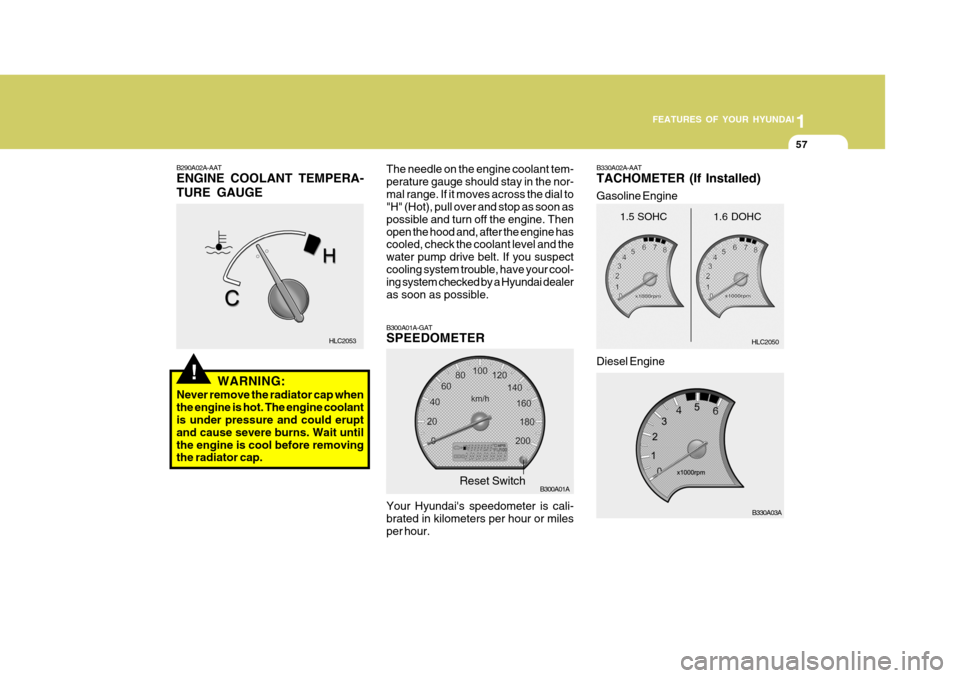
B290A02A-AAT ENGINE COOLANT TEMPERA- TURE GAUGE
WARNING:
Never remove the radiator cap when the engine is hot. The engine coolant is under pressure and could erupt and cause severe burns. Wait untilthe engine is cool before removing the radiator cap.
HLC2053 The needle on the engine coolant tem- perature gauge should stay in the nor-mal range. If it moves across the dial to "H" (Hot), pull over and stop as soon as possible and turn off the engine. Thenopen the hood and, after the engine has cooled, check the coolant level and the water pump drive belt. If you suspectcooling system trouble, have your cool- ing system checked by a Hyundai dealer as soon as possible.
B300A01A-GAT SPEEDOMETER
B300A01A
Your Hyundai's speedometer is cali- brated in kilometers per hour or miles per hour.
Reset Switch
B330A02A-AAT TACHOMETER (If Installed)
B330A03A
Diesel Engine
Gasoline Engine
HLC2050
1.5 SOHC 1.6 DOHC
Page 411 of 599
1CONTROLS AND EQUIPMENT
4RUNNING IN YOUR NEW HYUNDAI
B020A01FC-EAT (Petrol Engine) The longevity and performance of the vehicle are greatly affected by the careexercised during the first 1,000 miles of motoring. Because of modern manu- facturing techniques, rigid guidelinesregarding maximum road speeds have become unnecessary. However, cer- tain precautions should be observed inorder to obtain the best possible perfor- mance and useful life from the vehicle.
1) Do not race the engine without a load
(i.e revving the engine in neutral).
2) During the first 500 miles the maxi- mum engine speed should be re- stricted to 3,000 rpm and gradually increased thereafter.
3) Avoid prolonged constant speed op- eration. The internal components ofthe engine will become runin morequickly if the operation speed is var- ied during the running-in period.
4) Never allow the engine to labour. Use the gearbox freely and avoid largethrottle openings when the engine speed is below 1,500 rpm. 5) Avoid rapid acceleration and maxi-
mum throttle openings.
6) Avoid harsh braking during the first 100 miles of urban motoring or 1,000miles of motorway driving to allowthe friction facings of the brake pads and shoes to bed against the discs and drums properly.
7) No trailer towing should be under- taken during the running-in period.
B020B01FC-EAT (Diesel Engine) The longevity and performance of the vehicle are greatly affected by the care exercised during the first 1,000 miles of motoring. Because of modern manu-facturing techniques, rigid guidelines regarding maximum road speeds have become unnecessary. However, cer-tain precautions should be observed in order to obtain the best possible perfor- mance and useful life from the vehicle.AFTER ENTERING THE VEHICLE
YB020B1-E
o Ensure that all occupants fasten and
correctly adjust seat belts.
o Ensure that seat and headrestraint
positions are adjusted for optimum safety, control and comfort.
o Adjust interior and exterior rear view
mirrors.
o Verify correct operation of lamps,
horn and other electrical equipment.
o Ensure that warning lamps illumi- nate when ignition is turned on.
NOTE: Fluid levels such as engine oil, en- gine coolant, brake and windscreen washer fluid should be checked daily or at each refuelling, whichever oc-curs sooner.
Page 453 of 599
1CONTROLS AND EQUIPMENT
46
!
heating cannot be readily established, the assistance of a Hyundai dealershould be sought.
WARNING:
The engine cooling system is pres-surized and removal of the radiatorcap when the engine is hot may cause hot water and steam to be ejected from the radiator resulting inburns and scalding. The radiator cap must only be removed when the en- gine has cooled. Do not add coldwater to a hot engine to avoid the possibility of engine damage. The use of plain water in the coolingsystem is not recommended since the aluminium components of the cooling system require the use of acorrosion inhibitor found in the rec- ommended Ethylene Glycol type anti freeze solutions.
INSTRUMENT CLUSTER
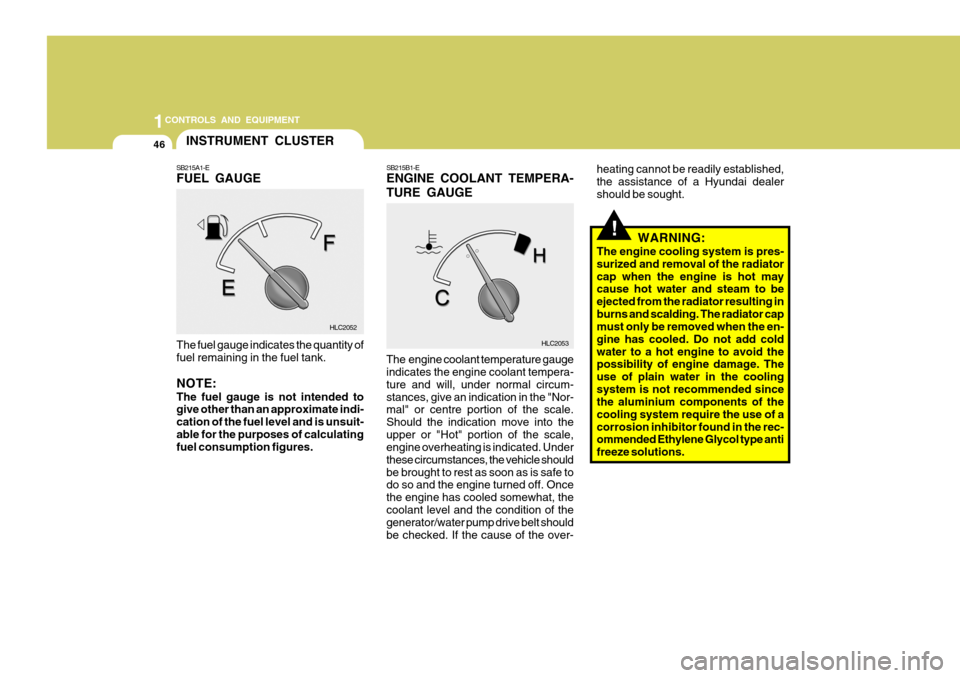
SB215B1-E ENGINE COOLANT TEMPERA- TURE GAUGE The engine coolant temperature gauge indicates the engine coolant tempera- ture and will, under normal circum-stances, give an indication in the "Nor- mal" or centre portion of the scale. Should the indication move into theupper or "Hot" portion of the scale, engine overheating is indicated. Under these circumstances, the vehicle shouldbe brought to rest as soon as is safe to do so and the engine turned off. Once the engine has cooled somewhat, thecoolant level and the condition of the generator/water pump drive belt should be checked. If the cause of the over-
The fuel gauge indicates the quantity offuel remaining in the fuel tank. NOTE: The fuel gauge is not intended to give other than an approximate indi- cation of the fuel level and is unsuit-able for the purposes of calculating fuel consumption figures.
SB215A1-E FUEL GAUGE
HLC2053
HLC2052
Page 518 of 599
3
IN CASE OF EMERGENCY
5IF THE ENGINE OVERHEATS
!
!
D030A01TB-EAT If the temperature gauge indicates overheating:
1. Pull off the road and stop as soon as
it is safe to do so.
2. Place the gear selector lever in "P"
(automatic), or neutral (manual transaxle) and set the parking brake. If the air conditioning is on, turn it off.
3. If coolant is running out under the car or steam is coming out from thebonnet, stop the engine. Do not open the bonnet until the coolanthas stopped running or the steam- ing has stopped. If there is no visible loss of coolant and no steam, leavethe engine running and check to be sure the engine cooling fan is oper- ating.If the fan is not running, turn the engine off.
4. Check to see if the water pump drive belt is missing. If it is not missing,check to see that it is tight. If the drive belt seems to be satisfactory,check for coolant leaking from the radiator, hoses or under the car. (If the air conditioning had been in use,it is normal for cold water to be draining from it). WARNING:
Whilst the engine is running, keep hands and clothing away from mov-ing parts such as the fan and drive belts to prevent injury.
WARNING (Diesel only):
Never work on injection system with engine running or within 30 sec- onds after shutting off engine. High pressure pump, rail, injectors andhigh pressure pipes are subject to high pressure even after the engine stopped. The fuel jet produced byfuel leaks may cause serious in- jury, if it touch the body. People using pacemakers should not movethan 12 in.(30 cm) closer to the ECU or wiring harness within the engine room whilst engine is running, sincethe high currents in the Common Rail system produce considerable magnetic fields. 5. If the water pump drive belt is broken
or coolant is leaking out, stop theengine immediately and call the near- est Hyundai dealer for assistance.
!WARNING:
Do not remove the radiator cap when the engine is hot since steam and boiling water may be ejected fromthe radiator resulting in burns or scalding.
6. If the cause of the overheating can- not be found, wait until the engine temperature has returned to nor- mal. Then, if coolant has been lost, carefully remove the radiator capand add water to bring the fluid level in the reservoir up to the base of the radiator fill opening. Fill the coolantexpansion tank to the halfway mark.
7. Proceed with caution until it is es-
tablished that the engine is operat-ing normally. If the engine over- heats repeatedly, the advice of a Hyundai dealer should be sought.
Page 543 of 599
Engine Compartment .................................................... 6-2
Daily Operating Checks ............................................... 6-5
Engine Oil ..................................................................... 6-5
Engine Oil and Filter Replacement ............................... 6-8
Engine Coolant Checking and Replacing ..................... 6-9
Sparking Plug Replacement ........................................6-12
Air Cleaner Element Replacement ............................... 6-13
Manual Transaxle Lubricant .................... ....................6-15
Automatic Transaxle Fl uid........................................... 6-16
Brake System Checking .............................................. 6-18
Checking the Clutch Fluid ............................................ 6-19
Air Conditioning System Maintenance ......................... 6-20
Changing the Pollen Filter
(For Evaporator and Blower U nit) .............................6-21
Drive Belts ................................................................... 6-23
Fusible Links ............................................................... 6-24
Power Steering Fluid Level .......................................... 6-27
Replacing Light Bulbs .................................................. 6-30
Fuse Panel Description ............................................... 6-37
OWNER MAINTENANCE
6
6
Page 544 of 599
6OWNER MAINTENANCE
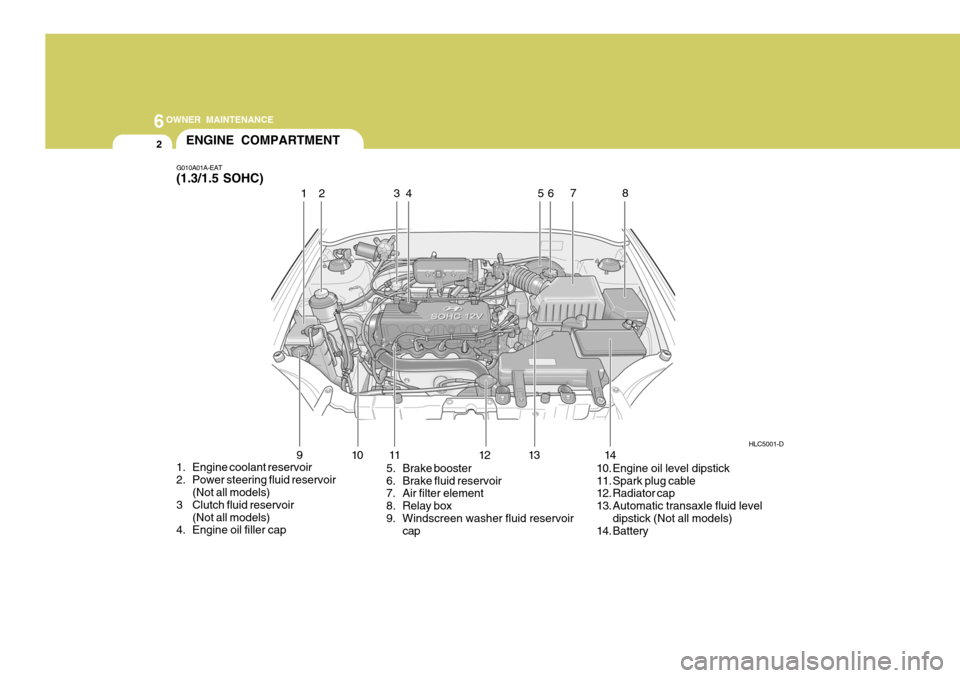
2ENGINE COMPARTMENT
HLC5001-D
G010A01A-EAT (1.3/1.5 SOHC)
1. Engine coolant reservoir
2. Power steering fluid reservoir
(Not all models)
3 Clutch fluid reservoir (Not all models)
4. Engine oil filler cap 5. Brake booster
6. Brake fluid reservoir
7. Air filter element
8. Relay box
9. Windscreen washer fluid reservoir
cap 10. Engine oil level dipstick
11. Spark plug cable
12. Radiator cap
13. Automatic transaxle fluid level
dipstick (Not all models)
14. Battery
12 34 56
78
91 011 1 213 1 4
Page 545 of 599
6
OWNER MAINTENANCE
3
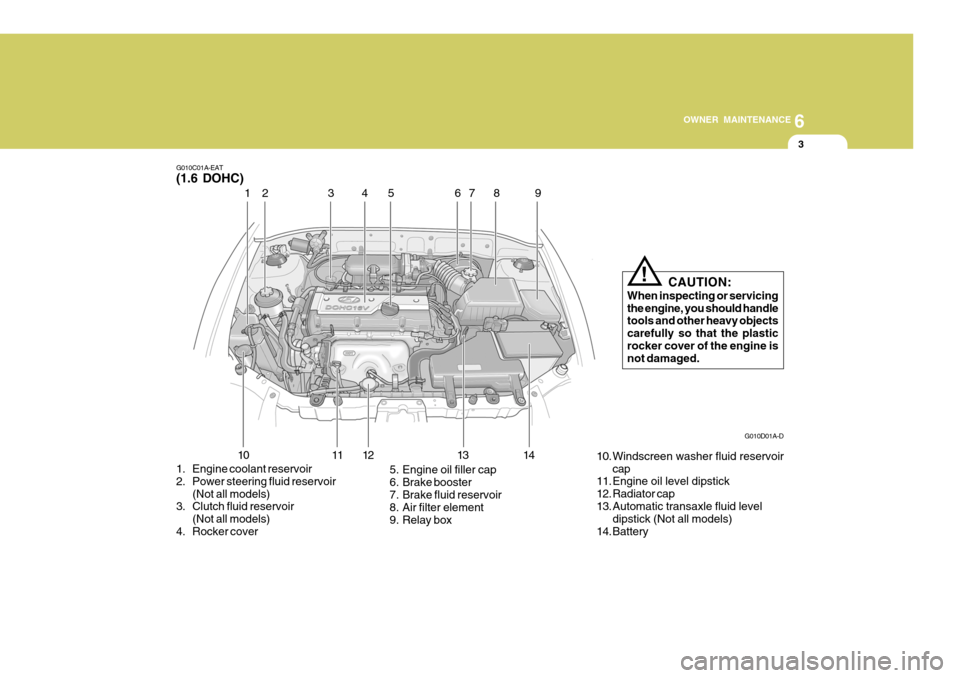
G010C01A-EAT (1.6 DOHC)
G010D01A-D
1. Engine coolant reservoir
2. Power steering fluid reservoir (Not all models)
3. Clutch fluid reservoir
(Not all models)
4. Rocker cover 5. Engine oil filler cap
6. Brake booster
7. Brake fluid reservoir
8. Air filter element
9. Relay box10. Windscreen washer fluid reservoir
cap
11. Engine oil level dipstick
12. Radiator cap
13. Automatic transaxle fluid level dipstick (Not all models)
14. Battery
12 4 5 67 8 9
10 11 12 3
CAUTION:
When inspecting or servicingthe engine, you should handle tools and other heavy objects carefully so that the plasticrocker cover of the engine is not damaged.
!
13 14
Page 546 of 599
6OWNER MAINTENANCE
4
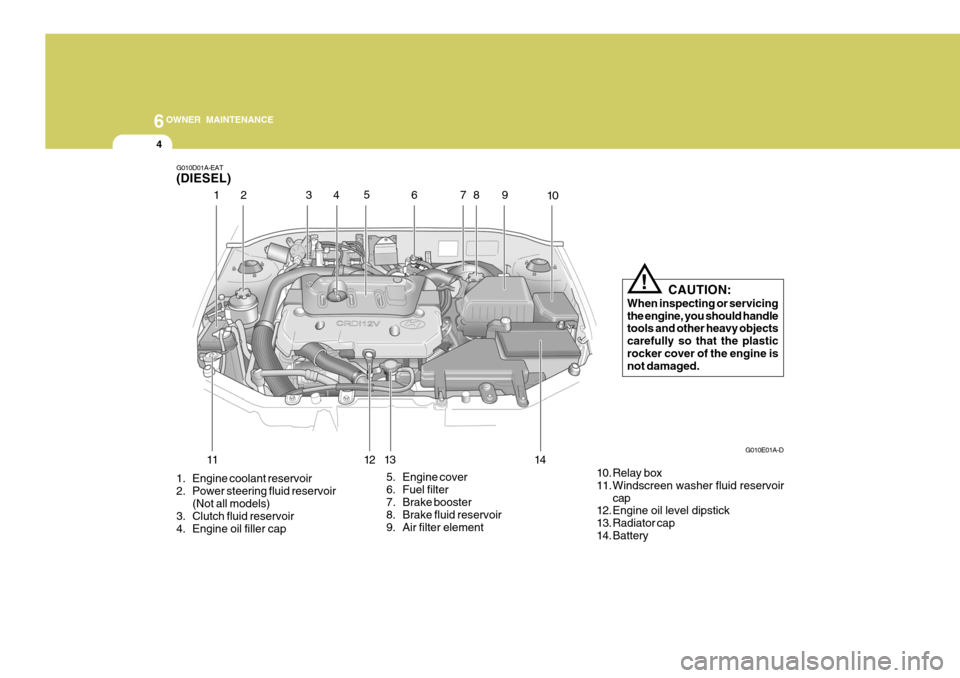
G010D01A-EAT (DIESEL)
1. Engine coolant reservoir
2. Power steering fluid reservoir
(Not all models)
3. Clutch fluid reservoir
4. Engine oil filler cap 5. Engine cover
6. Fuel filter
7. Brake booster
8. Brake fluid reservoir
9. Air filter element 10. Relay box
11. Windscreen washer fluid reservoir
cap
12. Engine oil level dipstick
13. Radiator cap
14. Battery G010E01A-D
12 34
5
67 89
11 12 13 14 10
CAUTION:
When inspecting or servicingthe engine, you should handle tools and other heavy objects carefully so that the plastic rocker cover of the engine is not damaged.
!
Page 547 of 599
6
OWNER MAINTENANCE
5ENGINE OILDAILY OPERATING CHECKS
SG020B1-E The following items should be checked on a daily basis or whenever the vehicle is refuelled, whichever occurs sooner.
o Engine oil level.
o Coolant level.
o Power steering fluid level.
o Brake fluid level.
o Windscreen washer fluid level.
o Battery condition.
o Tyre condition and pressures.
o Operation and cleanliness of all light- ing equipment.
o Windscreen wiper and washer opera- tion.
o Horn operation.
o Warning light operation.
o Adjustment and cleanliness of mir- rors.
o Seat and seat belt adjustment and operation.
o Fluid leakage. The vehicle must not be driven if the daily operating checks indicate thatany item of equipment related to the safety or roadworthiness of the vehicle is not functioning correctly. G030A01FC-EAT The correct engine oil level is of para- mount importance. An excessively high or low oil level may result in irreparable damage being sustained by the engine.The engine oil level must be checked on a daily basis, whenever the vehicle is refuelled or before starting a long trip,whichever occurs sooner. In addition, it is imperative that only an approved grade and specification of oilis used to avoid the possibility of seri- ous engine damage and premature wear. The use of "budget price" oil is a falseeconomy that must be avoided if the maximum reliability and useful life is to be obtained from the vehicle.
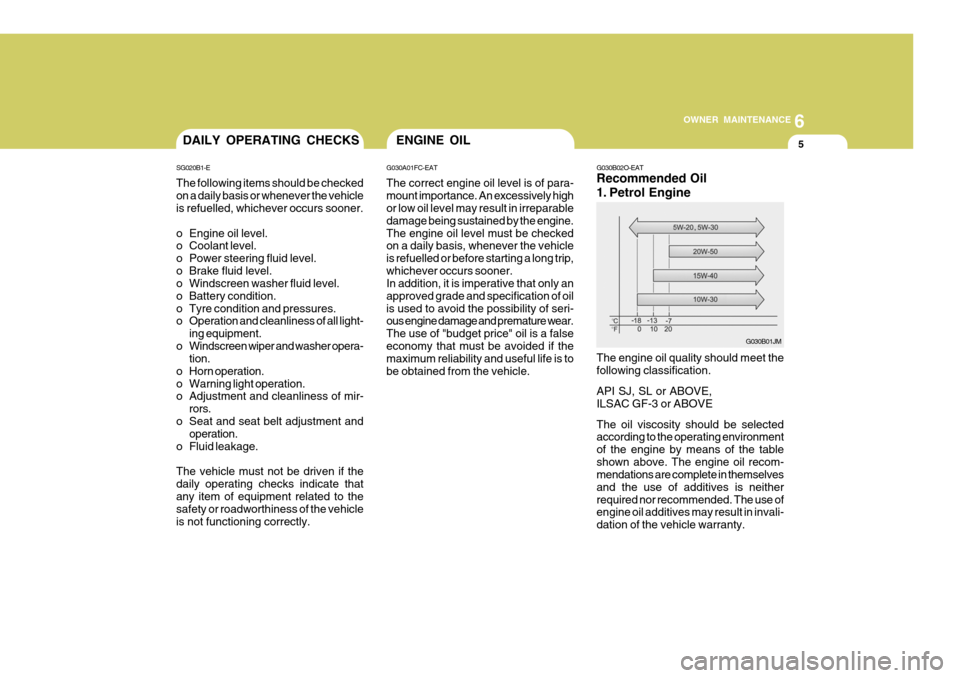
G030B02O-EAT Recommended Oil
1. Petrol Engine The engine oil quality should meet the following classification. API SJ, SL or ABOVE, ILSAC GF-3 or ABOVE The oil viscosity should be selected according to the operating environment of the engine by means of the tableshown above. The engine oil recom- mendations are complete in themselves and the use of additives is neitherrequired nor recommended. The use of engine oil additives may result in invali- dation of the vehicle warranty.
G030B01JM
Page 551 of 599
6
OWNER MAINTENANCE
9ENGINE COOLANT CHECK-
ING AND REPLACING
CAUTION:
The oil being drained from the en- gine will be hot. Care should beexercised to prevent scalding.
!
3. Prepare a suitable receptacle to col-
lect the displaced oil and remove the drain plug from the sump.
!
4. When the oil has drained from thesump, replace the drain plug using a new washer ensuring that the plug isnot over tightened. Tightening torque is: 3.5 ~ 4.5 kgf.m
5. Remove the oil filter by rotating coun- terclockwise, using a proprietary oil filter removal tool if necessary. Note that the oil filter will contain approxi-mately 0.3 litres of oil and this should be collected in a suitable receptacle.
6. Install a new oil filter having smeared the sealing ring with clean oil androtating clockwise until the filter con- tacts the mounting and then a furtherone half turn. Do not over-tighten. WARNING:
Prolonged and repeated contact with used engine oils may result in seri- ous skin disorders including derma-titis and cancer. Avoid contact with skin as far as possible and always wash thoroughly after any contact.Keep used oils out of reach of chil- dren. It is illegal to pollute drains, water courses and soil. Use onlyauthorized waste collection facili- ties including civic amenity sites and garages for the disposal of usedoil and oil filters. If in doubt, contact the local authority for disposal in- structions. Tightening torque:
Petrol -
1.2 ~ 1.6 kgf.m
Diesel - 2.3 ~ 2.5 kgf.m
7. Pour the specified quantity of the recommended oil into the engine and replace the filler cap. Start the en- gine and ensure that no oil leaksexist. Turn off the engine and after a couple minutes, recheck the oil level.
!
SG050A1-E
WARNING:
Do not remove the radiator cap when the engine is hot, since the system is pressurized and coolant may beejected from the radiator resulting in scalding.