coolant level Hyundai Accent 2006 Owner's Guide
[x] Cancel search | Manufacturer: HYUNDAI, Model Year: 2006, Model line: Accent, Model: Hyundai Accent 2006Pages: 599, PDF Size: 17.59 MB
Page 552 of 599
6OWNER MAINTENANCE
10
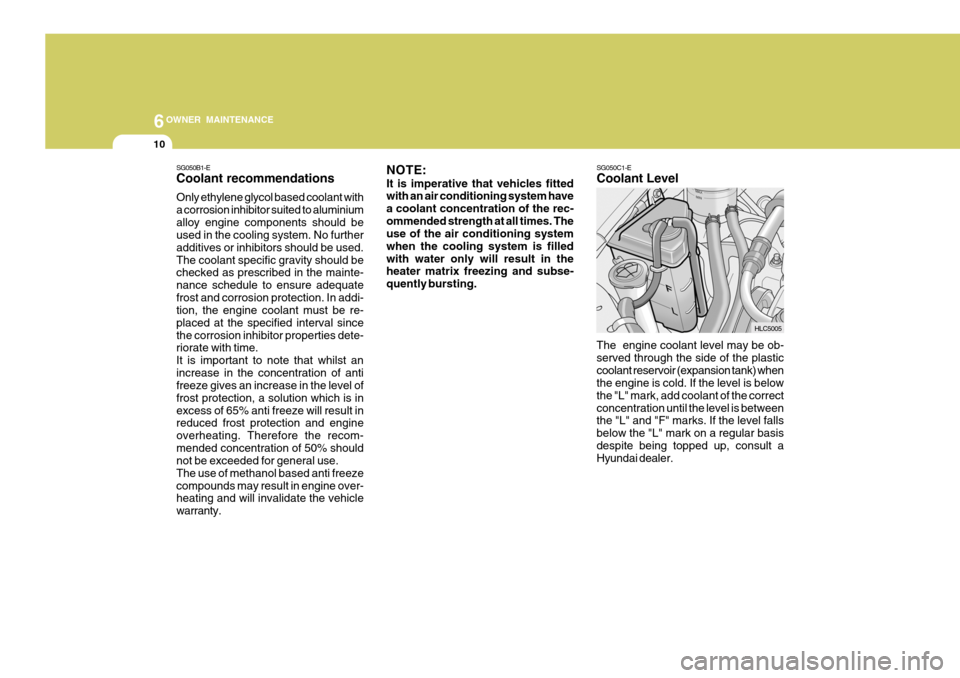
NOTE: It is imperative that vehicles fitted with an air conditioning system have a coolant concentration of the rec-ommended strength at all times. The use of the air conditioning system when the cooling system is filledwith water only will result in the heater matrix freezing and subse- quently bursting. SG050C1-E Coolant Level The engine coolant level may be ob- served through the side of the plasticcoolant reservoir (expansion tank) when the engine is cold. If the level is below the "L" mark, add coolant of the correctconcentration until the level is between the "L" and "F" marks. If the level falls below the "L" mark on a regular basisdespite being topped up, consult a Hyundai dealer.
SG050B1-E Coolant recommendations Only ethylene glycol based coolant with a corrosion inhibitor suited to aluminiumalloy engine components should be used in the cooling system. No further additives or inhibitors should be used.The coolant specific gravity should be checked as prescribed in the mainte- nance schedule to ensure adequatefrost and corrosion protection. In addi- tion, the engine coolant must be re- placed at the specified interval sincethe corrosion inhibitor properties dete- riorate with time. It is important to note that whilst anincrease in the concentration of anti freeze gives an increase in the level of frost protection, a solution which is inexcess of 65% anti freeze will result in reduced frost protection and engine overheating. Therefore the recom-mended concentration of 50% should not be exceeded for general use. The use of methanol based anti freezecompounds may result in engine over- heating and will invalidate the vehicle warranty.
HLC5005
Page 553 of 599
6
OWNER MAINTENANCE
11
SG050D1-E To Change the Coolant The coolant should be changed at those intervals specified in the vehicle main-tenance schedule in Section 5. NOTE: Care should be taken to ensure that coolant is not allowed to spill onto the paintwork since the finish may become damaged. If coolant spill-age occurs, the affected area should be rinsed thoroughly with water.
1. Park the vehicle on level ground and
ensure that the parking brake is firmly applied, and the engine allowed tocool. Do not attempt this operation whilst the engine is hot since burning orscalding may result.
2. Prepare a suitable receptacle to col-
lect the displaced coolant and posi-tion this under the radiator drain tap.
3. With the heater temperature control
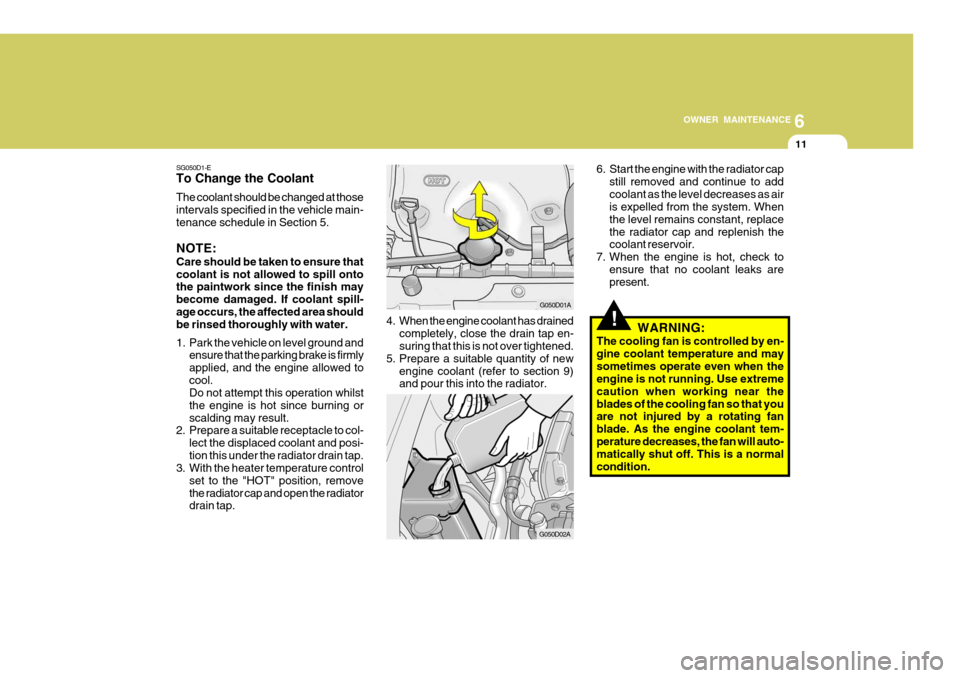
set to the "HOT" position, removethe radiator cap and open the radiator drain tap.
!
6. Start the engine with the radiator capstill removed and continue to add coolant as the level decreases as air is expelled from the system. When the level remains constant, replacethe radiator cap and replenish the coolant reservoir.
7. When the engine is hot, check to ensure that no coolant leaks arepresent.
4. When the engine coolant has drained completely, close the drain tap en-suring that this is not over tightened.
5. Prepare a suitable quantity of new
engine coolant (refer to section 9)and pour this into the radiator. WARNING:
The cooling fan is controlled by en- gine coolant temperature and maysometimes operate even when the engine is not running. Use extreme caution when working near theblades of the cooling fan so that you are not injured by a rotating fan blade. As the engine coolant tem-perature decreases, the fan will auto- matically shut off. This is a normal condition.
G050D01A
G050D02A
Page 556 of 599
6OWNER MAINTENANCE
14WINDSCREEN WIPER BLADES
CAUTION:
Engine coolant anti freeze must not be used in the windscreen washersystem since damage to the paintwork may result. Undiluted windscreen washer addi-tive must not be allowed to come into contact with the paintwork. If spillage occurs, flush the affectedarea immediately with water. Do not operate the windscreen washer for more than 15 seconds continuouslyor when the reservoir is empty since damage to the washer pump will result.
!
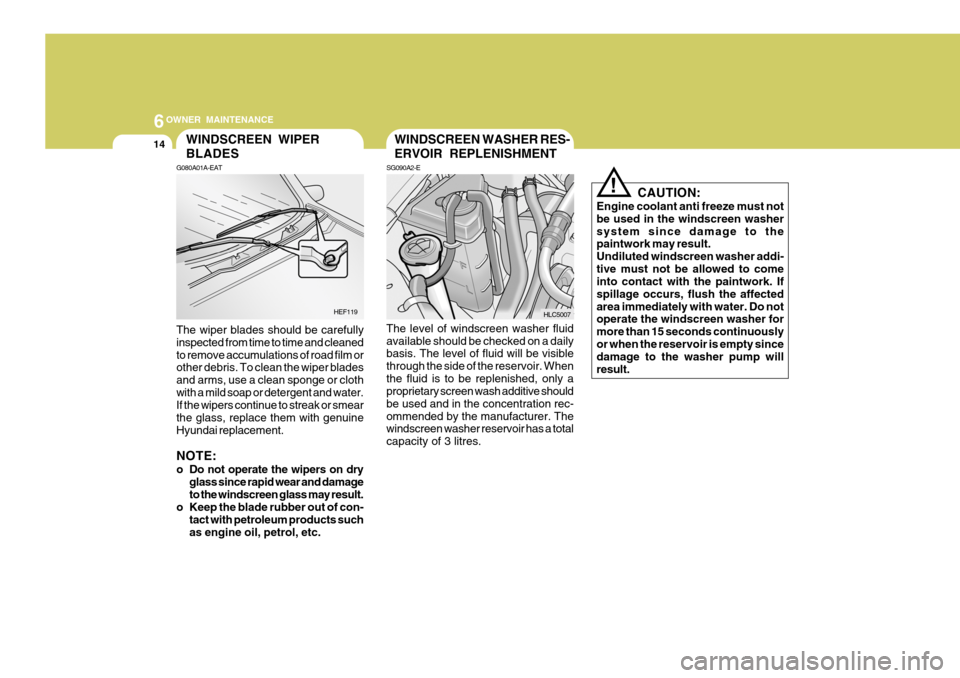
The level of windscreen washer fluid available should be checked on a daily basis. The level of fluid will be visible through the side of the reservoir. Whenthe fluid is to be replenished, only a proprietary screen wash additive should be used and in the concentration rec-ommended by the manufacturer. The windscreen washer reservoir has a total capacity of 3 litres.
SG090A2-E
G080A01A-EAT The wiper blades should be carefully inspected from time to time and cleanedto remove accumulations of road film or other debris. To clean the wiper blades and arms, use a clean sponge or clothwith a mild soap or detergent and water. If the wipers continue to streak or smear the glass, replace them with genuineHyundai replacement. NOTE:
o Do not operate the wipers on dry
glass since rapid wear and damage to the windscreen glass may result.
o Keep the blade rubber out of con-
tact with petroleum products suchas engine oil, petrol, etc.
HEF119 HLC5007
WINDSCREEN WASHER RES- ERVOIR REPLENISHMENT
Page 559 of 599
6
OWNER MAINTENANCE
17
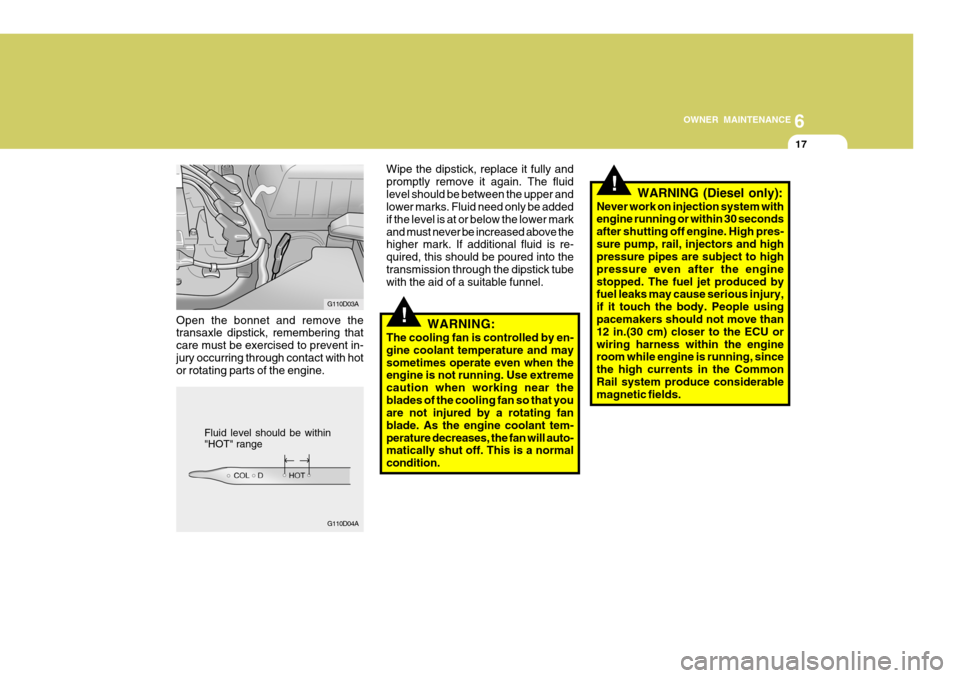
!Open the bonnet and remove the transaxle dipstick, remembering that care must be exercised to prevent in-jury occurring through contact with hot or rotating parts of the engine. WARNING:
The cooling fan is controlled by en- gine coolant temperature and maysometimes operate even when the engine is not running. Use extreme caution when working near theblades of the cooling fan so that you are not injured by a rotating fan blade. As the engine coolant tem-perature decreases, the fan will auto- matically shut off. This is a normal condition.
Wipe the dipstick, replace it fully andpromptly remove it again. The fluidlevel should be between the upper and lower marks. Fluid need only be added if the level is at or below the lower markand must never be increased above the higher mark. If additional fluid is re- quired, this should be poured into thetransmission through the dipstick tube with the aid of a suitable funnel.
G110D03A
G110D04A
Fluid level should be within "HOT" range
!WARNING (Diesel only):
Never work on injection system with engine running or within 30 seconds after shutting off engine. High pres-sure pump, rail, injectors and high pressure pipes are subject to high pressure even after the enginestopped. The fuel jet produced by fuel leaks may cause serious injury, if it touch the body. People usingpacemakers should not move than 12 in.(30 cm) closer to the ECU or wiring harness within the engine room while engine is running, since the high currents in the CommonRail system produce considerable magnetic fields.
Page 570 of 599
6OWNER MAINTENANCE
28HEADLIGHT AIMING ADJUSTMENT
!
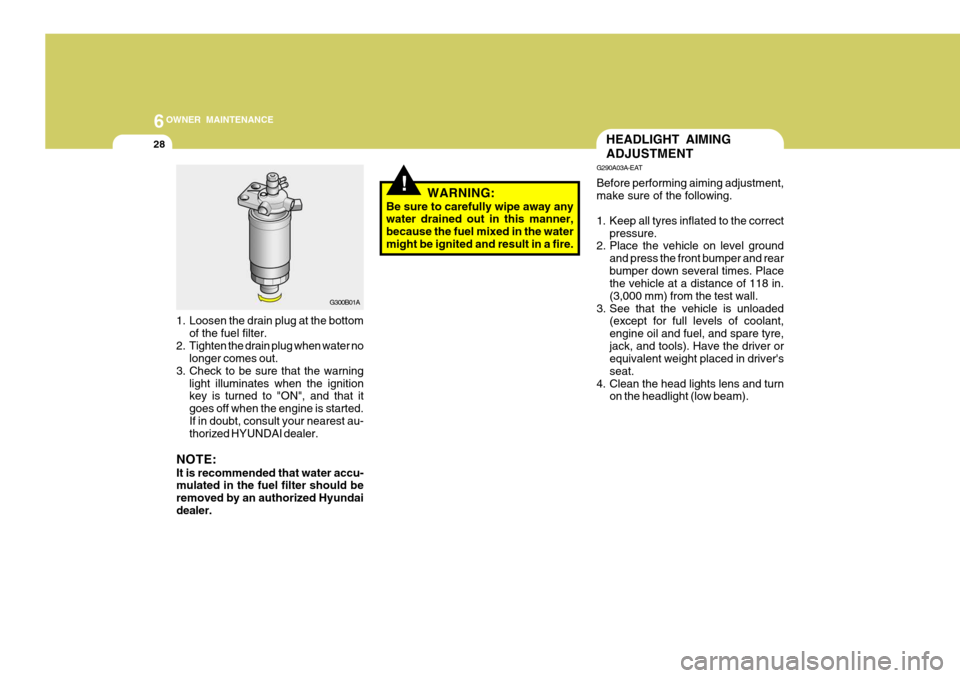
1. Loosen the drain plug at the bottom
of the fuel filter.
2. Tighten the drain plug when water no longer comes out.
3. Check to be sure that the warning light illuminates when the ignition key is turned to "ON", and that it goes off when the engine is started.If in doubt, consult your nearest au- thorized HYUNDAI dealer.
NOTE: It is recommended that water accu- mulated in the fuel filter should be removed by an authorized Hyundaidealer. WARNING:
Be sure to carefully wipe away any water drained out in this manner, because the fuel mixed in the watermight be ignited and result in a fire. G290A03A-EAT Before performing aiming adjustment, make sure of the following.
1. Keep all tyres inflated to the correct
pressure.
2. Place the vehicle on level ground
and press the front bumper and rear bumper down several times. Place the vehicle at a distance of 118 in. (3,000 mm) from the test wall.
3. See that the vehicle is unloaded (except for full levels of coolant,engine oil and fuel, and spare tyre,jack, and tools). Have the driver or equivalent weight placed in driver's seat.
4. Clean the head lights lens and turn on the headlight (low beam).
G300B01A
Page 597 of 599

10
INDEX
3
Driving Economical driving ................................................. 2-16
Smooth cornering ................................................... 2-17
Winter motoring ...................................................... 2-17
E Emission Control Syst em ........................................... 7-2
Engine Before starting the engine ....................................... 2-3
Compartment ........................................................... 6-2
Coolant ..................................................................... 6-9
Coolant temperature gauge ................................... 1-46
If the engine overheats ............................................ 3-5
Number .................................................................... 8-2
Oil ............................................................................. 6-5
Starting ..................................................................... 2-5
Engine Exhaust Can Be Dangerous ........................... 2-2
FFog Light Front ....................................................................... 1-56
Rear ....................................................................... 1-56
Front Seats
Head restraint adjustment...................................... 1-14
Lumbar support adjustment ................................... 1-14
Seat cushion height adjustment............................ 1-15
Seat rake adj ustment............................................. 1-13
Seat recline adjustment .............. ...........................1-13Fuel
Capacity ................................................................... 9-2
Gauge .................................................................... 1-46
Recommendations ................................................... 1-2
Fuel Filler Lid
Remote release ...................................................... 1-68
Fuses ........................................................................ 6-24
Fuse Panel description ............................................. 6-37
G Glove Box ................................................................. 1-63
H Hazard Warning System ........................................... 1-55
Headlight Aiming Adjustment ....................................6-28
Headlight Leveling Device Syst em ...........................1-54
Heated Rear Window ................................................ 1-55
Heating and Cooling Control ..................................... 1-72
Heating and Ventilation ............................................. 1-73
Air flow control ....................................................... 1-74
Air intake control .................................................... 1-73
Bi-level heating ....................................................... 1-77
Defrost/Defogging .................................................. 1-77
Fan speed control .................................................. 1-73
Temperature control ............................................... 1-76
High-Mounted Rear Stop light.................................... 1-66
Horn .......................................................................... 1-71