height Hyundai Accent 2006 Owner's Guide
[x] Cancel search | Manufacturer: HYUNDAI, Model Year: 2006, Model line: Accent, Model: Hyundai Accent 2006Pages: 599, PDF Size: 17.59 MB
Page 423 of 599
1CONTROLS AND EQUIPMENT
16
!WARNING:
o For maximum effectiveness in case of an accident, the headrest should be adjusted so the top of the head- rest is at the same height as the
top of the occupant's ears. Theuse of a cushion that holds the body away from the seatback is not recommended.
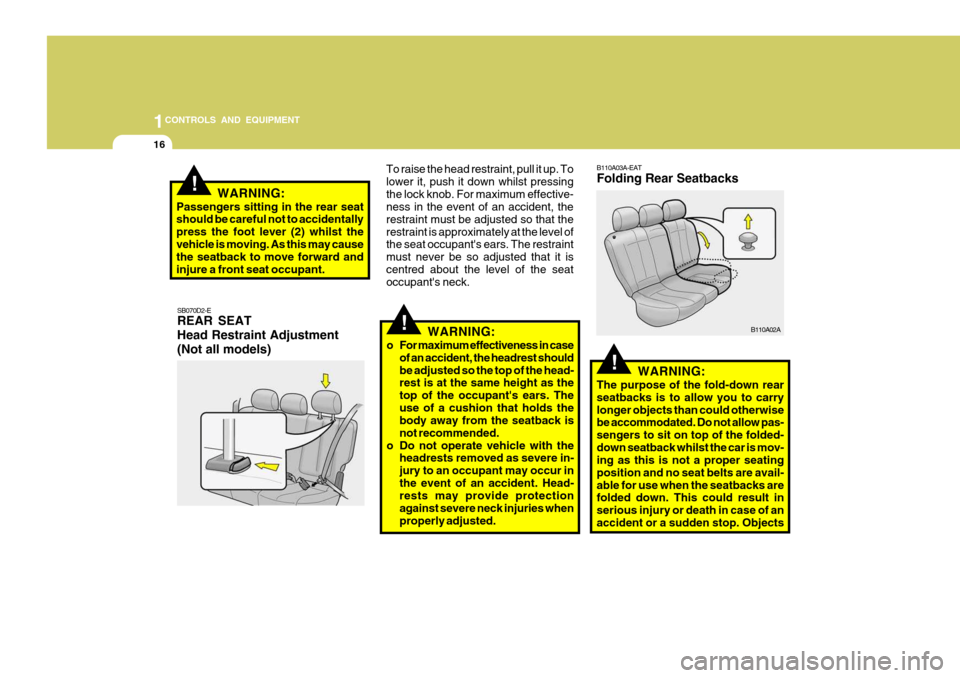
o Do not operate vehicle with the headrests removed as severe in-jury to an occupant may occur inthe event of an accident. Head- rests may provide protection against severe neck injuries whenproperly adjusted. B110A03A-EAT Folding Rear Seatbacks
B110A02A
To raise the head restraint, pull it up. To lower it, push it down whilst pressingthe lock knob. For maximum effective- ness in the event of an accident, the restraint must be adjusted so that therestraint is approximately at the level of the seat occupant's ears. The restraint must never be so adjusted that it iscentred about the level of the seat occupant's neck.
!WARNING:
The purpose of the fold-down rear seatbacks is to allow you to carrylonger objects than could otherwise be accommodated. Do not allow pas- sengers to sit on top of the folded-down seatback whilst the car is mov- ing as this is not a proper seating position and no seat belts are avail-able for use when the seatbacks are folded down. This could result in serious injury or death in case of anaccident or a sudden stop. Objects
SB070D2-E REAR SEAT Head Restraint Adjustment(Not all models)
!WARNING:
Passengers sitting in the rear seat should be careful not to accidentally press the foot lever (2) whilst thevehicle is moving. As this may cause the seatback to move forward and injure a front seat occupant.
Page 426 of 599
19
1
CONTROLS AND EQUIPMENT
!WARNING:
Sitting in a reclined position or lying down when your vehicle is in motion can be dangerous. Even if you buckleup, your seat belts can't do their job when you're reclined. The shoulder belt can't do its jobbecause it won't be against your body. Instead, it will be in front of you. In a crash you could go into itwith great force, receiving serious neck or other injuries. The lap belt can't do its job either. Ina crash the belt could go up over your abdomen. The belt forces would be applied there, not at your strongpelvic bones. This could cause seri- ous internal injuries. For proper protection when the ve-hicle is in motion, have the seatback upright. Then sit back in the seat and wear your seat belt properly. Seepage 1-20.
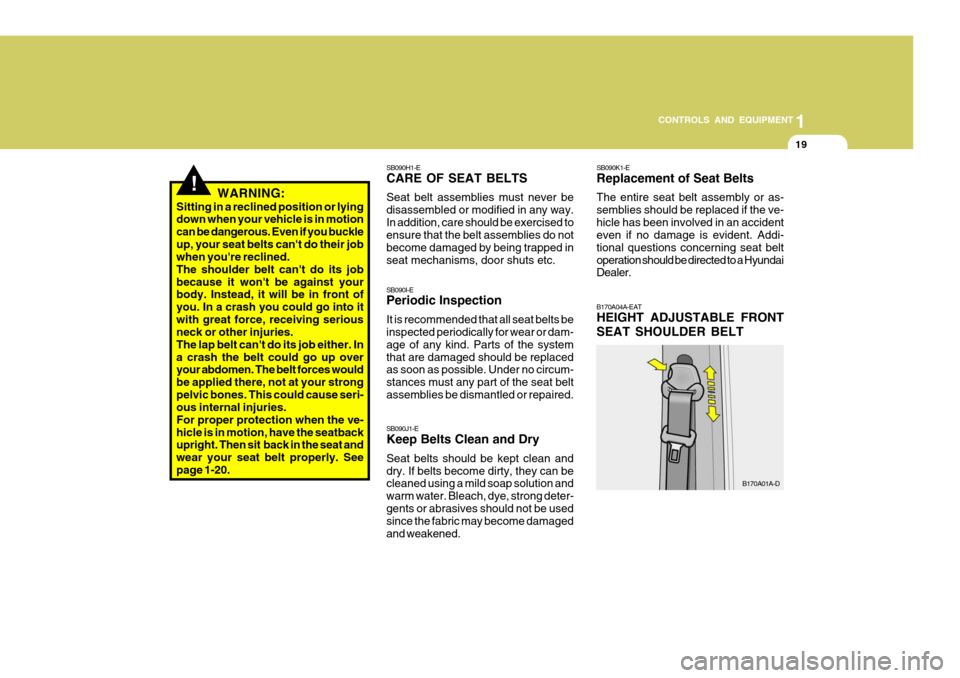
SB090K1-E Replacement of Seat Belts The entire seat belt assembly or as- semblies should be replaced if the ve-hicle has been involved in an accident even if no damage is evident. Addi- tional questions concerning seat beltoperation should be directed to a Hyundai Dealer. B170A04A-EAT HEIGHT ADJUSTABLE FRONT SEAT SHOULDER BELT
SB090H1-E CARE OF SEAT BELTS Seat belt assemblies must never be disassembled or modified in any way.In addition, care should be exercised to ensure that the belt assemblies do not become damaged by being trapped inseat mechanisms, door shuts etc. SB090I-E Periodic Inspection It is recommended that all seat belts be inspected periodically for wear or dam- age of any kind. Parts of the systemthat are damaged should be replaced as soon as possible. Under no circum- stances must any part of the seat beltassemblies be dismantled or repaired. SB090J1-E Keep Belts Clean and Dry Seat belts should be kept clean and dry. If belts become dirty, they can be cleaned using a mild soap solution and warm water. Bleach, dye, strong deter-gents or abrasives should not be used since the fabric may become damaged and weakened.
B170A01A-D
Page 427 of 599
1CONTROLS AND EQUIPMENT
20
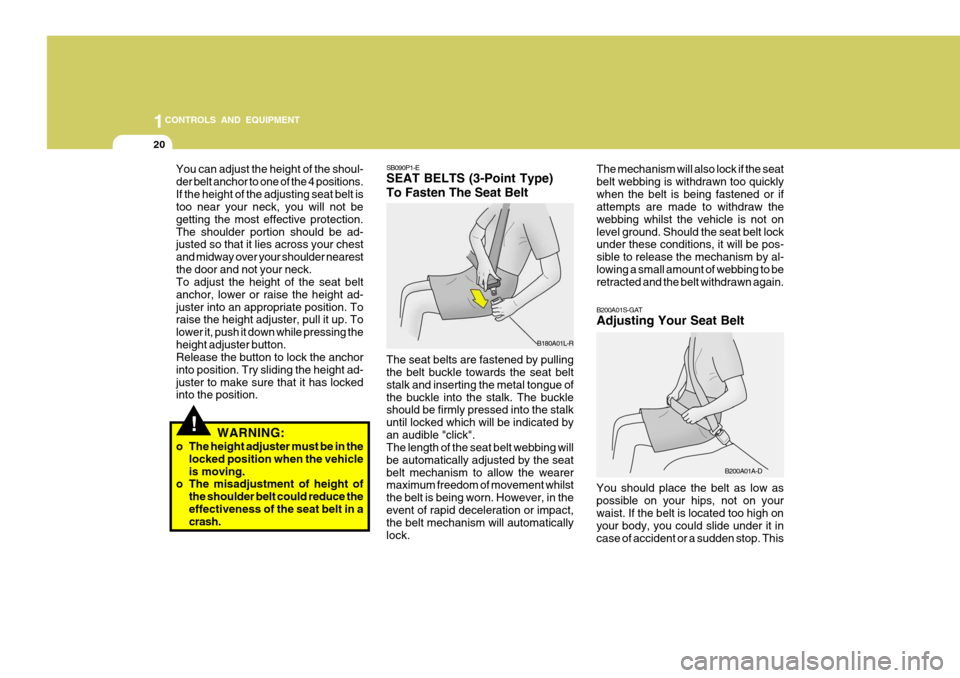
SB090P1-E SEAT BELTS (3-Point Type) To Fasten The Seat Belt The seat belts are fastened by pulling the belt buckle towards the seat belt stalk and inserting the metal tongue ofthe buckle into the stalk. The buckle should be firmly pressed into the stalk until locked which will be indicated byan audible "click". The length of the seat belt webbing will be automatically adjusted by the seatbelt mechanism to allow the wearer maximum freedom of movement whilst the belt is being worn. However, in theevent of rapid deceleration or impact, the belt mechanism will automatically lock. B180A01L-R
B200A01S-GAT Adjusting Your Seat Belt
B200A01A-D
The mechanism will also lock if the seat belt webbing is withdrawn too quicklywhen the belt is being fastened or if attempts are made to withdraw the webbing whilst the vehicle is not onlevel ground. Should the seat belt lock under these conditions, it will be pos- sible to release the mechanism by al-lowing a small amount of webbing to be retracted and the belt withdrawn again.
You should place the belt as low as possible on your hips, not on your waist. If the belt is located too high on your body, you could slide under it incase of accident or a sudden stop. This
!
You can adjust the height of the shoul- der belt anchor to one of the 4 positions.If the height of the adjusting seat belt is too near your neck, you will not be getting the most effective protection.The shoulder portion should be ad- justed so that it lies across your chest and midway over your shoulder nearestthe door and not your neck. To adjust the height of the seat belt anchor, lower or raise the height ad-juster into an appropriate position. To raise the height adjuster, pull it up. To lower it, push it down while pressing theheight adjuster button. Release the button to lock the anchor into position. Try sliding the height ad-juster to make sure that it has locked into the position. WARNING:
o The height adjuster must be in the locked position when the vehicle is moving.
o The misadjustment of height of
the shoulder belt could reduce theeffectiveness of the seat belt in a crash.
Page 430 of 599
23
1
CONTROLS AND EQUIPMENT
!WARNING:
o A child restraint system must be placed in the rear seat. Never in- stall a child or infant seat on the front passenger's seat. Should an accident occur andcause the passenger side airbag to deploy, it could severely injure or kill an infant or child seated inan infant or child seat. Thus, only use a child restraint in the rear seat of your vehicle.
o Since a safety belt or child re-
straint system can become veryhot if it is left in a closed vehicle, be sure to check the seat cover and buckles before placing a childthere.
o When the child restraint system is
not in use, store it in the boot orfasten it with a safety belt so that it will not be thrown forward in the case of a sudden stop or an acci-dent.
o Children who are too large to be in
a child restraint should sit in therear seat and be restrained with the available lap/shoulder belts.
Never allow children to ride in the front passenger seat.
o Always make sure that the shoul-
der belt portion of the outboardlap/shoulder belt is positioned midway over the shoulder, never across the neck or behind theback. Moving the child closer to the centre of the vehicle may help provide a good shoulder belt fit.The lap belt portion of the lap/ shoulder belt or the centre seat lap belt must always be positioned aslow as possible on the child's hips and as snug as possible.
o If the seat belt will not properly fit the child, Hyundai recommendsthe use of an approved booster seat in the rear seat in order toraise the child's seating height so that the seat belt will properly fit the child.
o Never allow a child to stand up or kneel on the seat.o Never use an infant carrier or child
safety seat that "hooks" over a seatback; it may not provide ad- equate security in an accident.
o Never allow a child to be held in a person's arms while they are in amoving vehicle, as this could re-sult in serious injury to the child in the event of an accident or a sudden stop. Holding a child in amoving vehicle does not provide the child with any means of pro- tection during an accident, even ifthe person holding the child is wearing a seat belt.
o If the child restraint seat is not anchored properly, the risk of achild being seriously injured or killed in a collision greatly in-creases.
Page 490 of 599
83
1
CONTROLS AND EQUIPMENT
ANTENNA
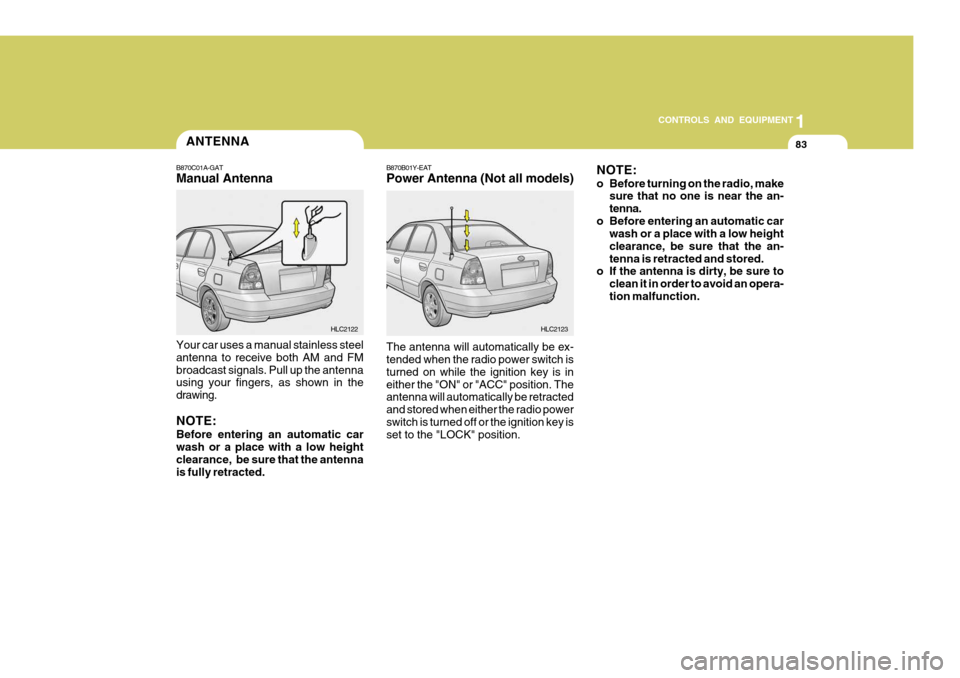
B870C01A-GAT Manual Antenna Your car uses a manual stainless steel antenna to receive both AM and FMbroadcast signals. Pull up the antenna using your fingers, as shown in the drawing. NOTE: Before entering an automatic car wash or a place with a low height clearance, be sure that the antennais fully retracted. HLC2122B870B01Y-EAT Power Antenna (Not all models)
HLC2123
The antenna will automatically be ex- tended when the radio power switch is turned on while the ignition key is ineither the "ON" or "ACC" position. The antenna will automatically be retracted and stored when either the radio powerswitch is turned off or the ignition key is set to the "LOCK" position. NOTE:
o Before turning on the radio, make
sure that no one is near the an- tenna.
o Before entering an automatic car wash or a place with a low heightclearance, be sure that the an-tenna is retracted and stored.
o If the antenna is dirty, be sure to
clean it in order to avoid an opera-tion malfunction.
Page 505 of 599
2
DRIVING YOUR HYUNDAI
15ANTI-LOCK BRAKE SYSTEM
C120A02A-EAT (Not all models) The Anti-Lock Brake System (ABS) is designed to prevent wheel lock-upduring sudden braking or on hazard- ous road surfaces. The ABS control module monitors the wheel speed andcontrols the pressure applied to each brake. Thus, in emergency situations or on slick roads, ABS will increasevehicle control during braking. NOTE: During ABS operation, a slight pul- sation may be felt in the brake pedal when the brakes are applied. Also, a noise may be heard in the enginecompartment whilst braking. These conditions are normal and indicate that the anti-lock brake system isfunctioning properly.
These roads should be driven at reduced speeds. The safety features of an ABS equipped vehicle should not be tested by high speed drivingor cornering. This could endanger the safety of yourself or others.
WARNING:
ABS will not prevent accidents due to improper or dangerous driving manoeuvres. Even though vehiclecontrol is improved during emer- gency braking, always maintain a safe distance between you and ob-jects ahead. Vehicle speeds should always be reduced during extreme road conditions. The braking distance for cars equipped with an anti-lock brakingsystem may be longer than for those without it in the following road con- ditions.
o Driving on rough, gravel or snow- covered roads.
o Driving with tyre chains installed.
o Driving on roads where the road surface is pitted or has different surface height.!
Page 592 of 599
9VEHICLE SPECIFICATIONS
2
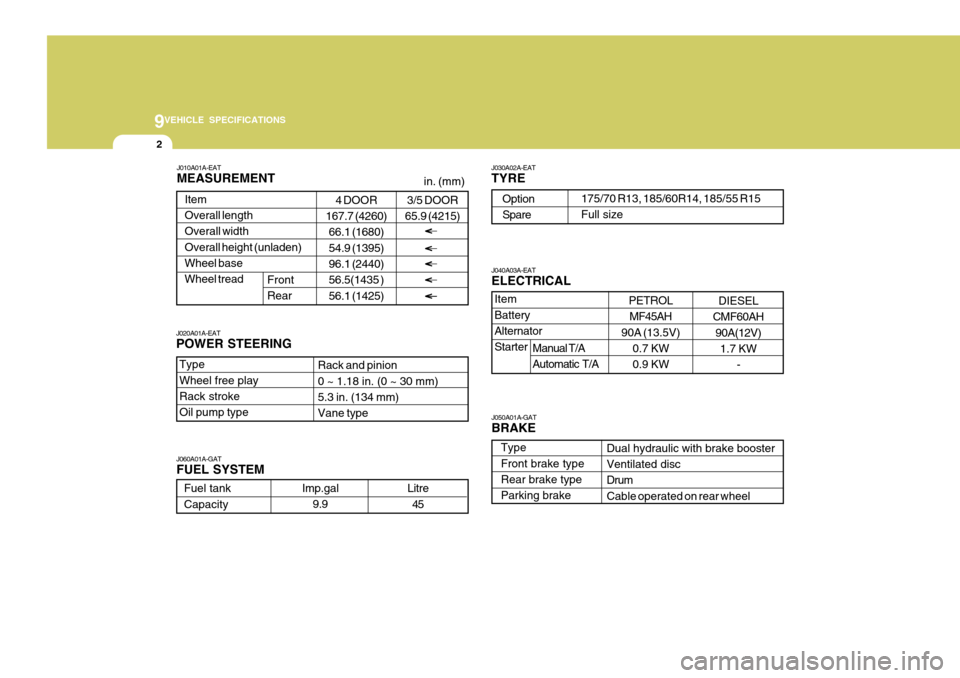
Type Wheel free playRack stroke Oil pump type 4 DOOR
167.7 (4260)
66.1 (1680) 54.9 (1395) 96.1 (2440) 56.5(1435 )56.1 (1425)
ItemOverall length Overall width Overall height (unladen)Wheel base Wheel tread J030A02A-EAT TYRE
PETROL
MF45AH
90A (13.5V) 0.7 KW 0.9 KW
Dual hydraulic with brake booster Ventilated disc DrumCable operated on rear wheel
J010A01A-EAT MEASUREMENT
J060A01A-GAT FUEL SYSTEM
Rack and pinion 0 ~ 1.18 in. (0 ~ 30 mm) 5.3 in. (134 mm) Vane type
175/70 R13, 185/60R14, 185/55 R15 Full size
Option Spare
Front Rear
in. (mm)
J020A01A-EAT POWER STEERING Fuel tank Capacity Imp.gal
9.9 Litre
45
J040A03A-EAT ELECTRICAL
Item Battery Alternator Starter
J050A01A-GAT BRAKE Type Front brake typeRear brake type Parking brake
3/5 DOOR
65.9 (4215)
DIESEL
CMF60AH 90A(12V) 1.7 KW
-
Manual T/A Automatic T/A
Page 597 of 599

10
INDEX
3
Driving Economical driving ................................................. 2-16
Smooth cornering ................................................... 2-17
Winter motoring ...................................................... 2-17
E Emission Control Syst em ........................................... 7-2
Engine Before starting the engine ....................................... 2-3
Compartment ........................................................... 6-2
Coolant ..................................................................... 6-9
Coolant temperature gauge ................................... 1-46
If the engine overheats ............................................ 3-5
Number .................................................................... 8-2
Oil ............................................................................. 6-5
Starting ..................................................................... 2-5
Engine Exhaust Can Be Dangerous ........................... 2-2
FFog Light Front ....................................................................... 1-56
Rear ....................................................................... 1-56
Front Seats
Head restraint adjustment...................................... 1-14
Lumbar support adjustment ................................... 1-14
Seat cushion height adjustment............................ 1-15
Seat rake adj ustment............................................. 1-13
Seat recline adjustment .............. ...........................1-13Fuel
Capacity ................................................................... 9-2
Gauge .................................................................... 1-46
Recommendations ................................................... 1-2
Fuel Filler Lid
Remote release ...................................................... 1-68
Fuses ........................................................................ 6-24
Fuse Panel description ............................................. 6-37
G Glove Box ................................................................. 1-63
H Hazard Warning System ........................................... 1-55
Headlight Aiming Adjustment ....................................6-28
Headlight Leveling Device Syst em ...........................1-54
Heated Rear Window ................................................ 1-55
Heating and Cooling Control ..................................... 1-72
Heating and Ventilation ............................................. 1-73
Air flow control ....................................................... 1-74
Air intake control .................................................... 1-73
Bi-level heating ....................................................... 1-77
Defrost/Defogging .................................................. 1-77
Fan speed control .................................................. 1-73
Temperature control ............................................... 1-76
High-Mounted Rear Stop light.................................... 1-66
Horn .......................................................................... 1-71
Page 598 of 599

10INDEX
4
I Ignition Sw itch ............................................................. 2-3
Immobilizer S ystem ..................................................... 1-5
Instrument Cluster and Indicator ..............................1-38
Interior Light
Interior light ............................................................ 1-63
Map light ................................................................ 1-62
JJump Starting .............................................................. 3-3
K
Key .............................................................................. 1-5 If you lose your keys ............................................. 3-14
Positions ................................................................... 2-4
Keyless Entry System ............................................... 1-10
LLubrication Chart ......................................................... 9-4
M Maintenance Intervals Explanation of scheduled maintenance items ......... 5-7
Maintenance and servicing requirements ................ 5-2
Maintenance under severe usage conditions .......... 5-6
Scheduled maintenance ............. .............................. 5-3
Mirrors
Interior rearview mirror ........................................... 1-66
Outside rearview mirror ...................... ...................1-64
Outside rearview mirror heater .............................. 1-65OOdometer / Trip
Odometer ....................................... 1-48
P Parking Brake ........................................................... 1-66
Pollen Filter ...................................................... 1-80, 6-21
Power Steering Fluid Level .......................................6-27
Power Windows ........................................................ 1-11
RRear S eat .................................................................. 1-15
Folding rear seatbacks ..................... ..................... 1-16
Head restraint adjustm ent ...................................... 1-14
Running In Your New Hyundai ................................... 1-4
SSeat Front seat ............................................................... 1-13
Rear seat ............................................................... 1-15
Rear seat entry (3-door model) ............................. 1-15
Seat Belts
3-Point type ............................................................ 1-20
Adjustable height .................................................... 1-19
Adjusting your seat belt ............. ............................ 1-20
Care of seat belts .................................................. 1-19
Precautions ............................................................ 1-18
Pre-tensioner seat bel t ........................................... 1-29
Sparking Plugs Replacement ....................................6-12
Speedometer ............................................................. 1-47
Starting ........................................................................ 2-5