steering wheel Hyundai Accent 2006 Owner's Guide
[x] Cancel search | Manufacturer: HYUNDAI, Model Year: 2006, Model line: Accent, Model: Hyundai Accent 2006Pages: 599, PDF Size: 17.59 MB
Page 281 of 599

10
INDEX
5
R Rear Seat .................................................................. 1-17
Folding Rear Seatbacks ............... ............................ 1-18
Rear Window Defroster Switch ................................ 1-66
S Seat Front seat ............................................................... 1-14
Rear seat ............................................................... 1-18
Rear seat entry (3-door model) ............................. 1-17
Seat Warmer .......................................................... 1-17
Seat Belts 2-Point type ............................................................ 1-24
3-Point system ............................................ 1-23 , 1-25
Adjustable height .................................................... 1-22
Adjusting your seat be lt .........................................1-23
Care of seat belts .................................................. 1-21
Precautions ............................................................ 1-19
Pre-tensioner seat belt (Without A/BAG) ..............1-32
Pre-tensioner seat belt (With A/BAG) ...................1-33
Pre-tensioner seat belt (With Dual-stage A/BAG) . 1-38
Spark Plugs ............................................................... 6-15
Speedometer ............................................................. 1-57
Starting ........................................................................ 2-5
Steering Wheel Freeplay .................. ........................ 6-26
Steering Wheel Tilt Lever .............. ...........................1-82Stereo Radio Operation (H215, H225, H265)
.......................................................... 1-96, 1-99, 1-104
Stereo Sound System ............................................... 1-94
Sun Visor .................................................................. 1-82
Sunroof ...................................................................... 1-71
Sunshad e .................................................................. 1-70
TTachometer ............................................................... 1-57
Theft-Alarm system ..................................................... 1-9
Tires
Balancing .................................................................. 8-5
Chains ...................................................................... 8-4
If you have a flat tire ............................................... 3-6
Information ............................................................... 8-3
Pressure ................................................................... 8-3
Replacement ............................................................ 8-5
Rotation .................................................................... 8-4
Snow tires ................................................................ 8-4
Spare tire ................................................................. 3-5
Traction .................................................................... 8-5
Towing A trailer (or vehicle) ............................................... 2-21
Emergency ............................................................. 3-13
If your car must be towed .....................................3-11
Trailer or Vehicle towing ........................................... 2-21
Page 317 of 599
1
FEATURES OF YOUR HYUNDAI
35SUPPLEMENTAL RESTRAINT (AIRBAG) SYSTEM
B240A03A
Driver's Airbag
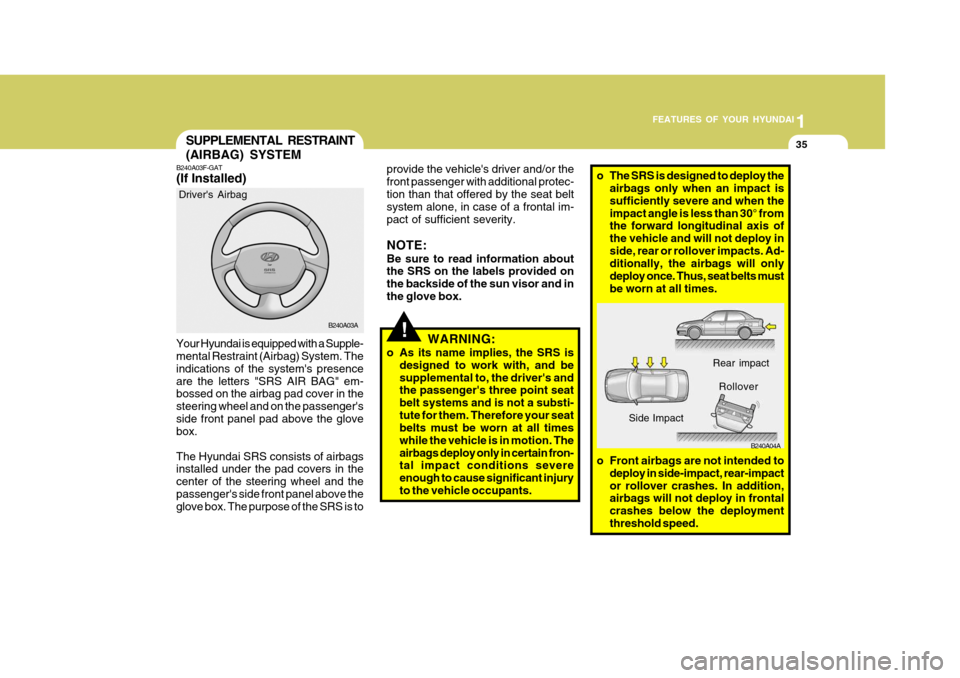
Your Hyundai is equipped with a Supple- mental Restraint (Airbag) System. The indications of the system's presenceare the letters "SRS AIR BAG" em- bossed on the airbag pad cover in the steering wheel and on the passenger'sside front panel pad above the glove box. The Hyundai SRS consists of airbags installed under the pad covers in the center of the steering wheel and thepassenger's side front panel above the glove box. The purpose of the SRS is to B240A03F-GAT (If Installed)!
o The SRS is designed to deploy the
airbags only when an impact is sufficiently severe and when theimpact angle is less than 30° from the forward longitudinal axis of the vehicle and will not deploy inside, rear or rollover impacts. Ad- ditionally, the airbags will only deploy once. Thus, seat belts mustbe worn at all times.
o Front airbags are not intended to deploy in side-impact, rear-impactor rollover crashes. In addition, airbags will not deploy in frontal crashes below the deploymentthreshold speed.
provide the vehicle's driver and/or thefront passenger with additional protec-tion than that offered by the seat belt system alone, in case of a frontal im- pact of sufficient severity. NOTE: Be sure to read information about the SRS on the labels provided on the backside of the sun visor and inthe glove box.
WARNING:
o As its name implies, the SRS is designed to work with, and besupplemental to, the driver's and the passenger's three point seat belt systems and is not a substi-tute for them. Therefore your seat belts must be worn at all times while the vehicle is in motion. Theairbags deploy only in certain fron- tal impact conditions severe enough to cause significant injuryto the vehicle occupants.
B240A04A
Rear impact
Side Impact Rollover
Page 318 of 599
1FEATURES OF YOUR HYUNDAI
36
severely injured or killed by an airbag deployment in case of an accident.
o Do not allow children to ride in the
front passenger seat. If older chil-dren (teenagers and older) must ride in the front seat, make surethey are always properly belted and that the seat is moved back as far as possible.
o For maximum safety protection in all types of crashes, all occupantsincluding the driver should alwayswear their seat belts whether or not an airbag is also provided at their seating position to minimizethe risk of severe injury or death in the event of a crash. Do not sit or lean unnecessarily close to theairbag while the vehicle is in mo- tion.
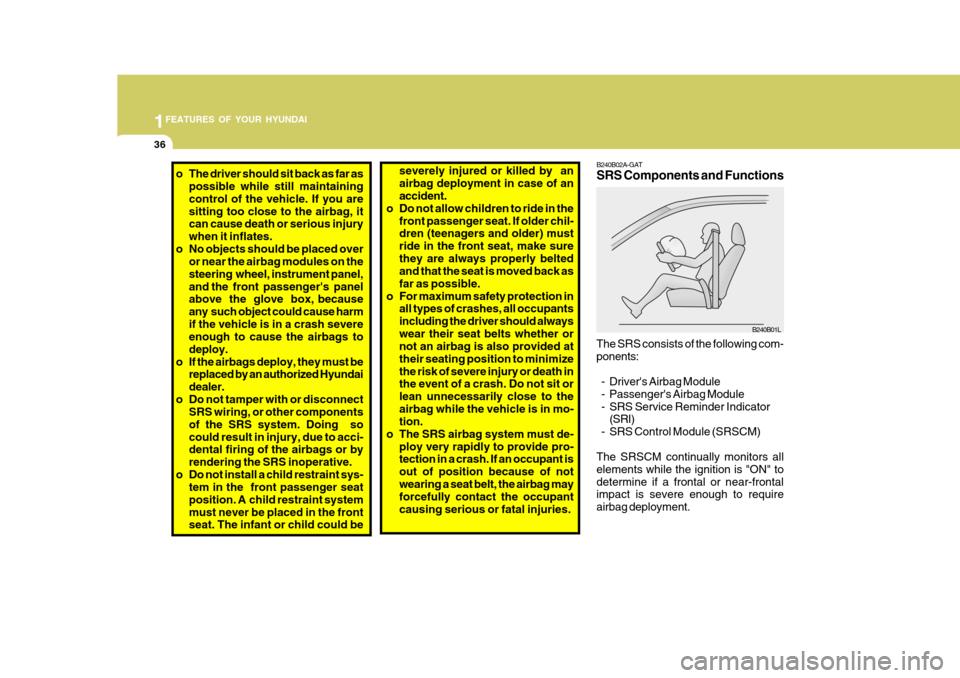
o The SRS airbag system must de- ploy very rapidly to provide pro-tection in a crash. If an occupant is out of position because of notwearing a seat belt, the airbag may forcefully contact the occupant causing serious or fatal injuries. The SRS consists of the following com-ponents:
- Driver's Airbag Module
- Passenger's Airbag Module
- SRS Service Reminder Indicator (SRI)
- SRS Control Module (SRSCM)
The SRSCM continually monitors allelements while the ignition is "ON" todetermine if a frontal or near-frontal impact is severe enough to require airbag deployment. B240B02A-GAT SRS Components and Functions
B240B01L
o The driver should sit back as far as
possible while still maintaining control of the vehicle. If you aresitting too close to the airbag, it can cause death or serious injury when it inflates.
o No objects should be placed over or near the airbag modules on thesteering wheel, instrument panel,and the front passenger's panel above the glove box, because any such object could cause harmif the vehicle is in a crash severe enough to cause the airbags to deploy.
o If the airbags deploy, they must be replaced by an authorized Hyundaidealer.
o Do not tamper with or disconnect SRS wiring, or other componentsof the SRS system. Doing socould result in injury, due to acci- dental firing of the airbags or by rendering the SRS inoperative.
o Do not install a child restraint sys- tem in the front passenger seatposition. A child restraint systemmust never be placed in the front seat. The infant or child could be
Page 319 of 599
1
FEATURES OF YOUR HYUNDAI
37
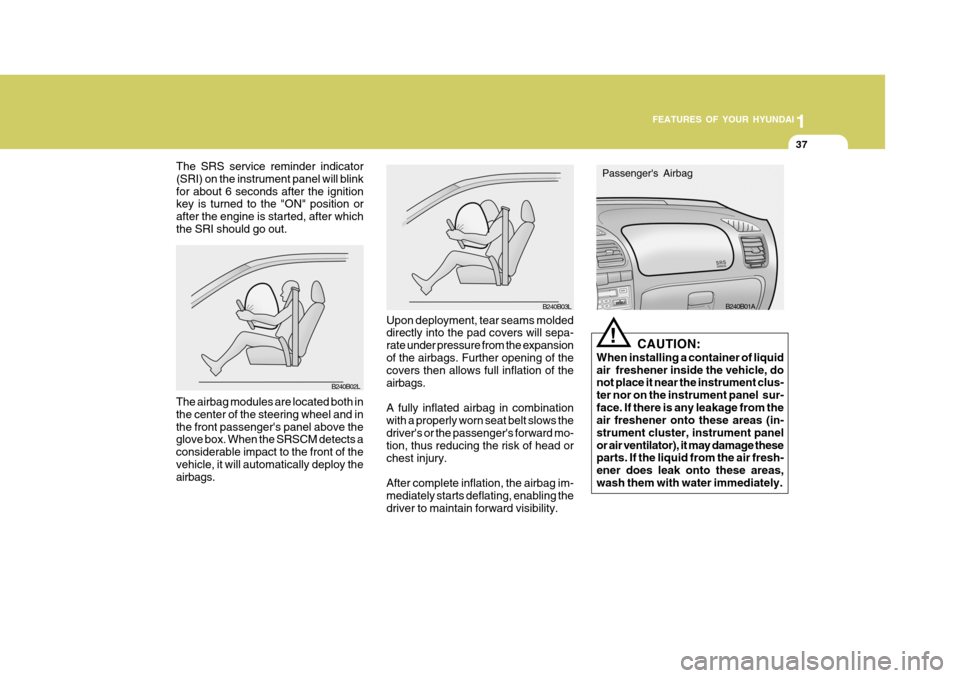
The SRS service reminder indicator (SRI) on the instrument panel will blinkfor about 6 seconds after the ignition key is turned to the "ON" position or after the engine is started, after whichthe SRI should go out.
The airbag modules are located both inthe center of the steering wheel and inthe front passenger's panel above the glove box. When the SRSCM detects a considerable impact to the front of thevehicle, it will automatically deploy the airbags.
B240B02L
! CAUTION:
When installing a container of liquid air freshener inside the vehicle, do not place it near the instrument clus- ter nor on the instrument panel sur-face. If there is any leakage from the air freshener onto these areas (in- strument cluster, instrument panelor air ventilator), it may damage these parts. If the liquid from the air fresh- ener does leak onto these areas,wash them with water immediately.
Upon deployment, tear seams molded directly into the pad covers will sepa- rate under pressure from the expansionof the airbags. Further opening of the covers then allows full inflation of the airbags. A fully inflated airbag in combination with a properly worn seat belt slows thedriver's or the passenger's forward mo- tion, thus reducing the risk of head or chest injury. After complete inflation, the airbag im- mediately starts deflating, enabling thedriver to maintain forward visibility.
B240B03LB240B01A
Passenger's Airbag
Page 323 of 599
1
FEATURES OF YOUR HYUNDAI
41DUAL-STAGE SUPPLEMENTAL RESTRAINT (AIRBAG) SYSTEM
B240A01A-AAT (If Installed)
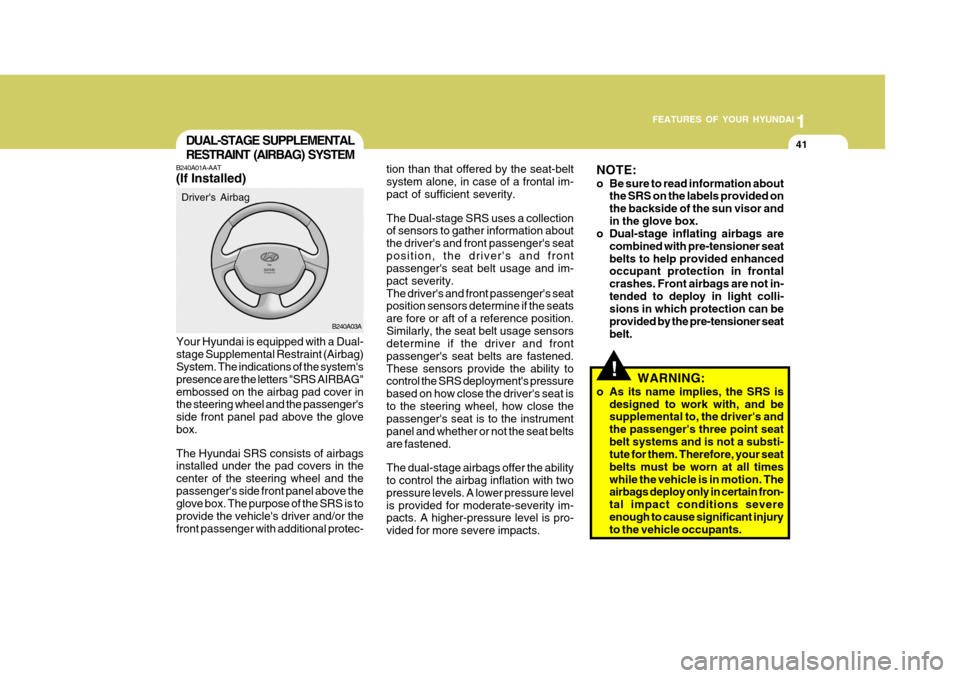
Your Hyundai is equipped with a Dual- stage Supplemental Restraint (Airbag) System. The indications of the system's presence are the letters "SRS AIRBAG"embossed on the airbag pad cover in the steering wheel and the passenger's side front panel pad above the glovebox. The Hyundai SRS consists of airbags installed under the pad covers in the center of the steering wheel and thepassenger's side front panel above the glove box. The purpose of the SRS is to provide the vehicle's driver and/or thefront passenger with additional protec- B240A03A
Driver's Airbag
!WARNING:
o As its name implies, the SRS is designed to work with, and be supplemental to, the driver's and the passenger's three point seatbelt systems and is not a substi- tute for them. Therefore, your seat belts must be worn at all timeswhile the vehicle is in motion. The airbags deploy only in certain fron- tal impact conditions severeenough to cause significant injury to the vehicle occupants.
NOTE:
o Be sure to read information about
the SRS on the labels provided on the backside of the sun visor andin the glove box.
o Dual-stage inflating airbags are
combined with pre-tensioner seatbelts to help provided enhanced occupant protection in frontal crashes. Front airbags are not in-tended to deploy in light colli- sions in which protection can be provided by the pre-tensioner seatbelt.
tion than that offered by the seat-beltsystem alone, in case of a frontal im-pact of sufficient severity. The Dual-stage SRS uses a collection of sensors to gather information about the driver's and front passenger's seatposition, the driver's and front passenger's seat belt usage and im- pact severity.The driver's and front passenger's seat position sensors determine if the seats are fore or aft of a reference position.Similarly, the seat belt usage sensors determine if the driver and front passenger's seat belts are fastened.These sensors provide the ability to control the SRS deployment's pressure based on how close the driver's seat isto the steering wheel, how close the passenger's seat is to the instrument panel and whether or not the seat beltsare fastened. The dual-stage airbags offer the ability to control the airbag inflation with two pressure levels. A lower pressure levelis provided for moderate-severity im- pacts. A higher-pressure level is pro- vided for more severe impacts.
Page 324 of 599
1FEATURES OF YOUR HYUNDAI
42
o The driver should sit back as far as
possible while still maintaining control of the vehicle. If you aresitting too close to the airbag, it can cause death or serious injury when it inflates.
o No objects should be placed over or near the airbag modules on thesteering wheel, instrument panel,and the front passenger's panel above the glove box, because any such object could cause harmif the vehicle is in a crash severe enough to cause the airbags to deploy.
o If the airbags deploy, they must be
replaced by an authorized Hyundaidealer.
o Do not tamper with or disconnect
SRS wiring, or other componentsof the SRS system. Doing so could result in injury, due to acci- dental firing of the airbags or byrendering the SRS inoperative.
o Do not install a child restraint sys-
tem in the front passenger seatposition. A child restraint system must never be placed in the front seat. The infant or child could be severely injured or killed by anairbag deployment in case of an accident.
o Do not allow children to ride in the front passenger seat. If older chil-dren (teenagers and older) must ride in the front seat, make surethey are always properly belted and that the seat is moved back as far as possible.
o For maximum safety protection in all types of crashes, all occupantsincluding the driver should alwayswear their seat belts whether or not an airbag is also provided at their seating position to minimizethe risk of severe injury or death in the event of a crash. Do not sit or lean unnecessarily close to theairbag while the vehicle is in mo- tion.
o The SRS airbag system must de- ploy very rapidly to provide pro-tection in a crash. If an occupant is out of position because of notwearing a seat belt, the airbag may forcefully contact the occupant causing serious or fatal injuries.
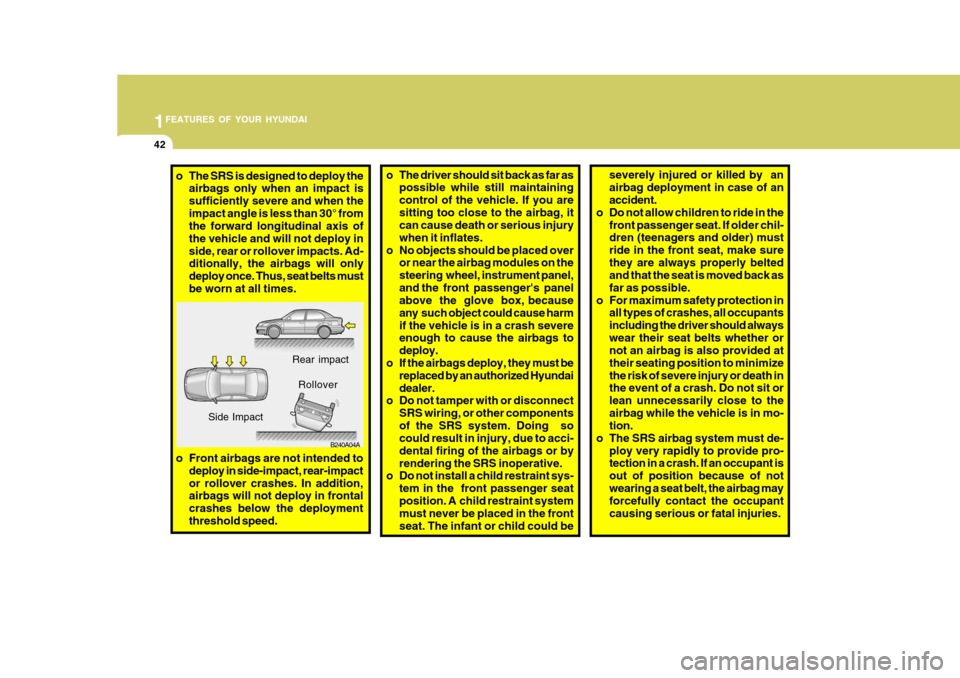
B240A04A
Rear impact
Side Impact Rollover
o The SRS is designed to deploy the
airbags only when an impact is sufficiently severe and when theimpact angle is less than 30° from the forward longitudinal axis of the vehicle and will not deploy inside, rear or rollover impacts. Ad- ditionally, the airbags will only deploy once. Thus, seat belts mustbe worn at all times.
o Front airbags are not intended to deploy in side-impact, rear-impactor rollover crashes. In addition, airbags will not deploy in frontal crashes below the deploymentthreshold speed.
Page 325 of 599
1
FEATURES OF YOUR HYUNDAI
43
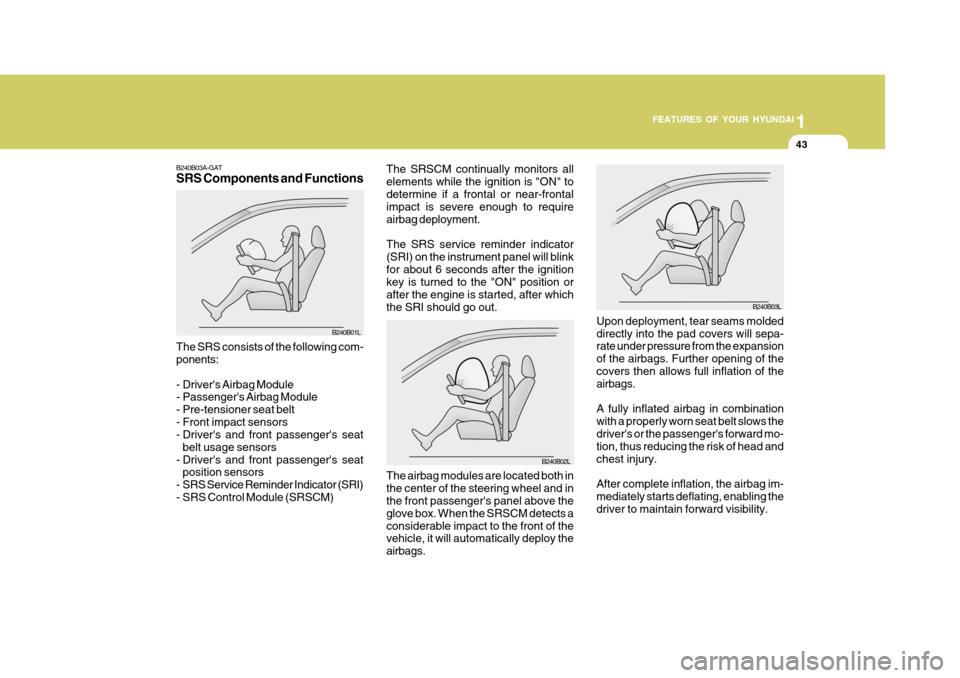
B240B03A-GAT SRS Components and Functions The SRS consists of the following com- ponents:
- Driver's Airbag Module
- Passenger's Airbag Module
- Pre-tensioner seat belt
- Front impact sensors
- Driver's and front passenger's seat belt usage sensors
- Driver's and front passenger's seat position sensors
- SRS Service Reminder Indicator (SRI)
- SRS Control Module (SRSCM)
B240B01L Upon deployment, tear seams molded directly into the pad covers will sepa- rate under pressure from the expansion of the airbags. Further opening of the covers then allows full inflation of the airbags. A fully inflated airbag in combination with a properly worn seat belt slows thedriver's or the passenger's forward mo- tion, thus reducing the risk of head and chest injury. After complete inflation, the airbag im- mediately starts deflating, enabling thedriver to maintain forward visibility.
The SRSCM continually monitors allelements while the ignition is "ON" todetermine if a frontal or near-frontal impact is severe enough to require airbag deployment. The SRS service reminder indicator (SRI) on the instrument panel will blinkfor about 6 seconds after the ignition key is turned to the "ON" position or after the engine is started, after whichthe SRI should go out. The airbag modules are located both in the center of the steering wheel and in the front passenger's panel above the glove box. When the SRSCM detects aconsiderable impact to the front of the vehicle, it will automatically deploy the airbags.
B240B02L
B240B03L
Page 327 of 599
1
FEATURES OF YOUR HYUNDAI
45SIDE IMPACT AIRBAG
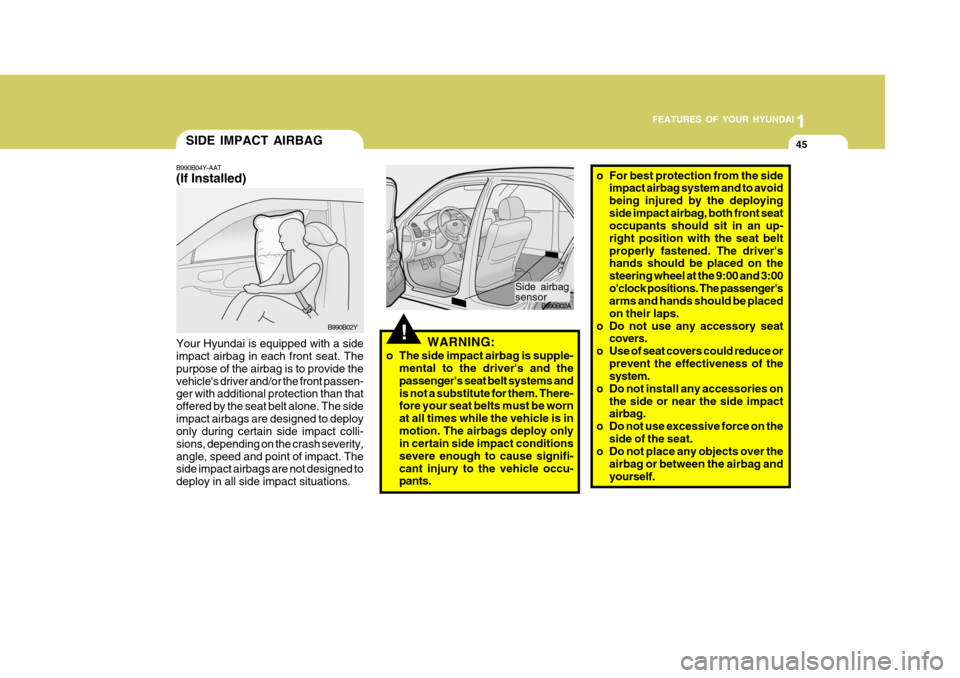
B990B04Y-AAT (If Installed) Your Hyundai is equipped with a side impact airbag in each front seat. The purpose of the airbag is to provide thevehicle's driver and/or the front passen- ger with additional protection than that offered by the seat belt alone. The sideimpact airbags are designed to deploy only during certain side impact colli- sions, depending on the crash severity,angle, speed and point of impact. The side impact airbags are not designed to deploy in all side impact situations.
B990B02Y!
o For best protection from the side impact airbag system and to avoid being injured by the deployingside impact airbag, both front seat occupants should sit in an up- right position with the seat beltproperly fastened. The driver's hands should be placed on the steering wheel at the 9:00 and 3:00o'clock positions. The passenger's arms and hands should be placed on their laps.
o Do not use any accessory seat covers.
o Use of seat covers could reduce or
prevent the effectiveness of the system.
o Do not install any accessories on
the side or near the side impactairbag.
o Do not use excessive force on the
side of the seat.
o Do not place any objects over the
airbag or between the airbag and yourself.
WARNING:
o The side impact airbag is supple- mental to the driver's and thepassenger's seat belt systems andis not a substitute for them. There- fore your seat belts must be worn at all times while the vehicle is inmotion. The airbags deploy only in certain side impact conditions severe enough to cause signifi-cant injury to the vehicle occu- pants.
B990B02A
Side airbag sensor
Page 328 of 599
1FEATURES OF YOUR HYUNDAI
46
!WARNING:
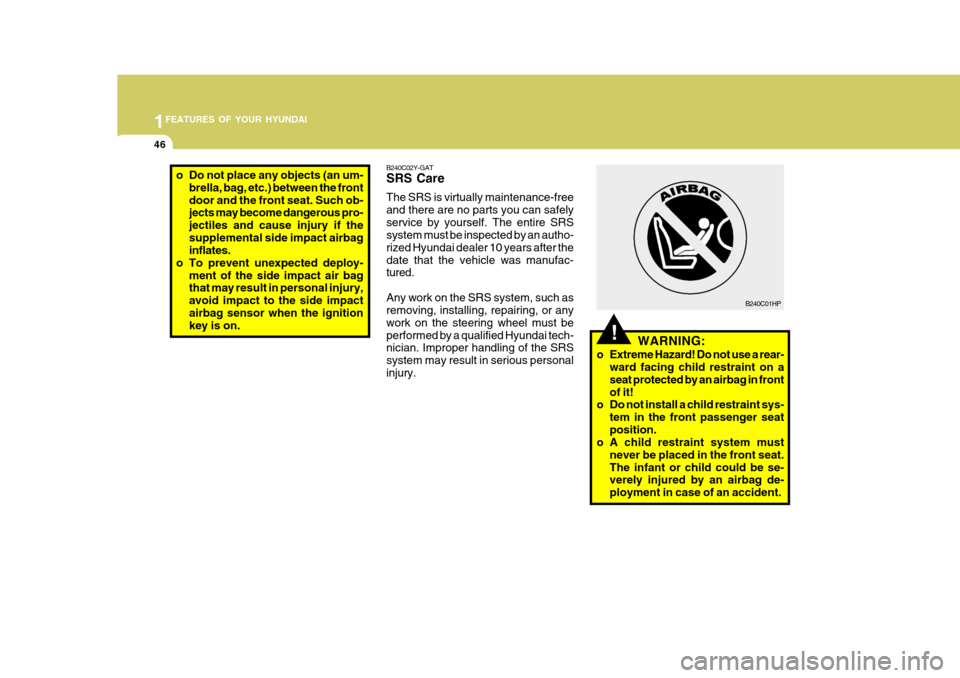
o Extreme Hazard! Do not use a rear- ward facing child restraint on a seat protected by an airbag in frontof it!
o Do not install a child restraint sys-
tem in the front passenger seatposition.
o A child restraint system must
never be placed in the front seat.The infant or child could be se- verely injured by an airbag de- ployment in case of an accident. B240C01HP
B240C02Y-GAT SRS Care The SRS is virtually maintenance-free and there are no parts you can safelyservice by yourself. The entire SRS system must be inspected by an autho- rized Hyundai dealer 10 years after thedate that the vehicle was manufac- tured. Any work on the SRS system, such as removing, installing, repairing, or any work on the steering wheel must beperformed by a qualified Hyundai tech- nician. Improper handling of the SRS system may result in serious personalinjury.
o Do not place any objects (an um-
brella, bag, etc.) between the front door and the front seat. Such ob- jects may become dangerous pro- jectiles and cause injury if thesupplemental side impact airbag inflates.
o To prevent unexpected deploy-
ment of the side impact air bagthat may result in personal injury, avoid impact to the side impactairbag sensor when the ignition key is on.
Page 329 of 599
1
FEATURES OF YOUR HYUNDAI
47
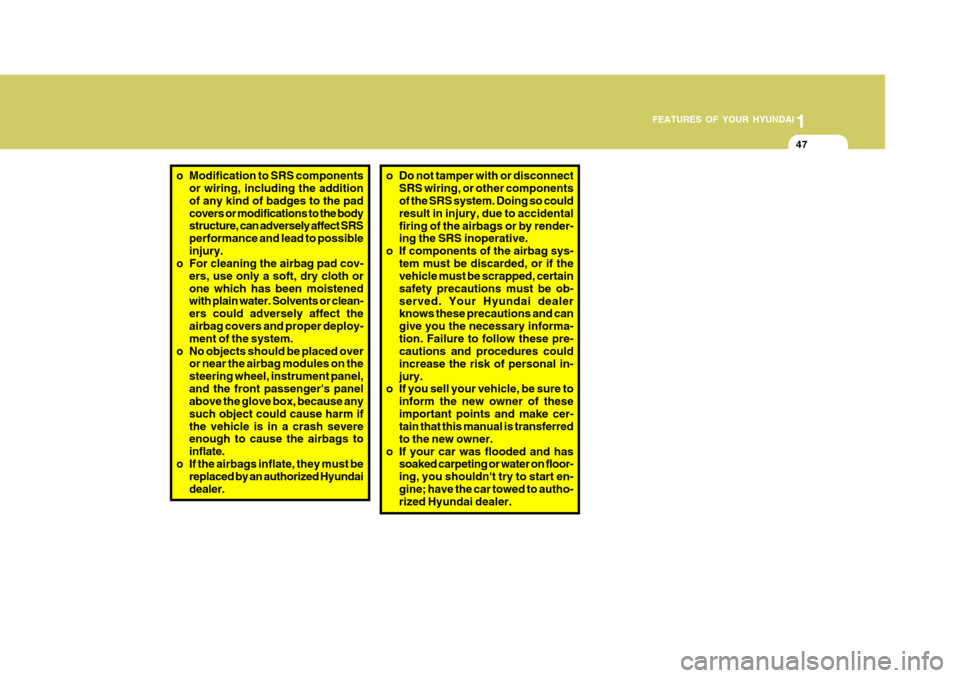
o Modification to SRS components
or wiring, including the addition of any kind of badges to the padcovers or modifications to the body structure, can adversely affect SRS performance and lead to possibleinjury.
o For cleaning the airbag pad cov-
ers, use only a soft, dry cloth orone which has been moistened with plain water. Solvents or clean- ers could adversely affect theairbag covers and proper deploy- ment of the system.
o No objects should be placed over or near the airbag modules on the steering wheel, instrument panel,and the front passenger's panel above the glove box, because any such object could cause harm ifthe vehicle is in a crash severe enough to cause the airbags to inflate.
o If the airbags inflate, they must be replaced by an authorized Hyundaidealer.o Do not tamper with or disconnect
SRS wiring, or other components of the SRS system. Doing so could result in injury, due to accidentalfiring of the airbags or by render- ing the SRS inoperative.
o If components of the airbag sys- tem must be discarded, or if thevehicle must be scrapped, certain safety precautions must be ob-served. Your Hyundai dealer knows these precautions and can give you the necessary informa-tion. Failure to follow these pre- cautions and procedures could increase the risk of personal in-jury.
o If you sell your vehicle, be sure to
inform the new owner of theseimportant points and make cer- tain that this manual is transferred to the new owner.
o If your car was flooded and has soaked carpeting or water on floor-ing, you shouldn't try to start en-gine; have the car towed to autho- rized Hyundai dealer.