tow Hyundai Accent 2006 Owner's Guide
[x] Cancel search | Manufacturer: HYUNDAI, Model Year: 2006, Model line: Accent, Model: Hyundai Accent 2006Pages: 599, PDF Size: 17.59 MB
Page 199 of 599
3 WHAT TO DO IN AN EMERGENCY
12
D080C02A
CAUTION:
A car with an automatic transaxle should never be towed from the rear with the front wheels on theground. This can cause serious damage to the transaxle. If the car must be towed from the rear, a tow-ing dolly must be used under the front wheels.
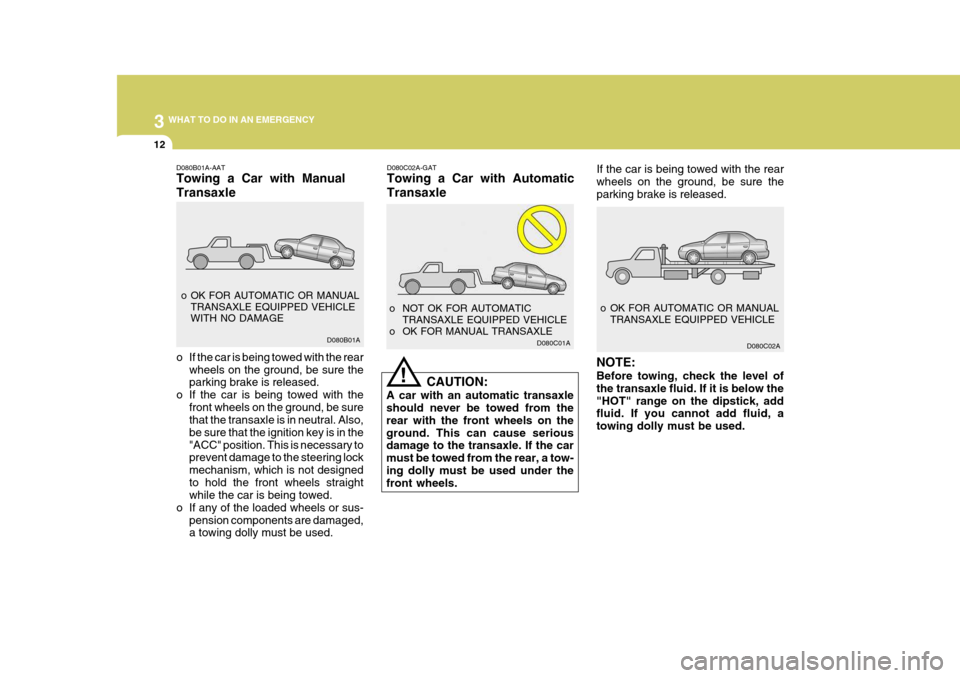
! o OK FOR AUTOMATIC OR MANUAL
TRANSAXLE EQUIPPED VEHICLE
If the car is being towed with the rear wheels on the ground, be sure theparking brake is released.
NOTE: Before towing, check the level of the transaxle fluid. If it is below the"HOT" range on the dipstick, add fluid. If you cannot add fluid, a towing dolly must be used.
D080B01A-AAT Towing a Car with Manual Transaxle
o If the car is being towed with the rear wheels on the ground, be sure the parking brake is released.
o If the car is being towed with the front wheels on the ground, be surethat the transaxle is in neutral. Also, be sure that the ignition key is in the"ACC" position. This is necessary to prevent damage to the steering lock mechanism, which is not designedto hold the front wheels straight while the car is being towed.
o If any of the loaded wheels or sus- pension components are damaged,a towing dolly must be used.
o OK FOR AUTOMATIC OR MANUAL
TRANSAXLE EQUIPPED VEHICLE WITH NO DAMAGE
D080B01A D080C02A-GAT Towing a Car with Automatic Transaxle
o NOT OK FOR AUTOMATIC TRANSAXLE EQUIPPED VEHICLE
o OK FOR MANUAL TRANSAXLE D080C01A
Page 200 of 599
3
WHAT TO DO IN AN EMERGENCY
13EMERGENCY TOWINGIF YOU LOSE YOUR KEYS
D120A01A-GAT If you lose your keys, many Hyundai dealers can make you a new key if you have your key number. If you lock the keys inside your car andyou cannot obtain a new key, many Hyundai dealers can use special tools to open the door for you. Information about the key of immobi- lizer system (If Installed) will be foundon page 1-5.
D080D03A-AAT
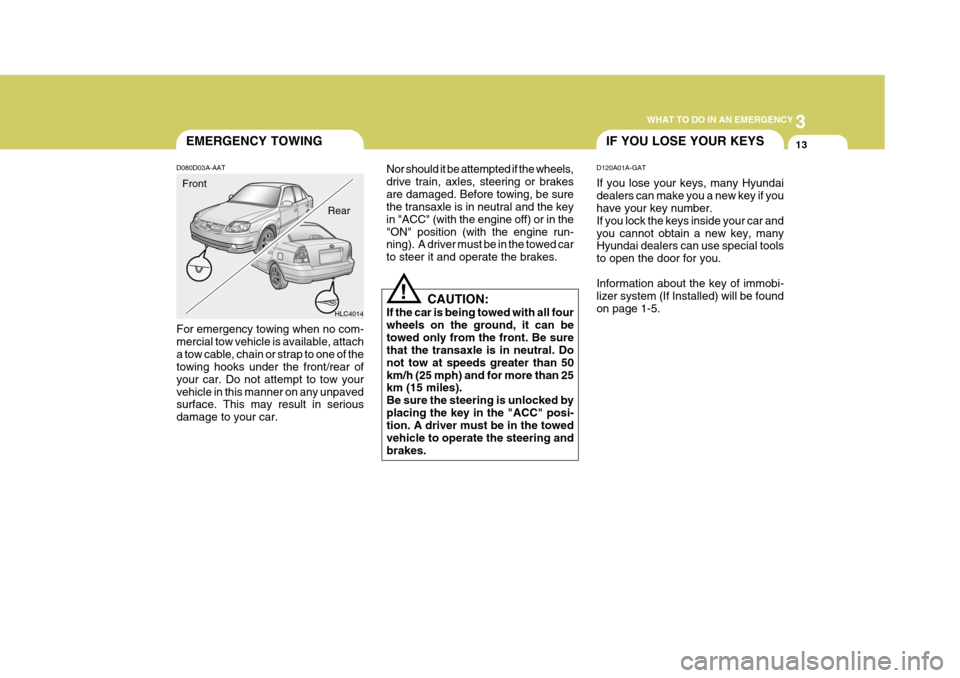
For emergency towing when no com-mercial tow vehicle is available, attacha tow cable, chain or strap to one of the towing hooks under the front/rear of your car. Do not attempt to tow yourvehicle in this manner on any unpaved surface. This may result in serious damage to your car. HLC4014
CAUTION:
If the car is being towed with all fourwheels on the ground, it can betowed only from the front. Be sure that the transaxle is in neutral. Do not tow at speeds greater than 50km/h (25 mph) and for more than 25 km (15 miles). Be sure the steering is unlocked byplacing the key in the "ACC" posi- tion. A driver must be in the towed vehicle to operate the steering andbrakes.
!
Front
RearNor should it be attempted if the wheels, drive train, axles, steering or brakesare damaged. Before towing, be sure the transaxle is in neutral and the key in "ACC" (with the engine off) or in the"ON" position (with the engine run- ning). A driver must be in the towed car to steer it and operate the brakes.
Page 214 of 599

5
VEHICLE MAINTENANCE REQUIREMENTS
7
ENGINE OIL AND FILTER AIR CLEANER FILTER SPARK PLUGS TIMING BELTBRAKE PADS, CALIPERS AND ROTORS REAR BRAKE DRUMS/LININGS, PARKING BRAKE STEERING GEAR BOX, LINKAGE & BOOTS/LOWER ARM BALL JOINT DRIVESHAFTS AND BOOTS MANUAL TRANSAXLE OILAUTOMATIC TRANSAXLE FLUID
AIR CONDITIONER FILTER (For Evaporator and Blower unit)
SEVERE DRIVING CONDITIONS
A - Repeatly driving short distance of less than 8km(5miles) in normal temperature or less than 16km(10miles) in freezing temperature
B - Extensive engine idling or low speed driving for long distances
C - Driving on rough, dusty, muddy, unpaved, graveled or salt-spread roads D - Driving in areas using salt or other corrosive materials or in very
cold weather
E - Driving in sandy areas
F - Driving in heavy traffic area over 32°C(90°F)G - Driving on uphill, downhill, or mountain roadH - Towing a Trailer, or using a camper, or roof rack
I - Driving as a patrol car, taxi, other commercial use or vehicle towing
J - Driving over 170 Km/h(100 MPH)K - Frequently driving in stop-and-go conditions R R R R
I I I I
RR R
European community Only Except European community
MAINTENANCE ITEM
EVERY 7,500 KM OR 6 MONTHS MORE FREQUENTLY MORE FREQUENTLY EVERY 60,000 KM OR 48 MONTHSMORE FREQUENTLY MORE FREQUENTLY MORE FREQUENTLY EVERY 15,000 KM OR 12 MONTHS EVERY 100,000 KM EVERY 45,000 KM EVERY 40,000 KMMORE FREQUENTLY A, B, C, D, E, F, G, H, I, KA, B, C, F, H, I, JC, E B, H D, E, F, GC, D, G, H C, D, G, H C, D, E, F C, D, E, F A, C, D, E, F, G, H, I, J A, C, E, F, G, H, I C, E
MAINTENANCE
INTERVALS DRIVING
CONDITION
MAINTENANCE
OPERATIONGASOLINE DIESEL
MAINTENANCE UNDER SEVERE USAGE CONDITIONS
F040A08A-GAT The following items must be serviced more frequently on cars normally used under severe driving conditions. Refer to the
chart below for the appropriate maintenance intervals.
R : Replace I : Inspect and, after inspection, clean, adjust, repair or replace if necessary
Page 247 of 599

6
DO-IT-YOURSELF MAINTENANCE
29
4. Replace the blown fuse by pressing
a new fuse of the same rating into place. The fuse should be a snug fit. If it is not, have the fuse clip repairedor replaced by a Hyundai dealer. If you do not have a spare fuse, you may be able to borrow a fuse of thesame or lower rating from an acces-
G200B02A-AAT Replacing Accessory Fuse The fuse box for the lights and other electrical accessories will be found lowon the dashboard on the driver's side. Inside the box you will find a list show- ing the circuits protected by each fuse.If any of your car's lights or other electrical accessories stop working, a blown fuse could be the reason. If thefuse has burned out, you will see that the metal strip inside the fuse has burned through. If you suspect a blownfuse, follow this procedure:
HLC40021. Turn off the ignition and all other
switches.
2. Open the fuse box and examine each fuse. Remove each fuse bypulling it toward you (a small "fusepuller" tool is contained in the fuse box to simplify this operation).
3. Be sure to check all other fuses even if you find one that appears tohave burned out.
HLC4003sory you can temporarily get along without (the radio or cigarette light-er, for example). Always remember to replace the borrowed fuse.
G200B02L
Good
Burned out
Page 257 of 599
6
DO-IT-YOURSELF MAINTENANCE
39
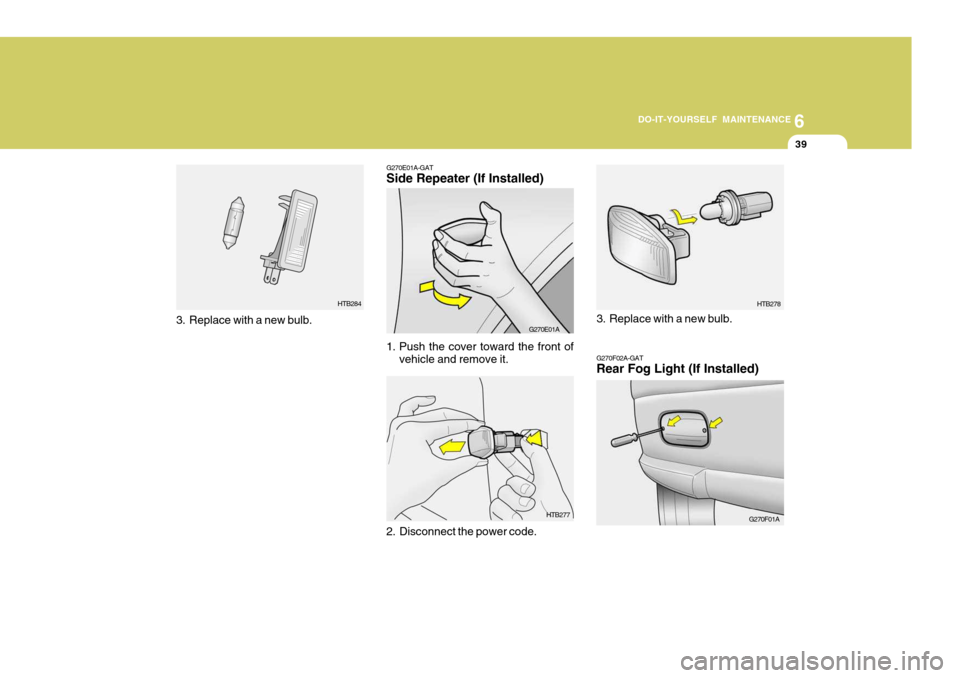
G270F02A-GAT Rear Fog Light (If Installed)
G270F01AHTB278
3. Replace with a new bulb.
HTB277
G270E01A-GATSide Repeater (If Installed)
G270E01A
1. Push the cover toward the front of vehicle and remove it.
2. Disconnect the power code.
3. Replace with a new bulb.
HTB284
Page 281 of 599

10
INDEX
5
R Rear Seat .................................................................. 1-17
Folding Rear Seatbacks ............... ............................ 1-18
Rear Window Defroster Switch ................................ 1-66
S Seat Front seat ............................................................... 1-14
Rear seat ............................................................... 1-18
Rear seat entry (3-door model) ............................. 1-17
Seat Warmer .......................................................... 1-17
Seat Belts 2-Point type ............................................................ 1-24
3-Point system ............................................ 1-23 , 1-25
Adjustable height .................................................... 1-22
Adjusting your seat be lt .........................................1-23
Care of seat belts .................................................. 1-21
Precautions ............................................................ 1-19
Pre-tensioner seat belt (Without A/BAG) ..............1-32
Pre-tensioner seat belt (With A/BAG) ...................1-33
Pre-tensioner seat belt (With Dual-stage A/BAG) . 1-38
Spark Plugs ............................................................... 6-15
Speedometer ............................................................. 1-57
Starting ........................................................................ 2-5
Steering Wheel Freeplay .................. ........................ 6-26
Steering Wheel Tilt Lever .............. ...........................1-82Stereo Radio Operation (H215, H225, H265)
.......................................................... 1-96, 1-99, 1-104
Stereo Sound System ............................................... 1-94
Sun Visor .................................................................. 1-82
Sunroof ...................................................................... 1-71
Sunshad e .................................................................. 1-70
TTachometer ............................................................... 1-57
Theft-Alarm system ..................................................... 1-9
Tires
Balancing .................................................................. 8-5
Chains ...................................................................... 8-4
If you have a flat tire ............................................... 3-6
Information ............................................................... 8-3
Pressure ................................................................... 8-3
Replacement ............................................................ 8-5
Rotation .................................................................... 8-4
Snow tires ................................................................ 8-4
Spare tire ................................................................. 3-5
Traction .................................................................... 8-5
Towing A trailer (or vehicle) ............................................... 2-21
Emergency ............................................................. 3-13
If your car must be towed .....................................3-11
Trailer or Vehicle towing ........................................... 2-21
Page 286 of 599
1FEATURES OF YOUR HYUNDAI
4KEYS
B020B01FC-GAT During the First 1,000 Km (600 Miles) (Diesel Engine) No formal "break-in" procedure is re- quired with your new Hyundai. How- ever, you can contribute to the eco- nomical operation and durability of your Hyundai by observing the following rec- ommendations during the first 1,000km (600 miles).
o While driving, keep your engine speed (rpm, or revolutions per minute) within 3,000 rpm.
o While driving, keep under three quar- ters of maximum speed.
o Use moderate acceleration. Don't
start, depress the accelerator pedal fully.
o For the first 300 km (200 miles), try
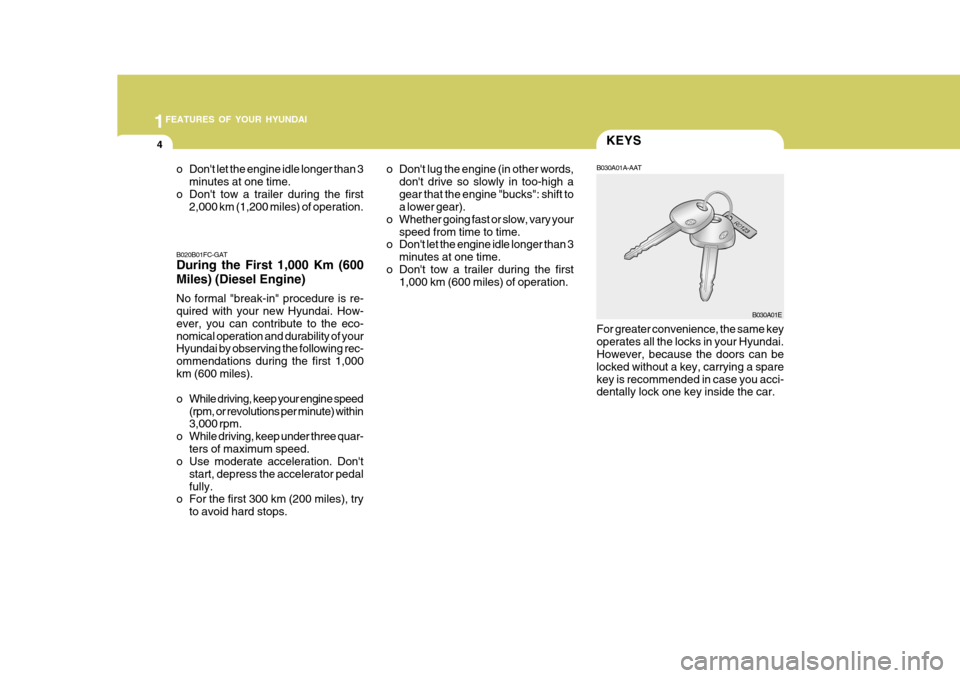
to avoid hard stops. B030A01A-AAT For greater convenience, the same key operates all the locks in your Hyundai. However, because the doors can be locked without a key, carrying a sparekey is recommended in case you acci- dentally lock one key inside the car.
o Don't lug the engine (in other words,
don't drive so slowly in too-high a gear that the engine "bucks": shift to a lower gear).
o Whether going fast or slow, vary your speed from time to time.
o Don't let the engine idle longer than 3
minutes at one time.
o Don't tow a trailer during the first 1,000 km (600 miles) of operation.
B030A01E
o Don't let the engine idle longer than 3
minutes at one time.
o Don't tow a trailer during the first 2,000 km (1,200 miles) of operation.
Page 289 of 599

1
FEATURES OF YOUR HYUNDAI
7
!
DOOR LOCKS
NOTE: If the engine dies while driving after limp home procedure, you can start your engine within 8 seconds with-out limp home procedure again.
5. If the immobilizer indicator blinks for five seconds, you have to try the limp home procedure again from the beginning.
After doing the limp home procedure,you have to consult with your autho-rized Hyundai dealer as soon as pos- sible.
! CAUTION:
o If you fail to try the limp home procedure with the sequence of three times, you have to wait for about one hour to do the limp home procedure again.
o If you cannot start your engine in spite of limp home procedure, haveyour vehicle towed by an autho-rized Hyundai dealer.
UNLOCK
HLC2003
LOCK
B040A02Y-AAT
B040B01A-AAT
Locking and Unlocking Front Doors With a Key
WARNING:
o Unlocked doors can be danger- ous. Before you drive away (espe- cially if there are children in the car), be sure that all the doors are securely closed and locked sothat the doors cannot be inadvert- ently opened from the inside. This helps ensure that the doors willnot be opened accidentally. Also, when combined with the proper use of seat belts, locking the doors helps keep occupants from being ejected from the car incase of an accident.
o Before opening the door, always
look for and avoid oncoming traf-fic.
o In case of accident, the door is
unlocked automatically (If In-stalled). o The door can be locked or unlocked
with a key.
o Lock the door by turning the key
toward the front of the vehicle and unlock it by turning the key toward the rear.
Page 291 of 599
1
FEATURES OF YOUR HYUNDAI
9THEFT-ALARM SYSTEM
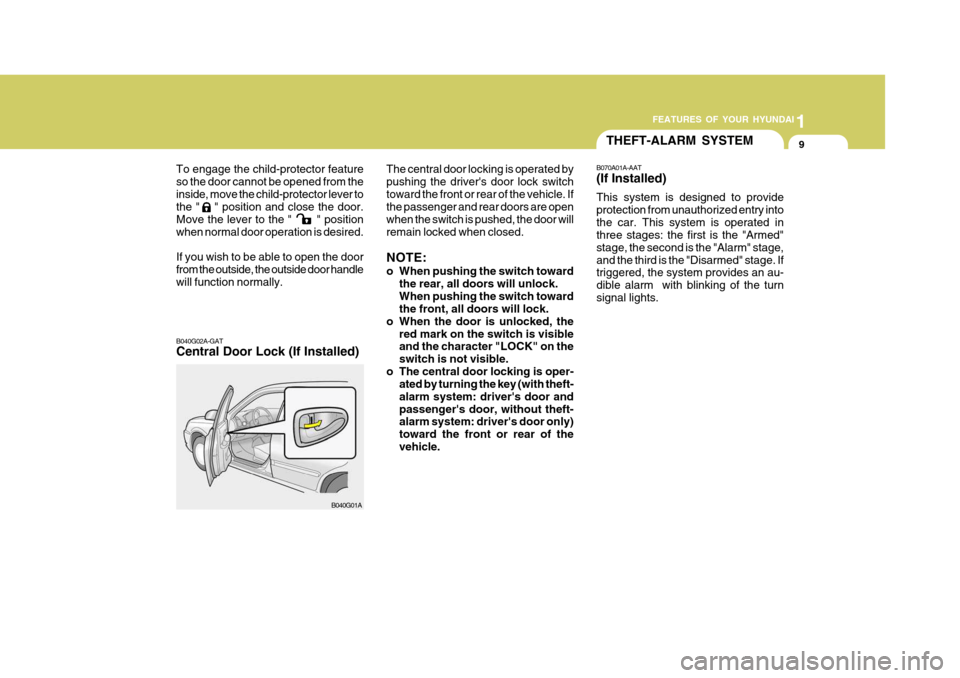
To engage the child-protector feature so the door cannot be opened from theinside, move the child-protector lever to the " " position and close the door. Move the lever to the " " positionwhen normal door operation is desired. If you wish to be able to open the door from the outside, the outside door handle will function normally. B040G02A-GAT Central Door Lock (If Installed)
B040G01A The central door locking is operated by pushing the driver's door lock switchtoward the front or rear of the vehicle. If the passenger and rear doors are open when the switch is pushed, the door willremain locked when closed. NOTE:
o When pushing the switch toward
the rear, all doors will unlock. When pushing the switch toward the front, all doors will lock.
o When the door is unlocked, the red mark on the switch is visibleand the character "LOCK" on the switch is not visible.
o The central door locking is oper- ated by turning the key (with theft-alarm system: driver's door andpassenger's door, without theft- alarm system: driver's door only) toward the front or rear of thevehicle. B070A01A-AAT (If Installed) This system is designed to provide protection from unauthorized entry intothe car. This system is operated in three stages: the first is the "Armed" stage, the second is the "Alarm" stage,and the third is the "Disarmed" stage. If triggered, the system provides an au- dible alarm with blinking of the turnsignal lights.
Page 296 of 599
1FEATURES OF YOUR HYUNDAI
14
!
!
ADJUSTABLE SEATS
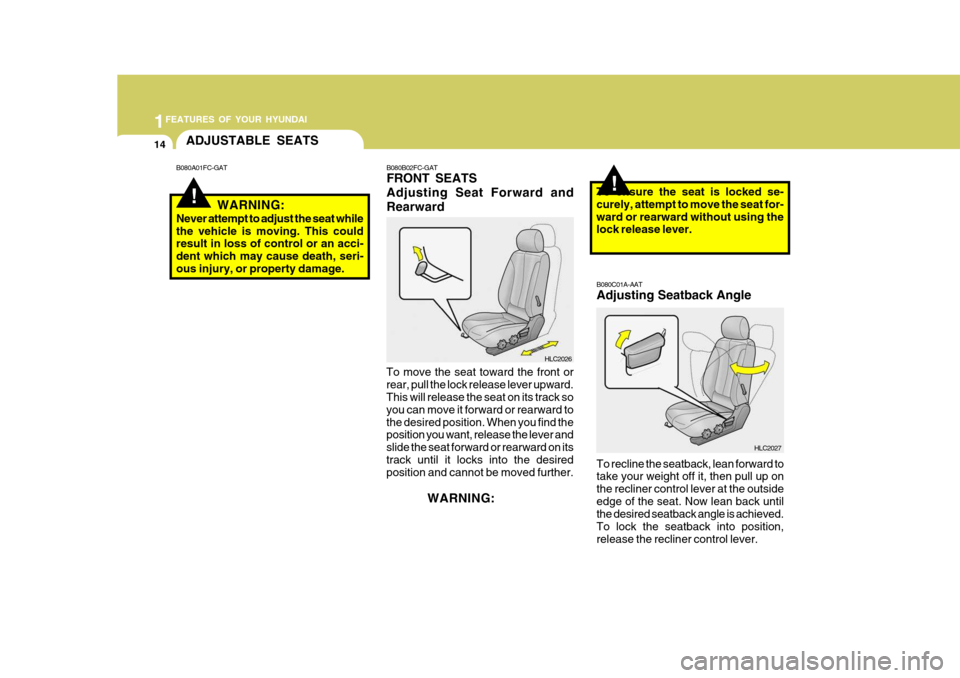
To recline the seatback, lean forward to take your weight off it, then pull up on the recliner control lever at the outsideedge of the seat. Now lean back until the desired seatback angle is achieved. To lock the seatback into position,release the recliner control lever.
B080C01A-AAT Adjusting Seatback Angle
HLC2027
To move the seat toward the front or rear, pull the lock release lever upward. This will release the seat on its track so you can move it forward or rearward tothe desired position. When you find the position you want, release the lever and slide the seat forward or rearward on itstrack until it locks into the desired position and cannot be moved further.
WARNING: To ensure the seat is locked se- curely, attempt to move the seat for-ward or rearward without using the lock release lever.
B080A01FC-GAT
B080B02FC-GAT FRONT SEATS Adjusting Seat Forward andRearward
WARNING:
Never attempt to adjust the seat while the vehicle is moving. This could result in loss of control or an acci- dent which may cause death, seri-ous injury, or property damage.
HLC2026