warning light Hyundai Accent 2006 Owner's Guide
[x] Cancel search | Manufacturer: HYUNDAI, Model Year: 2006, Model line: Accent, Model: Hyundai Accent 2006Pages: 599, PDF Size: 17.59 MB
Page 189 of 599
3 WHAT TO DO IN AN EMERGENCY
2
!
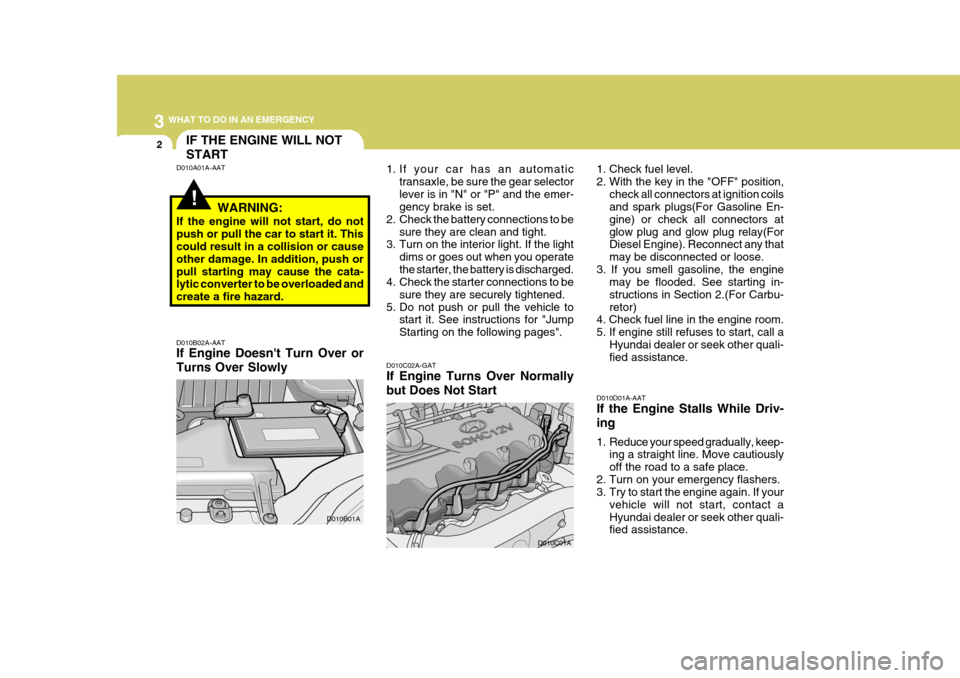
D010B02A-AAT If Engine Doesn't Turn Over or Turns Over Slowly 1. If your car has an automatic
transaxle, be sure the gear selector lever is in "N" or "P" and the emer- gency brake is set.
2. Check the battery connections to be
sure they are clean and tight.
3. Turn on the interior light. If the light
dims or goes out when you operate the starter, the battery is discharged.
4. Check the starter connections to be
sure they are securely tightened.
5. Do not push or pull the vehicle to start it. See instructions for "JumpStarting on the following pages".
D010C02A-GAT If Engine Turns Over Normally but Does Not Start 1. Check fuel level. 2. With the key in the "OFF" position,
check all connectors at ignition coils and spark plugs(For Gasoline En- gine) or check all connectors atglow plug and glow plug relay(For Diesel Engine). Reconnect any that may be disconnected or loose.
3. If you smell gasoline, the engine may be flooded. See starting in-structions in Section 2.(For Carbu-retor)
4. Check fuel line in the engine room.5. If engine still refuses to start, call a
Hyundai dealer or seek other quali- fied assistance.
D010D01A-AAT If the Engine Stalls While Driv- ing
1. Reduce your speed gradually, keep- ing a straight line. Move cautiously off the road to a safe place.
2. Turn on your emergency flashers.
3. Try to start the engine again. If your
vehicle will not start, contact a Hyundai dealer or seek other quali- fied assistance.
D010A01A-AAT
D010B01A
D010C01A
IF THE ENGINE WILL NOT START
WARNING:
If the engine will not start, do not push or pull the car to start it. This could result in a collision or cause other damage. In addition, push orpull starting may cause the cata- lytic converter to be overloaded and create a fire hazard.
Page 190 of 599
3
WHAT TO DO IN AN EMERGENCY
3
!
JUMP STARTING
WARNING:
The gas produced by the battery during the jump-start operation ishighly explosive. If these instruc- tions are not followed exactly, seri- ous personal injury and damage tothe vehicle may occur! If you are not sure how to follow this proce- dure, seek qualified assistance.Automobile batteries contain sul- furic acid. This is poisonous and highly corrosive. When jump start-ing, wear protective glasses and be careful not to get acid on yourself, your clothing or on the car. 1. If the booster battery is installed in
another vehicle, be sure the twovehicles are not touching.
2. Turn off all unnecessary lights and
accessories in both vehicles.
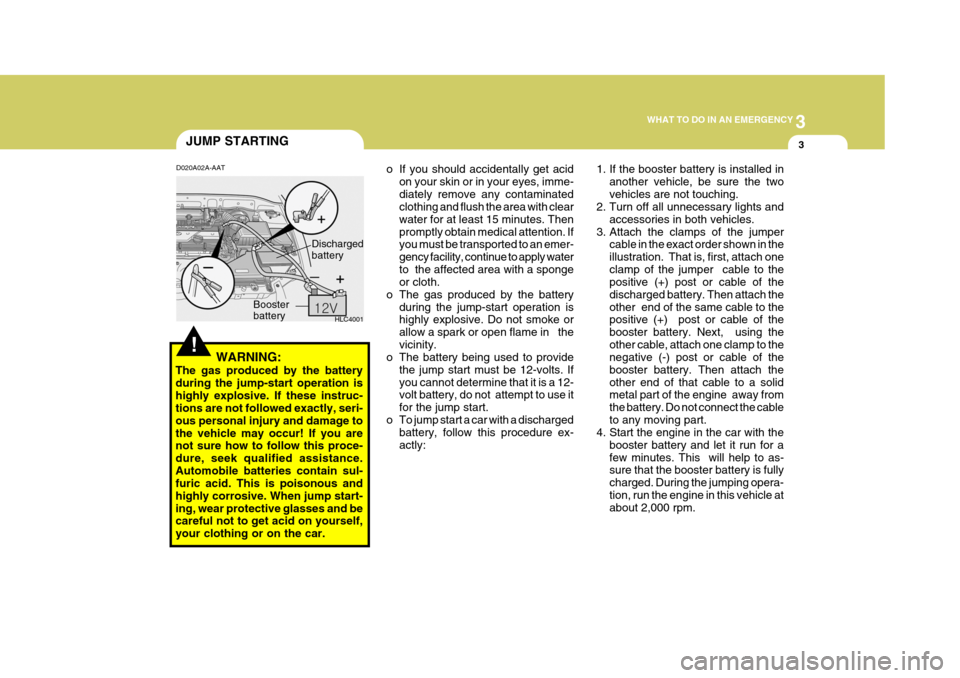
3. Attach the clamps of the jumper cable in the exact order shown in theillustration. That is, first, attach oneclamp of the jumper cable to the positive (+) post or cable of the discharged battery. Then attach theother end of the same cable to the positive (+) post or cable of the booster battery. Next, using theother cable, attach one clamp to the negative (-) post or cable of the booster battery. Then attach theother end of that cable to a solid metal part of the engine away from the battery. Do not connect the cableto any moving part.
4. Start the engine in the car with the
booster battery and let it run for afew minutes. This will help to as- sure that the booster battery is fully charged. During the jumping opera-tion, run the engine in this vehicle at about 2,000 rpm.
D020A02A-AAT
o If you should accidentally get acid
on your skin or in your eyes, imme- diately remove any contaminated clothing and flush the area with clear water for at least 15 minutes. Thenpromptly obtain medical attention. If you must be transported to an emer- gency facility, continue to apply waterto the affected area with a sponge or cloth.
o The gas produced by the battery during the jump-start operation ishighly explosive. Do not smoke or allow a spark or open flame in thevicinity.
o The battery being used to provide
the jump start must be 12-volts. Ifyou cannot determine that it is a 12- volt battery, do not attempt to use it for the jump start.
o To jump start a car with a discharged battery, follow this procedure ex-actly:
Discharged battery
Booster battery
HLC4001
Page 191 of 599
3 WHAT TO DO IN AN EMERGENCY
4
!
IF THE ENGINE OVERHEATS
D030A02TB-AAT If your temperature gauge indicates overheating, you experience a loss of power, or hear loud pinging or knock- ing, the engine is probably too hot. Ifthis happens to you, you should:
1. Pull off the road and stop as soon as it is safe to do so.
2. Place the gear selector lever in "P"
(automatic), or neutral (manual transaxle) and set the parking brake. If the air conditioning is on, turn it off.
3. If engine coolant is running out un- der the car or steam is coming outfrom the hood, stop the engine. Donot open the hood until the engine coolant has stopped running or the steaming has stopped. If there is novisible loss of engine coolant and no steam, leave the engine running and check to be sure the enginecooling fan is operating. If the fan is not running, turn the engine off.
5. Start the engine in the car with the
discharged battery using the nor- mal starting procedure. After the engine starts, leave the jumper cables connected and let the enginerun at fast idle or about 2,000 rpm for several minutes.
6. Carefully remove the jumper cables in the reverse order of attachment.
If you do not know why your battery became discharged (because the lights were left on, etc.), have the charging system checked by your Hyundaidealer. 4. Check to see if the water pump drive
belt is missing. If it is not missing,check to see that it is tight. If the drive belt seems to be satisfactory, check for coolant leaking from theradiator, hoses or under the car. (If the air conditioning had been in use, it is normal for cold water to bedraining from it when you stop).
WARNING:
While the engine is running, keephair, hands, and clothing away from moving parts such as the fan and drive belts to prevent injury.
Page 196 of 599
3
WHAT TO DO IN AN EMERGENCY
9
!
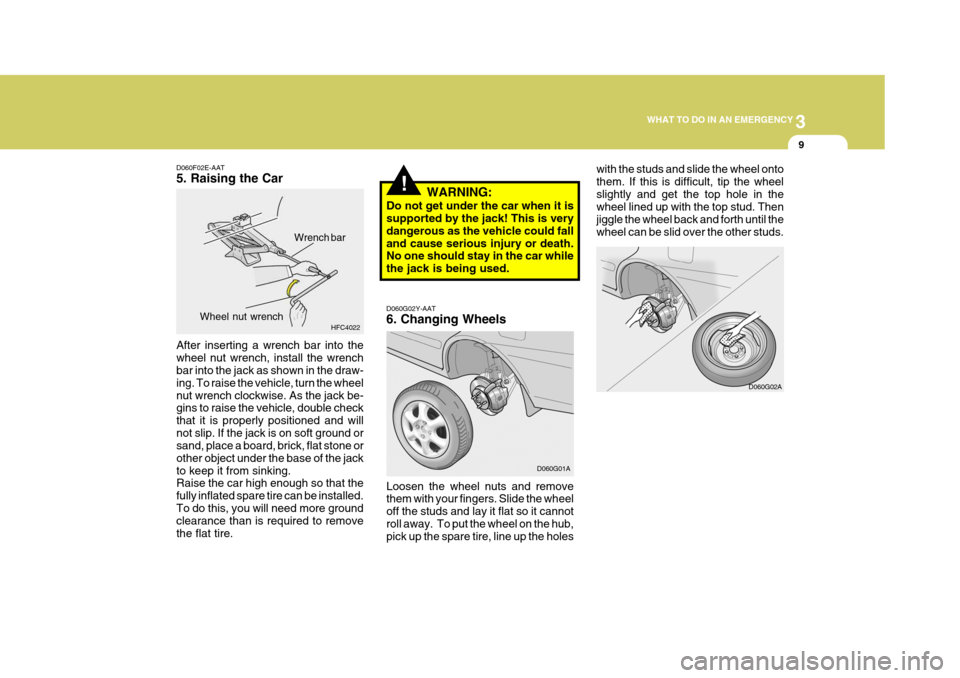
D060G02Y-AAT 6. Changing Wheels Loosen the wheel nuts and remove them with your fingers. Slide the wheel off the studs and lay it flat so it cannotroll away. To put the wheel on the hub, pick up the spare tire, line up the holes
D060F02E-AAT 5. Raising the Car After inserting a wrench bar into the wheel nut wrench, install the wrench bar into the jack as shown in the draw- ing. To raise the vehicle, turn the wheelnut wrench clockwise. As the jack be- gins to raise the vehicle, double check that it is properly positioned and willnot slip. If the jack is on soft ground or sand, place a board, brick, flat stone or other object under the base of the jackto keep it from sinking. Raise the car high enough so that the fully inflated spare tire can be installed.To do this, you will need more ground clearance than is required to remove the flat tire.
Wrench bar
Wheel nut wrench WARNING:
Do not get under the car when it is supported by the jack! This is very dangerous as the vehicle could falland cause serious injury or death. No one should stay in the car while the jack is being used.
HFC4022
D060G01Awith the studs and slide the wheel ontothem. If this is difficult, tip the wheelslightly and get the top hole in the wheel lined up with the top stud. Then jiggle the wheel back and forth until thewheel can be slid over the other studs.
D060G02A
Page 249 of 599
6
DO-IT-YOURSELF MAINTENANCE
31
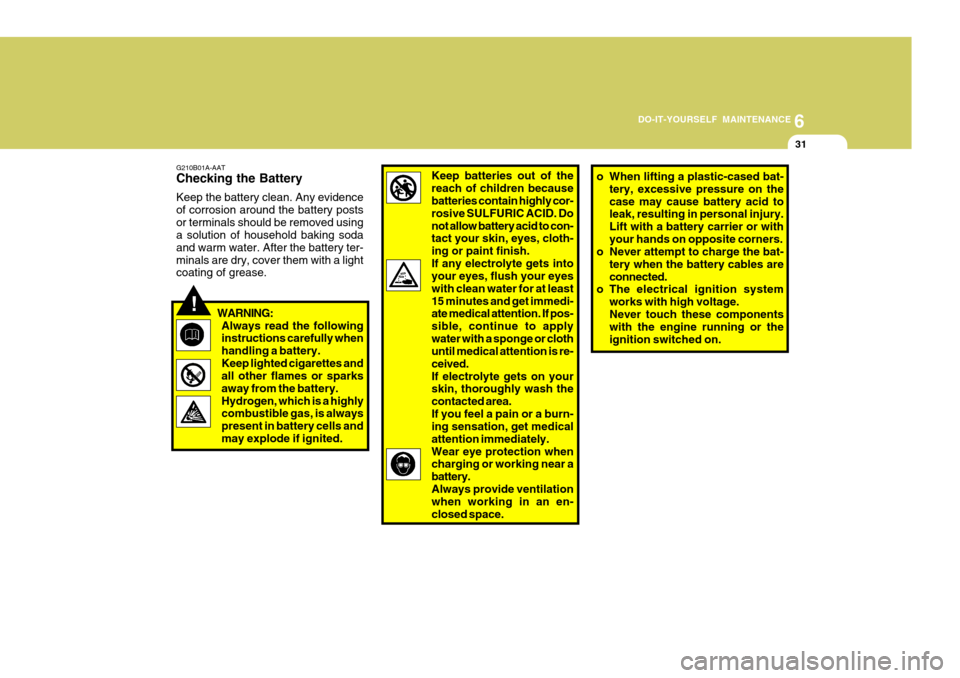
G210B01A-AAT Checking the Battery Keep the battery clean. Any evidence of corrosion around the battery postsor terminals should be removed using a solution of household baking soda and warm water. After the battery ter-minals are dry, cover them with a light coating of grease.
Keep batteries out of the reach of children because batteries contain highly cor- rosive SULFURIC ACID. Donot allow battery acid to con- tact your skin, eyes, cloth- ing or paint finish.If any electrolyte gets into your eyes, flush your eyes with clean water for at least15 minutes and get immedi- ate medical attention. If pos- sible, continue to applywater with a sponge or cloth until medical attention is re- ceived.If electrolyte gets on your skin, thoroughly wash the contacted area.If you feel a pain or a burn- ing sensation, get medical attention immediately.Wear eye protection when charging or working near a battery.Always provide ventilation when working in an en- closed space.
WARNING: Always read the following instructions carefully when handling a battery.Keep lighted cigarettes and all other flames or sparks away from the battery.Hydrogen, which is a highly combustible gas, is always present in battery cells andmay explode if ignited.!
o When lifting a plastic-cased bat- tery, excessive pressure on the case may cause battery acid to leak, resulting in personal injury. Lift with a battery carrier or withyour hands on opposite corners.
o Never attempt to charge the bat-
tery when the battery cables areconnected.
o The electrical ignition system
works with high voltage.Never touch these components with the engine running or the ignition switched on.
Page 251 of 599
6
DO-IT-YOURSELF MAINTENANCE
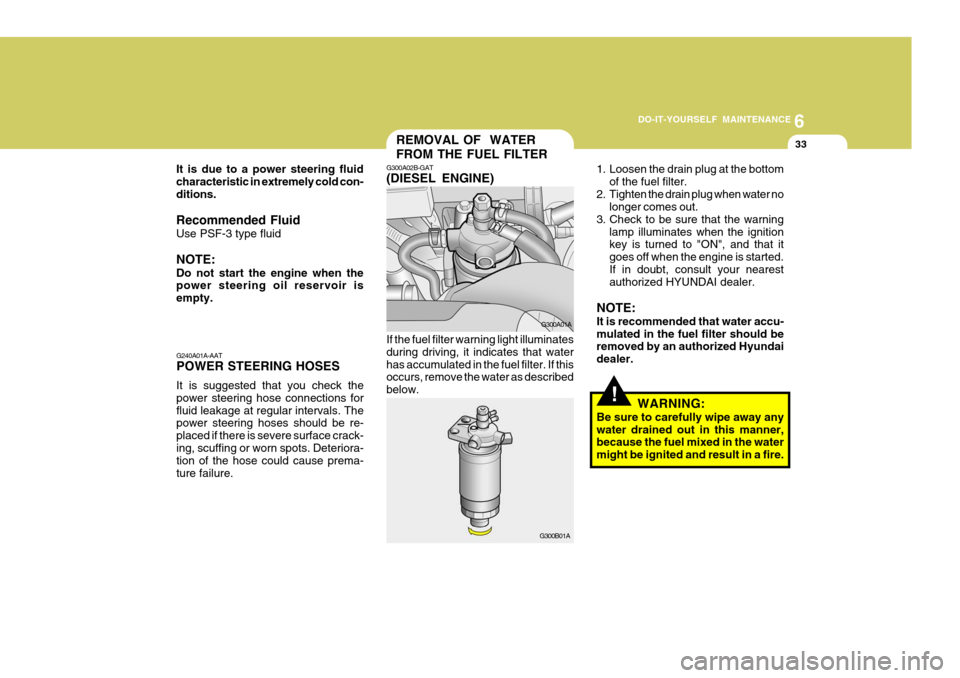
33REMOVAL OF WATER FROM THE FUEL FILTER
1. Loosen the drain plug at the bottom
of the fuel filter.
2. Tighten the drain plug when water no longer comes out.
3. Check to be sure that the warning
lamp illuminates when the ignition key is turned to "ON", and that it goes off when the engine is started.If in doubt, consult your nearest authorized HYUNDAI dealer.
NOTE: It is recommended that water accu- mulated in the fuel filter should be removed by an authorized Hyundai dealer.
G300B01A G300A01A
G240A01A-AAT POWER STEERING HOSES It is suggested that you check the power steering hose connections forfluid leakage at regular intervals. The power steering hoses should be re- placed if there is severe surface crack-ing, scuffing or worn spots. Deteriora- tion of the hose could cause prema- ture failure. G300A02B-GAT (DIESEL ENGINE) If the fuel filter warning light illuminates during driving, it indicates that waterhas accumulated in the fuel filter. If this occurs, remove the water as described below.
It is due to a power steering fluidcharacteristic in extremely cold con-ditions. Recommended Fluid Use PSF-3 type fluid NOTE: Do not start the engine when the power steering oil reservoir is empty.
!WARNING:
Be sure to carefully wipe away any water drained out in this manner, because the fuel mixed in the water might be ignited and result in a fire.
Page 255 of 599
6
DO-IT-YOURSELF MAINTENANCE
37
!
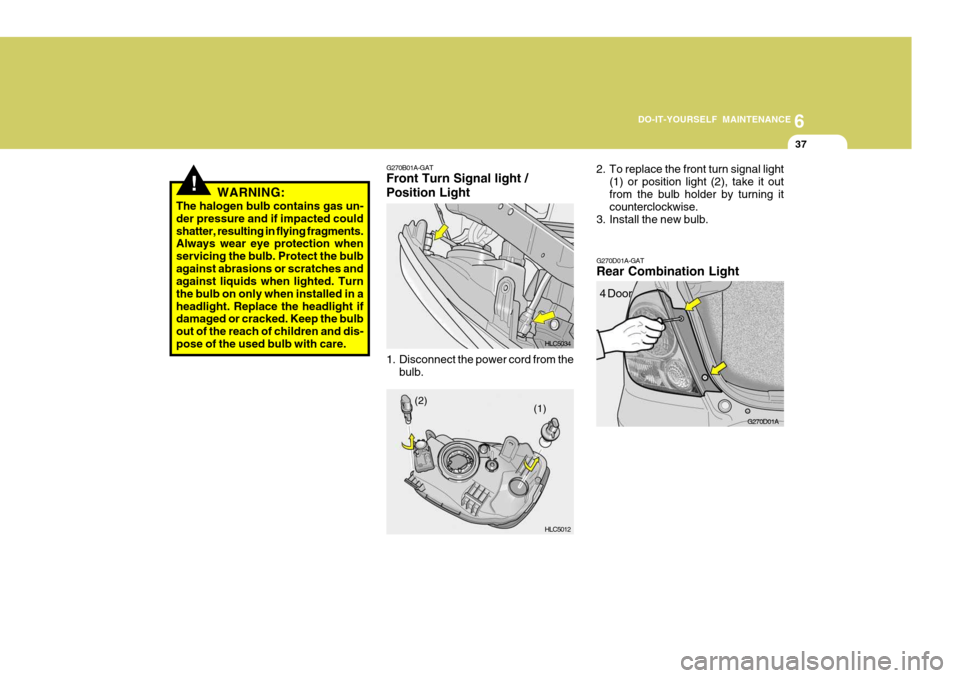
G270D01A-GAT Rear Combination Light
G270D01A
G270B01A-GAT Front Turn Signal light / Position Light
1. Disconnect the power cord from the
bulb. HLC5034 HLC50122. To replace the front turn signal light
(1) or position light (2), take it out from the bulb holder by turning it counterclockwise.
3. Install the new bulb.
4 Door
(1)
(2)
WARNING:
The halogen bulb contains gas un- der pressure and if impacted couldshatter, resulting in flying fragments. Always wear eye protection when servicing the bulb. Protect the bulbagainst abrasions or scratches and against liquids when lighted. Turn the bulb on only when installed in aheadlight. Replace the headlight if damaged or cracked. Keep the bulb out of the reach of children and dis- pose of the used bulb with care.
Page 262 of 599

6 DO-IT-YOURSELF MAINTENANCE
44
G200E01A-GAT Inner Panel
HLC5031 PROTECTED COMPONENTS
Hazard warning, Back-up lamp switch, Transaxle range switch, A/T shift & key lock control module
ETACM, Pre-Excitation resistor, Instrument cluster, Seat belt timer Instrument cluster Air bag
ECM, A/T shift lever, Transaxle range switch, Mass air flow sensor,
Vehicle speed sensor, Water sensor
Power door lock
Hazard warning, ETACM
Stop lamp, A/T shift lever, A/T key interlock solenoid Rear window defogger
Head lamp, Power window, Head lamp leveling, Head lamp washer,
ETACM, Front fog lamp, Blower control, Rear intermittent washer, Fuel filter relayFront wiper & washer Seat warmer ABS control, ABS bleedingDigital clock, Audio, A/T shift & key lock control module Cigarette lighter
Power outside mirrorRear window & outside mirror defogger Rear wiper
FUSE RATING
10A 10A 10A15A 10A10A 10A 10A20A 10A20A 20A10A 10A 15A10A 10A 20A
FUSE
1 2 3 4 56 78 9
10 11 12 13 1415 16 1718
Page 280 of 599

10INDEX
4
H Hazard Warning Syst em ........................................... 1-66
Headlight Aiming Adjustment ....................................6-34
Headlight Leveling Device Syst em ...........................1-65
Headlight Washer Switch ............ .............................. 1-65
Heating and Cooling Control ..................................... 1-84
Heating and Ventilation ............................................. 1-85
Air flow control ....................................................... 1-86
Air intake control .................................................... 1-85
Bi-level heating ....................................................... 1-89
Defrost/Defogging .................................................. 1-89
Fan speed control .................................................. 1-85
Temperature control ............................................... 1-88
High-Mounted Rear Stop Light................................. 1-78
Hood Release ........................................................... 1-79
Horn .......................................................................... 1-83
I Ignition Sw itch ............................................................. 2-3
Immobilizer S ystem ..................................................... 1-5
Instrument Cluster and Indicator Li ghts................... 1-48
Interior Light Interior light ............................................................ 1-73
Map light ................................................................ 1-74
JJump Starting .............................................................. 3-3 K
Key .............................................................................. 1-4
If you lose your keys ............................................. 3-13
Positions ................................................................... 2-4
Keyless Entry System ............................................... 1-11
LLubrication Chart ......................................................... 9-4
M Maintenance Intervals Explanation of scheduled maintenance items ......... 5-8
Maintenance under severe usage conditions .......... 5-7 Scheduled maintenance ........................................... 5-4
Service requ irements............................................... 5-2
Mirrors Day/night inside rearview .......................................1-78
Outside rearview mirror .................... ..................... 1-75
Outside rearview mirror heater .............................. 1-77
O
Odometer/ Trip Odometer ......... ...............................1-58
P Parking Brake ........................................................... 1-78
Power Steering Fluid Level .......................................6-32
Power Windows ........................................................ 1-13
Page 282 of 599

10INDEX
6
TransaxleAutomatic ............................................................... 2-11
Automatic transaxle fluid checkin g ........................6-20
Manual ..................................................................... 2-9
Manual transaxle Oil checking ...............................6-19
Trip Computer ........................................................... 1-59
Trip Odometer ........................................................... 1-58
Trunk Lid/Tail gate .................................................... 1-80
V Vehicle Identification Number ..................................... 8-2
W Warning Lights .......................................................... 1-52
Windshield Wiper and Washer................................. 1-63
Adjustable intermittent wiper operation ..................1-64
Rear window wiper and washer ............................ 1-64
Windshield Wiper Blades ................... ....................... 6-17
Winter Driving ........................................................... 2-18