ESP Hyundai Accent 2006 Service Manual
[x] Cancel search | Manufacturer: HYUNDAI, Model Year: 2006, Model line: Accent, Model: Hyundai Accent 2006Pages: 599, PDF Size: 17.59 MB
Page 496 of 599
2DRIVING YOUR HYUNDAI
6
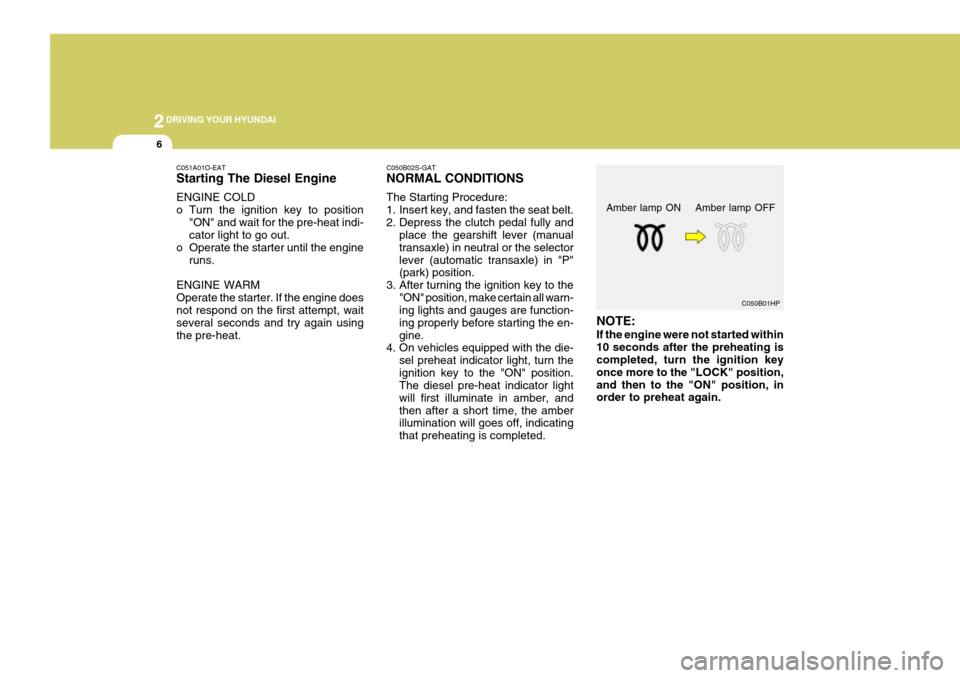
NOTE: If the engine were not started within 10 seconds after the preheating is completed, turn the ignition key once more to the "LOCK" position,and then to the "ON" position, in order to preheat again.
C051A01O-EAT Starting The Diesel Engine ENGINE COLD
o Turn the ignition key to position
"ON" and wait for the pre-heat indi- cator light to go out.
o Operate the starter until the engine runs.
ENGINE WARM Operate the starter. If the engine does not respond on the first attempt, wait several seconds and try again usingthe pre-heat. C050B02S-GAT NORMAL CONDITIONS The Starting Procedure:
1. Insert key, and fasten the seat belt.
2. Depress the clutch pedal fully and
place the gearshift lever (manualtransaxle) in neutral or the selectorlever (automatic transaxle) in "P" (park) position.
3. After turning the ignition key to the "ON" position, make certain all warn-ing lights and gauges are function- ing properly before starting the en-gine.
4. On vehicles equipped with the die-
sel preheat indicator light, turn theignition key to the "ON" position. The diesel pre-heat indicator light will first illuminate in amber, andthen after a short time, the amber illumination will goes off, indicating that preheating is completed. C050B01HP
Amber lamp ON Amber lamp OFF
Page 506 of 599

2DRIVING YOUR HYUNDAI
16DRIVING FOR ECONOMY
nance schedule in Section 5. If you drive your car in severe conditions,more frequent maintenance is re- quired (see Section 5 for details).
o Keep your car clean. For maximum
service, your car should be keptclean and free of corrosive materi- als. It is especially important thatmud, dirt, ice, etc. not be allowed to accumulate on the underside of the car. This extra weight can result inincreased fuel consumption and also contribute to corrosion.
o Travel lightly. Don't carry unneces- sary weight in your car. Weight is anenemy of good fuel economy.
o Don't let the engine idle longer than necessary. If you are waiting (andnot in traffic), turn off your engine and restart only when you're readyto go.
o Remember, your car does not re-
quire extended warm-up. As soonas the engine is running smoothly, you can drive away. In very cold weather, however, give your enginea slightly longer warm-up period.
C140A01A-EAT You can save fuel and get more miles from your car if you follow these sug- gestions:
o Drive smoothly. Accelerate at a
moderate rate. Don't make "jack- rabbit" starts or full-throttle shiftsand maintain a steady cruising speed. Don't race between stop- lights. Try to adjust your speed tothat of the other traffic so you don't have to change speeds unneces- sarily. Avoid heavy traffic wheneverpossible. Always maintain a safe distance from other vehicles so you can avoidunnecessary braking. This also re- duces brake wear.
o Drive at a moderate speed. The faster you drive, the more fuel yourcar uses. Driving at a moderate speed, especially on the highway, isone of the most effective ways to reduce fuel consumption. o Don't "ride" the brake or clutch pedal.
This can increase fuel consumption and also increase wear on these components. In addition, driving with your foot resting on the brake pedalmay cause the brakes to overheat, which reduces their effectiveness and may lead to more serious con-sequences.
o Take care of your tyres. Keep them
inflated to the recommended pres-sure. Incorrect inflation, either too much or too little, results in unnec- essary tyre wear. Check the tyrepressures at least once a month.
o Be sure that the wheels are aligned
correctly. Improper alignment canresult from hitting curbs or driving too fast over irregular surfaces. Poor alignment causes faster tyre wearand may also result in other prob- lems as well as greater fuel con- sumption.
o Keep your car in good condition. For better fuel economy and reducedmaintenance costs, maintain yourcar in accordance with the mainte-
Page 507 of 599

2
DRIVING YOUR HYUNDAI
17WINTER MOTORINGSMOOTH CORNERING
o Don't "lug" or "over-rev" the engine. Lugging is driving too slowly in too high a gear resulting in the engine bucking. If this happens to you, shift to a lower gear. Over-revving isracing the engine beyond its safe limit. This can be avoided by shifting at the recommended speeds.
o Use your air conditioning sparingly. The air conditioning system is oper-ated by the engine power so yourfuel economy is reduced when you use it. C150A01A-EAT Avoid braking or gear changing in cor- ners, especially when roads are wet. Ideally, corners should always be taken under gentle acceleration. If you followthese suggestions, tyre wear will be held to a minimum.
SC170A1-E The onset of winter conditions subject motor vehicles to greater operating demands. Therefore, the following suggestions will assist in maintainingpeak performance and reliability dur- ing these periods: ZC170B1-E Electrical System Winter conditions impose severe de- mands upon vehicle electrical systems, particularly the charging circuit. Thebattery condition and performance along with the alternator performance and drive belt condition should bechecked prior to the onset of winter.
Page 512 of 599

2DRIVING YOUR HYUNDAI
22
7. The vehicle/trailer combination ismore affected by crosswind and buffeting. When being passed by a large vehicle, keep a constant speedand steer straight ahead. If there is too much wind buffeting slow down to get out of the other vehicle's airturbulence.
8. When parking your car and trailer,
especially on a hill, be sure tofollow all the normal precautions. Turn your front wheel into the curb, set the parking brake firmly, andput the transaxle in 1st or Reverse (manual) or Park (automatic). In addition, place wheel chocks ateach of the trailer's tyres.
9. If the trailer has electric brakes,
start your vehicle and trailer mov-ing, and then apply the trailer brake controller by hand to be sure the brakes are working. This lets youcheck your electrical connection at the same time.
10. During your trip, check occasion- ally to be sure that the load issecure, and that the lights and any trailer brakes are still working.
C190F02A-EAT Trailer or Vehicle Towing Tips
1. Before towing, check towbar hitch
and safety cable connections as well as proper operation of the trailer running lights, brake lights, and turn signals.
2. Always drive your vehicle at a mod- erate speed (Less than 60 MPH)
3. Trailer towing requires more fuel than normal conditions.
4. To maintain engine braking effi-
ciency and electrical charging per-formance, do not use fifth gear (manual transaxle) or overdrive (automatic transaxle).
5. Always secure items in the trailer to prevent load shift whilst driving.
6. Check the condition and air pres- sure of all tyres on the trailer and your car. Low tyre pressure can seriously affect the handling. Alsocheck the spare tyre.
C190G01A-EAT Important Trailer Weight Infor- mation The Maximum Towable Weight of your Hyundai Accent will be reduced if thevehicle is load. The Maximum Towable Weight for a fully load is vehicle is calculated asfollows:
1. Find the Vehicle Identification Num-
ber (VIN) plate (see section 8).
2. Note the top 2 weights (in kg) of the
4 lines of weight information on the VIN plate.
3. Subtract the weight on line 1 from
line 2. This result (in kg) is themaximum towable weight of a fully loaded vehicle. For more information, contact yourlocal Hyundai Dealer.
Page 534 of 599
5VEHICLE MAINTENANCE REQUIREMENTS
2MAINTENANCE AND SER- VICING REQUIREMENTS
SF020A1-E To ensure the continued reliability and safety of the vehicle, certain routine maintenance operations are requiredat specific mileage or time intervals.It is the responsibility of the vehicleowner to ensure that the maintenanceschedules shown in both this Owners Manual and the Warranty and Service Passport are adhered to.The new vehicle warranty may beinvalidated if the routine maintenanceoperations are not performed in line with the recommendations outlined and the safety and durability of thevehicle adversely affected.It is recommended that all mainte-nance operations with the exceptionof the daily operating checks are en- trusted to a Hyundai dealer to ensure that the latest repair and maintenanceprocedures and specialized servicing tools are employed. In addition, the use of genuine Hyundai replacementparts will ensure that the vehicle safety and performance will not be compro- mised. NOTE:
The inspection and testing of cer-
tain electronic fuel injection/engine management and automatic trans- mission control systems requirespecialised electronic equipment specifically designed for Hyundai vehicles. The use of general pur-pose electrical test equipment may result in damage to the control unit microprocessors.
SF020C2-E
Specified Scheduled Procedures
The Specified scheduled procedures
are listed in the maintenance chartsbeginning at page 5-3. The opera- tions specified must be performed at the time or mileage intervals shownirrespective of whether the mileage interval has been reached before the specified time interval. Certain lubricants and components
degrade with both time and mileage(e.g. engine oil and brake fluid) and therefore it is not permissable to base the maintenance schedule upon mile-age alone. It is strongly recommended that the maintenance operations are performed by the factory-trained or distributor-trained technicians at yourHyundai dealer because of the need for specialized knowledge and tooling and to ensure that no possibility ofinvalidating the manufacturers war- ranty exists.
The maintenance schedules relate to
vehicles operated under normal con-ditions, vehicles which are operated under adverse conditions will requiremore frequent maintenance which is described at page 5-6. NOTE:
Service schedules may change de-
pending on individual country needs. Please ask your local Hyundai dealer for a copy of the service schedule that relates to thatcountry.
SF030B1-E
SERVICE HISTORY
It is important that all scheduled main-
tenance services are recorded in thewarranty and service passport to en-sure that proof of maintenance is avail- able when warranty service is required.
Page 548 of 599
6OWNER MAINTENANCE
6
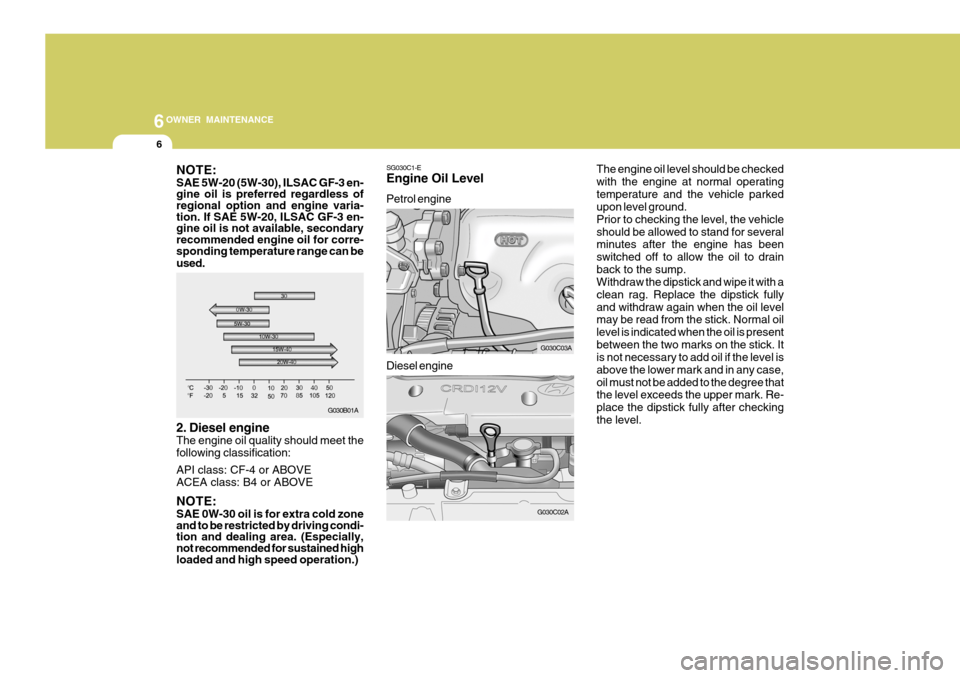
SG030C1-E Engine Oil Level Diesel engine The engine oil level should be checked with the engine at normal operatingtemperature and the vehicle parked upon level ground. Prior to checking the level, the vehicleshould be allowed to stand for several minutes after the engine has been switched off to allow the oil to drainback to the sump. Withdraw the dipstick and wipe it with a clean rag. Replace the dipstick fullyand withdraw again when the oil level may be read from the stick. Normal oil level is indicated when the oil is presentbetween the two marks on the stick. It is not necessary to add oil if the level is above the lower mark and in any case,oil must not be added to the degree that the level exceeds the upper mark. Re- place the dipstick fully after checkingthe level.
Petrol engine
G030B01A
G030C03A
G030C02A
NOTE: SAE 5W-20 (5W-30), ILSAC GF-3 en- gine oil is preferred regardless ofregional option and engine varia- tion. If SAE 5W-20, ILSAC GF-3 en- gine oil is not available, secondaryrecommended engine oil for corre- sponding temperature range can be used.
2. Diesel engine The engine oil quality should meet the following classification: API class: CF-4 or ABOVE ACEA class: B4 or ABOVE NOTE: SAE 0W-30 oil is for extra cold zone and to be restricted by driving condi- tion and dealing area. (Especially,not recommended for sustained high loaded and high speed operation.)
Page 552 of 599
6OWNER MAINTENANCE
10
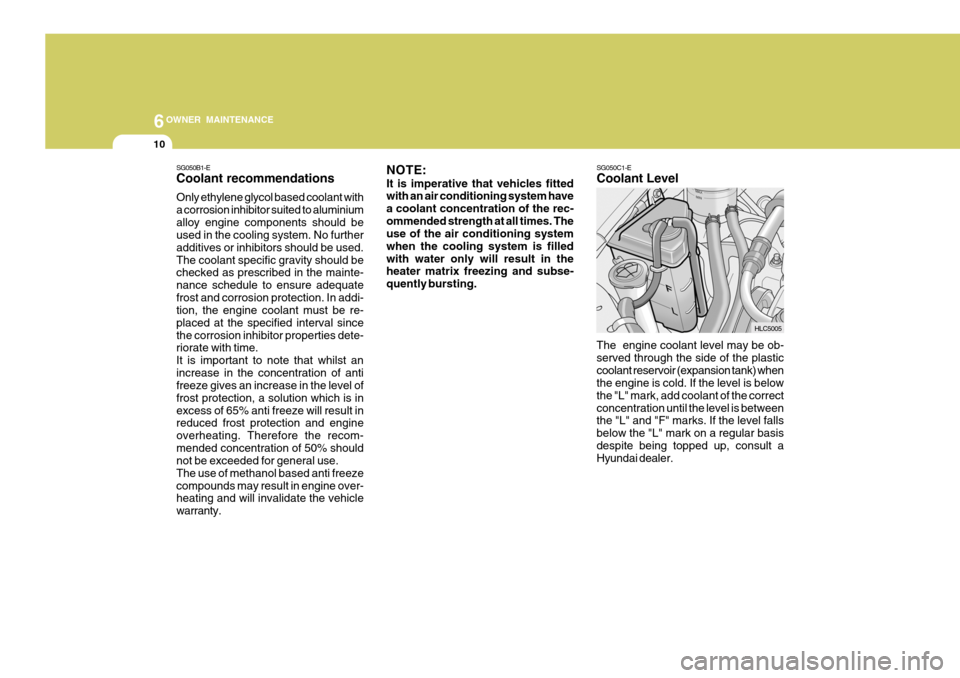
NOTE: It is imperative that vehicles fitted with an air conditioning system have a coolant concentration of the rec-ommended strength at all times. The use of the air conditioning system when the cooling system is filledwith water only will result in the heater matrix freezing and subse- quently bursting. SG050C1-E Coolant Level The engine coolant level may be ob- served through the side of the plasticcoolant reservoir (expansion tank) when the engine is cold. If the level is below the "L" mark, add coolant of the correctconcentration until the level is between the "L" and "F" marks. If the level falls below the "L" mark on a regular basisdespite being topped up, consult a Hyundai dealer.
SG050B1-E Coolant recommendations Only ethylene glycol based coolant with a corrosion inhibitor suited to aluminiumalloy engine components should be used in the cooling system. No further additives or inhibitors should be used.The coolant specific gravity should be checked as prescribed in the mainte- nance schedule to ensure adequatefrost and corrosion protection. In addi- tion, the engine coolant must be re- placed at the specified interval sincethe corrosion inhibitor properties dete- riorate with time. It is important to note that whilst anincrease in the concentration of anti freeze gives an increase in the level of frost protection, a solution which is inexcess of 65% anti freeze will result in reduced frost protection and engine overheating. Therefore the recom-mended concentration of 50% should not be exceeded for general use. The use of methanol based anti freezecompounds may result in engine over- heating and will invalidate the vehicle warranty.
HLC5005
Page 584 of 599
7
EMISSION CONTROL SYSTEMS
3
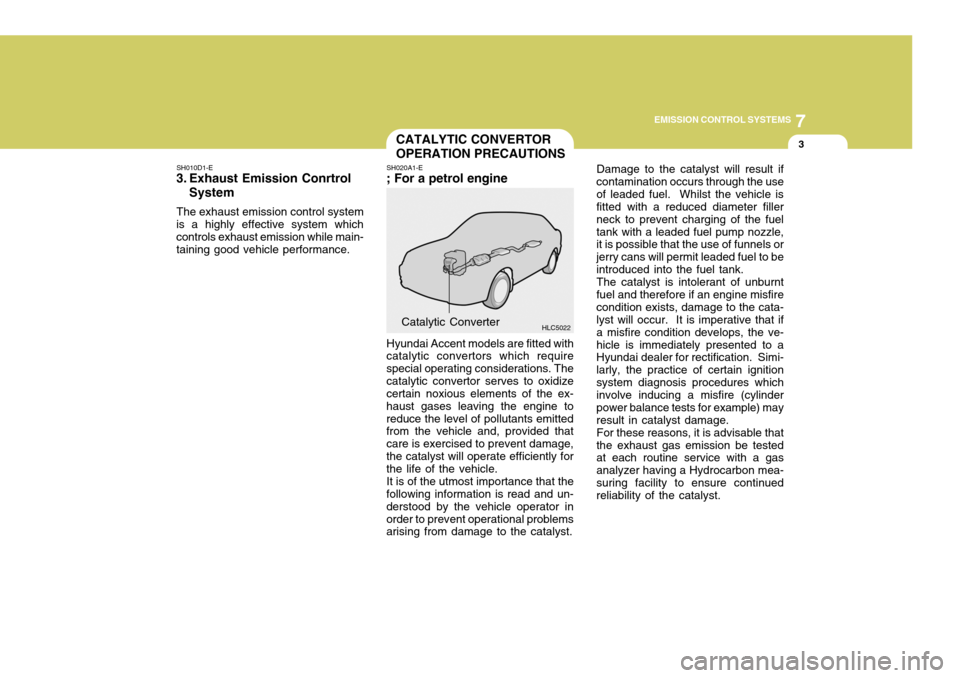
HLC5022Catalytic Converter
CATALYTIC CONVERTOR OPERATION PRECAUTIONS
SH010D1-E
3. Exhaust Emission Conrtrol
System
The exhaust emission control system
is a highly effective system which controls exhaust emission while main- taining good vehicle performance. SH020A1-E
; For a petrol engine
Hyundai Accent models are fitted with
catalytic convertors which requirespecial operating considerations. Thecatalytic convertor serves to oxidize certain noxious elements of the ex- haust gases leaving the engine toreduce the level of pollutants emitted from the vehicle and, provided that care is exercised to prevent damage,the catalyst will operate efficiently for the life of the vehicle.
It is of the utmost importance that the
following information is read and un- derstood by the vehicle operator inorder to prevent operational problems arising from damage to the catalyst. Damage to the catalyst will result if
contamination occurs through the use of leaded fuel. Whilst the vehicle is fitted with a reduced diameter filler neck to prevent charging of the fueltank with a leaded fuel pump nozzle, it is possible that the use of funnels or jerry cans will permit leaded fuel to beintroduced into the fuel tank. The catalyst is intolerant of unburnt
fuel and therefore if an engine misfirecondition exists, damage to the cata- lyst will occur. It is imperative that if a misfire condition develops, the ve-hicle is immediately presented to a Hyundai dealer for rectification. Simi- larly, the practice of certain ignitionsystem diagnosis procedures which involve inducing a misfire (cylinder power balance tests for example) mayresult in catalyst damage. For these reasons, it is advisable that
the exhaust gas emission be tested at each routine service with a gas analyzer having a Hydrocarbon mea-suring facility to ensure continued reliability of the catalyst.
Page 588 of 599
8
CONSUMER INFORMATION
3TYRE INFORMATION
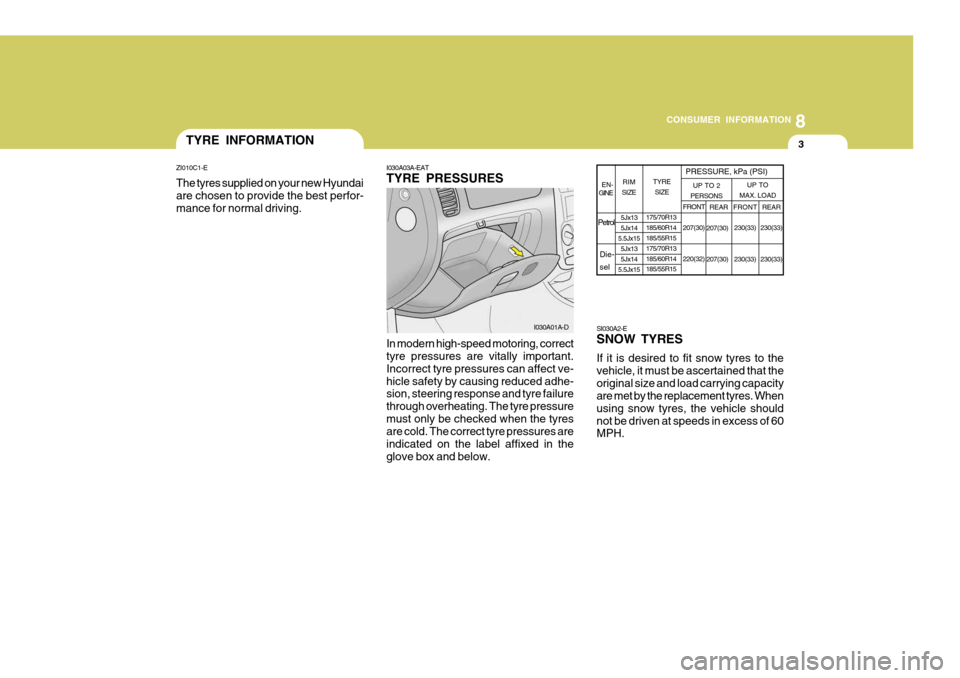
ZI010C1-E The tyres supplied on your new Hyundai are chosen to provide the best perfor- mance for normal driving. I030A03A-EAT TYRE PRESSURES In modern high-speed motoring, correct tyre pressures are vitally important. Incorrect tyre pressures can affect ve-hicle safety by causing reduced adhe- sion, steering response and tyre failure through overheating. The tyre pressuremust only be checked when the tyres are cold. The correct tyre pressures are indicated on the label affixed in theglove box and below.I030A01A-D
5Jx13 5Jx14
5.5Jx15 5Jx135Jx14
5.5Jx15 TYRE
SIZE
RIM
SIZE PRESSURE, kPa (PSI)
175/70R13185/60R14185/55R15175/70R13185/60R14 185/55R15 REAR
207(30) 207(30) FRONT
230(33) 230(33)
UP TO 2
PERSONS UP TO
MAX. LOAD
REAR
230(33)230(33)
FRONT 207(30) 220(32)
EN-
GINE
Die- sel
Petrol
SI030A2-E SNOW TYRES If it is desired to fit snow tyres to the vehicle, it must be ascertained that theoriginal size and load carrying capacity are met by the replacement tyres. When using snow tyres, the vehicle shouldnot be driven at speeds in excess of 60 MPH.