heating Hyundai Accent 2006 Workshop Manual
[x] Cancel search | Manufacturer: HYUNDAI, Model Year: 2006, Model line: Accent, Model: Hyundai Accent 2006Pages: 599, PDF Size: 17.59 MB
Page 483 of 599
1CONTROLS AND EQUIPMENT
76HEATING CONTROLS
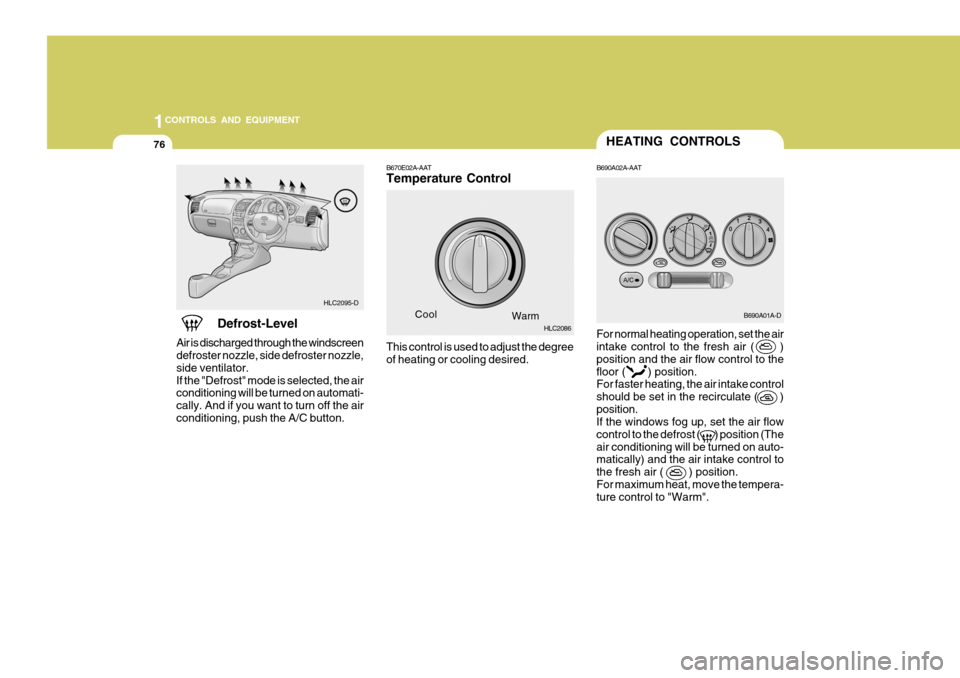
B670E02A-AAT Temperature Control
Defrost-Level
Air is discharged through the windscreen defroster nozzle, side defroster nozzle, side ventilator.If the "Defrost" mode is selected, the air conditioning will be turned on automati- cally. And if you want to turn off the airconditioning, push the A/C button. This control is used to adjust the degree of heating or cooling desired.
Cool
Warm
HLC2095-D
HLC2086B690A02A-AAT
For normal heating operation, set the air intake control to the fresh air ( ) position and the air flow control to thefloor ( ) position. For faster heating, the air intake control should be set in the recirculate ( )position. If the windows fog up, set the air flow control to the defrost ( ) position (Theair conditioning will be turned on auto- matically) and the air intake control to the fresh air ( ) position.For maximum heat, move the tempera- ture control to "Warm". B690A01A-D
Page 484 of 599
77
1
CONTROLS AND EQUIPMENT
DEFROSTING/DEFOGGINGVENTILATIONBI-LEVEL HEATING
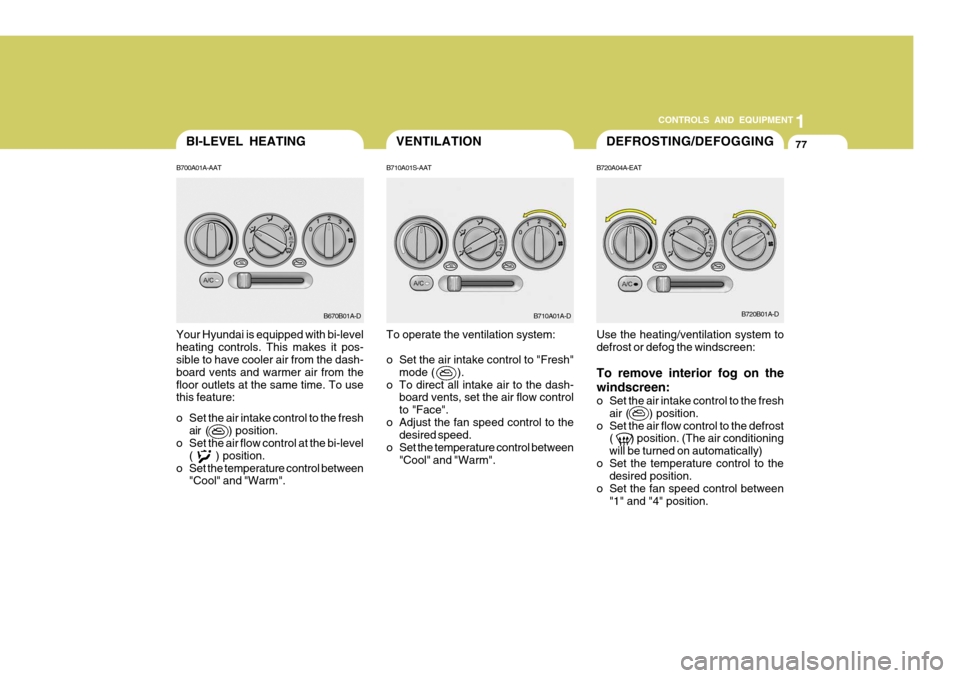
B720A04A-EAT Use the heating/ventilation system to defrost or defog the windscreen: To remove interior fog on the windscreen:
o Set the air intake control to the fresh
air ( ) position.
o Set the air flow control to the defrost ( ) position. (The air conditioning will be turned on automatically)
o Set the temperature control to the desired position.
o Set the fan speed control between "1" and "4" position.B700A01A-AAT
Your Hyundai is equipped with bi-level heating controls. This makes it pos- sible to have cooler air from the dash- board vents and warmer air from thefloor outlets at the same time. To use this feature:
o Set the air intake control to the fresh air ( ) position.
o Set the air flow control at the bi-level
( ) position.
o Set the temperature control between "Cool" and "Warm". B670B01A-D
B710A01S-AATTo operate the ventilation system:
o Set the air intake control to "Fresh"
mode ( ).
o To direct all intake air to the dash- board vents, set the air flow control to "Face".
o Adjust the fan speed control to the desired speed.
o Set the temperature control between "Cool" and "Warm". B710A01A-D
B720B01A-D
Page 485 of 599
1CONTROLS AND EQUIPMENT
78AIR CONDITIONING SYSTEM
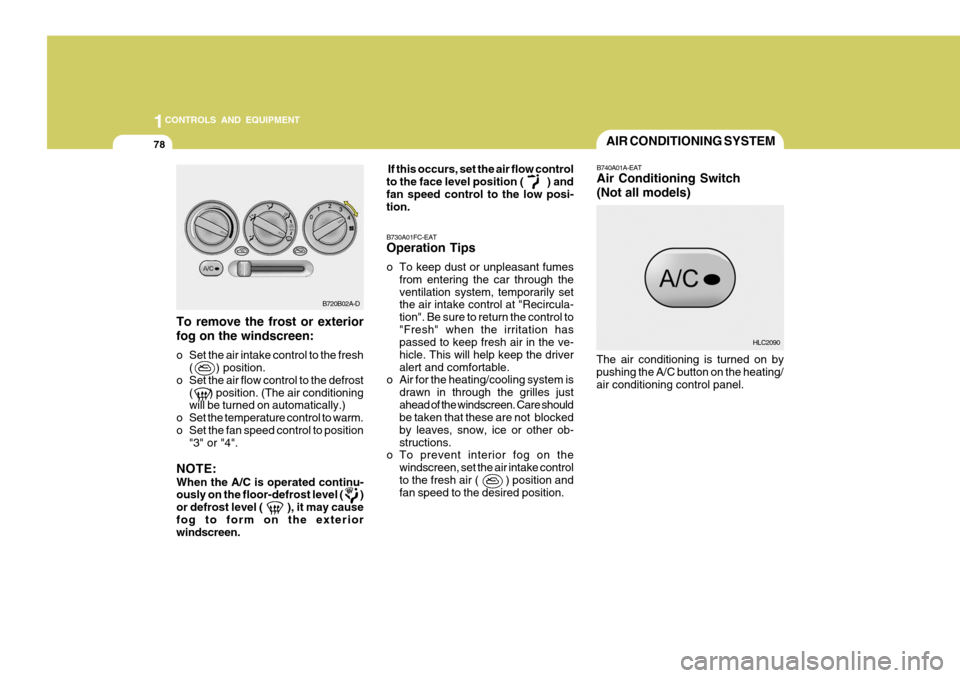
B740A01A-EAT Air Conditioning Switch (Not all models)
B730A01FC-EAT Operation Tips
o To keep dust or unpleasant fumes from entering the car through the ventilation system, temporarily set the air intake control at "Recircula- tion". Be sure to return the control to"Fresh" when the irritation has passed to keep fresh air in the ve- hicle. This will help keep the driveralert and comfortable.
o Air for the heating/cooling system is
drawn in through the grilles justahead of the windscreen. Care should be taken that these are not blocked by leaves, snow, ice or other ob-structions.
o To prevent interior fog on the
windscreen, set the air intake controlto the fresh air ( ) position and fan speed to the desired position.
To remove the frost or exterior fog on the windscreen:
o Set the air intake control to the fresh
( ) position.
o Set the air flow control to the defrost ( ) position. (The air conditioning will be turned on automatically.)
o Set the temperature control to warm.
o Set the fan speed control to position "3" or "4".
NOTE: When the A/C is operated continu- ously on the floor-defrost level ( ) or defrost level ( ), it may causefog to form on the exterior windscreen. The air conditioning is turned on bypushing the A/C button on the heating/ air conditioning control panel.
HLC2090
B720B02A-D
If this occurs, set the air flow control to the face level position ( ) andfan speed control to the low posi- tion.
Page 486 of 599
79
1
CONTROLS AND EQUIPMENT
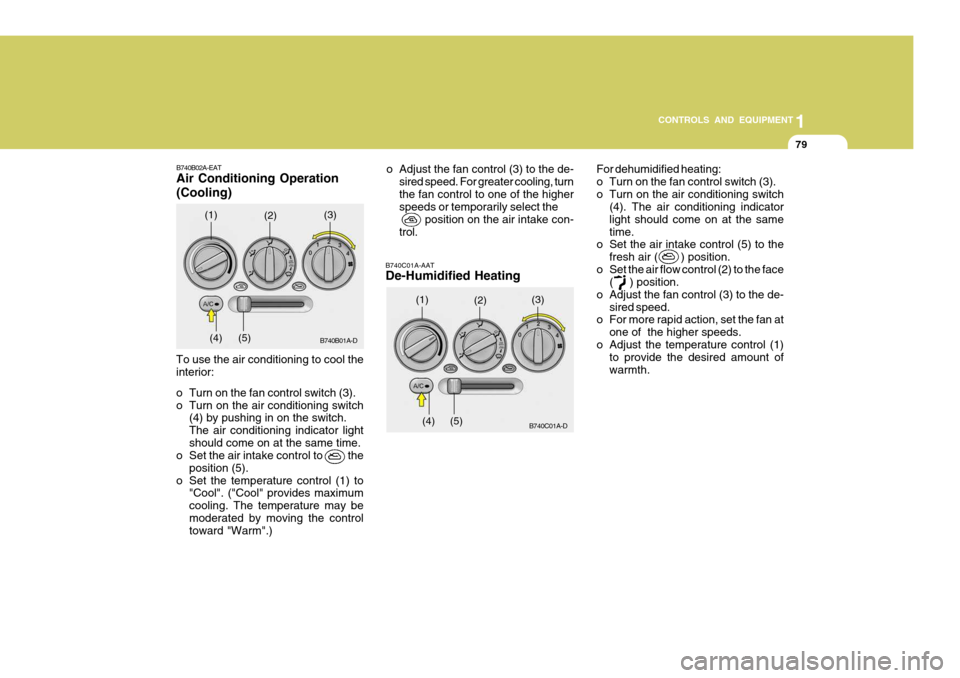
B740B02A-EAT Air Conditioning Operation (Cooling)
B740C01A-AAT De-Humidified Heating
To use the air conditioning to cool the interior:
o Turn on the fan control switch (3).
o Turn on the air conditioning switch(4) by pushing in on the switch.The air conditioning indicator lightshould come on at the same time.
o Set the air intake control to the
position (5).
o Set the temperature control (1) to "Cool". ("Cool" provides maximumcooling. The temperature may bemoderated by moving the control toward "Warm".) o Adjust the fan control (3) to the de-
sired speed. For greater cooling, turn the fan control to one of the higher speeds or temporarily select the position on the air intake con-
trol. For dehumidified heating:
o Turn on the fan control switch (3).
o Turn on the air conditioning switch
(4). The air conditioning indicatorlight should come on at the sametime.
o Set the air intake control (5) to the
fresh air ( ) position.
o Set the air flow control (2) to the face ( ) position.
o Adjust the fan control (3) to the de- sired speed.
o For more rapid action, set the fan at
one of the higher speeds.
o Adjust the temperature control (1) to provide the desired amount ofwarmth.
B740B01A-D
(1)
(2)
(3)
(4) (5) B740C01A-D
(1)
(2)
(3)
(4) (5)
Page 487 of 599
1CONTROLS AND EQUIPMENT
80POLLEN FILTER
B740D01A-AAT Operation Tips
o If the interior of the car is hot when you first get in, open the windows for a few minutes to expel the hot air.
o When you are using the air condi-
tioning system, keep all windowsclosed to keep hot air out.
o When moving slowly, as in heavy
traffic, shift to a lower gear. Thisincreases engine speed, which in turn increases the speed of the air conditioning compressor.
o On steep grades, turn the air condi- tioning off to avoid the possibility ofthe engine over-heating.
o During winter months or in periods when the air conditioning is not usedregularly, run the air conditioningonce every month for a few min- utes. This will help circulate the lubricants and keep your system inpeak operating condition.
!
B760A01Y
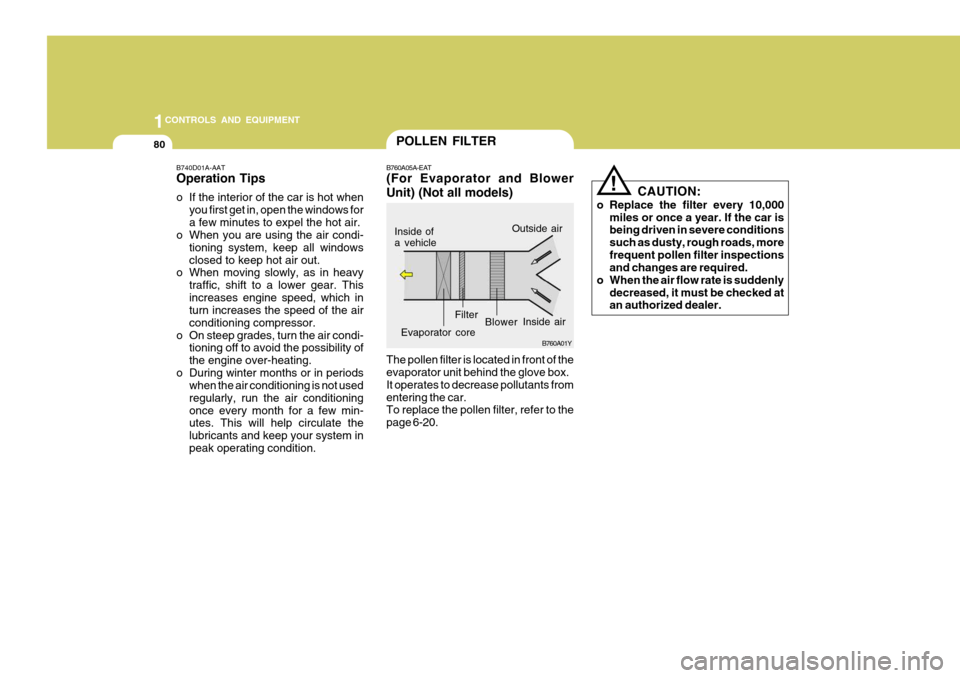
The pollen filter is located in front of the evaporator unit behind the glove box. It operates to decrease pollutants fromentering the car. To replace the pollen filter, refer to the page 6-20.
B760A05A-EAT
(For Evaporator and Blower Unit) (Not all models)
Inside of a vehicle
Evaporator core Filter
Blower Inside air CAUTION:
o Replace the filter every 10,000 miles or once a year. If the car is being driven in severe conditions such as dusty, rough roads, morefrequent pollen filter inspections and changes are required.
o When the air flow rate is suddenly
decreased, it must be checked atan authorized dealer.
Outside air
Page 492 of 599
2DRIVING YOUR HYUNDAI
2
!
SC020A1-E
WARNING: ENGINE EXHAUST CAN BE DANGEROUS!
Engine exhaust gases are potentially lethal. If at any time engine exhaust gas is detected within the passenger compartment, move the vehicle to an open area and open all windows. o Never inhale exhaust gas. Exhaust gases contain Carbon Monoxide which is colourless and odourless. Carbon Monoxide is poisonous and can cause unconsciousness and death by asphyxiation. o Exhaust System Maintenance. Ensure that the exhaust system is maintained in good condition and is free from excessive corrosion and damage which may result in leakage. If the vehicle is driven over an object which strikes the exhaust system,ensure that the exhaust system is inspected at the first available opportunity to ensure that no leakage exists. o Confined Areas. Do not run the engine in confined spaces, allowing the engine to idle in a garage, even when the doors are openis dangerous practice. Only start the engine immediately prior to moving the vehicle out of the garage. o Prolonged Idling. If it is necessary to allow the vehicle to idle for prolonged periods, ensure that the heating system air intakecontrol is set to the "Fresh" position, the blower is set to high speed operation and that the vehicle is standing in an open area. o Load Carrying. If it is necessary to carry long objects which do not permit the boot lid to be fully closed, the side windows must remain closed and the heating air intake control set to the "Fresh" position with the blower running at the highest speed setting. To ensure correct operation of the heater system, the air intake grilles at the base of the windscreen must not be obstructed by snow leaves etc..
Page 496 of 599
2DRIVING YOUR HYUNDAI
6
NOTE: If the engine were not started within 10 seconds after the preheating is completed, turn the ignition key once more to the "LOCK" position,and then to the "ON" position, in order to preheat again.
C051A01O-EAT Starting The Diesel Engine ENGINE COLD
o Turn the ignition key to position
"ON" and wait for the pre-heat indi- cator light to go out.
o Operate the starter until the engine runs.
ENGINE WARM Operate the starter. If the engine does not respond on the first attempt, wait several seconds and try again usingthe pre-heat. C050B02S-GAT NORMAL CONDITIONS The Starting Procedure:
1. Insert key, and fasten the seat belt.
2. Depress the clutch pedal fully and
place the gearshift lever (manualtransaxle) in neutral or the selectorlever (automatic transaxle) in "P" (park) position.
3. After turning the ignition key to the "ON" position, make certain all warn-ing lights and gauges are function- ing properly before starting the en-gine.
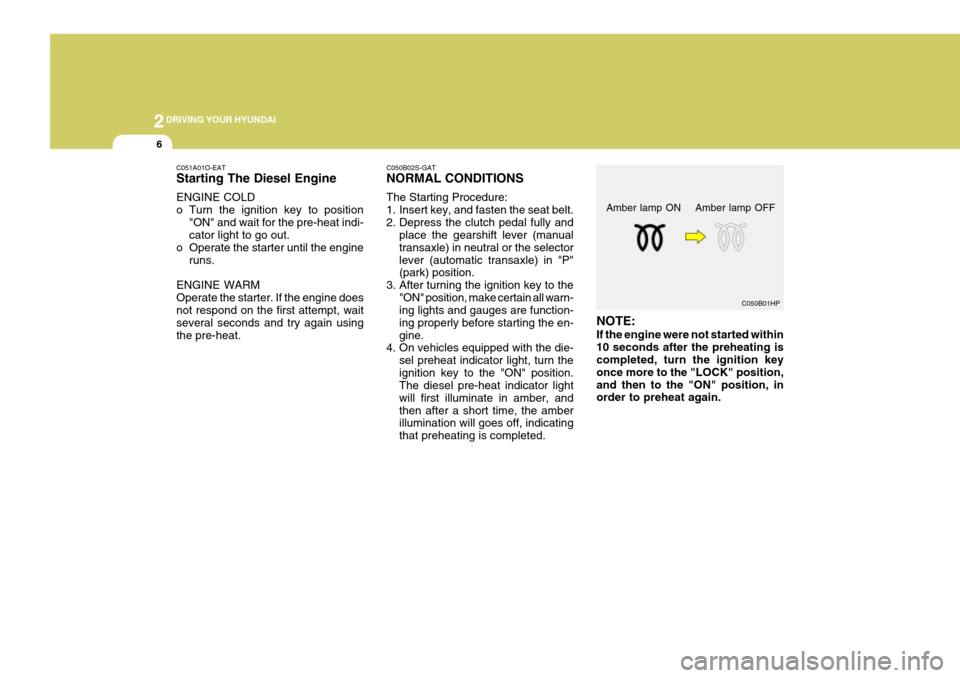
4. On vehicles equipped with the die-
sel preheat indicator light, turn theignition key to the "ON" position. The diesel pre-heat indicator light will first illuminate in amber, andthen after a short time, the amber illumination will goes off, indicating that preheating is completed. C050B01HP
Amber lamp ON Amber lamp OFF
Page 498 of 599
2DRIVING YOUR HYUNDAI
8MANUAL TRANSAXLE
CAUTION:
o Do not attempt to engage reverse gear when the car is in motion.
o To avoid damaging the selector
mechanism, do not use the gear shift lever as a hand rest. Release the lever immediately the shift is completed.
o To avoid premature clutch wear, do not use the clutch pedal as afoot rest, and do not hold thevehicle on a gradient using the clutch.
o Ensure that the engine is not over-revved by upshifting beforethe tachometer needle enters the red zone.
o Do not coast with the shift lever at the neutral position.
o When descending long gradi- ents, make use of the engine brak- ing to assist the footbrake to avoid brake fade or overheating.
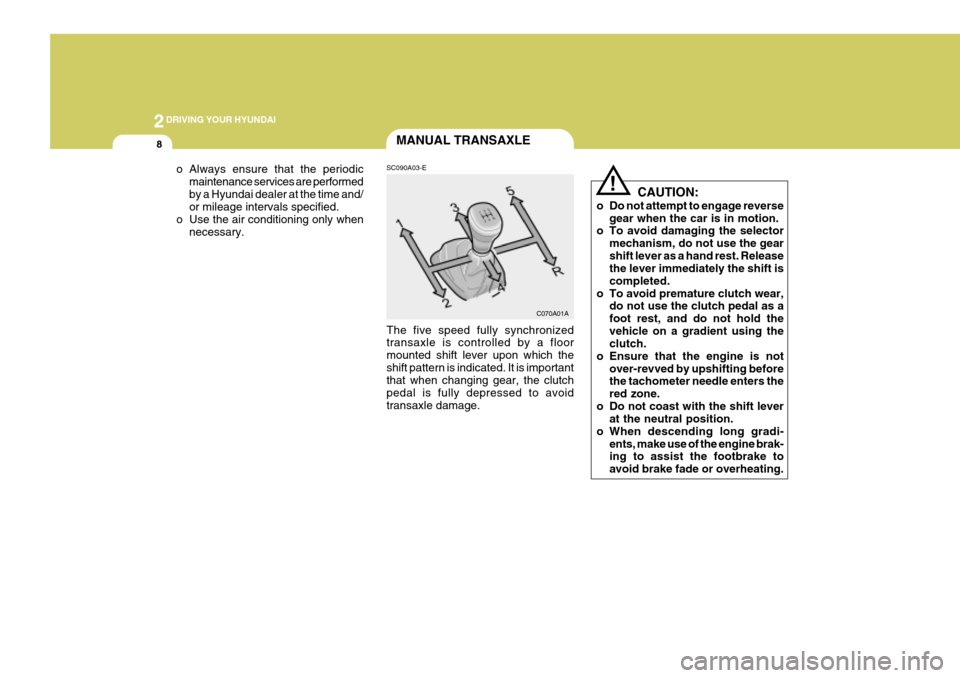
SC090A03-E
The five speed fully synchronized transaxle is controlled by a floor mounted shift lever upon which theshift pattern is indicated. It is important that when changing gear, the clutch pedal is fully depressed to avoidtransaxle damage.
o Always ensure that the periodic
maintenance services are performedby a Hyundai dealer at the time and/ or mileage intervals specified.
o Use the air conditioning only when necessary.
!
C070A01A
Page 513 of 599

2
DRIVING YOUR HYUNDAI
23
11. Avoid jerky starts, sudden accel- eration or sudden stops.
12. Avoid sharp turns and rapid lane changes.
13. Avoid holding the brake pedal down
too long or too frequently. This could cause the brakes to over- heat, resulting in reduced brakingefficiency.
14. When going down a hill, shift into a
lower gear and use the enginebraking effect. When ascending a long grade, downshift the transaxle to a lowergear and reduce speed to reduce chances of engine overloading and/ or overheating.
15. If you have to stop whilst going uphill, do not hold the vehicle inplace by pressing on the accelera-tor. This can cause the automatic transaxle to overheat. Use the park- ing brake or footbrake.
NOTE: When towing check transaxle fluid more frequently. CAUTION:
If overheating should occur when towing, (temperature gauge reads near red zone), taking the following action may reduce or eliminate theproblem.
1. Turn off the air conditioner.
2. Reduce highway speed.
3. Select a lower gear when going uphill.
4. Whilst in stop and go traffic, place the gear selection in park or neu- tral and idle the engine at a higherspeed.
!
Page 518 of 599
3
IN CASE OF EMERGENCY
5IF THE ENGINE OVERHEATS
!
!
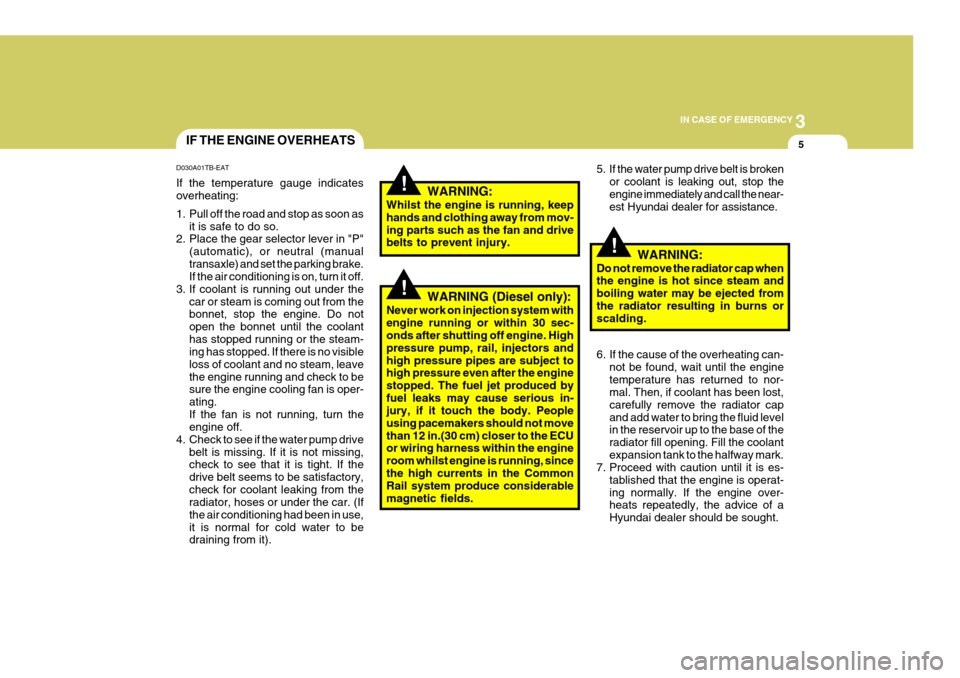
D030A01TB-EAT If the temperature gauge indicates overheating:
1. Pull off the road and stop as soon as
it is safe to do so.
2. Place the gear selector lever in "P"
(automatic), or neutral (manual transaxle) and set the parking brake. If the air conditioning is on, turn it off.
3. If coolant is running out under the car or steam is coming out from thebonnet, stop the engine. Do not open the bonnet until the coolanthas stopped running or the steam- ing has stopped. If there is no visible loss of coolant and no steam, leavethe engine running and check to be sure the engine cooling fan is oper- ating.If the fan is not running, turn the engine off.
4. Check to see if the water pump drive belt is missing. If it is not missing,check to see that it is tight. If the drive belt seems to be satisfactory,check for coolant leaking from the radiator, hoses or under the car. (If the air conditioning had been in use,it is normal for cold water to be draining from it). WARNING:
Whilst the engine is running, keep hands and clothing away from mov-ing parts such as the fan and drive belts to prevent injury.
WARNING (Diesel only):
Never work on injection system with engine running or within 30 sec- onds after shutting off engine. High pressure pump, rail, injectors andhigh pressure pipes are subject to high pressure even after the engine stopped. The fuel jet produced byfuel leaks may cause serious in- jury, if it touch the body. People using pacemakers should not movethan 12 in.(30 cm) closer to the ECU or wiring harness within the engine room whilst engine is running, sincethe high currents in the Common Rail system produce considerable magnetic fields. 5. If the water pump drive belt is broken
or coolant is leaking out, stop theengine immediately and call the near- est Hyundai dealer for assistance.
!WARNING:
Do not remove the radiator cap when the engine is hot since steam and boiling water may be ejected fromthe radiator resulting in burns or scalding.
6. If the cause of the overheating can- not be found, wait until the engine temperature has returned to nor- mal. Then, if coolant has been lost, carefully remove the radiator capand add water to bring the fluid level in the reservoir up to the base of the radiator fill opening. Fill the coolantexpansion tank to the halfway mark.
7. Proceed with caution until it is es-
tablished that the engine is operat-ing normally. If the engine over- heats repeatedly, the advice of a Hyundai dealer should be sought.