vin Hyundai Accent 2008 User Guide
[x] Cancel search | Manufacturer: HYUNDAI, Model Year: 2008, Model line: Accent, Model: Hyundai Accent 2008Pages: 273, PDF Size: 9.36 MB
Page 32 of 273
1FEATURES OF YOUR HYUNDAI20
To fold seatback down and seat
cushion up :1. Slide the front seats forward and place
the seatbacks upright before folding
the rear seatback and cushion.
!
B080G01MC-AATFolding Rear Seatback and Seat
Cushion (3 Door)For greater convenience, the entire
seatback may be folded down and the
seat cushion may be folded up.
WARNING:
The purpose of the fold-down rear seat
back and the fold-up rear seat cushion is
to allow you to carry more objects than
could be accommodated. Do not allow
passengers to sit on the cargo area
while the car is moving. This is not a
proper seating position and no seat belts
are available for use when the seat back
is folded down. This could result in seri-
ous injury or death in case of an accident
or a sudden stop. Objects should not
extend higher than the top of the front
seatbacks. This could allow cargo to
slide forward and cause injury or dam-
age during sudden stops.
!
WARNING:
When you return the rear seatback to its
upright position after being folded down:
Be careful not to damage the seat belt
webbing or buckle. Do not allow the seat
belt webbing or buckle to get caught or
pinched in the rear seat. Ensure that the
seatback is completely locked into its
upright position by pushing on the top of
the seatback. Otherwise, in an accident
or sudden stop, the seat could fold down
and allow cargo to enter the passenger
compartment, which could result in se-
rious injury or death.When you return the seatback to its up-
right position, always be sure it has locked
into position by pushing on the top of the
seatback.
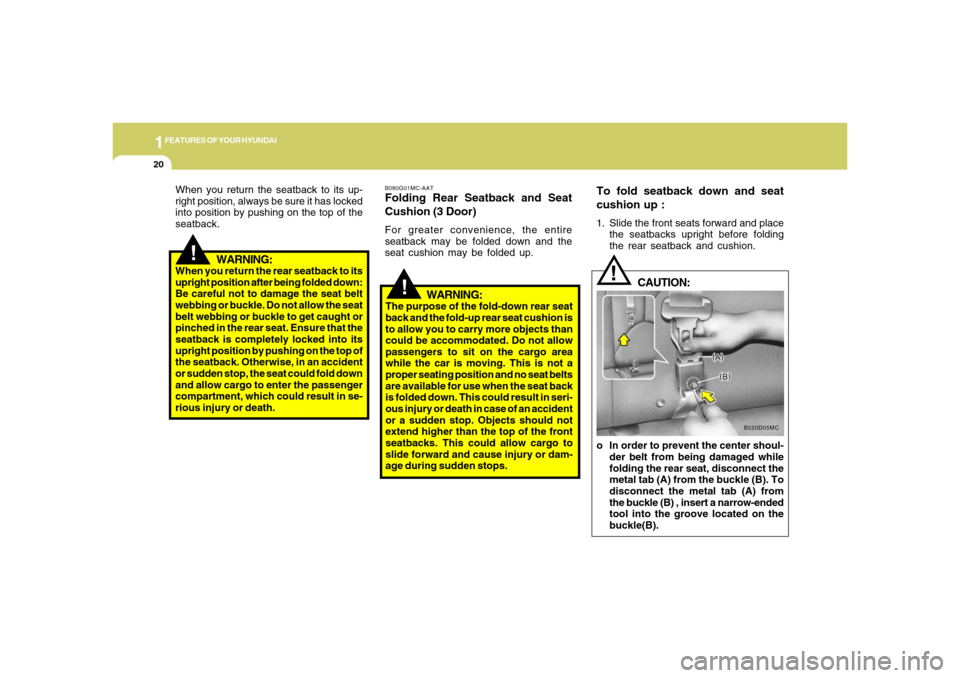
CAUTION:
!
o In order to prevent the center shoul-
der belt from being damaged while
folding the rear seat, disconnect the
metal tab (A) from the buckle (B). To
disconnect the metal tab (A) from
the buckle (B) , insert a narrow-ended
tool into the groove located on the
buckle(B).
B220D05MC
Page 36 of 273
1FEATURES OF YOUR HYUNDAI24
!
B150F01A-AATOne Person Per BeltTwo people (including children) should
never attempt to use a single seat belt.
This could increase the severity of inju-
ries in case of an accident.B150G02A-AATDo Not Lie DownTo reduce the chance of injuries in the
event of an accident and to achieve maxi-
mum effectiveness of the restraint sys-
tem, all passengers should be sitting up
and the front seats should be in an up-
right position when the car is moving. A
seat belt cannot provide proper protec-
tion if the person is lying down in the rear
seat or if the front seat is in a reclined
position.
WARNING:
Riding with a reclined seatback in-
creases your chance of serious or fatal
injuries in the event of a collision or
sudden stop. The protection of your
restraint system (seat belts and airbags)
is greatly reduced by reclining your seat.
Seat belts must be snug against your
hips and chest to work properly. The
more the seatback is reclined, the greater
the chance that an occupant's hips will
slide under the lap belt causing serious
internal injuries or the occupant's neck
could strike the shoulder belt. Drivers
and passengers should always sit well
back in their seats, properly belted (see
page 1-26), and with the seatbacks up-
right.
B150D01A-AATPregnant WomenThe use of a seat belt is recommended for
pregnant women to lessen the chance of
injury in an accident. When a seat belt is
used, the lap belt portion should be
placed as low and snugly as possible on
the hips, not across the abdomen. For
specific recommendations, consult a phy-
sician.B150E01A-AATInjured PersonA seat belt should be used when an
injured person is being transported. When
this is necessary, you should consult a
physician for recommendations.
Page 40 of 273
1FEATURES OF YOUR HYUNDAI28
!
WARNING:
!
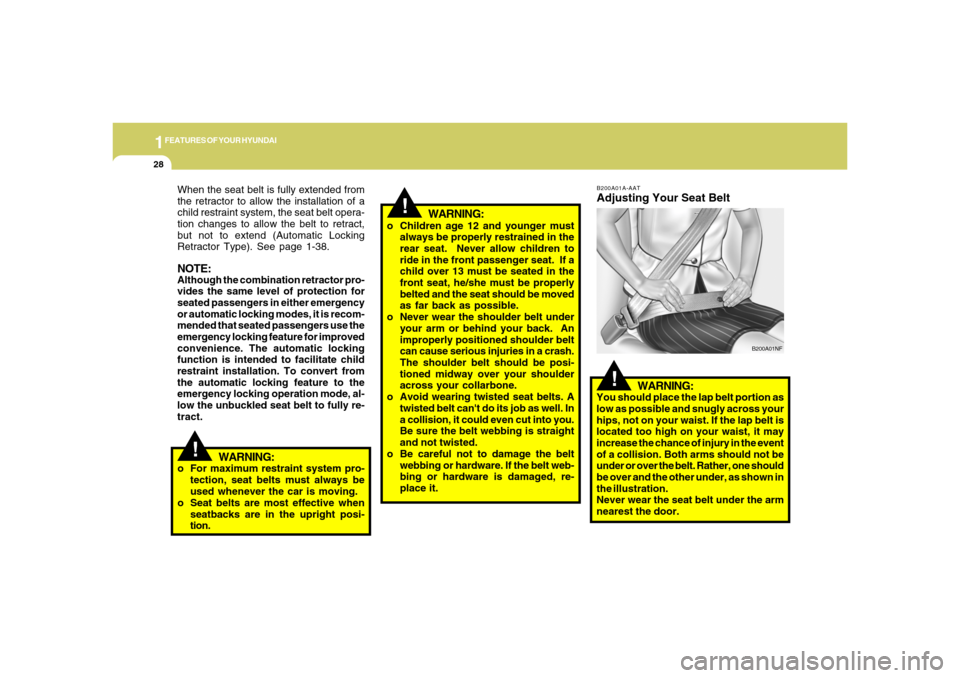
B200A01A-AATAdjusting Your Seat Belt
WARNING:You should place the lap belt portion as
low as possible and snugly across your
hips, not on your waist. If the lap belt is
located too high on your waist, it may
increase the chance of injury in the event
of a collision. Both arms should not be
under or over the belt. Rather, one should
be over and the other under, as shown in
the illustration.
Never wear the seat belt under the arm
nearest the door.
B200A01NF
o Children age 12 and younger must
always be properly restrained in the
rear seat. Never allow children to
ride in the front passenger seat. If a
child over 13 must be seated in the
front seat, he/she must be properly
belted and the seat should be moved
as far back as possible.
o Never wear the shoulder belt under
your arm or behind your back. An
improperly positioned shoulder belt
can cause serious injuries in a crash.
The shoulder belt should be posi-
tioned midway over your shoulder
across your collarbone.
o Avoid wearing twisted seat belts. A
twisted belt can't do its job as well. In
a collision, it could even cut into you.
Be sure the belt webbing is straight
and not twisted.
o Be careful not to damage the belt
webbing or hardware. If the belt web-
bing or hardware is damaged, re-
place it. When the seat belt is fully extended from
the retractor to allow the installation of a
child restraint system, the seat belt opera-
tion changes to allow the belt to retract,
but not to extend (Automatic Locking
Retractor Type). See page 1-38.
NOTE:Although the combination retractor pro-
vides the same level of protection for
seated passengers in either emergency
or automatic locking modes, it is recom-
mended that seated passengers use the
emergency locking feature for improved
convenience. The automatic locking
function is intended to facilitate child
restraint installation. To convert from
the automatic locking feature to the
emergency locking operation mode, al-
low the unbuckled seat belt to fully re-
tract.
!
WARNING:
o For maximum restraint system pro-
tection, seat belts must always be
used whenever the car is moving.
o Seat belts are most effective when
seatbacks are in the upright posi-
tion.
Page 45 of 273
1
FEATURES OF YOUR HYUNDAI
331
FEATURES OF YOUR HYUNDAI
33
!
WARNING:
o Never allow a child to stand-up or
kneel on the seat or floorboard of a
moving vehicle. During a collision or
sudden stop, the child can be vio-
lently thrown against the vehicles
interior, resulting in serious injury.
o Never use an infant carrier or a child
safety seat that "hooks" over a
seatback, it may not provide ad-
equate security in an accident.
o Seat belts can become very hot, es-
pecially when the car is parked in
direct sunlight. Always check seat
belt buckles before fastening them
over a child.
o Always store or secure a child seat,
even when it is not in use. During a
collision or sudden stop, the child
seat could be thrown inside the ve-
hicle.
B230B01E-AATUsing a Child Restraint System with
the "Tether Anchorage" SystemFor small children and babies, the use of
a child seat or infant seat is required. This
child seat or infant seat should be of
appropriate size for the child and should
be installed in accordance with the
manufacturer's instructions. It is further
required that the seat be placed in the
vehicle's rear seat since this can make an
important contribution to safety. Your ve-
hicle is provided with three child restraint
hook holders for installing the child seat
or infant seat.
B230C02MC-AATInstalling a Child Restraint Seat with
the "Tether Anchorage" System
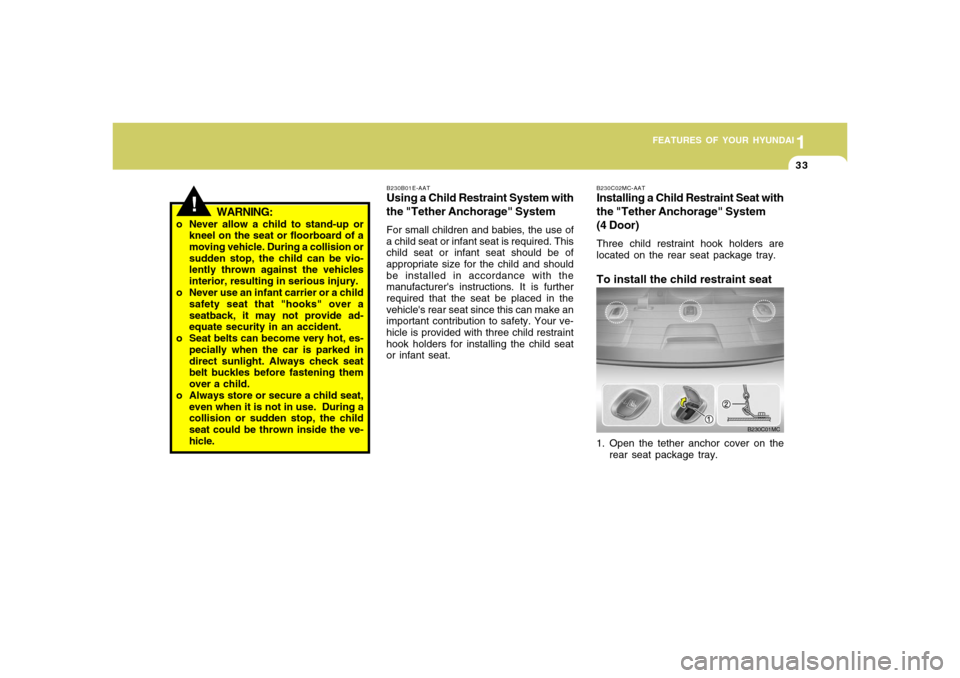
(4 Door)Three child restraint hook holders are
located on the rear seat package tray.To install the child restraint seat
B230C01MC
1. Open the tether anchor cover on the
rear seat package tray.
Page 52 of 273
1FEATURES OF YOUR HYUNDAI40
!
!
WARNING:
o Pre-tensioners are designed to op-
erate only one time. After activation,
pre-tensioner seat belts must be
replaced. All seat belts, of any type,
should always be replaced after they
have been worn during a collision.
o The pre-tensioner seat belt assem-
bly mechanisms become hot during
activation. Do not touch the pre-
tensioner seat belt assemblies for
several minutes after they have been
activated.o Do not attempt to inspect or replace
the pre-tensioner seat belts your-
self. This must be done by an autho-
rized Hyundai dealer.
o Do not strike the pre-tensioner seat
belt assemblies.
o Do not attempt to service or repair
the pre-tensioner seat belt system in
any manner.
o Improper handling of the pre-
tensioner seat belt assemblies, and
failure to heed the warnings to not
strike, modify, inspect, replace, ser-
vice or repair the pre-tensioner seat
belt assemblies may lead to improp-
er operation or inadvertent activa-
tion and serious injury.
o Always wear the seat belts when
driving or riding in a motor vehicle.
WARNING:
CAUTION:
o The sensor that activates the SRS
airbag is connected with the pre-
tensioner seat belt. The SRS airbag
warning light on the instrument
panel will illuminate for approximately
6 seconds after the ignition key has
been turned to the "ON" position,
and then it should turn off.
o If the pre-tensioner seat belt is not
working properly, this warning light
will illuminate even if there is no mal-
function of the SRS airbag.
!
o When the pre-tensioner seat belts
are activated, a loud noise may be
heard and fine dust, which may ap-
pear to be smoke, may be visible in
the passenger compartment. These
are normal operating conditions and
are not hazardous.
o Although it is harmless, the fine dust
may cause skin irritation and should
not be breathed for prolonged peri-
ods. Wash your hands and face thor-
oughly after an accident in which the
pre-tensioner seat belts were acti-
vated.If the SRS airbag warning light does
not illuminate when the ignition key
is turned to the "ON" position, re-
mains illuminated after approxi-
mately 6 seconds when the ignition
key is turned to the "ON" position, or
if it illuminates while the vehicle is
being driven, have an authorized
Hyundai dealer inspect the advanced
SRS airbag system as soon as pos-
sible.
Page 60 of 273
1FEATURES OF YOUR HYUNDAI48
!
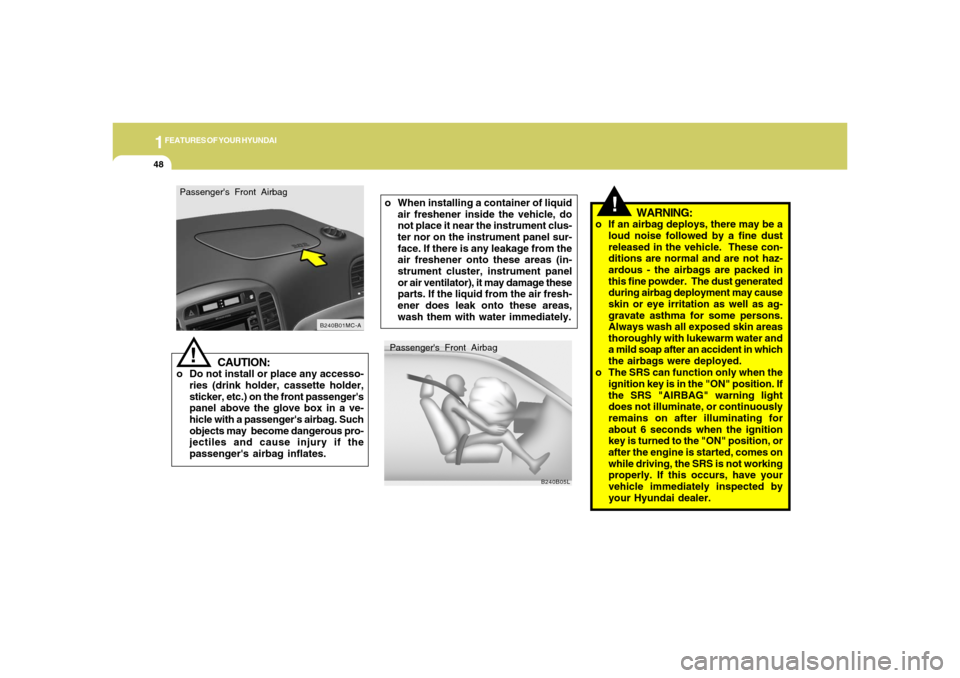
Passenger's Front Airbag
B240B05L
o When installing a container of liquid
air freshener inside the vehicle, do
not place it near the instrument clus-
ter nor on the instrument panel sur-
face. If there is any leakage from the
air freshener onto these areas (in-
strument cluster, instrument panel
or air ventilator), it may damage these
parts. If the liquid from the air fresh-
ener does leak onto these areas,
wash them with water immediately.
WARNING:
o If an airbag deploys, there may be a
loud noise followed by a fine dust
released in the vehicle. These con-
ditions are normal and are not haz-
ardous - the airbags are packed in
this fine powder. The dust generated
during airbag deployment may cause
skin or eye irritation as well as ag-
gravate asthma for some persons.
Always wash all exposed skin areas
thoroughly with lukewarm water and
a mild soap after an accident in which
the airbags were deployed.
o The SRS can function only when the
ignition key is in the "ON" position. If
the SRS "AIRBAG" warning light
does not illuminate, or continuously
remains on after illuminating for
about 6 seconds when the ignition
key is turned to the "ON" position, or
after the engine is started, comes on
while driving, the SRS is not working
properly. If this occurs, have your
vehicle immediately inspected by
your Hyundai dealer.
Passenger's Front Airbag
CAUTION:
o Do not install or place any accesso-
ries (drink holder, cassette holder,
sticker, etc.) on the front passenger's
panel above the glove box in a ve-
hicle with a passenger's airbag. Such
objects may become dangerous pro-
jectiles and cause injury if the
passenger's airbag inflates.
!
B240B01MC-A
Page 69 of 273
1
FEATURES OF YOUR HYUNDAI
571
FEATURES OF YOUR HYUNDAI
57
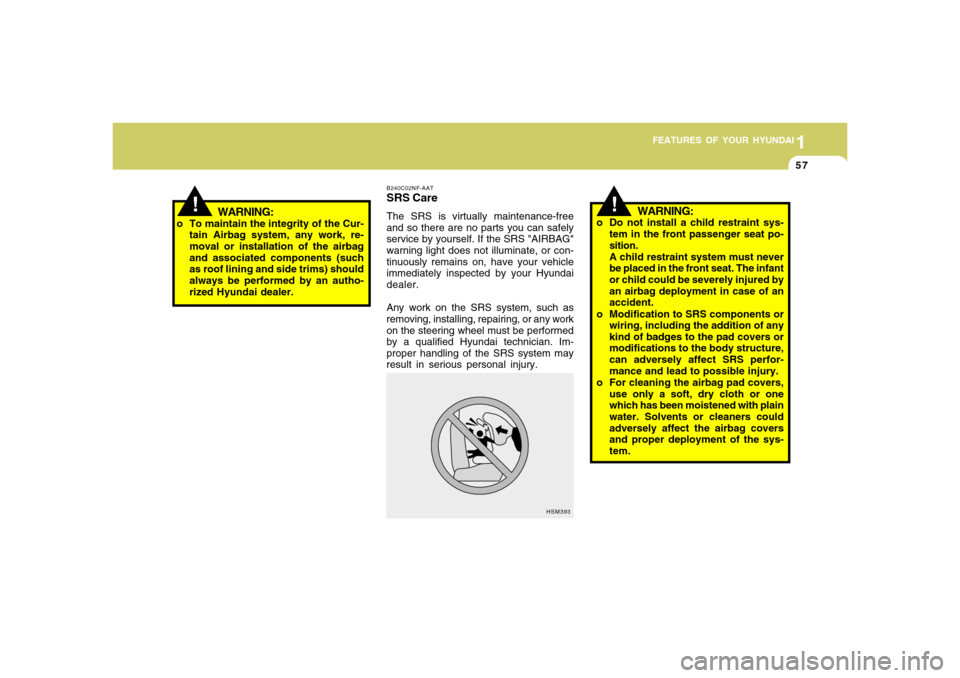
B240C02NF-AATSRS CareThe SRS is virtually maintenance-free
and so there are no parts you can safely
service by yourself. If the SRS "AIRBAG"
warning light does not illuminate, or con-
tinuously remains on, have your vehicle
immediately inspected by your Hyundai
dealer.
Any work on the SRS system, such as
removing, installing, repairing, or any work
on the steering wheel must be performed
by a qualified Hyundai technician. Im-
proper handling of the SRS system may
result in serious personal injury.
HSM393
!
WARNING:
o To maintain the integrity of the Cur-
tain Airbag system, any work, re-
moval or installation of the airbag
and associated components (such
as roof lining and side trims) should
always be performed by an autho-
rized Hyundai dealer.
WARNING:
o Do not install a child restraint sys-
tem in the front passenger seat po-
sition.
A child restraint system must never
be placed in the front seat. The infant
or child could be severely injured by
an airbag deployment in case of an
accident.
o Modification to SRS components or
wiring, including the addition of any
kind of badges to the pad covers or
modifications to the body structure,
can adversely affect SRS perfor-
mance and lead to possible injury.
o For cleaning the airbag pad covers,
use only a soft, dry cloth or one
which has been moistened with plain
water. Solvents or cleaners could
adversely affect the airbag covers
and proper deployment of the sys-
tem.
!
Page 70 of 273
1FEATURES OF YOUR HYUNDAI58
B240D02NF-AATAdditional Safety PrecautionsoNever let passengers ride in the
cargo area (trunk) or on top of a
folded-down back seat. All occupants
should sit upright, fully back in their
seats with their seat belts on and their
feet on the floor.
oPassengers should not move out of
or change seats while the vehicle is
moving. A passenger who is not wear-
ing a seat belt during a crash or emer-
gency stop can be thrown against the
inside of the vehicle, against other
occupants, or out of the vehicle.
oEach seat belt is designed to re-
strain one occupant. If more than one
person uses the same seat belt, they
could be seriously injured or killed in
a collision.
oDo not use any accessories on seat
belts. Devices claiming to improve oc-
cupant comfort or reposition the seat
belt can reduce the protection pro-
vided by the seat belt and increase the
chance of serious injury in a crash.
!
WARNING:
o No objects should be placed over or
near the airbag modules on the steer-
ing wheel, instrument panel, and the
front passenger's panel above the
glove box, because any such object
could cause harm if the vehicle is in
a crash severe enough to cause the
airbags to inflate.
o If the airbags inflate, they must be
replaced by an authorized Hyundai
dealer.
o Do not tamper with or disconnect
SRS wiring, or other components of
the SRS system. Doing so could re-
sult in injury, due to accidental infla-
tion of the airbags or by rendering
the SRS inoperative.
o If components of the airbag system
must be discarded, or if the vehicle
must be scrapped, certain safety
precautions must be observed. Your
Hyundai dealer knows these precau-
tions and can give you the neces-
sary information. Failure to follow
these precautions and procedures
could increase the risk of personal
injury.
!
WARNING:
o If your car was flooded and has
soaked carpeting or water on floor-
ing, you shouldn't try to start the
engine; have the car towed to an
authorized Hyundai dealer.
Page 76 of 273
1FEATURES OF YOUR HYUNDAI64
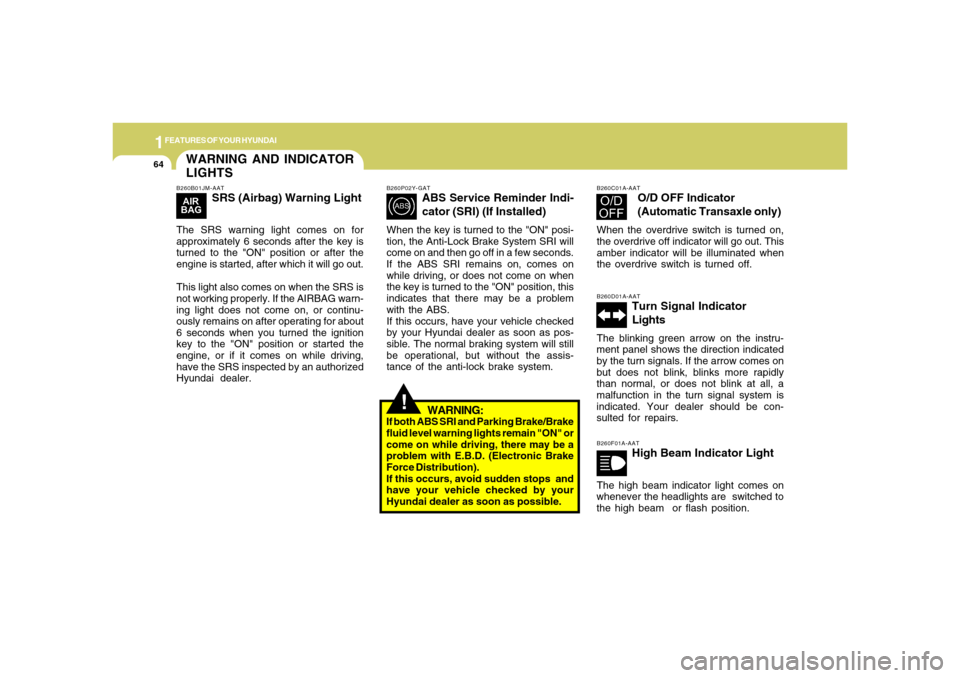
WARNING AND INDICATOR
LIGHTS
!
B260P02Y-GAT
ABS Service Reminder Indi-
cator (SRI) (If Installed)
When the key is turned to the "ON" posi-
tion, the Anti-Lock Brake System SRI will
come on and then go off in a few seconds.
If the ABS SRI remains on, comes on
while driving, or does not come on when
the key is turned to the "ON" position, this
indicates that there may be a problem
with the ABS.
If this occurs, have your vehicle checked
by your Hyundai dealer as soon as pos-
sible. The normal braking system will still
be operational, but without the assis-
tance of the anti-lock brake system.
WARNING:
If both ABS SRI and Parking Brake/Brake
fluid level warning lights remain "ON" or
come on while driving, there may be a
problem with E.B.D. (Electronic Brake
Force Distribution).
If this occurs, avoid sudden stops and
have your vehicle checked by your
Hyundai dealer as soon as possible.
B260C01A-AAT
O/D OFF Indicator
(Automatic Transaxle only)
When the overdrive switch is turned on,
the overdrive off indicator will go out. This
amber indicator will be illuminated when
the overdrive switch is turned off.B260D01A-AAT
Turn Signal Indicator
Lights
The blinking green arrow on the instru-
ment panel shows the direction indicated
by the turn signals. If the arrow comes on
but does not blink, blinks more rapidly
than normal, or does not blink at all, a
malfunction in the turn signal system is
indicated. Your dealer should be con-
sulted for repairs.B260F01A-AAT
High Beam Indicator Light
The high beam indicator light comes on
whenever the headlights are switched to
the high beam or flash position.
B260B01JM-AAT
SRS (Airbag) Warning Light
The SRS warning light comes on for
approximately 6 seconds after the key is
turned to the "ON" position or after the
engine is started, after which it will go out.
This light also comes on when the SRS is
not working properly. If the AIRBAG warn-
ing light does not come on, or continu-
ously remains on after operating for about
6 seconds when you turned the ignition
key to the "ON" position or started the
engine, or if it comes on while driving,
have the SRS inspected by an authorized
Hyundai dealer.
Page 77 of 273
1
FEATURES OF YOUR HYUNDAI
651
FEATURES OF YOUR HYUNDAI
65
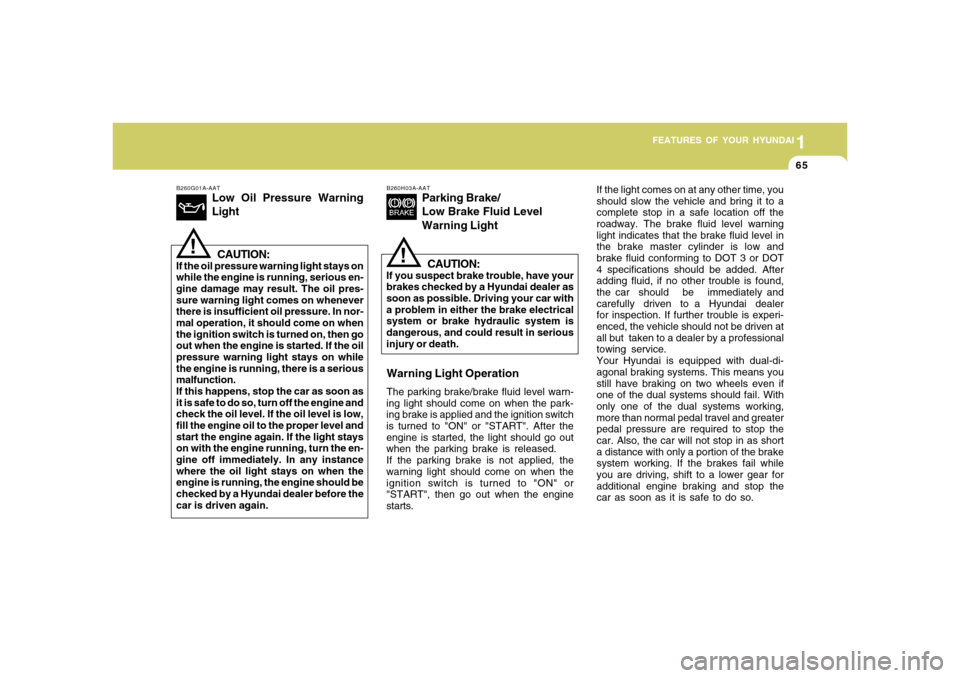
B260G01A-AAT
Low Oil Pressure Warning
LightCAUTION:
If the oil pressure warning light stays on
while the engine is running, serious en-
gine damage may result. The oil pres-
sure warning light comes on whenever
there is insufficient oil pressure. In nor-
mal operation, it should come on when
the ignition switch is turned on, then go
out when the engine is started. If the oil
pressure warning light stays on while
the engine is running, there is a serious
malfunction.
If this happens, stop the car as soon as
it is safe to do so, turn off the engine and
check the oil level. If the oil level is low,
fill the engine oil to the proper level and
start the engine again. If the light stays
on with the engine running, turn the en-
gine off immediately. In any instance
where the oil light stays on when the
engine is running, the engine should be
checked by a Hyundai dealer before the
car is driven again.
!
B260H03A-AAT
Parking Brake/
Low Brake Fluid Level
Warning Light
CAUTION:
If you suspect brake trouble, have your
brakes checked by a Hyundai dealer as
soon as possible. Driving your car with
a problem in either the brake electrical
system or brake hydraulic system is
dangerous, and could result in serious
injury or death.Warning Light OperationThe parking brake/brake fluid level warn-
ing light should come on when the park-
ing brake is applied and the ignition switch
is turned to "ON" or "START". After the
engine is started, the light should go out
when the parking brake is released.
If the parking brake is not applied, the
warning light should come on when the
ignition switch is turned to "ON" or
"START", then go out when the engine
starts.
!
If the light comes on at any other time, you
should slow the vehicle and bring it to a
complete stop in a safe location off the
roadway. The brake fluid level warning
light indicates that the brake fluid level in
the brake master cylinder is low and
brake fluid conforming to DOT 3 or DOT
4 specifications should be added. After
adding fluid, if no other trouble is found,
the car should be immediately and
carefully driven to a Hyundai dealer
for inspection. If further trouble is experi-
enced, the vehicle should not be driven at
all but taken to a dealer by a professional
towing service.
Your Hyundai is equipped with dual-di-
agonal braking systems. This means you
still have braking on two wheels even if
one of the dual systems should fail. With
only one of the dual systems working,
more than normal pedal travel and greater
pedal pressure are required to stop the
car. Also, the car will not stop in as short
a distance with only a portion of the brake
system working. If the brakes fail while
you are driving, shift to a lower gear for
additional engine braking and stop the
car as soon as it is safe to do so.