vin Hyundai Accent 2008 Owner's Manual
[x] Cancel search | Manufacturer: HYUNDAI, Model Year: 2008, Model line: Accent, Model: Hyundai Accent 2008Pages: 273, PDF Size: 9.36 MB
Page 2 of 273
A020A01A-AAT
RESPONSIBILITY FOR MAINTENANCE
The maintenance requirements for your new Hyundai are found in Section 5. As the owner, it is your
responsibility to see that all maintenance operations specified by the manufacturer are carried out
at the appropriate intervals. When the vehicle is used in severe driving conditions, more frequent
maintenance is required for some operations. Maintenance requirements for severe operating
conditions are also included in Section 5.A010A03A-AAT
WARRANTIES FOR YOUR HYUNDAI VEHICLE
Please consult your Owner's Handbook & Warranty Information booklet for your vehicle's
specific warranty coverage.
Page 6 of 273
F4
A110A01A-AAT
VEHICLE DATA COLLECTION AND EVENT DATA RECORDERS
Your Hyundai vehicle is equipped with many high technology, electronically controlled systems
that help to ensure your vehicle operates properly and provides the performance that you
expect. These systems utilize computers to monitor the operation of various systems and
components and help to control their operation. These computerized system operations are
wide-ranging and involve components to reduce emissions, to continuously evaluate the
readiness of the airbag and seat belt pretensioner systems, to determine when the airbag and
seat belt pre-tensioner systems should be deployed and then to activate the deployment, and
if equipped, to operate anti-lock braking, traction control and electrical stability control to assist
the driver to control the vehicle in difficult driving situations. These systems electronically store
information that is useful to service technicians when they need to diagnose and repair these
systems. Additional information is stored only when a crash occurs that results in the
deployment of the airbags or seat belt pre-tensioners. This type of data storage is done by
devices called event data recorders(EDR).
After a crash event, the airbag and seat belt pre-tensioner computer system, known as the
Supplemental Restraint System Control Module (SRSCM) or Airbag Control Unit (ACU), may
record some information about the condition of the vehicle and how it was being operated. This
information consists of data related to seat belt usage and if there was diagnostic information
in the airbag or seat belt systems at the time that a crash occurred, and if the ACU sensed that
a crash of sufficient severity occurred to require seat belt pre-tensioner or airbag deployment.
To retrieve this information, special equipment is needed and access to the vehicle or the device
that stores the data is required. Hyundai will not access information about a crash event or share
it with others except:
o in response to an official request of police or similar government office, or
o with the consent of the vehicle owner or, if the vehicle is leased, with the consent of the lessee,
or
o as part of Hyundai’s defense of litigation, or
o as required by law.
Page 9 of 273
F7
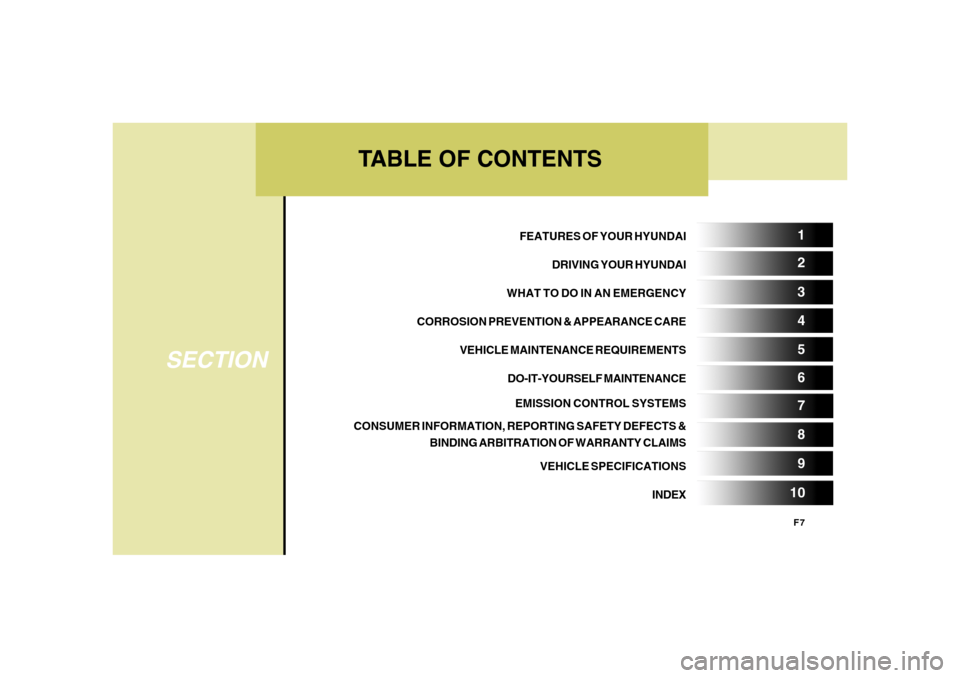
TABLE OF CONTENTS
SECTION
5 1
2
3
4
6
7
8
9
10
FEATURES OF YOUR HYUNDAI
DRIVING YOUR HYUNDAI
WHAT TO DO IN AN EMERGENCY
CORROSION PREVENTION & APPEARANCE CARE
VEHICLE MAINTENANCE REQUIREMENTS
DO-IT-YOURSELF MAINTENANCE
EMISSION CONTROL SYSTEMS
CONSUMER INFORMATION, REPORTING SAFETY DEFECTS &
BINDING ARBITRATION OF WARRANTY CLAIMS
VEHICLE SPECIFICATIONS
INDEX
Page 15 of 273
1
FEATURES OF YOUR HYUNDAI
31
FEATURES OF YOUR HYUNDAI
3
BREAKING IN YOUR NEW
HYUNDAI
B010F01A-AATOperation in Foreign CountriesIf you are going to drive your Hyundai in
another country, be sure to:
o Observe all regulations regarding reg-
istration and insurance.
o Determine that acceptable fuel is avail-
able.B010E01A-AATGasolines for Cleaner AirTo help contribute to cleaner air, Hyundai
recommends that you use gasolines
treated with detergent additives, which
help prevent deposit formation in the
engine. These gasolines will help the
engine run cleaner and enhance perfor-
mance of the Emission Control System.
B020A01S-AATDuring the First 1200 Miles (2000
Km)No formal "break-in" procedure is required
with your new Hyundai. However, you
can contribute to the economical opera-
tion and durability of your Hyundai by
observing the following recommenda-
tions during the first 1200 miles (2000
km).
o Don't drive faster than 55 MPH (88 km/
h).
o While driving, keep your engine speed
(rpm, or revolutions per minute) be-
tween 2,000 rpm and 4,000 rpm.
o Use moderate acceleration. Don't start
quickly or depress the accelerator
pedal fully.
o For the first 200 miles (300 km), try to
avoid hard stops.
o Don't lug the engine (in other words,
don't drive so slowly in too high a gear
that the engine "bucks"-shift to a lower
gear).o Whether going fast or slow, vary your
speed from time to time.
o Don't let the engine idle longer than 3
minutes at one time.
o Don't tow a trailer during the first 1,200
miles (2,000 km) of operation.
Page 17 of 273
1
FEATURES OF YOUR HYUNDAI
51
FEATURES OF YOUR HYUNDAI
5
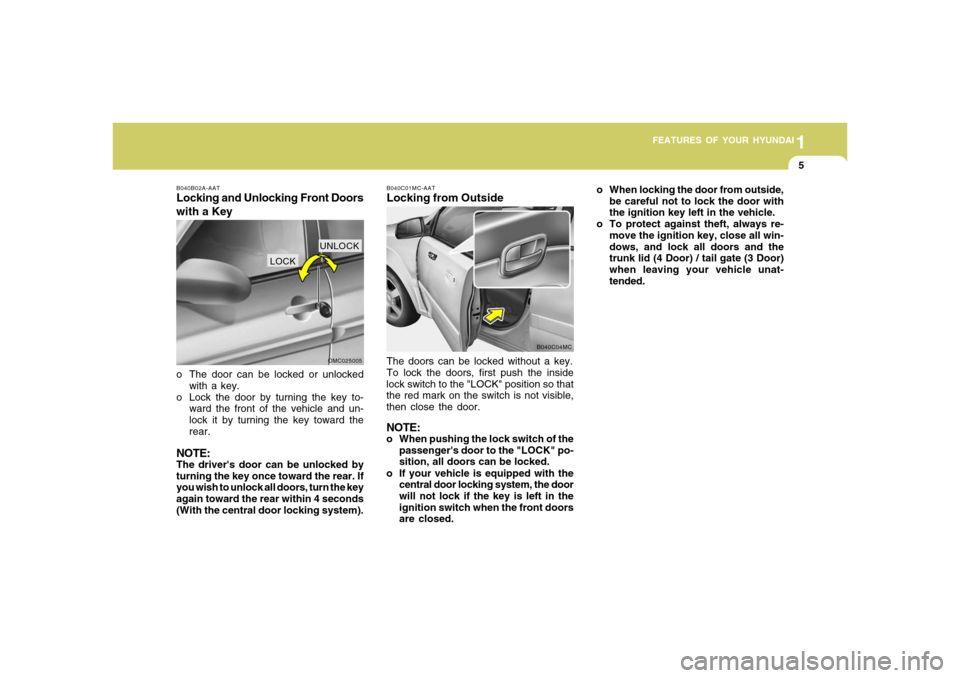
B040B02A-AATLocking and Unlocking Front Doors
with a Keyo The door can be locked or unlocked
with a key.
o Lock the door by turning the key to-
ward the front of the vehicle and un-
lock it by turning the key toward the
rear.NOTE:The driver's door can be unlocked by
turning the key once toward the rear. If
you wish to unlock all doors, turn the key
again toward the rear within 4 seconds
(With the central door locking system).
OMC025005UNLOCK
LOCK
The doors can be locked without a key.
To lock the doors, first push the inside
lock switch to the "LOCK" position so that
the red mark on the switch is not visible,
then close the door.NOTE:o When pushing the lock switch of the
passenger's door to the "LOCK" po-
sition, all doors can be locked.
o If your vehicle is equipped with the
central door locking system, the door
will not lock if the key is left in the
ignition switch when the front doors
are closed.B040C01MC-AATLocking from Outside
B040C04MC
o When locking the door from outside,
be careful not to lock the door with
the ignition key left in the vehicle.
o To protect against theft, always re-
move the ignition key, close all win-
dows, and lock all doors and the
trunk lid (4 Door) / tail gate (3 Door)
when leaving your vehicle unat-
tended.
Page 18 of 273
1FEATURES OF YOUR HYUNDAI6
!
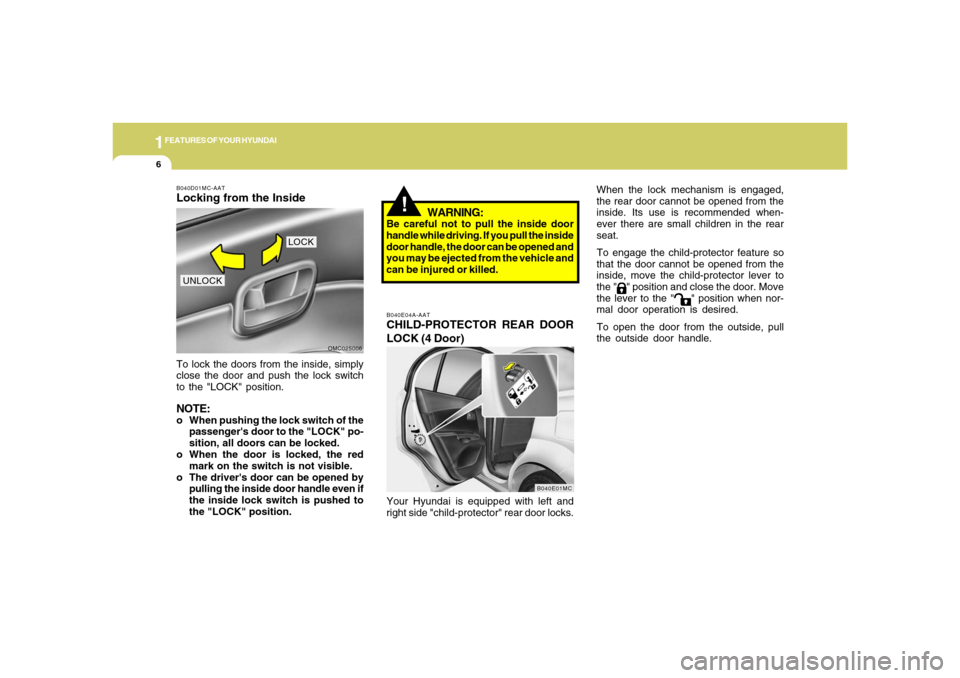
B040D01MC-AATLocking from the InsideTo lock the doors from the inside, simply
close the door and push the lock switch
to the "LOCK" position.NOTE:o When pushing the lock switch of the
passenger's door to the "LOCK" po-
sition, all doors can be locked.
o When the door is locked, the red
mark on the switch is not visible.
o The driver's door can be opened by
pulling the inside door handle even if
the inside lock switch is pushed to
the "LOCK" position.
B040E04A-AATCHILD-PROTECTOR REAR DOOR
LOCK (4 Door)Your Hyundai is equipped with left and
right side "child-protector" rear door locks.
OMC025006
UNLOCK
LOCK
B040E01MC
WARNING:
Be careful not to pull the inside door
handle while driving. If you pull the inside
door handle, the door can be opened and
you may be ejected from the vehicle and
can be injured or killed.When the lock mechanism is engaged,
the rear door cannot be opened from the
inside. Its use is recommended when-
ever there are small children in the rear
seat.
To engage the child-protector feature so
that the door cannot be opened from the
inside, move the child-protector lever to
the "
" position and close the door. Move
the lever to the "
" position when nor-
mal door operation is desired.
To open the door from the outside, pull
the outside door handle.
Page 19 of 273
1
FEATURES OF YOUR HYUNDAI
71
FEATURES OF YOUR HYUNDAI
7
!
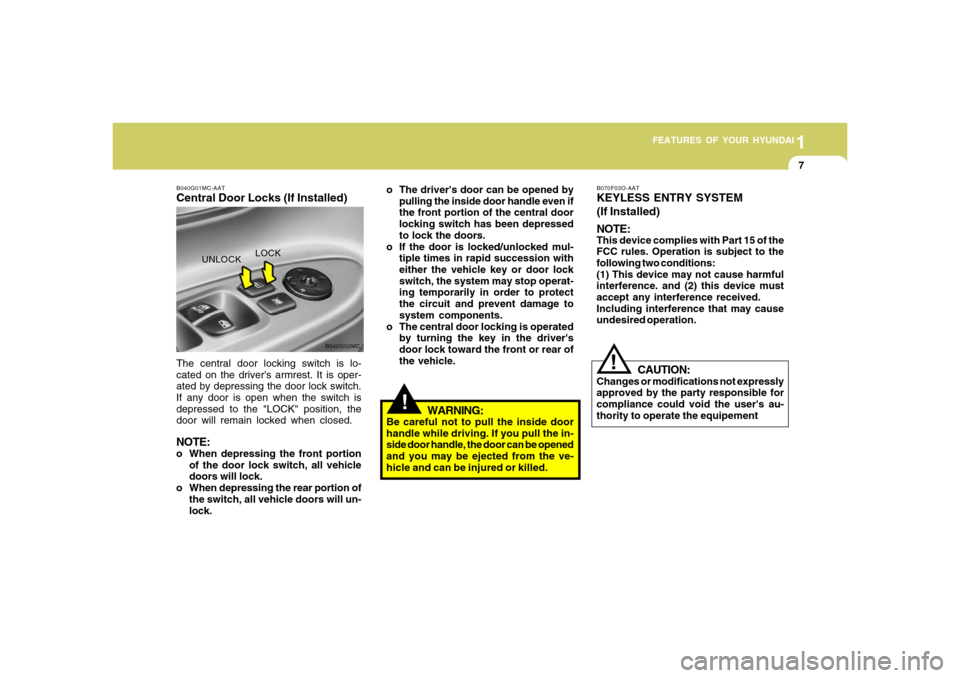
B040G01MC-AATCentral Door Locks (If Installed)The central door locking switch is lo-
cated on the driver's armrest. It is oper-
ated by depressing the door lock switch.
If any door is open when the switch is
depressed to the "LOCK" position, the
door will remain locked when closed.NOTE:o When depressing the front portion
of the door lock switch, all vehicle
doors will lock.
o When depressing the rear portion of
the switch, all vehicle doors will un-
lock.
B040G02MC
o The driver's door can be opened by
pulling the inside door handle even if
the front portion of the central door
locking switch has been depressed
to lock the doors.
o If the door is locked/unlocked mul-
tiple times in rapid succession with
either the vehicle key or door lock
switch, the system may stop operat-
ing temporarily in order to protect
the circuit and prevent damage to
system components.
o The central door locking is operated
by turning the key in the driver's
door lock toward the front or rear of
the vehicle.
WARNING:
Be careful not to pull the inside door
handle while driving. If you pull the in-
side door handle, the door can be opened
and you may be ejected from the ve-
hicle and can be injured or killed.
!
B070F03O-AATKEYLESS ENTRY SYSTEM
(If Installed)
NOTE:This device complies with Part 15 of the
FCC rules. Operation is subject to the
following two conditions:
(1) This device may not cause harmful
interference. and (2) this device must
accept any interference received.
Including interference that may cause
undesired operation.
CAUTION:
Changes or modifications not expressly
approved by the party responsible for
compliance could void the user's au-
thority to operate the equipement
UNLOCKLOCK
Page 26 of 273
1FEATURES OF YOUR HYUNDAI14
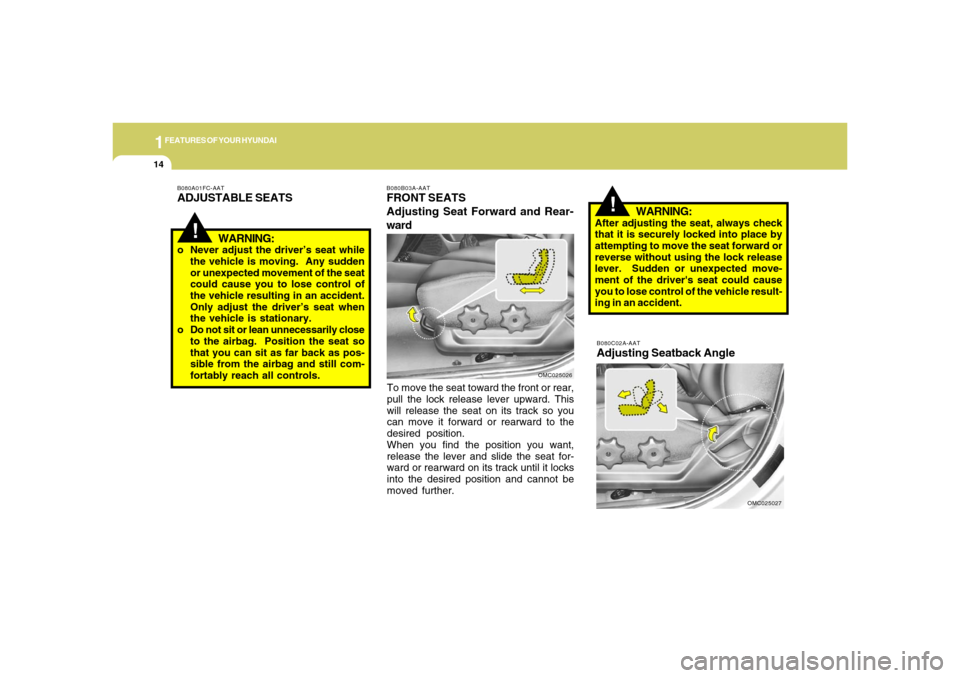
B080C02A-AATAdjusting Seatback Angle
OMC025027
To move the seat toward the front or rear,
pull the lock release lever upward. This
will release the seat on its track so you
can move it forward or rearward to the
desired position.
When you find the position you want,
release the lever and slide the seat for-
ward or rearward on its track until it locks
into the desired position and cannot be
moved further.
OMC025026
!
WARNING:
After adjusting the seat, always check
that it is securely locked into place by
attempting to move the seat forward or
reverse without using the lock release
lever. Sudden or unexpected move-
ment of the driver's seat could cause
you to lose control of the vehicle result-
ing in an accident.
B080B03A-AATFRONT SEATS
Adjusting Seat Forward and Rear-
ward
!
WARNING:
o Never adjust the driver’s seat while
the vehicle is moving. Any sudden
or unexpected movement of the seat
could cause you to lose control of
the vehicle resulting in an accident.
Only adjust the driver’s seat when
the vehicle is stationary.
o Do not sit or lean unnecessarily close
to the airbag. Position the seat so
that you can sit as far back as pos-
sible from the airbag and still com-
fortably reach all controls.B080A01FC-AATADJUSTABLE SEATS
Page 29 of 273
1
FEATURES OF YOUR HYUNDAI
171
FEATURES OF YOUR HYUNDAI
17
!
WARNING:
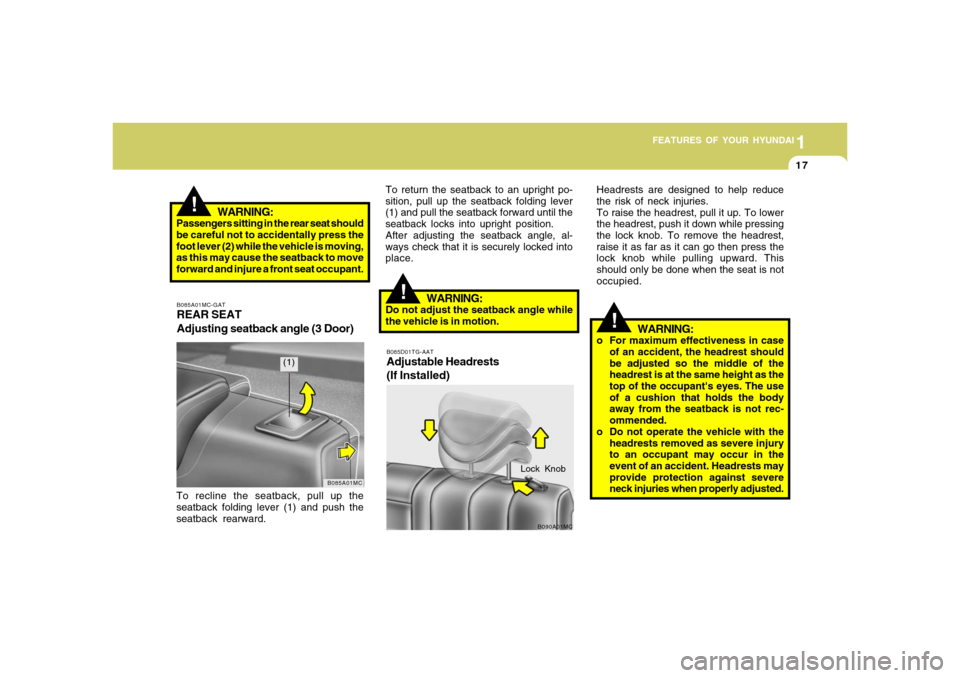
Passengers sitting in the rear seat should
be careful not to accidentally press the
foot lever (2) while the vehicle is moving,
as this may cause the seatback to move
forward and injure a front seat occupant.B085A01MC-GATREAR SEAT
Adjusting seatback angle (3 Door)To recline the seatback, pull up the
seatback folding lever (1) and push the
seatback rearward.
B085A01MC
(1)
To return the seatback to an upright po-
sition, pull up the seatback folding lever
(1) and pull the seatback forward until the
seatback locks into upright position.
After adjusting the seatback angle, al-
ways check that it is securely locked into
place.
!
WARNING:
Do not adjust the seatback angle while
the vehicle is in motion.
Lock Knob
B085D01TG-AATAdjustable Headrests
(If Installed)
B090A01MC
Headrests are designed to help reduce
the risk of neck injuries.
To raise the headrest, pull it up. To lower
the headrest, push it down while pressing
the lock knob. To remove the headrest,
raise it as far as it can go then press the
lock knob while pulling upward. This
should only be done when the seat is not
occupied.
!
WARNING:
o For maximum effectiveness in case
of an accident, the headrest should
be adjusted so the middle of the
headrest is at the same height as the
top of the occupant's eyes. The use
of a cushion that holds the body
away from the seatback is not rec-
ommended.
o Do not operate the vehicle with the
headrests removed as severe injury
to an occupant may occur in the
event of an accident. Headrests may
provide protection against severe
neck injuries when properly adjusted.
Page 30 of 273
1FEATURES OF YOUR HYUNDAI18
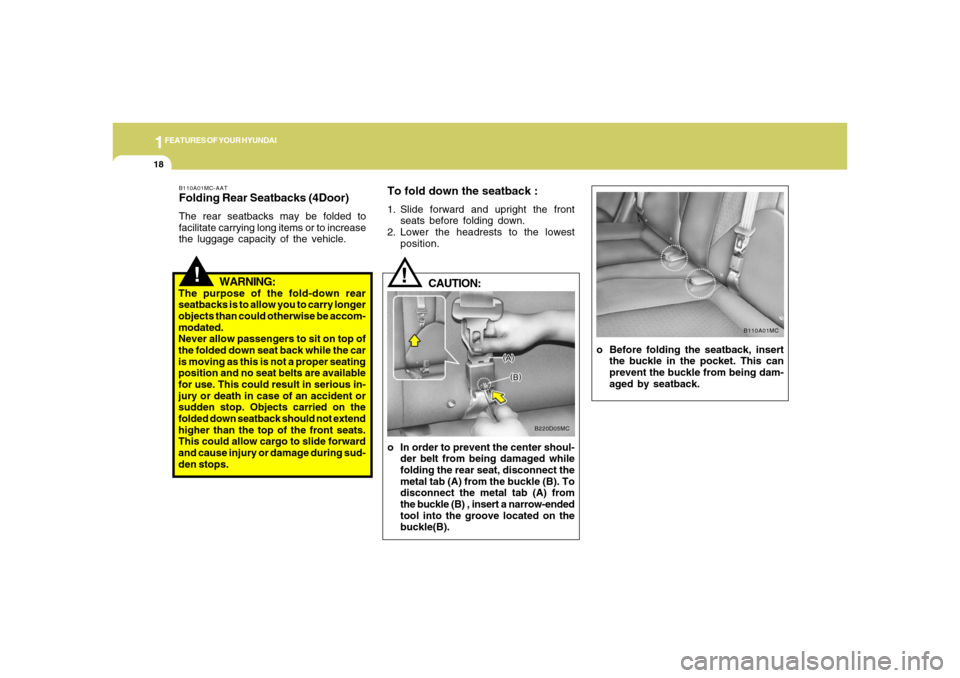
o Before folding the seatback, insert
the buckle in the pocket. This can
prevent the buckle from being dam-
aged by seatback.
B110A01MC
!
B110A01MC-AATFolding Rear Seatbacks (4Door)The rear seatbacks may be folded to
facilitate carrying long items or to increase
the luggage capacity of the vehicle.
WARNING:
The purpose of the fold-down rear
seatbacks is to allow you to carry longer
objects than could otherwise be accom-
modated.
Never allow passengers to sit on top of
the folded down seat back while the car
is moving as this is not a proper seating
position and no seat belts are available
for use. This could result in serious in-
jury or death in case of an accident or
sudden stop. Objects carried on the
folded down seatback should not extend
higher than the top of the front seats.
This could allow cargo to slide forward
and cause injury or damage during sud-
den stops.
To fold down the seatback :1. Slide forward and upright the front
seats before folding down.
2. Lower the headrests to the lowest
position.
B220D05MC
o In order to prevent the center shoul-
der belt from being damaged while
folding the rear seat, disconnect the
metal tab (A) from the buckle (B). To
disconnect the metal tab (A) from
the buckle (B) , insert a narrow-ended
tool into the groove located on the
buckle(B).
!
CAUTION: