height Hyundai Accent 2008 Owner's Manual
[x] Cancel search | Manufacturer: HYUNDAI, Model Year: 2008, Model line: Accent, Model: Hyundai Accent 2008Pages: 273, PDF Size: 9.36 MB
Page 25 of 273
1
FEATURES OF YOUR HYUNDAI
131
FEATURES OF YOUR HYUNDAI
13
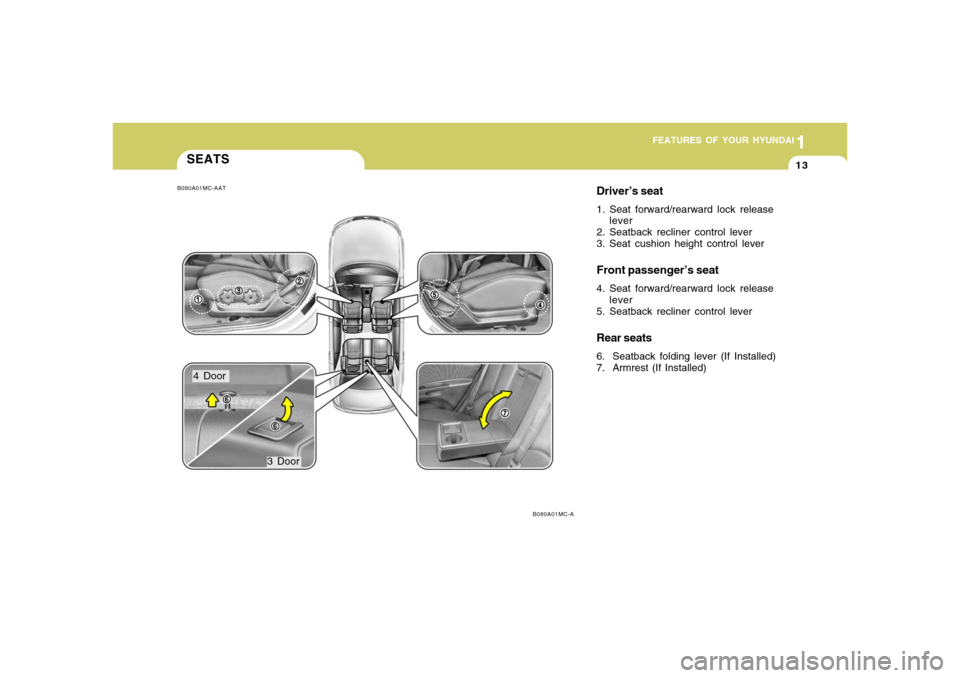
SEATSB080A01MC-AAT
B080A01MC-A
Driver’s seat1. Seat forward/rearward lock release
lever
2. Seatback recliner control lever
3. Seat cushion height control leverFront passenger’s seat4. Seat forward/rearward lock release
lever
5. Seatback recliner control leverRear seats6. Seatback folding lever (If Installed)
7. Armrest (If Installed)
4 Door
3 Door
Page 27 of 273
1
FEATURES OF YOUR HYUNDAI
151
FEATURES OF YOUR HYUNDAI
15
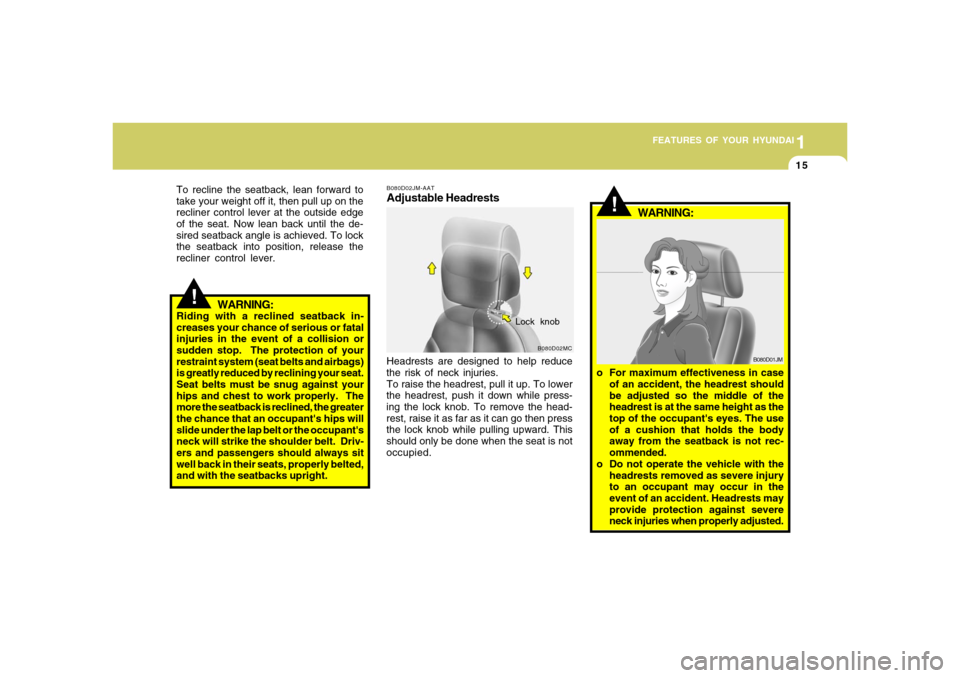
To recline the seatback, lean forward to
take your weight off it, then pull up on the
recliner control lever at the outside edge
of the seat. Now lean back until the de-
sired seatback angle is achieved. To lock
the seatback into position, release the
recliner control lever.
!
WARNING:
Riding with a reclined seatback in-
creases your chance of serious or fatal
injuries in the event of a collision or
sudden stop. The protection of your
restraint system (seat belts and airbags)
is greatly reduced by reclining your seat.
Seat belts must be snug against your
hips and chest to work properly. The
more the seatback is reclined, the greater
the chance that an occupant's hips will
slide under the lap belt or the occupant's
neck will strike the shoulder belt. Driv-
ers and passengers should always sit
well back in their seats, properly belted,
and with the seatbacks upright.
B080D02JM-AATAdjustable HeadrestsHeadrests are designed to help reduce
the risk of neck injuries.
To raise the headrest, pull it up. To lower
the headrest, push it down while press-
ing the lock knob. To remove the head-
rest, raise it as far as it can go then press
the lock knob while pulling upward. This
should only be done when the seat is not
occupied.
B080D02MC
Lock knob
!
WARNING:
o For maximum effectiveness in case
of an accident, the headrest should
be adjusted so the middle of the
headrest is at the same height as the
top of the occupant's eyes. The use
of a cushion that holds the body
away from the seatback is not rec-
ommended.
o Do not operate the vehicle with the
headrests removed as severe injury
to an occupant may occur in the
event of an accident. Headrests may
provide protection against severe
neck injuries when properly adjusted.
B080D01JM
Page 28 of 273
1FEATURES OF YOUR HYUNDAI16
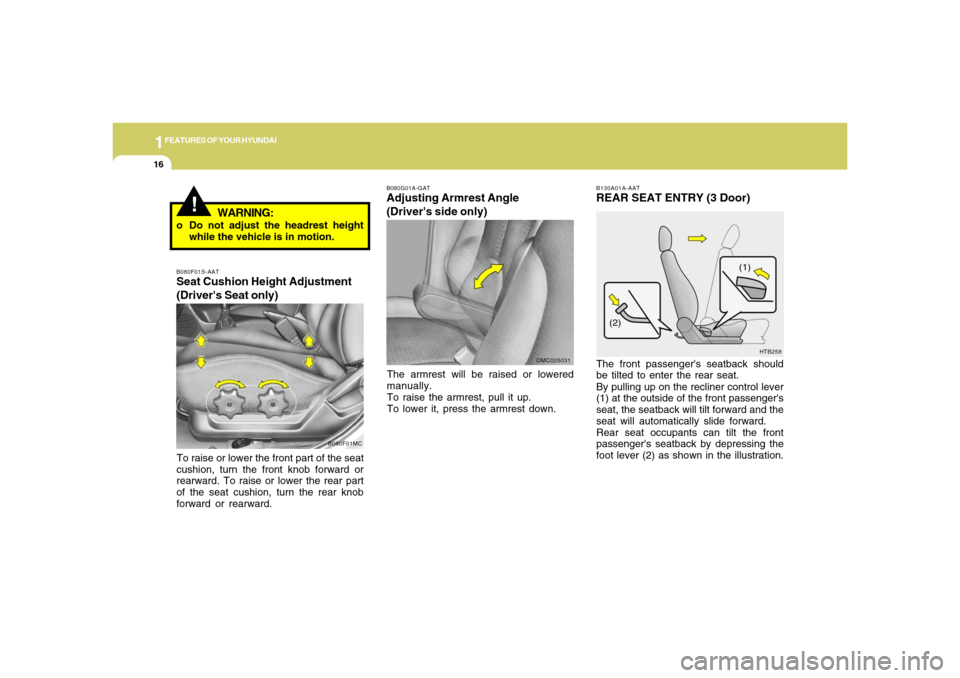
B130A01A-AATREAR SEAT ENTRY (3 Door)The front passenger's seatback should
be tilted to enter the rear seat.
By pulling up on the recliner control lever
(1) at the outside of the front passenger's
seat, the seatback will tilt forward and the
seat will automatically slide forward.
Rear seat occupants can tilt the front
passenger's seatback by depressing the
foot lever (2) as shown in the illustration.
HTB258
(1)
(2)
!
WARNING:
B080F01S-AATSeat Cushion Height Adjustment
(Driver's Seat only)To raise or lower the front part of the seat
cushion, turn the front knob forward or
rearward. To raise or lower the rear part
of the seat cushion, turn the rear knob
forward or rearward.
B080F01MCB080G01A-GAT
Adjusting Armrest Angle
(Driver's side only)The armrest will be raised or lowered
manually.
To raise the armrest, pull it up.
To lower it, press the armrest down.
OMC025031
o Do not adjust the headrest height
while the vehicle is in motion.
Page 29 of 273
1
FEATURES OF YOUR HYUNDAI
171
FEATURES OF YOUR HYUNDAI
17
!
WARNING:
Passengers sitting in the rear seat should
be careful not to accidentally press the
foot lever (2) while the vehicle is moving,
as this may cause the seatback to move
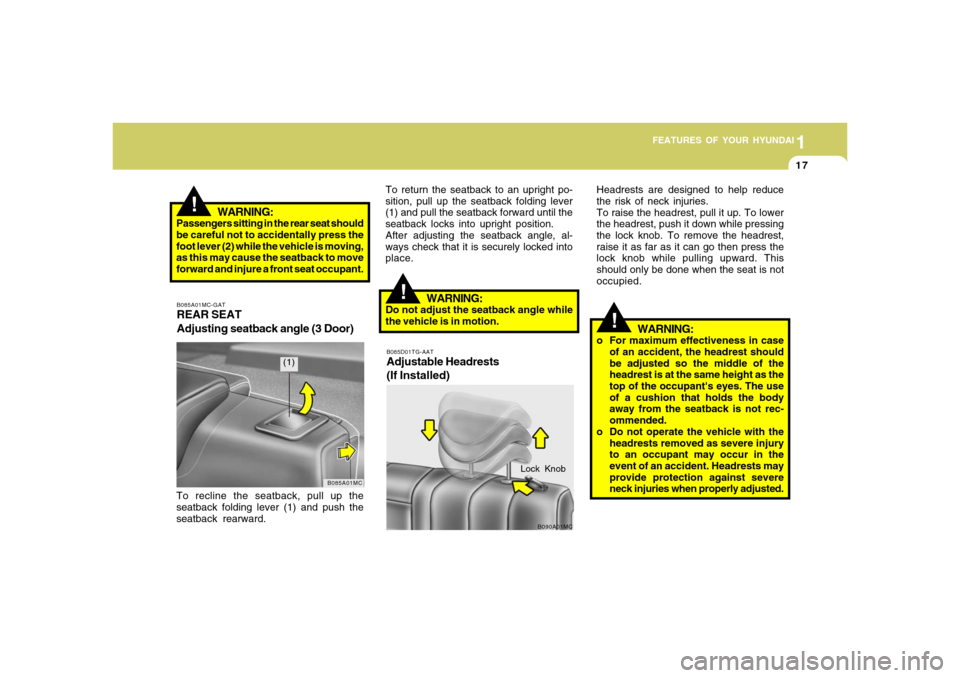
forward and injure a front seat occupant.B085A01MC-GATREAR SEAT
Adjusting seatback angle (3 Door)To recline the seatback, pull up the
seatback folding lever (1) and push the
seatback rearward.
B085A01MC
(1)
To return the seatback to an upright po-
sition, pull up the seatback folding lever
(1) and pull the seatback forward until the
seatback locks into upright position.
After adjusting the seatback angle, al-
ways check that it is securely locked into
place.
!
WARNING:
Do not adjust the seatback angle while
the vehicle is in motion.
Lock Knob
B085D01TG-AATAdjustable Headrests
(If Installed)
B090A01MC
Headrests are designed to help reduce
the risk of neck injuries.
To raise the headrest, pull it up. To lower
the headrest, push it down while pressing
the lock knob. To remove the headrest,
raise it as far as it can go then press the
lock knob while pulling upward. This
should only be done when the seat is not
occupied.
!
WARNING:
o For maximum effectiveness in case
of an accident, the headrest should
be adjusted so the middle of the
headrest is at the same height as the
top of the occupant's eyes. The use
of a cushion that holds the body
away from the seatback is not rec-
ommended.
o Do not operate the vehicle with the
headrests removed as severe injury
to an occupant may occur in the
event of an accident. Headrests may
provide protection against severe
neck injuries when properly adjusted.
Page 35 of 273
1
FEATURES OF YOUR HYUNDAI
231
FEATURES OF YOUR HYUNDAI
23
!
B150B03A-AATInfant or Small ChildAll 50 states have child restraint laws.
You should be aware of the specific re-
quirements in your state. Child and/or
infant safety seats must be properly placed
and installed in the rear seat. Information
about the use of these restraints begins
on page 1-31.
WARNING:
Every person in your vehicle needs to be
properly restrained at all times, includ-
ing infants and children. Never hold a
child in your arms or lap when riding in a
vehicle. The violent forces created dur-
ing a crash will tear the child from your
arms and throw the child against the
interior. Always use a child restraint
appropriate for your child's height and
weight, see page 1-31.
NOTE:Small children are best protected from
injury in an accident when properly re-
strained in the rear seat by a child re-
straint system that meets the require-
ments of the Federal Motor Vehicle
Safety Standards. Before buying any
child restraint system, make sure that it
has a label certifying that it meets Motor
Vehicle Safety Standard 213. The re-
straint must be appropriate for your
child's height and weight. Check the la-
bel on the child restraint for this informa-
tion. See page 1-31.
B150C02A-AATLarger ChildrenChildren who are too large for child re-
straint systems should always occupy the
rear seat and use the available lap/
shoulder belts. The lap portion should be
fastened snug on the hips and as low as
possible. Check belt fit periodically. A
child's squirming could put the belt out of
position. Children are afforded the most
safety in the event of an accident when
they are restrained by a proper restraint
system in the rear seat. If a larger child
(over age 13) must be seated in the front
seat, the child should be securely re-
strained by the available lap/shoulder
belt and the seat should be placed in the
rearmost position. Children under the age
of 13 should be restrained securely in the
rear seat. NEVER place a child under
the age of 13 in the front seat. NEVER
place a rear facing child seat in the front
seat of a vehicle.
Page 37 of 273
1
FEATURES OF YOUR HYUNDAI
251
FEATURES OF YOUR HYUNDAI
25
!
B160A02A-AATCARE OF SEAT BELTSSeat belt systems should never be disas-
sembled or modified. In addition, care
should be taken to assure that seat belts
and belt hardware are not damaged by
seat hinges, doors or other abuse.
WARNING:
When you return the rear seatback to its
upright position after the rear seatback
was folded down, be careful not to dam-
age the seat belt webbing or buckle. Be
sure that the webbing or buckle does not
get caught or pinched in the rear seat. A
seat belt with damaged webbing or buckle
will not be as strong and could possibly
fail during a collision or sudden stop,
resulting in serious injury.
B160D01A-AATWhen to Replace Seat BeltsEntire in-use seat belt assemblies should
be replaced if the vehicle has been in-
volved in an accident. This should be
done even if no damage is visible. Addi-
tional questions concerning seat belt
operation should be directed to your
Hyundai Dealer.B160C01A-AATKeep Belts Clean and DrySeat belts should be kept clean and dry.
If belts become dirty, they can be cleaned
by using a mild soap solution and warm
water. Bleach, dye, strong detergents or
abrasives should not be used because
they may damage and weaken the fabric.
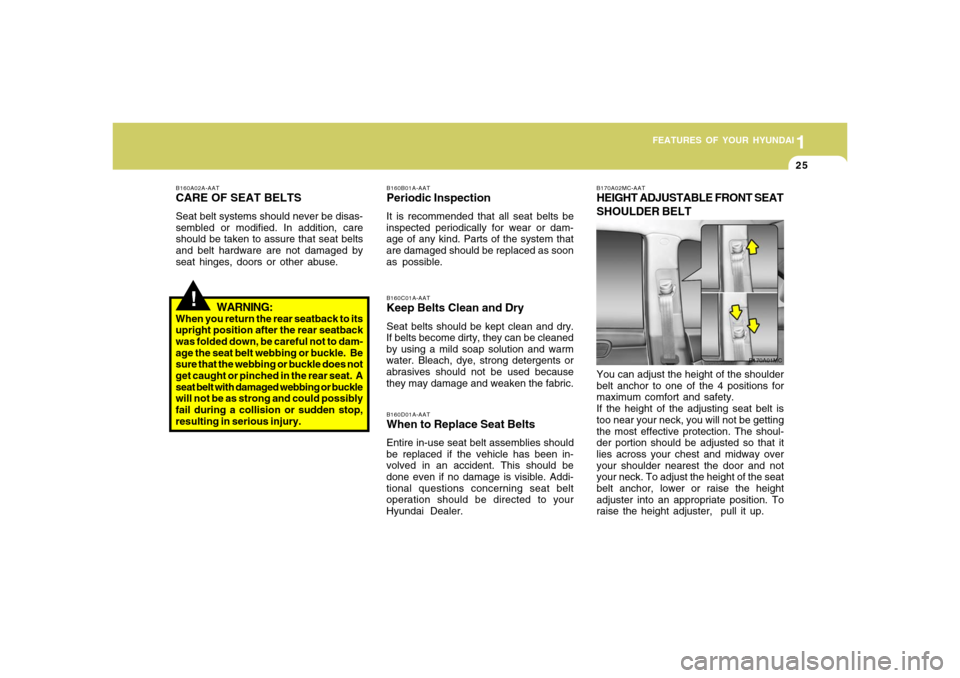
B170A02MC-AATHEIGHT ADJUSTABLE FRONT SEAT
SHOULDER BELT
B170A01MC
You can adjust the height of the shoulder
belt anchor to one of the 4 positions for
maximum comfort and safety.
If the height of the adjusting seat belt is
too near your neck, you will not be getting
the most effective protection. The shoul-
der portion should be adjusted so that it
lies across your chest and midway over
your shoulder nearest the door and not
your neck. To adjust the height of the seat
belt anchor, lower or raise the height
adjuster into an appropriate position. To
raise the height adjuster, pull it up.
B160B01A-AATPeriodic InspectionIt is recommended that all seat belts be
inspected periodically for wear or dam-
age of any kind. Parts of the system that
are damaged should be replaced as soon
as possible.
Page 38 of 273
1FEATURES OF YOUR HYUNDAI26
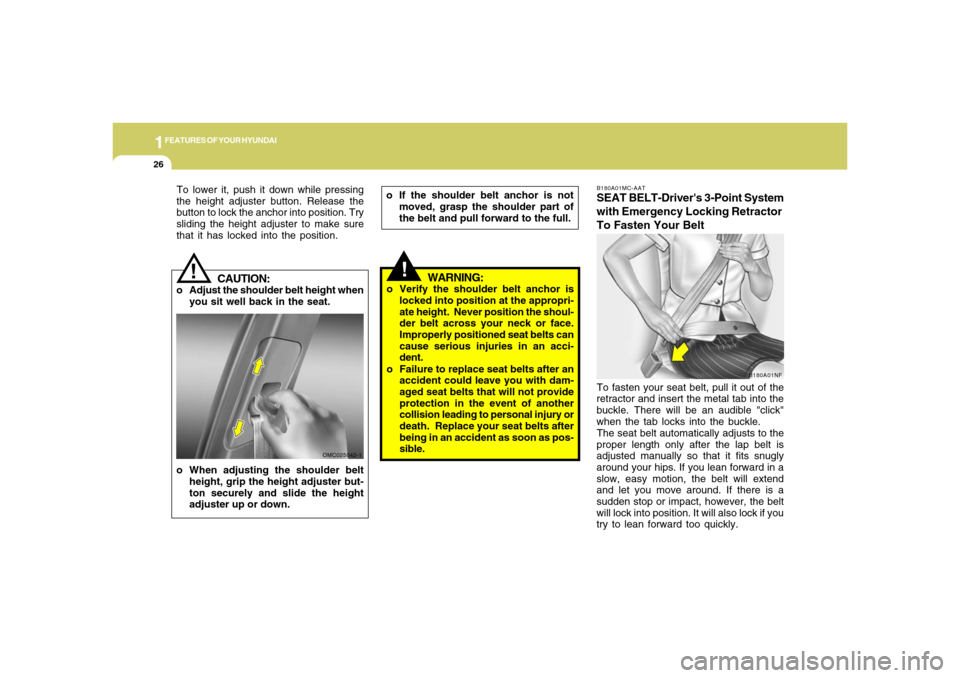
To fasten your seat belt, pull it out of the
retractor and insert the metal tab into the
buckle. There will be an audible "click"
when the tab locks into the buckle.
The seat belt automatically adjusts to the
proper length only after the lap belt is
adjusted manually so that it fits snugly
around your hips. If you lean forward in a
slow, easy motion, the belt will extend
and let you move around. If there is a
sudden stop or impact, however, the belt
will lock into position. It will also lock if you
try to lean forward too quickly.B180A01MC-AATSEAT BELT-Driver's 3-Point System
with Emergency Locking Retractor
To Fasten Your Belt
B180A01NF
o If the shoulder belt anchor is not
moved, grasp the shoulder part of
the belt and pull forward to the full.
!
WARNING:
o Verify the shoulder belt anchor is
locked into position at the appropri-
ate height. Never position the shoul-
der belt across your neck or face.
Improperly positioned seat belts can
cause serious injuries in an acci-
dent.
o Failure to replace seat belts after an
accident could leave you with dam-
aged seat belts that will not provide
protection in the event of another
collision leading to personal injury or
death. Replace your seat belts after
being in an accident as soon as pos-
sible. To lower it, push it down while pressing
the height adjuster button. Release the
button to lock the anchor into position. Try
sliding the height adjuster to make sure
that it has locked into the position.
OMC025042-1
!
CAUTION:
o Adjust the shoulder belt height when
you sit well back in the seat.
o When adjusting the shoulder belt
height, grip the height adjuster but-
ton securely and slide the height
adjuster up or down.
Page 71 of 273
1
FEATURES OF YOUR HYUNDAI
591
FEATURES OF YOUR HYUNDAI
59
!
WARNING:
o Sitting improperly or out of position
can cause occupants to be shifted
too close to a deploying airbag, strike
the interior structure or be thrown
from the vehicle resulting in serious
injury or death.
o Always sit upright with the seatback
in an upright position, centered on
the seat cushion with your seat belt
on, legs comfortably extended and
your feet on the floor. oNever hold an infant or child on your
lap. The infant or child could be seri-
ously injured or killed in the event of a
crash. All infants and children should
be properly restrained in appropriate
child safety seats or seat belts in the
rear seat.
Adding Equipment to or Modifying
Your Airbag-Equipped Vehicle.If you modify your vehicle by changing
your vehicle's frame, bumper system, front
end or side sheet metal or ride height,
this may affect the operation of your
vehicle's airbag system. oPassengers should not place hard or
sharp objects between themselves
and the airbags. Carrying hard or
sharp objects on your lap or in your
mouth can result in injuries if an airbag
inflates.
oKeep occupants away from the airbag
covers. All occupants should sit up-
right, fully back in their seats with their
seat belts on and their feet on the floor.
If occupants are too close to the airbag
covers, they could be injured if the
airbags inflate.
oDo not attach or place objects on or
near the airbag covers. Any object
attached to or placed on the front or
side impact airbag covers could inter-
fere with the proper operation of the
airbags.
oDo not modify the front seats. Modi-
fication of the front seats could inter-
fere with the operation of the supple-
mental restraint system sensing com-
ponents or side impact airbags.
oDo not place items under the front
seats. Placing items under the front
seats could interfere with the opera-
tion of the supplemental restraint sys-
tem sensing components and wiring
harnesses.
Page 133 of 273
1
FEATURES OF YOUR HYUNDAI
1211
FEATURES OF YOUR HYUNDAI
121
NOTE:Look at a tape before you insert it.
If the tape is loose, tighten it by turning
one of the hubs with a pencil or your
finger.
If the label is peeling off, do not put it in the
drive mechanism.
Do not leave tapes sitting where they are
exposed to hot, warm, or high humidity,
such as on top of the dashboard or in the
player.
If a tape is exposed to excessively hot or
cold, let it reach a moderate tempera-
ture before putting it in the player.
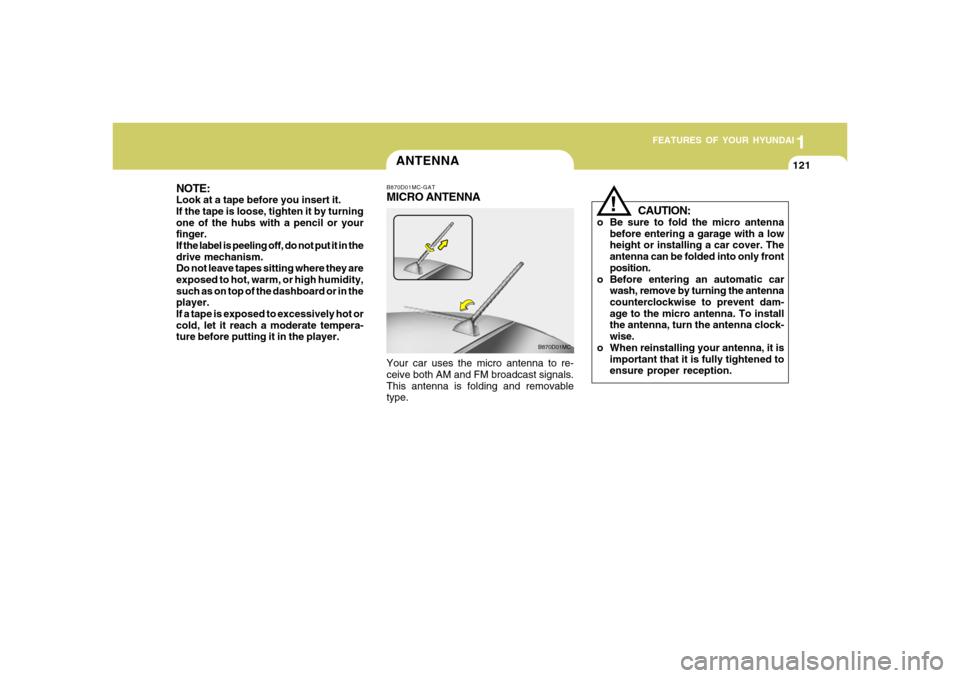
ANTENNAB870D01MC-GATMICRO ANTENNAYour car uses the micro antenna to re-
ceive both AM and FM broadcast signals.
This antenna is folding and removable
type.
B870D01MC
CAUTION:
o Be sure to fold the micro antenna
before entering a garage with a low
height or installing a car cover. The
antenna can be folded into only front
position.
o Before entering an automatic car
wash, remove by turning the antenna
counterclockwise to prevent dam-
age to the micro antenna. To install
the antenna, turn the antenna clock-
wise.
o When reinstalling your antenna, it is
important that it is fully tightened to
ensure proper reception.
!
Page 160 of 273
DRIVING YOUR HYUNDAI
132
!
o If your vehicle becomes stuck in
snow, mud, sand, etc., then you may
attempt to rock the vehicle free by
moving it forward and backward. Do
not attempt this procedure if people
or objects are anywhere near the
vehicle. During the rocking opera-
tion the vehicle may suddenly move
forward of backward as it becomes
unstuck, causing injury to nearby
people or damage to objects.
WARNING:
!
WARNING:
ABS will not prevent accidents due to
improper or dangerous driving maneu-
vers. Even though vehicle control is
improved during emergency braking,
always maintain a safe distance be-
tween you and objects ahead. Vehicle
speeds should always be reduced dur-
ing extreme road conditions.
The braking distance for cars equipped
with an anti-lock braking system may
be longer than for those without it in the
following road conditions.
During these conditions the veicle
should be driven at reduced speeds.
o Rough, gravel or snow-covered
roads.
o With tire chains installed.
o On roads where the road surface is
pitted or has different surface height.
These roads should be driven at re-
duced speeds. The safety features of
an ABS equipped vehicle should not be
tested by high speed driving or corner-
ing. This could endanger the safety of
yourself or others.
ANTI-LOCK BRAKE SYS-
TEMC120A01MC-AAT(If Installed)The Anti-Lock Brake System (ABS) is
designed to prevent wheel lock-up dur-
ing sudden braking or on hazardous road
surfaces. The ABS control module moni-
tors the wheel speed and controls the
pressure applied to each brake. Thus, in
emergency situations or on slick roads,
ABS will increase vehicle control during
braking.NOTE:o A click sound may be heard in the
engine compartment when the ve-
hicle begins to move after the engine
is started. These conditions are nor-
mal and indicate that the anti-lock
brake system is functioning prop-
erly.
o During ABS operation, a slight pulsa-
tion may be felt in the brake pedal
when the brakes are applied. Also, a
noise may be heard in the engine
compartment while braking. These
conditions are normal and indicate
that the anti-lock brake system is
functioning properly.