Check your oul Hyundai Accent 2010 User Guide
[x] Cancel search | Manufacturer: HYUNDAI, Model Year: 2010, Model line: Accent, Model: Hyundai Accent 2010Pages: 284, PDF Size: 10.23 MB
Page 76 of 284

1FEATURES OF YOUR HYUNDAI
64
B260N01MC-GATMalfunction Indicator Light (If Installed)
This light illuminates when there is a malfunction of an exhaust gas relatedcomponent, and the system is not func- tioning properly so that the exha ust gas
regulation values are not satisfied. This light will also illuminate when the ignition
key is turned to the "ON" position, and then it will go out in a few seconds after
the engine is started. If it illuminates
while driving, or does not illuminate whenthe ignition key is turned to the "ON"position, take your car to your nearest authorized Hyundai dealer and have the system checked.
B260M01A-AAT Low Fuel Level Warning Light
The low fuel level warning light comes on when the fuel tank is approaching empty. When it comes on, you shouldadd fuel as soon as possible. Driving with the fuel level warning light on or with the fuel level below "E" can causethe engine to misfire and damage the catalytic converter.
B260K01MC-AAT Trunk Lid/Tail Gate
Open Warning Light
This light remains on unless the trunk lid/tail gate is completely closed and latched.B260L01A-GAT Door Ajar Warning Light
The door ajar warning light warns you that a door is not completely closed.
B260L02HP-GAT Door Ajar Warning Light and Chime (Mideast only)
The door ajar warning light warns you that a door is not completely closed and the chime warns you that the key is inthe ignition switch. NOTE : The warning chime only sounds whenever the key is in the ignition switch and the driver's side frontdoor is open simultaneously. The chime sounds until the key is re- moved from the ignition switch orthe driver's side front door is closed.
Page 77 of 284
1
FEATURES OF YOUR HYUNDAI
65
B290A02MC-GAT
Engine Coolant Tempera-
ture Warning Light
WARNING:
Never remove the radiator cap when the engine is hot. The engine coolant is under pressure and could eruptand cause severe burns. Wait until the engine is cool before removing the radiator cap.
!
This warning light shows the tempera- ture of the engine coolant when the ignition switch is ON. The warning lightilluminates if the temperature of the engine coolant is above 123±3°C (253.4±5.4°F).If the warning light illuminates, pull over and stop as soon as possible and turn off the engine. Then open the hood andcheck the coolant level (See "If the engine overheats" on the page 3-4.) and the water pump drive belt. If you sus-pect cooling system trouble, have your cooling system checked by a Hyundai dealer as soon as possible. NOTE: If the engine coolant temperature warning light illuminates, it indicatesoverheating that may damage the engine.
CAUTION:
o Prolonged driving with the Emis- sion Control System MalfunctionIndicator Light illuminated may cause damage to the emissioncontrol systems which could ef- fect drivability or fuel economy. If the Emission Control SystemMalfunction Indicator Light be- gins to flash ON and OFF, poten- tial catalytic converter damage ispossible. This could result in loss of engine power. Have the Engine Control System inspected as soonas possible by an authorized Hyundai dealer (Gasoline Engine).
o In case the injection quantity ad- justment related error occurred,the Emission Control System Mal- function Indicator Light begins toflash ON and OFF. Continuous driving with this status could re- sult in abnormal engine powerloss (or power increase), com- bustion noise and poor emission. If this occurs, have your vehiclechecked by an authorized Hyundai dealer (Diesel Engine).
!
Page 79 of 284
1
FEATURES OF YOUR HYUNDAI
67
B265C01NF-GAT
Electronic Stability Program Indicator Lights(If Installed)
The electronic stability program indica- tors change operation according to the ignition switch position and whether thesystem is in operation or not. They will illuminate when the ignition key is turned to the "ON" position, butshould go out after three seconds. If the ESP or ESP-OFF indicator stays on, take your car to your authorized Hyundaidealer and have the system checked. See section 2 for more information about the ESP.B260U01TB-GAT Immobilizer Warning Light (If Installed)
This indicator light comes on for some seconds after the ignition key is turnedto the "ON" position. At this time, you can start the engine. The light goes out after the engine is running. In case thislight goes out before you start the en- gine, you must turn to the "LOCK" position and restart the engine. In casethis light blinks for five seconds when the ignition key is turned to "ON" posi- tion, this indicates that the immobilizersystem is out of order. At this time, refer to the explanation of the Limp home procedure(See page 1-7) or con-sult to the Hyundai dealer.B260T01TB-GAT Electronic Power Steering (EPS) SystemWarning Light(If Installed)
This indicator light comes on about 4 seconds after the ignition key is turned to the "ON" position or after the engineis started, it will go out. This light also comes on when the EPS has some troubles. If it comes on whiledriving, have your vehicle inspected by an authorized Hyundai Dealer. NOTE: When you move the electronic power steering back-end and forth-end con- tinuously in stop position, steering wheel plays heavily to operate anti-overload system. It is normal condi- tion. It returns to be normal getting time.
Page 109 of 284
1
FEATURES OF YOUR HYUNDAI
97
!WARNING:
o Always double check to be sure that the hood is firmly latched before driving away. If it is not latched, the hood could fly openwhile the vehicle is being driven, causing a total loss of visibility, which might result in an accident.
o The support rod must be inserted completely into the hole providedin the hood whenever you inspectthe engine compartment. This will prevent the hood from falling and possibly injuring you.
o Do not move the vehicle with the hood in the raised position, asvision is obstructed and the hoodcould fall or be damaged.
REMOTE FUEL-FILLER LID RELEASE
B560A01MC-GAT
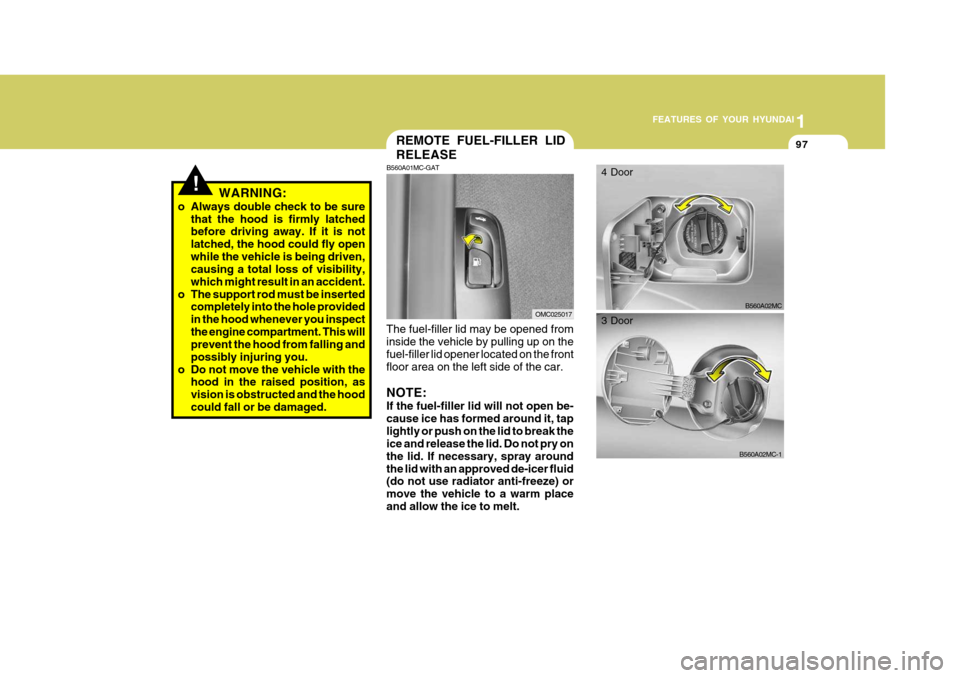
The fuel-filler lid may be opened from inside the vehicle by pulling up on the fuel-filler lid opener located on the front floor area on the left side of the car. NOTE: If the fuel-filler lid will not open be- cause ice has formed around it, taplightly or push on the lid to break the ice and release the lid. Do not pry on the lid. If necessary, spray aroundthe lid with an approved de-icer fluid (do not use radiator anti-freeze) or move the vehicle to a warm placeand allow the ice to melt.
OMC025017B560A02MC
4 Door
B560A02MC-1
3 Door
Page 111 of 284
1
FEATURES OF YOUR HYUNDAI
99
- When refueling always shut the
engine off. Sparks produced by electrical components related tothe engine can ignite fuel va- pors causing a fire. Always in- sure that the engine is OFF be-fore and during refueling. Once refueling is complete, check to make sure the fuel filler cap anddoor are securely closed, before starting the engine.
- Do not light any fire around a gas station. DO NOT use matchesor a lighter and DO NOT SMOKE or leave a lit cigarette in yourvehicle while at a gas station especially during refueling. Au- tomotive fuel is highly flammableand can, when ignited, result in explosion by flames.
- If a fire breaks out during refuel- ing, leave the vicinity of the ve-hicle, and immediately contact the manager of the gas stationor contact the police and local fire department. Follow any safety instructions they provide.
!
TRUNK LID/TAIL GATE
B540A01MC-GAT
WARNING:
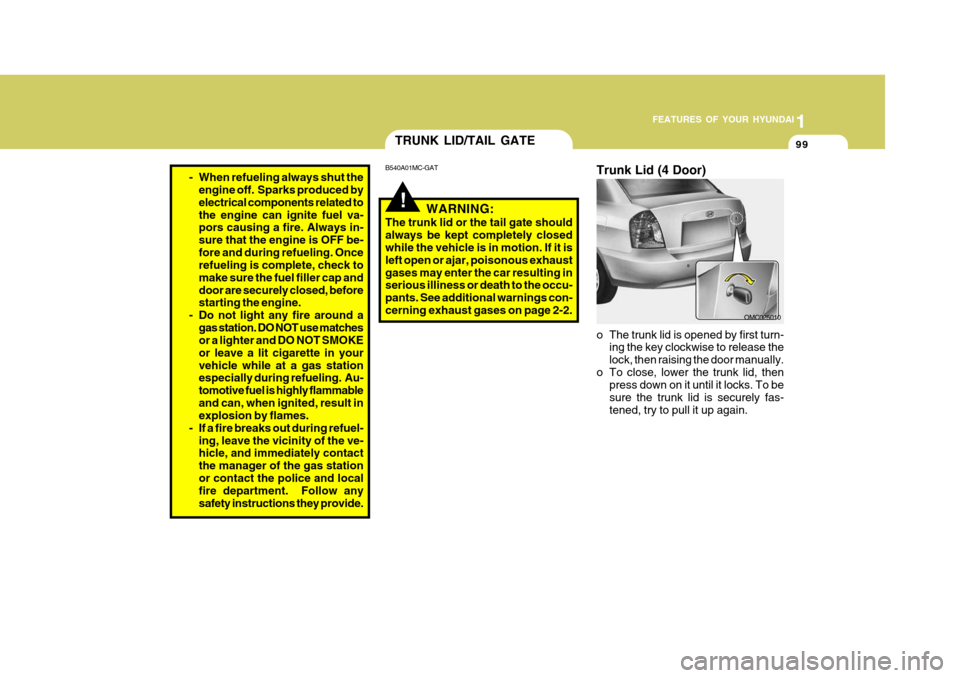
The trunk lid or the tail gate should always be kept completely closed while the vehicle is in motion. If it is left open or ajar, poisonous exhaustgases may enter the car resulting in serious illiness or death to the occu- pants. See additional warnings con-cerning exhaust gases on page 2-2. Trunk Lid (4 Door)
o The trunk lid is opened by first turn-
ing the key clockwise to release the lock, then raising the door manually.
o To close, lower the trunk lid, then press down on it until it locks. To besure the trunk lid is securely fas-tened, try to pull it up again.
OMC025010
Page 112 of 284
1FEATURES OF YOUR HYUNDAI
100
1JBA3113
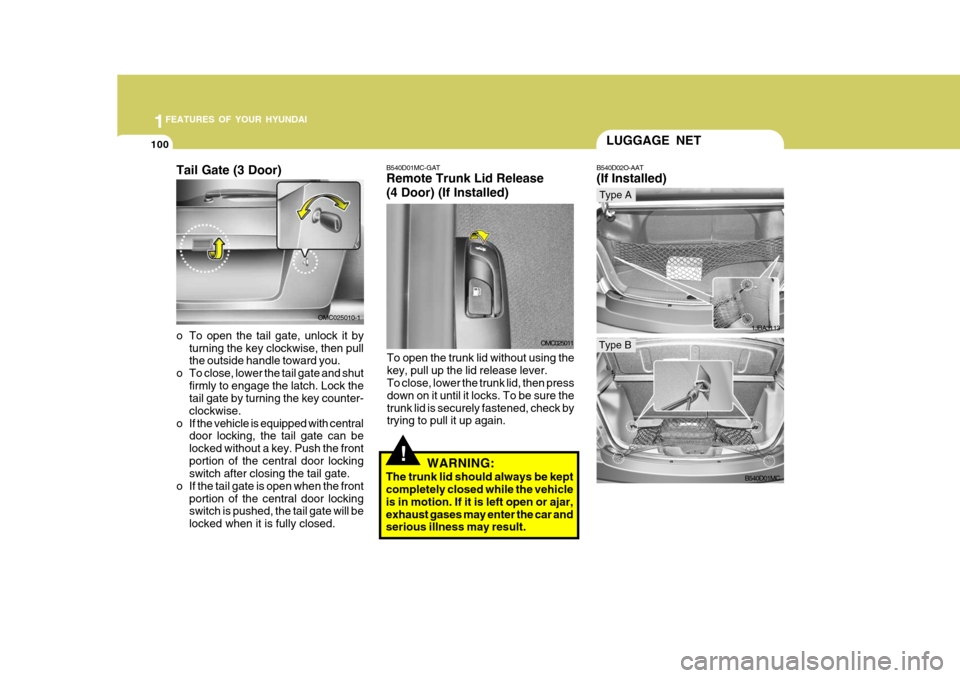
LUGGAGE NET
B540D02O-AAT (If Installed)
B540D01MC
Type A
Type B
!WARNING:
The trunk lid should always be kept completely closed while the vehicle is in motion. If it is left open or ajar,exhaust gases may enter the car and serious illness may result.
B540D01MC-GAT Remote Trunk Lid Release (4 Door) (If Installed)
OMC025011
To open the trunk lid without using the key, pull up the lid release lever. To close, lower the trunk lid, then press down on it until it locks. To be sure thetrunk lid is securely fastened, check by trying to pull it up again.
Tail Gate (3 Door)
o To open the tail gate, unlock it by
turning the key clockwise, then pull the outside handle toward you.
o To close, lower the tail gate and shut
firmly to engage the latch. Lock thetail gate by turning the key counter- clockwise.
o If the vehicle is equipped with central door locking, the tail gate can belocked without a key. Push the frontportion of the central door locking switch after closing the tail gate.
o If the tail gate is open when the front
portion of the central door lockingswitch is pushed, the tail gate will be locked when it is fully closed.
OMC025010-1
Page 115 of 284
1
FEATURES OF YOUR HYUNDAI
103STEERING WHEEL
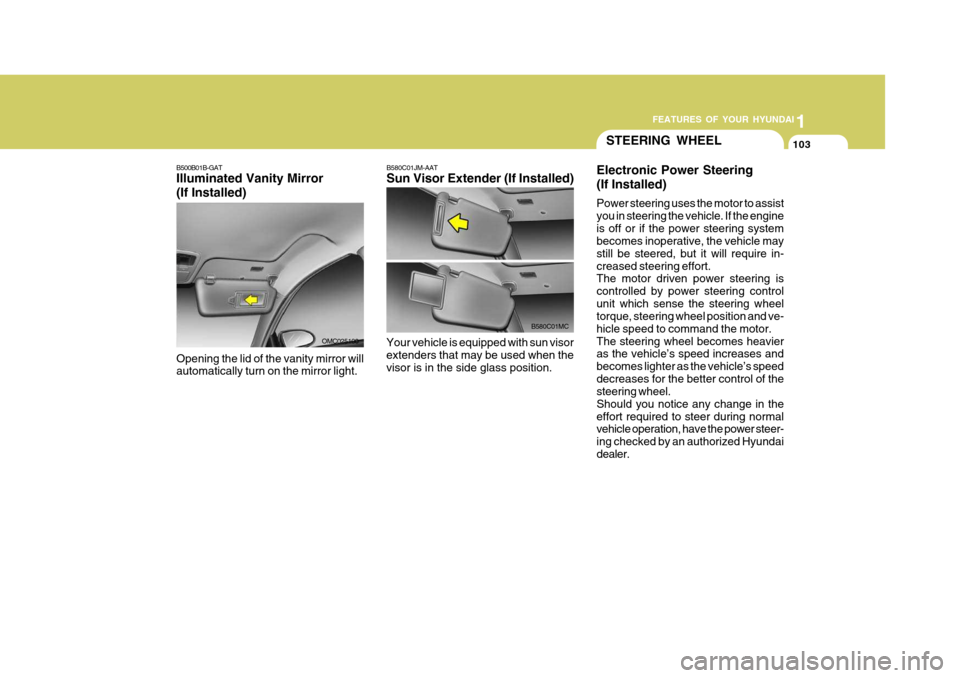
B580C01JM-AAT Sun Visor Extender (If Installed)
Your vehicle is equipped with sun visor extenders that may be used when the visor is in the side glass position.
B580C01MC
B500B01B-GAT Illuminated Vanity Mirror (If Installed) Opening the lid of the vanity mirror will automatically turn on the mirror light. OMC025100 Electronic Power Steering (If Installed) Power steering uses the motor to assist you in steering the vehicle. If the engineis off or if the power steering system becomes inoperative, the vehicle may still be steered, but it will require in-creased steering effort. The motor driven power steering is controlled by power steering controlunit which sense the steering wheel torque, steering wheel position and ve- hicle speed to command the motor.The steering wheel becomes heavier as the vehicle’s speed increases and becomes lighter as the vehicle’s speeddecreases for the better control of the steering wheel. Should you notice any change in theeffort required to steer during normal vehicle operation, have the power steer- ing checked by an authorized Hyundaidealer.
Page 164 of 284
2 DRIVING YOUR HYUNDAI
2
C010A01A-AAT
WARNING: ENGINE EXHAUST CAN BE DANGEROUS!
Engine exhaust fumes can be extremely dangerous. If, at any time, you smell exhaust fumes inside the vehicle, open the windows immediately. o Do not inhale exhaust fumes. Exhaust fumes contain carbon monoxide, a colorless, odorless gas that can cause unconsciousness and death by asphyxiation. o Be sure the exhaust system does not leak. The exhaust system should be checked whenever the vehicle is raised to change the oil or for any other purpose. If you hear a change in the sound of the exhaust or if you drive over something that strikes the underneath sideof the car, have the exhaust system checked as soon as possible by your Hyundai dealer. o Do not run the engine in an enclosed area. Letting the engine idle in your garage, even with the garage door open, is a hazardous practice. Never run the engine in your garage any longer than it takes to start the engine and back the car out. o Avoid idling the engine for prolonged periods with people inside the car. If it is necessary to idle the engine for a prolonged period with people inside the car, be sure to do so only in an open area with the air intake set at "Fresh" and fan operating at one of the higher speeds so fresh air is drawn into the interior. If you must drive with the trunk lid/tail gate open because you are carrying objects that make this necessary: 1. Close all windows. 2. Open side vents. 3. Set the air intake control at "Fresh", the air flow control at "Floor" or "Face" and the fan at one of the higher speeds.
To assure proper operation of the ventilation system, be sure the ventilation air intakes located just in front of the windshield are kept clear of snow, ice, leaves or other obstructions.
!
Page 165 of 284
2
DRIVING YOUR HYUNDAI
3
2
DRIVING YOUR HYUNDAI
3
!
BEFORE STARTING THE EN- GINE
C020A03O-GAT Before you start the engine, you should always:
1. Look around the vehicle to be sure
there are no flat tires, puddles of oil, water or other indications of pos- sible trouble.
2. After entering the car, check to be sure the parking brake is engaged.
3. Check that all windows, and lights are clean.
4. Check that the interior and exterior
mirrors are clean and in position.
5. Check your seat, seatback and headrest to be sure they are in theirproper positions.
6. Lock all the doors.
7. Fasten your seat belt and be sure
that all other occupants have fas- tened theirs.
8. Turn off all lights and accessories
that are not needed.
9. When you turn the ignition switch to "ON", check that all appropriatewarning lights are operating andthat you have sufficient fuel.
10.Check the operation of warning
lights and all bulbs when key is inthe "ON" position. WARNING:
(Diesel Engine)
To ensure that sufficient vacuum exists within the brake system dur-ing cold weather start-up condi- tions, it is necessary to run the engine at idle for several secondsafter starting the engine.TO START THE ENGINE
C030A01A-GAT COMBINATION IGNITION SWITCH
o If your Hyundai is equipped with a manual transaxle, place the shift lever in neutral and depress the clutch pedal fully.
o If your Hyundai has an automatic
transaxle, place the shift lever in "P"(park).
o To start the engine, insert the igni- tion key and turn it to the "START"position. Release it as soon as the engine starts. Do not hold the key inthe "START" position for more than 15 seconds.
NOTE: For safety, the engine will not start if the shift lever is not in "P" or "N" position (Automatic transaxle).
!WARNING:
o Always wear appropriate shoes when operating your vehicle. Unsuitable shoes (high heels, skiboots, etc.) may interfere with your ability to use the brake and accel- erator pedal, and the clutch (ifinstalled).
o When you intend to park or stop
the vehicle with the engine on, becareful not to depress the accel- erator pedal for a long period of time. It may overheat the engine orexhaust system and cause fire.
Page 173 of 284
2
DRIVING YOUR HYUNDAI
11
2
DRIVING YOUR HYUNDAI
11
o The brake pedal fully depressed in order to move the shift lever from the "P" (Park) position to any of the other positions.
o It is always possible to shift from
"R", "N", "D", "2", "L" position to"P" position. The vehicle must be fully stopped to avoidtransaxle damage.
C090I02MC-AAT
CAUTION:
o Shift into "R", "D" and "P" posi- tion only when the vehicle has completely stopped.
o Do not accelerate the engine in reverse or any of the forwardpositions with the brakes applied.
o Always apply the footbrake when shifting from "P" or "N", to "R",
"D", "2" or "L" position.
o Do not use the "P" (Park) position in place of the parking brake.Always set the parking brake, shift the transaxle into "P" (Park)position and turn off the ignition when you leave the vehicle, even momentarily.
!
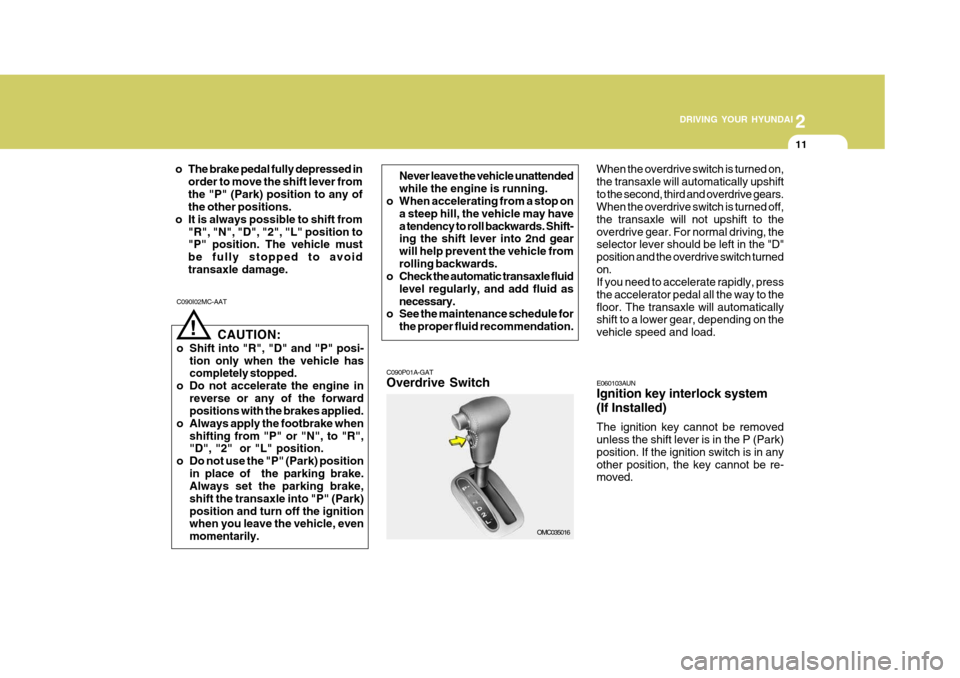
OMC035016
C090P01A-GAT Overdrive Switch When the overdrive switch is turned on, the transaxle will automatically upshiftto the second, third and overdrive gears. When the overdrive switch is turned off, the transaxle will not upshift to theoverdrive gear. For normal driving, the selector lever should be left in the "D" position and the overdrive switch turnedon. If you need to accelerate rapidly, press the accelerator pedal all the way to thefloor. The transaxle will automatically shift to a lower gear, depending on the vehicle speed and load.
Never leave the vehicle unattendedwhile the engine is running.
o When accelerating from a stop on
a steep hill, the vehicle may havea tendency to roll backwards. Shift- ing the shift lever into 2nd gear will help prevent the vehicle fromrolling backwards.
o Check the automatic transaxle fluid
level regularly, and add fluid asnecessary.
o See the maintenance schedule for
the proper fluid recommendation.
E060103AUN Ignition key interlock system (If Installed) The ignition key cannot be removed unless the shift lever is in the P (Park) position. If the ignition switch is in anyother position, the key cannot be re- moved.