Check your oul Hyundai Accent 2010 Owner's Guide
[x] Cancel search | Manufacturer: HYUNDAI, Model Year: 2010, Model line: Accent, Model: Hyundai Accent 2010Pages: 284, PDF Size: 10.23 MB
Page 188 of 284
2 DRIVING YOUR HYUNDAI
26
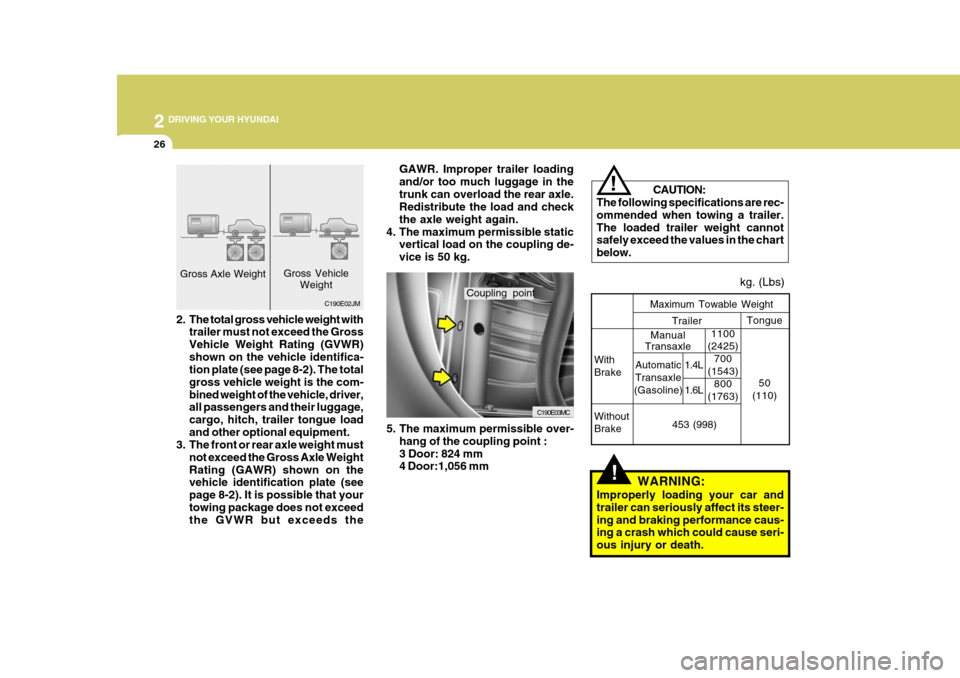
GAWR. Improper trailer loading and/or too much luggage in thetrunk can overload the rear axle. Redistribute the load and check the axle weight again.
4. The maximum permissible static vertical load on the coupling de-vice is 50 kg.
5. The maximum permissible over- hang of the coupling point :3 Door: 824 mm 4 Door:1,056 mm
Maximum Towable Weight kg. (Lbs)
Coupling point CAUTION:
The following specifications are rec- ommended when towing a trailer.The loaded trailer weight cannot safely exceed the values in the chart below.
!
Manual
Transaxle 1100
(2425)
700
(1543) 800
(1763)
453 (998)
Trailer
Tongue
50
(110)
With Brake Without Brake
Automatic Transaxle
(Gasoline) 1.4L 1.6L
!WARNING:
Improperly loading your car and trailer can seriously affect its steer-ing and braking performance caus- ing a crash which could cause seri- ous injury or death.
C190E03MC
2. The total gross vehicle weight with trailer must not exceed the Gross Vehicle Weight Rating (GVWR)shown on the vehicle identifica- tion plate (see page 8-2). The total gross vehicle weight is the com-bined weight of the vehicle, driver, all passengers and their luggage, cargo, hitch, trailer tongue loadand other optional equipment.
3. The front or rear axle weight must
not exceed the Gross Axle WeightRating (GAWR) shown on the vehicle identification plate (see page 8-2). It is possible that yourtowing package does not exceed the GVWR but exceeds the C190E02JM
Gross Axle Weight
Gross Vehicle
Weight
Page 189 of 284
2
DRIVING YOUR HYUNDAI
27
2
DRIVING YOUR HYUNDAI
27
13. Avoid holding the brake pedal down too long or too frequently. This could cause the brakes to over- heat, resulting in reduced braking efficiency.
14. When going down a hill, shift into a lower gear and use the engine brak-ing effect.When ascending a long grade, downshift the transaxle to a lower gear and reduce speed to reducechances of engine overloading and/ or overheating.
15. If you have to stop while going uphill, do not hold the vehicle inplace by pressing on the accelera- tor. This can cause the automatictransaxle to overheat. Use the park- ing brake or footbrake.
NOTE: When towing check transaxle fluid more frequently.
When being passed by a large ve-hicle, keep a constant speed andsteer straight ahead. If there is too much wind buffeting, slow down to get out of the other vehicle's airturbulence.
8. When parking your car and trailer,
especially on a hill, be sure to fol-low all the normal precautions. Turn your front wheel into the curb, set the parking brake firmly, and putthe transaxle in 1st or Reverse (manual) or Park (automatic). In addition, place wheel chocks ateach of the trailer's tires.
9. If the trailer has electric brakes,
start your vehicle and trailer mov-ing, and then apply the trailer brake controller by hand to be sure the brakes are working. This lets youcheck your electrical connection at the same time.
10. During your trip, check occasion- ally to be sure that the load issecure, and that the lights and any trailer brakes are still working.
11. Avoid jerky starts, sudden accel- eration or sudden stops.
12. Avoid sharp turns and rapid lane changes.
C190F02A-GAT Trailer or Vehicle Towing Tips
1. Before towing, check hitch and
safety chain connections as well as proper operation of the trailer running lights, brake lights, and turn signals.
2. Always drive your vehicle at a mod- erate speed (Less than 100 km/h).
3. Trailer towing requires more fuel than normal conditions.
4. To maintain engine braking effi-
ciency, do not tow a trailer withtransaxle in fifth gear (manual transaxle) or an overdrive gear (au- tomatic transaxle).
5. Always secure items in the trailer to prevent load shift while driving.
6. Check the condition and air pres- sure of all tires on the trailer and your car. Low tire pressure can seriously affect the handling. Alsocheck the spare tire.
7. The vehicle/trailer combination is
more affected by crosswind andbuffeting.
Page 192 of 284
3 WHAT TO DO IN AN EMERGENCY
2
!
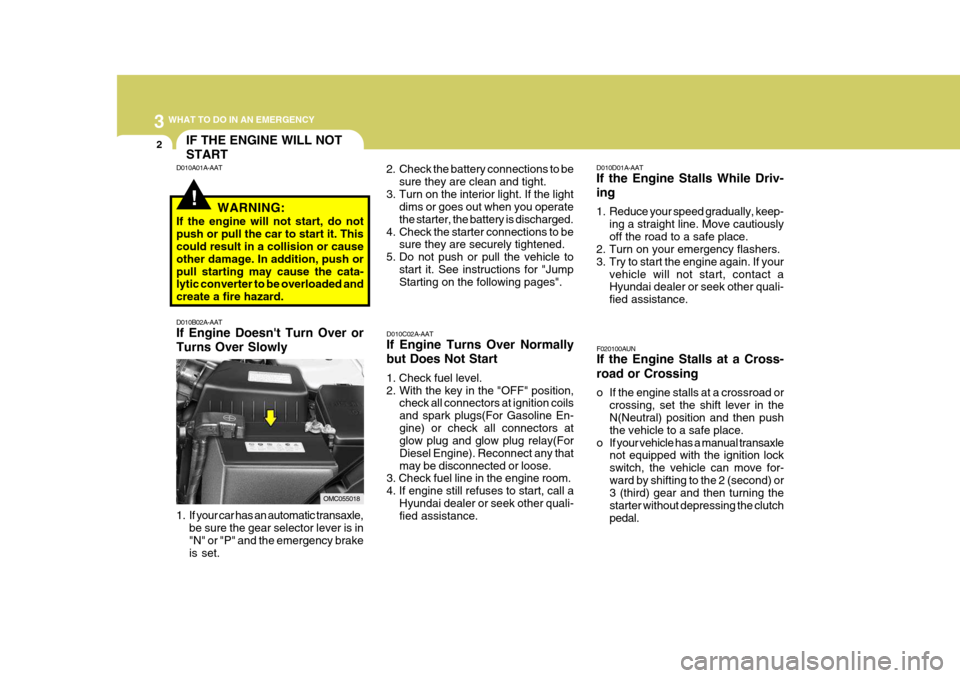
D010B02A-AAT If Engine Doesn't Turn Over or Turns Over Slowly
1. If your car has an automatic transaxle,
be sure the gear selector lever is in "N" or "P" and the emergency brake is set. D010C02A-AAT If Engine Turns Over Normally but Does Not Start 1. Check fuel level. 2. With the key in the "OFF" position,
check all connectors at ignition coilsand spark plugs(For Gasoline En-gine) or check all connectors at glow plug and glow plug relay(For Diesel Engine). Reconnect any thatmay be disconnected or loose.
3. Check fuel line in the engine room.4. If engine still refuses to start, call a
Hyundai dealer or seek other quali- fied assistance. D010D01A-AAT If the Engine Stalls While Driv- ing
1. Reduce your speed gradually, keep-
ing a straight line. Move cautiously off the road to a safe place.
2. Turn on your emergency flashers.
3. Try to start the engine again. If your
vehicle will not start, contact a Hyundai dealer or seek other quali- fied assistance.
D010A01A-AAT
IF THE ENGINE WILL NOT START
WARNING:
If the engine will not start, do not push or pull the car to start it. This could result in a collision or cause other damage. In addition, push orpull starting may cause the cata- lytic converter to be overloaded and create a fire hazard.
OMC055018 2. Check the battery connections to be
sure they are clean and tight.
3. Turn on the interior light. If the light dims or goes out when you operate the starter, the battery is discharged.
4. Check the starter connections to be sure they are securely tightened.
5. Do not push or pull the vehicle to start it. See instructions for "Jump Starting on the following pages".
F020100AUN If the Engine Stalls at a Cross- road or Crossing
o If the engine stalls at a crossroad orcrossing, set the shift lever in the N(Neutral) position and then push the vehicle to a safe place.
o If your vehicle has a manual transaxle not equipped with the ignition lockswitch, the vehicle can move for-ward by shifting to the 2 (second) or 3 (third) gear and then turning the starter without depressing the clutchpedal.
Page 194 of 284
3 WHAT TO DO IN AN EMERGENCY
4
!
IF THE ENGINE OVERHEATS
D030A02TB-AAT If your temperature gauge indicates overheating, you experience a loss of power, or hear loud pinging or knock- ing, the engine is probably too hot. Ifthis happens to you, you should:
1. Pull off the road and stop as soon as it is safe to do so.
2. Place the gear selector lever in "P"
(automatic), or neutral (manual transaxle) and set the parking brake. If the air conditioning is on, turn it off.
3. If engine coolant is running out un- der the car or steam is coming outfrom underneath the hood, stop theengine. Do not open the hood until the engine coolant has stopped running or the steaming has stopped.If there is no visible loss of engine coolant and no steam, leave the engine running and check to be surethe engine cooling fan is operating. If the fan is not running, turn the engine off.
5. Start the engine in the car with the
discharged battery using the nor-mal starting procedure. After the engine starts, leave the jumper cables connected and let the enginerun at fast idle or about 2,000 rpm for several minutes.
6. Carefully remove the jumper cables in the reverse order of attachment.
If you do not know why your battery became discharged (because the lights were left on, etc.), have the charging system checked by your Hyundaidealer. 4. Check to see if the water pump drive
belt is missing. If it is not missing,check to see that it is tight. If the drive belt seems to be satisfactory, check for coolant leaking from theradiator, hoses or under the car. (If the air conditioning had been in use, it is normal for cold water to bedraining from it when you stop).
WARNING:
While the engine is running, keephair, hands, and clothing away from moving parts such as the fan and drive belts to prevent injury.
Page 195 of 284
3
WHAT TO DO IN AN EMERGENCY
5SPARE TIRE
!!WARNING (Diesel Only):
Never work on injection system with engine running or within 30 sec- onds after shutting off engine. High pressure pump, rail, injectors andhigh pressure pipes are subject to high pressure even after the engine stopped. The fuel jet produced byfuel leaks may cause serious in- jury, if it touch the body. People using pacemakers should not movethan 30cm closer to the ECU or wiring harness within the engine room while engine is running, sincethe high currents in the Common Rail system produce considerable magnetic fields. WARNING:
Do not remove the radiator cap whenthe engine is hot. This may result incoolant being blown out of the open- ing and cause serious burns.
6. If you cannot find the cause of the overheating, wait until the engine temperature has returned to nor-mal. Then, if the engine coolant has been lost, carefully add coolant to the reservoir (Page 6-11) to bring thefluid level in the reservoir up to the halfway mark.
7. Proceed with caution, keeping alert
for further signs of overheating. Ifoverheating happens again, call a Hyundai dealer for assistance.
!
5. If the water pump drive belt is broken
or coolant is leaking out, stop the engine immediately and call the near- est Hyundai dealer for assistance. CAUTION:
Serious loss of engine coolant indi- cates there is a leak in the coolingsystem and this should be checked as soon as possible by a Hyundai dealer.
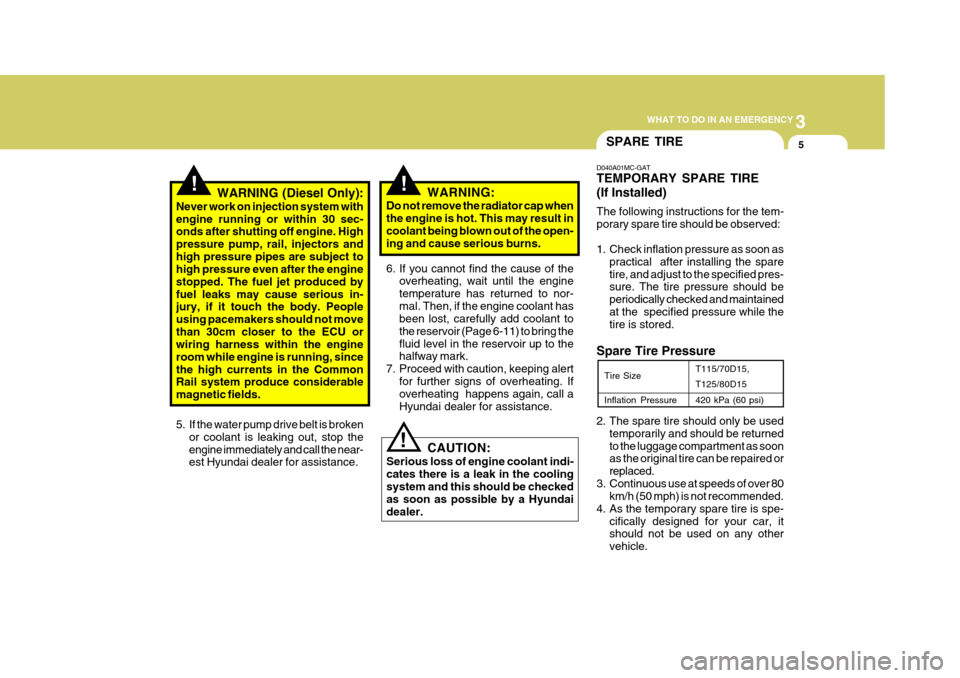
Inflation Pressure
Tire Size
T115/70D15, T125/80D15 420 kPa (60 psi)
2. The spare tire should only be used temporarily and should be returned to the luggage compartment as soon as the original tire can be repaired or replaced.
3. Continuous use at speeds of over 80 km/h (50 mph) is not recommended.
4. As the temporary spare tire is spe-
cifically designed for your car, it should not be used on any other vehicle.
D040A01MC-GAT TEMPORARY SPARE TIRE (If Installed) The following instructions for the tem- porary spare tire should be observed:
1. Check inflation pressure as soon as
practical after installing the spare tire, and adjust to the specified pres- sure. The tire pressure should be periodically checked and maintainedat the specified pressure while the tire is stored.
Spare Tire Pressure
Page 196 of 284
3 WHAT TO DO IN AN EMERGENCY
6
!
5. The temporary spare tire should not
be used on any other wheels, nor should standard tires, snow tires, wheel covers or trim rings be used with the temporary spare wheel. Ifsuch use is attempted, damage to these items or other car components may occur.
6. The temporary spare tire pressure should be checked once a monthwhile the tire is stored.
CAUTION:
o Do not use snow chains with your temporary spare tire.
o Do not use more than one tempo-
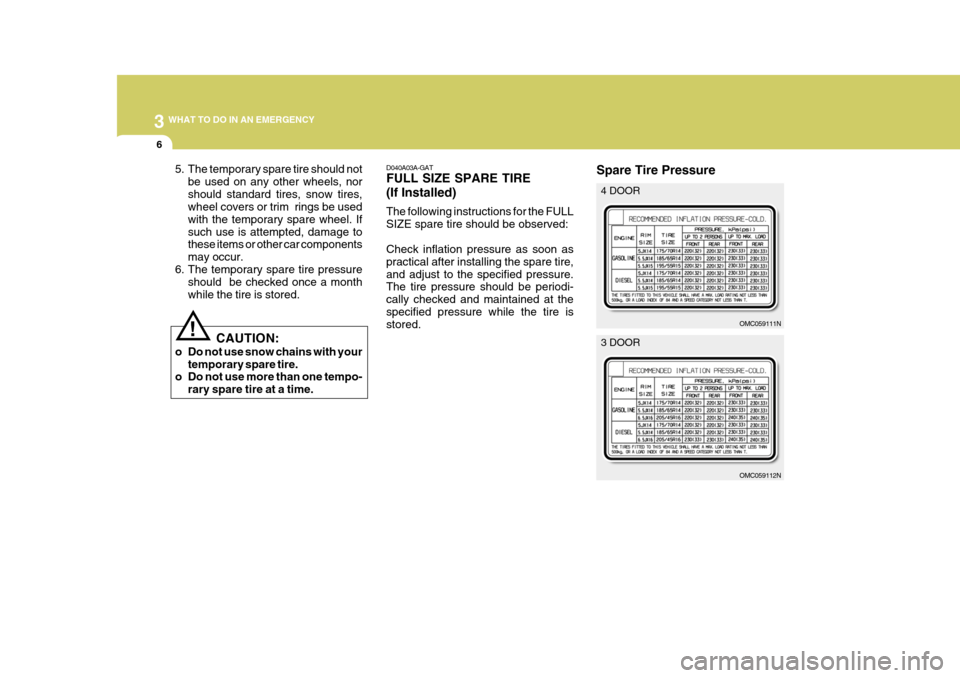
rary spare tire at a time. D040A03A-GAT FULL SIZE SPARE TIRE (If Installed) The following instructions for the FULL SIZE spare tire should be observed: Check inflation pressure as soon as practical after installing the spare tire,and adjust to the specified pressure. The tire pressure should be periodi- cally checked and maintained at thespecified pressure while the tire is stored.
Spare Tire Pressure
OMC059112N
3 DOOR
OMC059111N
4 DOOR
Page 201 of 284
3
WHAT TO DO IN AN EMERGENCY
11
D060H02A-AAT 7. Re-install Wheel Nuts
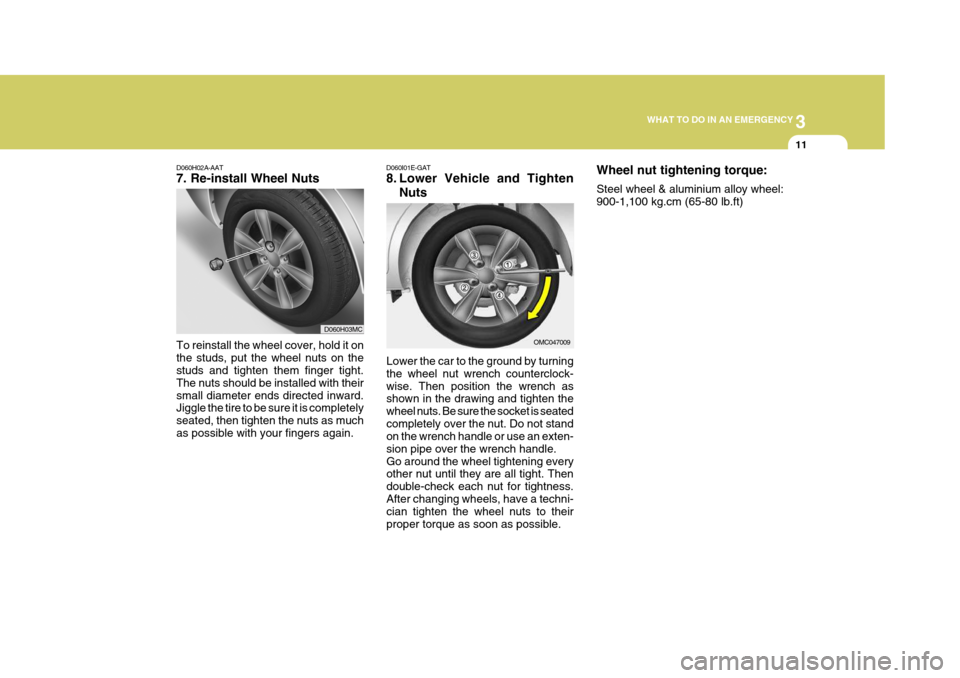
Lower the car to the ground by turning the wheel nut wrench counterclock-wise. Then position the wrench as shown in the drawing and tighten the wheel nuts. Be sure the socket is seatedcompletely over the nut. Do not stand on the wrench handle or use an exten- sion pipe over the wrench handle.Go around the wheel tightening every other nut until they are all tight. Then double-check each nut for tightness.After changing wheels, have a techni- cian tighten the wheel nuts to their proper torque as soon as possible.
D060I01E-GAT
8. Lower Vehicle and Tighten
Nuts
To reinstall the wheel cover, hold it on the studs, put the wheel nuts on the studs and tighten them finger tight. The nuts should be installed with theirsmall diameter ends directed inward. Jiggle the tire to be sure it is completely seated, then tighten the nuts as muchas possible with your fingers again. OMC047009
D060H03MCWheel nut tightening torque: Steel wheel & aluminium alloy wheel: 900-1,100 kg.cm (65-80 lb.ft)
Page 203 of 284
3
WHAT TO DO IN AN EMERGENCY
13
First Aid Kit The first aid kit is located in the trunk. There are some items such as scis- sors, bandage and adhesive tape and etc. in the kit to give first aid to aninjured person. Tire Pressure Gauge (If Installed) You can easily check the tire pressure with a tire pressure gauge that is found in OVM tool bag. Tires normally lose some air in day-to-day use, and youmay have to add a few pounds of air periodically and it is not usually a sign of a leaking tire, but of normal wear.Always check tire pressure when the tires are cold because tire pressure increases with temperature. To check the tire pressure, take the following steps; 1. Unscrew the inflation valve cap that
is located on the rim of the tire.
2. Press and hold the gauge against the tire valve. Some air will escape asyou begin and more will escape if youdon't press the gauge in firmly.
3. A firm non-leaking push will activate
the gauge.
4. Read the tire pressure on the gauge to know whether the tire pressure islow or high.
5. Adjust the tire pressures to the speci- fied pressure. See page 3-5.
6. Reinstall the inflation valve cap.IF YOUR VEHICLE MUST BE TOWED
D080A01O-GAT If your vehicle has to be towed, it should be done by your Hyundai dealer or a commercial tow truck service. This will help assure that your vehicle is notdamaged in towing. Also, professionals are generally aware of local laws gov- erning towing. In any case, rather thanrisk damage to your car, it is suggested that you show this information to the tow truck operator. Be sure that a safetychain system is used and that all local laws are observed. It is recommended that your vehicle betowed with a wheel lift and dollies or flatbed equipment with all the wheels off the ground.
! CAUTION:
o Your vehicle can be damaged if towed incorrectly!
o Be sure the transaxle is in neutral.
o When the engine will not start, be sure the steering is unlocked byplacing the key in the "ACC" posi-tion.
Page 205 of 284
3
WHAT TO DO IN AN EMERGENCY
15
!
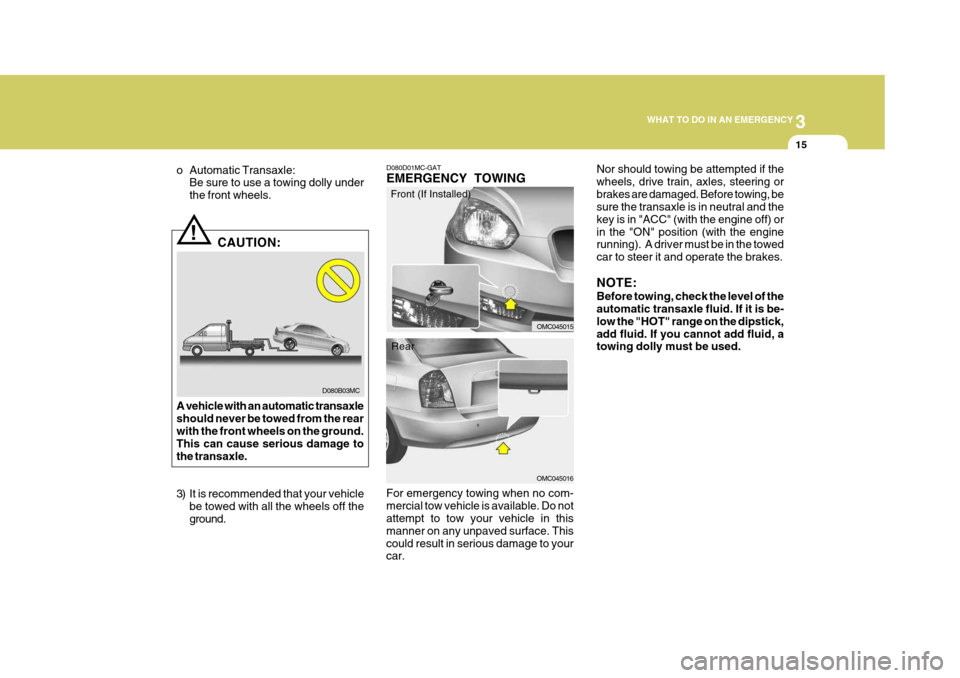
D080B03MC
o Automatic Transaxle:
Be sure to use a towing dolly under the front wheels.
CAUTION:
A vehicle with an automatic transaxleshould never be towed from the rearwith the front wheels on the ground. This can cause serious damage to the transaxle.
3) It is recommended that your vehicle be towed with all the wheels off the ground.
D080D01MC-GAT EMERGENCY TOWING
For emergency towing when no com- mercial tow vehicle is available. Do not attempt to tow your vehicle in this manner on any unpaved surface. Thiscould result in serious damage to your car.
OMC045016
OMC045015
Front (If Installed)
Rear Nor should towing be attempted if the wheels, drive train, axles, steering orbrakes are damaged. Before towing, be sure the transaxle is in neutral and the key is in "ACC" (with the engine off) orin the "ON" position (with the engine running). A driver must be in the towed car to steer it and operate the brakes. NOTE: Before towing, check the level of the automatic transaxle fluid. If it is be- low the "HOT" range on the dipstick,add fluid. If you cannot add fluid, a towing dolly must be used.
Page 210 of 284

4
CORROSION PREVENTION AND APPEARANCE CARE
3
4
CORROSION PREVENTION AND APPEARANCE CARE
3TO HELP PREVENT CORRO- SION
E020C01A-AAT Keep Your Garage Dry Don't park your car in a damp, poorly ventilated garage. This creates a fa- vorable environment for corrosion. Thisis particularly true if you wash your car in the garage or drive it into the garage when it is still wet or covered withsnow, ice or mud. Even a heated ga- rage can contribute to corrosion un- less it is well ventilated so moisture isdispersed. E020D01A-AAT Keep Paint and Trim in Good Condition Scratches or chips in the finish should be covered with "touch-up" paint assoon as possible to reduce the possi- bility of corrosion. If bare metal is show- ing through, the attention of a qualifiedbody and paint shop is recommended. E020E01A-AAT Don't Neglect the Interior Moisture can collect under the floor mats and carpeting to cause corro- sion. Check under the mats periodi- cally to be sure the carpeting is dry.Use particular care if you carry fertiliz- ers, cleaning materials or chemicals in the car.These should be carried only in proper containers and any spills or leaks should be cleaned up, flushed withclear water and thoroughly dried.
E020B01A-AAT Keep Your Car Clean The best way to prevent corrosion is to keep your car clean and free of corro- sive materials. Attention to the under- side of the car is particularly important.
o If you live in a high-corrosion area —
where road salts are used, near the ocean, areas with industrial pollu- tion, acid rain, etc.—, you should take extra care to prevent corro-sion. In winter, hose off the under- side of your car at least once a month and be sure to clean theunderside thoroughly when winter is over.
o When cleaning underneath the car, give particular attention to the com-ponents under the fenders and other areas that are hidden from view. Doa thorough job; just dampening the accumulated mud rather than wash-ing it away will accelerate corrosionrather than prevent it. Water under high pressure and steam are par- ticularly effective in removing accu-mulated mud and corrosive materi- als.
o When cleaning lower door panels,
rocker panels and frame members,be sure that drain holes are kept open so that moisture can escapeand not be trapped inside to ac- celerate corrosion.
E020A01A-AAT You can help prevent corrosion from getting started by observing the follow- ing: