maintenance schedule Hyundai Accent 2010 User Guide
[x] Cancel search | Manufacturer: HYUNDAI, Model Year: 2010, Model line: Accent, Model: Hyundai Accent 2010Pages: 284, PDF Size: 10.23 MB
Page 225 of 284
5VEHICLE MAINTENANCE REQUIREMENTS
10
F070L01A-AAT
o Suspension Mounting Bolts
Check the suspension connections for
looseness or damage. Retighten to the specified torque. F070J01A-AAT
o Brake Pads, Calipers and
Rotors
Check the pads for excessive wear,
discs for run out and wear, and cali- pers for fluid leakage.
F070K01A-AAT
o Exhaust Pipe and Muffler
Visually inspect the exhaust pipes,
muffler and hangers for cracks, dete-rioration, or damage. Start the engine and listen carefully for any exhaustgas leakage. Tighten connections or replace parts as necessary.
F070F01A-AAT
o Brake Hoses and Lines
Visually check for proper installation, chafing, cracks, deterioration and any leakage. Replace any deteriorated or damaged parts immediately. F070G02A-AAT
o Brake Fluid
Check brake fluid level in the brake fluid reservoir. The level should be between "MIN" and "MAX" marks on the side of the reservoir. Use onlyhydraulic brake fluid conforming to DOT 3 or DOT 4. F070H01A-AAT
o Rear Brake Drums/Linings
Parking Brake
Check the rear brake drums and lin- ings for scoring, burning, leaking fluid, broken parts, and excessive wear. Inspect the parking brake system in-cluding the parking brake lever and cables. For detailed service proce- dures, refer to the Shop Manual.
F070D01A-AAT
o Manual Transaxle Oil Inspect the manual transaxle oil ac- cording to the maintenance schedule. NOTE: If the oil level is low, check for possible leaks before adding oil. Do not overfill. F070E05A-AAT
o Automatic Transaxle Fluid The fluid level should be in the "HOT" range of the dipstick, after the engine and transaxle are at normal operating temperature. Check the automatictransaxle fluid level with the engine running and the transaxle in neutral, with the parking brake properly ap-plied. Use Hyundai Genuine ATF SP- III, DIAMOND ATF SP-III, SK ATF SP-III or other brands approved byHyundai Motor Co., when adding or changing fluid.
Page 240 of 284
6 DO-IT-YOURSELF MAINTENANCE
14
!
CAUTION:
o Radiator antifreeze (engine cool- ant) should not be used in the washer system because it will damage the car's finish.
o The washer should not be oper- ated if the washer reservoir isempty. This can damage thewasher fluid pump.!
WARNING:
o Windshield washer fluid agents contain some amounts of alcohol and can be flammable under cer- tain circumstances. Do not allow sparks or flame to contact thewasher fluid or the washer fluid reservoir. Damage to the vehicle or its occupants could occur.
o Windshield washer fluid is poi- sonous to humans and animals.Do not drink windshield washerfluid. Serious injury or death could occur.
CHECKING THE TRANSAXLE OIL (MANUAL)
G100A01MC-GAT
Transaxle lubricant in the manual transaxle should be checked at those intervals specified in the vehicle main-tenance schedule in Section 5.
!WARNING:
It is always better to check the transaxle oil level when the engine iscool or cold. If the engine is hot, you should exercise great caution to avoid burning yourself on hot en-gine or exhaust parts. NOTE: It is recommended that the manual transaxle fluid should be checked by an authorized Hyundai dealer.
FILLING THE WASHER RESERVOIR
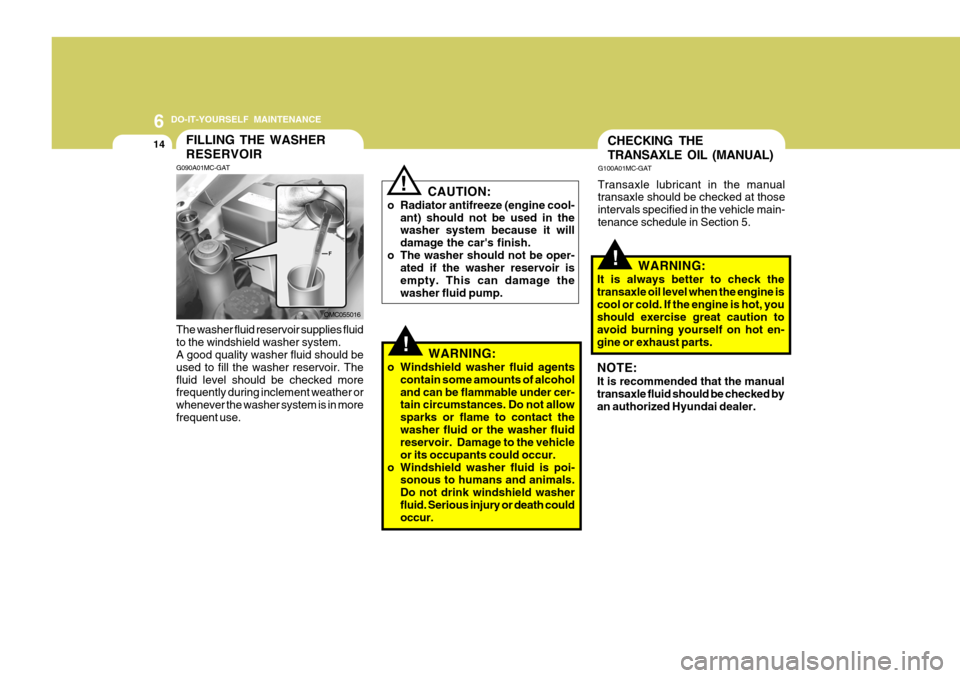
G090A01MC-GAT The washer fluid reservoir supplies fluid to the windshield washer system. A good quality washer fluid should be used to fill the washer reservoir. Thefluid level should be checked more frequently during inclement weather or whenever the washer system is in morefrequent use. OMC055016
Page 241 of 284
6
DO-IT-YOURSELF MAINTENANCE
15CHECKING THE TRANSAXLE FLUID (AUTOMATIC)
G110A01MC-AAT Transaxle fluid in the automatic transaxle should be checked at those intervals specified in the vehicle main- tenance schedule in Section 5. NOTE: Automatic transaxle fluid is basi- cally a red color. As driving distance increases, the fluid color turns dark-ish red gradually. It is normal condi- tion and you should not judge the need to replace based upon thechanging color. You must replace the automatic transaxle fluid in accordance withintervals specified in the vehicle maintenance schedule in section 5.
!WARNING:
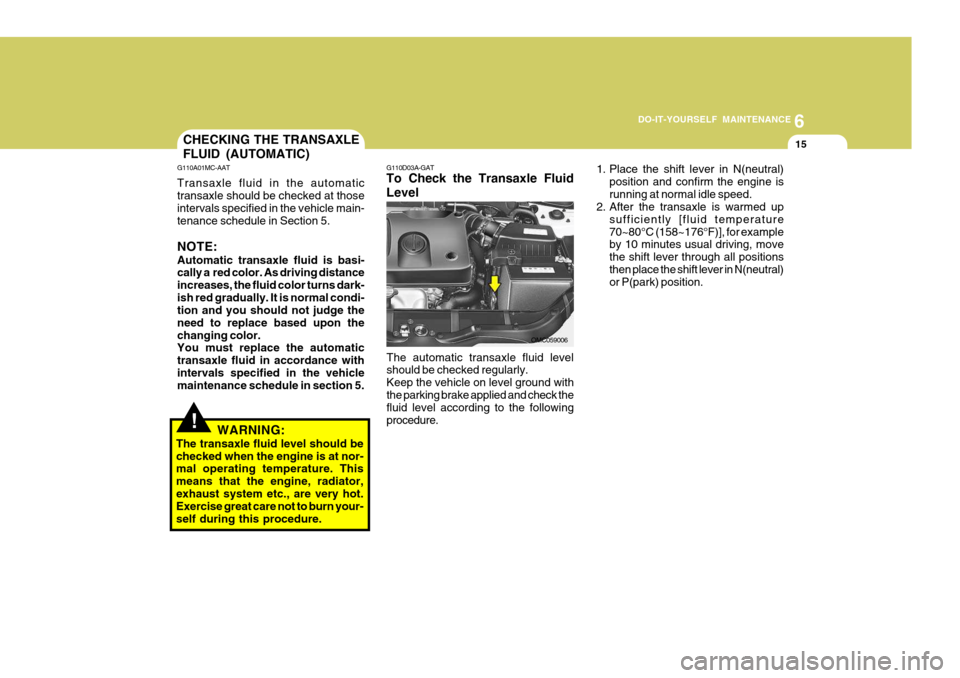
The transaxle fluid level should be checked when the engine is at nor- mal operating temperature. This means that the engine, radiator,exhaust system etc., are very hot. Exercise great care not to burn your- self during this procedure. G110D03A-GAT To Check the Transaxle Fluid Level
The automatic transaxle fluid level should be checked regularly. Keep the vehicle on level ground withthe parking brake applied and check the fluid level according to the following procedure. OMC0590061. Place the shift lever in N(neutral)
position and confirm the engine isrunning at normal idle speed.
2. After the transaxle is warmed up
sufficiently [fluid temperature70~80°C (158~176°F)], for example by 10 minutes usual driving, move the shift lever through all positionsthen place the shift lever in N(neutral) or P(park) position.
Page 243 of 284
6
DO-IT-YOURSELF MAINTENANCE
17
!
CHECKING THE BRAKES
G120A01A-AAT
G120B01A-AAT Checking the Brake Fluid Level
! CAUTION:
Because brakes are essential to the safe operation of the car, it is sug-gested that they be checked and inspected by your Hyundai dealer. The brakes should be checked andinspected for wear at those inter- vals specified in the vehicle mainte- nance schedule in Section 5.
WARNING:
Use caution when handling brakefluid. It can damage your vision if itgets into your eyes. It will also dam- age your vehicle's paint if spilled on it and not removed immediately.
G120D01A-AAT To Check the Fluid Level
OMC055015
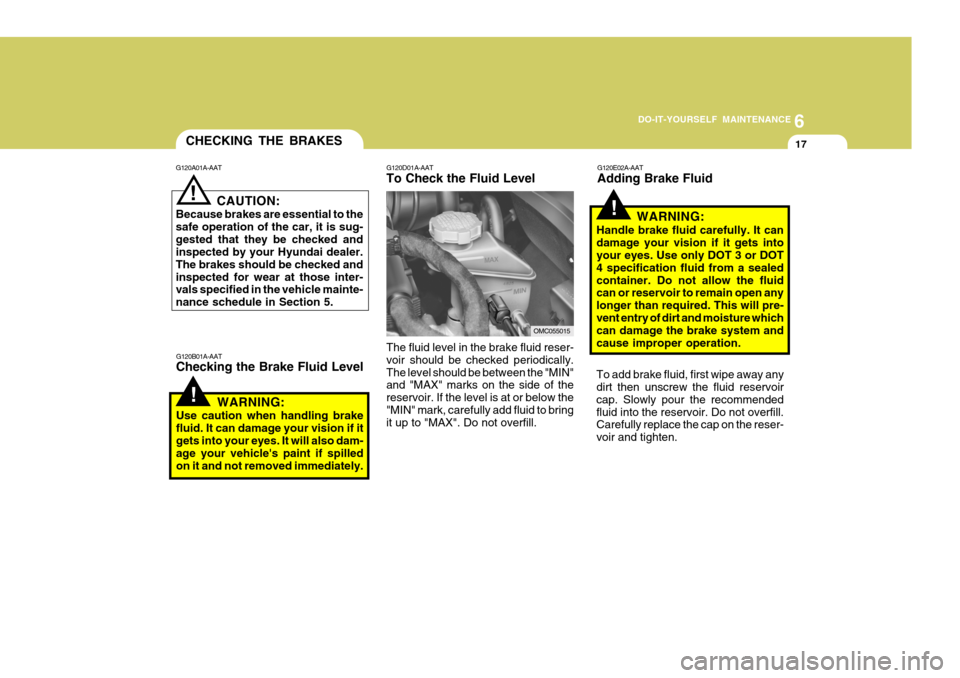
The fluid level in the brake fluid reser- voir should be checked periodically.The level should be between the "MIN" and "MAX" marks on the side of the reservoir. If the level is at or below the"MIN" mark, carefully add fluid to bring it up to "MAX". Do not overfill.
!
G120E02A-AAT Adding Brake Fluid
WARNING:
Handle brake fluid carefully. It can damage your vision if it gets into your eyes. Use only DOT 3 or DOT 4 specification fluid from a sealedcontainer. Do not allow the fluid can or reservoir to remain open any longer than required. This will pre-vent entry of dirt and moisture which can damage the brake system and cause improper operation. To add brake fluid, first wipe away any dirt then unscrew the fluid reservoir cap. Slowly pour the recommendedfluid into the reservoir. Do not overfill. Carefully replace the cap on the reser- voir and tighten.
Page 266 of 284
7EMISSION CONTROL SYSTEMS
2EMISSION CONTROL SYSTEM
H010A01A-GAT
(If Installed)
Your Hyundai is equipped with an
emission control system to meet all requirements of the Emission prohibi- tion rules of your province. There are three emission control sys-
tems which are as follows.
1) Crankcase emission control sys- tem
2) Evaporative emission control sys-
tem
3) Exhaust emission control system
In order to assure the proper function
of the emission control systems, it is recommended that you have your car inspected and maintained by an au- thorized Hyundai dealer in accordancewith the maintenance schedule in this manual. H010B01A-AAT
1. Crankcase Emission Control
System
The positive crankcase ventilation
system is employed to prevent airpollution caused by blow-by gases being emitted from the crankcase.This system supplies fresh air to the crankcase through the air intake hose. Inside the crankcase, the fresh airmixes with blow-by gases, which then pass through the PCV valve and into the induction system.
H010C02E-GAT
2. Evaporative Emission
Control System
The Evaporative Emission Control
System is designed to prevent fuelvapors from escaping into the atmo-sphere. Canister
Fuel vapors generated inside the fuel
tank are absorbed and stored in the canister. When the engine is running, the fuel vapors absorbed in the can-ister are drawn into the induction sys-tem through the purge control sole- noid valve. Purge Control Solenoid Valve (PCSV)
The purge control solenoid valve is
controlled by the Engine Control Mod- ule (ECM); when the engine coolant temperature is low during idling, the PCSV closes so that evaporated fuelis not taken into the engine. After the engine warms-up during ordinary driv- ing, the PCSV opens so as to intro-duce evaporated fuel to the engine. H010D01A-AAT
3. Exhaust Emission Control
System
The exhaust emission control system is a highly effective system which controls exhaust emission while main-taining good vehicle performance.
Page 283 of 284

10INDEX
4
Map light ................................................................. 1-89
J Jump Starting .............................................................. 3-3
K
Key .............................................................................. 1-5 If you lose y our keys ............................................. 3-17
Positions ................................................................... 2-4
Keyless Entry System .............................................. 1-13
L
Lubrication Chart .......................................................... 9-4
Luggage Net ............................................................ 1-100
MMaintenance Intervals Explanation of scheduled maintenance items .......... 5-8Maintenance under severe usage conditions ............ 5-7
Scheduled maintenance ............................................ 5-4
Service requirements ................................................ 5-3
Mirrors Day/night inside rearview .. ......................................1-94
Outside rearview mirror .. ......................................... 1-92
Multi Box ................................................................... 1-92
Multi-Function Light Switch ........................................ 1-75
Daytime running lights ............................................ 1-77
Headlight flasher ..................................................... 1-77
Headlight switch ..................................................... 1-76High-beam switch
................................................... 1-77
Lane change si gnal ................................................. 1-76
Parking light auto cut ............................................. 1-76
Turn signal operation .............................................. 1-75
O
Odometer/ Trip Odometer ...... ....................................1-71
P Parking Brake ............................................................ 1-94
Power Outlet .............................................................. 1-85
Power Steering Fluid Level ....... .................................6-24
Power Windows ......................................................... 1-14
RRear Parking Assist System ..................................... 2-16
Rear Seat .................................................................. 1-21
Folding rear seatbacks .... .......................................1-23
Rear Window Defroster Switch .................................. 1-83
SSeats ......................................................................... 1-16
Front seat ............................................................... 1-17
Rear seat ................................................................ 1-21
Rear seat entry ....................................................... 1-20
Seat warmer ........................................................... 1-20
Seat Belts
2-Point type ............................................................ 1-30
3-Point system ....................................................... 1-29
Adjustable height .................................................... 1-28