fuel Hyundai Accent 2011 User Guide
[x] Cancel search | Manufacturer: HYUNDAI, Model Year: 2011, Model line: Accent, Model: Hyundai Accent 2011Pages: 282, PDF Size: 14.82 MB
Page 78 of 282
1
FEATURES OF YOUR HYUNDAI
671
FEATURES OF YOUR HYUNDAI
67
B260N01MC-AAT
Malfunction Indicator Light
This light illuminates when there is a
malfunction of an exhaust gas related
component and the system is not func-
tioning properly. This light will also illumi-
nate when the ignition key is turned to the
"ON" position, and will go out in a few
seconds after the engine is started. If it
illuminates while driving, or does not illumi-
nate when the ignition key is turned to the
"ON" position, take your car to your nearest
authorized Hyundai dealer and have the
system checked.
!
CAUTION:
Prolonged driving with the Emission
Control System Malfunction Indicator
Light illuminated may cause damage to
the emission control systems which
could effect drivability or fuel economy.
If the Emission Control System Malfunc-
tion Indicator Light begins to flash ON
and OFF, potential catalytic converter
damage is possible. This could result in
loss of engine power. Have the Engine
Control System inspected as soon as
possible by an authorized Hyundai
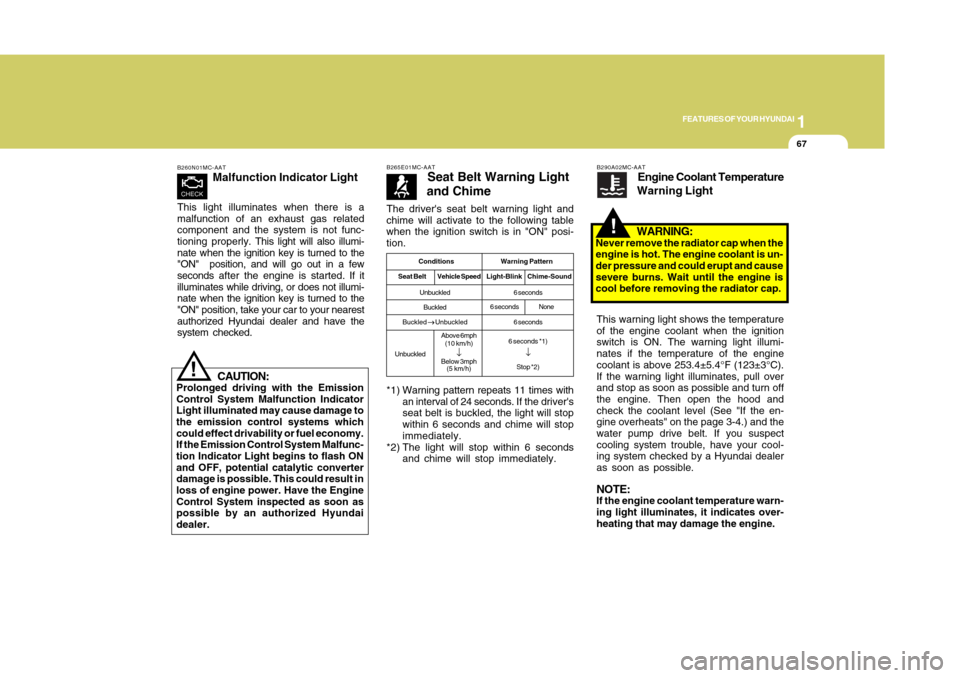
dealer.The driver's seat belt warning light and
chime will activate to the following table
when the ignition switch is in "ON" posi-
tion.
B265E01MC-AAT
Seat Belt Warning Light
and Chime
*1) Warning pattern repeats 11 times with
an interval of 24 seconds. If the driver's
seat belt is buckled, the light will stop
within 6 seconds and chime will stop
immediately.
*2) The light will stop within 6 seconds
and chime will stop immediately.
Conditions Warning Pattern
Seat BeltVehicle SpeedLight-Blink Chime-SoundUnbuckled
Buckled
Buckled
→ →→ →
→ Unbuckled
UnbuckledAbove 6mph
(10 km/h)
↓
Below 3mph
(5 km/h)6 seconds
6 seconds
6 seconds *1)
↓Stop *2)
6 secondsNone
B290A02MC-AAT
Engine Coolant Temperature
Warning Light
WARNING:
Never remove the radiator cap when the
engine is hot. The engine coolant is un-
der pressure and could erupt and cause
severe burns. Wait until the engine is
cool before removing the radiator cap.
!
This warning light shows the temperature
of the engine coolant when the ignition
switch is ON. The warning light illumi-
nates if the temperature of the engine
coolant is above 253.4±5.4°F (123±3°C).
If the warning light illuminates, pull over
and stop as soon as possible and turn off
the engine. Then open the hood and
check the coolant level (See "If the en-
gine overheats" on the page 3-4.) and the
water pump drive belt. If you suspect
cooling system trouble, have your cool-
ing system checked by a Hyundai dealer
as soon as possible.NOTE:If the engine coolant temperature warn-
ing light illuminates, it indicates over-
heating that may damage the engine.
Page 80 of 282
1
FEATURES OF YOUR HYUNDAI
691
FEATURES OF YOUR HYUNDAI
69
!
B265W01MC-AAT
TPMS (Tire Pressure Moni-
toring System) Malfunction
Indicator (If Installed)
TPMS malfunction indicator comes on for
3 seconds after the ignition key is turned
to the "ON" position. If the warning light
does not come on, or continuously re-
mains on after comming on for about 3
seconds when you turned the ignition key
to the "ON" position, the Tire Pressure
Monitoring System is not working porperly.
If this occurs, have your vehicle checked
by an authorized Hyundai dealer as soon
as possible.
The warning light also comes on and
stays on when there is a problem with the
Tire Pressure Monitoring System.
If this happens, the system may not moni-
tor the tire pressure. Have the system
checked by an authorized Hyundai dealer
as soon as possible.
WARNING:
o The TPMS cannot alert you to severe
and sudden tire damage caused by
external factors.
o If you feel any vehicle instability, im-
mediately take your foot off the ac-
celerator, apply the brakes gradu-
ally and with light force, and slowly
move to a safe position off the road.
D150340AMC-EU
ECO Indicator (If Installed)
The ECO indicator is displayed to help
you improve fuel efficiency when you are
driving.
o The ECO indicator (green) will turn on
when you drive fuel efficiently in the
ECO ON mode. If you don't want the
indicator displayed, you can turn the
ECO ON mode to OFF mode by press-
ing the TRIP button.
o The indicator will turn off when the
system is not working properly in the
ECO ON mode.
o The fuel efficiency depends on the
driver's driving habit and road condi-
tion.
o The ECO indicator does not function in
P (Park), N (Neutral), and R (Reverse).ECO
!
WARNING:
Don't keep watching the indicator while
driving. It will distract you and cause an
accident that results in severe personal
injury.
B270A01A-AATBRAKE PAD WEAR WARNING
SOUNDThe front disc brake pads have wear
indicators that should make a high-pitched
squealing or scraping noise when new
pads are needed. The sound may come
and go or be heard all the time when the
vehicle is moving. It may also be heard
when the brake pedal is pushed down
firmly. Expensive rotor damage will result
if the worn pads are not replaced. See
your Hyundai dealer immediately.
Page 81 of 282
1FEATURES OF YOUR HYUNDAI70
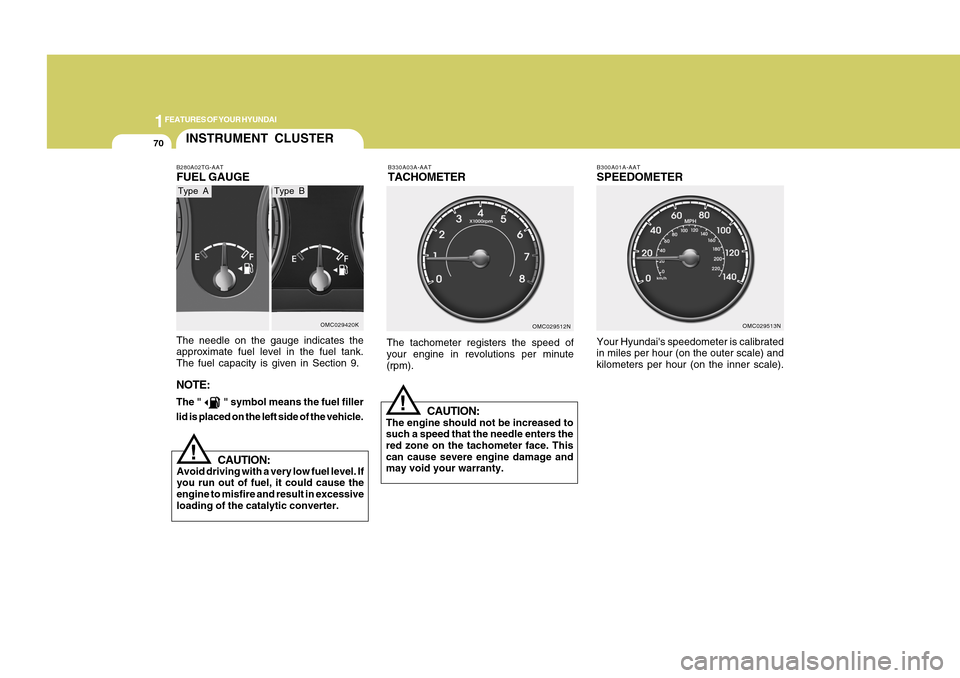
B330A03A-AATTACHOMETERThe tachometer registers the speed of
your engine in revolutions per minute
(rpm).
CAUTION:
The engine should not be increased to
such a speed that the needle enters the
red zone on the tachometer face. This
can cause severe engine damage and
may void your warranty.
!
B300A01A-AATSPEEDOMETERYour Hyundai's speedometer is calibrated
in miles per hour (on the outer scale) and
kilometers per hour (on the inner scale).
OMC029513N
INSTRUMENT CLUSTERB280A02TG-AATFUEL GAUGEThe needle on the gauge indicates the
approximate fuel level in the fuel tank.
The fuel capacity is given in Section 9.NOTE:The "
" symbol means the fuel filler
lid is placed on the left side of the vehicle.
OMC029420K
Type A
Type B
OMC029512N
CAUTION:
Avoid driving with a very low fuel level. If
you run out of fuel, it could cause the
engine to misfire and result in excessive
loading of the catalytic converter.
!
Page 84 of 282
1
FEATURES OF YOUR HYUNDAI
731
FEATURES OF YOUR HYUNDAI
73
2. Trip Odometero This mode indicates the drive distance
travelled since the last drive time reset.
o Refer to the explanation of the trip
computer (see page 1-74, Tripmeter).
TRIP COMPUTER
B400B01MC-A
The trip computer is a microcomputer-
controlled driver information gauge that
displays information related to driving
such as outside temperature, tripmeter,
average fuel consumption and distance
to empty on the LCD.B400B01MC-AAT(If Installed)
Outside temperature
Tripmeter
Average fuel consumption
Distance to empty
ECO ON/OFF mode (if installed)
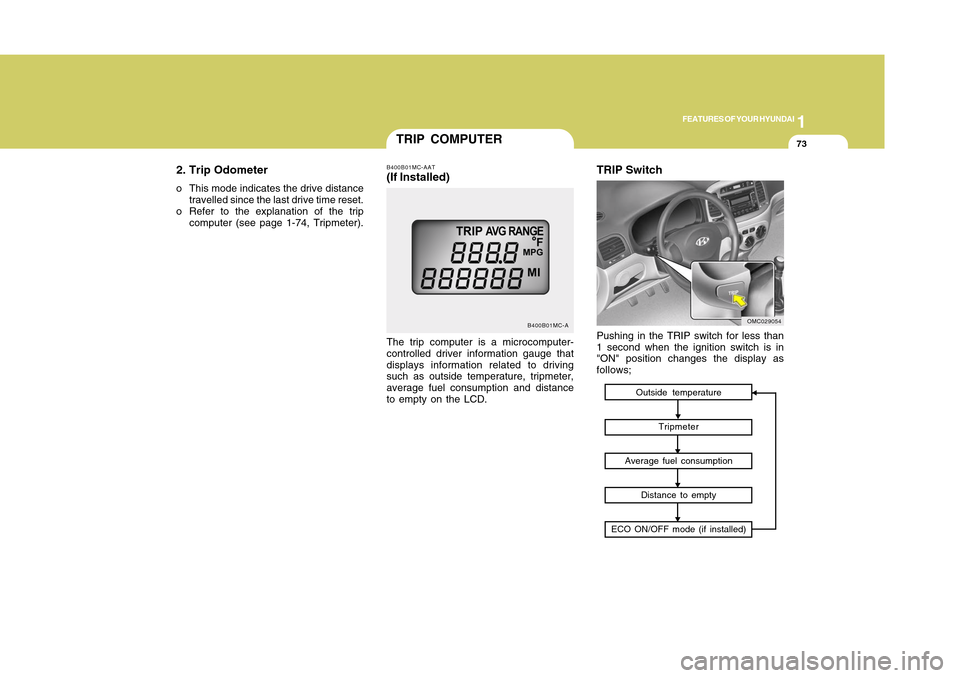
TRIP SwitchPushing in the TRIP switch for less than
1 second when the ignition switch is in
"ON" position changes the display as
follows;
OMC029054
Page 85 of 282
1FEATURES OF YOUR HYUNDAI74
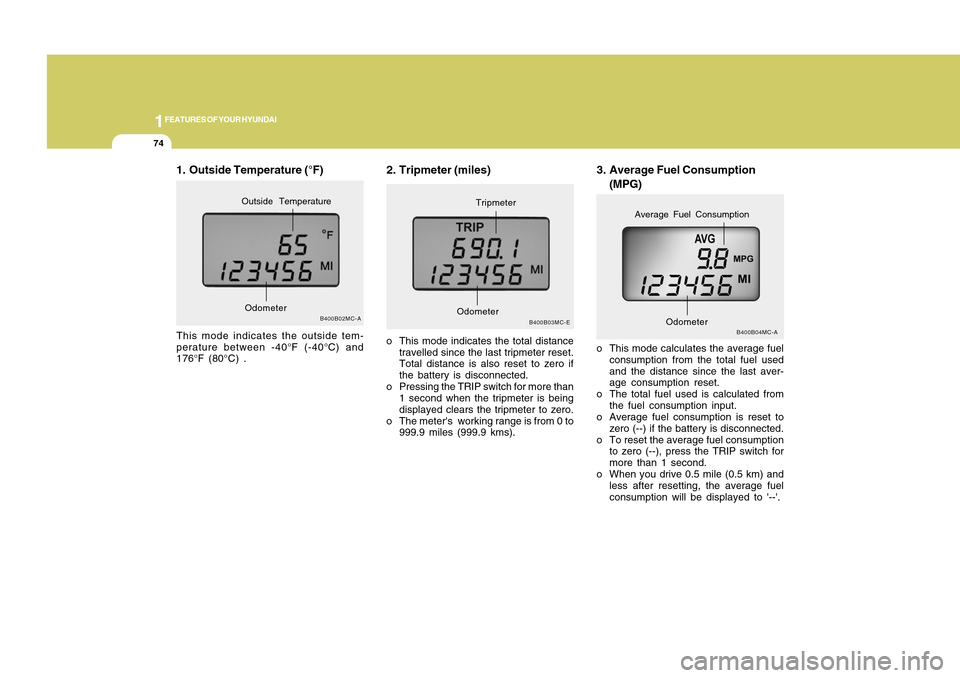
3. Average Fuel Consumption
(MPG)
B400B04MC-A
o This mode calculates the average fuel
consumption from the total fuel used
and the distance since the last aver-
age consumption reset.
o The total fuel used is calculated from
the fuel consumption input.
o Average fuel consumption is reset to
zero (--) if the battery is disconnected.
o To reset the average fuel consumption
to zero (--), press the TRIP switch for
more than 1 second.
o When you drive 0.5 mile (0.5 km) and
less after resetting, the average fuel
consumption will be displayed to '--'.
Odometer
Average Fuel Consumption
2. Tripmeter (miles)o This mode indicates the total distance
travelled since the last tripmeter reset.
Total distance is also reset to zero if
the battery is disconnected.
o Pressing the TRIP switch for more than
1 second when the tripmeter is being
displayed clears the tripmeter to zero.
o The meter's working range is from 0 to
999.9 miles (999.9 kms).
B400B03MC-E
OdometerTripmeter
1. Outside Temperature (°F)This mode indicates the outside tem-
perature between -40°F (-40°C) and
176°F (80°C) .
B400B02MC-A
OdometerOutside Temperature
Page 86 of 282
1
FEATURES OF YOUR HYUNDAI
751
FEATURES OF YOUR HYUNDAI
75
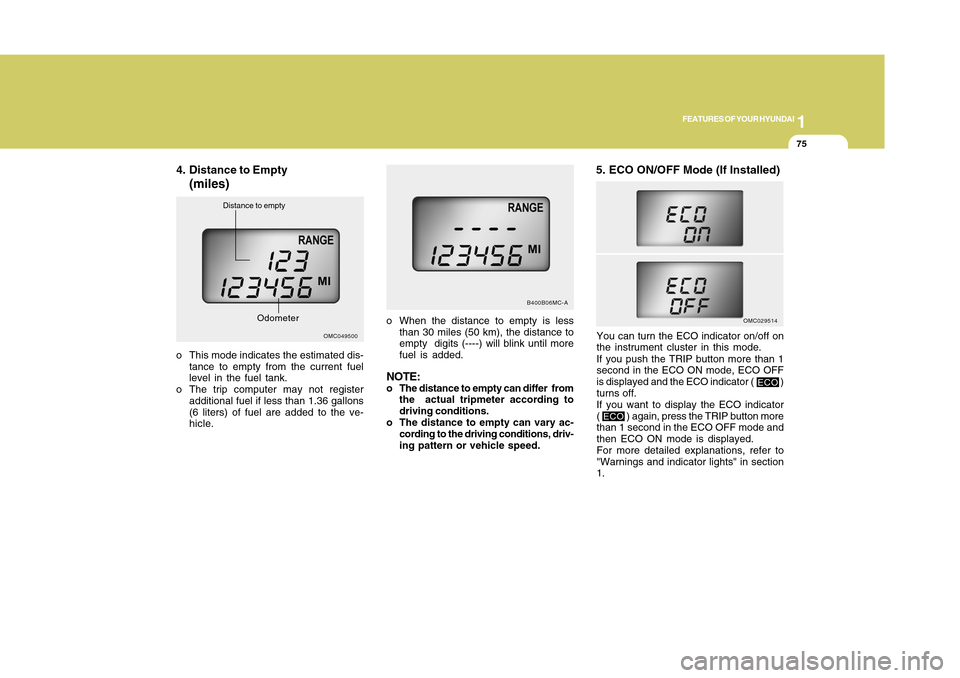
4. Distance to Empty
(miles)
o This mode indicates the estimated dis-
tance to empty from the current fuel
level in the fuel tank.
o The trip computer may not register
additional fuel if less than 1.36 gallons
(6 liters) of fuel are added to the ve-
hicle.
OMC049500
Distance to empty
Odometer
o When the distance to empty is less
than 30 miles (50 km), the distance to
empty digits (----) will blink until more
fuel is added.NOTE:o The distance to empty can differ from
the actual tripmeter according to
driving conditions.
o The distance to empty can vary ac-
cording to the driving conditions, driv-
ing pattern or vehicle speed.
B400B06MC-A
5. ECO ON/OFF Mode (If Installed)You can turn the ECO indicator on/off on
the instrument cluster in this mode.
If you push the TRIP button more than 1
second in the ECO ON mode, ECO OFF
is displayed and the ECO indicator ( )
turns off.
If you want to display the ECO indicator
( ) again, press the TRIP button more
than 1 second in the ECO OFF mode and
then ECO ON mode is displayed.
For more detailed explanations, refer to
"Warnings and indicator lights" in section
1.
OMC029514
ECO
ECO
Page 105 of 282
1FEATURES OF YOUR HYUNDAI94
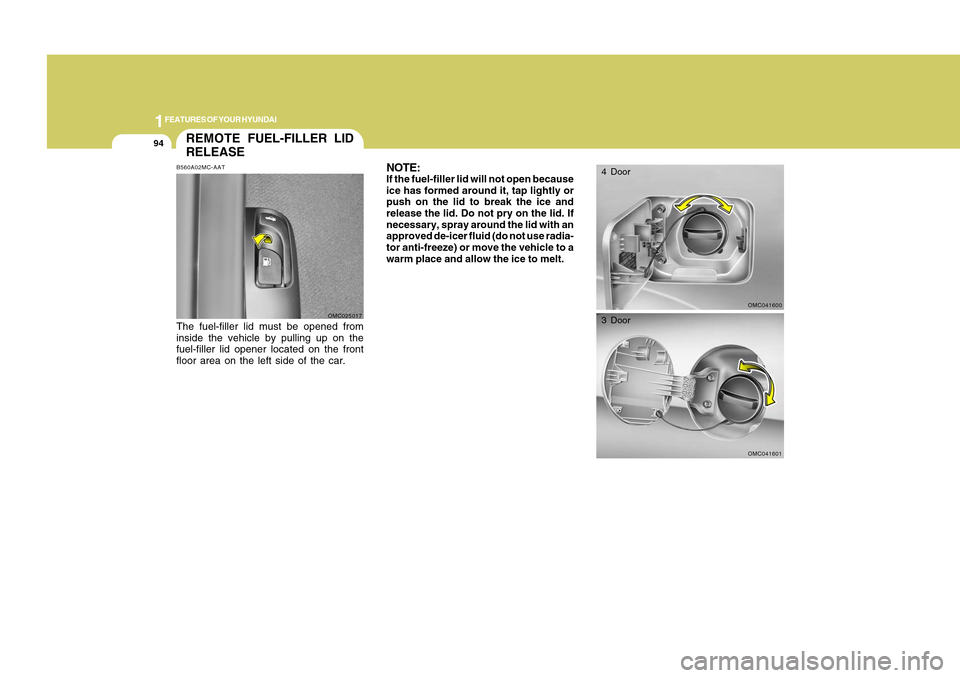
REMOTE FUEL-FILLER LID
RELEASE
NOTE:If the fuel-filler lid will not open because
ice has formed around it, tap lightly or
push on the lid to break the ice and
release the lid. Do not pry on the lid. If
necessary, spray around the lid with an
approved de-icer fluid (do not use radia-
tor anti-freeze) or move the vehicle to a
warm place and allow the ice to melt.
OMC041601OMC041600
4 Door
3 Door
B560A02MC-AAT
OMC025017The fuel-filler lid must be opened from
inside the vehicle by pulling up on the
fuel-filler lid opener located on the front
floor area on the left side of the car.
Page 106 of 282
1
FEATURES OF YOUR HYUNDAI
951
FEATURES OF YOUR HYUNDAI
95
!
WARNING:
If you must re-enter the vehicle,
you should once again eliminate
potentially dangerous static elec-
tricity discharge by touching a
metal part of the vehicle, away
from the fuel filler neck, nozzle or
other gasoline source.
- When using a portable fuel con-
tainer be sure to place the con-
tainer on the ground prior to refu-
eling. Static electricity discharge
from the container can ignite fuel
vapors causing a fire. Once refu-
eling has begun, contact with the
vehicle should be maintained until
the filling is complete. Use only
portable fuel containers designed
to carry and store gasoline.
- Do not use cellular phones around
a gas station or while refueling any
vehicle. Electric current and/or
electronic interference from cellu-
lar phones can potentially ignite
fuel vapors causing a fire. If you
must use your cellular phone use
it in a place away from the gas
station.
!
WARNING:
o Gasoline vapors are dangerous.
Before refueling, always stop the
engine and never smoke or allow
sparks and open flames near the
filler area.
o Never operate your vehicle without a
filler cap properly installed, flam-
mable vapors and gasoline could
leak out in dangerous situations such
as a collision or rollover. If the filler
cap must be replaced, only use genu-
ine Hyundai replacement parts.
o After refueling, make sure the fuel
cap is installed securely to prevent
fuel spillage in the event of an acci-
dent.
o Tighten the cap until it clicks one
time, otherwise the "
"light will
illuminate.
o If you open the fuel filler cap during
high ambient temperatures, a slight
"pressure sound" may be heard.
This is normal and not a cause for
concern. Whenever you open the fuel
filler cap, turn it slowly.
o Do not "top off" after the nozzle au-
tomatically shuts off when refueling.
o Automotive fuels are flammable/ex-
plosive materials. When refueling,
please note the following guidelines
carefully. Failure to follow these
guidelines may result in severe per-
sonal injury, severe burns or death
by fire or explosion.
- Read and follow all warnings posted
at the gas station facility.
- Before refueling, note the location
of the Emergency Gasoline Shut-
Off, if available, at the gas station
facility.
- Before touching the fuel nozzle or
fuel filler cap, you should eliminate
potentially dangerous static elec-
tricity discharge by touching an-
other metal part of the front of the
vehicle, a safe distance away from
the fuel filler neck, nozzle, or other
gas source.
- Do not get back into a vehicle once
you have begun refueling. Do not
touch, rub or slide against any item
or fabric (polyester, satin, nylon,
etc.) capable of producing static
electricity. Static electricity dis-
charge can ignite fuel vapors re-
sulting in explosion.
!
WARNING:
Page 107 of 282
1FEATURES OF YOUR HYUNDAI96
!
WARNING:
- When refueling always shut the
engine off. Sparks produced by
electrical components related to
the engine can ignite fuel vapors
causing a fire. Always insure that
the engine is OFF before and dur-
ing refueling. Once refueling is
complete, check to make sure the
fuel filler cap and door are se-
curely closed, before starting the
engine.
- Do not light any fire around a gas
station. DO NOT use matches or a
lighter and DO NOT SMOKE or
leave a lit cigarette in your vehicle
while at a gas station especially
during refueling. Automotive fuel
is highly flammable and can, when
ignited, result in explosion by
flames.
- If a fire breaks out during refueling,
leave the vicinity of the vehicle,
and immediately contact the man-
ager of the gas station or contact
the police and local fire depart-
ment. Follow any safety instruc-
tions they provide.
!TRUNK LID/TAIL GATEB540A01MC-GAT
WARNING:
The trunk lid or the tail gate should al-
ways be kept completely closed while
the vehicle is in motion. If it is left open or
ajar, poisonous exhaust gases may en-
ter the car resulting in serious illiness or
death to the occupants. See additional
warnings concerning exhaust gases on
page 2-2.
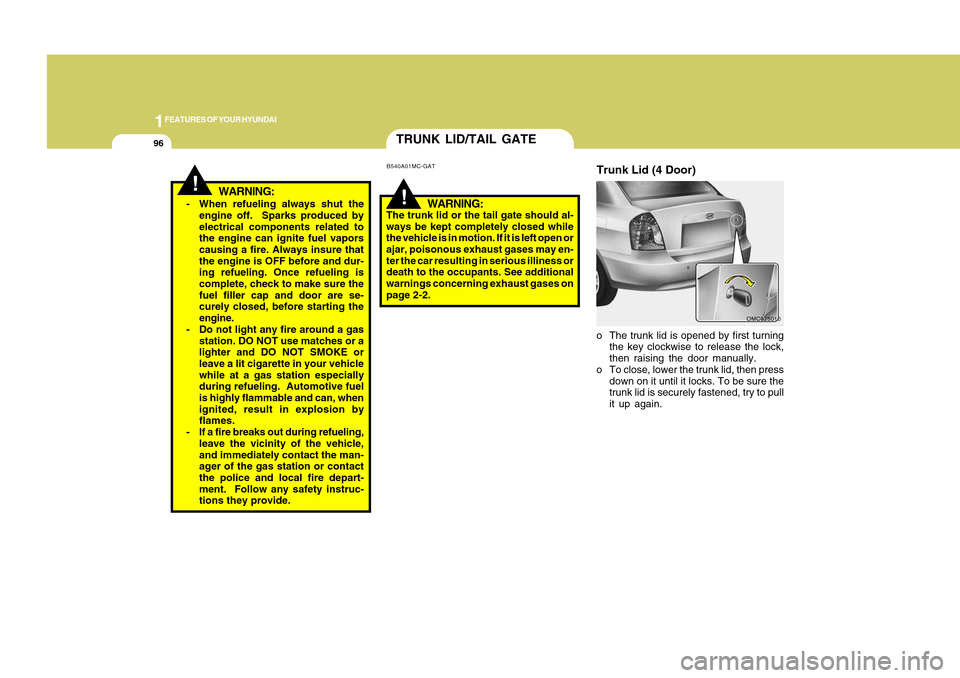
o The trunk lid is opened by first turning
the key clockwise to release the lock,
then raising the door manually.
o To close, lower the trunk lid, then press
down on it until it locks. To be sure the
trunk lid is securely fastened, try to pull
it up again.
OMC025010
Trunk Lid (4 Door)
Page 159 of 282
3
DRIVING YOUR HYUNDAI
2
!
BEFORE STARTING THE
ENGINEC020A03A-AATBefore you start the engine, you should
always:
1. Look around the vehicle to be sure
there are no flat tires, puddles of oil or
water or other indications of possible
trouble.
2. After entering the car, check to be
sure the parking brake is engaged.
3. Check that all windows, and lights are
clean.
4. Check that the interior and exterior
mirrors are clean and in position.
5. Check your seat, seatback and head-
rest to be sure they are in their proper
positions.
6. Lock all the doors.
7. Fasten your seat belt and be sure that
all other occupants have fastened
theirs.
8. Turn off all lights and accessories that
are not needed.
9. When you turn the ignition switch to
"ON", check that all appropriate warn-
ing lights are operating and that you
have sufficient fuel.
10. Check the operation of warning lights
and all bulbs when key is in the "ON"
position.
CALIFORNIA PROPOSITION
65 WARNING:
Engine exhaust and a wide variety of
automobile components and parts, in-
cluding components found in the inte-
rior furnishings in a vehicle, contain or
emit chemicals known to the State of
California to cause cancer and birth
defects and reproductive harm. In addi-
tion, certain fluids contained in vehicles
and certain products of component
wear contain or emit chemicals known
to the State of California to cause can-
cer and birth defects or other reproduc-
tive harm.
!
WARNING:
o Always wear appropriate shoes
when operating your vehicle. Unsuit-
able shoes (high heels, ski boots,
etc.) may interfere with your ability
to use the brake and accelerator
pedal, and the clutch (if installed).
o All passengers must be properly
belted whenever the vehicle is mov-
ing. Refer to pages: 1-22 through 1-
31 for more information on their
proper use.
o Always check the surrounding ar-
eas near your vehicle for people,
especially children, before putting a
car into 'drive'.
o When you intend to park or stop the
vehicle with the engine on, be careful
not to depress the accelerator pedal
for a long period of time. It may over-
heat the engine or exhaust system
and cause fire.