fuel Hyundai Accent 2011 Owner's Guide
[x] Cancel search | Manufacturer: HYUNDAI, Model Year: 2011, Model line: Accent, Model: Hyundai Accent 2011Pages: 282, PDF Size: 14.82 MB
Page 210 of 282
5
VEHICLE MAINTENANCE REQUIREMENTS2
MAINTENANCE INTERVALSF010B01A-AATMaintenance RequirementsThe maintenance required for your
Hyundai can be divided into three main
areas:
o Specified scheduled procedures
o General checks
o Do-it-yourself maintenanceF010A01A-AATService RequirementsTo ensure that you receive the greatest
number of miles of satisfying operation
from your Hyundai, certain maintenance
procedures must be performed. Although
careful design and engineering have re-
duced these to a minimum, those that are
required are of the utmost importance.
It is your responsibility to have these
maintenance procedures performed to
comply with the terms of the warranties
covering your new Hyundai. The Owner's
Handbook supplied with your new ve-
hicle provides further information about
these warranties.
F010D01A-AATGeneral ChecksThese are the regular checks you should
perform when you drive your Hyundai or
you fill the fuel tank. A list of these items
will be found on page 6-4.
F010C01A-AATSpecified Scheduled ProceduresThese are the procedures such as in-
spections, adjustments and replacements
that are listed in the maintenance charts
starting on page 5-4. These procedures
must be performed at the intervals shown
in the maintenance schedule to assure
that your warranty remains in effect. Al-
though it is strongly recommended that
they be performed by the factory-trained
or distributor-trained technicians at your
Hyundai dealer, these procedures may
be performed at any qualified service
facility.
It is suggested that genuine Hyundai
service parts be used for any required
repairs or replacements. Other parts of
equivalent quality such as engine oil,
engine coolant, manual or auto transaxle
oil, brake fluid and so on which are not
supplied by Hyundai Motor Company or
its distributor may be used without affect-
ing your warranty coverage but you should
always be sure these are equivalent to
the quality of the original Hyundai parts.
Your Owner's Handbook provides further
information about your warranty cover-
age.
F010E01A-AATDo-It-Yourself MaintenanceIf you are mechanically inclined, own a
few tools that are required and want to
take the time to do so, you can inspect
and service a number of items. For more
information about doing it yourself, see
Section 6.
Page 212 of 282
5
VEHICLE MAINTENANCE REQUIREMENTS4
SCHEDULED MAINTENANCE
150
240
120
I
I
I
R
R
R MILES X 1000
KILOMETERS X 1000
MONTHS
EMISSION CONTROL ITEMS
ENGINE OIL AND FILTER
FUEL FILTER
FUEL LINES, FUEL HOSES AND CONNECTIONS
VACUUM HOSE
VAPOR HOSE AND FUEL FILLER CAP
AIR CLEANER FILTER
FUEL TANK AIR FILTER
SPARK PLUGS No.DESCRIPTION
1
2
3
4
5
6
7
87.5
12
6
I
I15
24
12
I
I
I22.5
36
18
I
I30
48
24
I
I
I
R
R
R37.5
60
30
I
I45
72
36
I
I
I52.5
84
42
R
I
I60
96
48
I
I
I
R
R
R67.5
108
54
I75
120
60
I
I
I82.5
132
66
I90
144
72
I
I
I
R
R
R97.5
156
78
I
I105
168
84
R
I
I
I112.5
180
90
I
I120
192
96
I
I
I
R
R
R127.5
204
102
I
I135
216
108
I
I
I142.5
228
114
I
I
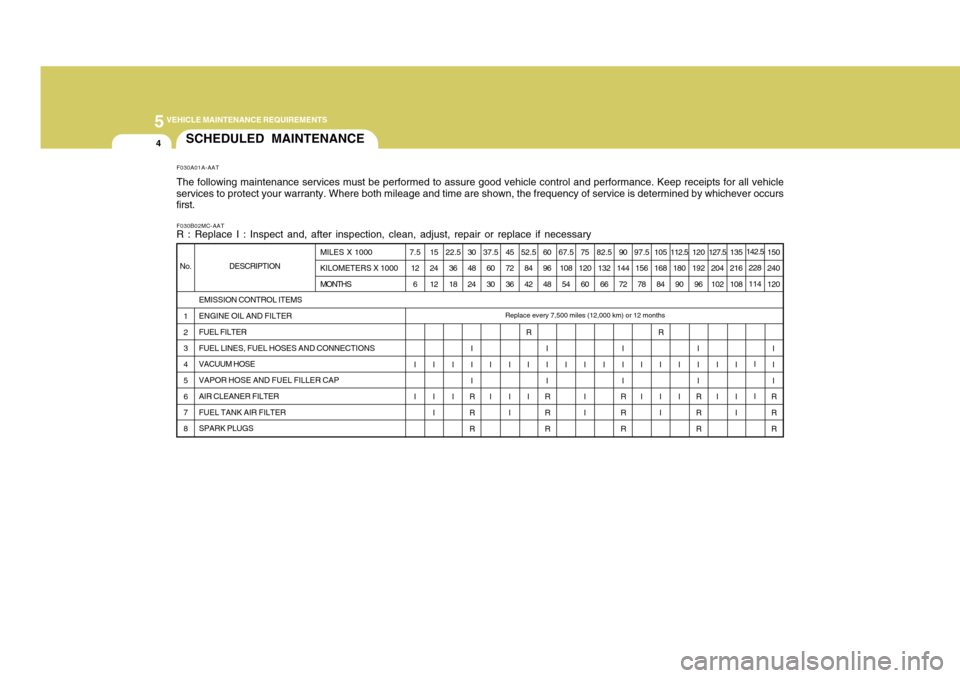
F030B02MC-AATR : Replace I : Inspect and, after inspection, clean, adjust, repair or replace if necessaryF030A01A-AATThe following maintenance services must be performed to assure good vehicle control and performance. Keep receipts for all vehicle
services to protect your warranty. Where both mileage and time are shown, the frequency of service is determined by whichever occurs
first.
Replace every 7,500 miles (12,000 km) or 12 months
Page 215 of 282
5
VEHICLE MAINTENANCE REQUIREMENTS
7
EXPLANATION OF SCHEDULED
MAINTENANCE ITEMS
F060D01A-AATo Fuel Lines, Fuel Hoses and
ConnectionsCheck the fuel lines, fuel hoses and con-
nections for leakage and damage. Have
a trained techincian, replace any dam-
aged or leaking parts immediately.
F060C01A-AATo Fuel FilterA clogged filter can limit the speed at
which the vehicle may be driven, damage
the emission system and cause hard start-
ing. If an excessive amount of foreign
matter accumulates in the fuel tank, the
filter may require replacement more fre-
quently.
After installing a new filter, run the engine
for several minutes, and check for leaks
at the connections.
Fuel filters should be installed by trained
technicians.F060M01A-AATo Engine Oil and FilterThe engine oil and filter should be
changed at the intervals specified in the
maintenance schedule. If the car is being
driven in severe conditions, more fre-
quent oil and filter changes are required.
F060H01A-AATo Air Cleaner FilterA Genuine Hyundai air cleaner filter is
recommended when the filter is replaced.F060G01A-AATo Vapor Hose and Fuel Filler CapThe vapor hose and fuel filler cap should
be inspected at those intervals specified
in the maintenance schedule. Make sure
that a new vapor hose or fuel filler cap is
correctly replaced.
F060F01A-AATo Vacuum, Crankcase Ventilation
HosesInspect the surface of hoses for evidence
of heat and/or mechanical damage. Hard
and brittle rubber, cracking, tears, cuts,
abrasions, and excessive swelling indi-
cate deterioration. Particular attention
should be paid to examine those hose
surfaces nearest to high heat sources,
such as the exhaust manifold.
Inspect the hose routing to assure that
the hoses do not come in contact with any
heat source, sharp edges or moving com-
ponent which might cause heat damage
or mechanical wear. Inspect all hose
connections, such as clamps and cou-
plings, to make sure they are secure, and
that no leaks are present. Hoses should
be replaced immediately if there is any
evidence of deterioration or damage.
F060B01A-AATo Drive BeltsInspect all drive belts for evidence of cuts,
cracks, excessive wear or oil saturation
and replace if necessary. Drive belts
should be checked periodically for proper
tension and adjusted as necessary.F060J01A-AATo Spark PlugsMake sure to install new spark plugs of
the correct heat range.
Page 224 of 282
6
DO-IT-YOURSELF MAINTENANCE6
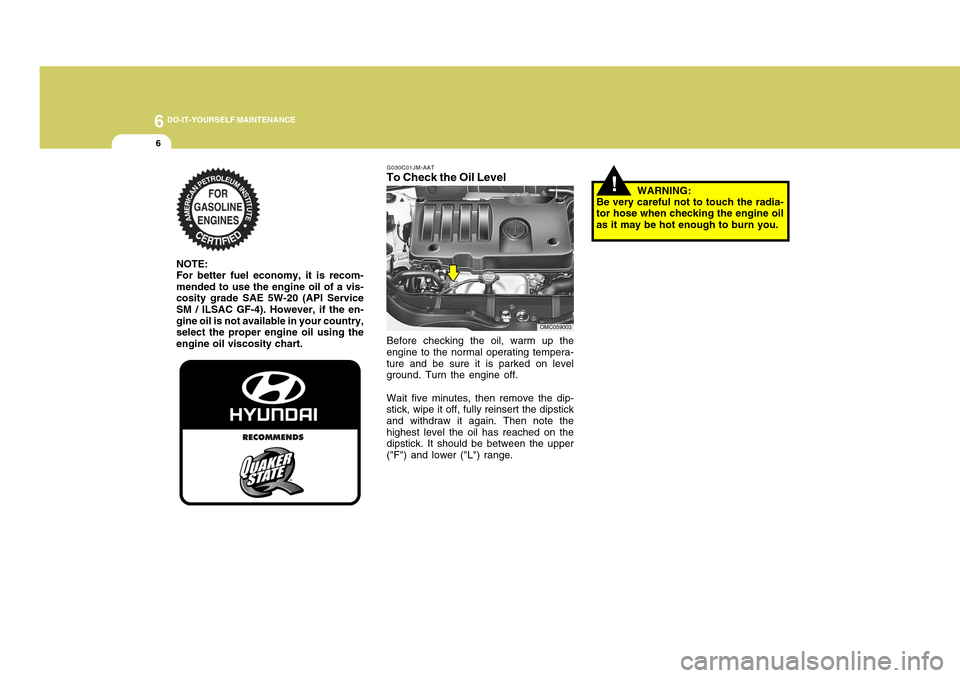
G030C01JM-AATTo Check the Oil LevelBefore checking the oil, warm up the
engine to the normal operating tempera-
ture and be sure it is parked on level
ground. Turn the engine off.
Wait five minutes, then remove the dip-
stick, wipe it off, fully reinsert the dipstick
and withdraw it again. Then note the
highest level the oil has reached on the
dipstick. It should be between the upper
("F") and lower ("L") range.
OMC059003
NOTE:
For better fuel economy, it is recom-
mended to use the engine oil of a vis-
cosity grade SAE 5W-20 (API Service
SM / ILSAC GF-4). However, if the en-
gine oil is not available in your country,
select the proper engine oil using the
engine oil viscosity chart.
!
WARNING:
Be very careful not to touch the radia-
tor hose when checking the engine oil
as it may be hot enough to burn you.
Page 248 of 282
6
DO-IT-YOURSELF MAINTENANCE
30
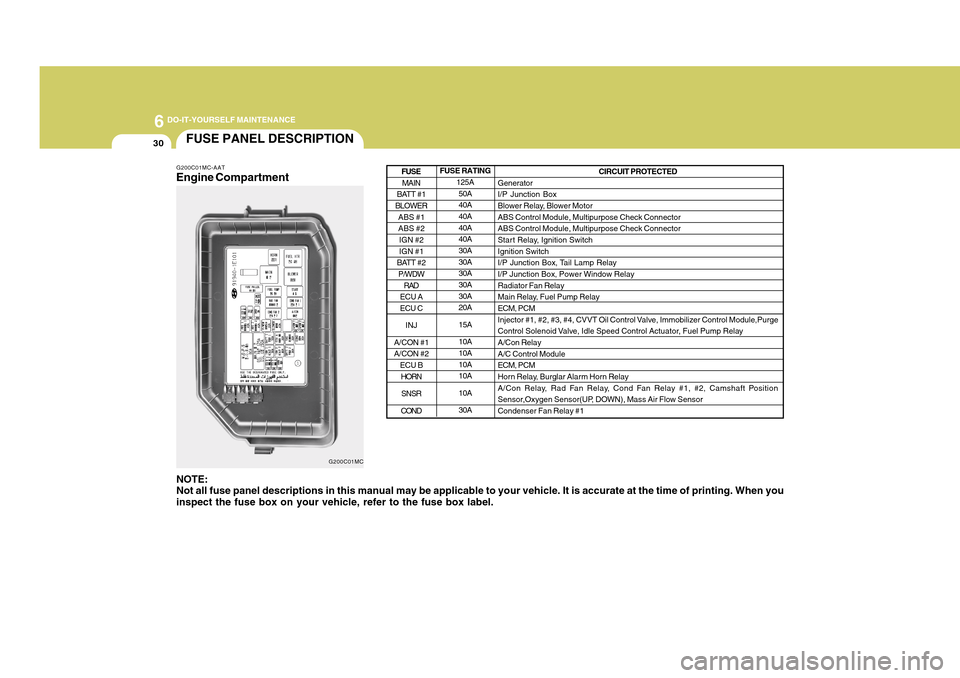
FUSE PANEL DESCRIPTION
FUSE RATING
125A
50A
40A
40A
40A
40A
30A
30A
30A
30A
30A
20A
15A
10A
10A
10A
10A
10A
30A
G200C01MC-AATEngine CompartmentNOTE:
Not all fuse panel descriptions in this manual may be applicable to your vehicle. It is accurate at the time of printing. When you
inspect the fuse box on your vehicle, refer to the fuse box label.
CIRCUIT PROTECTED
Generator
I/P Junction Box
Blower Relay, Blower Motor
ABS Control Module, Multipurpose Check Connector
ABS Control Module, Multipurpose Check Connector
Star t Relay, Ignition Switch
Ignition Switch
I/P Junction Box, Tail Lamp Relay
I/P Junction Box, Power Window Relay
Radiator Fan Relay
Main Relay, Fuel Pump Relay
ECM, PCM
Injector #1, #2, #3, #4, CVVT Oil Control Valve, Immobilizer Control Module,Purge
Control Solenoid Valve, Idle Speed Control Actuator, Fuel Pump Relay
A/Con Relay
A/C Control Module
ECM, PCM
Horn Relay, Burglar Alarm Horn Relay
A/Con Relay, Rad Fan Relay, Cond Fan Relay #1, #2, Camshaft Position
Sensor,Oxygen Sensor(UP, DOWN), Mass Air Flow Sensor
Condenser Fan Relay #1
MAIN
BATT #1
BLOWER
ABS #1
ABS #2
IGN #2
IGN #1
BATT #2
P/WDW
RAD
ECU A
ECU C
INJ
A/CON #1
A/CON #2
ECU B
HORN
SNSR
CONDFUSE
G200C01MC
Page 252 of 282
7
EMISSION CONTROL SYSTEMS2
EMISSION CONTROL SYSTEM
CanisterFuel vapors generated inside the fuel
tank are absorbed and stored in the
onboard canister. When the engine is
running, the fuel vapors absorbed in the
canister are drawn into the induction sys-
tem through the purge control solenoid
valve.Purge Control Solenoid Valve (PCSV)The purge control solenoid valve is con-
trolled by the Engine Control Module
(ECM); when the engine coolant tem-
perature is low during idling, the PCSV
closes so that evaporated fuel is not taken
into the engine. After the engine warms-
up during ordinary driving, the PCSV
opens to introduce evaporated fuel to the
engine.
H010B01A-AAT1. Crankcase Emission Control
SystemThe positive crankcase ventilation sys-
tem is employed to prevent air pollution
caused by blow-by gases being emitted
from the crankcase. This system supplies
filtered fresh air to the crankcase through
the air intake hose. Inside the crankcase,
the fresh air mixes with blow-by gases,
then passes through the PCV valve into
the induction system.
H010A01A-AATYour Hyundai is equipped with an emis-
sion control system to meet all require-
ments of the U.S. Environmental Protec-
tion Agency or California Air Resources
Board.
There are three emission control systems
which are as follows.
1) Crankcase Emission Control System
2) Evaporative Emission Control System
3) Exhaust Emission Control System
In order to ensure the proper function of
the emission control systems, it is recom-
mended that you have your car inspected
and maintained by an authorized Hyundai
dealer in accordance with the mainte-
nance schedule in this manual.
H010C01S-AAT2. Evaporative Emission Control (In-
cluding ORVR: Onboard Refuel-
ing Vapor Recovery) SystemThe Evaporative Emission Control Sys-
tem is designed to prevent fuel vapors
from escaping into the atmosphere.
(The ORVR system is designed to allow
the vapors from the fuel tank to be loaded
into a canister while refueling at the gas
station, preventing the escape of fuel
vapors into the atmosphere.)
Page 253 of 282
7
EMISSION CONTROL SYSTEMS
3
CATALYTIC CONVERTER
!
H010D02A-AAT3. Exhaust Emission
Control SystemThe Exhaust Emission Control System is
a highly effective system which controls
exhaust emissions while maintaining
good vehicle performace.
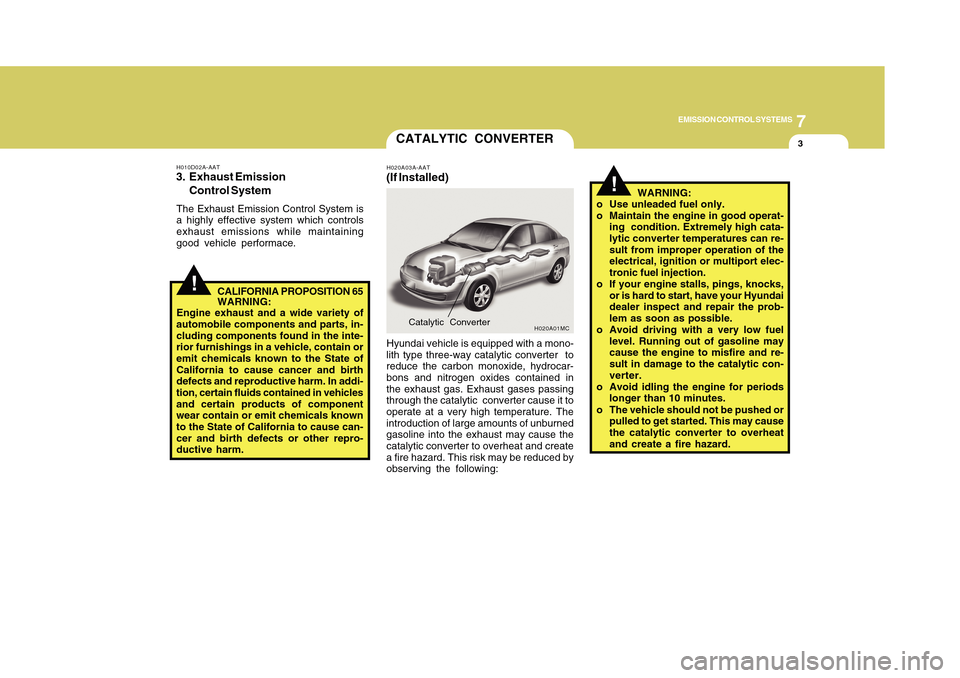
H020A03A-AAT(If Installed)Hyundai vehicle is equipped with a mono-
lith type three-way catalytic converter to
reduce the carbon monoxide, hydrocar-
bons and nitrogen oxides contained in
the exhaust gas. Exhaust gases passing
through the catalytic converter cause it to
operate at a very high temperature. The
introduction of large amounts of unburned
gasoline into the exhaust may cause the
catalytic converter to overheat and create
a fire hazard. This risk may be reduced by
observing the following:
H020A01MC
Catalytic Converter
WARNING:
o Use unleaded fuel only.
o Maintain the engine in good operat-
ing condition. Extremely high cata-
lytic converter temperatures can re-
sult from improper operation of the
electrical, ignition or multiport elec-
tronic fuel injection.
o If your engine stalls, pings, knocks,
or is hard to start, have your Hyundai
dealer inspect and repair the prob-
lem as soon as possible.
o Avoid driving with a very low fuel
level. Running out of gasoline may
cause the engine to misfire and re-
sult in damage to the catalytic con-
verter.
o Avoid idling the engine for periods
longer than 10 minutes.
o The vehicle should not be pushed or
pulled to get started. This may cause
the catalytic converter to overheat
and create a fire hazard.
!
CALIFORNIA PROPOSITION 65
WARNING:
Engine exhaust and a wide variety of
automobile components and parts, in-
cluding components found in the inte-
rior furnishings in a vehicle, contain or
emit chemicals known to the State of
California to cause cancer and birth
defects and reproductive harm. In addi-
tion, certain fluids contained in vehicles
and certain products of component
wear contain or emit chemicals known
to the State of California to cause can-
cer and birth defects or other repro-
ductive harm.
Page 259 of 282
8
CONSUMER INFORMATION, REPORTING SAFETY DEFECTS & BINDING ARBITRATION OF WARRANTY CLAIMS
5
!
!
o Worn tires can cause accidents.
Replace tires that are worn, show
uneven wear, or are damaged.
See page 8-12.
o Remember to check the pressure
of your spare tire. Hyundai rec-
ommends that you check the
spare every time you check the
pressure of the other tires on
your vehicle.
WARNING:
Overinflation or underinflation can
reduce the tire life, adversely affect
vehicle handling, and lead to sud-
den tire failure. This could rusult in
loss of vehicle control and potential
injury.CAUTION:
Always observe the following:
o Check pressures when the tires
are cold. (After the vehicle has
been parked for at least three
hours or hasn't been driven more
than one mile (1.6 km) since start-
ing up.)
o Check the pressure of your spare
tire each time you check the pres-
sure of other tires.
o Never overload your vehicle. Be
especially careful about overload-
ing if you equip your vehicle with
a luggage rack.
o Worn, old tires can cause acci-
dents. If your tread is badly worn,
or if your tires have been dam-
aged, replace them.
!
WARNING:NOTE:
o Underinflation also results in ex-
cessive wear, poor handling and
reduced fuel economy. Wheel de-
formation also is possible. Keep
your tire pressures at the proper
levels. If a tire frequently needs
refilling, have it checked by your
Hyundai Dealer.
o Overinflation produces a harsh
ride, excessive wear at the center
of the tire tread, and a greater
possibility of damage from road
hazards.
Page 262 of 282
8
CONSUMER INFORMATION, REPORTING SAFETY DEFECTS & BINDING ARBITRATION OF WARRANTY CLAIMS8
I030D01JM-AATTIRE TERMINOLOGY AND DEFINI-
TIONS
Air Pressure: The amount of air inside
the tire pressing outward on the tire.
Air pressure is expressed in pounds
per square inch (psi) or kilopascal (kPa).
Accessory Weight: This means the
combined weight of optional accesso-
ries. Some examples of optional ac-
cessories are, automatic transmission,
power seats, and air conditioning.
Aspect Ratio: The relationship of a
tire's height to its width.
Belt: A rubber coated layer of cords
that is located between the plies and
the tread. Cords may be made from
steel or other reinforcing materials.
Bead: The tire bead contains steel
wires wrapped by steel cords that hold
the tire onto the rim.
Bias Ply Tire: A pneumatic tire in
which the plies are laid at alternate
angles less than 90 degrees to the
centerline of the tread.Cold Tire Pressure: The amount of
air pressure in a tire, measured in
pounds per square inch (psi) or
kilopascals (kPa) before a tire has
built up heat from driving.
Curb Weight: This means the weight
of a motor vehicle with standard and
optional equipment including the maxi-
mum capacity of fuel, oil and coolant,
but without passengers and cargo.
DOT Markings: A code molded into
the sidewall of a tire signifying that the
tire is in compliance with the U.S.
Department of Transportation motor
vehicle safety standards. The DOT
code includes the Tire Identification
Number (TIN), an alphanumeric desig-
nator which can also identify the tire
manufacturer, production plant, brand
and date of production.
GVWR: Gross Vehicle Weight Rating
GAWR FRT: Gross Axle Weight Rat-
ing for the front Axle.
GAWR RR: Gross Axle Weight Rating
for the rear axle. 6. Maximum load rating
This number indicates the maxi-
mum load in kilograms and pounds
that can be carried by the tire. When
replacing the tires on the vehicle,
always use a tire that has the same
load rating as the factory installed
tire.
7. Uniform Tire Quality Grading
(UTQG):
Tire manufacturers are required to
grade tires based on three perfor-
mance factors: treadwear, traction
and temperature resistance. For
more information, see Uniform Tire
Quality Grading on page 8-15.
Page 274 of 282
9
VEHICLE SPECIFICATIONS2
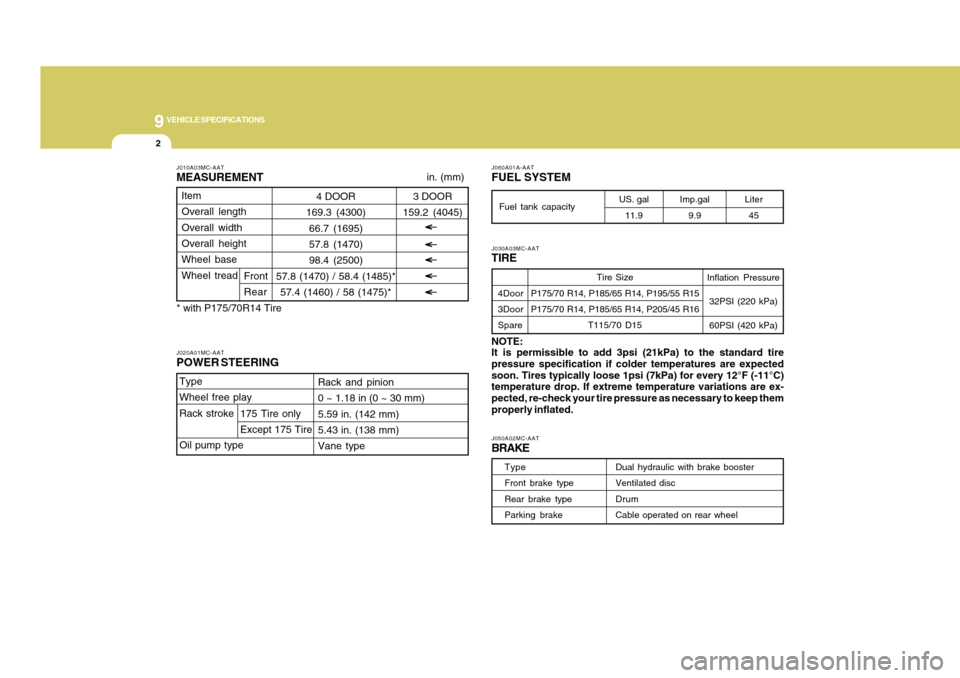
Tire Size
P175/70 R14, P185/65 R14, P195/55 R15
P175/70 R14, P185/65 R14, P205/45 R16
T115/70 D15
in. (mm)
Liter
45
4Door
3Door
Spare
US. gal
11.9 Fuel tank capacityImp.gal
9.9
Inflation Pressure
32PSI (220 kPa)
60PSI (420 kPa)
J010A03MC-AATMEASUREMENTJ020A01MC-AATPOWER STEERING
J060A01A-AATFUEL SYSTEMJ030A03MC-AATTIRE
4 DOOR
169.3 (4300)
66.7 (1695)
57.8 (1470)
98.4 (2500)
57.8 (1470) / 58.4 (1485)*
57.4 (1460) / 58 (1475)* Item
Overall length
Overall width
Overall height
Wheel base
Wheel tread
Front
Rear
3 DOOR
159.2 (4045)
Type
Wheel free play
Rack stroke
Oil pump type
Rack and pinion
0 ~ 1.18 in (0 ~ 30 mm)
5.59 in. (142 mm)
5.43 in. (138 mm)
Vane type
175 Tire only
Except 175 Tire
* with P175/70R14 Tire
NOTE:
It is permissible to add 3psi (21kPa) to the standard tire
pressure specification if colder temperatures are expected
soon. Tires typically loose 1psi (7kPa) for every 12°F (-11°C)
temperature drop. If extreme temperature variations are ex-
pected, re-check your tire pressure as necessary to keep them
properly inflated.
Dual hydraulic with brake booster
Ventilated disc
Drum
Cable operated on rear wheel Type
Front brake type
Rear brake type
Parking brake
J050A02MC-AATBRAKE