fuel Hyundai Accent 2011 Owner's Guide
[x] Cancel search | Manufacturer: HYUNDAI, Model Year: 2011, Model line: Accent, Model: Hyundai Accent 2011Pages: 282, PDF Size: 14.82 MB
Page 163 of 282
7
DRIVING YOUR HYUNDAI
2
!
CAUTION:
o Do not downshift more than 2 gears
or downshift the gear when the en-
gine is running at high speed (5,000
RPM or higher). Such downshifting
may damage the engine.
o When downshifting from fifth gear to
fourth gear, caution should be taken
not to inadvertently press the gear
shift lever sideways in such a man-
ner that second gear is engaged.
Such a drastic downshift may cause
the engine speed to increase to the
point that the tachometer will enter
the red zone. Such over revving of
the engine may possibly cause en-
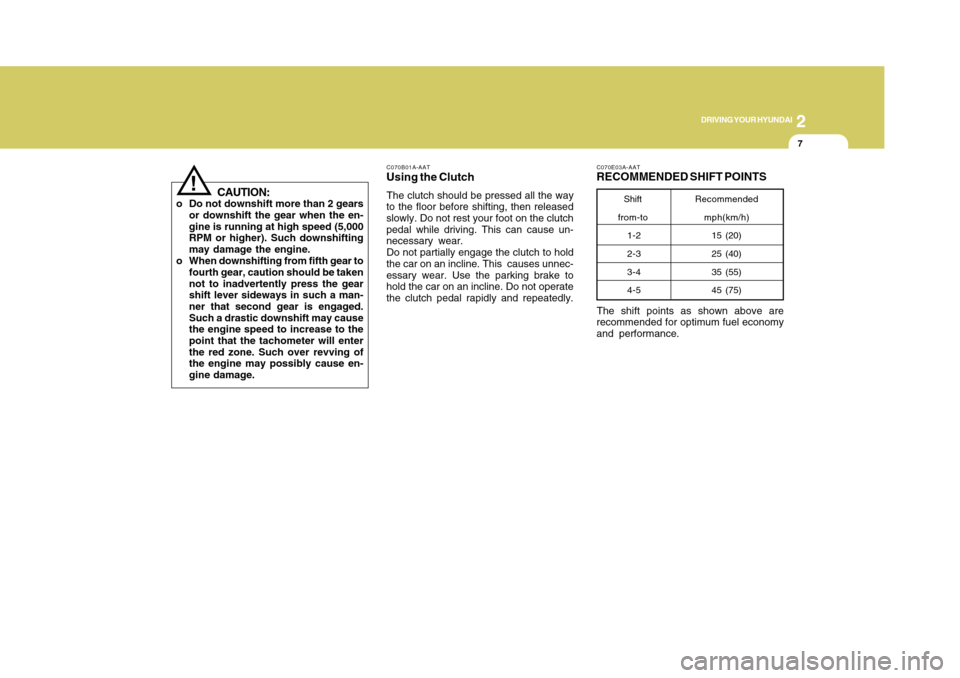
gine damage.The shift points as shown above are
recommended for optimum fuel economy
and performance.
C070E03A-AATRECOMMENDED SHIFT POINTS
C070B01A-AATUsing the ClutchThe clutch should be pressed all the way
to the floor before shifting, then released
slowly. Do not rest your foot on the clutch
pedal while driving. This can cause un-
necessary wear.
Do not partially engage the clutch to hold
the car on an incline. This causes unnec-
essary wear. Use the parking brake to
hold the car on an incline. Do not operate
the clutch pedal rapidly and repeatedly.
Shift
from-toRecommended
mph(km/h)
15 (20)
25 (40)
35 (55)
45 (75) 1-2
2-3
3-4
4-5
Page 165 of 282
9
DRIVING YOUR HYUNDAI
2
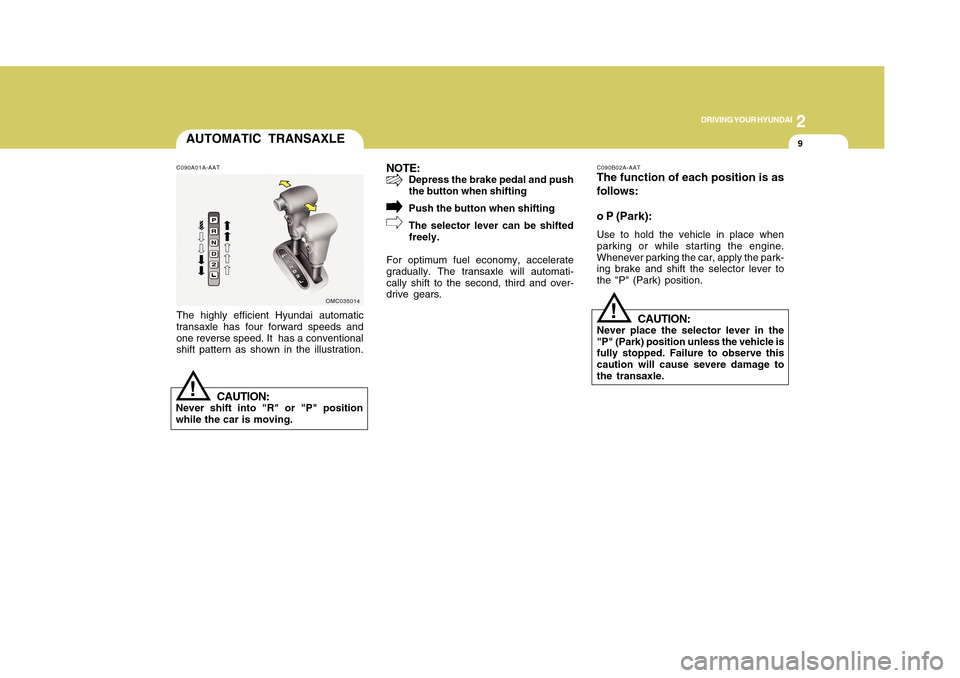
AUTOMATIC TRANSAXLEC090A01A-AATThe highly efficient Hyundai automatic
transaxle has four forward speeds and
one reverse speed. It has a conventional
shift pattern as shown in the illustration.
OMC035014
CAUTION:
Never shift into "R" or "P" position
while the car is moving.
!
NOTE:
Depress the brake pedal and push
the button when shifting
Push the button when shifting
The selector lever can be shifted
freely.
For optimum fuel economy, accelerate
gradually. The transaxle will automati-
cally shift to the second, third and over-
drive gears.
C090B02A-AATThe function of each position is as
follows:
o P (Park):Use to hold the vehicle in place when
parking or while starting the engine.
Whenever parking the car, apply the park-
ing brake and shift the selector lever to
the "P" (Park) position.
CAUTION:
Never place the selector lever in the
"P" (Park) position unless the vehicle is
fully stopped. Failure to observe this
caution will cause severe damage to
the transaxle.
!
Page 168 of 282
2
DRIVING YOUR HYUNDAI
12
WARNING:
o Always buckle-up! In a collision, an
unbelted occupant is significantly
more likely to be seriously injured or
killed than a properly belted occu-
pant.
o Avoid high speeds when cornering
or turning.
o Do not make quick steering wheel
movements, such as sharp lane
changes or fast, sharp turns.
o The risk of rollover is greatly in-
creased if you lose control of your
vehicle at highway speeds.
o Loss of control often occurs if two or
more wheels drop off the roadway
and the driver oversteers to reenter
the roadway.
o In the event your vehicle leaves the
roadway, do not steer sharply. In-
stead, slow down before pulling back
into the travel lanes.
o Never exceed posted speed limits.
!
o Exercise extreme caution when driv-
ing on a slippery surface. Be espe-
cially careful when braking, accelerat-
ing or shifting gears. On a slippery
surface, an abrupt change in vehicle
speed can cause the drive wheels to
lose traction and the vehicle to go out
of control.
o Optimum vehicle performance and
economy is obtained by smoothly de-
pressing and releasing the accelera-
tor pedal.
o Turn the overdrive switch on for good
fuel economy and smooth driving. If
engine braking is needed in the "D"
range or if repeated upshifting and
downshifting between the 3rd and 4th
gear is needed when climbing a gentle
slope, it is recommended that the over-
drive switch be turned off. Turn the
overdrive switch back on immediately
afterward.
C090N07A-AATGood Driving Practiceso Never move the gear selector lever
from "P" or "N" to any other position
with the accelerator pedal depressed.
o Never move the gear selector lever
into "P" when the vehicle is in motion.
o Be sure the car is completely stopped
before you attempt to shift into "R" or
"D".
o Never take the car out of gear and
coast down a hill. This may be ex-
tremely hazardous. Always leave the
car in gear when moving.
o Do not "ride" the brakes. This can
cause them to overheat and malfunc-
tion. Instead, when you are driving
down a long hill, slow down and shift
to a lower gear. When you do this,
engine braking will help slow the car.
o Slow down before shifting to a lower
gear. Otherwise, the lower gear may
not be engaged.
o Always use the parking brake. Do not
depend on placing the transaxle in "P"
to keep the car from moving.
Page 171 of 282
15
DRIVING YOUR HYUNDAI
2
DRIVING FOR ECONOMYC140A02A-AATYou can save fuel and get more miles
from your car if you follow these sugges-
tions:
o Drive smoothly. Accelerate at a mod-
erate rate. Don't make "jack-rabbit"
starts or full-throttle shifts and maintain
a steady cruising speed. Don't race
between stoplights. Try to adjust your
speed to that of the other traffic so you
don't have to change speeds unnec-
essarily. Avoid heavy traffic whenever
possible. Always maintain a safe dis-
tance from other vehicles so you can
avoid unnecessary braking. This also
reduces brake wear.
o Drive at a moderate speed. The faster
you drive the more fuel your vehicle
uses. Driving at a moderate speed, in
the highest gear appropriate for the
conditions, especially on the highway,
is one of the most effective ways to
reduce fuel consumption.
o Don't "ride" the brake or clutch pedal.
This can increase fuel consumption
and also increase wear on these com-
ponents. In addition, driving with your
foot resting on the brake pedal may
cause the brakes to overheat, which
reduces their effectiveness and may
lead to more serious consequences. o Under some conditions your parking
brake can freeze in the engaged posi-
tion. This is most likely to happen when
there is an accumulation of snow or ice
around or near the rear brakes or if the
brakes are wet. If there is a risk that the
parking brake may freeze, apply it only
temporarily while you put the gear
selector lever in "P" (automatic) or in
first or reverse gear (manual transaxle)
and block the rear wheels so the car
cannot roll. Then release the parking
brake.
o Do not hold the vehicle on the upgrade
with the accelerator pedal. This can
cause the transaxle to overheat. Al-
ways use the brake pedal or parking
brake.o Take care of your tires. Keep them
inflated to the recommended pressure.
Incorrect inflation, either too much or
too little, results in unnecessary tire
wear. Check the tire pressures at least
once a month.
o Be sure that the wheels are aligned
correctly. Improper alignment can re-
sult from hitting curbs or driving too fast
over irregular surfaces. Poor align-
ment causes faster tire wear and may
also result in other problems as well as
greater fuel consumption.
o Keep your car in good condition. For
better fuel economy and reduced main-
tenance costs, maintain your car in
accordance with the maintenance
schedule in Section 5. If you drive your
car in severe conditions, more fre-
quent maintenance is required (see
Section 5 for details).
o Keep your car clean. For maximum
service, your Hyundai should be kept
clean and free of corrosive materials.
It is especially important that mud, dirt,
ice, etc. not be allowed to accumulate
on the underside of the car. This extra
weight can result in increased fuel
consumption and also contribute to
corrosion.
Page 172 of 282
2
DRIVING YOUR HYUNDAI
16
WINTER DRIVINGC160A01A-AATThe more severe weather conditions of
winter result in greater wear and other
problems. To minimize the problems of
winter driving, you should follow these
suggestions: o Travel lightly. Don't carry unnecessary
weight in your car. Weight reduces fuel
economy.
o Don't let the engine idle longer than
necessary. If you are waiting (and not
in traffic), turn off your engine and
restart only when you're ready to go.
o Remember, your Hyundai does not
require extended warm-up. After the
engine has started, allow the engine to
run for 10 to 20 seconds prior to plac-
ing the vehicle in gear. In very cold
weather, however, give your engine a
slightly longer warm-up period.
o Don't "lug" or "over-rev" the engine.
Lugging is driving too slowly in too
high a gear resulting in the engine
bucking. If this happens, shift to a lower
gear. Over-revving is racing the en-
gine beyond its safe limit. This can be
avoided by shifting at the recommend-
ed speeds.
o Use your air conditioning sparingly.
The air conditioning system is oper-
ated by engine power so your fuel
economy is reduced when you use it.
SMOOTH CORNERINGC150A01A-AATAvoid braking or gear changing in cor-
ners, especially when roads are wet. Ide-
ally, corners should always be taken
under gentle acceleration. If you follow
these suggestions, tire wear will be held
to a minimum.
Page 175 of 282
19
DRIVING YOUR HYUNDAI
2
!
!
USE OF LIGHTSC180A01A-AATCheck your lights regularly for correct
operation and always keep them clean.
When driving during the day in conditions
of poor visibility, it is helpful to drive with
headlights on low beam. This enables
you to be seen, as well as to see.
HIGHER SPEED MOTORINGC170A02A-AATPre-Trip Inspections1. Tires:
Adjust the tire inflation pressures for high-
way driving. Low tire inflation pressures
will result in overheating and possible
failure of the tires.
Avoid using worn or damaged tires which
may result in reduced traction or tire fail-
ure.NOTE:Never exceed the maximum tire infla-
tion pressure shown on the tires.
WARNING:
o Underinflated or overinflated tires
can cause poor handling, loss of ve-
hicle control, and sudden tire failure
leading to accidents, injuries, and
even death. Always check tires are
properly inflated before driving. Refer
to pages 2-20 and 8-3 for proper tire
pressures and further information.2. Fuel, engine coolant and engine oil:
High speed travel consumes more fuel
than urban motoring. Do not forget to
check both engine coolant and engine
oil.
3. Drive belt:
A loose or damaged drive belt may result
in overheating of the engine. o Driving on tires with no or insuffi-
cient tread is dangerous. Worn-out
tires can result in loss of vehicle
control, collisions, injury, and even
death. Worn-out tires should be re-
placed as soon as possible and
should never be used for driving.
Always check tire tread before driv-
ing your car. Refer to 8-12 for further
information and tread limits.
WARNING:
Page 176 of 282
2
DRIVING YOUR HYUNDAI
20
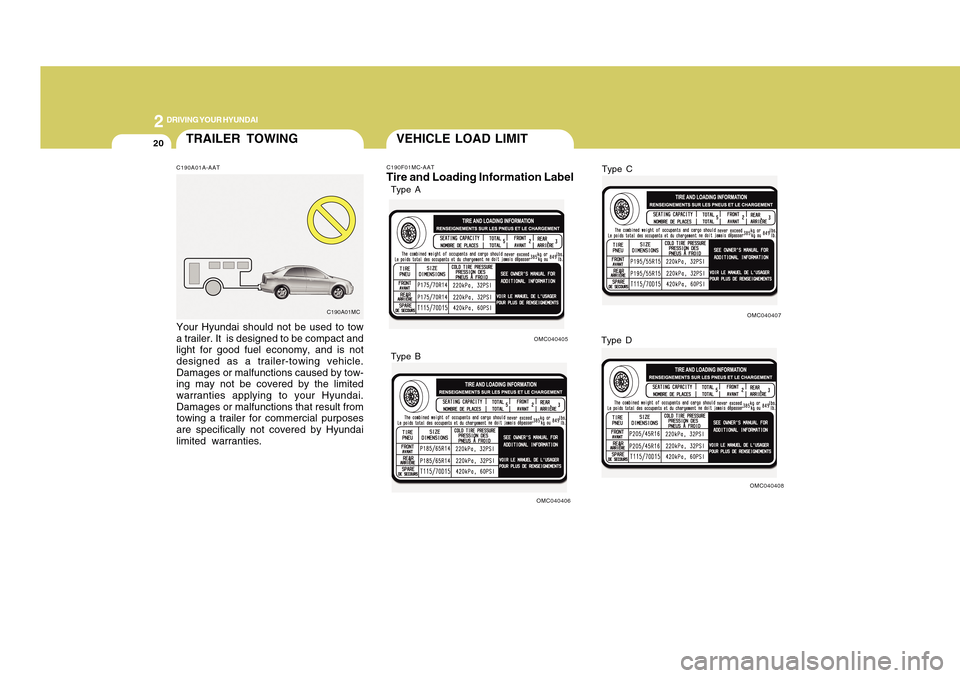
TRAILER TOWINGC190A01A-AATYour Hyundai should not be used to tow
a trailer. It is designed to be compact and
light for good fuel economy, and is not
designed as a trailer-towing vehicle.
Damages or malfunctions caused by tow-
ing may not be covered by the limited
warranties applying to your Hyundai.
Damages or malfunctions that result from
towing a trailer for commercial purposes
are specifically not covered by Hyundai
limited warranties.
C190A01MC
VEHICLE LOAD LIMITC190F01MC-AATTire and Loading Information Label
OMC040405
OMC040406
Type A
Type B
OMC040407
OMC040408
Type C
Type D
Page 179 of 282
23
DRIVING YOUR HYUNDAI
2
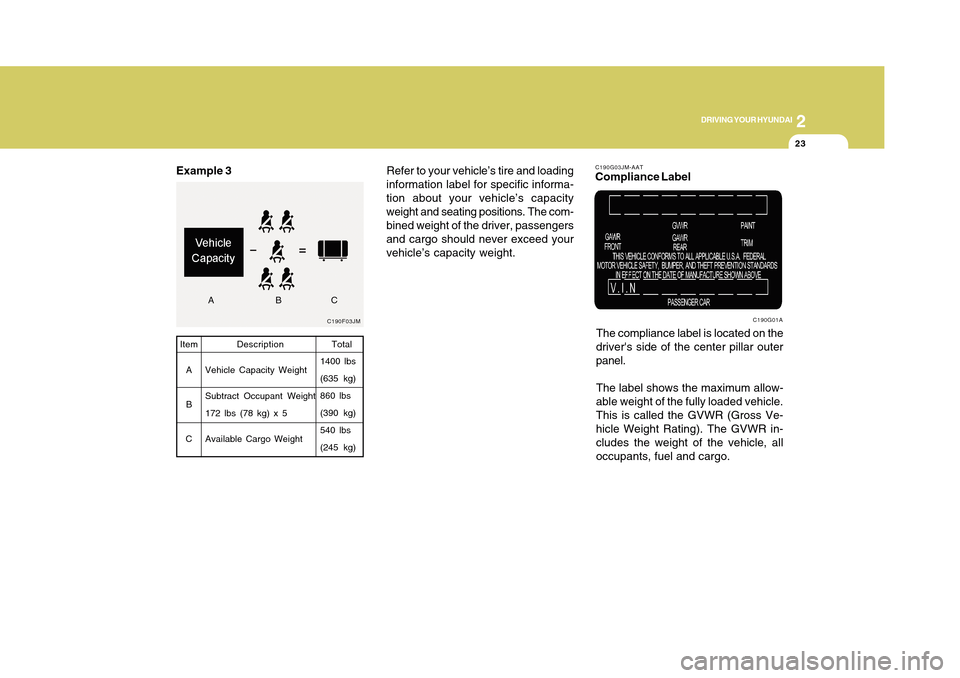
C190G03JM-AATCompliance Label
The compliance label is located on the
driver's side of the center pillar outer
panel.
The label shows the maximum allow-
able weight of the fully loaded vehicle.
This is called the GVWR (Gross Ve-
hicle Weight Rating). The GVWR in-
cludes the weight of the vehicle, all
occupants, fuel and cargo.
C190G01A
Refer to your vehicle’s tire and loading
information label for specific informa-
tion about your vehicle’s capacity
weight and seating positions. The com-
bined weight of the driver, passengers
and cargo should never exceed your
vehicle’s capacity weight.
C190F03JMTotal
1400 lbs
(635 kg)
860 lbs
(390 kg)
540 lbs
(245 kg) Item
A
B
CDescription
Vehicle Capacity Weight
Subtract Occupant Weight
172 lbs (78 kg) x 5
Available Cargo Weight
Example 3
ABC
Page 183 of 282
32WHAT TO DO IN AN EMERGENCY
IF THE ENGINE WILL NOT
START!
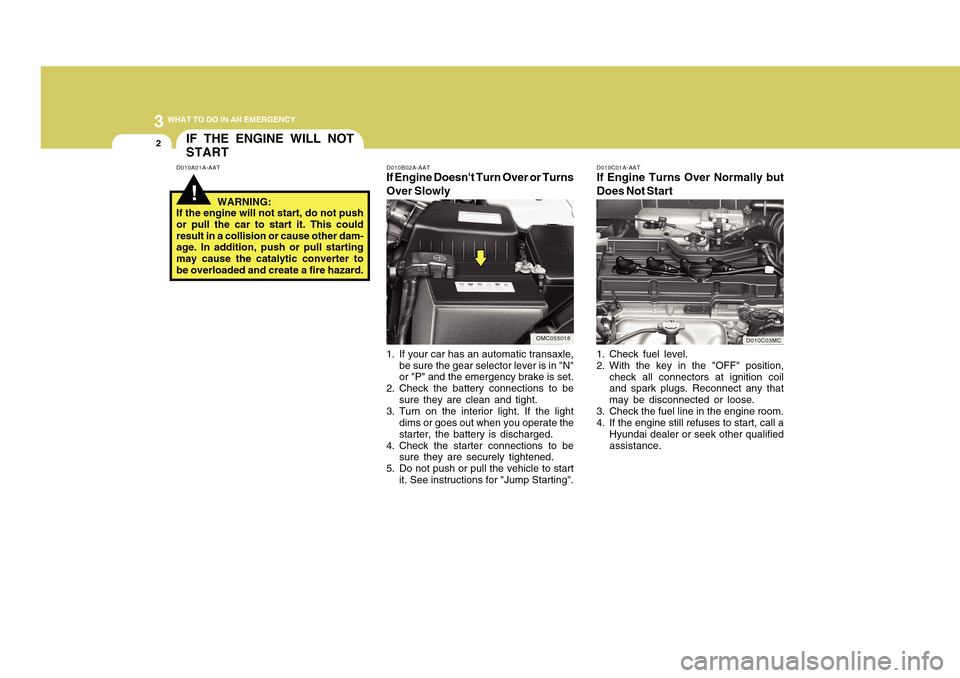
D010B02A-AATIf Engine Doesn't Turn Over or Turns
Over Slowly
D010A01A-AATD010C01A-AAT
If Engine Turns Over Normally but
Does Not Start1. Check fuel level.
2. With the key in the "OFF" position,
check all connectors at ignition coil
and spark plugs. Reconnect any that
may be disconnected or loose.
3. Check the fuel line in the engine room.
4. If the engine still refuses to start, call a
Hyundai dealer or seek other qualified
assistance. WARNING:
If the engine will not start, do not push
or pull the car to start it. This could
result in a collision or cause other dam-
age. In addition, push or pull starting
may cause the catalytic converter to
be overloaded and create a fire hazard.
1. If your car has an automatic transaxle,
be sure the gear selector lever is in "N"
or "P" and the emergency brake is set.
2. Check the battery connections to be
sure they are clean and tight.
3. Turn on the interior light. If the light
dims or goes out when you operate the
starter, the battery is discharged.
4. Check the starter connections to be
sure they are securely tightened.
5. Do not push or pull the vehicle to start
it. See instructions for "Jump Starting".
OMC055018
D010C03MC
Page 187 of 282
36WHAT TO DO IN AN EMERGENCY
Low Tire Pressure Telltale
When the tire pressure monitoring sys-
tem warning telltale is illuminated, one
or more of your tires is significantly
under-inflated.
Immediately reduce your speed, avoid
hard cornering and anticipate increased
stopping distances. You should stop
and check your tires as soon as pos-
sible. Inflate the tires to the proper
pressure as indicated on the vehicle’s
placard or tire inflation pressure label
located on the driver’s side center
pillar outer panel. If you cannot reach
a service station or if the tire cannot
hold the newly added air, replace the
low pressure tire with the temporary
spare tire. Then the TPMS malfunc-
tion indicator or the Low Tire Pressure
telltale may turn on until you have the
low-pressure tire repaired and replaced
on the vehicle.
As an added safety feature, your ve-
hicle has been equipped with a Tire
Pressure Monitoring System (TPMS)
that illuminates a low tire pressure
telltale when one or more of your tires
is significantly under-inflated. Accord-
ingly, when the low tire pressure tell-
tale illuminates, you should stop and
check your tires as soon as possible,
and inflate them to the proper pres-
sure. Driving on a significantly under-
inflated tire causes the tire to overheat
and can lead to tire failure. Under-
inflation also reduces fuel efficiency
and tire tread life, and may affect the
vehicle’s handling and stopping ability.
Please note that the TPMS is not a
substitute for proper tire maintenance,
and it is the driver’s responsibility to
maintain correct tire pressure, even if
under-inflation has not reached the
level to trigger illumination of the TPMS
low tire pressure telltale.Your vehicle has also been equipped
with a TPMS malfunction indicator to
indicate when the system is not oper-
ating properly. The TPMS malfunction
indicator is provided by a separate
telltale, which displays the symbol
"TPMS" when illuminated. When the
malfunction indicator is illuminated, the
system may not be able to detect or
signal low tire pressure as intended.
TPMS malfunctions may occur for a
variety of reasons, including the instal-
lation of replacement or alternate tires
or wheels on the vehicle that prevent
the TPMS from functioning properly.
Always check the TPMS malfunction
indicator after replacing one or more
tires or wheels on your vehicle to
ensure that the replacement or alter-
nate tires and wheels allow the TPMS
to continue to function properly.