wheel Hyundai Accent 2011 User Guide
[x] Cancel search | Manufacturer: HYUNDAI, Model Year: 2011, Model line: Accent, Model: Hyundai Accent 2011Pages: 282, PDF Size: 14.82 MB
Page 113 of 282
1FEATURES OF YOUR HYUNDAI
102
NOTE:o If there is no CD or the auxiliary
device is not connected, the mode
cannot be converted to the CD, CDC
or AUX mode.
o The CD, CDC or AUX mode is not
available for some audio models.SEEK SwitchPress the SEEK switch 1 sec. or more.1. RADIO modeWhen the upper portion SEEK is pressed,
the unit will automatically tune to the next
higher frequency and when the lower
portion SEEK is pressed, it will automati-
cally tune to the next lower frequency.2. CD (Compact Disc)/CDC (Com-
pact Disc Changer)/AUX modeo Press the upper portion SEEK once to
skip forward to the beginning of the
next track.
o Press the lower portion SEEK once to
skip back to the beginning of the track.
VOL Switcho Press the upper portion VOL switch to
increase volume.
o Press the lower portion VOL switch to
decease volume.
AUDIO REMOTE CONTROL
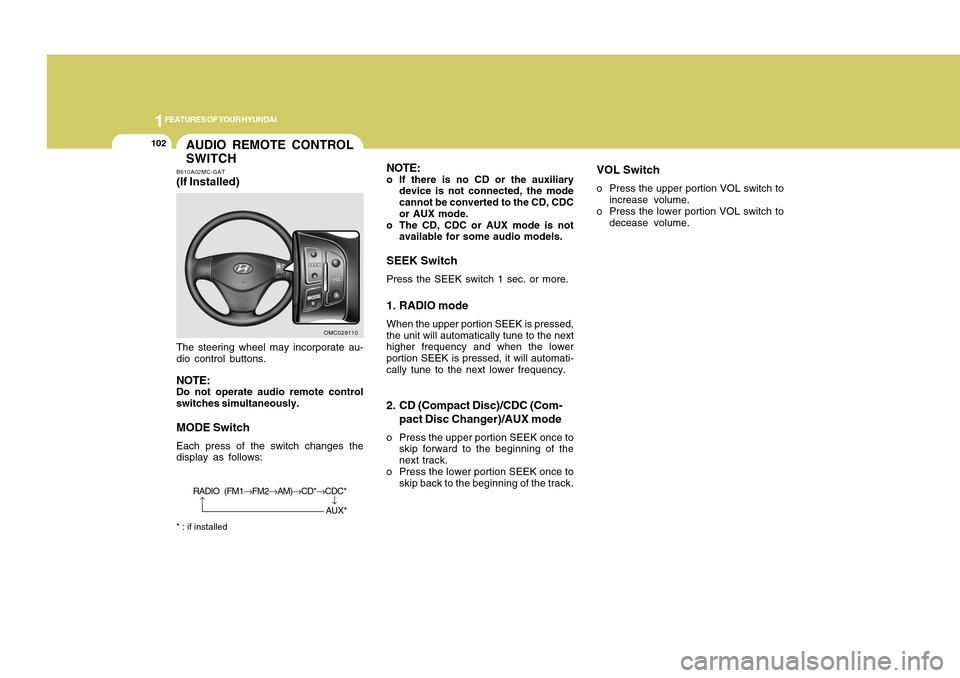
SWITCHB610A02MC-GAT(If Installed)The steering wheel may incorporate au-
dio control buttons.NOTE:Do not operate audio remote control
switches simultaneously.MODE SwitchEach press of the switch changes the
display as follows:* : if installed
OMC029110
→
RADIO (FM1→FM2→AM)→CD*→CDC*
→AUX*
Page 114 of 282
1
FEATURES OF YOUR HYUNDAI
1031
FEATURES OF YOUR HYUNDAI
103
!
WARNING:
o Pay particular attention to the driv-
ing conditions whenever using the
cruise control system.
o Be careful when driving downhill
using the cruise control system,
which may increase the vehicle
speed.
!
CAUTION:
During cruise-speed driving of a manual
transaxle vehicle, do not shift into neu-
tral without depressing the clutch pedal,
since the engine will be overrevved. If
this happens, depress the clutch pedal
or release the cruise control ON/OFF
switch.NOTE:During normal cruise control operation,
when the -/SET switch is activated or
reactivated after applying the brakes,
the cruise control will energize after ap-
proximately 3 seconds. This delay is
normal.
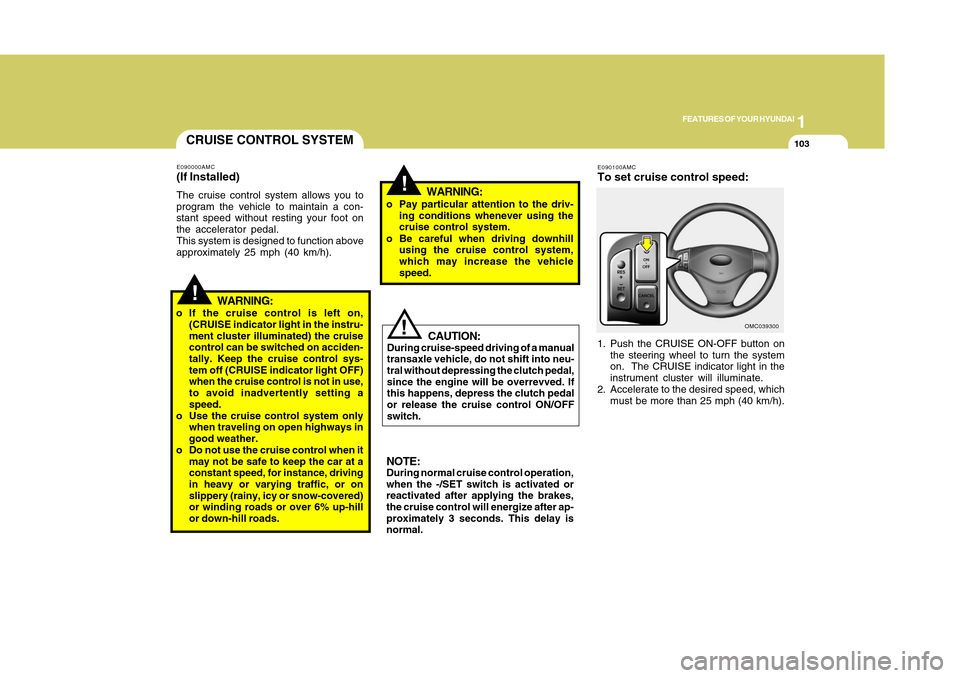
E090100AMCTo set cruise control speed:1. Push the CRUISE ON-OFF button on
the steering wheel to turn the system
on. The CRUISE indicator light in the
instrument cluster will illuminate.
2. Accelerate to the desired speed, which
must be more than 25 mph (40 km/h).
OMC039300
CRUISE CONTROL SYSTEME090000AMC(If Installed)The cruise control system allows you to
program the vehicle to maintain a con-
stant speed without resting your foot on
the accelerator pedal.
This system is designed to function above
approximately 25 mph (40 km/h).
!
WARNING:
o If the cruise control is left on,
(CRUISE indicator light in the instru-
ment cluster illuminated) the cruise
control can be switched on acciden-
tally. Keep the cruise control sys-
tem off (CRUISE indicator light OFF)
when the cruise control is not in use,
to avoid inadvertently setting a
speed.
o Use the cruise control system only
when traveling on open highways in
good weather.
o Do not use the cruise control when it
may not be safe to keep the car at a
constant speed, for instance, driving
in heavy or varying traffic, or on
slippery (rainy, icy or snow-covered)
or winding roads or over 6% up-hill
or down-hill roads.
Page 116 of 282
1
FEATURES OF YOUR HYUNDAI
1051
FEATURES OF YOUR HYUNDAI
105
E090500AMCTo cancel cruise control, do one of
the following:o Press the brake pedal.
o Press the clutch pedal with a manual
transaxle.
o Shift into N (Neutral) with an automatic
transaxle.
o Press the CANCEL switch located on
the steering wheel.
o Decrease the vehicle speed lower than
the memory speed by 9 mph (15 km/h).
o Decrease the vehicle speed to less
than approximately 25 mph (40 km/h).
OMC039303 E090400AUN
To temporarily accelerate with the
cruise control on:If you want to speed up temporarily when
the cruise control is on, depress the ac-
celerator pedal. Increased speed will not
interfere with cruise control operation or
change the set speed.
To return to the set speed, take your foot
off the accelerator.
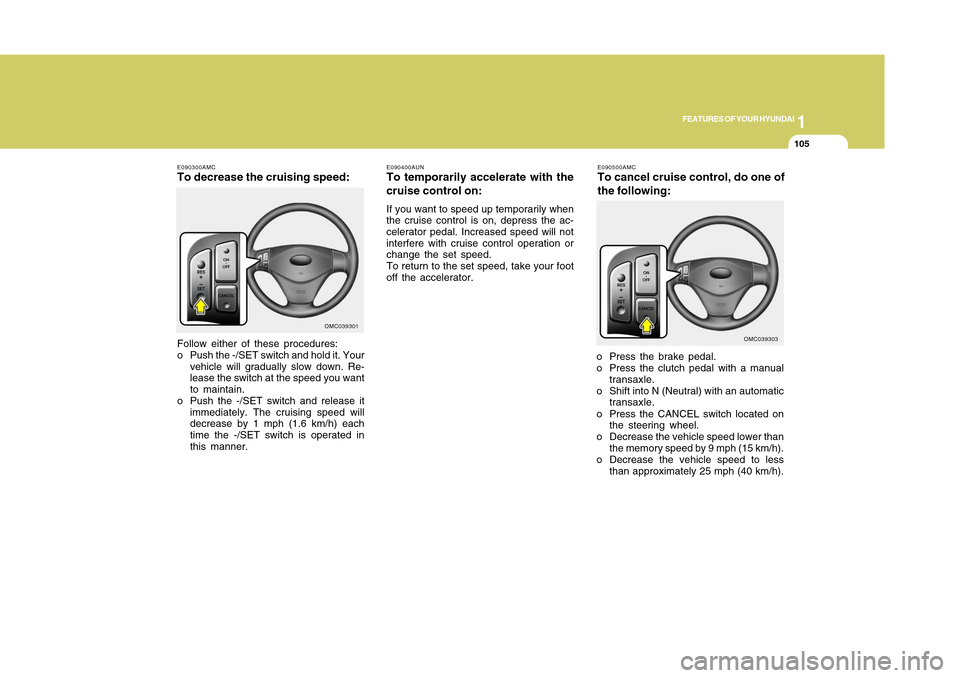
E090300AMCTo decrease the cruising speed:Follow either of these procedures:
o Push the -/SET switch and hold it. Your
vehicle will gradually slow down. Re-
lease the switch at the speed you want
to maintain.
o Push the -/SET switch and release it
immediately. The cruising speed will
decrease by 1 mph (1.6 km/h) each
time the -/SET switch is operated in
this manner.
OMC039301
Page 117 of 282
1FEATURES OF YOUR HYUNDAI
106
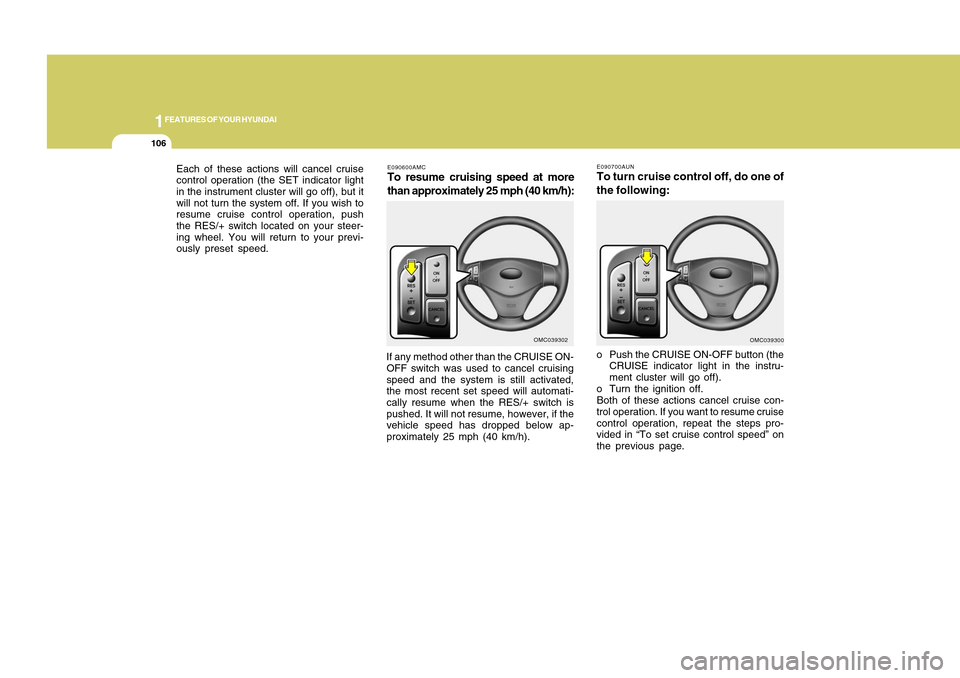
E090600AMCTo resume cruising speed at more
than approximately 25 mph (40 km/h):If any method other than the CRUISE ON-
OFF switch was used to cancel cruising
speed and the system is still activated,
the most recent set speed will automati-
cally resume when the RES/+ switch is
pushed. It will not resume, however, if the
vehicle speed has dropped below ap-
proximately 25 mph (40 km/h).
OMC039302
o Push the CRUISE ON-OFF button (the
CRUISE indicator light in the instru-
ment cluster will go off).
o Turn the ignition off.
Both of these actions cancel cruise con-
trol operation. If you want to resume cruise
control operation, repeat the steps pro-
vided in “To set cruise control speed” on
the previous page. Each of these actions will cancel cruise
control operation (the SET indicator light
in the instrument cluster will go off), but it
will not turn the system off. If you wish to
resume cruise control operation, push
the RES/+ switch located on your steer-
ing wheel. You will return to your previ-
ously preset speed.
OMC039300 E090700AUN
To turn cruise control off, do one of
the following:
Page 160 of 282
2
DRIVING YOUR HYUNDAI4
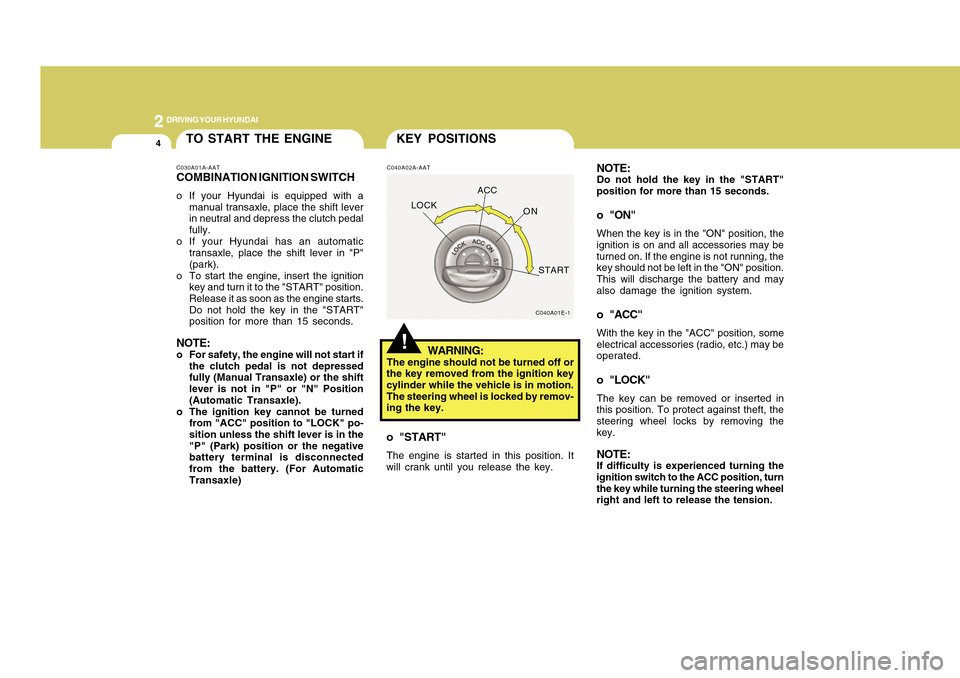
C040A02A-AAT
WARNING:
The engine should not be turned off or
the key removed from the ignition key
cylinder while the vehicle is in motion.
The steering wheel is locked by remov-
ing the key.o "START"The engine is started in this position. It
will crank until you release the key.
!KEY POSITIONS
C040A01E-1
LOCKACC
ON
START
NOTE:Do not hold the key in the "START"
position for more than 15 seconds.o "ON"When the key is in the "ON" position, the
ignition is on and all accessories may be
turned on. If the engine is not running, the
key should not be left in the "ON" position.
This will discharge the battery and may
also damage the ignition system.o "ACC"With the key in the "ACC" position, some
electrical accessories (radio, etc.) may be
operated.o "LOCK"The key can be removed or inserted in
this position. To protect against theft, the
steering wheel locks by removing the
key.NOTE:If difficulty is experienced turning the
ignition switch to the ACC position, turn
the key while turning the steering wheel
right and left to release the tension.
TO START THE ENGINEC030A01A-AATCOMBINATION IGNITION SWITCHo If your Hyundai is equipped with a
manual transaxle, place the shift lever
in neutral and depress the clutch pedal
fully.
o If your Hyundai has an automatic
transaxle, place the shift lever in "P"
(park).
o To start the engine, insert the ignition
key and turn it to the "START" position.
Release it as soon as the engine starts.
Do not hold the key in the "START"
position for more than 15 seconds.NOTE:o For safety, the engine will not start if
the clutch pedal is not depressed
fully (Manual Transaxle) or the shift
lever is not in "P" or "N" Position
(Automatic Transaxle).
o The ignition key cannot be turned
from "ACC" position to "LOCK" po-
sition unless the shift lever is in the
"P" (Park) position or the negative
battery terminal is disconnected
from the battery. (For Automatic
Transaxle)
Page 164 of 282
2
DRIVING YOUR HYUNDAI8
!
o Exercise extreme caution when driv-
ing on a slippery surface. Be espe-
cially careful when braking, accelerat-
ing or shifting gears. On a slippery
surface, an abrupt change in vehicle
speed can cause the drive wheels to
lose traction and the vehicle to go out
of control.
WARNING:
o Always buckle-up! In a collision, an
unbelted occupant is significantly
more likely to be seriously injured or
killed than a properly belted occu-
pant.
o Avoid high speeds when cornering
or turning.
o Do not make quick steering wheel
movements, such as sharp lane
changes or fast, sharp turns.
o The risk of rollover is greatly in-
creased if you lose control of your
vehicle at highway speeds.
o Loss of control often occurs if two or
more wheels drop off the roadway
and the driver oversteers to reenter
the roadway.
o In the event your vehicle leaves the
roadway, do not steer sharply. In-
stead, slow down before pulling back
into the travel lanes.
o Never exceed posted speed limits.
C070D03O-AATGood Driving Practiceso Never take the car out of gear and
coast down a hill. This is extremely
hazardous. Always leave the car in
gear.
o Don't "ride" the brakes. This can cause
them to overheat and malfunction. In-
stead, when you are driving down a
long hill, slow down and shift to a lower
gear. When you do this, engine brak-
ing will help slow the car.
o Slow down before shifting to a lower
gear. This will help avoid over-revving
the engine, which can cause damage.
o Slow down when you encounter cross
winds. This gives you much better
control of your car.
o Be sure the car is completely stopped
before you attempt to shift into reverse.
The transaxle can be damaged if you
do not. To shift into reverse, depress
the clutch, move the shift lever to neu-
tral, wait three seconds, then shift to
the reverse position.
Page 168 of 282
2
DRIVING YOUR HYUNDAI
12
WARNING:
o Always buckle-up! In a collision, an
unbelted occupant is significantly
more likely to be seriously injured or
killed than a properly belted occu-
pant.
o Avoid high speeds when cornering
or turning.
o Do not make quick steering wheel
movements, such as sharp lane
changes or fast, sharp turns.
o The risk of rollover is greatly in-
creased if you lose control of your
vehicle at highway speeds.
o Loss of control often occurs if two or
more wheels drop off the roadway
and the driver oversteers to reenter
the roadway.
o In the event your vehicle leaves the
roadway, do not steer sharply. In-
stead, slow down before pulling back
into the travel lanes.
o Never exceed posted speed limits.
!
o Exercise extreme caution when driv-
ing on a slippery surface. Be espe-
cially careful when braking, accelerat-
ing or shifting gears. On a slippery
surface, an abrupt change in vehicle
speed can cause the drive wheels to
lose traction and the vehicle to go out
of control.
o Optimum vehicle performance and
economy is obtained by smoothly de-
pressing and releasing the accelera-
tor pedal.
o Turn the overdrive switch on for good
fuel economy and smooth driving. If
engine braking is needed in the "D"
range or if repeated upshifting and
downshifting between the 3rd and 4th
gear is needed when climbing a gentle
slope, it is recommended that the over-
drive switch be turned off. Turn the
overdrive switch back on immediately
afterward.
C090N07A-AATGood Driving Practiceso Never move the gear selector lever
from "P" or "N" to any other position
with the accelerator pedal depressed.
o Never move the gear selector lever
into "P" when the vehicle is in motion.
o Be sure the car is completely stopped
before you attempt to shift into "R" or
"D".
o Never take the car out of gear and
coast down a hill. This may be ex-
tremely hazardous. Always leave the
car in gear when moving.
o Do not "ride" the brakes. This can
cause them to overheat and malfunc-
tion. Instead, when you are driving
down a long hill, slow down and shift
to a lower gear. When you do this,
engine braking will help slow the car.
o Slow down before shifting to a lower
gear. Otherwise, the lower gear may
not be engaged.
o Always use the parking brake. Do not
depend on placing the transaxle in "P"
to keep the car from moving.
Page 169 of 282
13
DRIVING YOUR HYUNDAI
2
!
o If your vehicle becomes stuck in
snow, mud, sand, etc., then you may
attempt to rock the vehicle free by
moving it forward and backward. Do
not attempt this procedure if people
or objects are anywhere near the
vehicle. During the rocking opera-
tion the vehicle may suddenly move
forward or backward as it becomes
unstuck, causing injury to nearby
people or damage to objects.
WARNING:
!
WARNING:
ABS will not prevent accidents due to
improper or dangerous driving maneu-
vers. Even though vehicle control is
improved during emergency braking,
always maintain a safe distance be-
tween you and objects ahead. Vehicle
speeds should always be reduced dur-
ing extreme road conditions.
The braking distance for cars equipped
with an anti-lock braking system may
be longer than for those without it in the
following road conditions.
During these conditions the veicle
should be driven at reduced speeds.
o Rough, gravel or snow-covered
roads.
o With tire chains installed.
o On roads where the road surface is
pitted or has different surface height.
These roads should be driven at re-
duced speeds. The safety features of
an ABS equipped vehicle should not be
tested by high speed driving or corner-
ing. This could endanger the safety of
yourself or others.
ANTI-LOCK BRAKE SYS-
TEMC120A01MC-AAT(If Installed)The Anti-Lock Brake System (ABS) is
designed to prevent wheel lock-up dur-
ing sudden braking or on hazardous road
surfaces. The ABS control module moni-
tors the wheel speed and controls the
pressure applied to each brake. Thus, in
emergency situations or on slick roads,
ABS will increase vehicle control during
braking.NOTE:o A click sound may be heard in the
engine compartment when the ve-
hicle begins to move after the engine
is started. These conditions are nor-
mal and indicate that the anti-lock
brake system is functioning prop-
erly.
o During ABS operation, a slight pulsa-
tion may be felt in the brake pedal
when the brakes are applied. Also, a
noise may be heard in the engine
compartment while braking. These
conditions are normal and indicate
that the anti-lock brake system is
functioning properly.
Page 170 of 282
2
DRIVING YOUR HYUNDAI
14
o After being parked, check to be sure
the parking brake is not engaged and
that the parking brake indicator light is
out before driving away.
o Driving through water may get the
brakes wet. They can also get wet
when the car is washed. Wet brakes
can be dangerous! Your car will not
stop as quickly if the brakes are wet.
Wet brakes may cause the car to pull
to one side. To dry the brakes, apply
the brakes lightly until the braking ac-
tion returns to normal, taking care to
keep the car under control at all times.
If the braking action does not return to
normal, stop as soon as it is safe to do
so and call your Hyundai dealer for
assistance.
o Don't coast down hills with the car out
of gear. This is extremely hazardous.
Keep the car in gear at all times, use
the brakes to slow down, then shift to
a lower gear so that engine braking
will help you maintain a safe speed.
o Don't "ride" the brake pedal. Resting
your foot on the brake pedal while
driving can be dangerous because it
can result in the brakes overheating
and losing their effectiveness. It also
increases the wear of the brake com-
ponents.o If a tire goes flat while you are driving,
apply the brakes gently and keep the
car pointed straight ahead while you
slow down. When you are moving
slowly enough for it to be safe to do so,
pull off the road and stop in a safe
place.
o If your car is equipped with an auto-
matic transaxle, don't let your car creep
forward. To avoid creeping forward,
keep your foot firmly on the brake pedal
when the car is stopped.
o Use caution when parking on a hill.
Firmly engage the parking brake and
place the gear selector lever in "P"
(automatic transaxle) or in first or re-
verse gear (manual transaxle). If your
car is facing downhill, turn the front
wheels into the curb to help keep the
car from rolling. If your car is facing
uphill, turn the front wheels away from
the curb to help keep the car from
rolling. If there is no curb or if it is
required by other conditions to keep
the car from rolling, block the wheels.
GOOD BRAKING PRACTICES!
C130A02A-AAT
WARNING:
o Whenever leaving vehicle or park-
ing, always set the parking brake as
far as possible and fully engage the
vehicle's transaxle into the P (Park)
position (automatic transaxle) or in
first or reverse (manual transaxle).
Vehicles not fully engaged in P (Park)
with the parking brake set are at risk
for moving inadvertently and injuring
yourself or others.
o All vehicles should always have the
parking brake fully engaged when
parking to avoid inadvertent move-
ment of the car which can injure
occupants or pedestrians.
o Nothing should be carried on top of
the shelf panel behind the rear seat.
If there were an accident or a sudden
stop, such objects could move for-
ward and cause damage to the ve-
hicle or injure the occupants.
Page 171 of 282
15
DRIVING YOUR HYUNDAI
2
DRIVING FOR ECONOMYC140A02A-AATYou can save fuel and get more miles
from your car if you follow these sugges-
tions:
o Drive smoothly. Accelerate at a mod-
erate rate. Don't make "jack-rabbit"
starts or full-throttle shifts and maintain
a steady cruising speed. Don't race
between stoplights. Try to adjust your
speed to that of the other traffic so you
don't have to change speeds unnec-
essarily. Avoid heavy traffic whenever
possible. Always maintain a safe dis-
tance from other vehicles so you can
avoid unnecessary braking. This also
reduces brake wear.
o Drive at a moderate speed. The faster
you drive the more fuel your vehicle
uses. Driving at a moderate speed, in
the highest gear appropriate for the
conditions, especially on the highway,
is one of the most effective ways to
reduce fuel consumption.
o Don't "ride" the brake or clutch pedal.
This can increase fuel consumption
and also increase wear on these com-
ponents. In addition, driving with your
foot resting on the brake pedal may
cause the brakes to overheat, which
reduces their effectiveness and may
lead to more serious consequences. o Under some conditions your parking
brake can freeze in the engaged posi-
tion. This is most likely to happen when
there is an accumulation of snow or ice
around or near the rear brakes or if the
brakes are wet. If there is a risk that the
parking brake may freeze, apply it only
temporarily while you put the gear
selector lever in "P" (automatic) or in
first or reverse gear (manual transaxle)
and block the rear wheels so the car
cannot roll. Then release the parking
brake.
o Do not hold the vehicle on the upgrade
with the accelerator pedal. This can
cause the transaxle to overheat. Al-
ways use the brake pedal or parking
brake.o Take care of your tires. Keep them
inflated to the recommended pressure.
Incorrect inflation, either too much or
too little, results in unnecessary tire
wear. Check the tire pressures at least
once a month.
o Be sure that the wheels are aligned
correctly. Improper alignment can re-
sult from hitting curbs or driving too fast
over irregular surfaces. Poor align-
ment causes faster tire wear and may
also result in other problems as well as
greater fuel consumption.
o Keep your car in good condition. For
better fuel economy and reduced main-
tenance costs, maintain your car in
accordance with the maintenance
schedule in Section 5. If you drive your
car in severe conditions, more fre-
quent maintenance is required (see
Section 5 for details).
o Keep your car clean. For maximum
service, your Hyundai should be kept
clean and free of corrosive materials.
It is especially important that mud, dirt,
ice, etc. not be allowed to accumulate
on the underside of the car. This extra
weight can result in increased fuel
consumption and also contribute to
corrosion.