oil Hyundai Accent 2011 Owner's Guide
[x] Cancel search | Manufacturer: HYUNDAI, Model Year: 2011, Model line: Accent, Model: Hyundai Accent 2011Pages: 282, PDF Size: 14.82 MB
Page 233 of 282
6
DO-IT-YOURSELF MAINTENANCE
15
!
G120E02A-AATAdding Brake Fluid
WARNING:
Handle brake fluid carefully. It can dam-
age your vision if it gets into your eyes.
Use only DOT 3 or DOT 4 specification
fluid from a sealed container. Do not
allow the fluid can or reservoir to re-
main open any longer than required.
This will avoid entry of dirt and moisture
which can damage the brake system
and cause improper operation.
To add brake fluid, first wipe away any
dirt, then unscrew the fluid reservoir cap.
Slowly pour the recommended fluid into
the reservoir. Do not overfill. Carefully
replace the cap on the reservoir and
tighten.
AIR CONDITIONER CAREG140A01A-AATKeeping the Condenser CleanThe air conditioner condenser (and en-
gine radiator) should be checked periodi-
cally for accumulation of dirt, dead in-
sects, leaves, etc. These can interfere
with maximum cooling efficiency. When
removing such accumulations, brush or
hose them away carefully to avoid bend-
ing the cooling fans.
Checking the amount of air condi-
tioner refrigerant and compressor
lubricantWhen the amount of refrigerant is low, the
performance of the air conditioning is
reduced. Overfilling also has a negative
impact on the air conditioning system.
Therefore, if abnormal operation is found,
have the system inspected by an autho-
rized HYUNDAI dealer.
NOTE:
It is important when servicing the air
conditioning system that the correct
type and amount of oil and refrigerant is
used. Otherwise, damage to the com-
pressor and abnormal system opera-
tion may occur.
Page 238 of 282
6
DO-IT-YOURSELF MAINTENANCE
20
CHECKING THE BATTERY!
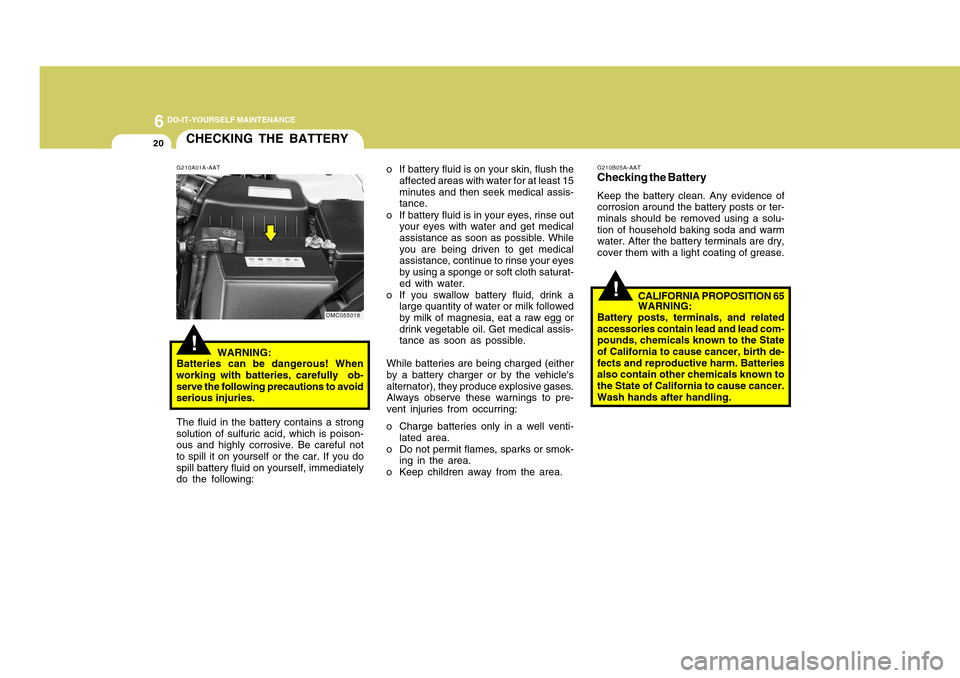
G210A01A-AAT
WARNING:
Batteries can be dangerous! When
working with batteries, carefully ob-
serve the following precautions to avoid
serious injuries.o If battery fluid is on your skin, flush the
affected areas with water for at least 15
minutes and then seek medical assis-
tance.
o If battery fluid is in your eyes, rinse out
your eyes with water and get medical
assistance as soon as possible. While
you are being driven to get medical
assistance, continue to rinse your eyes
by using a sponge or soft cloth saturat-
ed with water.
o If you swallow battery fluid, drink a
large quantity of water or milk followed
by milk of magnesia, eat a raw egg or
drink vegetable oil. Get medical assis-
tance as soon as possible.
While batteries are being charged (either
by a battery charger or by the vehicle's
alternator), they produce explosive gases.
Always observe these warnings to pre-
vent injuries from occurring:
o Charge batteries only in a well venti-
lated area.
o Do not permit flames, sparks or smok-
ing in the area.
o Keep children away from the area.
OMC055018
The fluid in the battery contains a strong
solution of sulfuric acid, which is poison-
ous and highly corrosive. Be careful not
to spill it on yourself or the car. If you do
spill battery fluid on yourself, immediately
do the following:
G210B05A-AATChecking the BatteryKeep the battery clean. Any evidence of
corrosion around the battery posts or ter-
minals should be removed using a solu-
tion of household baking soda and warm
water. After the battery terminals are dry,
cover them with a light coating of grease.
!
CALIFORNIA PROPOSITION 65
WARNING:
Battery posts, terminals, and related
accessories contain lead and lead com-
pounds, chemicals known to the State
of California to cause cancer, birth de-
fects and reproductive harm. Batteries
also contain other chemicals known to
the State of California to cause cancer.
Wash hands after handling.
Page 240 of 282
6
DO-IT-YOURSELF MAINTENANCE
22
G240A01A-AATPOWER STEERING HOSESIt is suggested that you check the power
steering hose connections for fluid leak-
age at those intervals specified in the
vehicle maintenance schedule in Section
5.
The power steering hoses should be re-
placed if there is severe surface cracking,
pulling, scuffing or worn spots. Deteriora-
tion of the hose could cause premature
failure.
POWER STEERING FLUID
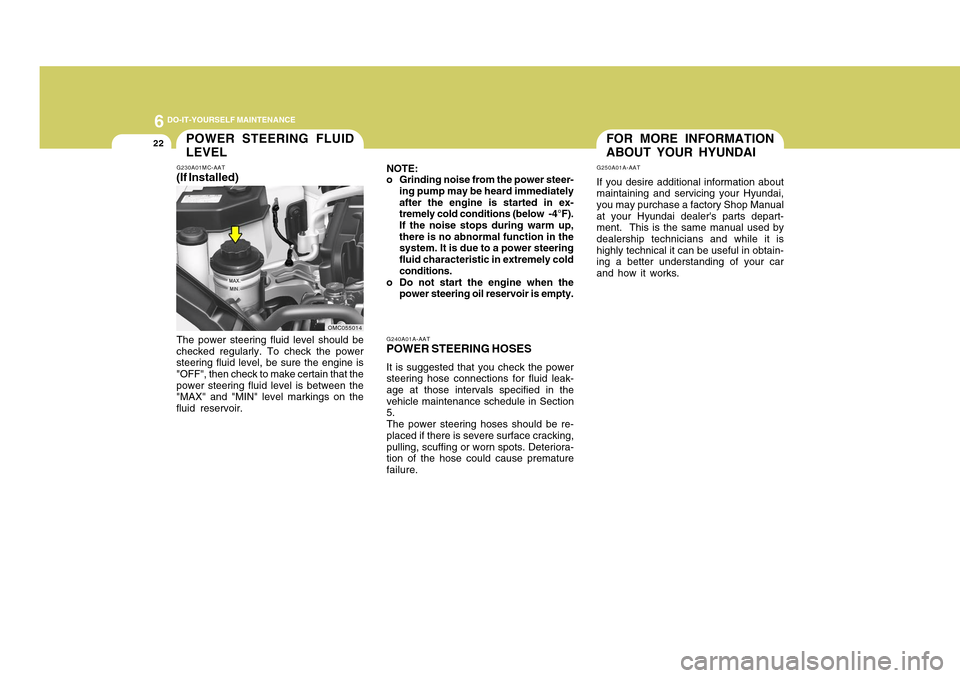
LEVELG230A01MC-AAT(If Installed)The power steering fluid level should be
checked regularly. To check the power
steering fluid level, be sure the engine is
"OFF", then check to make certain that the
power steering fluid level is between the
"MAX" and "MIN" level markings on the
fluid reservoir.NOTE:
o Grinding noise from the power steer-
ing pump may be heard immediately
after the engine is started in ex-
tremely cold conditions (below -4°F).
If the noise stops during warm up,
there is no abnormal function in the
system. It is due to a power steering
fluid characteristic in extremely cold
conditions.
o Do not start the engine when the
power steering oil reservoir is empty.
OMC055014
FOR MORE INFORMATION
ABOUT YOUR HYUNDAIG250A01A-AATIf you desire additional information about
maintaining and servicing your Hyundai,
you may purchase a factory Shop Manual
at your Hyundai dealer's parts depart-
ment. This is the same manual used by
dealership technicians and while it is
highly technical it can be useful in obtain-
ing a better understanding of your car
and how it works.
Page 241 of 282
6
DO-IT-YOURSELF MAINTENANCE
23
Headlight
1. Allow the bulb to cool. Wear eye pro-
tection.
2. Open the engine hood and disconnect
the negative (-) post of the battery.
3. Always grasp the bulb by its plastic
base, avoid touching the glass.
4. Disconnect the power cord from the
back of the headlight.
REPLACEMENT OF LIGHT
BULBS!
G260A01MC-AATBefore attempting to replace a light bulb,
be sure the switch is turned to the "OFF"
position.
The next paragraph shows how to reach
the light bulbs so they may be changed.
Be sure to replace the burned-out bulb
with one of the same number and watt-
age rating.
See page 6-29 for the wattage descrip-
tions.
CAUTION:
o Keep the lamps out of contact with
petroleum products, such as oil,
gasoline, etc.
o If you don't have necessary tools,
the correct bulbs and the expertise,
consult your authorized Hyundai
dealer.
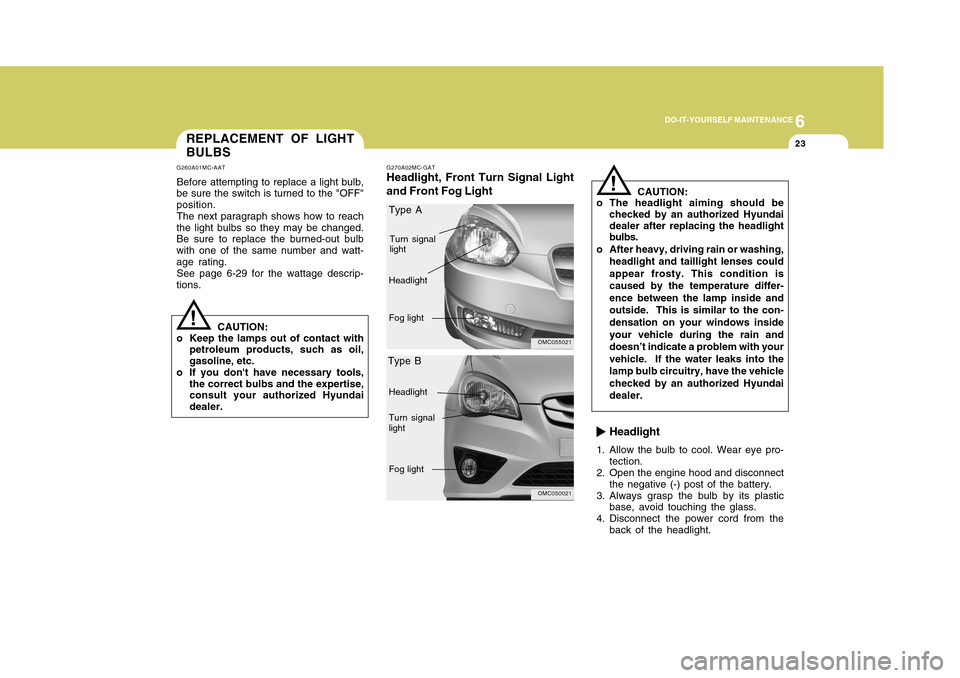
G270A02MC-GATHeadlight, Front Turn Signal Light
and Front Fog Light
CAUTION:
o The headlight aiming should be
checked by an authorized Hyundai
dealer after replacing the headlight
bulbs.
o After heavy, driving rain or washing,
headlight and taillight lenses could
appear frosty. This condition is
caused by the temperature differ-
ence between the lamp inside and
outside. This is similar to the con-
densation on your windows inside
your vehicle during the rain and
doesn’t indicate a problem with your
vehicle. If the water leaks into the
lamp bulb circuitry, have the vehicle
checked by an authorized Hyundai
dealer.
!
OMC055021
Turn signal
light
Headlight
Fog light
OMC050021
Headlight
Turn signal
light
Fog lightType A
Type B
Page 242 of 282
6
DO-IT-YOURSELF MAINTENANCE
24
G270A03O
!
WARNING:
o When removing/replacing halogen
bulbs, always handle the metal body
of the bulb, not the glass. Residual oil
may cause the bulb to overheat and
burst when lit.
o The halogen bulb contains gas under
pressure and if impacted could shat-
ter, resulting in flying fragments. Al-
ways wear eye protection when ser-
vicing the bulb. Protect the bulb
against abrasions or scratches and
against liquids when lighted. Turn
the bulb on only when installed in a
headlight. Replace the headlight if
damaged or cracked. Keep the bulb
out of the reach of children and dis-
pose of the used bulb with care.
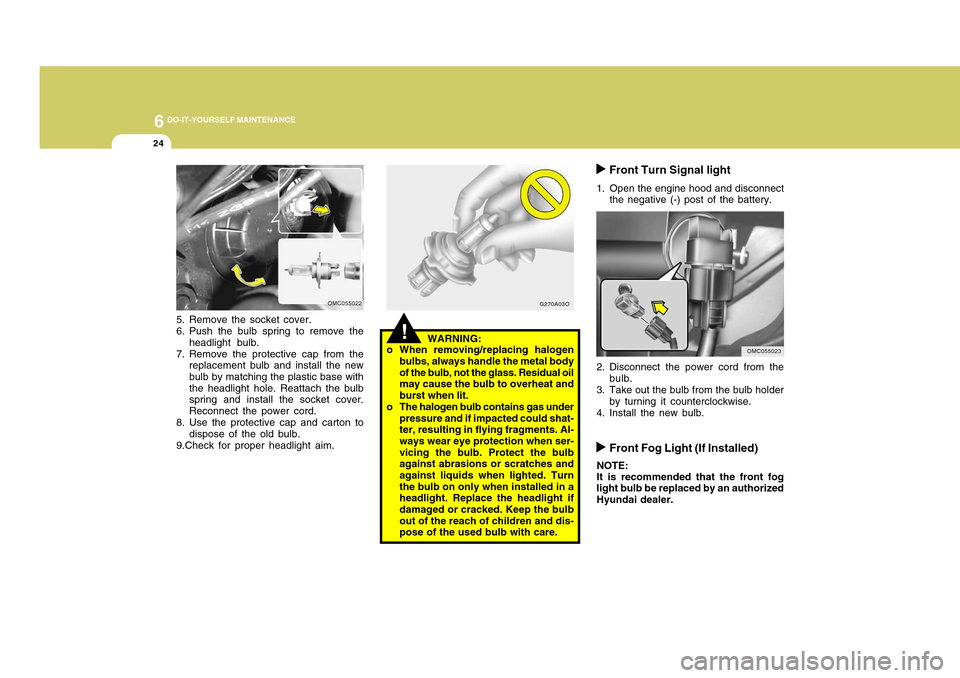
5. Remove the socket cover.
6. Push the bulb spring to remove the
headlight bulb.
7. Remove the protective cap from the
replacement bulb and install the new
bulb by matching the plastic base with
the headlight hole. Reattach the bulb
spring and install the socket cover.
Reconnect the power cord.
8. Use the protective cap and carton to
dispose of the old bulb.
9.Check for proper headlight aim.
OMC055022
Front Turn Signal light
1. Open the engine hood and disconnect
the negative (-) post of the battery.
2. Disconnect the power cord from the
bulb.
3. Take out the bulb from the bulb holder
by turning it counterclockwise.
4. Install the new bulb.
OMC055023
Front Fog Light (If Installed)
NOTE:
It is recommended that the front fog
light bulb be replaced by an authorized
Hyundai dealer.
Page 248 of 282
6
DO-IT-YOURSELF MAINTENANCE
30
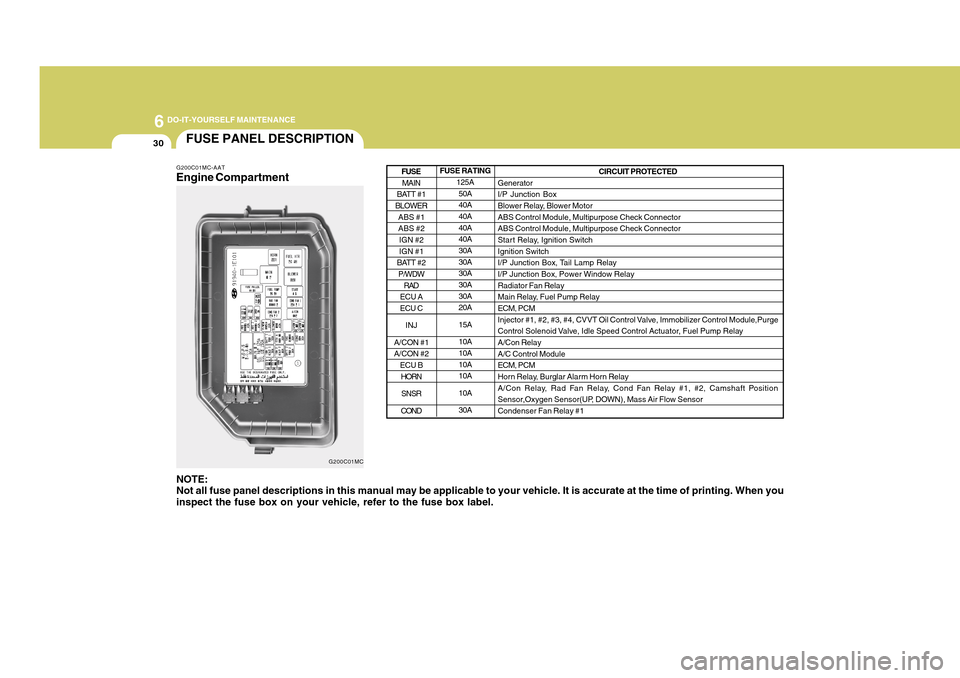
FUSE PANEL DESCRIPTION
FUSE RATING
125A
50A
40A
40A
40A
40A
30A
30A
30A
30A
30A
20A
15A
10A
10A
10A
10A
10A
30A
G200C01MC-AATEngine CompartmentNOTE:
Not all fuse panel descriptions in this manual may be applicable to your vehicle. It is accurate at the time of printing. When you
inspect the fuse box on your vehicle, refer to the fuse box label.
CIRCUIT PROTECTED
Generator
I/P Junction Box
Blower Relay, Blower Motor
ABS Control Module, Multipurpose Check Connector
ABS Control Module, Multipurpose Check Connector
Star t Relay, Ignition Switch
Ignition Switch
I/P Junction Box, Tail Lamp Relay
I/P Junction Box, Power Window Relay
Radiator Fan Relay
Main Relay, Fuel Pump Relay
ECM, PCM
Injector #1, #2, #3, #4, CVVT Oil Control Valve, Immobilizer Control Module,Purge
Control Solenoid Valve, Idle Speed Control Actuator, Fuel Pump Relay
A/Con Relay
A/C Control Module
ECM, PCM
Horn Relay, Burglar Alarm Horn Relay
A/Con Relay, Rad Fan Relay, Cond Fan Relay #1, #2, Camshaft Position
Sensor,Oxygen Sensor(UP, DOWN), Mass Air Flow Sensor
Condenser Fan Relay #1
MAIN
BATT #1
BLOWER
ABS #1
ABS #2
IGN #2
IGN #1
BATT #2
P/WDW
RAD
ECU A
ECU C
INJ
A/CON #1
A/CON #2
ECU B
HORN
SNSR
CONDFUSE
G200C01MC
Page 250 of 282
6
DO-IT-YOURSELF MAINTENANCE
32
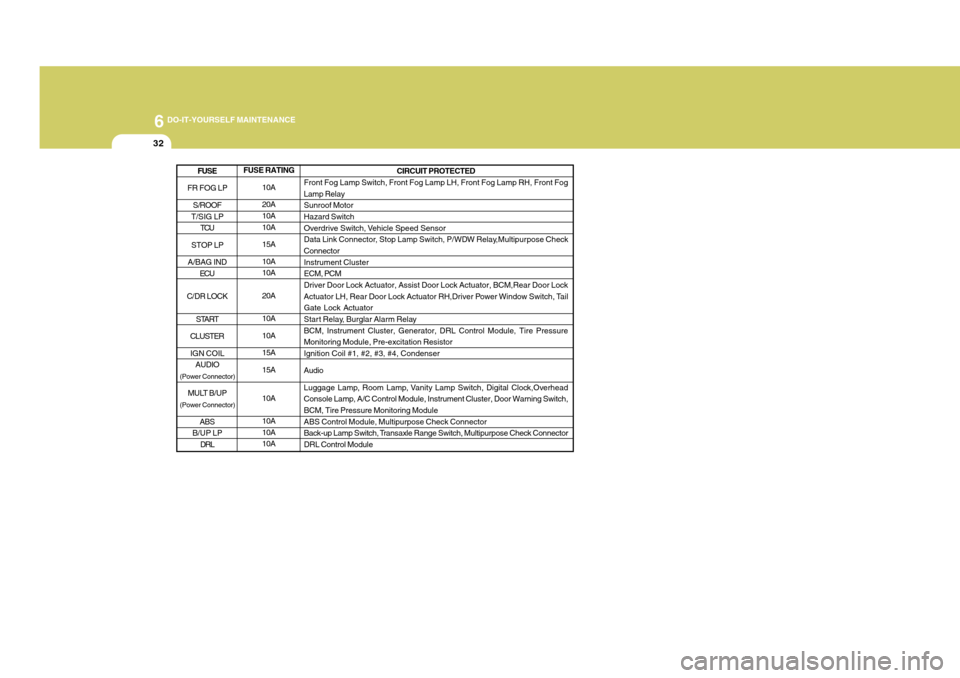
FUSE RATING
10A
20A
10A
10A
15A
10A
10A
20A
10A
10A
15A
15A
10A
10A
10A
10ACIRCUIT PROTECTED
Front Fog Lamp Switch, Front Fog Lamp LH, Front Fog Lamp RH, Front Fog
Lamp Relay
Sunroof Motor
Hazard Switch
Overdrive Switch, Vehicle Speed Sensor
Data Link Connector, Stop Lamp Switch, P/WDW Relay,Multipurpose Check
Connector
Instrument Cluster
ECM, PCM
Driver Door Lock Actuator, Assist Door Lock Actuator, BCM,Rear Door Lock
Actuator LH, Rear Door Lock Actuator RH,Driver Power Window Switch, Tail
Gate Lock Actuator
Star t Relay, Burglar Alarm Relay
BCM, Instrument Cluster, Generator, DRL Control Module, Tire Pressure
Monitoring Module, Pre-excitation Resistor
Ignition Coil #1, #2, #3, #4, Condenser
Audio
Luggage Lamp, Room Lamp, Vanity Lamp Switch, Digital Clock,Overhead
Console Lamp, A/C Control Module, Instrument Cluster, Door Warning Switch,
BCM, Tire Pressure Monitoring Module
ABS Control Module, Multipurpose Check Connector
Back-up Lamp Switch, Transaxle Range Switch, Multipurpose Check Connector
DRL Control Module
FR FOG LP
S/ROOF
T/SIG LP
TCU
STOP LP
A/BAG IND
ECU
C/DR LOCK
START
CLUSTER
IGN COIL
AUDIO(Power Connector)MULT B/UP(Power Connector)
ABS
B/UP LP
DRLFUSE
Page 262 of 282
8
CONSUMER INFORMATION, REPORTING SAFETY DEFECTS & BINDING ARBITRATION OF WARRANTY CLAIMS8
I030D01JM-AATTIRE TERMINOLOGY AND DEFINI-
TIONS
Air Pressure: The amount of air inside
the tire pressing outward on the tire.
Air pressure is expressed in pounds
per square inch (psi) or kilopascal (kPa).
Accessory Weight: This means the
combined weight of optional accesso-
ries. Some examples of optional ac-
cessories are, automatic transmission,
power seats, and air conditioning.
Aspect Ratio: The relationship of a
tire's height to its width.
Belt: A rubber coated layer of cords
that is located between the plies and
the tread. Cords may be made from
steel or other reinforcing materials.
Bead: The tire bead contains steel
wires wrapped by steel cords that hold
the tire onto the rim.
Bias Ply Tire: A pneumatic tire in
which the plies are laid at alternate
angles less than 90 degrees to the
centerline of the tread.Cold Tire Pressure: The amount of
air pressure in a tire, measured in
pounds per square inch (psi) or
kilopascals (kPa) before a tire has
built up heat from driving.
Curb Weight: This means the weight
of a motor vehicle with standard and
optional equipment including the maxi-
mum capacity of fuel, oil and coolant,
but without passengers and cargo.
DOT Markings: A code molded into
the sidewall of a tire signifying that the
tire is in compliance with the U.S.
Department of Transportation motor
vehicle safety standards. The DOT
code includes the Tire Identification
Number (TIN), an alphanumeric desig-
nator which can also identify the tire
manufacturer, production plant, brand
and date of production.
GVWR: Gross Vehicle Weight Rating
GAWR FRT: Gross Axle Weight Rat-
ing for the front Axle.
GAWR RR: Gross Axle Weight Rating
for the rear axle. 6. Maximum load rating
This number indicates the maxi-
mum load in kilograms and pounds
that can be carried by the tire. When
replacing the tires on the vehicle,
always use a tire that has the same
load rating as the factory installed
tire.
7. Uniform Tire Quality Grading
(UTQG):
Tire manufacturers are required to
grade tires based on three perfor-
mance factors: treadwear, traction
and temperature resistance. For
more information, see Uniform Tire
Quality Grading on page 8-15.
Page 274 of 282
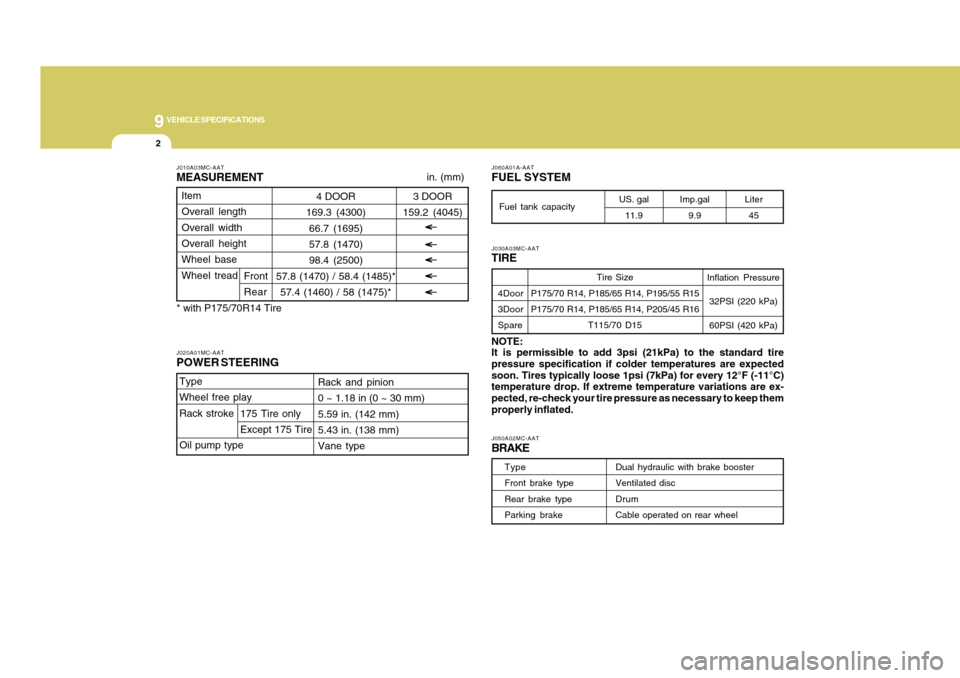
9
VEHICLE SPECIFICATIONS2
Tire Size
P175/70 R14, P185/65 R14, P195/55 R15
P175/70 R14, P185/65 R14, P205/45 R16
T115/70 D15
in. (mm)
Liter
45
4Door
3Door
Spare
US. gal
11.9 Fuel tank capacityImp.gal
9.9
Inflation Pressure
32PSI (220 kPa)
60PSI (420 kPa)
J010A03MC-AATMEASUREMENTJ020A01MC-AATPOWER STEERING
J060A01A-AATFUEL SYSTEMJ030A03MC-AATTIRE
4 DOOR
169.3 (4300)
66.7 (1695)
57.8 (1470)
98.4 (2500)
57.8 (1470) / 58.4 (1485)*
57.4 (1460) / 58 (1475)* Item
Overall length
Overall width
Overall height
Wheel base
Wheel tread
Front
Rear
3 DOOR
159.2 (4045)
Type
Wheel free play
Rack stroke
Oil pump type
Rack and pinion
0 ~ 1.18 in (0 ~ 30 mm)
5.59 in. (142 mm)
5.43 in. (138 mm)
Vane type
175 Tire only
Except 175 Tire
* with P175/70R14 Tire
NOTE:
It is permissible to add 3psi (21kPa) to the standard tire
pressure specification if colder temperatures are expected
soon. Tires typically loose 1psi (7kPa) for every 12°F (-11°C)
temperature drop. If extreme temperature variations are ex-
pected, re-check your tire pressure as necessary to keep them
properly inflated.
Dual hydraulic with brake booster
Ventilated disc
Drum
Cable operated on rear wheel Type
Front brake type
Rear brake type
Parking brake
J050A02MC-AATBRAKE
Page 276 of 282
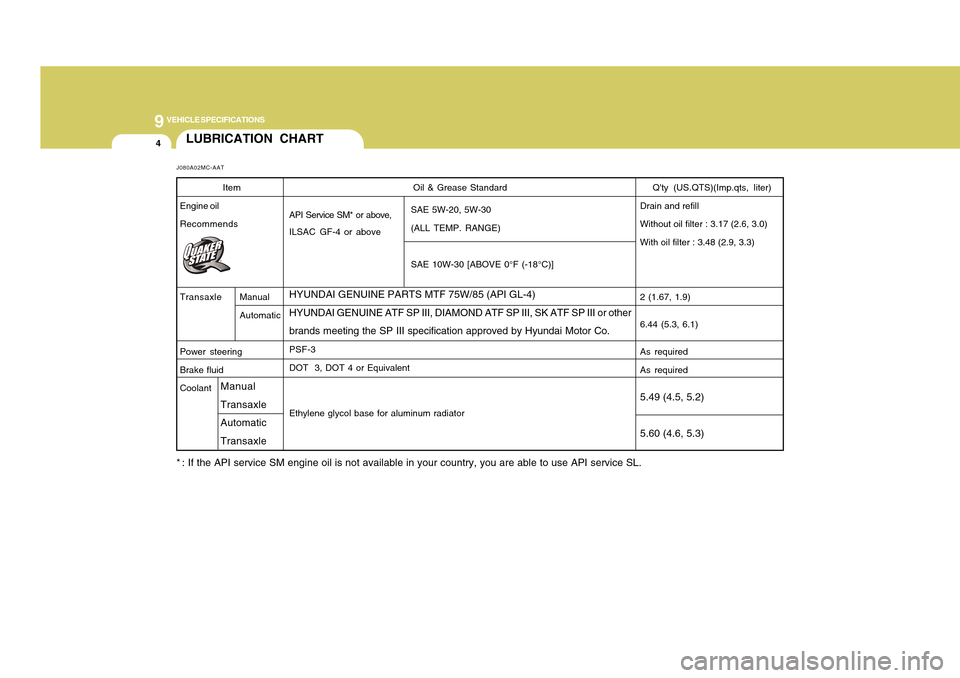
9
VEHICLE SPECIFICATIONS4
Oil & Grease Standard
API Service SM* or above,
ILSAC GF-4 or above
HYUNDAI GENUINE PARTS MTF 75W/85 (API GL-4)
HYUNDAI GENUINE ATF SP III, DIAMOND ATF SP III, SK ATF SP III or other
brands meeting the SP III specification approved by Hyundai Motor Co.PSF-3
DOT 3, DOT 4 or Equivalent
Ethylene glycol base for aluminum radiatorSAE 5W-20, 5W-30
(ALL TEMP. RANGE)
SAE 10W-30 [ABOVE 0°F (-18°C)]
LUBRICATION CHART
Item
Engine oil
Recommends
TransaxleManual
Automatic
Power steering
Brake fluid
CoolantManual
Transaxle
Automatic
Transaxle
J080A02MC-AAT
Q'ty (US.QTS)(Imp.qts, liter)
Drain and refill
Without oil filter : 3.17 (2.6, 3.0)
With oil filter : 3.48 (2.9, 3.3)
2 (1.67, 1.9)
6.44 (5.3, 6.1)
As required
As required
5.49 (4.5, 5.2)
5.60 (4.6, 5.3)
* : If the API service SM engine oil is not available in your country, you are able to use API service SL.