connect Hyundai Accent 2011 Owner's Manual
[x] Cancel search | Manufacturer: HYUNDAI, Model Year: 2011, Model line: Accent, Model: Hyundai Accent 2011Pages: 282, PDF Size: 14.82 MB
Page 31 of 282
1FEATURES OF YOUR HYUNDAI20
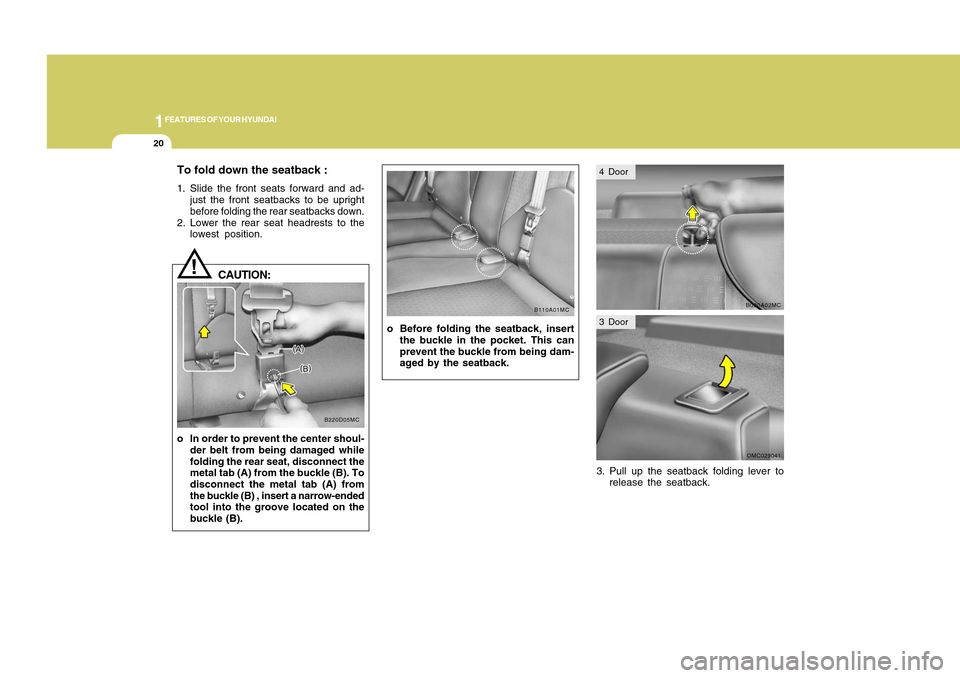
3. Pull up the seatback folding lever to
release the seatback. o Before folding the seatback, insert
the buckle in the pocket. This can
prevent the buckle from being dam-
aged by the seatback.
B110A01MC
To fold down the seatback :1. Slide the front seats forward and ad-
just the front seatbacks to be upright
before folding the rear seatbacks down.
2. Lower the rear seat headrests to the
lowest position.
B220D05MC
o In order to prevent the center shoul-
der belt from being damaged while
folding the rear seat, disconnect the
metal tab (A) from the buckle (B). To
disconnect the metal tab (A) from
the buckle (B) , insert a narrow-ended
tool into the groove located on the
buckle (B).
!
CAUTION:
B090A02MCOMC029041
4 Door3 Door
Page 42 of 282
1
FEATURES OF YOUR HYUNDAI
311
FEATURES OF YOUR HYUNDAI
31
!
B220D05MC
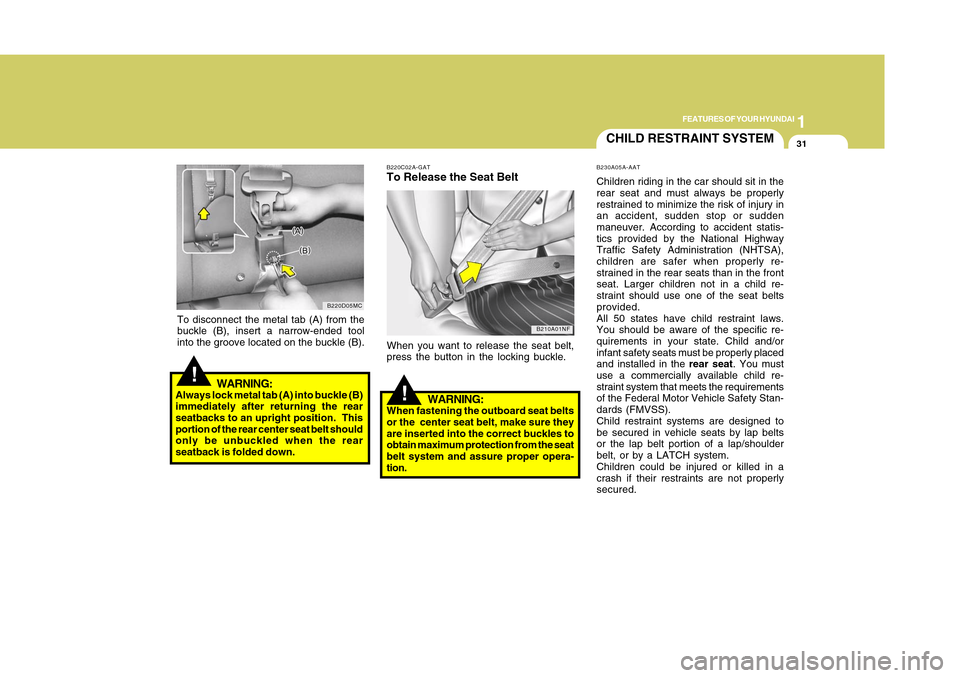
To disconnect the metal tab (A) from the
buckle (B), insert a narrow-ended tool
into the groove located on the buckle (B).
WARNING:
Always lock metal tab (A) into buckle (B)
immediately after returning the rear
seatbacks to an upright position. This
portion of the rear center seat belt should
only be unbuckled when the rear
seatback is folded down.
!
B220C02A-GATTo Release the Seat BeltWhen you want to release the seat belt,
press the button in the locking buckle.
WARNING:
When fastening the outboard seat belts
or the center seat belt, make sure they
are inserted into the correct buckles to
obtain maximum protection from the seat
belt system and assure proper opera-
tion.
B210A01NF
CHILD RESTRAINT SYSTEMB230A05A-AATChildren riding in the car should sit in the
rear seat and must always be properly
restrained to minimize the risk of injury in
an accident, sudden stop or sudden
maneuver. According to accident statis-
tics provided by the National Highway
Traffic Safety Administration (NHTSA),
children are safer when properly re-
strained in the rear seats than in the front
seat. Larger children not in a child re-
straint should use one of the seat belts
provided.
All 50 states have child restraint laws.
You should be aware of the specific re-
quirements in your state. Child and/or
infant safety seats must be properly placed
and installed in the rear seat. You must
use a commercially available child re-
straint system that meets the requirements
of the Federal Motor Vehicle Safety Stan-
dards (FMVSS).
Child restraint systems are designed to
be secured in vehicle seats by lap belts
or the lap belt portion of a lap/shoulder
belt, or by a LATCH system.
Children could be injured or killed in a
crash if their restraints are not properly
secured.
Page 45 of 282
1FEATURES OF YOUR HYUNDAI34
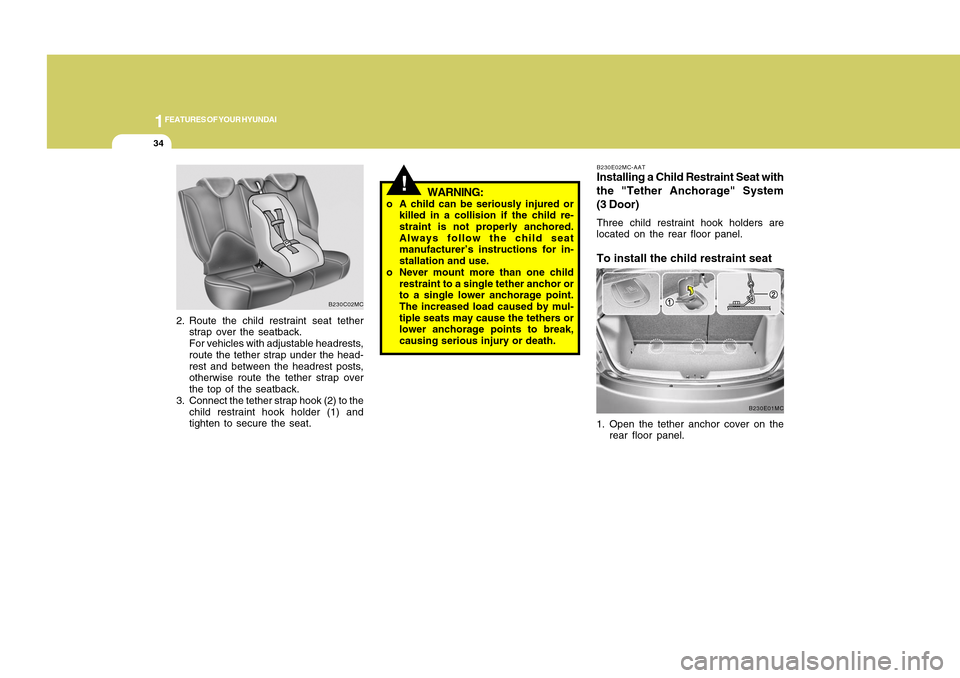
B230E02MC-AATInstalling a Child Restraint Seat with
the "Tether Anchorage" System
(3 Door)Three child restraint hook holders are
located on the rear floor panel.To install the child restraint seat
!
WARNING:
o A child can be seriously injured or
killed in a collision if the child re-
straint is not properly anchored.
Always follow the child seat
manufacturer’s instructions for in-
stallation and use.
o Never mount more than one child
restraint to a single tether anchor or
to a single lower anchorage point.
The increased load caused by mul-
tiple seats may cause the tethers or
lower anchorage points to break,
causing serious injury or death.
1. Open the tether anchor cover on the
rear floor panel.
B230E01MC
2. Route the child restraint seat tether
strap over the seatback.
For vehicles with adjustable headrests,
route the tether strap under the head-
rest and between the headrest posts,
otherwise route the tether strap over
the top of the seatback.
3. Connect the tether strap hook (2) to the
child restraint hook holder (1) and
tighten to secure the seat.
B230C02MC
Page 46 of 282
1
FEATURES OF YOUR HYUNDAI
351
FEATURES OF YOUR HYUNDAI
35
B230C02MC
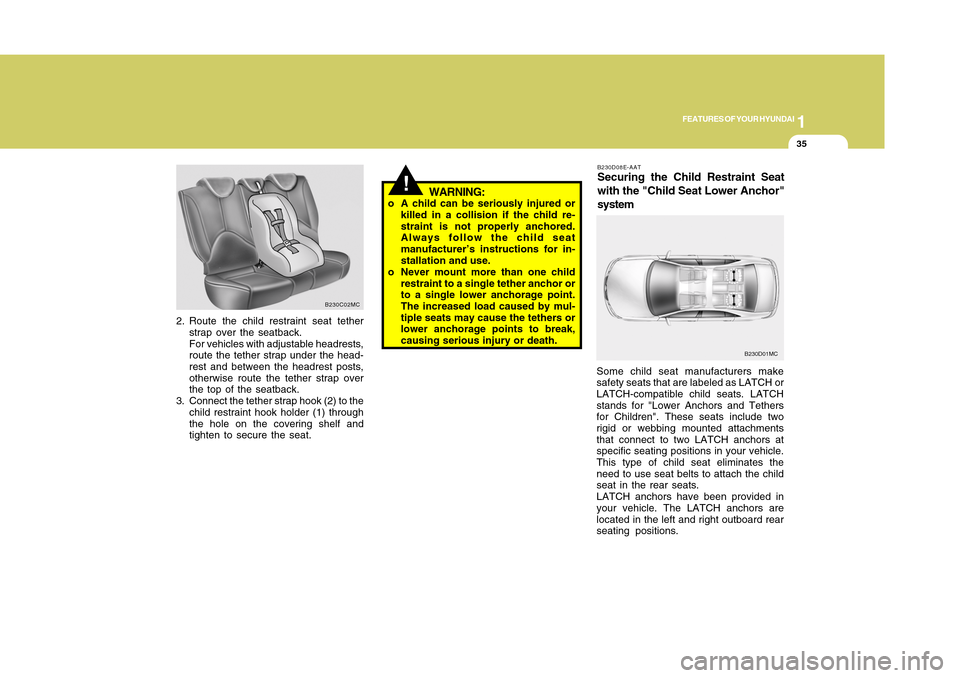
2. Route the child restraint seat tether
strap over the seatback.
For vehicles with adjustable headrests,
route the tether strap under the head-
rest and between the headrest posts,
otherwise route the tether strap over
the top of the seatback.
3. Connect the tether strap hook (2) to the
child restraint hook holder (1) through
the hole on the covering shelf and
tighten to secure the seat.
!
WARNING:
o A child can be seriously injured or
killed in a collision if the child re-
straint is not properly anchored.
Always follow the child seat
manufacturer’s instructions for in-
stallation and use.
o Never mount more than one child
restraint to a single tether anchor or
to a single lower anchorage point.
The increased load caused by mul-
tiple seats may cause the tethers or
lower anchorage points to break,
causing serious injury or death.
B230D08E-AATSecuring the Child Restraint Seat
with the "Child Seat Lower Anchor"
systemSome child seat manufacturers make
safety seats that are labeled as LATCH or
LATCH-compatible child seats. LATCH
stands for "Lower Anchors and Tethers
for Children". These seats include two
rigid or webbing mounted attachments
that connect to two LATCH anchors at
specific seating positions in your vehicle.
This type of child seat eliminates the
need to use seat belts to attach the child
seat in the rear seats.
LATCH anchors have been provided in
your vehicle. The LATCH anchors are
located in the left and right outboard rear
seating positions.
B230D01MC
Page 51 of 282
1FEATURES OF YOUR HYUNDAI40
!
!
WARNING:
o Pre-tensioners are designed to op-
erate only one time. After activation,
pre-tensioner seat belts must be
replaced. All seat belts, of any type,
should always be replaced after they
have been worn during a collision.
o The pre-tensioner seat belt assem-
bly mechanisms become hot during
activation. Do not touch the pre-
tensioner seat belt assemblies for
several minutes after they have been
activated.o Do not attempt to inspect or replace
the pre-tensioner seat belts your-
self. This must be done by an autho-
rized Hyundai dealer.
o Do not strike the pre-tensioner seat
belt assemblies.
o Do not attempt to service or repair
the pre-tensioner seat belt system in
any manner.
o Improper handling of the pre-
tensioner seat belt assemblies, and
failure to heed the warnings to not
strike, modify, inspect, replace, ser-
vice or repair the pre-tensioner seat
belt assemblies may lead to improp-
er operation or inadvertent activa-
tion and serious injury.
o Always wear the seat belts when
driving or riding in a motor vehicle.
o If the vehicle or pre-tensioner seat
belt must be discarded, contact an
authorized HYUNDAI dealer.
WARNING:
CAUTION:
o The sensor that activates the SRS
airbag is connected with the pre-
tensioner seat belt. The SRS airbag
warning light on the instrument
panel will illuminate for approximately
6 seconds after the ignition key has
been turned to the "ON" position,
and then it should turn off.
o If the pre-tensioner seat belt is not
working properly, this warning light
will illuminate even if there is no mal-
function of the SRS airbag.
!
o When the pre-tensioner seat belts
are activated, a loud noise may be
heard and fine dust, which may ap-
pear to be smoke, may be visible in
the passenger compartment. These
are normal operating conditions and
are not hazardous.
o Although it is harmless, the fine dust
may cause skin irritation and should
not be breathed for prolonged peri-
ods. Wash your hands and face thor-
oughly after an accident in which the
pre-tensioner seat belts were acti-
vated.If the SRS airbag warning light does
not illuminate when the ignition key
is turned to the "ON" position, re-
mains illuminated after approxi-
mately 6 seconds when the ignition
key is turned to the "ON" position, or
if it illuminates while the vehicle is
being driven, have an authorized
Hyundai dealer inspect the advanced
SRS airbag system as soon as pos-
sible.
Page 54 of 282
1
FEATURES OF YOUR HYUNDAI
431
FEATURES OF YOUR HYUNDAI
43
!
WARNING:
If a seat track position sensor or an
occupant classification system is not
working properly, the SRS airbag warn-
ing light on the instrument panel
will illuminate because the SRS airbag
warning light is connected with the seat
track position sensor and the occupant
classification system. If the SRS airbag
warning light does not illuminate when
the ignition key is turned to the "ON"
position, remains illuminated after ap-
proximately 6 seconds when the ignition
key is turned to the "ON" position, or if it
illuminates while the vehicle is being
driven, have an authorized Hyundai
dealer inspect the advanced SRS airbag
system as soon as possible.
AIR
BAG
!
WARNING:
o Modification to the seat structure
can adversely affect the seat track
position sensor and cause the airbag
to deploy at a different level than
should be provided.
o Do not place any objects underneath
the front seats as they could dam-
age the seat track position sensor or
interfere with the occupant classifi-
cation system.
o Do not place any objects that may
cause magnetic fields near the front
seat. These may cause a malfunc-
tion of the seat track position sen-
sor.
NOTE:o Be sure to read information about
the SRS on the labels provided on
the topside of the sun visor.
o Advanced airbags are combined with
pre-tensioner seat belts to help pro-
vide enhanced occupant protection
in frontal crashes. Front airbags are
not intended to deploy in collisions in
which sufficient protection can be
provided by the pre-tensioner seat
belt.
o If you are considering modification
of your vehicle due to a disability,
please contact the Hyundai Cus-
tomer Assistance Center at 1-800-
633-5151.
Page 55 of 282
1FEATURES OF YOUR HYUNDAI44
!
WARNING:
o Move your seat as far back as prac-
tical from the front airbags, while still
maintaining control of the vehicle.
o Never sit or lean unnecessarily close
to the front or side airbags.
o Never lean against the door or cen-
ter console – always sit in an upright
position.
o Do not allow an adult passenger to
ride in the front seat when the “Pas-
senger Airbag OFF” indicator is illu-
minated, because the airbag will not
deploy in the event of a moderate or
severe frontal crash.
o Never place objects over or near
any airbag module (front or side im-
pact airbags), because these objects
can injure passengers in a crash.
o Never place covers, blankets or
aftermarket seat warmers on the
passenger seat as these may inter-
fere with the occupant classification
system.
!
WARNING:
Always use seat belts and child restraints
– every trip, every time, everyone!
Airbags inflate with considerable force
and in the blink of an eye. Seat belts help
keep occupants in proper position to
obtain maximum benefit from the airbag.
Even with advanced airbags, improp-
erly belted and unbelted occupants can
be severely injured when the airbag in-
flates. Always follow the precautions
about seat belts, airbags and occupant
safety contained in this manual.
To reduce the chance of serious or fatal
injuries and receive the maximum safety
benefit from your restraint system:
o Never place a child in any child or
booster seat in the front seat (see
child restraints 1-31).
o ABC – Always Buckle Children in the
back seat. It is the safest place for
children of any age to ride.
o Front and side impact airbags can
injure occupants improperly posi-
tioned in the front seats.
!
WARNING:
o Do not tamper or disconnect SRS
wiring or other components. Injuries
could result from inadvertent deploy-
ment or failure of the airbag to de-
ploy in a crash.
o If the SRS airbag warning light (see
pg 1-64) remains illuminated while
the vehicle is being driven, have an
authorized Hyundai dealer inspect
the airbag system as soon as pos-
sible.
o Airbags can only be used once –
have an authorized Hyundai dealer
replace the airbag immediately after
deployment.
o The SRS is designed to deploy the
front airbags only when an impact is
sufficiently severe and when the im-
pact angle is within a range as mea-
sured from the forward longitudinal
axis of the vehicle. The front airbags
will not deploy in side, rear or rollover
impacts. Additionally, the airbags will
only deploy once. Seat belts must be
worn at all times.
Page 56 of 282
1
FEATURES OF YOUR HYUNDAI
451
FEATURES OF YOUR HYUNDAI
45
!
WARNING:
o No objects should be placed over or
near the airbag modules on the steer-
ing wheel, instrument panel, and the
front passenger's panel above the
glove box, because any such object
could cause harm if the vehicle is in
a crash severe enough to cause the
airbags to deploy.
o If the airbags deploy, they must be
replaced by an authorized Hyundai
dealer. Deployed airbags WILL NOT
inflate again and will provide no pro-
tection in subsequent collisions.
o Do not tamper with or disconnect
SRS wiring or other components of
the SRS system. Doing so could
result in injury, due to accidental
deployment of the airbags or by ren-
dering the SRS inoperative.
o Even though your vehicle is equipped
with the occupant classification sys-
tem, do not install a child restraint
system in the front passenger seat
position. A child restraint system
must never be placed in the front
seat.
An infant or child could be severely
injured or killed by an airbag deploy-
ment in case of an accident.
o Children younger than 13 years must
always be properly restrained in the
rear seat. Never allow children to
ride in the front passenger seat. If a
child over 13 must be seated in the
front seat, he or she must be prop-
erly belted and the seat should be
moved as far back as possible.
o For maximum safety protection in all
types of crashes, all occupants in-
cluding the driver should always wear
their seat belts whether or not an
airbag is also provided at their seat-
ing position to minimize the risk of
severe injury or death in the event of
a crash. Do not sit or lean unneces-
sarily close to the airbag while the
vehicle is in motion.!
WARNING:
!
WARNING:
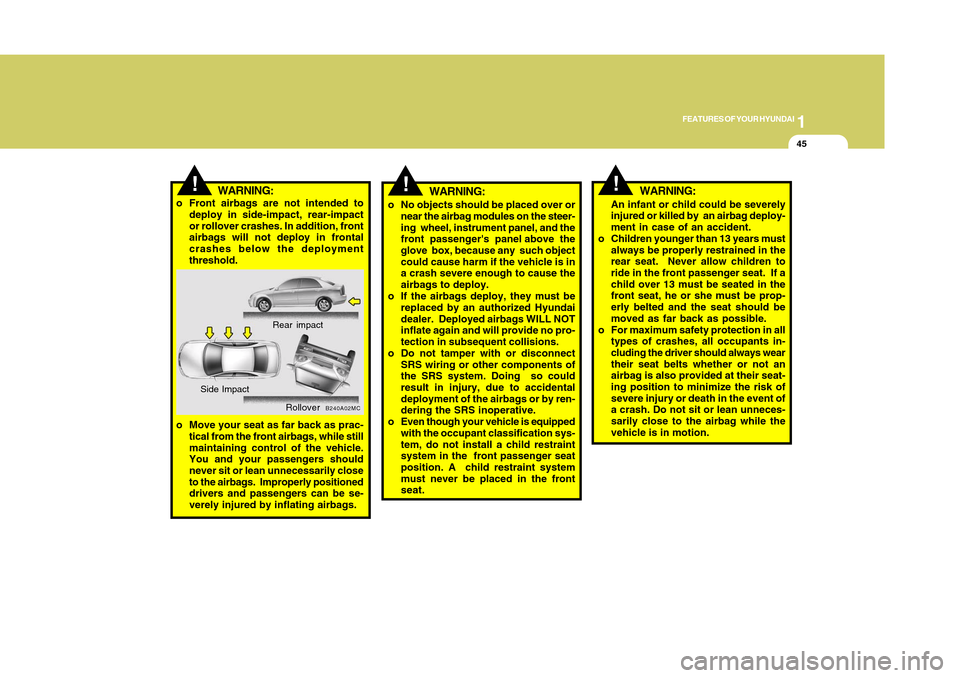
B240A02MC
Rear impact
Side Impact
Rollover
o Front airbags are not intended to
deploy in side-impact, rear-impact
or rollover crashes. In addition, front
airbags will not deploy in frontal
crashes below the deployment
threshold.
o Move your seat as far back as prac-
tical from the front airbags, while still
maintaining control of the vehicle.
You and your passengers should
never sit or lean unnecessarily close
to the airbags. Improperly positioned
drivers and passengers can be se-
verely injured by inflating airbags.
Page 60 of 282
1
FEATURES OF YOUR HYUNDAI
491
FEATURES OF YOUR HYUNDAI
49
!
o Before you replace a fuse or discon-
nect a battery terminal, turn the igni-
tion key to the "LOCK" position and
remove the ignition key. Never re-
move or replace the airbag related
fuse(s) when the ignition key is in the
"ON" position. Failure to heed this
warning will cause the SRS "AIR
BAG" warning light to illuminate.
WARNING:
The occupant classification system cre-
ates a field which is designed to detect
the presence of a properly-seated front
passenger and determine if the
passenger's front air bag should be en-
abled (may inflate) or not. The driver's
front air bag is not affected or controlled
by the occupant classification system.Main components of occupant clas-
sification system• An Electronic Capacity measurement
system in the front passenger seat
which detects major characteristics of
a person or object on the seat.
Electronic system to determine whether
the passenger air bag systems (both
front and side) should be activated or
deactivated.
A warning light located on the instru-
ment panel which illuminates the words
"PASSENGER AIR BAG OFF" indicat-
ing the front passenger air bag system
is deactivated.
The instrument panel air bag warning
light is interconnected with the occu-
pant classification system.
OMC029200N
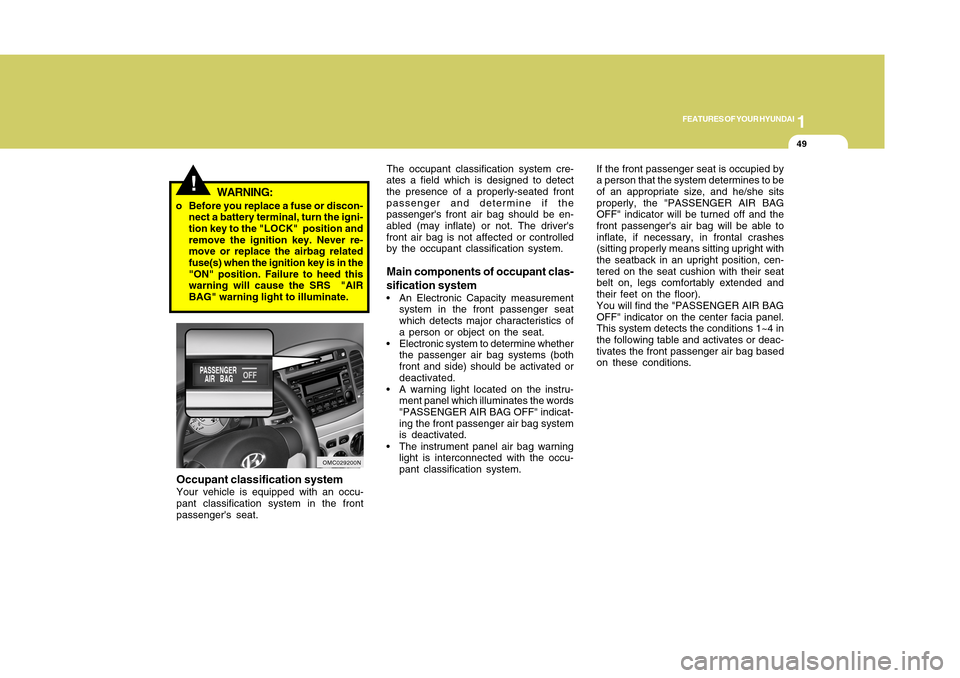
Occupant classification systemYour vehicle is equipped with an occu-
pant classification system in the front
passenger's seat.If the front passenger seat is occupied by
a person that the system determines to be
of an appropriate size, and he/she sits
properly, the "PASSENGER AIR BAG
OFF" indicator will be turned off and the
front passenger's air bag will be able to
inflate, if necessary, in frontal crashes
(sitting properly means sitting upright with
the seatback in an upright position, cen-
tered on the seat cushion with their seat
belt on, legs comfortably extended and
their feet on the floor).
You will find the "PASSENGER AIR BAG
OFF" indicator on the center facia panel.
This system detects the conditions 1~4 in
the following table and activates or deac-
tivates the front passenger air bag based
on these conditions.
Page 65 of 282
1FEATURES OF YOUR HYUNDAI54
!
WARNING:
If the occupant classification system is
not working properly, the SRS air bag
warning light on the instrument panel
will illuminate because the passenger's
front air bag is connected with the occu-
pant classification system. If there is a
malfunction of the occupant classifica-
tion system, the "PASSENGER AIR BAG
OFF" indicator will not illuminate and the
passenger's front air bag will inflate in
frontal impact crashes even if there is no
occupant in the front passenger's seat.
If the SRS air bag warning light does not
illuminate when the ignition switch is
turned to the ON position, remains illu-
minated after approximately 6 seconds
when the ignition switch is turned to the
ON position, or if it illuminates while the
vehicle is being driven, have an autho-
rized HYUNDAI dealer inspect the occu-
pant classification system and the SRS
air bag system as soon as possible.
!
WARNING:
o Accident statistics show that chil-
dren are safer if they are restrained
in the rear, as opposed to the front
seat. It is recommended that child
restraints be secured in a rear seat,
including an infant riding in a rear-
facing infant seat, a child riding in a
forward-facing child seat and an older
child riding in a booster seat.
o Air bags can only be used once –
have an authorized HYUNDAI dealer
replace the air bag immediately after
deployment.
o The occupant classification system
may not work properly if water, cof-
fee or any other liquid including rain
gets on the seat. Keep the front seat
dry at all times.
o Do not place an electronic device
such as a laptop computer on the
front passenger seat. Its electronic
field may cause the OCS to switch to
the "on" condition and thus allow the
passenger airbag to deploy need-
lessly in a collision, increasing your
repair costs.
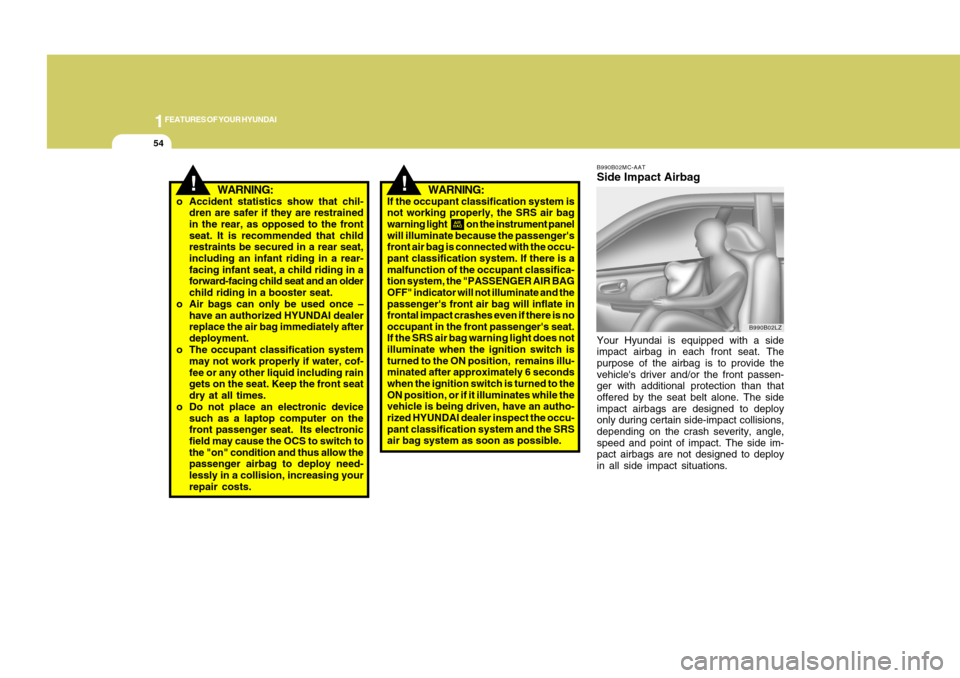
B990B02MC-AATSide Impact AirbagYour Hyundai is equipped with a side
impact airbag in each front seat. The
purpose of the airbag is to provide the
vehicle's driver and/or the front passen-
ger with additional protection than that
offered by the seat belt alone. The side
impact airbags are designed to deploy
only during certain side-impact collisions,
depending on the crash severity, angle,
speed and point of impact. The side im-
pact airbags are not designed to deploy
in all side impact situations.
B990B02LZ