service Hyundai Accent 2013 Owner's Guide
[x] Cancel search | Manufacturer: HYUNDAI, Model Year: 2013, Model line: Accent, Model: Hyundai Accent 2013Pages: 402, PDF Size: 8.49 MB
Page 379 of 402
Maintenance
88 7
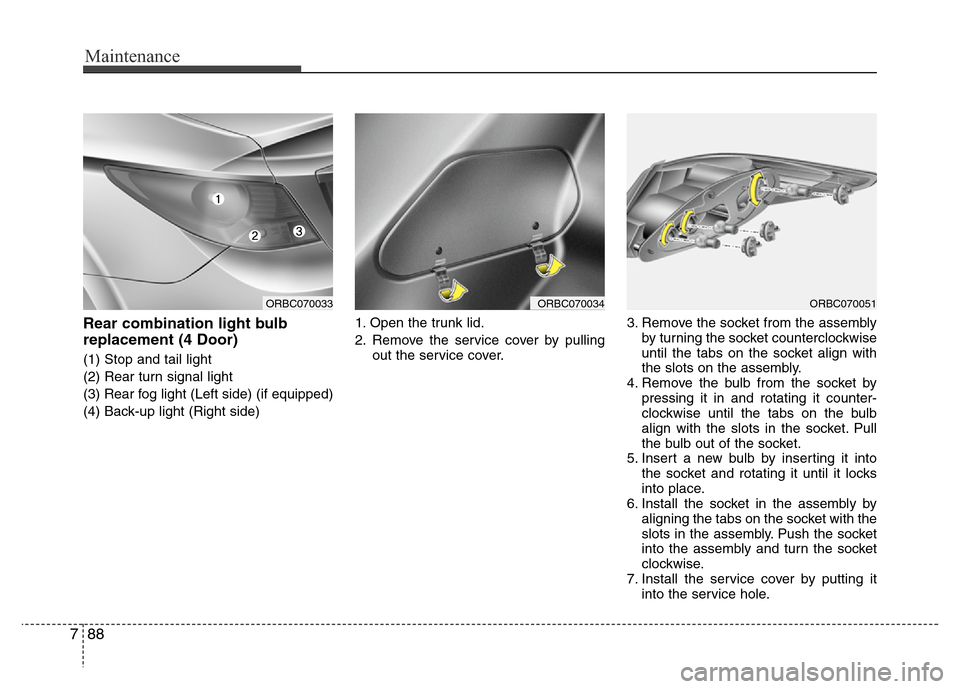
Rear combination light bulb
replacement (4 Door)
(1) Stop and tail light
(2) Rear turn signal light
(3) Rear fog light (Left side) (if equipped)
(4) Back-up light (Right side)1. Open the trunk lid.
2. Remove the service cover by pulling
out the service cover.3. Remove the socket from the assembly
by turning the socket counterclockwise
until the tabs on the socket align with
the slots on the assembly.
4. Remove the bulb from the socket by
pressing it in and rotating it counter-
clockwise until the tabs on the bulb
align with the slots in the socket. Pull
the bulb out of the socket.
5. Insert a new bulb by inserting it into
the socket and rotating it until it locks
into place.
6. Install the socket in the assembly by
aligning the tabs on the socket with the
slots in the assembly. Push the socket
into the assembly and turn the socket
clockwise.
7. Install the service cover by putting it
into the service hole.
ORBC070034ORBC070033ORBC070051
Page 390 of 402
799
Maintenance
EMISSION CONTROL SYSTEM (IF EQUIPPED)
The emission control system of your
vehicle is covered by a written limited
warranty. Please see the warranty infor-
mation contained in the Service Passport
in your vehicle.
Your vehicle is equipped with an emis-
sion control system to meet all applicable
emission regulations.
There are three emission control sys-
tems, as follows.
(1) Crankcase emission control system
(2) Evaporative emission control system
(3) Exhaust emission control system
In order to assure the proper function of
the emission control systems, it is rec-
ommended that you have your car
inspected and maintained by an author-
ized HYUNDAI dealer in accordance with
the maintenance schedule in this manu-
al.Caution for the Inspection and
Maintenance Test (With Electronic
Stability Program (ESP) system)
• To prevent the vehicle from misfir-
ing during dynamometer testing,
turn the Electronic Stability
Program (ESP) system off by press-
ing the ESP switch.
• After dynamometer testing is com-
pleted, turn the ESP system back on
by pressing the ESP switch again.1. Crankcase emission control
system
The positive crankcase ventilation sys-
tem is employed to prevent air pollution
caused by blow-by gases being emitted
from the crankcase. This system supplies
fresh filtered air to the crankcase through
the air intake hose. Inside the crankcase,
the fresh air mixes with blow-by gases,
which then pass through the PCV valve
into the induction system.
2. Evaporative emission control
system
The Evaporative Emission Control
System is designed to prevent fuel
vapors from escaping into the atmos-
phere.
Page 398 of 402
85
Specifications & Consumer information
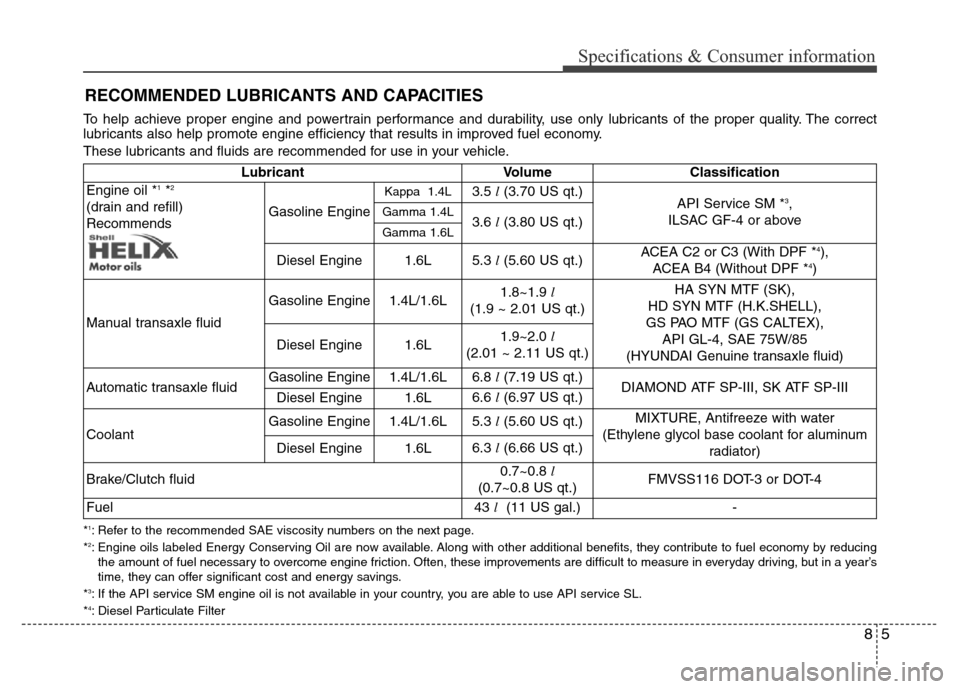
RECOMMENDED LUBRICANTS AND CAPACITIES
Lubricant Volume Classification
Engine oil *1*2
(drain and refill)
RecommendsGasoline Engine
Kappa 1.4L3.5 l(3.70 US qt.)
API Service SM *3,
ILSAC GF-4 or aboveGamma 1.4L3.6 l(3.80 US qt.)Gamma 1.6L
Diesel Engine1.6L5.3 l(5.60 US qt.)ACEA C2 or C3 (With DPF *4),
ACEA B4 (Without DPF *4)
Manual transaxle fluid
Gasoline Engine1.4L/1.6L1.8~1.9 l
(1.9 ~ 2.01 US qt.)HA SYN MTF (SK),
HD SYN MTF (H.K.SHELL),
GS PAO MTF (GS CALTEX),
API GL-4, SAE 75W/85
(HYUNDAI Genuine transaxle fluid)
Diesel Engine1.6L1.9~2.0 l
(2.01 ~ 2.11 US qt.)
Automatic transaxle fluidGasoline Engine 1.4L/1.6L6.8 l(7.19 US qt.)
DIAMOND ATF SP-III, SK ATF SP-III
Diesel Engine1.6L6.6 l(6.97 US qt.)
Coolant Gasoline Engine 1.4L/1.6L5.3 l(5.60 US qt.)MIXTURE, Antifreeze with water
(Ethylene glycol base coolant for aluminum
radiator)
Diesel Engine1.6L6.3 l(6.66 US qt.)
Brake/Clutch fluid0.7~0.8 l
(0.7~0.8 US qt.)FMVSS116 DOT-3 or DOT-4
Fuel43 l(11 US gal.)-
To help achieve proper engine and powertrain performance and durability, use only lubricants of the proper quality. The correct
lubricants also help promote engine efficiency that results in improved fuel economy.
These lubricants and fluids are recommended for use in your vehicle.
*1: Refer to the recommended SAE viscosity numbers on the next page.
*2: Engine oils labeled Energy Conserving Oil are now available. Along with other additional benefits, they contribute to fuel economy by reducing
the amount of fuel necessary to overcome engine friction. Often, these improvements are difficult to measure in everyday driving, but in a year’s
time, they can offer significant cost and energy savings.
*
3: If the API service SM engine oil is not available in your country, you are able to use API service SL.
*4: Diesel Particulate Filter
Page 402 of 402
89
Specifications & Consumer information
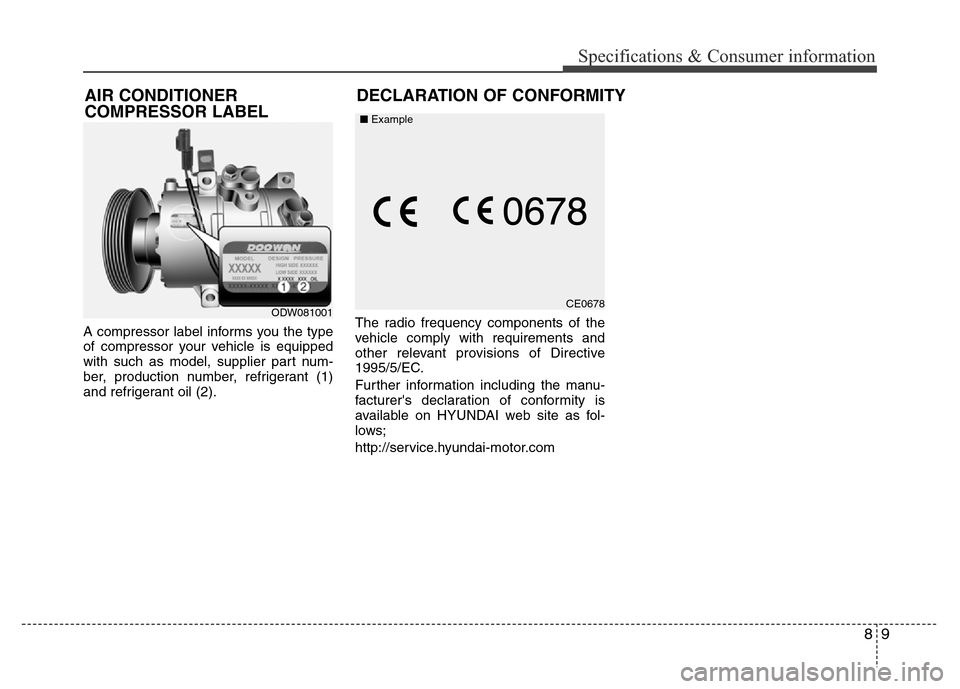
A compressor label informs you the type
of compressor your vehicle is equipped
with such as model, supplier part num-
ber, production number, refrigerant (1)
and refrigerant oil (2).The radio frequency components of the
vehicle comply with requirements and
other relevant provisions of Directive
1995/5/EC.
Further information including the manu-
facturer's declaration of conformity is
available on HYUNDAI web site as fol-
lows;
http://service.hyundai-motor.com
ODW081001
AIR CONDITIONER
COMPRESSOR LABELDECLARATION OF CONFORMITY
CE0678 ■Example