child lock Hyundai Accent 2017 User Guide
[x] Cancel search | Manufacturer: HYUNDAI, Model Year: 2017, Model line: Accent, Model: Hyundai Accent 2017Pages: 380, PDF Size: 12.45 MB
Page 83 of 380
4-9
Features of your vehicle
Impact sensing door unlock sys-
tem (if equipped)
All doors will be automatically unlocked
when the impact is delivered to impact
sensors while the ignition switch is ON.
However, the doors may not be unlocked
if mechanical problems occur with the
door lock system or battery.
Speed sensing door lock system
(if equipped)
All doors will be automatically locked
after the vehicle speed exceeds 9 mph
(15 km/h). And all doors will be automat-
ically unlocked when you turn the engine
off or when you remove the ignition key.
(if equipped)
Auto door lock/unlock feature
(Automatic transaxle)
(if equipped)
All doors will automatically lock whenthe shift lever is moved out of P (Park).
All doors will automatically unlock when the shift lever is moved into P
(Park).
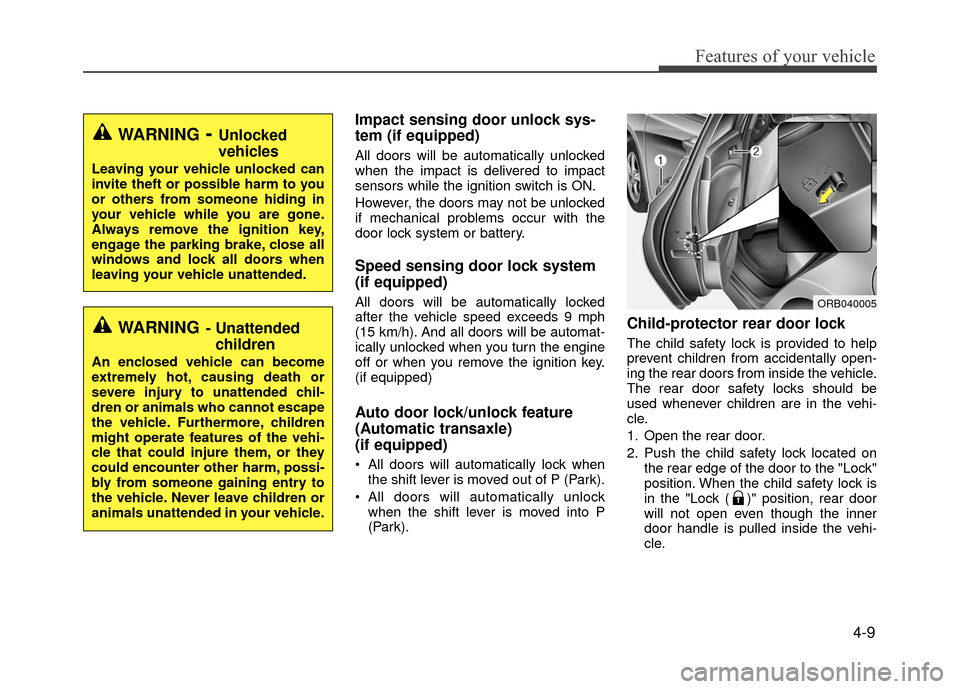
Child-protector rear door lock
The child safety lock is provided to help
prevent children from accidentally open-
ing the rear doors from inside the vehicle.
The rear door safety locks should be
used whenever children are in the vehi-
cle.
1. Open the rear door.
2. Push the child safety lock located on the rear edge of the door to the "Lock"
position. When the child safety lock is
in the "Lock ( )" position, rear door
will not open even though the inner
door handle is pulled inside the vehi-
cle.WARNING- Unattendedchildren
An enclosed vehicle can become
extremely hot, causing death or
severe injury to unattended chil-
dren or animals who cannot escape
the vehicle. Furthermore, children
might operate features of the vehi-
cle that could injure them, or they
could encounter other harm, possi-
bly from someone gaining entry to
the vehicle. Never leave children or
animals unattended in your vehicle.
WARNING- Unlocked
vehicles
Leaving your vehicle unlocked can
invite theft or possible harm to you
or others from someone hiding in
your vehicle while you are gone.
Always remove the ignition key,
engage the parking brake, close all
windows and lock all doors when
leaving your vehicle unattended.
ORB040005
Page 84 of 380
Features of your vehicle
4-10
3. Close the rear door.
To open the rear door, pull the outside
door handle (2).
Even though the doors may be unlocked,
the rear door will not open by pulling the
inner door handle until the rear door child
safety lock is unlocked.
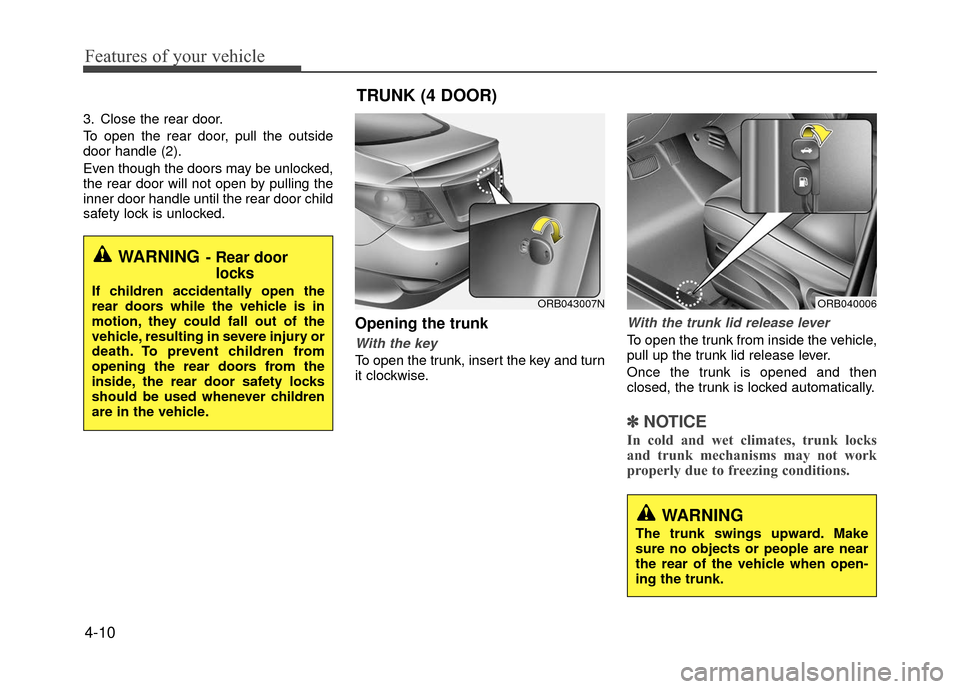
Opening the trunk
With the key
To open the trunk, insert the key and turn
it clockwise.
With the trunk lid release lever
To open the trunk from inside the vehicle,
pull up the trunk lid release lever.
Once the trunk is opened and then
closed, the trunk is locked automatically.
✽ ✽NOTICE
In cold and wet climates, trunk locks
and trunk mechanisms may not work
properly due to freezing conditions.
WARNING- Rear door
locks
If children accidentally open the
rear doors while the vehicle is in
motion, they could fall out of the
vehicle, resulting in severe injury or
death. To prevent children from
opening the rear doors from the
inside, the rear door safety locks
should be used whenever children
are in the vehicle.
TRUNK (4 DOOR)
ORB040006ORB043007N
WARNING
The trunk swings upward. Make
sure no objects or people are near
the rear of the vehicle when open-
ing the trunk.
Page 85 of 380
4-11
Features of your vehicle
Closing the trunk
To close the trunk, lower the trunk lid,
then press down on it until it locks. To be
sure the trunk lid is securely fastened,
always check by trying to pull it up again.
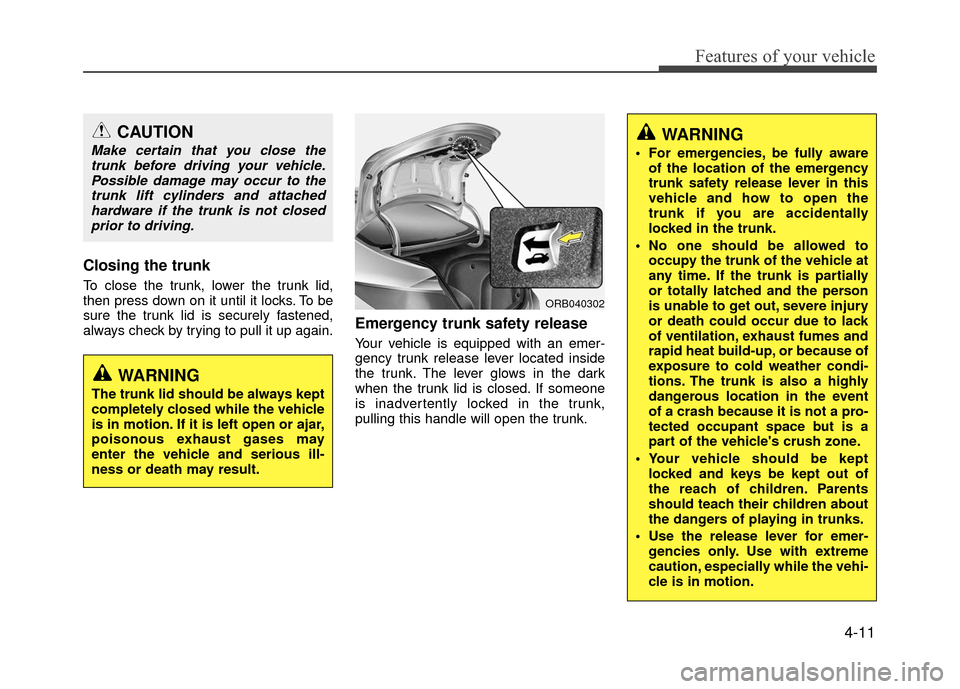
Emergency trunk safety release
Your vehicle is equipped with an emer-
gency trunk release lever located inside
the trunk. The lever glows in the dark
when the trunk lid is closed. If someone
is inadvertently locked in the trunk,
pulling this handle will open the trunk.
CAUTION
Make certain that you close thetrunk before driving your vehicle.Possible damage may occur to thetrunk lift cylinders and attachedhardware if the trunk is not closed prior to driving.
ORB040302
WARNING
The trunk lid should be always kept
completely closed while the vehicle
is in motion. If it is left open or ajar,
poisonous exhaust gases may
enter the vehicle and serious ill-
ness or death may result.
WARNING
For emergencies, be fully aware of the location of the emergency
trunk safety release lever in this
vehicle and how to open the
trunk if you are accidentally
locked in the trunk.
No one should be allowed to occupy the trunk of the vehicle at
any time. If the trunk is partially
or totally latched and the person
is unable to get out, severe injury
or death could occur due to lack
of ventilation, exhaust fumes and
rapid heat build-up, or because of
exposure to cold weather condi-
tions. The trunk is also a highly
dangerous location in the event
of a crash because it is not a pro-
tected occupant space but is a
part of the vehicle's crush zone.
Your vehicle should be kept locked and keys be kept out of
the reach of children. Parents
should teach their children about
the dangers of playing in trunks.
Use the release lever for emer- gencies only. Use with extreme
caution, especially while the vehi-
cle is in motion.
Page 90 of 380
Features of your vehicle
4-16
✽
✽NOTICE
The automatic reverse feature is only
active when the "Auto Up" feature is
used by fully pulling up the switch to the
second detent.
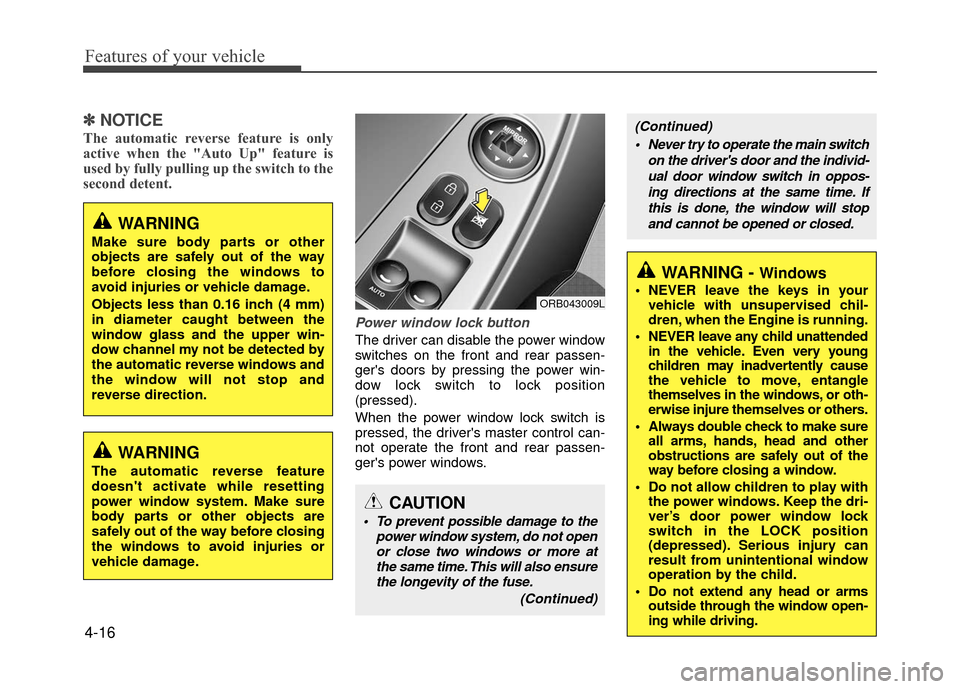
Power window lock button
The driver can disable the power window
switches on the front and rear passen-
ger's doors by pressing the power win-
dow lock switch to lock position
(pressed).
When the power window lock switch is
pressed, the driver's master control can-
not operate the front and rear passen-
ger's power windows.
ORB043009L
CAUTION
To prevent possible damage to the
power window system, do not openor close two windows or more atthe same time. This will also ensurethe longevity of the fuse.
(Continued)
(Continued)
Never try to operate the main switch on the driver's door and the individ-ual door window switch in oppos-ing directions at the same time. Ifthis is done, the window will stopand cannot be opened or closed.
WARNING - Windows
NEVER leave the keys in your vehicle with unsupervised chil-
dren, when the Engine is running.
NEVER leave any child unattended in the vehicle. Even very young
children may inadvertently cause
the vehicle to move, entangle
themselves in the windows, or oth-
erwise injure themselves or others.
Always double check to make sure all arms, hands, head and other
obstructions are safely out of the
way before closing a window.
Do not allow children to play with the power windows. Keep the dri-
ver’s door power window lock
switch in the LOCK position
(depressed). Serious injury can
result from unintentional window
operation by the child.
Do not extend any head or arms outside through the window open-
ing while driving.
WARNING
Make sure body parts or other
objects are safely out of the way
before closing the windows to
avoid injuries or vehicle damage.
Objects less than 0.16 inch (4 mm)
in diameter caught between the
window glass and the upper win-
dow channel my not be detected by
the automatic reverse windows and
the window will not stop and
reverse direction.
WARNING
The automatic reverse feature
doesn't activate while resetting
power window system. Make sure
body parts or other objects are
safely out of the way before closing
the windows to avoid injuries or
vehicle damage.
Page 207 of 380
Driving your vehicle
5-4
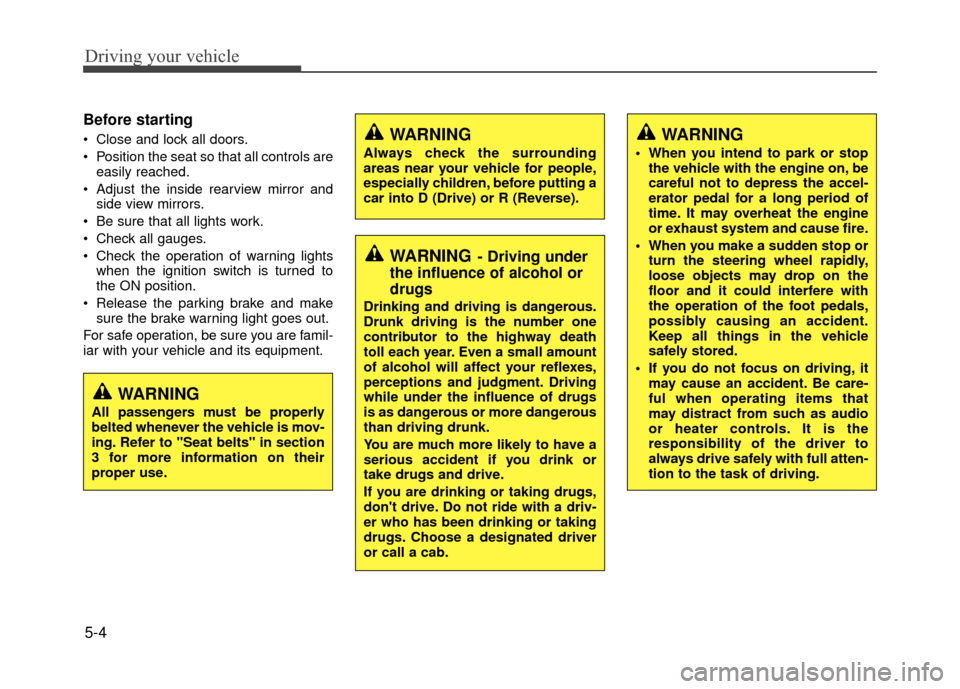
Before starting
Close and lock all doors.
Position the seat so that all controls areeasily reached.
Adjust the inside rearview mirror and side view mirrors.
Be sure that all lights work.
Check all gauges.
Check the operation of warning lights when the ignition switch is turned to
the ON position.
Release the parking brake and make sure the brake warning light goes out.
For safe operation, be sure you are famil-
iar with your vehicle and its equipment.WARNING
Always check the surrounding
areas near your vehicle for people,
especially children, before putting a
car into D (Drive) or R (Reverse).
WARNING- Driving under
the influence of alcohol or
drugs
Drinking and driving is dangerous.
Drunk driving is the number one
contributor to the highway death
toll each year. Even a small amount
of alcohol will affect your reflexes,
perceptions and judgment. Driving
while under the influence of drugs
is as dangerous or more dangerous
than driving drunk.
You are much more likely to have a
serious accident if you drink or
take drugs and drive.
If you are drinking or taking drugs,
don't drive. Do not ride with a driv-
er who has been drinking or taking
drugs. Choose a designated driver
or call a cab.
WARNING
When you intend to park or stop
the vehicle with the engine on, be
careful not to depress the accel-
erator pedal for a long period of
time. It may overheat the engine
or exhaust system and cause fire.
When you make a sudden stop or turn the steering wheel rapidly,
loose objects may drop on the
floor and it could interfere with
the operation of the foot pedals,
possibly causing an accident.
Keep all things in the vehicle
safely stored.
If you do not focus on driving, it may cause an accident. Be care-
ful when operating items that
may distract from such as audio
or heater controls. It is the
responsibility of the driver to
always drive safely with full atten-
tion to the task of driving.
WARNING
All passengers must be properly
belted whenever the vehicle is mov-
ing. Refer to "Seat belts" in section
3 for more information on their
proper use.
Page 214 of 380
5-11
Driving your vehicle
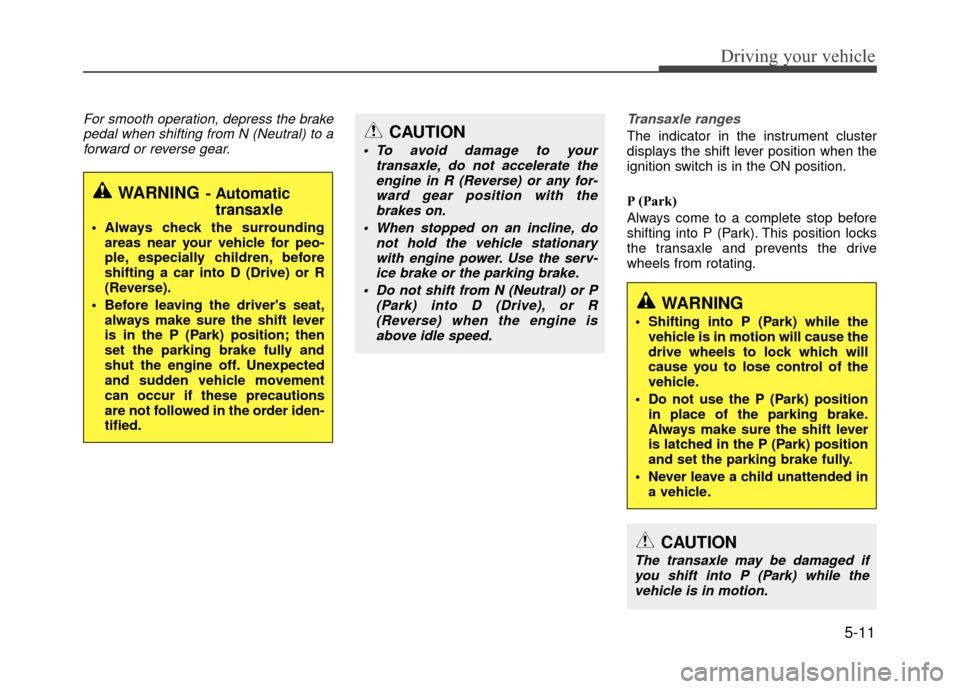
For smooth operation, depress the brakepedal when shifting from N (Neutral) to aforward or reverse gear. Transaxle ranges
The indicator in the instrument cluster
displays the shift lever position when the
ignition switch is in the ON position.
P (Park)
Always come to a complete stop before
shifting into P (Park). This position locks
the transaxle and prevents the drive
wheels from rotating.
WARNING- Automatic
transaxle
Always check the surrounding
areas near your vehicle for peo-
ple, especially children, before
shifting a car into D (Drive) or R
(Reverse).
Before leaving the driver's seat, always make sure the shift lever
is in the P (Park) position; then
set the parking brake fully and
shut the engine off. Unexpected
and sudden vehicle movement
can occur if these precautions
are not followed in the order iden-
tified.
CAUTION
To avoid damage to your transaxle, do not accelerate theengine in R (Reverse) or any for-ward gear position with thebrakes on.
When stopped on an incline, do not hold the vehicle stationarywith engine power. Use the serv-ice brake or the parking brake.
Do not shift from N (Neutral) or P (Park) into D (Drive), or R(Reverse) when the engine isabove idle speed.
WARNING
Shifting into P (Park) while the vehicle is in motion will cause the
drive wheels to lock which will
cause you to lose control of the
vehicle.
Do not use the P (Park) position in place of the parking brake.
Always make sure the shift lever
is latched in the P (Park) position
and set the parking brake fully.
Never leave a child unattended in a vehicle.
CAUTION
The transaxle may be damaged ifyou shift into P (Park) while thevehicle is in motion.
Page 374 of 380

I3
Index
Cargo capacity··················\
··················\
·········· ·5-41
Cargo weight ··················\
··················\
············ ·5-45
Center console storage ··················\
··················\
· ·4-75
Central door lock switch ··················\
··················\
·4-8
Certification label ··················\
··················\
······· ·5-43
Certification label ··················\
··················\
·········8-7
Chains Tire chains ··················\
··················\
············ ·5-37
Changing tires ··················\
··················\
··········· ·6-18
Checking tire inflation pressure ··················\
·········7-37
Child restraint system ··················\
··················\
·· ·3-25
Lower anchor ··················\
··················\
·········3-31
Seat belt ··················\
··················\
··············· ·3-26
Tether anchor system ··················\
················· ·3-29
Child-protector rear door lock ··················\
·············4-9
Climate control air filter ··················\
················· ·4-64
Climate control air filter ··················\
················· ·7-28
Clock (Digital) ··················\
··················\
·········· ·4-80
Clothes hanger ··················\
··················\
·········· ·4-80
Combined instrument, see instrument cluster ···········4-29
Compact spare tire ··················\
··················\
······ ·6-22
Compact spare tire replacement ··················\
·········7-41
Coolant ··················\
··················\
··················\
· ·7-22
Cooling fluid, see engine coolant ··················\
·······7-22
Crankcase emission control system ··················\
·····7-75
Cruise control system ··················\
··················\
·· ·5-26
Cup holder ··················\
··················\
··············· ·4-78
Curtain air bag ··················\
··················\
·········· ·3-50Dashboard illumination,
see instrument panel illumination ··················\
····4-30
Dashboard, see instrument cluster ··················\
·······4-29
Defogging (Windshield) ··················\
················· ·4-71
Defogging logic (Windshield) ··················\
···········4-73
Defroster (Rear window) ··················\
················ ·4-55
Defrosting (Windshield) ··················\
················· ·4-71
Digital clock ··················\
··················\
··············4-80
Dimensions ··················\
··················\
·················8-2
Display illumination, see instrument panel illumination
·4-30
Displays, see instrument cluster ··················\
·········4-29
Door locks ··················\
··················\
················· ·4-6
Central door lock switch ··················\
··············· ·4-8
Child-protector rear door lock ··················\
·········4-9
Drinks holders, see cup holders ··················\
·········4-78
Driver's 3-point seat belt ··················\
················· ·3-15
Driver's and passenger's front air bag ··················\
···3-45
Driving at night ··················\
··················\
········· ·5-33
Driving in flooded areas ··················\
················· ·5-34
Driving in the rain ··················\
··················\
······ ·5-34
Economical operation ··················\
··················\
·· ·5-30
Electric power steering ··················\
··················\
· ·4-24
Electronic stability control (ESC) ··················\
·······5-20
D
E