driving system Hyundai Accent 2017 Repair Manual
[x] Cancel search | Manufacturer: HYUNDAI, Model Year: 2017, Model line: Accent, Model: Hyundai Accent 2017Pages: 380, PDF Size: 12.45 MB
Page 317 of 380
Maintenance
7-34
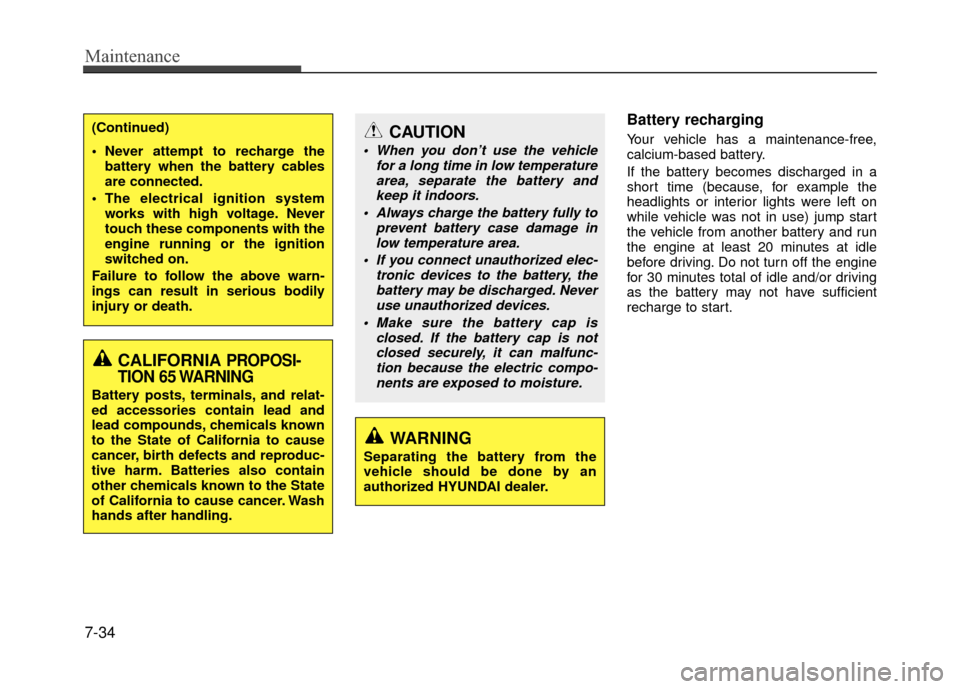
Battery recharging
Your vehicle has a maintenance-free,
calcium-based battery.
If the battery becomes discharged in a
short time (because, for example the
headlights or interior lights were left on
while vehicle was not in use) jump start
the vehicle from another battery and run
the engine at least 20 minutes at idle
before driving. Do not turn off the engine
for 30 minutes total of idle and/or driving
as the battery may not have sufficient
recharge to start.
CALIFORNIA PROPOSI-
TION 65 WARNING
Battery posts, terminals, and relat-
ed accessories contain lead and
lead compounds, chemicals known
to the State of California to cause
cancer, birth defects and reproduc-
tive harm. Batteries also contain
other chemicals known to the State
of California to cause cancer. Wash
hands after handling.
(Continued)
Never attempt to recharge the
battery when the battery cables
are connected.
The electrical ignition system works with high voltage. Never
touch these components with the
engine running or the ignition
switched on.
Failure to follow the above warn-
ings can result in serious bodily
injury or death.CAUTION
When you don’t use the vehicle for a long time in low temperaturearea, separate the battery andkeep it indoors.
Always charge the battery fully to prevent battery case damage inlow temperature area.
If you connect unauthorized elec- tronic devices to the battery, thebattery may be discharged. Never use unauthorized devices.
Make sure the battery cap is closed. If the battery cap is notclosed securely, it can malfunc- tion because the electric compo-nents are exposed to moisture.
WARNING
Separating the battery from the
vehicle should be done by an
authorized HYUNDAI dealer.
Page 343 of 380
Maintenance
7-60
LIGHT BULBS
Use only bulbs of the specified wattage.
✽
✽NOTICE
After heavy, driving rain or washing,
headlight and taillight lenses could
appear frosty. This condition is caused by
the temperature difference between the
lamp inside and outside. This is similar
to the condensation on your windows
inside your vehicle during the rain and
doesn’t indicate a problem with your
vehicle. If the water leaks into the lamp
bulb circuitry, have the vehicle checked
by an authorized HYUNDAI dealer.WARNING - Working on
the lights
Prior to working on the light, firmly
apply the parking brake, ensure
that the ignition switch is turned to
the LOCK position and turn off the
lights to avoid sudden movement
of the vehicle and burning your fin-
gers or receiving an electric shock.
CAUTION
Be sure to replace the burned-out
bulb with one of the same wattagerating. Otherwise, it may cause damage to the fuse or electricalwiring system.
CAUTION
If you don’t have necessary tools, the correct bulbs and the expert-ise, consult an authorizedHYUNDAI dealer. In many cases, itis difficult to replace vehicle light bulbs because other parts of thevehicle must be removed beforeyou can get to the bulb. This isespecially true if you have toremove the headlight assembly to
get to the bulb(s).
Removing
the headlight assembly
can result in damage to the vehi- cle.
Do not install additional bulbs or LED type bulbs. If you install that,the lamp may not be operatedproperly and fuse box or electrical wiring system may have a prob-lem.
Page 355 of 380
Maintenance
7-72
Underbody maintenance
Corrosive materials used for ice and
snow removal and dust control may col-
lect on the underbody. If these materials
are not removed, accelerated rusting can
occur on underbody parts such as the
fuel lines, frame, floor pan and exhaust
system, even though they have been
treated with rust protection.
Thoroughly flush the vehicle underbody
and wheel openings with lukewarm or
cold water once a month, after off-road
driving and at the end of each winter. Pay
special attention to these areas because
it is difficult to see all the mud and dirt. It
will do more harm than good to wet down
the road grime without removing it. The
lower edges of doors, rocker panels, and
frame members have drain holes that
should not be allowed to clog with dirt;
trapped water in these areas can cause
rusting.
Aluminum wheel maintenance
The aluminum wheels are coated with a
clear protective finish.
Do not use any abrasive cleaner, pol-ishing compound, solvent, or wire
brushes on aluminum wheels. They
may scratch or damage the finish.
Clean the wheel when it has cooled.
Use only a mild soap or neutral deter- gent, and rinse thoroughly with water.
Also, be sure to clean the wheels after
driving on salted roads. This helps pre-
vent corrosion.
Avoid washing the wheels with high- speed car wash brushes.
Do not use any alkaline or acid deter- gent. It may damage and corrode the
aluminum wheels coated with a clear
protective finish.
Corrosion protection
Protecting your vehicle from corrosion
By using the most advanced design and
construction practices to combat corro-
sion, we produce cars of the highest
quality. However, this is only part of the
job. To achieve the long-term corrosion
resistance your vehicle can deliver, the
owner's cooperation and assistance is
also required.
Common causes of corrosion
The most common causes of corrosion
on your car are:
allowed to accumulate underneath the
car.
Removal of paint or protective coatings by stones, gravel, abrasion or minor
scrapes and dents which leave unpro-
tected metal exposed to corrosion.
High-corrosion areas
If you live in an area where your car is
regularly exposed to corrosive materials,
corrosion protection is particularly impor-
tant. Some of the common causes of
accelerated corrosion are road salts,
dust control chemicals, ocean air and
industrial pollution.
WARNING
After washing the vehicle, test the
brakes while driving slowly to see if
they have been affected by water. If
braking performance is impaired,
dry the brakes by applying them
lightly while maintaining a slow for-
ward speed.
Page 359 of 380
Maintenance
7-76
EMISSION CONTROL SYSTEM
The emission control system of your
vehicle is covered by a written limited
warranty. Please see the warranty infor-
mation contained in the Owner's
Handbook & Warranty Information book-
let in your vehicle.
Your vehicle is equipped with an emis-
sion control system to meet all applicable
emission regulations.
There are three emission control sys-
tems, as follows.
(1) Crankcase emission control system
(2) Evaporative emission control system
(3) Exhaust emission control system
In order to assure the proper function of
the emission control systems, it is recom-
mended that you have your car inspected
and maintained by an authorized
HYUNDAI dealer in accordance with the
maintenance schedule in this manual.Caution for the Inspection and
Maintenance Test (With Electronic
Stability Control (ESC) system)
To prevent the vehicle from misfir-
ing during dynamometer testing,
turn the Electronic Stability Control
(ESC) system off by pressing the
ESC switch.
After dynamometer testing is com- pleted, turn the ESC system back on
by pressing the ESC switch again.
1. Crankcase emission control system
The positive crankcase ventilation sys-
tem is employed to prevent air pollution
caused by blow-by gases being emitted
from the crankcase. This system supplies
fresh filtered air to the crankcase through
the air intake hose. Inside the crankcase,
the fresh air mixes with blow-by gases,
which then pass through the PCV valve
into the induction system.
2. Evaporative emission control(including ORVR: Onboard
Refueling Vapor Recovery)
system
The Evaporative Emission Control
System is designed to prevent fuel
vapors from escaping into the atmos-
phere.
(The ORVR system is designed to allow
the vapors from the fuel tank to be
loaded into a canister while refueling at
the gas station, preventing the escape of
fuel vapors into the atmosphere.)
Canister
Fuel vapors generated inside the fuel
tank are absorbed and stored in the
onboard canister. When the engine is
running, the fuel vapors absorbed in the
canister are drawn into the surge tank
through the purge control solenoid valve.
Purge Control Solenoid Valve (PCSV)
The purge control solenoid valve is con-
trolled by the Engine Control Module
(ECM); when the engine coolant temper-
ature is low during idling, the PCSV clos-
es so that evaporated fuel is not taken
into the engine. After the engine warms-
up during ordinary driving, the PCSV
opens to introduce evaporated fuel to the
engine.
Page 361 of 380
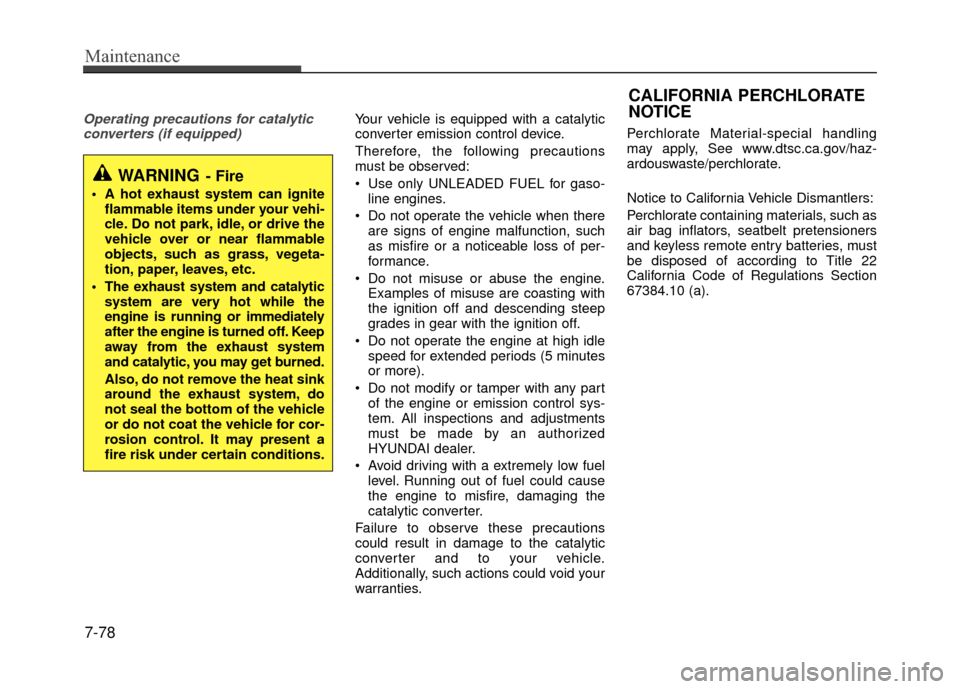
Operating precautions for catalyticconverters (if equipped)Your vehicle is equipped with a catalytic
converter emission control device.
Therefore, the following precautions
must be observed:
Use only UNLEADED FUEL for gaso- line engines.
Do not operate the vehicle when there are signs of engine malfunction, such
as misfire or a noticeable loss of per-
formance.
Do not misuse or abuse the engine. Examples of misuse are coasting with
the ignition off and descending steep
grades in gear with the ignition off.
Do not operate the engine at high idle speed for extended periods (5 minutes
or more).
Do not modify or tamper with any part of the engine or emission control sys-
tem. All inspections and adjustments
must be made by an authorized
HYUNDAI dealer.
Avoid driving with a extremely low fuel level. Running out of fuel could cause
the engine to misfire, damaging the
catalytic converter.
Failure to observe these precautions
could result in damage to the catalytic
converter and to your vehicle.
Additionally, such actions could void your
warranties. Perchlorate Material-special handling
may apply, See www.dtsc.ca.gov/haz-
ardouswaste/perchlorate.
Notice to California Vehicle Dismantlers:
Perchlorate containing materials, such as
air bag inflators, seatbelt pretensioners
and keyless remote entry batteries, must
be disposed of according to Title 22
California Code of Regulations Section
67384.10 (a).
WARNING- Fire
A hot exhaust system can ignite
flammable items under your vehi-
cle. Do not park, idle, or drive the
vehicle over or near flammable
objects, such as grass, vegeta-
tion, paper, leaves, etc.
The exhaust system and catalytic system are very hot while the
engine is running or immediately
after the engine is turned off. Keep
away from the exhaust system
and catalytic, you may get burned.
Also, do not remove the heat sink
around the exhaust system, do
not seal the bottom of the vehicle
or do not coat the vehicle for cor-
rosion control. It may present a
fire risk under certain conditions.
CALIFORNIA PERCHLORATE
NOTICE
7-78
Maintenance
Page 373 of 380

Index
2I
Active ECO system··················\
··················\
···· ·5-30
Air bag warning label ··················\
··················\
·· ·3-58
Air bag warning light ··················\
··················\
·· ·3-36
Air bags ··················\
··················\
··················\
·3-33
Air bag warning label ··················\
················· ·3-58
Air bag warning light ··················\
················· ·3-36
Curtain air bag ··················\
··················\
······· ·3-50
Driver's and passenger's front air bag ·················3-45
Occupant detection system ··················\
············3-39
Side impact air bag ··················\
··················\
·· ·3-49
SRS components and functions ··················\
······3-36
Air cleaner ··················\
··················\
··············· ·7-27
Antenna (Roof) ··················\
··················\
········· ·4-84
Anti-lock brake system (ABS) ··················\
···········5-18
Appearance care ··················\
··················\
·········7-70
Exterior care ··················\
··················\
········· ·7-70
Interior care ··················\
··················\
·········· ·7-74
Armrest(front) ··················\
··················\
·············3-6
Audio system ··················\
··················\
············ ·4-84
Roof antenna ··················\
··················\
········· ·4-84
Steering wheel audio control ··················\
·········4-85
Automatic climate control system ··················\
·······4-65
Air conditioning ··················\
··················\
····· ·4-70
Automatic heating and air conditioning ···············4-66
Manual heating and air conditioning ··················4-67
Automatic transaxle Manual shift mode ·················5-12
Automatic transaxle ··················\
··················\
···· ·5-10Aux, USB and iPod
®port
··················\
··············· ·4-82
Base curb weight··················\
··················\
·········5-45
Battery ··················\
··················\
··················\
·· ·7-33
Battery saver function ··················\
··················\
·· ·4-44
Before driving ··················\
··················\
············ ·5-3
Bottle holders, see cup holders ··················\
··········4-78
Brake system ··················\
··················\
············ ·5-15
Anti-lock brake system (ABS) ··················\
·······5-18
Electronic stability control (ESC) ··················\
····5-20
Hill-start assist control ··················\
················ ·5-25
Parking brake ··················\
··················\
·········5-16
Power brakes ··················\
··················\
········· ·5-15
Vehicle stability management ··················\
········5-24
Brakes/clutch fluid ··················\
··················\
····· ·7-25
Bulb replacement ··················\
··················\
······· ·7-61
Bulb wattage ··················\
··················\
·············· ·8-2
California perchlorate notice ··················\
·············7-78
Capacities (Lubricants) ··················\
··················\
·· ·8-4
Care Exterior care ··················\
··················\
········· ·7-70
Interior care ··················\
··················\
·········· ·7-74
Tire care ··················\
··················\
·············· ·7-36A
B
C
Page 374 of 380

I3
Index
Cargo capacity··················\
··················\
·········· ·5-41
Cargo weight ··················\
··················\
············ ·5-45
Center console storage ··················\
··················\
· ·4-75
Central door lock switch ··················\
··················\
·4-8
Certification label ··················\
··················\
······· ·5-43
Certification label ··················\
··················\
·········8-7
Chains Tire chains ··················\
··················\
············ ·5-37
Changing tires ··················\
··················\
··········· ·6-18
Checking tire inflation pressure ··················\
·········7-37
Child restraint system ··················\
··················\
·· ·3-25
Lower anchor ··················\
··················\
·········3-31
Seat belt ··················\
··················\
··············· ·3-26
Tether anchor system ··················\
················· ·3-29
Child-protector rear door lock ··················\
·············4-9
Climate control air filter ··················\
················· ·4-64
Climate control air filter ··················\
················· ·7-28
Clock (Digital) ··················\
··················\
·········· ·4-80
Clothes hanger ··················\
··················\
·········· ·4-80
Combined instrument, see instrument cluster ···········4-29
Compact spare tire ··················\
··················\
······ ·6-22
Compact spare tire replacement ··················\
·········7-41
Coolant ··················\
··················\
··················\
· ·7-22
Cooling fluid, see engine coolant ··················\
·······7-22
Crankcase emission control system ··················\
·····7-75
Cruise control system ··················\
··················\
·· ·5-26
Cup holder ··················\
··················\
··············· ·4-78
Curtain air bag ··················\
··················\
·········· ·3-50Dashboard illumination,
see instrument panel illumination ··················\
····4-30
Dashboard, see instrument cluster ··················\
·······4-29
Defogging (Windshield) ··················\
················· ·4-71
Defogging logic (Windshield) ··················\
···········4-73
Defroster (Rear window) ··················\
················ ·4-55
Defrosting (Windshield) ··················\
················· ·4-71
Digital clock ··················\
··················\
··············4-80
Dimensions ··················\
··················\
·················8-2
Display illumination, see instrument panel illumination
·4-30
Displays, see instrument cluster ··················\
·········4-29
Door locks ··················\
··················\
················· ·4-6
Central door lock switch ··················\
··············· ·4-8
Child-protector rear door lock ··················\
·········4-9
Drinks holders, see cup holders ··················\
·········4-78
Driver's 3-point seat belt ··················\
················· ·3-15
Driver's and passenger's front air bag ··················\
···3-45
Driving at night ··················\
··················\
········· ·5-33
Driving in flooded areas ··················\
················· ·5-34
Driving in the rain ··················\
··················\
······ ·5-34
Economical operation ··················\
··················\
·· ·5-30
Electric power steering ··················\
··················\
· ·4-24
Electronic stability control (ESC) ··················\
·······5-20
D
E
Page 375 of 380

Index
4I
Emergency starting··················\
··················\
········6-4
Jump starting ··················\
··················\
···········6-4
Push starting ··················\
··················\
············6-5
Emergency while driving ··················\
··················\
6-2
Emission control system ··················\
················· ·7-76
Crankcase emission control system ··················\
··7-76
Evaporative emission control System ·················7-76
Exhaust emission control system · · · · · · · ···············7-77
Engine ··················\
··················\
··················\
····8-2
Engine compartment ··················\
··················\
······2-4
Engine coolant ··················\
··················\
·········· ·7-22
Engine number ··················\
··················\
············8-8
Engine oil ··················\
··················\
·················7-21
Engine overheats ··················\
··················\
··········6-6
Engine temperature gauge ··················\
··············· ·4-30
Engine will not start ··················\
··················\
······6-3
Evaporative emission control system ··················\
···7-75
Exhaust emission control system ··················\
········7-76
Explanation of scheduled maintenance items ···········7-19
Exterior care ··················\
··················\
··············7-70
Flat tire (with spare tire) ··················\
················· ·6-17
Jack and tools ··················\
··················\
·········6-17
Changing tires ··················\
··················\
······· ·6-18
Compact spare tire ··················\
··················\
·· ·6-22
Removing and storing the spare tire ··················\
·6-18Flat tire (with tire mobility kit)
··················\
··········6-25
Floor mat anchor(s) ··················\
··················\
···· ·4-81
Fluid Brakes/clutch fluid ··················\
··················\
·· ·7-25
Washer fluid ··················\
··················\
·········· ·7-26
Folding the rear seat ··················\
··················\
·····3-11
Front passenger and rear seat belt ··················\
·······3-15
Front seat adjustment ··················\
··················\
···· ·3-5
Fuel filler lid··················\
··················\
··············4-18
Fuel gauge ··················\
··················\
··············· ·4-32
Fuel requirements ··················\
··················\
·········1-2
Fuses ··················\
··················\
··················\
···· ·7-51
Fuse/relay panel description ··················\
··········7-54
Instrument panel fuse ··················\
················· ·7-51
Memory fuse ··················\
··················\
········· ·7-52
Multi fuse ··················\
··················\
··············7-53
Gauge Engine temperature gauge ··················\
············4-31
Fuel gauge ··················\
··················\
············ ·4-32
GA
W (Gross axle weight) ··················\
··············· ·5-45
GAWR (Gross axle weight rating) ··················\
······5-45
Glove box ··················\
··················\
·················4-76
GVW (Gross vehicle weight) ··················\
············5-45
GVWR (Gross vehicle weight rating) ··················\
··5-45
F
G
Page 379 of 380

Index
8I
Spare tireCompact spare tire ··················\
··················\
·· ·6-22
Compact spare tire replacement ··················\
······7-42
Removing and storing the spare tire ··················\
·6-18
Special driving conditions ··················\
··············· ·5-32
Driving at night ··················\
··················\
······ ·5-33
Driving in flooded areas ··················\
···············5-34
Driving in the rain ··················\
··················\
··· ·5-34
Hazardous driving conditions ··················\
········5-32
Highway driving ··················\
··················\
····· ·5-35
Rocking the vehicle ··················\
··················\
· ·5-32
Smooth cornering ··················\
··················\
··· ·5-33
Speedometer ··················\
··················\
··············4-30
SRS components and functions ··················\
··········3-36
Starting difficulties, see engine will not start ·············6-3
Steering wheel ··················\
··················\
··········· ·4-24
Electric power steering ··················\
··············· ·4-24
Horn ··················\
··················\
··················\
· ·4-26
Tilt and telescopic steering ··················\
············4-25
Steering wheel audio control ··················\
·············4-85
Steps For Determining Correct Load Limit ··············5-41
Storage compartment ··················\
··················\
··· ·4-75
Center console storage ··················\
················ ·4-75
Glove box ··················\
··················\
············ ·4-76
Luggage net ··················\
··················\
·········· ·4-77
Sliding armrest ··················\
··················\
······· ·4-76
Sunglass holder ··················\
··················\
······ ·4-76Sunroof
··················\
··················\
··················\
· ·4-21
Sunvisor ··················\
··················\
··················\
·4-78
Tachometer ··················\
··················\
·············· ·4-30
Tailgate ··················\
··················\
··················\
· ·4-12
Tether anchor system ··················\
··················\
··· ·3-29
Tilt and telescopic steering ··················\
··············4-25
Tire and loading information label ··················\
······5-40
Tire chains ··················\
··················\
··············· ·5-37
Tire mobility kit ··················\
··················\
········· ·6-25
T
ire pressure monitoring system (TPMS) ··········6-7, 6-12
Tire specification and pressure label ··················\
·····8-7
Tires and wheels ··················\
··················\
·········7-36
Checking tire inflation pressure ··················\
······7-37
Compact spare tire replacement ··················\
······7-41
Low aspect ratio tire ··················\
··················\
·7-45
Recommended cold tire inflation pressures ··········7-36
Tire care ··················\
··················\
·············· ·7-36
Tire maintenance ··················\
··················\
···· ·7-41
Tire replacement ··················\
··················\
····· ·7-40
Tire rotation ··················\
··················\
·········· ·7-38
Tire sidewall labeling ··················\
················· ·7-42
Tire traction ··················\
··················\
·········· ·7-41
Wheel alignment and tire balance ··················\
···7-39
Wheel replacement ··················\
··················\
·· ·7-40
T