Eco Hyundai Accent 2020 Owner's Manual
[x] Cancel search | Manufacturer: HYUNDAI, Model Year: 2020, Model line: Accent, Model: Hyundai Accent 2020Pages: 445, PDF Size: 42.28 MB
Page 338 of 445
6-13
What to do in an emergency
6
You may not be able identify a tire
with low pressure by simply looking
at it. Always use a good quality tire
pressure gage to measure the tire's
inflation pressure. Please note that a
tire that is hot (from being driven) will
have a higher pressure measure-
ment than a tire that is cold.
A cold tire means the vehicle has
been sitting for 3 hours and driven for
less than 1 mile (1.6 km) in that 3
hour period.
Allow the tire to cool before measur-
ing the inflation pressure. Always be
sure the tire is cold before inflating to
the recommended pressure.Information
This device complies with Part 15 of
the FCC rules.
Operation is subject to the following
three conditions:
1. This device may not cause harmful
interference, and
2. This device must accept any inter-
ference received, including interfer-
ence that may cause undesired
operation.
3. Changes or modifications not
expressly approved by the party
responsible for compliance could
void the user's authority to operate
the equipment.
i
The TPMS cannot alert you to
severe and sudden tire dam-
age caused by external fac-
tors such as nails or road
debris.
If you feel any vehicle instabil-
ity, immediately take your foot
off the accelerator, apply the
brakes gradually with light
force, and slowly move to a
safe position off the road.
WARNING
Tampering with, modifying, or
disabling the Tire Pressure
Monitoring System (TPMS)
components may interfere with
the system's ability to warn the
driver of low tire pressure con-
ditions and/or TPMS malfunc-
tions. Tampering with, modify-
ing, or disabling the Tire
Pressure Monitoring System
(TPMS) components may void
the warranty for that portion of
the vehicle.
WARNING
HCa HMA 6.qxp 4/9/2019 3:07 PM Page 13
Page 342 of 445
6-17
What to do in an emergency
6
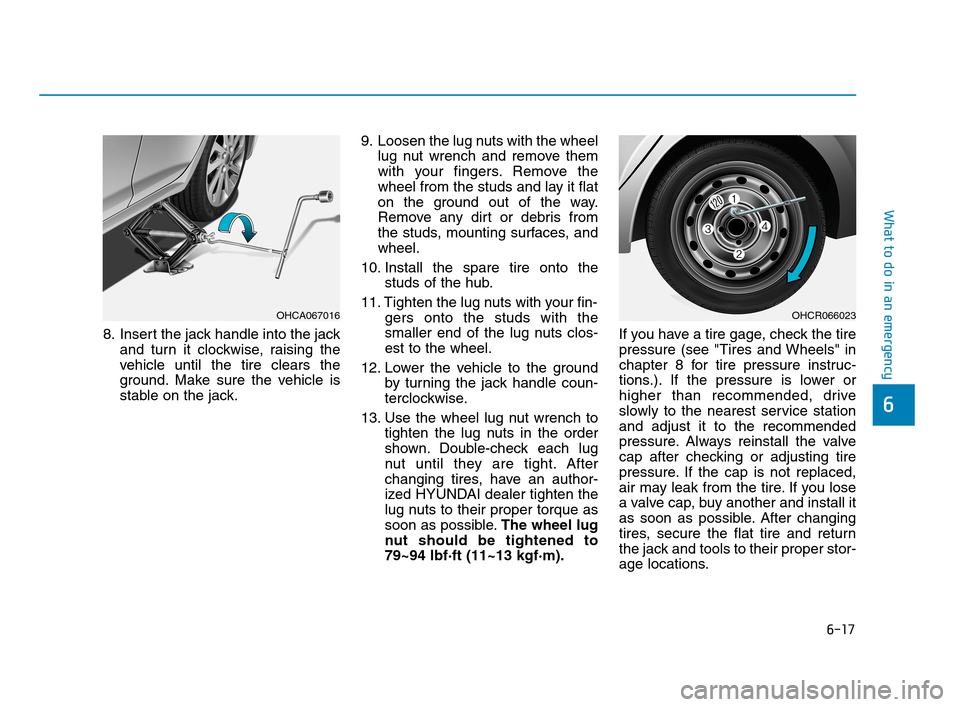
8. Insert the jack handle into the jack
and turn it clockwise, raising the
vehicle until the tire clears the
ground. Make sure the vehicle is
stable on the jack.9. Loosen the lug nuts with the wheel
lug nut wrench and remove them
with your fingers. Remove the
wheel from the studs and lay it flat
on the ground out of the way.
Remove any dirt or debris from
the studs, mounting surfaces, and
wheel.
10. Install the spare tire onto the
studs of the hub.
11. Tighten the lug nuts with your fin-
gers onto the studs with the
smaller end of the lug nuts clos-
est to the wheel.
12. Lower the vehicle to the ground
by turning the jack handle coun-
terclockwise.
13. Use the wheel lug nut wrench to
tighten the lug nuts in the order
shown. Double-check each lug
nut until they are tight. After
changing tires, have an author-
ized HYUNDAI dealer tighten the
lug nuts to their proper torque as
soon as possible.The wheel lug
nut should be tightened to
79~94 lbf·ft (11~13 kgf·m).If you have a tire gage, check the tire
pressure (see "Tires and Wheels" in
chapter 8 for tire pressure instruc-
tions.). If the pressure is lower or
higher than recommended, drive
slowly to the nearest service station
and adjust it to the recommended
pressure. Always reinstall the valve
cap after checking or adjusting tire
pressure. If the cap is not replaced,
air may leak from the tire. If you lose
a valve cap, buy another and install it
as soon as possible. After changing
tires, secure the flat tire and return
the jack and tools to their proper stor-
age locations.
OHCR066023OHCA067016
HCa HMA 6.qxp 4/9/2019 3:08 PM Page 17
Page 346 of 445
6-21
What to do in an emergency
6
Towing Service
If emergency towing is necessary,
we recommend having it done by an
authorized HYUNDAI dealer or a
commercial tow-truck service.
Proper lifting and towing procedures
are necessary to prevent damage to
the vehicle. The use of wheel dollies
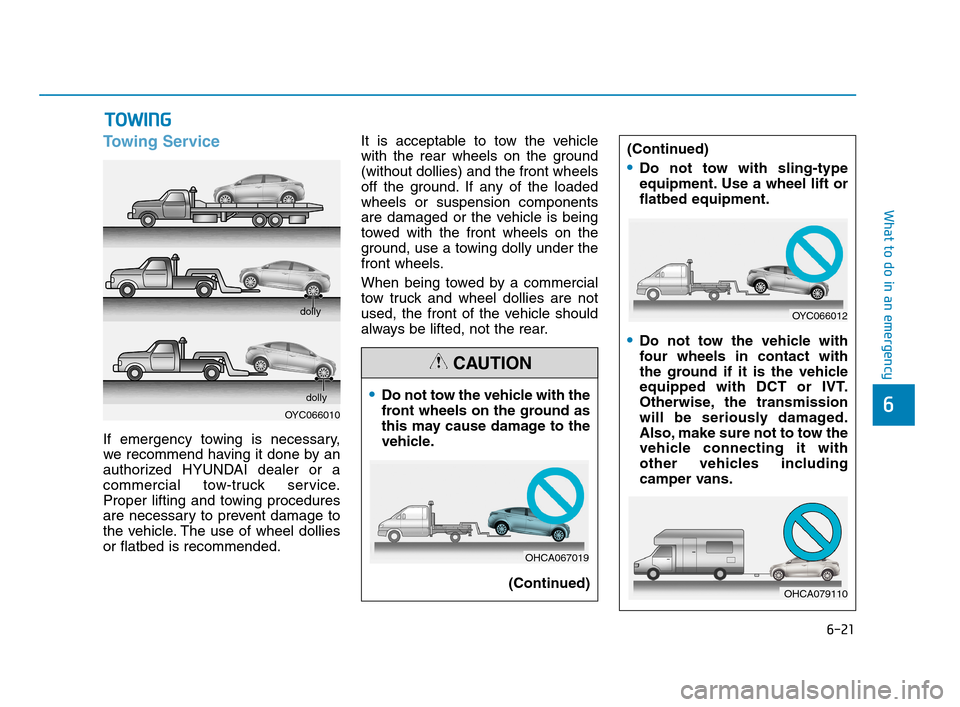
or flatbed is recommended.It is acceptable to tow the vehicle
with the rear wheels on the ground
(without dollies) and the front wheels
off the ground. If any of the loaded
wheels or suspension components
are damaged or the vehicle is being
towed with the front wheels on the
ground, use a towing dolly under the
front wheels.
When being towed by a commercial
tow truck and wheel dollies are not
used, the front of the vehicle should
always be lifted, not the rear.
T TO
OW
WI
IN
NG
G
OYC066010dolly dolly
Do not tow the vehicle with the
front wheels on the ground as
this may cause damage to the
vehicle.
(Continued)
(Continued)
Do not tow with sling-type
equipment. Use a wheel lift or
flatbed equipment.
Do not tow the vehicle with
four wheels in contact with
the ground if it is the vehicle
equipped with DCT or IVT.
Otherwise, the transmission
will be seriously damaged.
Also, make sure not to tow the
vehicle connecting it with
other vehicles including
camper vans.
CAUTION
OHCA067019
OYC066012
OHCA079110
HCa HMA 6.qxp 4/9/2019 3:08 PM Page 21
Page 348 of 445
6-23
What to do in an emergency
6
Emergency Towing
If towing is necessary, we recom-
mend you have it done by an author-
ized HYUNDAI dealer or a commer-
cial tow truck service.If a towing service is not available in
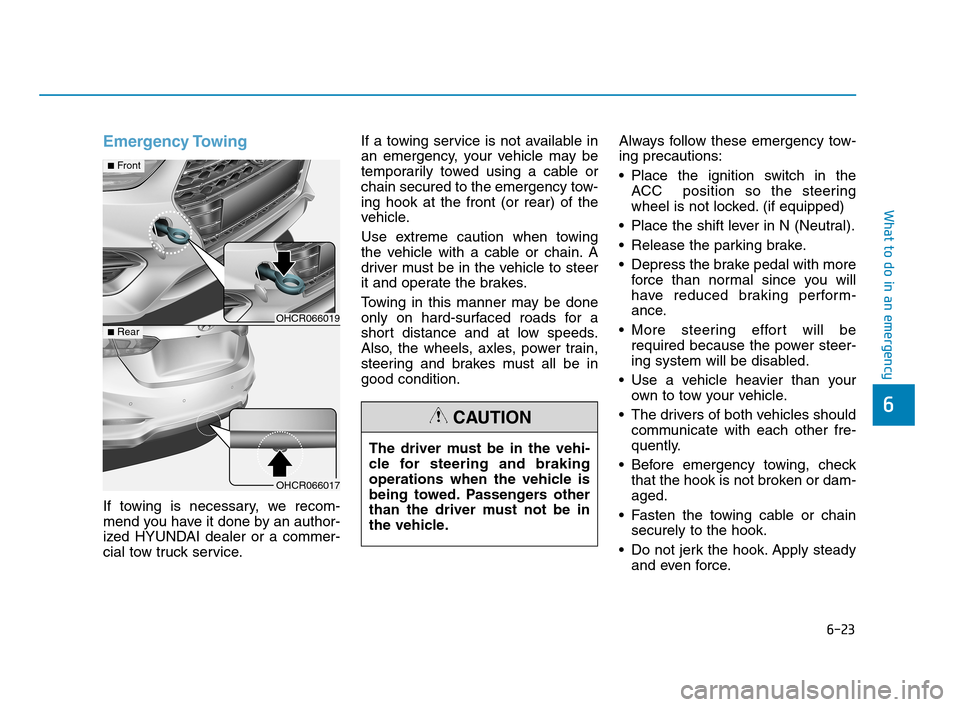
an emergency, your vehicle may be
temporarily towed using a cable or
chain secured to the emergency tow-
ing hook at the front (or rear) of the
vehicle.
Use extreme caution when towing
the vehicle with a cable or chain. A
driver must be in the vehicle to steer
it and operate the brakes.
Towing in this manner may be done
only on hard-surfaced roads for a
short distance and at low speeds.
Also, the wheels, axles, power train,
steering and brakes must all be in
good condition.Always follow these emergency tow-
ing precautions:
Place the ignition switch in the
ACC position so the steering
wheel is not locked. (if equipped)
Place the shift lever in N (Neutral).
Release the parking brake.
Depress the brake pedal with more
force than normal since you will
have reduced braking perform-
ance.
More steering effort will be
required because the power steer-
ing system will be disabled.
Use a vehicle heavier than your
own to tow your vehicle.
The drivers of both vehicles should
communicate with each other fre-
quently.
Before emergency towing, check
that the hook is not broken or dam-
aged.
Fasten the towing cable or chain
securely to the hook.
Do not jerk the hook. Apply steady
and even force.
OHCR066019
OHCR066017
■Front
■Rear
The driver must be in the vehi-
cle for steering and braking
operations when the vehicle is
being towed. Passengers other
than the driver must not be in
the vehicle.
CAUTION
HCa HMA 6.qxp 4/9/2019 3:08 PM Page 23
Page 351 of 445
7
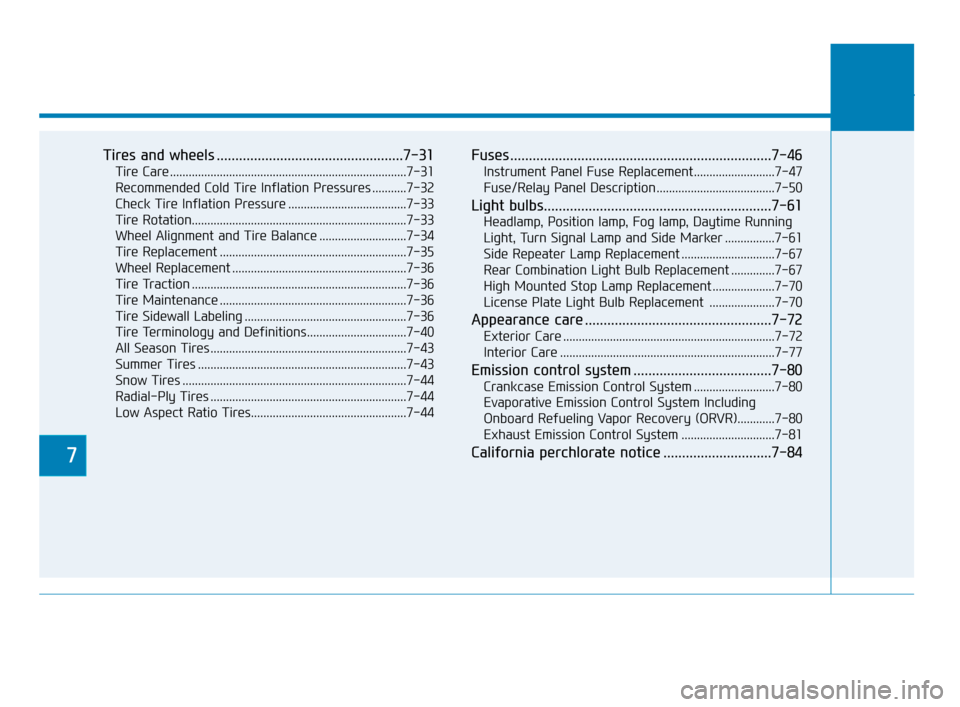
Tires and wheels ..................................................7-31
Tire Care ............................................................................7-31
Recommended Cold Tire Inflation Pressures ...........7-32
Check Tire Inflation Pressure ......................................7-33
Tire Rotation.....................................................................7-33
Wheel Alignment and Tire Balance ............................7-34
Tire Replacement ............................................................7-35
Wheel Replacement ........................................................7-36
Tire Traction .....................................................................7-36
Tire Maintenance ............................................................7-36
Tire Sidewall Labeling ....................................................7-36
Tire Terminology and Definitions................................7-40
All Season Tires ...............................................................7-43
Summer Tires ...................................................................7-43
Snow Tires ........................................................................7-44
Radial-Ply Tires ...............................................................7-44
Low Aspect Ratio Tires..................................................7-44
Fuses ......................................................................7-46
Instrument Panel Fuse Replacement..........................7-47
Fuse/Relay Panel Description ......................................7-50
Light bulbs.............................................................7-61
Headlamp, Position lamp, Fog lamp, Daytime Running
Light, Turn Signal Lamp and Side Marker ................7-61
Side Repeater Lamp Replacement ..............................7-67
Rear Combination Light Bulb Replacement ..............7-67
High Mounted Stop Lamp Replacement ....................7-70
License Plate Light Bulb Replacement .....................7-70
Appearance care ..................................................7-72
Exterior Care ....................................................................7-72
Interior Care .....................................................................7-77
Emission control system .....................................7-80
Crankcase Emission Control System ..........................7-80
Evaporative Emission Control System Including
Onboard Refueling Vapor Recovery (ORVR)............7-80
Exhaust Emission Control System ..............................7-81
California perchlorate notice .............................7-84
HCa HMA 7.qxp 4/9/2019 2:47 PM Page 2
Page 353 of 445
7-4
Maintenance
M MA
AI
IN
NT
TE
EN
NA
AN
NC
CE
E
S
SE
ER
RV
VI
IC
CE
ES
S
You should exercise the utmost care
to prevent damage to your vehicle
and injury to yourself whenever per-
forming any maintenance or inspec-
tion procedures.
We recommend you have your vehi-
cle maintained and repaired by an
authorized HYUNDAI dealer. An
authorized HYUNDAI dealer meets
HYUNDAI's high service quality
standards and receives technical
support from HYUNDAI in order to
provide you with a high level of serv-
ice satisfaction.
Owner's Responsibility
Maintenance service and record
retention are the owner's responsibil-
ity.
You should retain documents that
show proper maintenance has been
performed on your vehicle in accor-
dance with the scheduled mainte-
nance service charts shown on the
following pages. You need this infor-
mation to establish your compliance
with the servicing and maintenance
requirements of your vehicle war-
ranties.Detailed warranty information is pro-
vided in your Owner's Handbook &
Warranty Information booklet.
Repairs and adjustments required as
a result of improper maintenance or
a lack of required maintenance are
not covered.
Owner Maintenance
Precautions
Inadequate, incomplete or insuffi-
cient servicing may result in opera-
tional problems with your vehicle that
could lead to vehicle damage, an
accident, or personal injury. This
chapter provides instructions only for
the maintenance items that are easy
to perform. Several procedures can
be done only by an authorized
HYUNDAI dealer with special tools.
Your vehicle should not be modified
in any way. Such modifications may
adversely affect the performance,
safety or durability of your vehicle
and may, in addition, violate condi-
tions of the limited warranties cover-
ing the vehicle.Certain modifications may also be in
violation of regulations established by
the U.S. Department of Transportation
and other federal or state agencies.
Improper owner maintenance dur-
ing the warranty period may affect
warranty coverage. For details, read
the separate Owner's Handbook &
Warranty Information booklet pro-
vided with the vehicle. If you're
unsure about any service or mainte-
nance procedure, have it done by an
authorized HYUNDAI dealer.
NOTICE
HCa HMA 7.qxp 4/9/2019 2:47 PM Page 4
Page 354 of 445
7-5
7
Maintenance
O OW
WN
NE
ER
R
M
MA
AI
IN
NT
TE
EN
NA
AN
NC
CE
E
The following lists are vehicle checks
and inspections that should be per-
formed by the owner or an author-
ized HYUNDAI dealer at the frequen-
cies indicated to help ensure safe,
dependable operation of your vehi-
cle.
Any adverse conditions should be
brought to the attention of your deal-
er as soon as possible.
These Owner Maintenance vehicle
checks are generally not covered by
warranties and you may be charged
for labor, parts and lubricants used. Performing maintenance work
on a vehicle can be dangerous.
If you lack sufficient knowledge
and experience or the proper
tools and equipment to do the
work, have it done by an author-
ized HYUNDAI dealer.
ALWAYS follow these precau-
tions for performing mainte-
nance work:
•Park your vehicle on level
ground, move the shift lever
into the P (Park, for intelligent
variable transmission vehicle)
position or neutral (for manu-
al transmission vehicle),
apply the parking brake, place
the ignition switch in the
LOCK/OFF position.
(Continued)
WARNING (Continued)
Block the tires (front and
back) to prevent the vehicle
from moving.
Remove loose clothing or jew-
elry that can become entan-
gled in moving parts.
If you must run the engine
during maintenance, do so
out doors or in an area with
plenty of ventilation.
Keep flames, sparks, or smok-
ing materials away from the
battery and fuel-related parts.
HCa HMA 7.qxp 4/9/2019 2:47 PM Page 5
Page 357 of 445
7-8
Maintenance
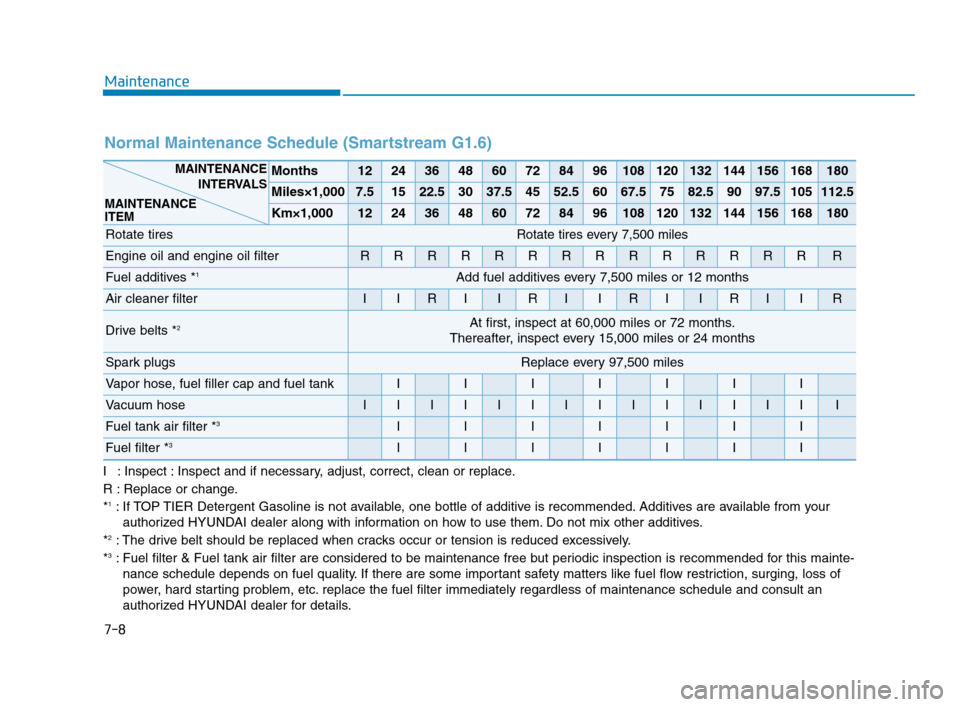
I : Inspect : Inspect and if necessary, adjust, correct, clean or replace.
R : Replace or change.
*
1: If TOP TIER Detergent Gasoline is not available, one bottle of additive is recommended. Additives are available from your
authorized HYUNDAI dealer along with information on how to use them. Do not mix other additives.
*
2: The drive belt should be replaced when cracks occur or tension is reduced excessively.
*3: Fuel filter & Fuel tank air filter are considered to be maintenance free but periodic inspection is recommended for this mainte-
nance schedule depends on fuel quality. If there are some important safety matters like fuel flow restriction, surging, loss of
power, hard starting problem, etc. replace the fuel filter immediately regardless of maintenance schedule and consult an
authorized HYUNDAI dealer for details.
Normal Maintenance Schedule (Smartstream G1.6)
Months1224364860728496108120132144156168180
Miles×1,0007.51522.53037.54552.56067.57582.59097.5105112.5
Km×1,0001224364860728496108120132144156168180
Rotate tiresRotate tires every 7,500 miles
Engine oil and engine oil filterRRRRRRRRRRRRRRR
Fuel additives *1Add fuel additives every 7,500 miles or 12 months
Air cleaner filterIIRIIRIIRIIRIIR
Drive belts *2At first, inspect at 60,000 miles or 72 months.
Thereafter, inspect every 15,000 miles or 24 months
Spark plugsReplace every 97,500 miles
Vapor hose, fuel filler cap and fuel tankIIIIIII
Vacuum hoseIIIIIIIIIIIIIII
Fuel tank air filter *3IIIIIII
Fuel filter *3IIIIIII
MAINTENANCE
INTERVALS
MAINTENANCE
ITEM
HCa HMA 7.qxp 4/9/2019 2:47 PM Page 8
Page 363 of 445
7-14
Maintenance
Air Cleaner Filter
A genuine HYUNDAI air cleaner filter
is recommended when the filter is
replaced.
Spark Plugs
Make sure to install new spark plugs
of the correct heat range.
Cooling System
Check cooling system components,
such as radiator, coolant reservoir,
hoses and connections for leakage
and damage. Replace any damaged
parts.
Engine Coolant
The coolant should be changed at
the intervals specified in the mainte-
nance schedule.
Intelligent Variable
Transmission (IVT) Fluid
(if equipped)
Intelligent Variable Transmission
(IVT) Fluid should not be checked
under normal usage conditions. But,
the Intelligent Variable Transmission
(IVT) Fluid should be changed under
severe usage conditions. We recom-
mend that the Intelligent Variable
Transmission (IVT) Fluid changed by
an authorized HYUNDAI dealer
according to the maintenance sched-
ule.
(Refer to "Maintenance Under
Severe Usage Conditions" in this
chapter.)
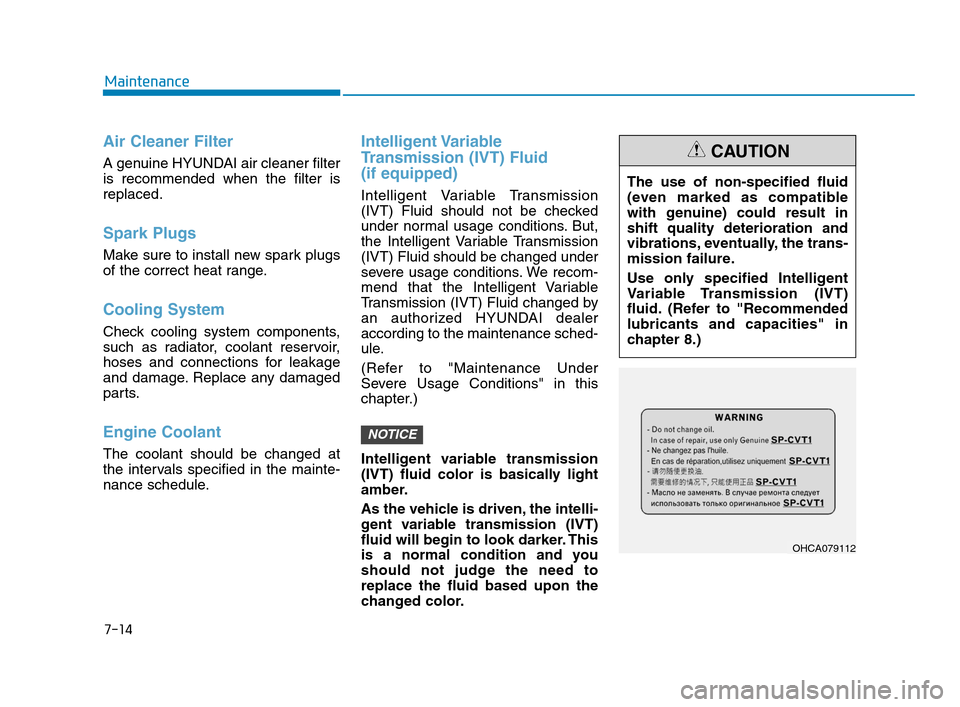
Intelligent variable transmission
(IVT) fluid color is basically light
amber.
As the vehicle is driven, the intelli-
gent variable transmission (IVT)
fluid will begin to look darker. This
is a normal condition and you
should not judge the need to
replace the fluid based upon the
changed color.
NOTICE
The use of non-specified fluid
(even marked as compatible
with genuine) could result in
shift quality deterioration and
vibrations, eventually, the trans-
mission failure.
Use only specified Intelligent
Variable Transmission (IVT)
fluid. (Refer to "Recommended
lubricants and capacities" in
chapter 8.)
CAUTION
OHCA079112
HCa HMA 7.qxp 4/9/2019 2:47 PM Page 14
Page 365 of 445
7-16
Maintenance
E EN
NG
GI
IN
NE
E
O
OI
IL
L
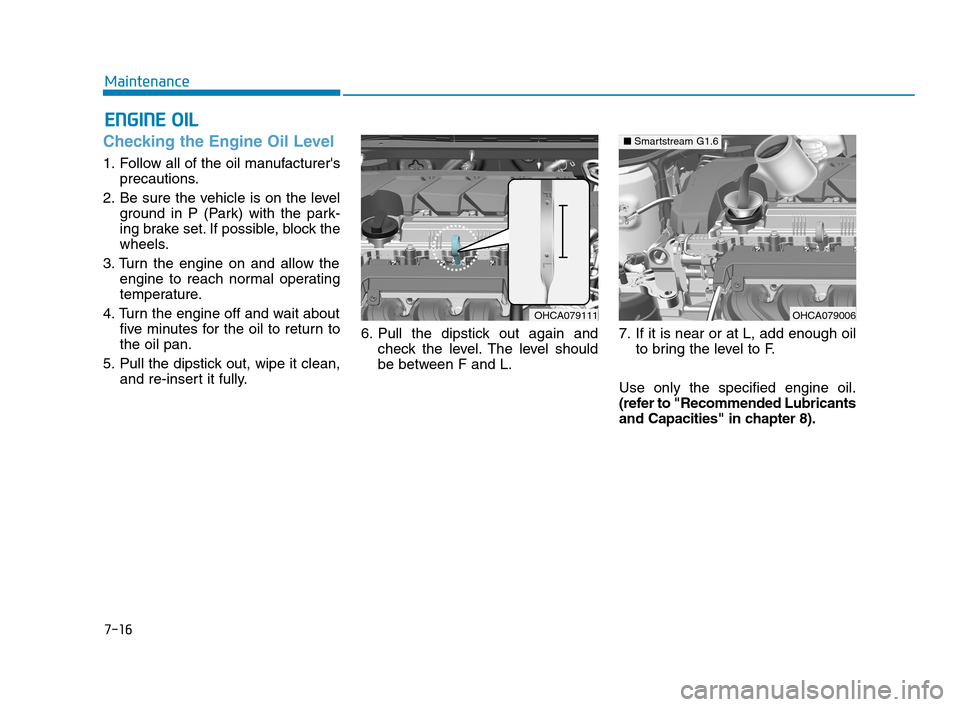
Checking the Engine Oil Level
1. Follow all of the oil manufacturer's
precautions.
2. Be sure the vehicle is on the level
ground in P (Park) with the park-
ing brake set. If possible, block the
wheels.
3. Turn the engine on and allow the
engine to reach normal operating
temperature.
4. Turn the engine off and wait about
five minutes for the oil to return to
the oil pan.
5. Pull the dipstick out, wipe it clean,
and re-insert it fully.6. Pull the dipstick out again and
check the level. The level should
be between F and L.7. If it is near or at L, add enough oil
to bring the level to F.
Use only the specified engine oil.
(refer to "Recommended Lubricants
and Capacities" in chapter 8).
OHCA079111OHCA079006
■Smartstream G1.6
HCa HMA 7.qxp 4/9/2019 2:47 PM Page 16