clutch Hyundai Atos 2002 User Guide
[x] Cancel search | Manufacturer: HYUNDAI, Model Year: 2002, Model line: Atos, Model: Hyundai Atos 2002Pages: 249, PDF Size: 3.11 MB
Page 197 of 249
DRIVING YOUR HYUNDAI
2- 8 in emergency situations or on slick roads, ABS will increase vehicle control during braking. NOTE: During ABS operation, a slight pulsation may be felt in the brake pedal when thebrakes are applied. Also, a noise may beheard in the engine compartment while brak-ing. These conditions are normal and indi-cate that the anti-lock brake system is func-tioning properly. WARNING: Your ABS will not prevent accidents due to improper or dangerous driving maneuvers.Even though vehicle control is improvedduring emergency braking, always maintaina safe distance between you and objectsahead. Vehicle speeds should always bereduced during extreme road conditions.The braking distance for cars equipped withan anti-lock braking system may be longerthan for those without it in the followingroad conditions.
o Driving on rough, gravel or snow-cov- ered roads.
o Driving with tire chains installed.
o Driving on roads where the road surface is pitted or has different surface height.
These roads should be driven at reduced speeds. The safety features of an ABSequipped vehicle should not be tested by high speed driving or cornering. This couldendanger the safety of yourself or others.
unnecessary tire wear. Check the tire pres-sures at least once a month.
o Be sure that the wheels are aligned cor- rectly. Improper alignment can result fromhitting curbs or driving too fast over irregularsurfaces. Poor alignment causes faster tirewear and may also result in other problemsas well as greater fuel consumption.
o Keep your car in good condition. For better fuel economy and reduced maintenancecosts, maintain your car in accordance withthe maintenance schedule in Section 5. Ifyou drive your car in severe conditions,more frequent maintenance is required (seeSection 5 for details).
o Keep your car clean. For maximum service, your car should be kept clean and free ofcorrosive materials. It is especially impor-tant that mud, dirt, ice, etc. not be allowed toaccumulate on the underside of the car. Thisextra weight can result in increased fuelconsumption and also contribute to corro-sion.
o Travel lightly. Don’t carry unnecessary weight in your car. Weight is an enemy of good fueleconomy.
o Don’t let the engine idle longer than neces- sary. If you are waiting (and not in traffic),turn off your engine and restart only whenyou’re ready to go.
o Remember, your car does not require ex- tended warm-up. As soon as the engine isrunning smoothly, you can drive away. Invery cold weather, however, give your en-gine a slightly longer warm-up period.
SC150A1-F
DRIVING FOR ECONOMY You can save fuel and get more miles from yourcar if you follow these suggestions:
o Drive smoothly. Accelerate at a moderate rate. Don’t make "jack-rabbit" starts or full-throttle shifts and maintain a steady cruisingspeed. Don’t race between stoplights. Try toadjust your speed to that of the other trafficso you don’t have to change speeds unnec-essarily. Avoid heavy traffic whenever possible. Al- ways maintain a safe distance from othervehicles so you can avoid unnecessary brak-ing. This also reduces brake wear.
o Drive at a moderate speed. The faster you drive, the more fuel your car uses. Driving ata moderate speed, especially on the high-way, is one of the most effective ways toreduce fuel consumption.
o Don’t "ride" the brake or clutch pedal. This can increase fuel consumption and alsoincrease wear on these components. In ad-dition, driving with your foot resting on thebrake pedal may cause the brakes to over-heat, which reduces their effectiveness andmay lead to more serious consequences.
o Take care of your tires. Keep them inflated to the recommended pressure. Incorrect infla-tion, either too much or too little, results in
Page 202 of 249
3-1
WHAT TO DO IN AN EMERGENCY
fitted with automatic transaxle ensure that the transaxle selector is at the "P" or"N"position.
2. Check the battery terminals and connec- tions to ensure that these are clean and alsotight.
3. If the ignition warning lamps dim when the engine is cranked and the battery terminalshave been checked, a discharged battery isindicated.
4. Do not attempt to push or tow start the vehicle, refer to "Jump Starting" for informa-tion regarding engine starting when the bat-tery is discharged.
DD020A1-E
IF THE ENGINE WILL NOT START Seek assistance from the nearest Hyundai
dealer with regard to the method of ignition andfuel system diagnosis.
CAUTION: If the engine refuses to start, no attempt
should be made to push or tow start the vehicle. Vehicles with automatic transaxleor fuel injection will not be able to be startedin this manner since no drive is transmittedthrough the automatic transaxle whilst theengine is not running, and in the case of fuelinjected derivatives, the fuel pump will notoperate under tow start conditions. In addi-tion, if the vehicle is equipped with an ex-haust catalyst, damage to the catalyst mayresult if the vehicle is tow started. ZD000A1-E
3. WHAT TO DO IN AN
EMERGENCY
DD020B1-E
IF THE ENGINE CANNOT BE
CRANKED
1. If the vehicle is fitted with manual transaxle ensure that the clutch pedal is depressedwhilst cranking the engine. If the vehicle is ZD020C2-D
If Engine Turns Over Normally but Does Not Start AD020D1-A
If Engine Stalls While Driving
1. Reduce your speed gradually, keeping a straight line. Move cautiously off the road to a safe place.
2. Turn on your emergency flashers.
3. Try starting the engine again. If your vehicle will not start, see “IF THE ENGINE WILL NOT START”
DD030A1-E
JUMP STARTING
1. Check fuel level.
2. Check all connectors at coil and spark plugs.
Re-connect any that may be disconnected or loose.
3. Check fuel line in the engine room.
4. If engine still refuses to start, call a Hyundai dealer or seek other qualified assistance.
AX30030A
Negative to the enginenot to the battery
Positive to positive
Dead battery Booster battery
D010C01X-1Spark plug
3
Page 214 of 249
VEHICLE MAINTENANCE REQUIREMENTS 5-3
F030C02X-EAT R : Replace I : Inspect and, after inspection, clean, adjust, repair or replace if necessary
DESCRIPTION
GENERAL MAINTENANCE COOLING SYSTEMENGINE COOLANT ENGINE COOLANT SPECIFIC GRAVITY MANUAL TRANSAXLE OILAUTOMATIC TRANSAXLE FLUID AND FILTER BRAKE PIPES, HOSES, AND CONNECTIONS BRAKE FLUIDCLUTCH FLUID REAR BRAKE LININGS AND CYLINDERS BRAKE PADSSUSPENSION AND STEERING SYSTEM FRONT SUSPENSION BALL JOINTS POLLEN FILTERTRANSFER CASE OIL REAR AXLE OIL CLEAN PROPELLAR SHAFT/RETIGHTEN BOLTSREAR WHEEL BEARINGS TYRE CONDITION AND PRESSURE (incl uding Spare)
LUBRICATE LOCKS AND HINGES CHECK ALL ELECTRICAL SYSTEMS ROAD TEST CHECK ALL SYSTEMS WITH HI-SCAN
60 72
I I I
R I
R R
I I II
R
II I II I II I
50 60
I I I II I I I II
RRR III I II I
40 48
I I I II
RR
I I II
R
II I II I II I
30 36
I
R I I II I I I II
R
II I II I II I
20 24
I I I II
RR
I I II
R
II I II I II I
10 12
I I I II I I I II
R
II I II I II I
MILES X 1000 MONTHSNO.
1 2 3 45 6 78 9
1011 1213 14 1516 17 1819 20 2122
Page 220 of 249
DO-IT-YOURSELF MAINTENANCE
6-2 ZG020B1-E
GENERAL CHECKS Engine Compartment
The following should be checked regularly:
o Engine oil level and condition
o Transaxle fluid level and condition
o Brake reservoir fluid level
o Engine coolant level
o Windscreen washer fluid level
o Accessory drive belt condition
o Coolant hose condition
o Fluid leaks (on or below components)
o Power steering fluid level
o Tyre pressure and condition (including spare)
o Battery condition ZG020C1-A
Vehicle Exterior
The following should be checked monthly:
o Overall appearance and condition
o Wheel condition and wheel nut tightness
o Exhaust system condition
o Light condition and operation
o Windscreen glass condition
o Wiper blade condition
o Paint condition and corrosion
o Fluid leaks
o Door and hood lock condition o Air filter element condition G020C02X-GAT
Vehicle Interior
The following should be checked each time
when the vehicle is driven:
o Lights operation
o Windscreen wipers operation
o Horn operation
o Defroster, heating system operation (and air conditioning, if installed)
o Steering operation and condition
o Mirror condition and operation
o Turn signal operation
o Accelerator pedal operation
o Brake operation, including parking brake
o Manual transaxle operation, including clutch operation
o Automatic transaxle operation, including "Park" mechanism operation
o Seat control condition and operation
o Seat belt condition and operation
o Sunvisor operation
If you notice anything that does not operate
correctly or appear to be functioning correctly, inspect it carefully and seek assistance fromyour Hyundai dealer if service is needed. ZG030A1-A
CHECKING THE ENGINE OIL
Engine oil is essential to the performance andservice of the engine. It is suggested that youcheck the oil level at least once a week innormal use and more often if you are on a tripor driving in severe conditions. ZG030B1-E
Recommended Oil
SSA6030B°C °F -25-13 20W-40 20W-50
15W-40 15W-50
10W-30
10W-40 10W-50
5W-40
5W-30
5W-20
40104
2068
1050
032
-15 5 -10-14
SH, SG or SG/CD (API) multi-grade and fuel efficient oil is recommended. NOTE: SAE 5W-20 is not recommended for sus-tained high speed vehicle operation.
Page 231 of 249
DO-IT-YOURSELF MAINTENANCE 6-13
ZG150A1-A
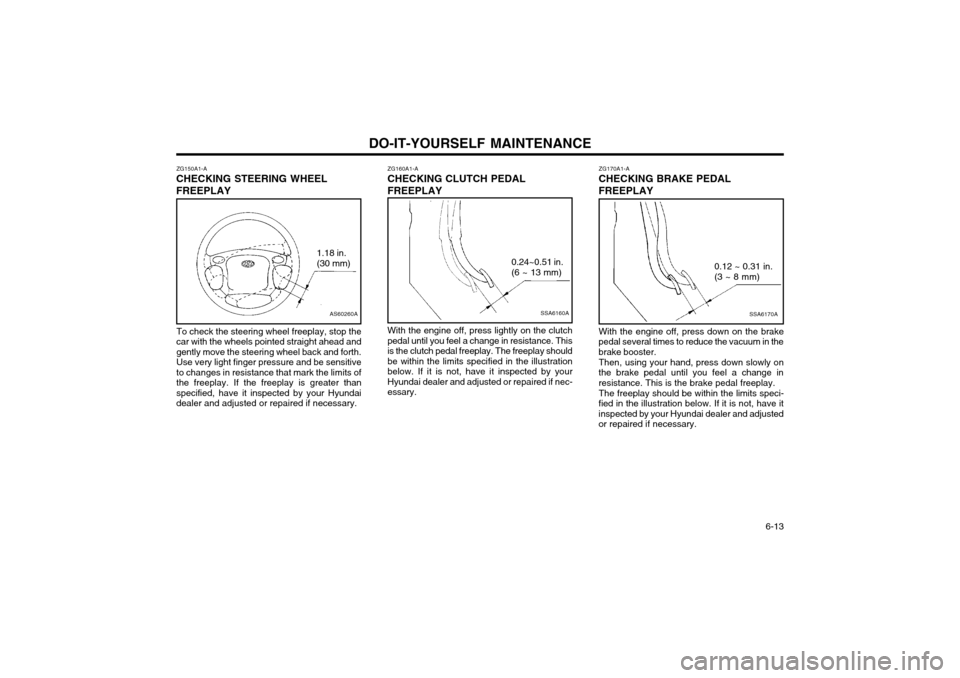
CHECKING STEERING WHEEL FREEPLAY
AS60260A
1.18 in. (30 mm)
To check the steering wheel freeplay, stop the
car with the wheels pointed straight ahead and gently move the steering wheel back and forth.Use very light finger pressure and be sensitiveto changes in resistance that mark the limits ofthe freeplay. If the freeplay is greater thanspecified, have it inspected by your Hyundaidealer and adjusted or repaired if necessary. ZG160A1-A CHECKING CLUTCH PEDAL FREEPLAY
SSA6160A
0.24~0.51 in. (6 ~ 13 mm)
With the engine off, press lightly on the clutch pedal until you feel a change in resistance. Thisis the clutch pedal freeplay. The freeplay shouldbe within the limits specified in the illustrationbelow. If it is not, have it inspected by yourHyundai dealer and adjusted or repaired if nec-essary.
SSA6170A
0.12 ~ 0.31 in. (3 ~ 8 mm)
ZG170A1-A
CHECKING BRAKE PEDAL FREEPLAY
With the engine off, press down on the brake
pedal several times to reduce the vacuum in the brake booster.
Then, using your hand, press down slowly on
the brake pedal until you feel a change inresistance. This is the brake pedal freeplay.
The freeplay should be within the limits speci-
fied in the illustration below. If it is not, have itinspected by your Hyundai dealer and adjustedor repaired if necessary.
Page 247 of 249
INDEX10-1
A ABS SYSTEM
..................................................................................... 2-7
ADJUSTABLE FRONT SEATS .......................................................... 1-5
AIR CLEANER FILTER ...................................................................... 6-8
AIR CONDITIONER CARE .............................................................. 6-12
AIR CONDITIONING SWITCH ......................................................... 1-36
AIR CONDITIONING OPERATION .................................................1-37
ANTENNA ......................................................................................... 1-52
APPEARANCE CARE ....... ........................................................ 4-1 ~ 4-2
ASHTRAY ......................................................................................... 1-25
AUDIO FAULT CODE ...................................................................... 1-49
AUTOMATIC TRANSAXLE ......................... .............................. 2-5 ~ 2-6
BBATTERY MAINTENANCE .............................................................. 6-15
BEFORE STARTING THE ENGINE .................................................. 2-2
BONNET RELEASE ......................................................................... 1-30
BRAKE CIRCUIT FAILURE WARNING LAMP ................................1-18
BRAKE PEDAL CLEARANCE ......................................................... 6-14
BRAKE PEDAL FREEPLAY ............................................................. 6-13
BRAKES ........................................................................................... 6-11
C
CARE OF SEAT BELTS .................................................................... 1-7
CARE OF CASSETTE TAPE ................................................ 1-50 ~ 1-51
CARE OF DISC ................................................................................ 1-50
CATALYTIC CONVERTER (For MFI ) ................................................ 7-1 CENTRAL DOOR LOCKING
SYSTEM ............................................. 1-7
CHANGING THE OIL AND FILTER .................. ....................... 6-4 ~ 6-5
CHARGING WARNING LIGHT ........................................................ 1-19
CHILD PROTECTOR REAR DOOR LOCKS .................................... 1-4
CHILD RESTRAINT SYSTEM ............................................... 1-10 ~ 1-11
CIGAR LIGHTER .............................................................................. 1-24
CLOCK .............................................................................................. 1-24
CLUTCH PEDAL FREEPLAY .......................................................... 6-13
COMPACT DISK PLAYER OPERATION (H922M) .............. 1-47 ~ 1-48
COMPRESSOR DRIVE BELT ......................................................... 6-12
COOLING FANS .............................................................................. 6-15
D
DAY-NIGHT REAR VIEW MIRROR .................................................1-26
DOOR LOCKS .................................................................................... 1-3DRIVE BELTS .................................................................................. 6-14
DRIVING FOR ECONOMY ................................................................ 2-8
EEFFECTIVE BRAKING ....................................................................... 2-7
EMERGENCY T OWING ..................................................................... 3-8
EMISSION CONTROL SYSTEM ......... .............................................. 7-1
ENGINE COMPARTMENT (For MFI Engine) .................................... 6-1
ENGINE COOLANT ........................................................................... 6-5
ENGINE COOLANT TEMPERATURE GAUGE ...............................1-20
ENGINE OIL CONSUMPTION ........................................................... 6-3
F
FILLING THE WASHER RESERVOIR .............................................. 6-9
FOLDING REAR SEAT BACK AND SEAT CUSHION ...................1-27
FOLDING THE OUTSIDE REAR VIEW MIRRORS ........................1-26
ZK000A1-E 10. INDEX
10