ignition Hyundai Atos 2002 Service Manual
[x] Cancel search | Manufacturer: HYUNDAI, Model Year: 2002, Model line: Atos, Model: Hyundai Atos 2002Pages: 249, PDF Size: 3.11 MB
Page 195 of 249
DRIVING YOUR HYUNDAI
2- 6 C090I01E-EAT
CAUTION:
o Shift into "R" and "P" only when the vehicle has completely stopped.
o Do not accelerate the engine in the re- verse or any of the forward positions
with the brakes applied.
o Always apply the footbrake when shift- ing from "P" or "N", to "R", "D", "2" or "L".
o Do not use the "P" (Park) position in place of the parking brake. Always setthe park-ing brake, shift the transaxleinto "P" (Park) and turn off the ignitionwhen you leave the vehicle, even mo-mentarily. Never leave the vehicle unat-tended whilst the engine is running.
C090H01E-EAT
NOTE:
o The brake pedal should be depressed when shifting from NEUTRAL to a for- ward or reverse gear.
o The brake pedal fully depressed in order to move the shift lever from the "P"(Park) position to any of the other posi-tions.
o It is always possible to shift from "R", "N", "D", "2", "L" position.
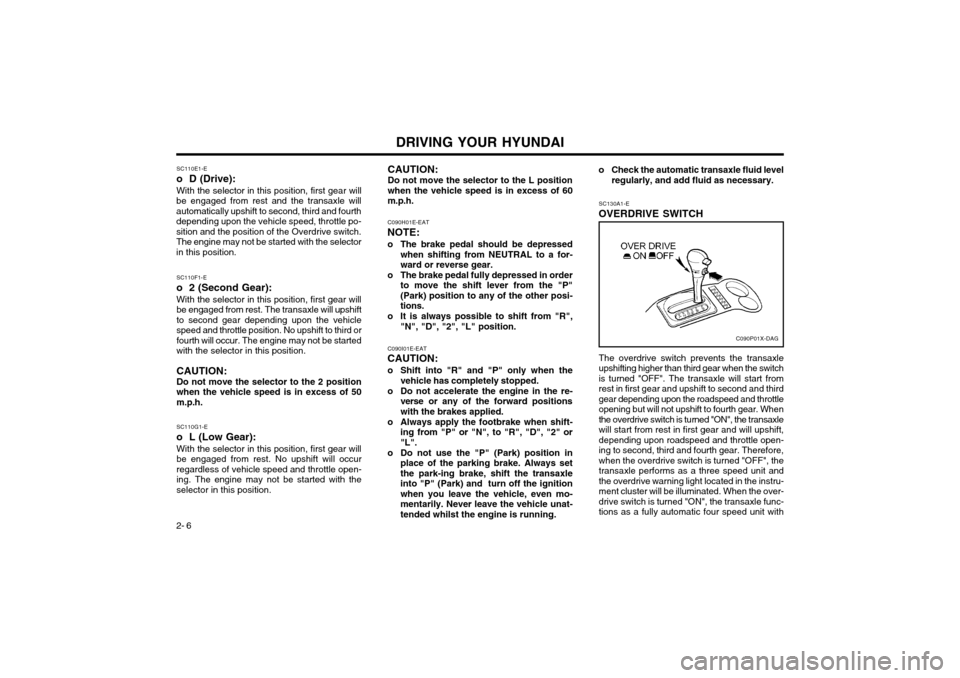
C090P01X-DAG
SC130A1-E
OVERDRIVE SWITCH
SC110E1-E
o D (Drive):
With the selector in this position, first gear will
be engaged from rest and the transaxle will automatically upshift to second, third and fourthdepending upon the vehicle speed, throttle po-sition and the position of the Overdrive switch.The engine may not be started with the selectorin this position.
SC110G1-E
o L (Low Gear): With the selector in this position, first gear willbe engaged from rest. No upshift will occurregardless of vehicle speed and throttle open-ing. The engine may not be started with theselector in this position.
SC110F1-E
o 2 (Second Gear): With the selector in this position, first gear willbe engaged from rest. The transaxle will upshiftto second gear depending upon the vehiclespeed and throttle position. No upshift to third orfourth will occur. The engine may not be startedwith the selector in this position. CAUTION: Do not move the selector to the 2 positionwhen the vehicle speed is in excess of 50m.p.h. CAUTION: Do not move the selector to the L position when the vehicle speed is in excess of 60m.p.h.
o Check the automatic transaxle fluid level
regularly, and add fluid as necessary.
The overdrive switch prevents the transaxleupshifting higher than third gear when the switchis turned "OFF". The transaxle will start fromrest in first gear and upshift to second and thirdgear depending upon the roadspeed and throttleopening but will not upshift to fourth gear. Whenthe overdrive switch is turned "ON", the transaxlewill start from rest in first gear and will upshift,depending upon roadspeed and throttle open-ing to second, third and fourth gear. Therefore,when the overdrive switch is turned "OFF", thetransaxle performs as a three speed unit andthe overdrive warning light located in the instru-ment cluster will be illuminated. When the over-drive switch is turned "ON", the transaxle func-tions as a fully automatic four speed unit with
Page 202 of 249
3-1
WHAT TO DO IN AN EMERGENCY
fitted with automatic transaxle ensure that the transaxle selector is at the "P" or"N"position.
2. Check the battery terminals and connec- tions to ensure that these are clean and alsotight.
3. If the ignition warning lamps dim when the engine is cranked and the battery terminalshave been checked, a discharged battery isindicated.
4. Do not attempt to push or tow start the vehicle, refer to "Jump Starting" for informa-tion regarding engine starting when the bat-tery is discharged.
DD020A1-E
IF THE ENGINE WILL NOT START Seek assistance from the nearest Hyundai
dealer with regard to the method of ignition andfuel system diagnosis.
CAUTION: If the engine refuses to start, no attempt
should be made to push or tow start the vehicle. Vehicles with automatic transaxleor fuel injection will not be able to be startedin this manner since no drive is transmittedthrough the automatic transaxle whilst theengine is not running, and in the case of fuelinjected derivatives, the fuel pump will notoperate under tow start conditions. In addi-tion, if the vehicle is equipped with an ex-haust catalyst, damage to the catalyst mayresult if the vehicle is tow started. ZD000A1-E
3. WHAT TO DO IN AN
EMERGENCY
DD020B1-E
IF THE ENGINE CANNOT BE
CRANKED
1. If the vehicle is fitted with manual transaxle ensure that the clutch pedal is depressedwhilst cranking the engine. If the vehicle is ZD020C2-D
If Engine Turns Over Normally but Does Not Start AD020D1-A
If Engine Stalls While Driving
1. Reduce your speed gradually, keeping a straight line. Move cautiously off the road to a safe place.
2. Turn on your emergency flashers.
3. Try starting the engine again. If your vehicle will not start, see “IF THE ENGINE WILL NOT START”
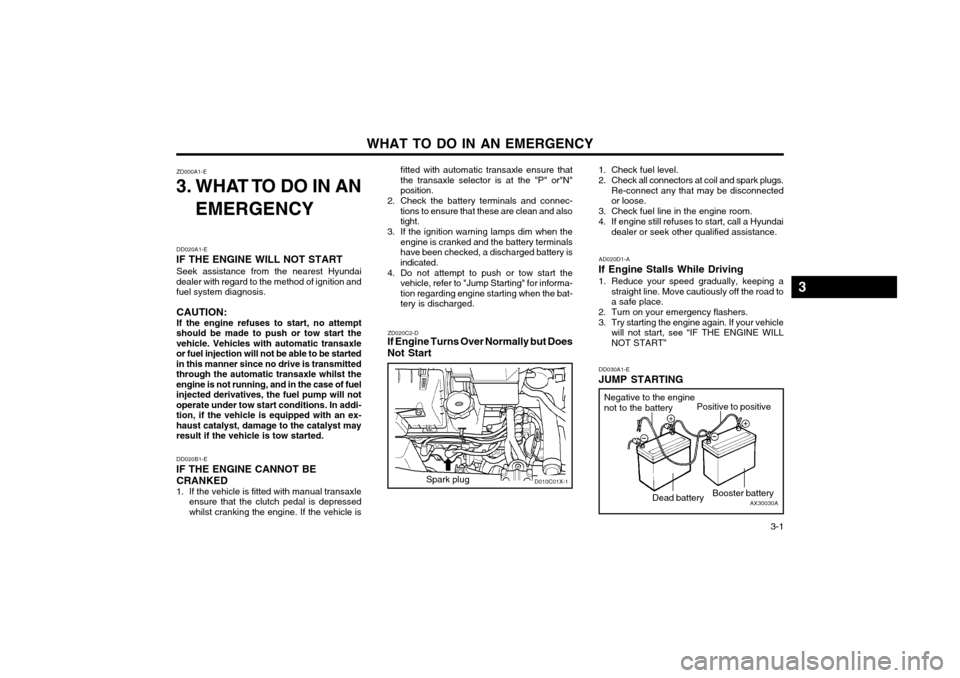
DD030A1-E
JUMP STARTING
1. Check fuel level.
2. Check all connectors at coil and spark plugs.
Re-connect any that may be disconnected or loose.
3. Check fuel line in the engine room.
4. If engine still refuses to start, call a Hyundai dealer or seek other qualified assistance.
AX30030A
Negative to the enginenot to the battery
Positive to positive
Dead battery Booster battery
D010C01X-1Spark plug
3
Page 208 of 249
3-7
WHAT TO DO IN AN EMERGENCY
SD090A1-E
Manual Transaxle Vehicle o If a suspended tow is being given to the
rear, the ignition key must be at the "ACC" position since the steering lock is notdesigned to withstand the force requiredto hold the front wheels straight duringthe tow.
o The vehicle must not be towed with the front wheels on the ground for more thanthirty miles.
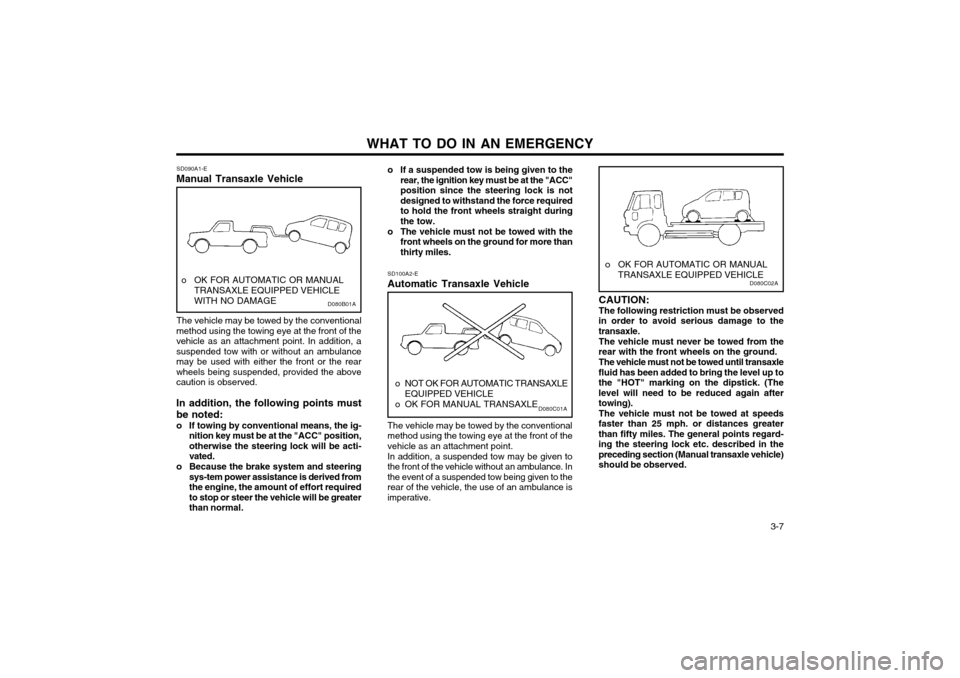
D080B01A
o OK FOR AUTOMATIC OR MANUAL
TRANSAXLE EQUIPPED VEHICLE WITH NO DAMAGE
The vehicle may be towed by the conventional
method using the towing eye at the front of the vehicle as an attachment point. In addition, asuspended tow with or without an ambulancemay be used with either the front or the rearwheels being suspended, provided the abovecaution is observed. In addition, the following points must be noted:
o If towing by conventional means, the ig- nition key must be at the "ACC" position, otherwise the steering lock will be acti-vated.
o Because the brake system and steering sys-tem power assistance is derived fromthe engine, the amount of effort requiredto stop or steer the vehicle will be greaterthan normal. SD100A2-E Automatic Transaxle Vehicle
D080C01A
o NOT OK FOR AUTOMATIC TRANSAXLE
EQUIPPED VEHICLE
o OK FOR MANUAL TRANSAXLE
The vehicle may be towed by the conventional method using the towing eye at the front of thevehicle as an attachment point. In addition, a suspended tow may be given to the front of the vehicle without an ambulance. Inthe event of a suspended tow being given to therear of the vehicle, the use of an ambulance isimperative.
D080C02A
o OK FOR AUTOMATIC OR MANUAL TRANSAXLE EQUIPPED VEHICLE
CAUTION: The following restriction must be observed
in order to avoid serious damage to the transaxle.
The vehicle must never be towed from the
rear with the front wheels on the ground.
The vehicle must not be towed until transaxle
fluid has been added to bring the level up tothe "HOT" marking on the dipstick. (Thelevel will need to be reduced again aftertowing). The vehicle must not be towed at speeds
faster than 25 mph. or distances greaterthan fifty miles. The general points regard-ing the steering lock etc. described in thepreceding section (Manual transaxle vehicle)should be observed.
Page 234 of 249
DO-IT-YOURSELF MAINTENANCE
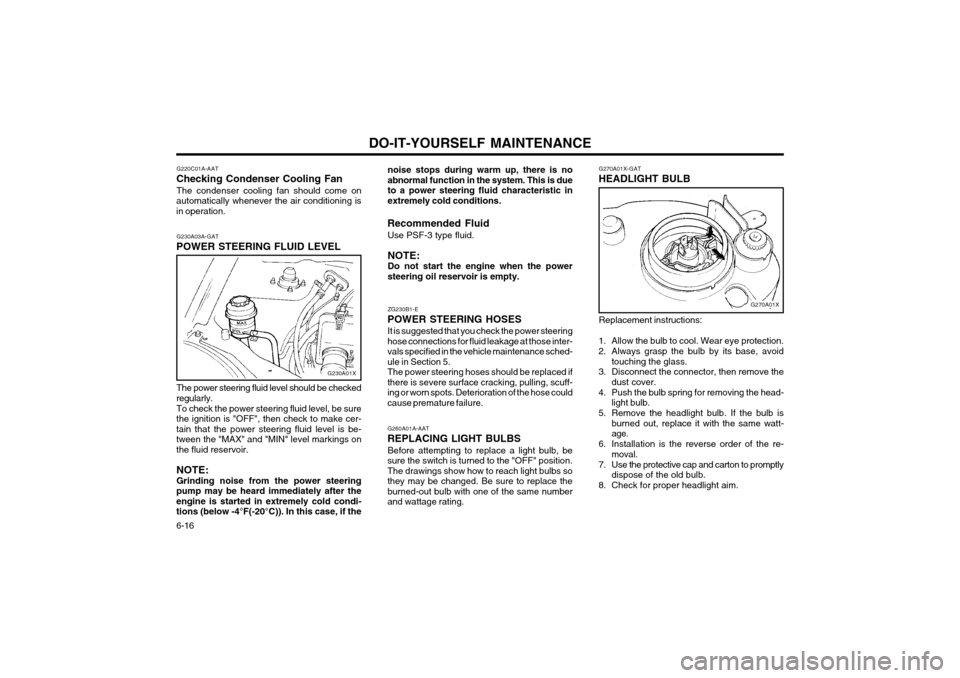
6-16 G270A01X-GAT
HEADLIGHT BULB
G270A01X
Replacement instructions:
1. Allow the bulb to cool. Wear eye protection.
2. Always grasp the bulb by its base, avoid touching the glass.
3. Disconnect the connector, then remove the dust cover.
4. Push the bulb spring for removing the head- light bulb.
5. Remove the headlight bulb. If the bulb is burned out, replace it with the same watt- age.
6. Installation is the reverse order of the re- moval.
7. Use the protective cap and carton to promptly dispose of the old bulb.
8. Check for proper headlight aim.
noise stops during warm up, there is no
abnormal function in the system. This is dueto a power steering fluid characteristic inextremely cold conditions.
Recommended Fluid Use PSF-3 type fluid. NOTE: Do not start the engine when the power
steering oil reservoir is empty. ZG230B1-E
POWER STEERING HOSES It is suggested that you check the power steering hose connections for fluid leakage at those inter-vals specified in the vehicle maintenance sched-ule in Section 5.The power steering hoses should be replaced ifthere is severe surface cracking, pulling, scuff-ing or worn spots. Deterioration of the hose couldcause premature failure.
G260A01A-AAT
REPLACING LIGHT BULBS Before attempting to replace a light bulb, be
sure the switch is turned to the "OFF" position.
The drawings show how to reach light bulbs sothey may be changed. Be sure to replace the
burned-out bulb with one of the same numberand wattage rating.
G220C01A-AAT
Checking Condenser Cooling Fan
The condenser cooling fan should come on
automatically whenever the air conditioning is in operation.
G230A03A-GAT
POWER STEERING FLUID LEVEL
G230A01X
The power steering fluid level should be checked
regularly.
To check the power steering fluid level, be sure
the ignition is "OFF", then check to make cer- tain that the power steering fluid level is be-
tween the "MAX" and "MIN" level markings onthe fluid reservoir.
NOTE: Grinding noise from the power steering
pump may be heard immediately after the engine is started in extremely cold condi-tions (below -4°F(-20°C)). In this case, if the
Page 240 of 249
7-2EMISSION CONTROL SYSTEMS
H020B01A-GAT About the Catalytic ConverterExhaust gases passing through the catalytic
converter cause it to operate at very high tem- peratures. As a result, the introduction of large
amounts of unburned gasoline may cause it to
overheat and create a fire hazard. This can beavoided by observing the following:
o Use unleaded fuel only.
o Maintain your engine in good condition. Ex- tremely high converter temperatures can result from improper operation of the electri-cal, ignition or fuel injection systems.
o If your engine stalls, pings, knocks, or is hard to start, take your car to your Hyundaidealer as soon as possible and have thedifficulty corrected.
o Avoid driving with a very low fuel level. If your run out of gasoline, it could cause theengine to misfire and result in excessive
loading of the catalytic converter.
o Avoid idling the engine for periods longer than 10 minutes.
o Your Hyundai should not be either pushed or pulled to get it started. This can cause thecatalytic converter to overload.
o Take care not to stop your Hyundai over any combustible material such as grass, paper,leaves or rags. As these materials could
come in contact with the catalytic converterand could cause a fire. o Do not touch the catalytic converter or any
other part of the exhaust system while theengine is running as it is very hot and couldresult in burns.
o Remember that your Hyundai dealer is your best source of assistance.
Page 245 of 249
VEHICLE SPECIFICATIONS
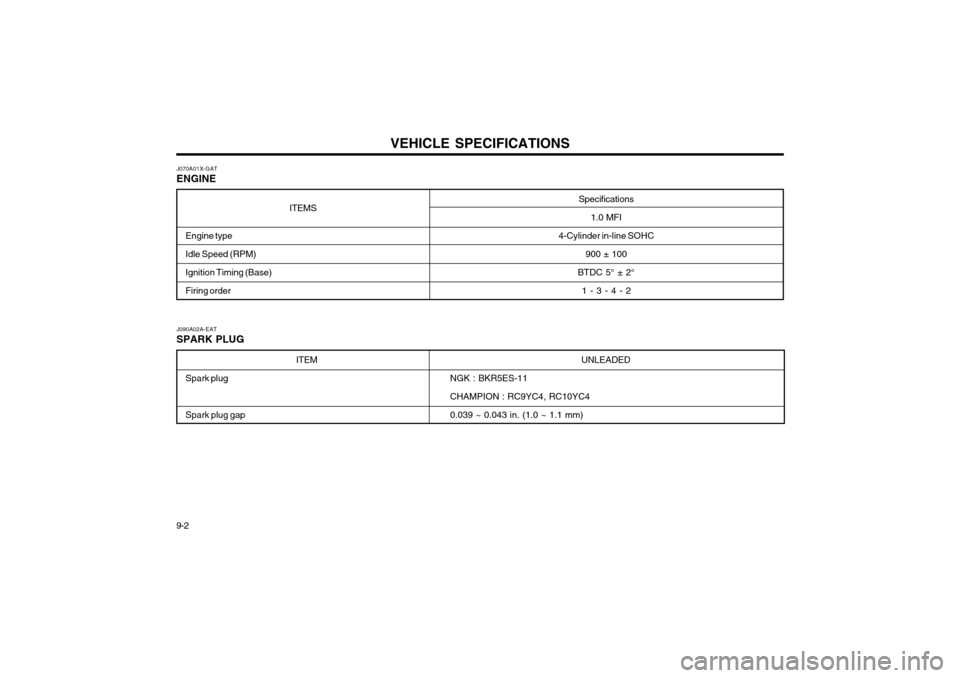
9-2 J070A01X-GAT ENGINE
ITEMS
Engine type Idle Speed (RPM)Ignition Timing (Base)Firing order Specifications
1.0 MFI
4-Cylinder in-line SOHC 900 ± 100
BTDC 5° ± 2°
1 - 3 - 4 - 2
J090A02A-EAT SPARK PLUG
ITEM
Spark plug Spark plug gap UNLEADED
NGK : BKR5ES-11 CHAMPION : RC9YC4, RC10YC40.039 ~ 0.043 in. (1.0 ~ 1.1 mm)
Page 248 of 249
INDEX
10-2
FRONT FOG LIGHT
SWITCH ......................................................... 1-29
FUEL ECONOMY ............................................................................... 2-3
FUEL GAUGE .................................................................................. 1-20
FUEL RECOMMENDATIONS ........... ................................................. 1-1
FUSIBLE LINKS ............................................................................... 6-14
G GENERAL CHECKS .......................................................................... 6-2
H
HAZARD WARNING SYSTEM ........................................................ 1-24
HEADLIGHT BULB ........................................................................... 6-16
HEADLIGHT LEVELING DEVICE SYSTEM ....................................1-23
HEADRESTRAINT .............................................................................. 1-5
HEADLIGHT FLASH ER .................................................................... 1-22
HEADLIGHT SWITCH ...................................................................... 1-21
HEATED REAR WINDOW ................... ............................................1-24
HEATING AND VENTILATION ........................................................ 1-32
HIGH AND LOW BEAM ................................................................... 1-21
HIGH-MOUNTED REAR STOPLIGHT .............................................1-27
HORN ............................................................................................... 1-32
IIF THE ENGINE CANNOT BE CRANKED ........................................ 3-1
IF THE ENGINE OVERHEATS .......................................................... 3-2
IF THE ENGINE WILL NOT START .................................................. 3-1
IGNITION SWITCH ............................................................................. 2-2
IMMOBILIZER SYSTEM ..................................................................... 1-2INDIVIDUAL CIRCUIT FUSES ......................................................... 6-15
INSTRUMENT CLUSTER AND INDICATOR ..................................1-17INSTRUMENTS AND CONTROLS
..................................................1-16
INTERIOR LIGHT ............................................................................. 1-25
JJUMP STARTI NG ........................................................................ 3-1~3-2
KKEY POSITIONS ................................................................................ 2-2
KEYS .................................................................................................. 1-2 L LIGHT BULBS .................................................................................. 6-16
LIMP HOME PROCEDURES ............................................................. 1-2
LOW FUEL LEVEL WARNING LAMP .............................................1-19
M
MAINTENANCE AND SERVICING REQUIREMENTS ..................... 5-1
MAINTENANCE UNDER SEVERE USAGE CONDITIONS .............. 5-4
MANUAL TRANSAXLE LUBRICANT ................................................. 6-9
MANUAL TRANSAXLE ...................................................................... 2-4
MULTI FUNCTION SWITCH ................................. ...........................1-21
OODOMETER ..................................................................................... 1-21
OIL PRESSURE WARNING LIGHT ................................................. 1-18
OUTSIDE REAR VIEW MIRROR ....................................................1-25
PPARKING BRAKE ............................................................................ 1-26
POWER STEERING FLUID LEVEL ................................................. 6-16