ignition Hyundai Atos 2002 User Guide
[x] Cancel search | Manufacturer: HYUNDAI, Model Year: 2002, Model line: Atos, Model: Hyundai Atos 2002Pages: 249, PDF Size: 3.11 MB
Page 52 of 249
FEATURES OF YOUR HYUNDAI
FEATURES OF YOUR HYUNDAI FEATURES OF YOUR HYUNDAI
FEATURES OF YOUR HYUNDAI
FEATURES OF YOUR HYUNDAI
1- 43
B901B02X-GAT
1. POWER ON-OFF/VOLUME CON-
TROL KNOB
The radio unit may be operated when the ignition key is in the "ACC" or "ON" position. Rotatethe knob clockwise to switch the radio unit on,and to increase the volume.The LCD shows the radio frequency in the radiomode. Turn the knob counterclockwise to reducethe volume, and to switch the radio unit off. BAL (Balance Control) Knob Pull and turn the control knob clockwise to em- phasize right speaker sound. (Left speaker soundwill be attenuated). When the control knob isturned counterclockwise, left speaker sound willbe emphasized. (Right speaker sound will beattenuated). 2. BASS Control Knob Press to pop the knob out and turn to the left or right for the desired bass tone. TREBLE Control Knob Further pull-lock position of popped-up knob. Turn to the left or right for the desired treble tone. 3. BAND Selector Pressing the button changes the AM, FM1 and FM2 bands. The mode selected is displayedon LCD. 4. TUNE (manual) Select Button Press the (+) side or (-) side to increase or to decrease the frequency. With the button helddown for 0.5 sec. or more, the stop signal (broad-casting radio wave) is ignored and channel se-lection continues. SEEK Operation (Automatic Channel Selection) Press the TUNE select button 1 sec. or more. When the (+) side is pressed, the unit will auto-matically tune to the next higher frequency andwhen the (-) side is pressed, it will automaticallytune to the next lower frequency.
5. PRESET STATION SELECT Six (6) stations for AM, FM and FM2 respectively can be preset in the electronic memory circuit onthis unit.
FM
AMHOW TO PRESET STATIONS Six AM and twelve FM stations may be pro- grammed into the memory of the radio. Then, bysimply pressing the band select button and/orone of the six station select buttons, you mayrecall any of these stations instantly. To programthe stations, follow these steps:
o Press band selector to set the band for AM,
FM and FM2.
o Select the desired station to be stored by seek, scan or manual tuning.
o Determine the preset station select button you wish to use to access that station.
o Press the station select button for more than two seconds. A select button indicator will show in the display indicating which selectbutton you have depressed. The frequencydisplay will flash after it has been stored intothe memory. You should then release thebutton, and proceed to program the nextdesired station. A total of 18 stations can beprogrammed by selecting one AM and twoFM stations per button.
o When completed, any preset station may be recalled by selecting AM, FM or FM2 bandand the appropriate station button.
Page 54 of 249
FEATURES OF YOUR HYUNDAI
FEATURES OF YOUR HYUNDAI FEATURES OF YOUR HYUNDAI
FEATURES OF YOUR HYUNDAI
FEATURES OF YOUR HYUNDAI
1- 45
B900B02X-GAT
1. POWER ON-OFF/VOLUME CON-
TROL KNOB
The radio unit may be operated when the ignition key is in the "ACC" or "ON" position. Rotatethe knob clockwise to switch the radio unit on andto increase the volume.The LCD shows the radio frequency in the radiomode, or the tape direction indicator in the tapemode. Turn the knob counterclockwise to reducethe volume and to switch the radio unit off. BAL (Balance Control) Knob Pull and turn the control knob clockwise to em- phasize right speaker sound. (Left speaker soundwill be attenuated) When the control knob isturned counterclockwise, left speaker sound willbe emphasized. (Right speaker sound will beattenuated) 2. BASS Control Knob Press to pop the knob out and turn to the left or right for the desired bass tone. TREBLE Control Knob Further pull-lock position of popped-up knob. Turn to the left or right for the desired treble tone. 3. BAND Selector Pressing the button changes the AM, FM1 and FM2 bands. The mode selected is displayedon LCD. 4. TUNE (manual) Select Button Press the (+) side or (-) side to increase or to decrease the frequency. With the button helddown for 0.5 sec. or more, the stop signal (broad-casting radio wave) is ignored and channel se-lection continues. SEEK Operation (Automatic Channel Selection) Press the TUNE select button 1 sec. or more. When the (+) side is pressed, the unit will auto-matically tune to the next higher frequency andwhen the (-) side is pressed, it will automaticallytune to the next lower frequency.
5. PRESET STATION SELECT Button Six (6) stations for AM, FM and FM2 respectively can be preset in the electronic memory circuit onthis unit.
FM
AMHOW TO PRESET STATIONS Six AM and twelve FM stations may be pro- grammed into the memory of the radio. Then, bysimply pressing the band select button and/orone of the six station select buttons, you mayrecall any of these stations instantly. To programthe stations, follow these steps:
o Press band selector to set the band for AM,
FM, and FM2.
o Select the desired station to be stored by seek, scan or manual tuning.
o Determine the preset station select button you wish to use to access that station.
o Press the station select button for more than two seconds. A select button indicator will show in the display indicating which selectbutton you have depressed. The frequencydisplay will flash after it has been stored intothe memory. You should then release thebutton, and proceed to program the nextdesired station. A total of 18 stations can beprogrammed by selecting one AM and oneFM station per button.
o When completed, any preset station may be recalled by selecting AM, FM or FM2 bandand the appropriate station button.
Page 57 of 249
FEATURES OF YOUR HYUNDAI
FEATURES OF YOUR HYUNDAI FEATURES OF YOUR HYUNDAI
FEATURES OF YOUR HYUNDAI
FEATURES OF YOUR HYUNDAI
1- 48
B922B03X-GAT
1. POWER ON-OFF/VOLUME
CONTROL KNOB
The radio unit may be operated when the ignition key is in the "ACC" or "ON" position. The clockwill be displayed automatically, although the ra-dio unit has gone out. Press the button to switchthe power on. The LCD shows the radio fre-quency in the radio mode or the CD track indica-tor in the CD mode. To switch the power off,press the button again. VOLUME Control Rotate the knob clockwise to increase the vol- ume and turn the knob counterclockwise to re-duce the volume. BALANCE Control Pull and turn the control knob clockwise to em- phasize right speaker sound. (Left speaker soundwill be attenuated) When the control knob isturned counterclockwise, left speaker sound willbe emphasized. (Right speaker sound will beattenuated) 2. FAD (Fader Control) Knob Turn the control knob counterclockwise to em- phasize front speaker sound. (Rear speakersound will be attenuated) When the control knobis turned clockwise, rear speaker sound will beemphasized. (Front speaker sound will be atten-uated)
FM/AM 6. PRESET STATION SELECT Button Six (6) stations for AM, FM and FM2 respectively can be preset in the electronic memory circuit onthis unit. HOW TO PRESET STATIONS Six AM and twelve FM stations may be pro- grammed into the memory of the radio. Then, bysimply pressing the band select button and/orone of the six station select buttons, you mayrecall any of these stations instantly. To programthe stations, follow these steps:
o Press band selector to set the band for AM,
FM, and FM2.
o Select the desired station to be stored by seek, scan or manual tuning.
o Determine the preset station select button you wish to use to access that station.
o Press the station select button for more than two seconds. A select button indicator will show in the display indicating which selectbutton you have depressed. The frequencydisplay will flash after it has been stored intothe memory. You should then release thebutton, and proceed to program the nextdesired station. A total of 18 stations can beprogrammed by selecting one AM and oneFM station per button.
o When completed, any preset station may be recalled by selecting AM, FM or FM2 bandand the appropriate station button.
3. BASS/TREBLE Control Knob BASS Control Knob Press to pop the knob out and turn to the left or right for the desired bass tone. TREBLE Control Knob Further pull-lock position of popped-up knob. Turn to the left or right for the desired treble tone. 4. BAND Selector Pressing the button changes the AM, FM1 and FM2 bands. The mode selected is displayedon LCD. 5. TUNE (Manual) Select Button Press the (+) side or (-) side to increase or to decrease the frequency. With the button helddown for 0.5 sec. or more, the stop signal (broad-casting radio wave) is ignored and channel se-lection continues. SEEK Operation (Automatic Channel Selection) Press the TUNE select button 1 sec. or more, and releasing will automatically tune the nextavailable station. When the (+) side is pressedlonger than 1 second and releasing will automat-ically tune the next higher frequency and whenthe (-) side is pressed longer than 1 second andreleasing will automatically tune the next lowerfrequency.
Page 65 of 249
DRIVING YOUR HYUNDAI
DRIVING YOUR HYUNDAI DRIVING YOUR HYUNDAI
DRIVING YOUR HYUNDAI
DRIVING YOUR HYUNDAI
2- 2 C020A01A-AAT
BEFORE STARTING THE ENGINE
BEFORE STARTING THE ENGINE BEFORE STARTING THE ENGINE
BEFORE STARTING THE ENGINE
BEFORE STARTING THE ENGINE
Before you start the engine, you should always:
1. Look around the vehicle to be sure there are no flat tires, puddles of oil, water or other indications of possible trouble.
2. After entering the car, check to be sure the parking brake is engaged.
3. Check that all windows, and lights are clean.
4. Check that the interior and exterior mirrors are clean and in position.
5. Check your seat, seatback and headrest to be sure they are in their proper positions.
6. Lock all the doors.
7. Fasten your seat belt and be sure that all other occupants have fastened theirs.
8. Turn off all lights and accessories that are not needed.
9. When you turn the ignition switch to "ON", check that all appropriate warning lights are operating and that you have sufficient fuel.
10. Check the operation of warning lights and all bulbs when key is in the "ON" position. o To start the engine, insert the ignition key
and turn it to the "START" position. Releaseit as soon as the engine starts. Do not hold
the key in the "START" position for morethan 15 seconds.
NOTE:
NOTE: NOTE:
NOTE:
NOTE:
For safety, the engine will not start if the
For safety, the engine will not start if the For safety, the engine will not start if the
For safety, the engine will not start if the
For safety, the engine will not start if the
shift lever is not
shift lever is not shift lever is not
shift lever is not
shift lever is not in "P" or "N" Position
in "P" or "N" Position in "P" or "N" Position
in "P" or "N" Position
in "P" or "N" Position
(Automatic Transaxle).
(Automatic Transaxle). (Automatic Transaxle).
(Automatic Transaxle).
(Automatic Transaxle). C040A01A-AAT
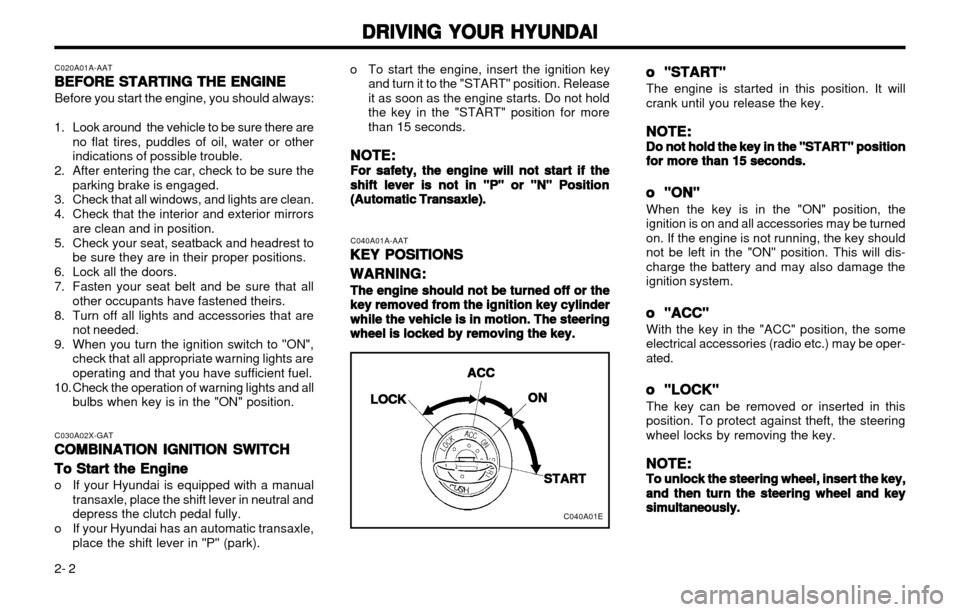
KEY POSITIONS
KEY POSITIONS KEY POSITIONS
KEY POSITIONS
KEY POSITIONS
WARNING:
WARNING: WARNING:
WARNING:
WARNING:
The engine should not be turned off or the
The engine should not be turned off or the The engine should not be turned off or the
The engine should not be turned off or the
The engine should not be turned off or the
key removed from
key removed from key removed from
key removed from
key removed from the ignition key cylinder
the ignition key cylinder the ignition key cylinder
the ignition key cylinder
the ignition key cylinder
while the vehicle is in motion. The steering
while the vehicle is in motion. The steering while the vehicle is in motion. The steering
while the vehicle is in motion. The steering
while the vehicle is in motion. The steering
wheel
wheel wheel
wheel
wheel is locked by removing the key.
is locked by removing the key. is locked by removing the key.
is locked by removing the key.
is locked by removing the key. oo
oo
o "START"
"START" "START"
"START"
"START"
The engine is started in this position. It will crank until you release the key.
NOTE:
NOTE: NOTE:
NOTE:
NOTE:
Do not hold the key in the "START" position
Do not hold the key in the "START" position Do not hold the key in the "START" position
Do not hold the key in the "START" position
Do not hold the key in the "START" position
for more than 15 seconds.
for more than 15 seconds. for more than 15 seconds.
for more than 15 seconds.
for more than 15 seconds.
oo
oo
o
"ON"
"ON" "ON"
"ON"
"ON"
When the key is in the "ON" position, the
ignition is on and all accessories may be turnedon. If the engine is not running, the key shouldnot be left in the "ON" position. This will dis-
charge the battery and may also damage theignition system.
oo
oo
o "ACC"
"ACC" "ACC"
"ACC"
"ACC"
With the key in the "ACC" position, the some
electrical accessories (radio etc.) may be oper-ated.
oo
oo
o "LOCK"
"LOCK" "LOCK"
"LOCK"
"LOCK"
The key can be removed or inserted in thisposition. To protect against theft, the steeringwheel locks by removing the key.
NOTE:
NOTE: NOTE:
NOTE:
NOTE:
To unlock the steering wheel, insert the key,
To unlock the steering wheel, insert the key, To unlock the steering wheel, insert the key,
To unlock the steering wheel, insert the key,
To unlock the steering wheel, insert the key,
and then turn the
and then turn the and then turn the
and then turn the
and then turn the
steering wheel and key
steering wheel and key steering wheel and key
steering wheel and key
steering wheel and key
simultaneously.
simultaneously. simultaneously.
simultaneously.
simultaneously.
C030A02X-GAT
COMBINATION IGNITION SWITCH
COMBINATION IGNITION SWITCH COMBINATION IGNITION SWITCH
COMBINATION IGNITION SWITCH
COMBINATION IGNITION SWITCH
To Start the Engine
To Start the Engine To Start the Engine
To Start the Engine
To Start the Engine
o If your Hyundai is equipped with a manual
transaxle, place the shift lever in neutral and depress the clutch pedal fully.
o If your Hyundai has an automatic transaxle, place the shift lever in "P" (park).
C040A01E
LOCK
LOCK LOCK
LOCK
LOCK ACC
ACC ACC
ACC
ACC
ONON
ONON
ON
START
START START
START
START
Page 66 of 249
DRIVING YOUR HYUNDAI
DRIVING YOUR HYUNDAI DRIVING YOUR HYUNDAI
DRIVING YOUR HYUNDAI
DRIVING YOUR HYUNDAI
2- 3
C050A01X-GAT
STARTING
STARTING STARTING
STARTING
STARTING
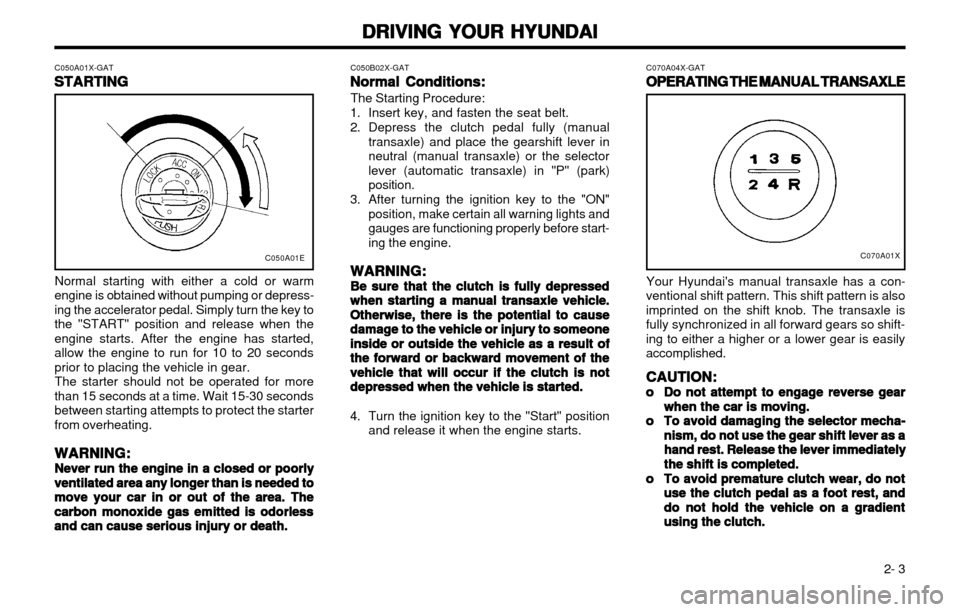
Normal starting with either a cold or warm
engine is obtained without pumping or depress-
ing the accelerator pedal. Simply turn the key tothe "START" position and release when theengine starts. After the engine has started,allow the engine to run for 10 to 20 secondsprior to placing the vehicle in gear. The starter should not be operated for more
than 15 seconds at a time. Wait 15-30 secondsbetween starting attempts to protect the starterfrom overheating.
WARNING:
WARNING: WARNING:
WARNING:
WARNING:
Never run the engine in a closed or poorly
Never run the engine in a closed or poorly Never run the engine in a closed or poorly
Never run the engine in a closed or poorly
Never run the engine in a closed or poorly ventilated area
ventilated area ventilated area
ventilated area
ventilated area any longer than is needed to
any longer than is needed to any longer than is needed to
any longer than is needed to
any longer than is needed to
move your car in or out of the area. The
move your car in or out of the area. The move your car in or out of the area. The
move your car in or out of the area. The
move your car in or out of the area. The
carbon
carbon carbon
carbon
carbon monoxide gas emitted is odorless
monoxide gas emitted is odorless monoxide gas emitted is odorless
monoxide gas emitted is odorless
monoxide gas emitted is odorless
and can cause serious injury or death.
and can cause serious injury or death. and can cause serious injury or death.
and can cause serious injury or death.
and can cause serious injury or death. C050B02X-GAT
Normal Conditions:
Normal Conditions: Normal Conditions:
Normal Conditions:
Normal Conditions:
The Starting Procedure:
1. Insert key, and fasten the seat belt.
2. Depress the clutch pedal fully (manual transaxle) and place the gearshift lever in neutral (manual transaxle) or the selectorlever (automatic transaxle) in "P" (park)position.
3. After turning the ignition key to the "ON" position, make certain all warning lights andgauges are functioning properly before start-
ing the engine.
WARNING:
WARNING: WARNING:
WARNING:
WARNING:
Be sure that the clutch is fully depressed
Be sure that the clutch is fully depressed Be sure that the clutch is fully depressed
Be sure that the clutch is fully depressed
Be sure that the clutch is fully depressed when starting a
when starting a when starting a
when starting a
when starting a manual transaxle vehicle.
manual transaxle vehicle. manual transaxle vehicle.
manual transaxle vehicle.
manual transaxle vehicle.
Otherwise, there is the potential to cause
Otherwise, there is the potential to cause Otherwise, there is the potential to cause
Otherwise, there is the potential to cause
Otherwise, there is the potential to cause
damage
damage damage
damage
damage to the vehicle or injury to someone
to the vehicle or injury to someone to the vehicle or injury to someone
to the vehicle or injury to someone
to the vehicle or injury to someone
inside or outside the vehicle as a result
inside or outside the vehicle as a result inside or outside the vehicle as a result
inside or outside the vehicle as a result
inside or outside the vehicle as a result ofof
ofof
of
the forward or backward movement of the
the forward or backward movement of the the forward or backward movement of the
the forward or backward movement of the
the forward or backward movement of the
vehicle that will occur if the
vehicle that will occur if the vehicle that will occur if the
vehicle that will occur if the
vehicle that will occur if the clutch is not
clutch is not clutch is not
clutch is not
clutch is not
depressed when the vehicle is started.
depressed when the vehicle is started. depressed when the vehicle is started.
depressed when the vehicle is started.
depressed when the vehicle is started.
4. Turn the ignition key to the "Start" position
and release it when the engine starts. C070A04X-GAT
OPERATING THE MANUAL TRANSAXLE
OPERATING THE MANUAL TRANSAXLE OPERATING THE MANUAL TRANSAXLE
OPERATING THE MANUAL TRANSAXLE
OPERATING THE MANUAL TRANSAXLE
C070A01X
Your Hyundai's manual transaxle has a con-
ventional shift pattern. This shift pattern is also imprinted on the shift knob. The transaxle isfully synchronized in all forward gears so shift-
ing to either a higher or a lower gear is easilyaccomplished.
CAUTION:
CAUTION: CAUTION:
CAUTION:
CAUTION:
oo
oo
o Do not attempt to engage reverse gear
Do not attempt to engage reverse gear Do not attempt to engage reverse gear
Do not attempt to engage reverse gear
Do not attempt to engage reverse gear
when the
when the when the
when the
when the car is moving.
car is moving. car is moving.
car is moving.
car is moving.
oo
oo
o To avoid damaging the selector mecha-
To avoid damaging the selector mecha- To avoid damaging the selector mecha-
To avoid damaging the selector mecha-
To avoid damaging the selector mecha-
nism, do not use the gear
nism, do not use the gear nism, do not use the gear
nism, do not use the gear
nism, do not use the gear shift lever as a
shift lever as a shift lever as a
shift lever as a
shift lever as a
hand rest. Release the lever immediately
hand rest. Release the lever immediately hand rest. Release the lever immediately
hand rest. Release the lever immediately
hand rest. Release the lever immediately
the shift is completed.
the shift is completed. the shift is completed.
the shift is completed.
the shift is completed.
oo
oo
o To avoid premature clutch wear, do not
To avoid premature clutch wear, do not To avoid premature clutch wear, do not
To avoid premature clutch wear, do not
To avoid premature clutch wear, do not
use the clutch pedal as
use the clutch pedal as use the clutch pedal as
use the clutch pedal as
use the clutch pedal as
a foot rest, and
a foot rest, and a foot rest, and
a foot rest, and
a foot rest, and
do not hold the vehicle on a gradient
do not hold the vehicle on a gradient do not hold the vehicle on a gradient
do not hold the vehicle on a gradient
do not hold the vehicle on a gradient
using the clutch.
using the clutch. using the clutch.
using the clutch.
using the clutch.
C050A01E
Page 68 of 249

DRIVING YOUR HYUNDAI
DRIVING YOUR HYUNDAI DRIVING YOUR HYUNDAI
DRIVING YOUR HYUNDAI
DRIVING YOUR HYUNDAI
2- 5
Shift
from-toRecommended
1-2 2-3 3-4 4-5 20 km/h (15 mph)40 km/h (25 mph) 55 km/h (35 mph) 75 km/h (45 mph)
NOTE:
NOTE: NOTE:
NOTE:
NOTE:
Depress the brake pedal and push the
Depress the brake pedal and push the Depress the brake pedal and push the
Depress the brake pedal and push the
Depress the brake pedal and push the
button when shifting.
button when shifting. button when shifting.
button when shifting.
button when shifting.
Push the button when shifting.
Push the button when shifting. Push the button when shifting.
Push the button when shifting.
Push the button when shifting.
The selector lever can be shifted free-
The selector lever can be shifted free- The selector lever can be shifted free-
The selector lever can be shifted free-
The selector lever can be shifted free-
ly.ly.
ly.ly.
ly.
For optimum fuel economy, accelerate gradual- ly. The transaxle will automatically shift to thesecond, third and overdrive gears. C090B01A-AAT The function of each position is as
The function of each position is as The function of each position is as
The function of each position is as
The function of each position is as
follows:
follows: follows:
follows:
follows:
o P (Park):
o P (Park): o P (Park):
o P (Park):
o P (Park): Use to hold the vehicle in place when parking or
while starting the engine; shift the selector lever to the "P" (Park) position. Whenever parkingthe car, apply the parking brake and shift theselector lever to the "P" (Park) position.
CAUTION:
CAUTION: CAUTION:
CAUTION:
CAUTION:
Never place the selector lever in the "P"
Never place the selector lever in the "P" Never place the selector lever in the "P"
Never place the selector lever in the "P"
Never place the selector lever in the "P" (Park) position unless the vehicle is fully
(Park) position unless the vehicle is fully (Park) position unless the vehicle is fully
(Park) position unless the vehicle is fully
(Park) position unless the vehicle is fully
stopped. Failure to observe this caution will
stopped. Failure to observe this caution will stopped. Failure to observe this caution will
stopped. Failure to observe this caution will
stopped. Failure to observe this caution will
cause severe damage to the transaxle.
cause severe damage to the transaxle. cause severe damage to the transaxle.
cause severe damage to the transaxle.
cause severe damage to the transaxle.
C090A01A-GAT
AUTOMATIC TRANSAXLE
AUTOMATIC TRANSAXLE AUTOMATIC TRANSAXLE
AUTOMATIC TRANSAXLE
AUTOMATIC TRANSAXLE
The highly efficient Hyundai automatic transaxle
has four forward speeds and one reverse speed. It has a conventional shift pattern as shown inthe illustration. At night, with the first position ofthe multi-function switch, the appropriate sym-bol on the shift pattern indicator will be illuminat-ed according to the range selected.
CAUTION:
CAUTION: CAUTION:
CAUTION:
CAUTION:
Never shift into "R" or "P" position while
Never shift into "R" or "P" position while Never shift into "R" or "P" position while
Never shift into "R" or "P" position while
Never shift into "R" or "P" position while the vehicle is moving.
the vehicle is moving. the vehicle is moving.
the vehicle is moving.
the vehicle is moving.
C090B01X
C070C01A-AAT
To Remove the Ignition Key
To Remove the Ignition Key To Remove the Ignition Key
To Remove the Ignition Key
To Remove the Ignition Key
1. Turn the ignition key to the "ACC" position.
2. Simultaneously push and turn the ignition
key counterclockwise from the "ACC" posi- tion to the "LOCK" position.
3. The key can be removed in the "LOCK" position.
C070E02A-GAT Recommended Shift Points
Recommended Shift Points Recommended Shift Points
Recommended Shift Points
Recommended Shift Points
C070C01E
LOCK
LOCK LOCK
LOCK
LOCK ACC
ACC ACC
ACC
ACC
ONON
ONON
ON
START
START START
START
START
The shift points as shown are recommended for
optimum fuel economy and performance.
Page 73 of 249
DRIVING YOUR HYUNDAI
DRIVING YOUR HYUNDAI DRIVING YOUR HYUNDAI
DRIVING YOUR HYUNDAI
DRIVING YOUR HYUNDAI
2- 10 ice. If the lock is frozen internally, you may be able to thaw it out by using a heated key.Handle the heated key with care to avoid burn-ing your fingers.
NOTE:
NOTE: NOTE:
NOTE:
NOTE:
The proper temperature for using the immo-
The proper temperature for using the immo- The proper temperature for using the immo-
The proper temperature for using the immo-
The proper temperature for using the immo-
bilizer key is from -40°C to 80°C. If you heat
bilizer key is from -40°C to 80°C. If you heat bilizer key is from -40°C to 80°C. If you heat
bilizer key is from -40°C to 80°C. If you heat
bilizer key is from -40°C to 80°C. If you heat
the immobilizer key over 80°C to open the
the immobilizer key over 80°C to open the the immobilizer key over 80°C to open the
the immobilizer key over 80°C to open the
the immobilizer key over 80°C to open the
frozen lock,
frozen lock, frozen lock,
frozen lock,
frozen lock, it may cause damage to the
it may cause damage to the it may cause damage to the
it may cause damage to the
it may cause damage to the
transponder in its head.
transponder in its head. transponder in its head.
transponder in its head.
transponder in its head. C160H01A-AAT
Use Approved Anti-Freeze in Window
Use Approved Anti-Freeze in Window Use Approved Anti-Freeze in Window
Use Approved Anti-Freeze in Window
Use Approved Anti-Freeze in Window
Washer System
Washer System Washer System
Washer System
Washer System
To keep the water in the window washer sys- tem from freezing, add an approved anti-freezesolution in accordance with instructions on thecontainer. Window washer anti-freeze is avail-able from Hyundai dealers and most auto partsoutlets. Do not use engine coolant or othertypes of anti-freeze as these may damage thefinish. C160I01X-GAT
Don't Let Your Parking Brake Freeze
Don't Let Your Parking Brake Freeze Don't Let Your Parking Brake Freeze
Don't Let Your Parking Brake Freeze
Don't Let Your Parking Brake Freeze
Under some conditions your parking brake can freeze in the engaged position. This is mostlikely to happen when there is an accumulationof snow or ice around or near the rear brakes orif the brakes are wet. If there is a risk theparking brake may freeze, apply it only tempo-
C160F01A-AAT
Check Spark Plugs and Ignition
Check Spark Plugs and Ignition Check Spark Plugs and Ignition
Check Spark Plugs and Ignition
Check Spark Plugs and Ignition
System
System System
System
System
Inspect your spark plugs as described in Sec-tion 6 and replace them if necessary. Alsocheck all ignition wiring and components to besure they are not cracked, worn or damaged inany way.
C160D01A-AAT
Check Battery and Cables
Check Battery and Cables Check Battery and Cables
Check Battery and Cables
Check Battery and Cables
Winter puts additional burdens on the batterysystem. Visually inspect the battery and cablesas described in Section 6. The level of chargein your battery can be checked by your Hyundaidealer or a service station. C160E01A-AATChange to "Winter Weight" Oil if
Change to "Winter Weight" Oil if Change to "Winter Weight" Oil if
Change to "Winter Weight" Oil if
Change to "Winter Weight" Oil if
Necessary
Necessary Necessary
Necessary
Necessary
In some climates it is recommended that a lower viscosity "winter weight" oil be used dur-ing cold weather. See Section 9 for recommen-dations. If you aren't sure what weight oil youshould use, consult your Hyundai dealer. C160G01A-GAT
To Keep Locks from Freezing
To Keep Locks from Freezing To Keep Locks from Freezing
To Keep Locks from Freezing
To Keep Locks from Freezing
To keep the locks from freezing, squirt an approved de-icer fluid or glycerine into the keyopening. If a lock is covered with ice, squirt itwith an approved de-icing fluid to remove the
Failure to do so may adversely affect the safety
and handling of your car. Speeding, rapid accel-eration, sudden brake applications, and sharpturns are potentially very hazardous practices.During deceleration, use engine braking to thefullest extent. Sudden brake applications onsnowy or icy roads may cause skids to occur.
You need to keep sufficient distance betweenthe vehicle in front and your vehicle. Also, applythe brake gently.
It should be noted that installing tire chains on
the tire will provide a greater driving force, butwill not prevent side skids.
NOTE:
NOTE: NOTE:
NOTE:
NOTE:
Tire chains are not legal in all provinces.
Tire chains are not legal in all provinces. Tire chains are not legal in all provinces.
Tire chains are not legal in all provinces.
Tire chains are not legal in all provinces. Check
Check Check
Check
Check province laws before fitting tire
province laws before fitting tire province laws before fitting tire
province laws before fitting tire
province laws before fitting tire
chains.
chains. chains.
chains.
chains.
C160C01A-AATUse High Quality Ethylene Glycol
Use High Quality Ethylene Glycol Use High Quality Ethylene Glycol
Use High Quality Ethylene Glycol
Use High Quality Ethylene Glycol
Coolant
Coolant Coolant
Coolant
Coolant
Your Hyundai is delivered with high quality
ethylene glycol coolant in the cooling system. It is the only type of coolant that should be usedbecause it helps prevent corrosion in the cool-ing system, lubricates the water pump andprevents freezing. Be sure to replace or replen-ish your coolant in accordance with the main-tenance schedule in Section 5. Before winter,have your coolant tested to assure that itsfreezing point is sufficient for the temperaturesanticipated during the winter.
Page 78 of 249
WHAT TO DO IN AN EMERGENCY
WHAT TO DO IN AN EMERGENCY WHAT TO DO IN AN EMERGENCY
WHAT TO DO IN AN EMERGENCY
WHAT TO DO IN AN EMERGENCY
3-1
D010B01A-AATIf Engine Doesn't Turn Over or Turns
If Engine Doesn't Turn Over or Turns If Engine Doesn't Turn Over or Turns
If Engine Doesn't Turn Over or Turns
If Engine Doesn't Turn Over or Turns
Over Slowly
Over Slowly Over Slowly
Over Slowly
Over Slowly 3.3.
3.3.
3.
WHA
WHA WHA
WHA
WHA
T
T T
T
T
TT
TT
T
O DO IN AN
O DO IN AN O DO IN AN
O DO IN AN
O DO IN AN
EMERGENCY
EMERGENCY EMERGENCY
EMERGENCY
EMERGENCY
D010A01A-AAT IF THE ENGINE WILL NOT START
IF THE ENGINE WILL NOT START IF THE ENGINE WILL NOT START
IF THE ENGINE WILL NOT START
IF THE ENGINE WILL NOT START
CAUTION:
CAUTION: CAUTION:
CAUTION:
CAUTION:
If the engine will not start, do not push or
If the engine will not start, do not push or If the engine will not start, do not push or
If the engine will not start, do not push or
If the engine will not start, do not push or pull the car to
pull the car to pull the car to
pull the car to
pull the car to start it. This could result in a
start it. This could result in a start it. This could result in a
start it. This could result in a
start it. This could result in a
collision or cause other damage. In addi-
collision or cause other damage. In addi- collision or cause other damage. In addi-
collision or cause other damage. In addi-
collision or cause other damage. In addi-
tion,
tion, tion,
tion,
tion, push or pull starting may cause the
push or pull starting may cause the push or pull starting may cause the
push or pull starting may cause the
push or pull starting may cause the
catalytic converter to be overloaded and
catalytic converter to be overloaded and catalytic converter to be overloaded and
catalytic converter to be overloaded and
catalytic converter to be overloaded and
create a fire hazard.
create a fire hazard. create a fire hazard.
create a fire hazard.
create a fire hazard. 1. If your car has an automatic transaxle, be
sure the gear selector lever is in "N" or "P" and the emergency brake is set.
2. Check the battery connections to be sure they are clean and tight.
3. Turn on the interior light. If the light dims or goes out when you operate the starter, thebattery is discharged.
4. Check the starter connections to be sure they are securely tightened.
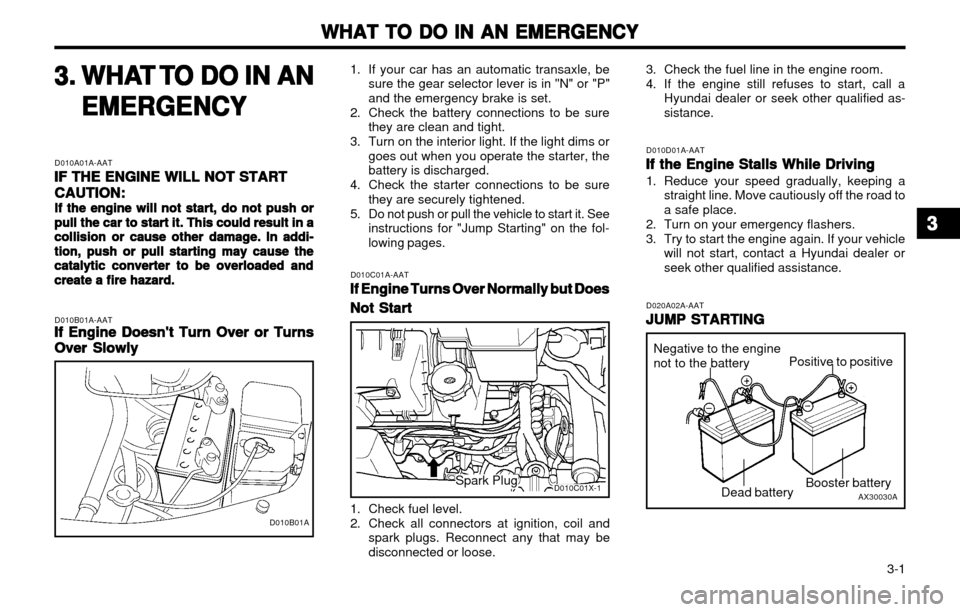
5. Do not push or pull the vehicle to start it. See instructions for "Jump Starting" on the fol-lowing pages.
D010C01A-AAT If Engine Turns Over Normally but Does
If Engine Turns Over Normally but Does If Engine Turns Over Normally but Does
If Engine Turns Over Normally but Does
If Engine Turns Over Normally but Does
Not Start
Not Start Not Start
Not Start
Not Start
1. Check fuel level.
2. Check all connectors at ignition, coil and
spark plugs. Reconnect any that may be disconnected or loose. D010D01A-AAT
If the Engine Stalls While Driving
If the Engine Stalls While Driving If the Engine Stalls While Driving
If the Engine Stalls While Driving
If the Engine Stalls While Driving
1. Reduce your speed gradually, keeping a
straight line. Move cautiously off the road to a safe place.
2. Turn on your emergency flashers.
3. Try to start the engine again. If your vehicle will not start, contact a Hyundai dealer or seek other qualified assistance.
D010B01A
3. Check the fuel line in the engine room.
4. If the engine still refuses to start, call aHyundai dealer or seek other qualified as- sistance.
D020A02A-AAT JUMP STARTING
JUMP STARTING JUMP STARTING
JUMP STARTING
JUMP STARTING
AX30030A
Negative to the engine not to the battery
Booster battery
Positive to positive
Dead battery
D010C01X-1Spark Plug
33
33
3
Page 84 of 249
WHAT TO DO IN AN EMERGENCY
WHAT TO DO IN AN EMERGENCY WHAT TO DO IN AN EMERGENCY
WHAT TO DO IN AN EMERGENCY
WHAT TO DO IN AN EMERGENCY
3-7
D060J01FC-GAT
After Changing Wheels
After Changing Wheels After Changing Wheels
After Changing Wheels
After Changing Wheels
If you have a tire gauge, remove the valve cap
and check the air pressure. If the pressure is lower than recommended, drive slowly to thenearest service station and inflate to the correctpressure. If it is too high, adjust it until it iscorrect. Always reinstall the valve cap afterchecking or adjusting tire pressure. If the cap isnot replaced, air may leak from the tire. If youlose a valve cap, buy another and install it assoon as possible.
After you have changed wheels, always secure
the flat tire in its place in the luggage room andreturn the jack and tools to their proper storagelocations. D080A01A-GAT
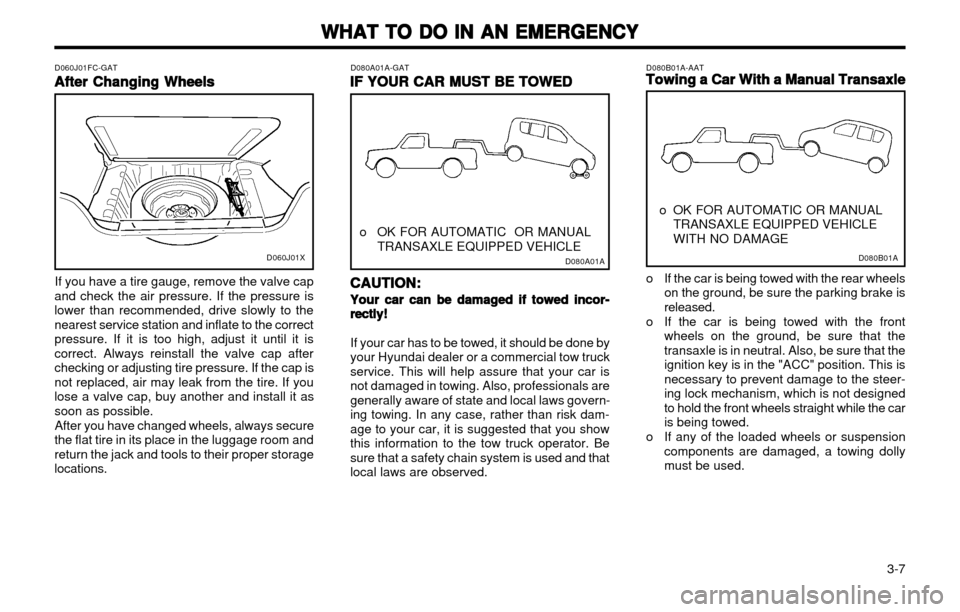
IF YOUR CAR MUST BE TOWED
IF YOUR CAR MUST BE TOWED IF YOUR CAR MUST BE TOWED
IF YOUR CAR MUST BE TOWED
IF YOUR CAR MUST BE TOWED D080B01A-AAT
Towing a Car With a Manual Transaxle
Towing a Car With a Manual Transaxle Towing a Car With a Manual Transaxle
Towing a Car With a Manual Transaxle
Towing a Car With a Manual Transaxle
o OK FOR AUTOMATIC OR MANUAL TRANSAXLE EQUIPPED VEHICLE WITH NO DAMAGE
o OK FOR AUTOMATIC OR MANUAL
TRANSAXLE EQUIPPED VEHICLE
CAUTION:
CAUTION: CAUTION:
CAUTION:
CAUTION:
Your car can be damaged if towed incor-
Your car can be damaged if towed incor- Your car can be damaged if towed incor-
Your car can be damaged if towed incor-
Your car can be damaged if towed incor-
rectly!
rectly! rectly!
rectly!
rectly!
If your car has to be towed, it should be done by
your Hyundai dealer or a commercial tow truck service. This will help assure that your car isnot damaged in towing. Also, professionals aregenerally aware of state and local laws govern-ing towing. In any case, rather than risk dam-age to your car, it is suggested that you showthis information to the tow truck operator. Besure that a safety chain system is used and thatlocal laws are observed. o If the car is being towed with the rear wheels
on the ground, be sure the parking brake isreleased.
o If the car is being towed with the front wheels on the ground, be sure that thetransaxle is in neutral. Also, be sure that theignition key is in the "ACC" position. This isnecessary to prevent damage to the steer-ing lock mechanism, which is not designedto hold the front wheels straight while the caris being towed.
o If any of the loaded wheels or suspension components are damaged, a towing dollymust be used.
D080A01AD080B01AD060J01X
Page 111 of 249
DO-IT-YOURSELF MAINTENANCE
DO-IT-YOURSELF MAINTENANCE DO-IT-YOURSELF MAINTENANCE
DO-IT-YOURSELF MAINTENANCE
DO-IT-YOURSELF MAINTENANCE
6-15
CAUTION:
CAUTION: CAUTION:
CAUTION:
CAUTION:
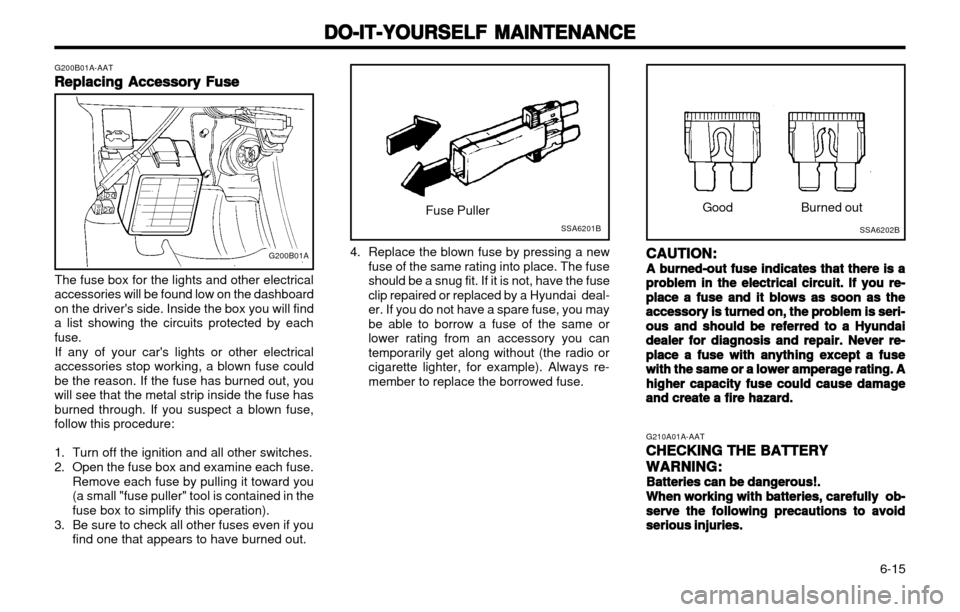
A burned-out fuse indicates that there is a
A burned-out fuse indicates that there is a A burned-out fuse indicates that there is a
A burned-out fuse indicates that there is a
A burned-out fuse indicates that there is a problem in the electrical circuit. If you re-
problem in the electrical circuit. If you re- problem in the electrical circuit. If you re-
problem in the electrical circuit. If you re-
problem in the electrical circuit. If you re-
place a fuse and it blows as soon as the
place a fuse and it blows as soon as the place a fuse and it blows as soon as the
place a fuse and it blows as soon as the
place a fuse and it blows as soon as the
accessory is turned on, the problem is seri-
accessory is turned on, the problem is seri- accessory is turned on, the problem is seri-
accessory is turned on, the problem is seri-
accessory is turned on, the problem is seri-
ous and should be referred to a Hyundai
ous and should be referred to a Hyundai ous and should be referred to a Hyundai
ous and should be referred to a Hyundai
ous and should be referred to a Hyundai
dealer for diagnosis and repair. Never re-
dealer for diagnosis and repair. Never re- dealer for diagnosis and repair. Never re-
dealer for diagnosis and repair. Never re-
dealer for diagnosis and repair. Never re-
place a fuse with anything except a fuse
place a fuse with anything except a fuse place a fuse with anything except a fuse
place a fuse with anything except a fuse
place a fuse with anything except a fuse
with the same or a lower amperage rating. A
with the same or a lower amperage rating. A with the same or a lower amperage rating. A
with the same or a lower amperage rating. A
with the same or a lower amperage rating. A
higher capacity fuse could cause damage
higher capacity fuse could cause damage higher capacity fuse could cause damage
higher capacity fuse could cause damage
higher capacity fuse could cause damage
and create a fire hazard.
and create a fire hazard. and create a fire hazard.
and create a fire hazard.
and create a fire hazard. Good
Burned out
4. Replace the blown fuse by pressing a new fuse of the same rating into place. The fuse should be a snug fit. If it is not, have the fuseclip repaired or replaced by a Hyundai deal-er. If you do not have a spare fuse, you maybe able to borrow a fuse of the same orlower rating from an accessory you cantemporarily get along without (the radio orcigarette lighter, for example). Always re-member to replace the borrowed fuse.
G200B01A-AAT
Replacing Accessory Fuse
Replacing Accessory Fuse Replacing Accessory Fuse
Replacing Accessory Fuse
Replacing Accessory Fuse
The fuse box for the lights and other electrical
accessories will be found low on the dashboardon the driver's side. Inside the box you will finda list showing the circuits protected by eachfuse.
If any of your car's lights or other electrical
accessories stop working, a blown fuse couldbe the reason. If the fuse has burned out, youwill see that the metal strip inside the fuse hasburned through. If you suspect a blown fuse,follow this procedure:
1. Turn off the ignition and all other switches.
2. Open the fuse box and examine each fuse. Remove each fuse by pulling it toward you (a small "fuse puller" tool is contained in thefuse box to simplify this operation).
3. Be sure to check all other fuses even if you find one that appears to have burned out.
G200B01A
SSA6201BSSA6202B
Fuse Puller
G210A01A-AATCHECKING THE BATTERY
CHECKING THE BATTERY CHECKING THE BATTERY
CHECKING THE BATTERY
CHECKING THE BATTERY
WARNING:
WARNING: WARNING:
WARNING:
WARNING:
Batteries can be dangerous!.
Batteries can be dangerous!. Batteries can be dangerous!.
Batteries can be dangerous!.
Batteries can be dangerous!.
When working with batteries, carefully ob-
When working with batteries, carefully ob- When working with batteries, carefully ob-
When working with batteries, carefully ob-
When working with batteries, carefully ob-
serve the following precautions to avoid
serve the following precautions to avoid serve the following precautions to avoid
serve the following precautions to avoid
serve the following precautions to avoid
serious injuries.
serious injuries. serious injuries.
serious injuries.
serious injuries.