engine Hyundai Atos 2003 Workshop Manual
[x] Cancel search | Manufacturer: HYUNDAI, Model Year: 2003, Model line: Atos, Model: Hyundai Atos 2003Pages: 127, PDF Size: 1.55 MB
Page 104 of 127

DO-IT-YOURSELF MAINTENANCE 6-9
G090A01X-GAT
FILLING THE WASHER RESERVOIR
The washer fluid reservoir supplies fluid to the
windshield washer system. A good quality washer fluid should be used to fill
the washer reservoir. The fluid level should be checked more frequently during bad weather orwhenever the washer system is in more fre-quent use.
The capacity of the washer reservoir is 2.5
liters (2.63 U.S. quarts).
CAUTION:
o Radiator antifreeze (engine coolant) should not be used in the washer systembecause it will damage the car's finish.
o The washer lever should not be pulled and the washer should not be operated ifthe washer reservoir is empty. This candamage the washer fluid pump.
G070A01X-GAT
CHANGING THE AIR CLEANER FIL- TER G080A02A-AAT
WINDSHIELD WIPER BLADES The wiper blades should be carefully inspected from time to time and cleaned to remove accu-mulations of road film or other debris. To cleanthe wiper blades and arms, use a clean spongeor cloth with a mild soap or detergent and water.If the wipers continue to streak or smear theglass, replace them with Genuine HyundaiReplacement Parts or their equivalent. CAUTION:
o Do not operate the wipers on dry glass. This can result in more rapid wear of the wiper blades and may scratch the glass.
o Keep the blade rubber out of contact with petroleum products such as engineoil, gasoline etc.
To change the filter, loosen the clamps (1) on
the cover. When this is done, the cover can be
lifted off, the old filter removed and the new filterput in its place. Genuine Hyundai replacement
parts are recommended.
CAUTION: Operating your vehicle without a proper air
filter in place can result in excessive engine wear.
G070A01X
(1)
AS60160AG090A01X
Page 105 of 127
DO-IT-YOURSELF MAINTENANCE
6-10 G110A01A-AAT
CHECKING THE TRANSAXLE FLUID (AUTOMATIC)
Transaxle fluid in the automatic transaxle should be checked at those intervals specified in thevehicle maintenance schedule in Section 5. G110B01X-AAT Recommended Fluid Your Hyundai automatic transaxle is specially designed to operate with ESSO JWS3314. Dam-age caused by a nonspecified fluid is not cov-ered by your new vehicle limited warranty. G110C01X-GAT
Transaxle Fluid Capacity The fluid capacity of the automatic transaxle is
5.2 liters (5.48 U.S. quarts). WARNING: The transaxle fluid level should be checked
when the engine is at normal operating tem-perature. This means that the engine, radia-
tor, exhaust system etc., are very hot. Exer-
cise great care not to burn yourself duringthis procedure.
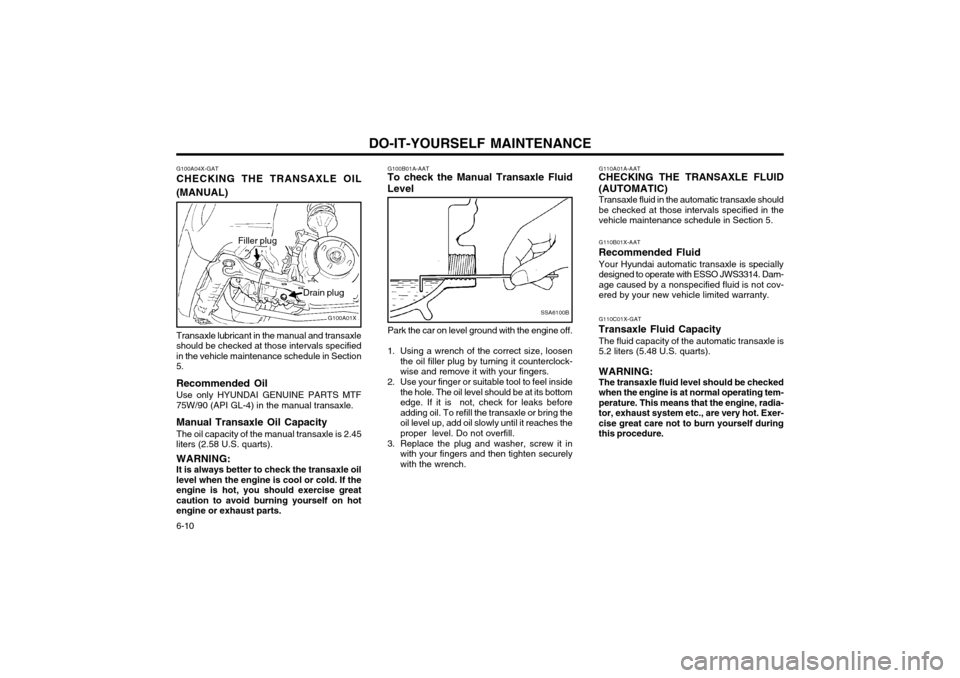
G100A04X-GAT CHECKING THE TRANSAXLE OIL (MANUAL) Transaxle lubricant in the manual and transaxle should be checked at those intervals specified in the vehicle maintenance schedule in Section5. Recommended Oil Use only HYUNDAI GENUINE PARTS MTF 75W/90 (API GL-4) in the manual transaxle. Manual Transaxle Oil Capacity The oil capacity of the manual transaxle is 2.45 liters (2.58 U.S. quarts). WARNING: It is always better to check the transaxle oil level when the engine is cool or cold. If theengine is hot, you should exercise greatcaution to avoid burning yourself on hotengine or exhaust parts. G100B01A-AAT
To check the Manual Transaxle Fluid Level
SSA6100B
Park the car on level ground with the engine off.
1. Using a wrench of the correct size, loosen the oil filler plug by turning it counterclock- wise and remove it with your fingers.
2. Use your finger or suitable tool to feel inside the hole. The oil level should be at its bottomedge. If it is not, check for leaks beforeadding oil. To refill the transaxle or bring theoil level up, add oil slowly until it reaches theproper level. Do not overfill.
3. Replace the plug and washer, screw it in with your fingers and then tighten securelywith the wrench.
G100A01X
Filler plug
Drain plug
Page 106 of 127

DO-IT-YOURSELF MAINTENANCE 6-11
WARNING: The cooling fan is controlled by engine cool-
ant temperature and may sometimes oper- ate even when the engine is not running.Use extreme caution when working near theblades of the cooling fan, so that you are notinjured by a rotating fan blade. As the en-gine coolant temperature decreases, the fanwill automatically shut off. This is a normalcondition.
G120C02A-AAT
Recommended Brake Fluid
Use only hydraulic brake fluid conforming to
DOT 3 or DOT 4 specifications in your braking G120A01A-AAT
CHECKING THE BRAKES
CAUTION: Because brakes are essential to the safe
operation of the car, it is suggested that they be checked and inspected by yourHyundai dealer. The brakes should bechecked and inspected for wear at thoseintervals specified in the vehicle mainte-nance schedule in Section 5.
G120B01A-AAT
Checking the Brake Fluid Level
WARNING: Use caution when handling brake fluid. It
can damage your vision if it gets into your eyes. It will also damage your vehicle's paintif spilled on it and not removed immediately.
G110D02A-GAT
To Check the Automatic Transaxle Fluid Level
Park the car on level ground with the parking
brake engaged. When the transaxle fluid level is checked, the transaxle fluid should be atnormal operating temperature and the engineidling. While the engine is idling, apply the brakes andmove the gear selector lever from "P" to eachof its other positions — "R", "N", "D", "2", "L" —and then return to "N" or "P" with the engine stillidling:
1. Open the hood, being careful to keep hands,
long hair and clothing clear of any moving parts.
2. Remove the transaxle dipstick, wipe it clean, reinsert the dipstick as far as it will go, thenremove it again. Now check the fluid level onthe dipstick. It should be in the "HOT" rangeon the dipstick.
Fluid level should be within this range
3. If the transaxle fluid level is low, use a funnel to add transaxle fluid through the dipsticktube until the level reaches the "HOT" range.Do not overfill.
C090B01X
G110D02A
G110D03A
Page 107 of 127

DO-IT-YOURSELF MAINTENANCE
6-12 G140B01A-AAT
Checking the Air Conditioning Opera- tion
1. Start the engine and let it run at a fast idle for
several minutes with the air conditioning set at the maximum cold setting.
2. If the air coming out of the in-dash vents is not cold, have the air conditioning systeminspected by your Hyundai dealer.
CAUTION: Running the air conditioning system for ex- tended periods of time with a low refrigerantlevel may damage the compressor.
When the air conditioning is being used regu-larly, the compressor drive belt tension shouldbe checked at least once a month. To check the drive belt tension, press down on the belt halfway between the engine crankshaftand compressor pulleys. Pressing with yourfinger, you should not be able to deflect this belt
anymore than 5 - 5.5 mm. If you have theinstruments to check it with a force of 98N (22lb.), the deflection should be approx. 5 - 5.5(0.197 - 0.217 inches). If the belt is too loose,have it adjusted by your Hyundai dealer.
G120D01A-AAT
To Check the Fluid Level The fluid level in the brake fluid reservoir should
be checked periodically. The level should bebetween the "MIN" and "MAX" marks on theside of the reservoir. If the level is at or belowthe "MIN" mark, carefully add fluid to bring it upto "MAX". Do not overfill.
G120E02A-AAT
Adding Brake Fluid
WARNING: Handle brake fluid carefully. It can damage
your vision if it gets into your eyes. Use only DOT 3 or DOT 4 specification fluid from asealed container. Do not allow the fluid canor reservoir to remain open any longer thanrequired. This will prevent entry of dirt and moisture which can damage the brake sys-tem and cause improper operation.
To add brake fluid, first wipe away any dirt then
unscrew the fluid reservoir cap. Slowly pour therecommended fluid into the reservoir. Do notoverfill. Carefully replace the cap on the reser-voir and tighten.
G120E01A
G140A01A-AAT
AIR CONDITIONER CARE Keeping the Condenser Clean
The air conditioner condenser (and engine ra-
diator) should be checked periodically for accu- mulation of dirt, dead insects, leaves, etc. Thesecan interfere with maximum cooling efficiency.When removing such accumulations, brush orhose them away carefully to avoid bending thecooling fans.
G140D01X-GAT
Checking the Compressor Drive Belt
A/C pulley
Crank pulley
G140D01X
5 ~ 5.5 mm
system. Follow the instructions printed on the container.
Page 108 of 127

DO-IT-YOURSELF MAINTENANCE 6-13
G170A01A-GAT
CHECKING BRAKE PEDAL FREEPLAY
To check the steering wheel freeplay, stop the car with the wheels pointed straight ahead andgently move the steering wheel back and forth.Use very light finger pressure and be sensitiveto changes in resistance that mark the limits ofthe freeplay. If the freeplay is greater thanspecified, have it inspected by your Hyundaidealer and adjusted or repaired if necessary. G160A01A-GAT
CHECKING CLUTCH PEDAL FREEPLAY
SSA6160A
6 ~ 13 mm (0.24 ~ 0.51 in.)
With the engine off, press lightly on the clutch
pedal until you feel a change in resistance. This is the clutch pedal freeplay. The freeplay shouldbe within the limits specified in the illustration. Ifit is not, have it inspected by your Hyundaidealer and adjusted or repaired if necessary.
SSA6170A
3 ~ 8 mm (0.12 ~ 0.31 in.)
With the engine off, press down on the brake
pedal several times to reduce the vacuum in the brake booster.
Then, using your hand, press down slowly on
the brake pedal until you feel a change inresistance. This is the brake pedal freeplay.
The freeplay should be within the limits speci-
fied in the illustration. If it is not, have it in-spected by your Hyundai dealer and adjustedor repaired if necessary.
G140C01A-AAT
Lubrication
To lubricate the compressor and the seals in
the system, the air conditioning should be run for at least 10 minutes each week. This isparticularly important during cool weather whenthe air conditioning system is not otherwise inuse.
G150A01A-GAT
CHECKING STEERING WHEEL FREEPLAY
AS60260A
30 mm (1.18 in.)
Page 109 of 127
DO-IT-YOURSELF MAINTENANCE
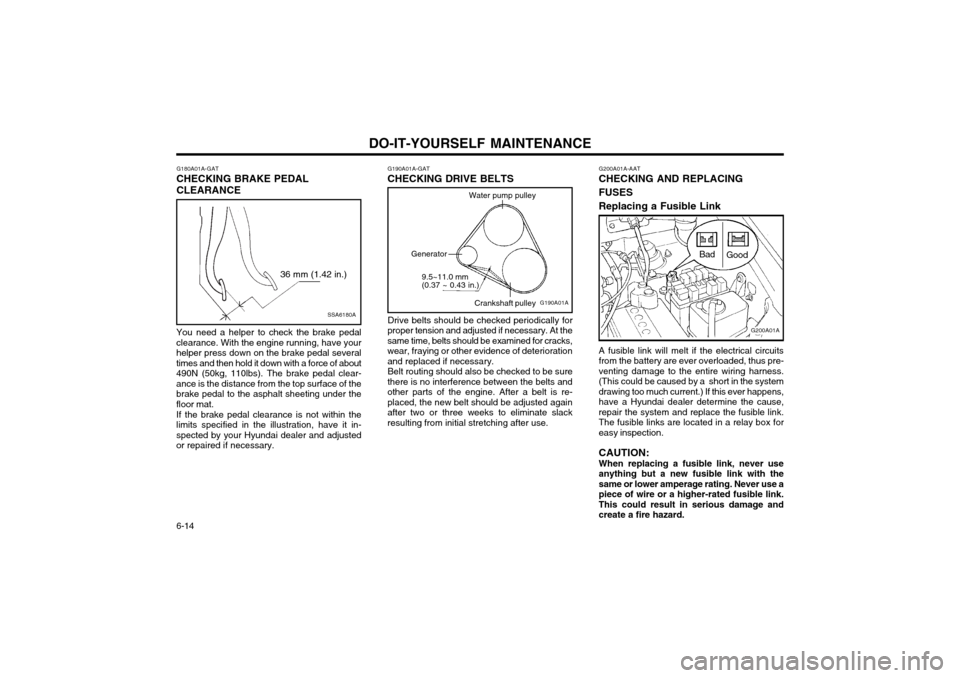
6-14 G200A01A-AAT CHECKING AND REPLACING FUSESReplacing a Fusible Link A fusible link will melt if the electrical circuits from the battery are ever overloaded, thus pre-venting damage to the entire wiring harness.(This could be caused by a short in the systemdrawing too much current.) If this ever happens,have a Hyundai dealer determine the cause,repair the system and replace the fusible link.The fusible links are located in a relay box foreasy inspection. CAUTION: When replacing a fusible link, never use anything but a new fusible link with thesame or lower amperage rating. Never use apiece of wire or a higher-rated fusible link.This could result in serious damage andcreate a fire hazard.
G200A01A
Bad
Good
G180A01A-GAT
CHECKING BRAKE PEDAL
CLEARANCE
SSA6180A
36 mm (1.42 in.)
You need a helper to check the brake pedal clearance. With the engine running, have yourhelper press down on the brake pedal severaltimes and then hold it down with a force of about490N (50kg, 110lbs). The brake pedal clear-ance is the distance from the top surface of thebrake pedal to the asphalt sheeting under thefloor mat. If the brake pedal clearance is not within the limits specified in the illustration, have it in-spected by your Hyundai dealer and adjustedor repaired if necessary.
G190A01A-GAT
CHECKING DRIVE BELTS
Water pump pulley
Crankshaft pulley
Drive belts should be checked periodically for
proper tension and adjusted if necessary. At the same time, belts should be examined for cracks,wear, fraying or other evidence of deteriorationand replaced if necessary. Belt routing should also be checked to be sure
there is no interference between the belts andother parts of the engine. After a belt is re-placed, the new belt should be adjusted againafter two or three weeks to eliminate slackresulting from initial stretching after use.
G190A01A
9.5~11.0 mm (0.37 ~ 0.43 in.)
Generator
Page 111 of 127

DO-IT-YOURSELF MAINTENANCE
6-16
G230A03A-GAT
POWER STEERING FLUID LEVEL
The power steering fluid level should be checked
regularly.
To check the power steering fluid level, be sure
the ignition is "OFF", then check to make cer- tain that the power steering fluid level is be-tween the "MAX" and "MIN" level markings onthe fluid reservoir.
NOTE: Grinding noise from the power steering
pump may be heard immediately after the engine is started in extremely cold condi-
tions (below -20°C). If the noise stops dur-ing warm up, there is no abnormal functionin the system. This is due to a power steer-ing fluid characteristic in extremely coldconditions.
G230A01X
The fluid in the battery contains a strong solu-
tion of sulfuric acid, which is poisonous and highly corrosive. Be careful not to spill it onyourself or the car. If you do spill battery fluid onyourself, immediately do the following:
o If battery fluid is on your skin, flush the affected areas with water for at least 15 minutes and then seek medical assistance.
o If battery fluid is in your eyes, rinse out your eyes with water and get medical assistanceas soon as possible. While you are beingdriven to get medical assistance, continueto rinse your eyes by using a sponge or softcloth saturated with water.
o If you swallow battery fluid, drink a large quantity of water or milk followed by milk ofmagnesia, eat a raw egg or drink vegetableoil. Get medical assistance as soon aspossible.
While batteries are being charged (either by abattery charger or by the vehicle's alternator),they produce explosive gases. Always observethese warnings to prevent injuries from occur-ring:
o Charge batteries only in a well ventilated area.
o Do not permit flames, sparks or smoking in the area.
o Keep children away from the area. G210B01A-AAT
Checking the Battery
Keep the battery clean. Any evidence of corro-
sion around the battery posts or terminals should be removed using a solution of household bak-ing soda and warm water. After the batteryterminals are dry, cover them with a light coat-ing of grease.
G220A01A-AAT
CHECKING ELECTRIC COOLING
FANS
WARNING: The radiator fan is controlled by engine cool- ant temperature and may sometimes operateeven when the engine is not running. Use extreme caution when working near the blades of the cooling fan, so that you are not injuredby a rotating fan blade. As the coolant tem-perature decreases the fan will automaticallyshut off. This is a normal condition.
G220B01A-AAT
Checking Engine Cooling Fan The engine cooling fan should come on auto-
matically if the engine coolant temperature ishigh.
G220C01A-AAT
Checking Condenser Cooling Fan The condenser cooling fan should come on
automatically whenever the air conditioning isin operation.
Page 112 of 127

DO-IT-YOURSELF MAINTENANCE 6-17
G270A02X-GAT
HEADLIGHT BULB
Replacement instructions:
1. Allow the bulb to cool. Wear eye protection.
2. Always grasp the bulb by its base, avoid touching the glass.
3. Disconnect the connector, then remove the dust cover.
4. Push the bulb spring for removing the head- light bulb.
5. Remove the headlight bulb. If the bulb is burned out, replace it with the same watt- age.
6. Installation is the reverse order of the re- moval.
7. Use the protective cap and carton to promptly dispose of the old bulb.
8. Check for proper headlight aim. WARNING: The halogen bulb contains gas under pres-
sure and if impacted could shatter, and re- sulting in flying fragments. Always wear eye
protection when servicing the bulb. Protectthe bulb against abrasions or scratches andagainst liquids when lighted. Turn the bulbon only when installed in a headlight. Re-place the headlight if damaged or cracked.
Keep the bulb out of the reach of childrenand dispose of the used bulb with care. G290A02X-GAT HEADLIGHT AIMING ADJUSTMENT Before performing aiming adjustment, make sure of the following.
1. Keep all tires inflated to the correct pres- sure.
2. Place the vehicle on level ground and press the front bumper & rear bumper down sev- eral times. Place the vehicle at a distance of3,000 mm (118 in.) from the test wall.
3. See that the vehicle is unloaded (except for full levels of coolant, engine oil and fuel, andspare tire, jack, and tools). Have the driveror equivalent weight placed in driver's seat.
Recommended Fluid
Use PSF-3 type fluid. NOTE: Do not start the engine when the power
steering oil reservoir is empty.
G240A01A-AAT
POWER STEERING HOSES
It is suggested that you check the power steer-
ing hose connections for fluid leakage at those intervals specified in the vehicle maintenanceschedule in Section 5.
The power steering hoses should be replaced if
there is severe surface cracking, pulling, scuff-ing or worn spots. Deterioration of the hosecould cause premature failure.
G260A03A-AAT
REPLACING HEADLIGHT BULBS Before attempting to replace a headlight bulb,
be sure the switch is turned to the "OFF"position.
The next paragraph shows how to reach head-
light bulbs so they may be changed. Be sure toreplace the burned-out bulb with one of thesame number and wattage rating.
CAUTION: Keep the lamps out of contact with petro-
leum product, such as oil, gasoline, etc.
G270A01X
Page 116 of 127

EMISSION CONTROL SYSTEMS 7-1
7. EMISSION CON-
TROL SYSTEMS
H010A01A-GAT
EMISSION CONTROL SYSTEM (If Installed)
Your Hyundai is equipped with an emission
control system to meet all requirements of the Emission prohibition rules of your province. There are three emission control systems which
are as follows.
1) Crankcase emission control system
2) Evaporative emission control system
3) Exhaust emission control system In order to assure the proper function of the
emission control systems, it is recommended that you have your car inspected and main-tained by an authorized Hyundai dealer in ac-cordance with the maintenance schedule in thismanual. the crankcase through the air intake hose.Inside the crankcase, the fresh air mixes withblow-by gases, which then pass through thePCV valve and into the induction system.
H010C02A-GAT
2. Evaporative Emission Control
System (If installed)
The Evaporative Emission Control System is
designed to prevent fuel vapors from escapinginto the atmosphere. Canister
While the engine is inoperative, fuel vapors
generated inside the fuel tank are absorbed and stored in the onboard canister. When the en-gine is running, the fuel vapors absorbed in thecanister are drawn into the induction systemthrough
the purge control solenoid valve.
Purge Control Solenoid Valve The purge control solenoid valve is controlled
by the ECM; when the engine coolant temper-ature is low, and during idling, it closes, so thatevaporated fuel is not taken into the engine.After engine warm-up, during ordinary driving, itopens so as to introduce evaporated fuel to theengine.
H010B01A-AAT
1. Crankcase Emission Control Sys-
tem
The Positive Crankcase Ventilation System is
employed to prevent air pollution caused byblow-by gases being emitted from the crank-case. This system supplies fresh filtered air to H010D01A-AAT
3. Exhaust Emission Control System
The exhaust emission control system is a high-
ly effective system which controls exhaust emis-sion while maintaining good vehicle perfor-mance.
H020A01A-GAT
CATALYTIC CONVERTER (If Installed)
The catalytic converter is part of the exhaust
emission control system. It's purpose is to re-move certain engine emission products from
the engine's exhaust. It looks something like amuffler and is located underneath the car in theexhaust system. Catalytic Converter
H020A01A
7
Page 117 of 127

EMISSION CONTROL SYSTEMS
7-2 o Do not touch the catalytic converter or any
other part of the exhaust system while the engine is running as it is very hot and couldresult in burns.
o Remember that your Hyundai dealer is your best source of assistance.
H020B01A-GAT
About the Catalytic Converter
Exhaust gases passing through the catalytic
converter cause it to operate at very high tem-peratures. As a result, the introduction of large
amounts of unburned gasoline may cause it to
overheat and create a fire hazard.
This can be avoided by observing the following:
o Use unleaded fuel only.
o Maintain your engine in good condition. Ex- tremely high converter temperatures can result from improper operation of the electri-cal, ignition or fuel injection systems.
o If your engine stalls, pings, knocks, or is hard to start, take your car to your Hyundaidealer as soon as possible and have thedifficulty corrected.
o Avoid driving with a very low fuel level. If you run out of gasoline, it could cause the engineto misfire and result in excessive loading of
the catalytic converter.
o Avoid idling the engine for periods longer than 10 minutes.
o Your Hyundai should not be either pushed or pulled to get it started.This can cause the catalytic converter tooverload.
o Take care not to stop your Hyundai over any combustible material such as grass, paper,leaves or rags. As these materials could
come in contact with the catalytic converterand could cause a fire.