belt Hyundai Azera 2006 User Guide
[x] Cancel search | Manufacturer: HYUNDAI, Model Year: 2006, Model line: Azera, Model: Hyundai Azera 2006Pages: 307, PDF Size: 12.62 MB
Page 44 of 307
1FEATURES OF YOUR HYUNDAI30
!
To raise the height adjuster, pull it up. To
lower it, push it down while pressing the
height adjuster button.
Release the button to lock the anchor into
position. Try sliding the height adjuster
down to make sure that it has locked into
position.
WARNING:
o The height adjuster must be in the
locked position when the vehicle is
moving.
o Misadjustment of height of the shoul-
der belt could reduce the effective-
ness of the seat belt in a crash.
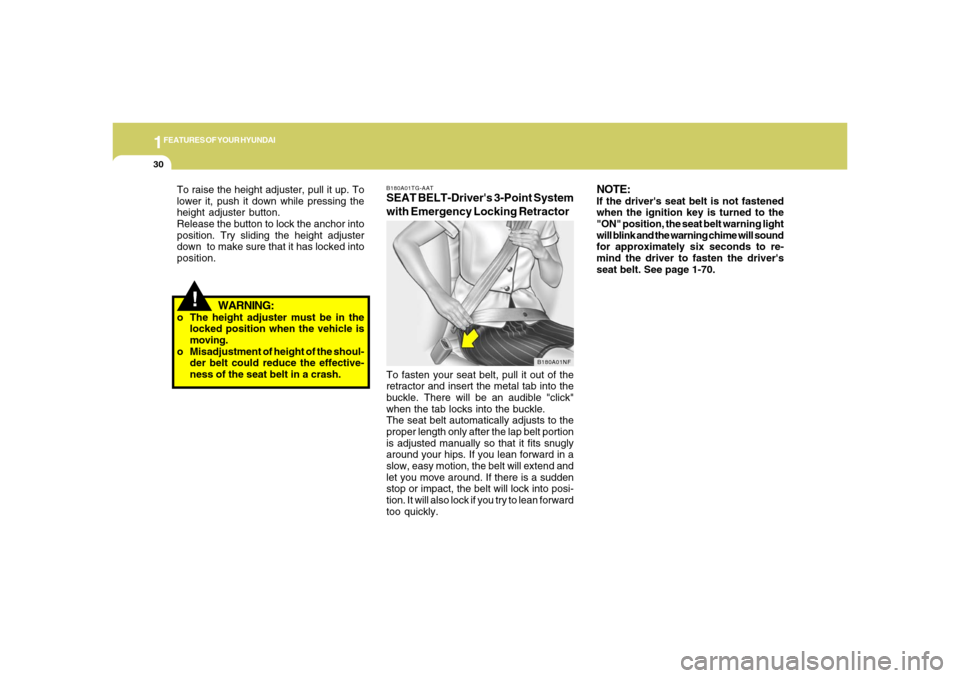
B180A01TG-AATSEAT BELT-Driver's 3-Point System
with Emergency Locking RetractorTo fasten your seat belt, pull it out of the
retractor and insert the metal tab into the
buckle. There will be an audible "click"
when the tab locks into the buckle.
The seat belt automatically adjusts to the
proper length only after the lap belt portion
is adjusted manually so that it fits snugly
around your hips. If you lean forward in a
slow, easy motion, the belt will extend and
let you move around. If there is a sudden
stop or impact, the belt will lock into posi-
tion. It will also lock if you try to lean forward
too quickly.
B180A01NF
NOTE:If the driver's seat belt is not fastened
when the ignition key is turned to the
"ON" position, the seat belt warning light
will blink and the warning chime will sound
for approximately six seconds to re-
mind the driver to fasten the driver's
seat belt. See page 1-70.
Page 45 of 307
1
FEATURES OF YOUR HYUNDAI
31
When the seat belt is fully extended from
the retractor to allow the installation of a
child restraint system, the seat belt opera-
tion changes to allow the belt to retract, but
not to extend (Automatic Locking Retrac-
tor Type). See page 1-39.NOTE:o Although the combination retractor
provides the same level of protection
for seated passengers in either emer-
gency or automatic locking modes, it
is recommended that seated passen-
gers use the emergency locking fea-
ture for improved convenience. The
automatic locking function is intended
to facilitate child restraint installa-
tion. To convert from the automatic
locking feature to the emergency lock-
ing operation mode, allow the unbuck-
led seat belt to fully retract.
o If the front passenger's seat belt is not
fastened when the ignition key is
turned to the "ON" position, the seat
belt warning light on the center fascia
panel will blink for approximately six
seconds to remind the front passen-
ger to fasten the front passenger's
seat belt. See page 1-70.
WARNING:
o For maximum restraint system pro-
tection, the seat belts must always be
used whenever the car is moving.
o Seat belts are most effective when
seatbacks are in the upright position.
o Children must always be seatbelted
in the rear seats. Never allow children
to ride in the front passenger seat.
o The shoulder belt should be positioned
midway over the shoulder nearest
the door for the most effective protec-
tion. Never wear the seat belt under
the arm nearest the door. Wearing the
belt under the arm nearest the door
could cause serious or fatal injuries in
an accident.
o Avoid wearing twisted seat belts. A
twisted belt can't do its job as well. In
a collision, it could even cut into you.
Be sure the belt webbing is straight
and not twisted.
o Be careful not to damage the belt
webbing or hardware. If the belt web-
bing or hardware is damaged, replace
it.
!
B190A01TG-AATSEAT BELTS-Front Passenger and
Rear Seat 3-Point System with Com-
bination Locking RetractorCombination retractor type seat belts are
installed in the rear seat positions to help
accommodate the installation of child re-
straint systems. Although a combination
retractor is also installed in the front passen-
ger seat position, Hyundai strongly recom-
mends that children always be seated in the
rear seat. NEVER place any infant restraint
system in the front seat of the vehicle.
This type of seat belt combines the fea-
tures of both an emergency locking retrac-
tor seat belt and an automatic locking
retractor seat belt. To fasten your seat belt,
pull it out of the retractor and insert the
metal tab into the buckle. There will be an
audible "click" when the tab locks into the
buckle. When not securing a child restraint,
the seat belt operates in the same way as
the driver's seat belt (Emergency Locking
Retractor Type). It automatically adjusts to
the proper length only after the lap belt
portion of the seat belt is adjusted manu-
ally so that it fits snugly around your hips.
Page 46 of 307
1FEATURES OF YOUR HYUNDAI32
WARNING:
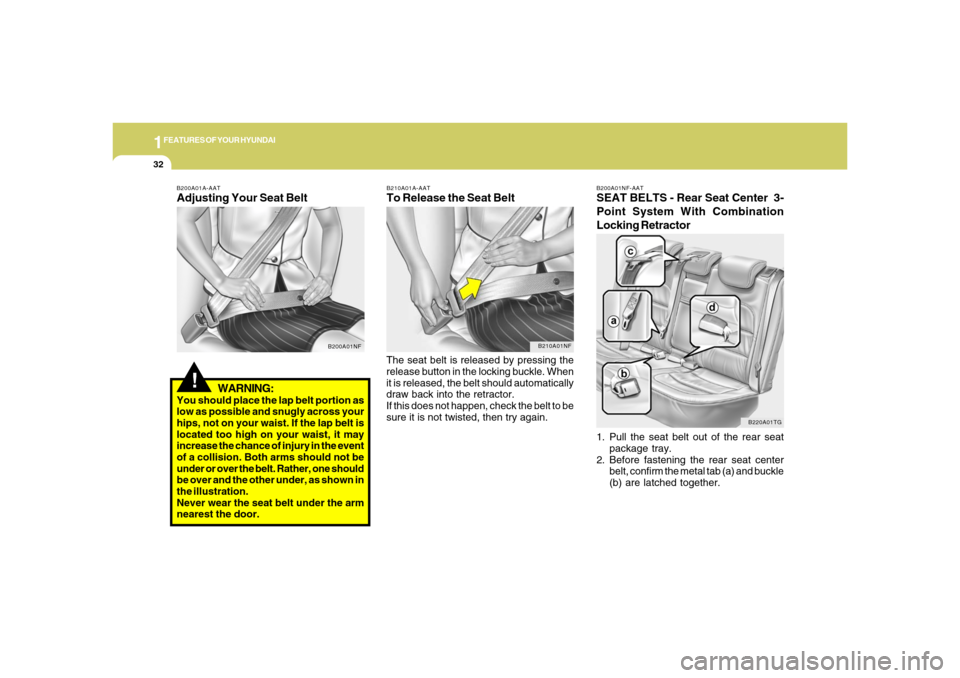
You should place the lap belt portion as
low as possible and snugly across your
hips, not on your waist. If the lap belt is
located too high on your waist, it may
increase the chance of injury in the event
of a collision. Both arms should not be
under or over the belt. Rather, one should
be over and the other under, as shown in
the illustration.
Never wear the seat belt under the arm
nearest the door.
!
B200A01A-AATAdjusting Your Seat Belt
B200A01NF
B200A01NF-AATSEAT BELTS - Rear Seat Center 3-
Point System With Combination
Locking Retractor1. Pull the seat belt out of the rear seat
package tray.
2. Before fastening the rear seat center
belt, confirm the metal tab (a) and buckle
(b) are latched together.
B220A01TG
The seat belt is released by pressing the
release button in the locking buckle. When
it is released, the belt should automatically
draw back into the retractor.
If this does not happen, check the belt to be
sure it is not twisted, then try again.B210A01A-AATTo Release the Seat Belt
B210A01NF
Page 47 of 307
1
FEATURES OF YOUR HYUNDAI
33
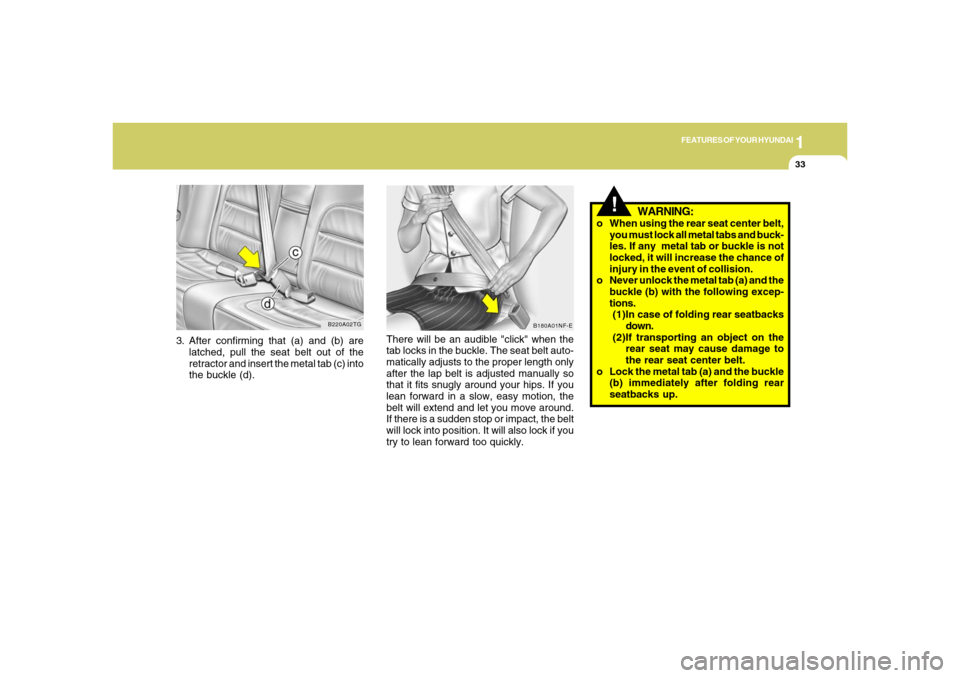
There will be an audible "click" when the
tab locks in the buckle. The seat belt auto-
matically adjusts to the proper length only
after the lap belt is adjusted manually so
that it fits snugly around your hips. If you
lean forward in a slow, easy motion, the
belt will extend and let you move around.
If there is a sudden stop or impact, the belt
will lock into position. It will also lock if you
try to lean forward too quickly.
!
WARNING:
o When using the rear seat center belt,
you must lock all metal tabs and buck-
les. If any metal tab or buckle is not
locked, it will increase the chance of
injury in the event of collision.
o Never unlock the metal tab (a) and the
buckle (b) with the following excep-
tions.
(1)In case of folding rear seatbacks
down.
(2)If transporting an object on the
rear seat may cause damage to
the rear seat center belt.
o Lock the metal tab (a) and the buckle
(b) immediately after folding rear
seatbacks up.
B180A01NF-E
3. After confirming that (a) and (b) are
latched, pull the seat belt out of the
retractor and insert the metal tab (c) into
the buckle (d).
B220A02TG
Page 48 of 307
1FEATURES OF YOUR HYUNDAI34
!
B220A03TG
WARNING:
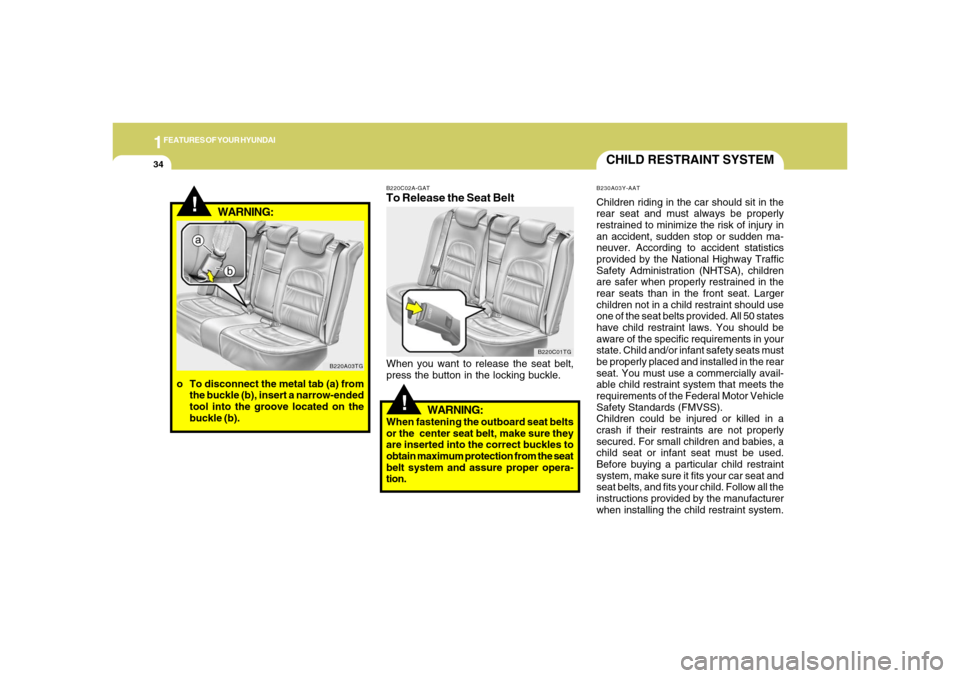
o To disconnect the metal tab (a) from
the buckle (b), insert a narrow-ended
tool into the groove located on the
buckle (b).
B220C02A-GATTo Release the Seat BeltWhen you want to release the seat belt,
press the button in the locking buckle.
!
WARNING:
When fastening the outboard seat belts
or the center seat belt, make sure they
are inserted into the correct buckles to
obtain maximum protection from the seat
belt system and assure proper opera-
tion.
CHILD RESTRAINT SYSTEMB230A03Y-AATChildren riding in the car should sit in the
rear seat and must always be properly
restrained to minimize the risk of injury in
an accident, sudden stop or sudden ma-
neuver. According to accident statistics
provided by the National Highway Traffic
Safety Administration (NHTSA), children
are safer when properly restrained in the
rear seats than in the front seat. Larger
children not in a child restraint should use
one of the seat belts provided. All 50 states
have child restraint laws. You should be
aware of the specific requirements in your
state. Child and/or infant safety seats must
be properly placed and installed in the rear
seat. You must use a commercially avail-
able child restraint system that meets the
requirements of the Federal Motor Vehicle
Safety Standards (FMVSS).
Children could be injured or killed in a
crash if their restraints are not properly
secured. For small children and babies, a
child seat or infant seat must be used.
Before buying a particular child restraint
system, make sure it fits your car seat and
seat belts, and fits your child. Follow all the
instructions provided by the manufacturer
when installing the child restraint system.
B220C01TG
Page 49 of 307
1
FEATURES OF YOUR HYUNDAI
35
!
WARNING:
o Children who are too large to be in a
child restraint should sit in the rear
seat and be restrained with the avail-
able lap/shoulder belts. Never allow
children to ride in the front passenger
seat.
o Always make sure that the shoulder
belt portion of the lap/shoulder belt is
positioned midway over the shoulder
and never across the neck or behind
the back. Moving the child closer to-
ward the seat belt buckle may help
provide a good shoulder belt fit. The
lap belt portion of the lap/shoulder belt
must always be positioned as low as
possible on the child's hips, and as
snug as possible.
o If the seat belt will not properly fit the
child, Hyundai recommends the use
of an approved booster seat in the
rear seat in order to raise the child's
seating height so that the seat belt will
properly fit the child.
WARNING:
Before purchasing a booster seat,
make sure that it meets applicable
Federal Motor Vehicle Safety Stan-
dards (FMVSS) and that it is satisfac-
tory for use with this vehicle.
o Never allow a child to stand up or
kneel on the seat.
o Never use an infant carrier or a child
safety seat that "hooks" over a
seatback; it may not provide ad-
equate security in an accident.
o Never allow a child to be held in a
person's arms while they are in a
moving vehicle, as this could result in
serious injury to the child in the event
of an accident or a sudden stop. Hold-
ing a child in a moving vehicle does
not provide the child with any means
of protection during an accident, even
if the person holding the child is wear-
ing a seat belt.
!
!
WARNING:
o A child restraint system must be
placed in the rear seat. Never install
a child or infant seat on the front
passenger's seat. Should an accident
occur and cause the passenger's
front airbag to deploy, it could se-
verely injure or kill an infant or child
seated in an infant or child seat. Thus
only use a child restraint in the rear
seat of your vehicle.
o A safety belt or child restraint system
can become very hot if it is left in a
closed vehicle on a sunny day, even
if the outside temperature does not
feel hot. Be sure to check the seat
cover and buckles before placing a
child there.
o When the child restraint system is not
in use, store it in the trunk or fasten it
with a safety belt so that it will not be
thrown forward in the case of a sud-
den stop or an accident.
Page 51 of 307
1
FEATURES OF YOUR HYUNDAI
37
B230D04E-AATSecuring the Child Restraint Seat
with the "ISOFIX" systemSome child seat manufacturers make safety
seats that are labeled as ISOFIX or ISOFIX-
compatible child seats. These seats in-
clude two rigid or webbing mounted at-
tachments that connect to two ISOFIX an-
chors at specific seating positions in your
vehicle. This type of child seat eliminates
the need to use seat belts to attach the child
seat for forward-facing child seats.
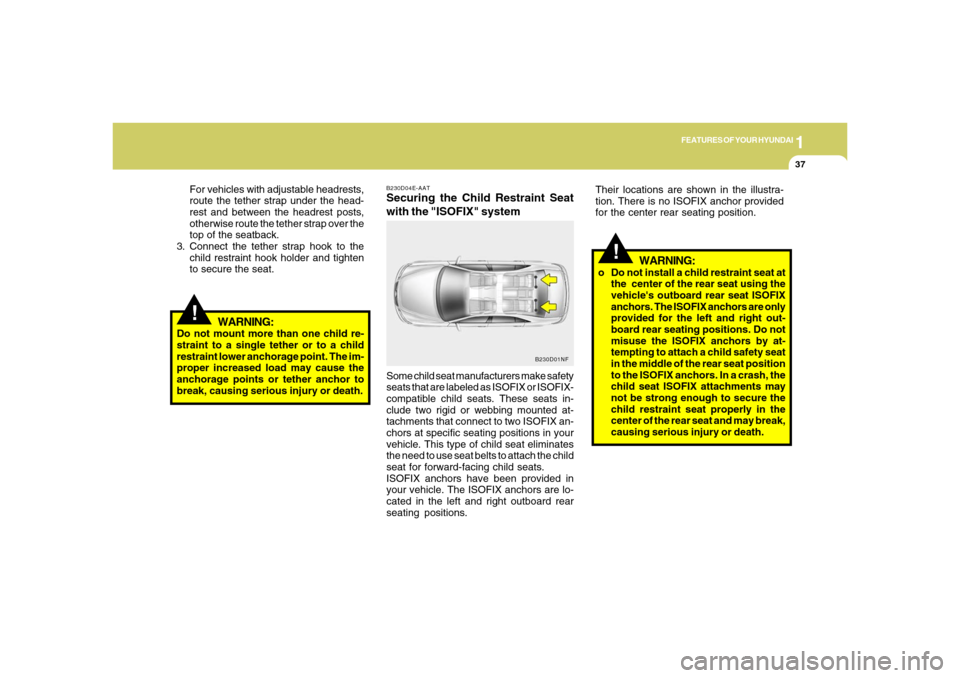
ISOFIX anchors have been provided in
your vehicle. The ISOFIX anchors are lo-
cated in the left and right outboard rear
seating positions.
B230D01NF
!
WARNING:
o Do not install a child restraint seat at
the center of the rear seat using the
vehicle's outboard rear seat ISOFIX
anchors. The ISOFIX anchors are only
provided for the left and right out-
board rear seating positions. Do not
misuse the ISOFIX anchors by at-
tempting to attach a child safety seat
in the middle of the rear seat position
to the ISOFIX anchors. In a crash, the
child seat ISOFIX attachments may
not be strong enough to secure the
child restraint seat properly in the
center of the rear seat and may break,
causing serious injury or death.
!For vehicles with adjustable headrests,
route the tether strap under the head-
rest and between the headrest posts,
otherwise route the tether strap over the
top of the seatback.
3. Connect the tether strap hook to the
child restraint hook holder and tighten
to secure the seat.
WARNING:
Do not mount more than one child re-
straint to a single tether or to a child
restraint lower anchorage point. The im-
proper increased load may cause the
anchorage points or tether anchor to
break, causing serious injury or death.Their locations are shown in the illustra-
tion. There is no ISOFIX anchor provided
for the center rear seating position.
Page 52 of 307
1FEATURES OF YOUR HYUNDAI38
!
!
WARNING:
o When using the vehicle’s “ISOFIX”
system to install a child restraint sys-
tem in the rear seat, all unused ve-
hicle rear seat belt metal latch plates
or tabs must be latched securely in
their seat belt buckles and the seat
belt webbing must be retracted be-
hind the child restraint to prevent the
child from reaching and taking hold of
unretracted seat belts. Unlatched
metal latch plates or tabs may allow
the child to reach the unretracted seat
belts which may result in strangula-
tion and a serious injury or death to
the child in the child restraint.
o Do not mount more than one child
restraint to a single tether or to a child
restraint lower anchorage point. The
improper increased load may cause
the anchorage points or tether an-
chor to break, causing serious injury
or death.
o Attach the ISOFIX or ISOFIX-compat-
ible child seat only to the appropriate
locations shown.
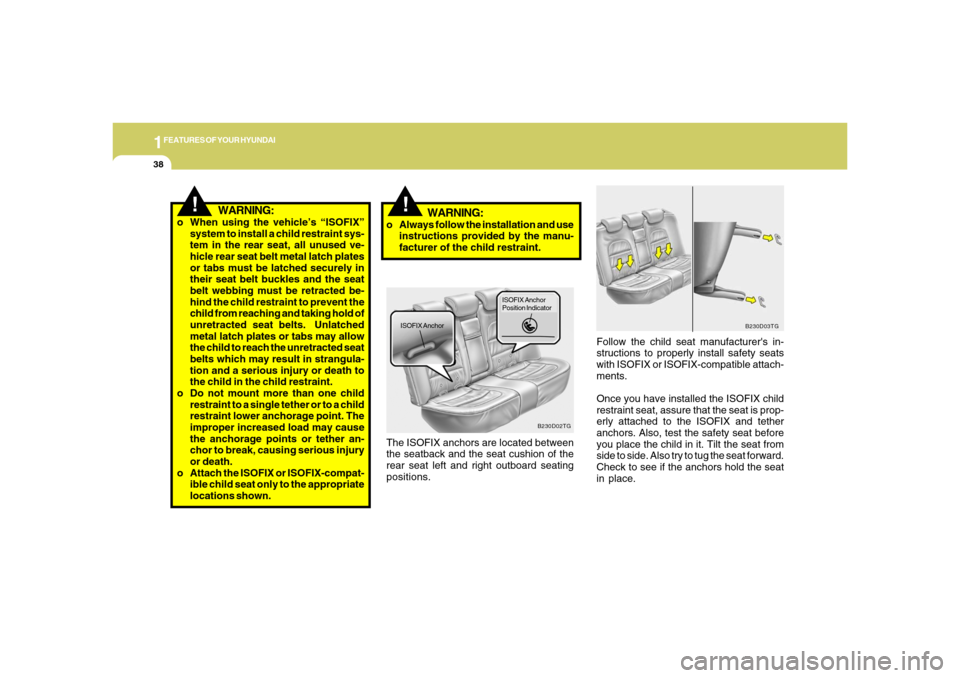
The ISOFIX anchors are located between
the seatback and the seat cushion of the
rear seat left and right outboard seating
positions.
B230D02TG
ISOFIX AnchorISOFIX Anchor
Position Indicator
B230D03TG
WARNING:
o Always follow the installation and use
instructions provided by the manu-
facturer of the child restraint.
Follow the child seat manufacturer's in-
structions to properly install safety seats
with ISOFIX or ISOFIX-compatible attach-
ments.
Once you have installed the ISOFIX child
restraint seat, assure that the seat is prop-
erly attached to the ISOFIX and tether
anchors. Also, test the safety seat before
you place the child in it. Tilt the seat from
side to side. Also try to tug the seat forward.
Check to see if the anchors hold the seat
in place.
Page 53 of 307
1
FEATURES OF YOUR HYUNDAI
39
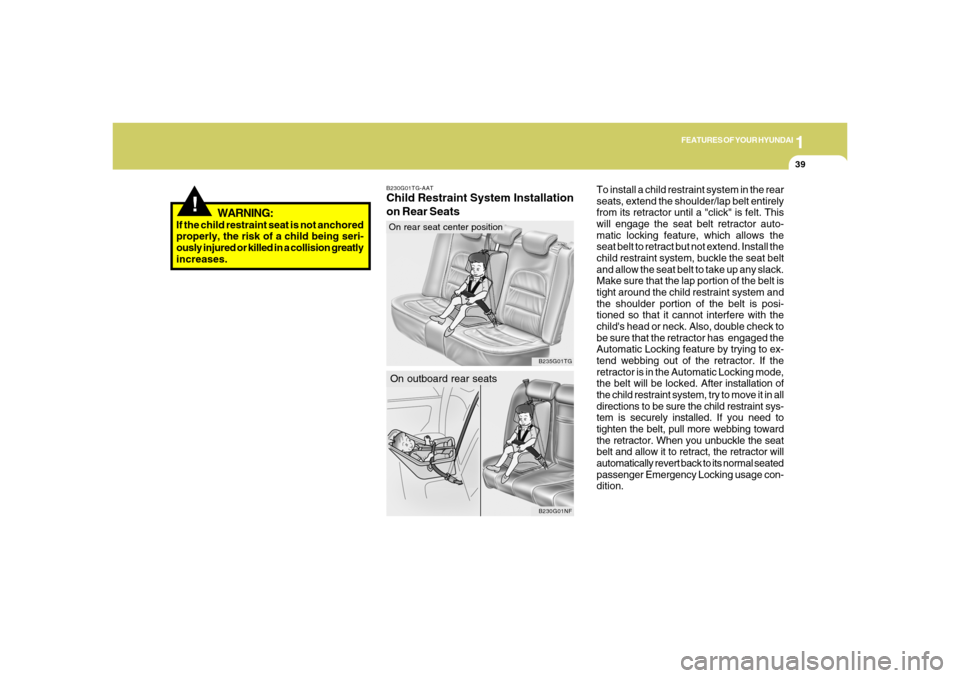
To install a child restraint system in the rear
seats, extend the shoulder/lap belt entirely
from its retractor until a "click" is felt. This
will engage the seat belt retractor auto-
matic locking feature, which allows the
seat belt to retract but not extend. Install the
child restraint system, buckle the seat belt
and allow the seat belt to take up any slack.
Make sure that the lap portion of the belt is
tight around the child restraint system and
the shoulder portion of the belt is posi-
tioned so that it cannot interfere with the
child's head or neck. Also, double check to
be sure that the retractor has engaged the
Automatic Locking feature by trying to ex-
tend webbing out of the retractor. If the
retractor is in the Automatic Locking mode,
the belt will be locked. After installation of
the child restraint system, try to move it in all
directions to be sure the child restraint sys-
tem is securely installed. If you need to
tighten the belt, pull more webbing toward
the retractor. When you unbuckle the seat
belt and allow it to retract, the retractor will
automatically revert back to its normal seated
passenger Emergency Locking usage con-
dition.
B230G01TG-AATChild Restraint System Installation
on Rear Seats
B230G01NF
On outboard rear seats
B235G01TG
On rear seat center position
!
WARNING:
If the child restraint seat is not anchored
properly, the risk of a child being seri-
ously injured or killed in a collision greatly
increases.
Page 54 of 307
1FEATURES OF YOUR HYUNDAI40
!
WARNING:
o If the retractor is not in the Automatic
Locking mode, the child restraint sys-
tem can move when your vehicle turns
or stops abruptly.
o Do not install any child restraint sys-
tem in the front passenger seat.
Should an accident occur and cause
the passenger side airbag to deploy,
it could severely injure or kill an infant
or child seated in an infant or child
seat. Therefore, only use a child re-
straint system in the rear seat of your
vehicle.
o Before installing Child Restraint Sys-
tems to vehicles fitted with Curtain
Airbags, always refer to safety no-
tices for Curtain Airbag systems in
this manual. Whenever installing child
restraints, use only approved devices
and refer to the "Child Restraint Sys-
tem" section to ensure correct instal-
lation and occupant protection is maxi-
mized.
NOTE:o Before installing the child restraint
system in any seating position, read
the instructions supplied by the child
restraint system manufacturer.
o If the seat belt does not operate as
described, have the system checked
immediately by your authorized
Hyundai dealer.
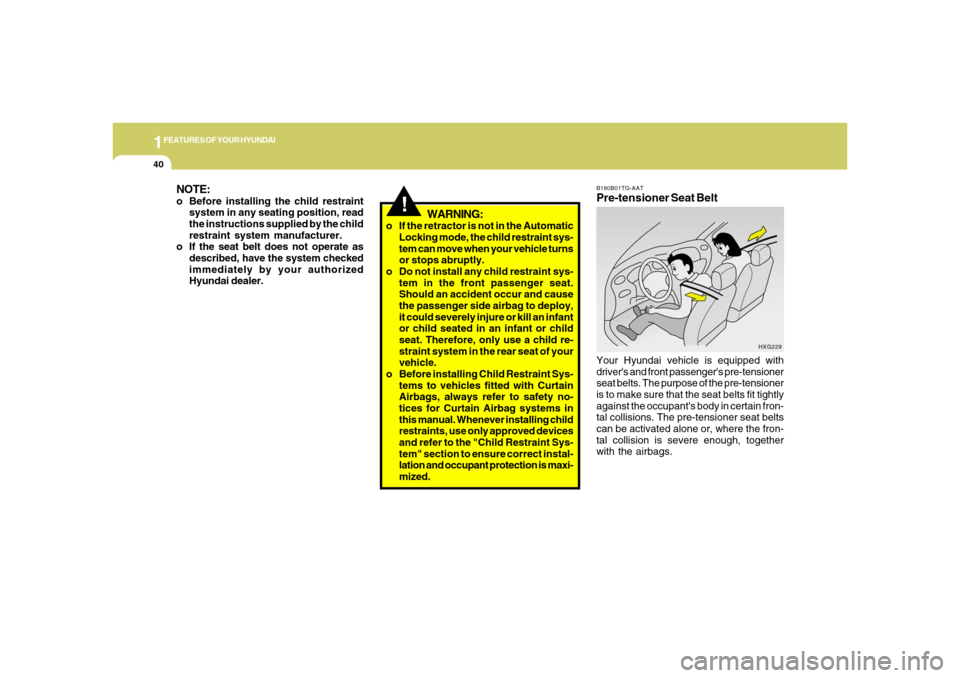
B180B01TG-AATPre-tensioner Seat BeltYour Hyundai vehicle is equipped with
driver's and front passenger's pre-tensioner
seat belts. The purpose of the pre-tensioner
is to make sure that the seat belts fit tightly
against the occupant's body in certain fron-
tal collisions. The pre-tensioner seat belts
can be activated alone or, where the fron-
tal collision is severe enough, together
with the airbags.
HXG229