service Hyundai Azera 2006 Owner's Guide
[x] Cancel search | Manufacturer: HYUNDAI, Model Year: 2006, Model line: Azera, Model: Hyundai Azera 2006Pages: 307, PDF Size: 12.62 MB
Page 243 of 307
6
DO-IT-YOURSELF MAINTENANCE
6
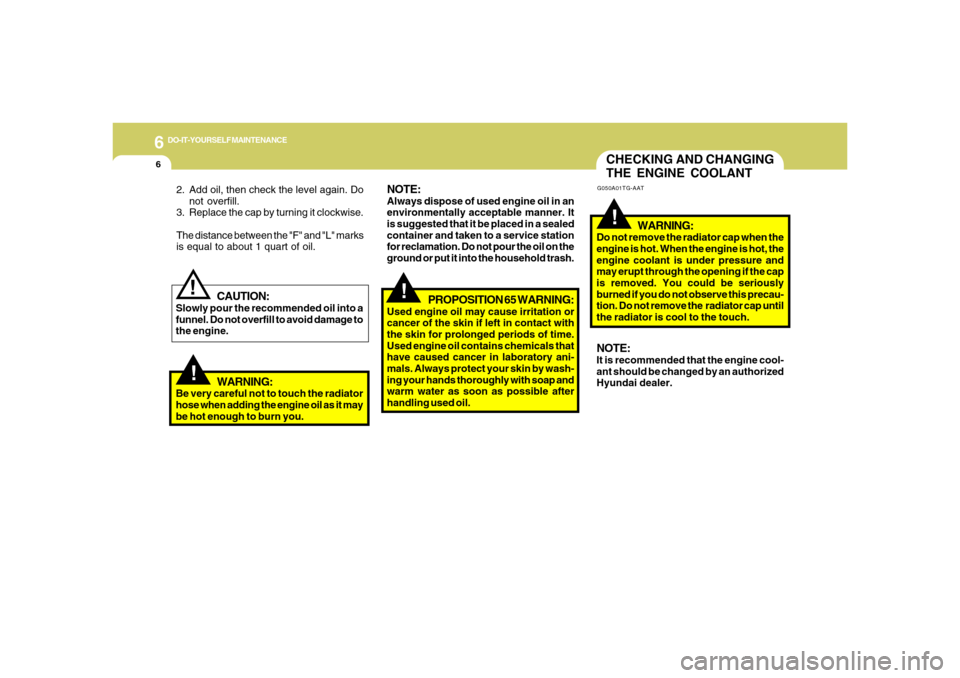
CHECKING AND CHANGING
THE ENGINE COOLANT!
G050A01TG-AAT
WARNING:
Do not remove the radiator cap when the
engine is hot. When the engine is hot, the
engine coolant is under pressure and
may erupt through the opening if the cap
is removed. You could be seriously
burned if you do not observe this precau-
tion. Do not remove the radiator cap until
the radiator is cool to the touch.
!
NOTE:Always dispose of used engine oil in an
environmentally acceptable manner. It
is suggested that it be placed in a sealed
container and taken to a service station
for reclamation. Do not pour the oil on the
ground or put it into the household trash.
PROPOSITION 65 WARNING:
Used engine oil may cause irritation or
cancer of the skin if left in contact with
the skin for prolonged periods of time.
Used engine oil contains chemicals that
have caused cancer in laboratory ani-
mals. Always protect your skin by wash-
ing your hands thoroughly with soap and
warm water as soon as possible after
handling used oil.
!!
CAUTION:
Slowly pour the recommended oil into a
funnel. Do not overfill to avoid damage to
the engine.
WARNING:
Be very careful not to touch the radiator
hose when adding the engine oil as it may
be hot enough to burn you.
NOTE:It is recommended that the engine cool-
ant should be changed by an authorized
Hyundai dealer. 2. Add oil, then check the level again. Do
not overfill.
3. Replace the cap by turning it clockwise.
The distance between the "F" and "L" marks
is equal to about 1 quart of oil.
Page 250 of 307
6
DO-IT-YOURSELF MAINTENANCE
13
G110A01E-AATTransaxle fluid in the automatic transaxle
should be checked at those intervals speci-
fied in the vehicle maintenance schedule
in Section 5.NOTE:Automatic transaxle fluid is basically
red in color. As driving distance in-
creases, the fluid color turns darkish red
gradually. It is a normal condition and
you should not judge the need to replace
based upon the changing color.
You must replace the automatic
transaxle fluid in accordance with inter-
vals specified in the vehicle maintenance
schedule in section 5.
!
G110B05A-AATRecommended Fluid
Your Hyundai automatic transaxle is spe-
cially designed to operate with HYUNDAI
GENUINE ATF SP III, DIAMOND ATF SP III,
SK ATF SP III or other brands meeting the
SP III specification approved by Hyundai
Motor Co.. Damage caused by a
nonspecified fluid is not covered by your
new vehicle limited warranty.
CAUTION:
Use of aftermarket ATF additives may
cause damage to the automatic
transaxle.
Only use HYUNDAI GENUINE ATF SP III,
DIAMOND ATF SP III, SK ATF SP III or
other brands meeting the SP III specifi-
cation approved by Hyundai Motor Co..
If you are having your vehicle serviced
at a facility other than a Hyundai dealer,
verify that the correct ATF is used for
your vehicle.
CAUTION:
o Radiator antifreeze (engine coolant)
should not be used in the washer sys-
tem because it will damage the car's
finish.
o The washer lever should not be pulled
and the washer should not be oper-
ated if the washer reservoir is empty.
This can damage the washer fluid
pump.
!!
WARNING:
o Windshield washer fluid agents con-
tain some amounts of alcohol and can
be flammable under certain circum-
stances. Do not allow sparks or flame
to contact the washer fluid or the
washer fluid reservoir. Damage to
the vehicle or its occupants could
occur.
o Windshield washer fluid is poisonous
to humans and animals. Do not drink
windshield washer fluid. Serious in-
jury or death could occur.
CHECKING THE TRANSAXLE
FLUID (AUTOMATIC)
Page 291 of 307
8
CONSUMER INFORMATION, REPORTING SAFETY DEFECTS & BINDING ARBITRATION OF WARRANTY CLAIMS
14
Temperature A, B, C - The tempera-
ture grades are A (the highest), B, and
C, representing the tire's resistance to
the generation of heat and its ability to
dissipate heat when tested under con-
trolled conditions on a specified indoor
laboratory test wheel. Sustained high
temperature can cause the material of
the tire to degenerate and reduce tire
life, and excessive temperature can
lead to sudden tire failure. The grade C
corresponds to a level of performance
which all passenger car tires must meet
under the Federal Motor Vehicle Safety
Standard No. 109. Grades B and A
represent higher levels of performance
on the laboratory test wheel than the
minimum required by law.
Traction AA, A, B, C - The traction
grades, from highest to lowest, are AA,
A, B, and C. Those grades represent
the tire's ability to stop on wet pave-
ment as measured under controlled
conditions on specified government test
surfaces of asphalt and concrete. A tire
marked C may have poor traction per-
formance.
!
WARNING:
The traction grade assigned to this
tire is based on straight-ahead brak-
ing traction tests, and does not in-
clude acceleration, cornering, hy-
droplaning, or peak traction charac-
teristics.
I130B04A-AATTire Quality Grading
Department of Transportation quality
grades - All passenger vehicle tires
must conform to Federal Safety Stan-
dards in addition to these grades. These
quality grades are molded on the
sidewall.
Treadwear - The treadwear grade is a
comparative rating based on the wear
rate of the tire when tested under con-
trolled conditions on a specified gov-
ernment test course. For example, a
tire graded 150 would wear one and a
half (1 - 1/2) times as well on the
government course as a tire graded
100. The relative performance of tires
depends upon the actual conditions of
their use, however, and may depart
significantly from the norm due to varia-
tions in driving habits, service prac-
tices and differences in road character-
istics and climate.
Page 303 of 307

10
INDEX
5
L
Light Bulb Watages ............................................................6-32
Light Bulbs Replacement ..................................................6-24
Lubrication Chart .................................................................. 9-4
Luggage Net ....................................................................1-110
M
Maintenance Intervals .......................................................... 5-2
Explanation of scheduled maintenance items ................ 5-7
Maintenance under severe usage conditions ................. 5-6
Scheduled maintenance .................................................. 5-4
Service requirements ........................................................ 5-2
Maintenance Precautions.................................................... 6-4
Mirrors
Homelink mirror ............................................................1-101
Outside rearview .............................................................1-98
Outside rearview mirror folding switch ........................1-100
Outside rearview mirror heater ......................................1-99
O
Odometer............................................................................1-76
Outside Rearview Mirror ....................................................1-98P
Parking Brake ...................................................................1-107
Checking parking brake pedal .......................................6-18
Power Adjustable Pedals ..................................................2-10
Power Outlets .....................................................................1-88
Power Steering Fluid Level ...............................................6-23
R
Rear Seat
Armrest ..........................................................................1-116
Folding rear seatbacks ...................................................1-25
Rear seatback safety lock ..............................................1-26
Warning...........................................................................1-26
Rear Window Curtain ......................................................1-117
Rear Window Defroster Switch .........................................1-86
Reporting Safety Defects ...................................................8-16
S
Seat
Front ................................................................................1-19
Rear.................................................................................1-25
Seat Belts ...........................................................................1-27
3-Point system ................................................................1-30
Adjusting your seat belt ..................................................1-32
Care of seat belts ...........................................................1-29
Pre-tensioner seat belt ...................................................1-40
Precautions.....................................................................1-27
Page 307 of 307

Seoul KoreaPrinting: AUG. 25, 2005
Publication No.: A3LO-EU58A
Printed in KoreaSERVICE STATION INFORMATION
FUEL:UNLEADED gasoline only
Pump Octane Rating of 87 (Research Octane Number 91) or higher.FUEL TANK CAPACITYUS.gal (Imp.gal., liter) 19.8 (16.4, 75)TIRE PRESSURE:See the label on the driver's side of the center pillar outer panel.OTHER TIRE INFORMATION:See pages 8-2 through 8-13.HOOD RELEASE:Pull handle under left side of dash.ENGINE OIL:API grade SJ, SL or ABOVE / ILSAC grade GF-3 or ABOVE and fuel efficient
oil. Use SAE 5W-20, 5W-30 or 10W-30 if normal temperatures are above
0°F (-18°C). See page 6-4 or 9-4.
AUTOMATIC TRANSAXLE:Apply the parking brake, with the engine running, shift the selector lever
through all ranges and return to "N" (Neutral) position. Then check the level
of fluid on the dipstick. Use only HYUNDAI GENUINE ATF SP III,
DIAMOND ATF SP III, SK ATF SP III or other brands meeting the SP III
specification approved by Hyundai Motor Co..QUICK INDEXo Car will not start ....................................................................... 3-2
o Flat tire ...................................................................................... 3-6
o Warning light/chime comes on...................................... 1-66 ~ 1-74
o Engine overheats....................................................................... 3-4
o Towing of your vehicle ........................................................... 3-11
o Starting the engine ..................................................................... 2-4
o Driving tips for first 1,200 miles (2,000 km) ............................ 1-3
o Scheduled maintenance.............................................................. 5-4
o Reporting safety defects ......................................................... 8-16